
Solid wastes
Issues and Approach
Presented by
Santhosh kumar
GARBAGE CRISIS
REASONS
The rapid urbanization.
Neglect from authorities.
Public apathy towards solid waste
sector.
WHY ACTION IS REQUIRED ON WAR
FOOTING ?
Municipal Solid Waste (Management and
Handling) Rules 2000.
Municipal authorities in the country to
implement proper Solid Waste Management
System by December 2003
Spread of epidemics in various parts of the
Country.
Opposition from the communities encircle
the existing dump sites.
Litigations against various ULB s.
Public awareness
OBJECTIVE OF THE REPORT
To discuss,
 Present situation
 Various methods available for treatment of solid
wastes
 Operational aspects of solid waste treatment
systems
 Requirements for an effective solid waste
management (SWM) system.
 Importance of Awareness and community level
initiatives.
SOLID WASTE GENERATION IN
KERALA
Kerala generates approximately 3,000
tones of solid waste daily.
Only less than a half of this is removed
from the streets
Only a tiny portion is processed or
recycled.
Rest is simply dumped in water bodies or
at land-filling sites.
EFFECTS OF INDISCRIMINATE
DUMPING OF WASTE
 Blockage of drainage channels contributing to flooding.
 Spreading of diseases by different vectors like insects,
rodents and birds.
 Emissions of green house gas that contributes global
warming effect. (Methane is 20 times more harmful than
CO2 in this regard)
 Contamination of surface and ground water through
leachate.
 Soil contamination through direct waste contact or
leachate.
 Air pollution by burning of wastes
EFFECTED PARTIES
All people in general
Urban poor and slum dwellers are the
most effected.
Wealthy residents avoid direct exposure of
garbage piles close to home and the
problems are shifted away from their
neighborhood to elsewhere.
The Ministry of Environment and Forest -Municipal Solid
Waste (Management and Handling) Rules 2000
Directives:
 Prohibit littering on the streets
 Ensuring storage of waste at source in two bins; one
for biodegradable waste and another for recyclable
material.
 Primary collection of biodegradable and non-
biodegradable waste from the door step on a day- to-
day.
 Street sweeping.
 Abolition of open waste storage bins.
 Transportation of waste in covered vehicles
 Treatment of biodegradable waste using composting
or waste to energy technologies.
 Minimize the waste going to the land fill.
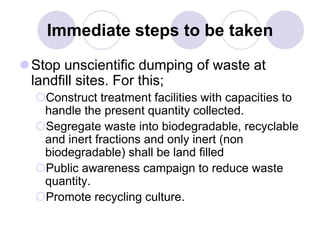
Immediate steps to be taken
Stop unscientific dumping of waste at
landfill sites. For this;
Construct treatment facilities with capacities to
handle the present quantity collected.
Segregate waste into biodegradable, recyclable
and inert fractions and only inert (non
biodegradable) shall be land filled
Public awareness campaign to reduce waste
quantity.
Promote recycling culture.
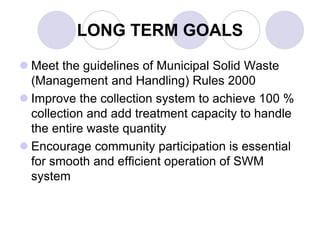
LONG TERM GOALS
 Meet the guidelines of Municipal Solid Waste
(Management and Handling) Rules 2000
 Improve the collection system to achieve 100 %
collection and add treatment capacity to handle
the entire waste quantity
 Encourage community participation is essential
for smooth and efficient operation of SWM
system
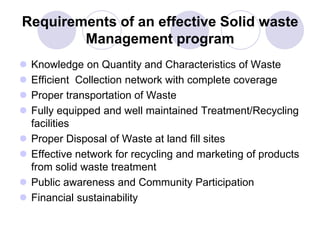
Requirements of an effective Solid waste
Management program
 Knowledge on Quantity and Characteristics of Waste
 Efficient Collection network with complete coverage
 Proper transportation of Waste
 Fully equipped and well maintained Treatment/Recycling
facilities
 Proper Disposal of Waste at land fill sites
 Effective network for recycling and marketing of products
from solid waste treatment
 Public awareness and Community Participation
 Financial sustainability
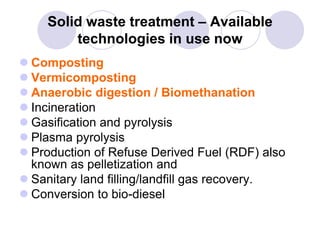
Solid waste treatment – Available
technologies in use now
 Composting
 Vermicomposting
 Anaerobic digestion / Biomethanation
 Incineration
 Gasification and pyrolysis
 Plasma pyrolysis
 Production of Refuse Derived Fuel (RDF) also
known as pelletization and
 Sanitary land filling/landfill gas recovery.
 Conversion to bio-diesel
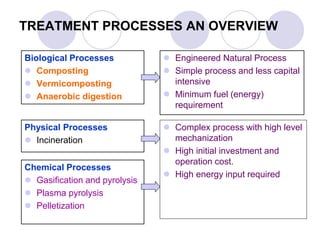
TREATMENT PROCESSES AN OVERVIEW
Biological Processes
 Composting
 Vermicomposting
 Anaerobic digestion
 Engineered Natural Process
 Simple process and less capital
intensive
 Minimum fuel (energy)
requirement
 Complex process with high level
mechanization
 High initial investment and
operation cost.
 High energy input required
Physical Processes
 Incineration
Chemical Processes
 Gasification and pyrolysis
 Plasma pyrolysis
 Pelletization
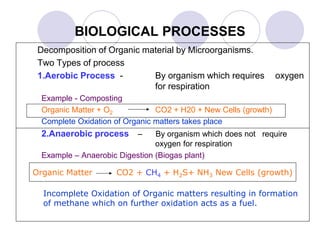
BIOLOGICAL PROCESSES
Decomposition of Organic material by Microorganisms.
Two Types of process
1.Aerobic Process - By organism which requires oxygen
for respiration
Example - Composting
Organic Matter + O2 CO2 + H20 + New Cells (growth)
Complete Oxidation of Organic matters takes place
2.Anaerobic process – By organism which does not require
oxygen for respiration
Example – Anaerobic Digestion (Biogas plant)
Organic Matter CO2 + CH4 + H2S+ NH3 New Cells (growth)
Incomplete Oxidation of Organic matters resulting in formation
of methane which on further oxidation acts as a fuel.
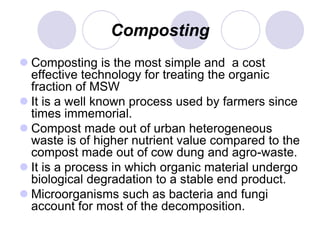
Composting
 Composting is the most simple and a cost
effective technology for treating the organic
fraction of MSW
 It is a well known process used by farmers since
times immemorial.
 Compost made out of urban heterogeneous
waste is of higher nutrient value compared to the
compost made out of cow dung and agro-waste.
 It is a process in which organic material undergo
biological degradation to a stable end product.
 Microorganisms such as bacteria and fungi
account for most of the decomposition.
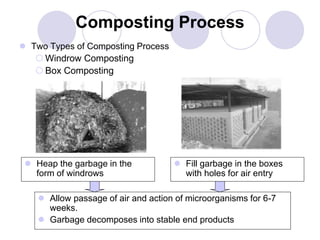
Composting Process
 Two Types of Composting Process
 Windrow Composting
 Box Composting
 Allow passage of air and action of microorganisms for 6-7
weeks.
 Garbage decomposes into stable end products
 Heap the garbage in the
form of windrows
 Fill garbage in the boxes
with holes for air entry
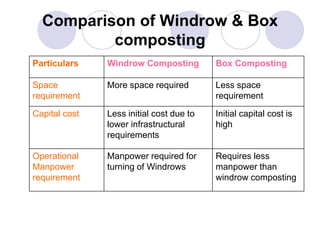
Comparison of Windrow & Box
composting
Particulars Windrow Composting Box Composting
Space
requirement
More space required Less space
requirement
Capital cost Less initial cost due to
lower infrastructural
requirements
Initial capital cost is
high
Operational
Manpower
requirement
Manpower required for
turning of Windrows
Requires less
manpower than
windrow composting
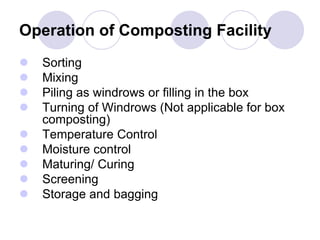
Operation of Composting Facility
 Sorting
 Mixing
 Piling as windrows or filling in the box
 Turning of Windrows (Not applicable for box
composting)
 Temperature Control
 Moisture control
 Maturing/ Curing
 Screening
 Storage and bagging
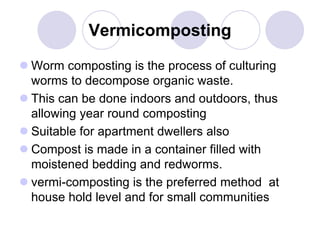
Vermicomposting
 Worm composting is the process of culturing
worms to decompose organic waste.
 This can be done indoors and outdoors, thus
allowing year round composting
 Suitable for apartment dwellers also
 Compost is made in a container filled with
moistened bedding and redworms.
 vermi-composting is the preferred method at
house hold level and for small communities
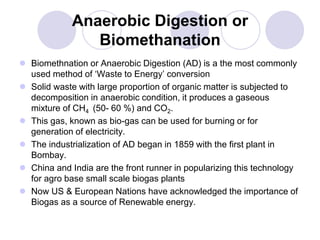
Anaerobic Digestion or
Biomethanation
 Biomethnation or Anaerobic Digestion (AD) is a the most commonly
used method of ‘Waste to Energy’ conversion
 Solid waste with large proportion of organic matter is subjected to
decomposition in anaerobic condition, it produces a gaseous
mixture of CH4 (50- 60 %) and CO2.
 This gas, known as bio-gas can be used for burning or for
generation of electricity.
 The industrialization of AD began in 1859 with the first plant in
Bombay.
 China and India are the front runner in popularizing this technology
for agro base small scale biogas plants
 Now US & European Nations have acknowledged the importance of
Biogas as a source of Renewable energy.
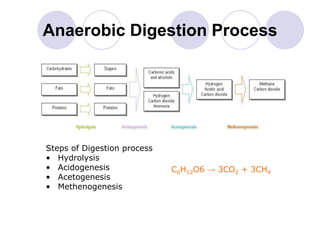
Anaerobic Digestion Process
Steps of Digestion process
• Hydrolysis
• Acidogenesis
• Acetogenesis
• Methenogenesis
C6H12O6 → 3CO2 + 3CH4
General Process Description
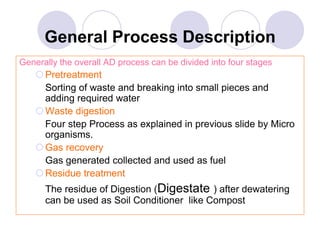
Generally the overall AD process can be divided into four stages
Pretreatment
Sorting of waste and breaking into small pieces and
adding required water
Waste digestion
Four step Process as explained in previous slide by Micro
organisms.
Gas recovery
Gas generated collected and used as fuel
Residue treatment
The residue of Digestion (Digestate ) after dewatering
can be used as Soil Conditioner like Compost
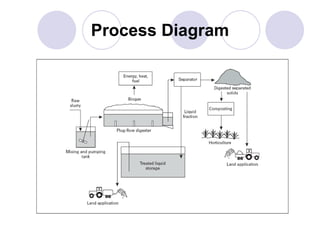
Process Diagram
Biogas
 Anaerobic Digestion Process produce a much
valuable end product biogas compared to
composting process.
 Initial investment and operating cost required for
anaerobic digestion plant for MSW is much higher
than that of Composting Plant.
 Hence effective utilization of Biogas is very
important to make AD process financially atractive.
 Biogas yield is up to 350 m3/ Ton of waste with a
calorific value of about 4000 kcal/m3
Electricity Generation from Biogas
 About 100-150 kWh of Electricity can be generated per
tone of waste input.
 IC engines designed to burn propane or natural gas are
easily converted to burn biogas by adjusting carburation
and ignition systems
 Two types of generators are used
Induction generators
Synchronous generators
 Induction generators derive their phase, frequency and
voltage from the utility
 Synchronous generators operate as an isolated system
or in parallel to the utility
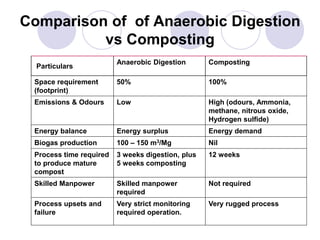
Comparison of of Anaerobic Digestion
vs Composting
Particulars
Anaerobic Digestion Composting
Space requirement
(footprint)
50% 100%
Emissions & Odours Low High (odours, Ammonia,
methane, nitrous oxide,
Hydrogen sulfide)
Energy balance Energy surplus Energy demand
Biogas production 100 – 150 m3/Mg Nil
Process time required
to produce mature
compost
3 weeks digestion, plus
5 weeks composting
12 weeks
Skilled Manpower Skilled manpower
required
Not required
Process upsets and
failure
Very strict monitoring
required operation.
Very rugged process
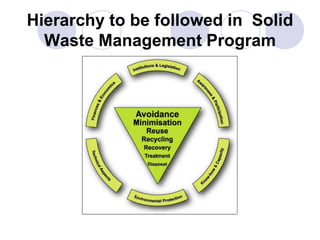
Hierarchy to be followed in Solid
Waste Management Program
Conclusions and Recommended
Options
 Vermicomposting is preferred at individual house and small
community level.
 Composting is the simplest and cheapest method for medium level
capacities.
 It is the preferred process for panchayaths as it is less capital
intensive and has less O&M requirements
 Anaerobic digestion plants are suitable for large plants
(Municipalities) as it requires less space.
 A hybrid System comprising of Anaerobic Digestion Plant with
Composting facility (for organic waste not easily digestible) will be a
complete plant.
 A effective network for marketing of Compost and recyclable items is
very important.
 In case of Power generation from biogas, the possibility of grid
connection need to be studied.
THANK YOU

Solid waste management

  • 1.
    Solid wastes Issues andApproach Presented by Santhosh kumar
  • 2.
    GARBAGE CRISIS REASONS The rapidurbanization. Neglect from authorities. Public apathy towards solid waste sector.
  • 3.
    WHY ACTION ISREQUIRED ON WAR FOOTING ? Municipal Solid Waste (Management and Handling) Rules 2000. Municipal authorities in the country to implement proper Solid Waste Management System by December 2003 Spread of epidemics in various parts of the Country. Opposition from the communities encircle the existing dump sites. Litigations against various ULB s. Public awareness
  • 4.
    OBJECTIVE OF THEREPORT To discuss,  Present situation  Various methods available for treatment of solid wastes  Operational aspects of solid waste treatment systems  Requirements for an effective solid waste management (SWM) system.  Importance of Awareness and community level initiatives.
  • 5.
    SOLID WASTE GENERATIONIN KERALA Kerala generates approximately 3,000 tones of solid waste daily. Only less than a half of this is removed from the streets Only a tiny portion is processed or recycled. Rest is simply dumped in water bodies or at land-filling sites.
  • 6.
    EFFECTS OF INDISCRIMINATE DUMPINGOF WASTE  Blockage of drainage channels contributing to flooding.  Spreading of diseases by different vectors like insects, rodents and birds.  Emissions of green house gas that contributes global warming effect. (Methane is 20 times more harmful than CO2 in this regard)  Contamination of surface and ground water through leachate.  Soil contamination through direct waste contact or leachate.  Air pollution by burning of wastes
  • 7.
    EFFECTED PARTIES All peoplein general Urban poor and slum dwellers are the most effected. Wealthy residents avoid direct exposure of garbage piles close to home and the problems are shifted away from their neighborhood to elsewhere.
  • 8.
    The Ministry ofEnvironment and Forest -Municipal Solid Waste (Management and Handling) Rules 2000 Directives:  Prohibit littering on the streets  Ensuring storage of waste at source in two bins; one for biodegradable waste and another for recyclable material.  Primary collection of biodegradable and non- biodegradable waste from the door step on a day- to- day.  Street sweeping.  Abolition of open waste storage bins.  Transportation of waste in covered vehicles  Treatment of biodegradable waste using composting or waste to energy technologies.  Minimize the waste going to the land fill.
  • 9.
    Immediate steps tobe taken Stop unscientific dumping of waste at landfill sites. For this; Construct treatment facilities with capacities to handle the present quantity collected. Segregate waste into biodegradable, recyclable and inert fractions and only inert (non biodegradable) shall be land filled Public awareness campaign to reduce waste quantity. Promote recycling culture.
  • 10.
    LONG TERM GOALS Meet the guidelines of Municipal Solid Waste (Management and Handling) Rules 2000  Improve the collection system to achieve 100 % collection and add treatment capacity to handle the entire waste quantity  Encourage community participation is essential for smooth and efficient operation of SWM system
  • 11.
    Requirements of aneffective Solid waste Management program  Knowledge on Quantity and Characteristics of Waste  Efficient Collection network with complete coverage  Proper transportation of Waste  Fully equipped and well maintained Treatment/Recycling facilities  Proper Disposal of Waste at land fill sites  Effective network for recycling and marketing of products from solid waste treatment  Public awareness and Community Participation  Financial sustainability
  • 12.
    Solid waste treatment– Available technologies in use now  Composting  Vermicomposting  Anaerobic digestion / Biomethanation  Incineration  Gasification and pyrolysis  Plasma pyrolysis  Production of Refuse Derived Fuel (RDF) also known as pelletization and  Sanitary land filling/landfill gas recovery.  Conversion to bio-diesel
  • 13.
    TREATMENT PROCESSES ANOVERVIEW Biological Processes  Composting  Vermicomposting  Anaerobic digestion  Engineered Natural Process  Simple process and less capital intensive  Minimum fuel (energy) requirement  Complex process with high level mechanization  High initial investment and operation cost.  High energy input required Physical Processes  Incineration Chemical Processes  Gasification and pyrolysis  Plasma pyrolysis  Pelletization
  • 14.
    BIOLOGICAL PROCESSES Decomposition ofOrganic material by Microorganisms. Two Types of process 1.Aerobic Process - By organism which requires oxygen for respiration Example - Composting Organic Matter + O2 CO2 + H20 + New Cells (growth) Complete Oxidation of Organic matters takes place 2.Anaerobic process – By organism which does not require oxygen for respiration Example – Anaerobic Digestion (Biogas plant) Organic Matter CO2 + CH4 + H2S+ NH3 New Cells (growth) Incomplete Oxidation of Organic matters resulting in formation of methane which on further oxidation acts as a fuel.
  • 15.
    Composting  Composting isthe most simple and a cost effective technology for treating the organic fraction of MSW  It is a well known process used by farmers since times immemorial.  Compost made out of urban heterogeneous waste is of higher nutrient value compared to the compost made out of cow dung and agro-waste.  It is a process in which organic material undergo biological degradation to a stable end product.  Microorganisms such as bacteria and fungi account for most of the decomposition.
  • 16.
    Composting Process  TwoTypes of Composting Process  Windrow Composting  Box Composting  Allow passage of air and action of microorganisms for 6-7 weeks.  Garbage decomposes into stable end products  Heap the garbage in the form of windrows  Fill garbage in the boxes with holes for air entry
  • 17.
    Comparison of Windrow& Box composting Particulars Windrow Composting Box Composting Space requirement More space required Less space requirement Capital cost Less initial cost due to lower infrastructural requirements Initial capital cost is high Operational Manpower requirement Manpower required for turning of Windrows Requires less manpower than windrow composting
  • 18.
    Operation of CompostingFacility  Sorting  Mixing  Piling as windrows or filling in the box  Turning of Windrows (Not applicable for box composting)  Temperature Control  Moisture control  Maturing/ Curing  Screening  Storage and bagging
  • 19.
    Vermicomposting  Worm compostingis the process of culturing worms to decompose organic waste.  This can be done indoors and outdoors, thus allowing year round composting  Suitable for apartment dwellers also  Compost is made in a container filled with moistened bedding and redworms.  vermi-composting is the preferred method at house hold level and for small communities
  • 20.
    Anaerobic Digestion or Biomethanation Biomethnation or Anaerobic Digestion (AD) is a the most commonly used method of ‘Waste to Energy’ conversion  Solid waste with large proportion of organic matter is subjected to decomposition in anaerobic condition, it produces a gaseous mixture of CH4 (50- 60 %) and CO2.  This gas, known as bio-gas can be used for burning or for generation of electricity.  The industrialization of AD began in 1859 with the first plant in Bombay.  China and India are the front runner in popularizing this technology for agro base small scale biogas plants  Now US & European Nations have acknowledged the importance of Biogas as a source of Renewable energy.
  • 21.
    Anaerobic Digestion Process Stepsof Digestion process • Hydrolysis • Acidogenesis • Acetogenesis • Methenogenesis C6H12O6 → 3CO2 + 3CH4
  • 22.
    General Process Description Generallythe overall AD process can be divided into four stages Pretreatment Sorting of waste and breaking into small pieces and adding required water Waste digestion Four step Process as explained in previous slide by Micro organisms. Gas recovery Gas generated collected and used as fuel Residue treatment The residue of Digestion (Digestate ) after dewatering can be used as Soil Conditioner like Compost
  • 23.
  • 24.
    Biogas  Anaerobic DigestionProcess produce a much valuable end product biogas compared to composting process.  Initial investment and operating cost required for anaerobic digestion plant for MSW is much higher than that of Composting Plant.  Hence effective utilization of Biogas is very important to make AD process financially atractive.  Biogas yield is up to 350 m3/ Ton of waste with a calorific value of about 4000 kcal/m3
  • 25.
    Electricity Generation fromBiogas  About 100-150 kWh of Electricity can be generated per tone of waste input.  IC engines designed to burn propane or natural gas are easily converted to burn biogas by adjusting carburation and ignition systems  Two types of generators are used Induction generators Synchronous generators  Induction generators derive their phase, frequency and voltage from the utility  Synchronous generators operate as an isolated system or in parallel to the utility
  • 26.
    Comparison of ofAnaerobic Digestion vs Composting Particulars Anaerobic Digestion Composting Space requirement (footprint) 50% 100% Emissions & Odours Low High (odours, Ammonia, methane, nitrous oxide, Hydrogen sulfide) Energy balance Energy surplus Energy demand Biogas production 100 – 150 m3/Mg Nil Process time required to produce mature compost 3 weeks digestion, plus 5 weeks composting 12 weeks Skilled Manpower Skilled manpower required Not required Process upsets and failure Very strict monitoring required operation. Very rugged process
  • 27.
    Hierarchy to befollowed in Solid Waste Management Program
  • 28.
    Conclusions and Recommended Options Vermicomposting is preferred at individual house and small community level.  Composting is the simplest and cheapest method for medium level capacities.  It is the preferred process for panchayaths as it is less capital intensive and has less O&M requirements  Anaerobic digestion plants are suitable for large plants (Municipalities) as it requires less space.  A hybrid System comprising of Anaerobic Digestion Plant with Composting facility (for organic waste not easily digestible) will be a complete plant.  A effective network for marketing of Compost and recyclable items is very important.  In case of Power generation from biogas, the possibility of grid connection need to be studied.
  • 29.