Solid waste management
Dr. Vijaya Gupta
Panjab University
Chandigarh
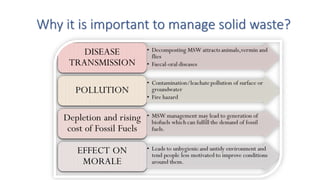
Why it is important to manage solid waste?
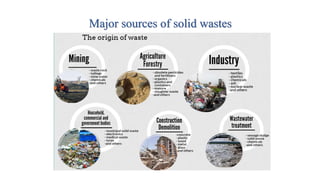
Major sources of solid wastes
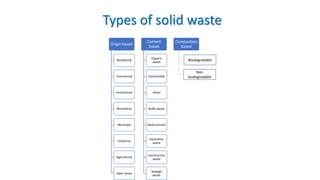
Types of solid waste
Origin based
Residential
Commercial
Institutional
Biomedical
Municipal
Industrial
Agricultural
Open areas
Content
based
Organic
waste
Combustible
Ashes
Bulky waste
Dead animals
Hazardous
waste
Construction
waste
Sewage
waste
Composition
based
Biodegradable
Non
biodegradable
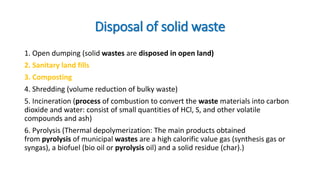
Disposal of solid waste
1. Open dumping (solid wastes are disposed in open land)
2. Sanitary land fills
3. Composting
4. Shredding (volume reduction of bulky waste)
5. Incineration (process of combustion to convert the waste materials into carbon
dioxide and water: consist of small quantities of HCl, S, and other volatile
compounds and ash)
6. Pyrolysis (Thermal depolymerization: The main products obtained
from pyrolysis of municipal wastes are a high calorific value gas (synthesis gas or
syngas), a biofuel (bio oil or pyrolysis oil) and a solid residue (char).)
Landfills
These areas receive non hazardous wastes, such as household waste
and non hazardous commercial waste.
A landfill is an engineered pit, in which layers of solid waste are filled, compacted
and covered for final disposal. It is lined at the bottom to prevent groundwater
pollution. Engineered landfills consist of a lined bottom; a leachate collection and
treatment system; groundwater monitoring; gas extraction (the gas is flared or
used for energy production) and a cap system.
Liner of thick clay, plastic etc is formed in
the bottom to protect ground water from
contamination through leaching
Garbage is
spread out
When landfill is full then it is
covered with clay, sand, gravel and
top soil to prevent seepage of
water.
Drills are grilled to monitor
possible contaminations of
ground water.
Methane is collected
Advantages
• Effective disposal method if managed
well
• Energy production and fast
degradation if designed as a
bioreactor landfill
Disadvantages
• Fills up quickly if waste is not reduced
and reusable waste is not collected
separately and recycled
• A reasonably large area is required
• Risk of groundwater contamination if not
sealed correctly or the liner system is
damaged
• High costs for high-tech landfills
What are the criteria's for selection of landfills
site
• Location restrictions—ensure that landfills are built in suitable
geological areas away from faults, wetlands, flood plains or other
restricted areas as these areas generally have high leaching.
• Should be above the water table, to minimize interaction with
groundwater.
• Preferably located in clay or silt.
Composting
• Composting is the natural process of recycling organic matter, such as
leaves and food scraps, into a valuable fertilizer that can enrich soil
and plants.
• Compost is organic material that can be added to soil to help plants
grow.
Types of composting
According to the design
• Static piles
• Aerated piles
• Continuous feed reactors
According to organisms used
• Aerobic
• Anaerobic
• Vermicomposting
What need to be considered before
composting
• Decomposition of organic matter
• It requires initial separation: mechanical separators are used
• Ferrous metals separate by using magnets
• Remaining waste is mixed with sludge and bulking agents (shredded
newspaper or wood chips)
Air floatation Inertial energy
• Slow: take months
• Waste piles are
mechanically turned
for aeration
Issues
• Odor
• Insects
• Self heating
• Relatively faster
(weeks) due to
aeration
• Aeration done
through perforated
pipes
Issue
• Costly than static
Static piles (windrows) Aerated piles Continuous feed reactors
• Faster (days)
• compressed air
passes through a
flow meter
• Compost requires
curing (decomposition is still on but
at very slow rate) (Humification of organic
matter)
Issue
High initial investment
Static piles (windrows)
Aerated piles
Continuous feed reactors
Aerated piles
• Beltsville process
Involved suction of air through perforated pipes
Inadequate temp control
• Rutger process
Reverse the airflow through suction to injection
(Blower operating either to pull or push air into the pile, drawing air
from the base or the core of the pile and the recirculation of the air in a
reactor)
Thermostat placed
• Composting at thermophilic temp. is desirable.
WHY?
Speeds up the process
Kills pathogens
Composting process generally starts with mesophilic microbes as the temp. rises in
piles microbial growth shifts to thermophilic microbes.
Bacteria
Bacillus stearothermophiles
Thermonospora
Thermoactinomyces
Clostridium thermocellus
Fungi
Geotrichum candidum
Aspergillus fumigatus
Mucor pusillus
Chaetomium thermophile
Thermoascus auranticus
Torula thermophile
Thermophilic organisms
Requirements for optimal composting
• Adequate moisture (50-70%)
However, excess moisture interferes with aeration and lowers self
heating.
• C/N ratio (40:1)
Lowers nitrogen does not permit the growth of microbial biomass thus
lowers fertilizers value
• Sewage sludge should not be high in amount
Because it contains heavy metals thus it can contaminate agricultural
soil.
Therefore, at large scale composting should be monitored regularly.
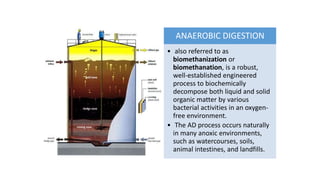
ANAEROBIC DIGESTION
• also referred to as
biomethanization or
biomethanation, is a robust,
well-established engineered
process to biochemically
decompose both liquid and solid
organic matter by various
bacterial activities in an oxygen-
free environment.
• The AD process occurs naturally
in many anoxic environments,
such as watercourses, soils,
animal intestines, and landfills.
Anaerobic composting
• It is done in airtight containers
• First anaerobic composting was setup in Belgium and it was named as DRANCO (DRy
ANaerobic COnversion)
Process:-
Organic matter (30-40%) added in preheated system.
Gastight loading is done which prevents loss of biogas and loss of energy from the reactor.
30% energy generated energy used to run the system
70% converted into electricity.
Final product
Product is dewatered on filter press, dried and marketed under the trade name Humotex.
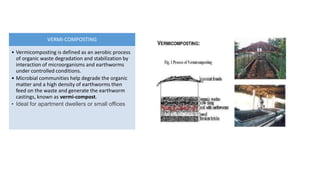
VERMI-COMPOSTING
• Vermicomposting is defined as an aerobic process
of organic waste degradation and stabilization by
interaction of microorganisms and earthworms
under controlled conditions.
• Microbial communities help degrade the organic
matter and a high density of earthworms then
feed on the waste and generate the earthworm
castings, known as vermi-compost.
• Ideal for apartment dwellers or small offices
Thank you

Solid waste management

  • 1.
    Solid waste management Dr.Vijaya Gupta Panjab University Chandigarh
  • 2.
    Why it isimportant to manage solid waste?
  • 3.
    Major sources ofsolid wastes
  • 4.
    Types of solidwaste Origin based Residential Commercial Institutional Biomedical Municipal Industrial Agricultural Open areas Content based Organic waste Combustible Ashes Bulky waste Dead animals Hazardous waste Construction waste Sewage waste Composition based Biodegradable Non biodegradable
  • 5.
    Disposal of solidwaste 1. Open dumping (solid wastes are disposed in open land) 2. Sanitary land fills 3. Composting 4. Shredding (volume reduction of bulky waste) 5. Incineration (process of combustion to convert the waste materials into carbon dioxide and water: consist of small quantities of HCl, S, and other volatile compounds and ash) 6. Pyrolysis (Thermal depolymerization: The main products obtained from pyrolysis of municipal wastes are a high calorific value gas (synthesis gas or syngas), a biofuel (bio oil or pyrolysis oil) and a solid residue (char).)
  • 6.
    Landfills These areas receivenon hazardous wastes, such as household waste and non hazardous commercial waste. A landfill is an engineered pit, in which layers of solid waste are filled, compacted and covered for final disposal. It is lined at the bottom to prevent groundwater pollution. Engineered landfills consist of a lined bottom; a leachate collection and treatment system; groundwater monitoring; gas extraction (the gas is flared or used for energy production) and a cap system.
  • 7.
    Liner of thickclay, plastic etc is formed in the bottom to protect ground water from contamination through leaching Garbage is spread out When landfill is full then it is covered with clay, sand, gravel and top soil to prevent seepage of water. Drills are grilled to monitor possible contaminations of ground water. Methane is collected
  • 8.
    Advantages • Effective disposalmethod if managed well • Energy production and fast degradation if designed as a bioreactor landfill Disadvantages • Fills up quickly if waste is not reduced and reusable waste is not collected separately and recycled • A reasonably large area is required • Risk of groundwater contamination if not sealed correctly or the liner system is damaged • High costs for high-tech landfills
  • 9.
    What are thecriteria's for selection of landfills site • Location restrictions—ensure that landfills are built in suitable geological areas away from faults, wetlands, flood plains or other restricted areas as these areas generally have high leaching. • Should be above the water table, to minimize interaction with groundwater. • Preferably located in clay or silt.
  • 10.
    Composting • Composting isthe natural process of recycling organic matter, such as leaves and food scraps, into a valuable fertilizer that can enrich soil and plants. • Compost is organic material that can be added to soil to help plants grow.
  • 12.
    Types of composting Accordingto the design • Static piles • Aerated piles • Continuous feed reactors According to organisms used • Aerobic • Anaerobic • Vermicomposting
  • 13.
    What need tobe considered before composting • Decomposition of organic matter • It requires initial separation: mechanical separators are used • Ferrous metals separate by using magnets • Remaining waste is mixed with sludge and bulking agents (shredded newspaper or wood chips) Air floatation Inertial energy
  • 14.
    • Slow: takemonths • Waste piles are mechanically turned for aeration Issues • Odor • Insects • Self heating • Relatively faster (weeks) due to aeration • Aeration done through perforated pipes Issue • Costly than static Static piles (windrows) Aerated piles Continuous feed reactors • Faster (days) • compressed air passes through a flow meter • Compost requires curing (decomposition is still on but at very slow rate) (Humification of organic matter) Issue High initial investment
  • 15.
    Static piles (windrows) Aeratedpiles Continuous feed reactors
  • 16.
    Aerated piles • Beltsvilleprocess Involved suction of air through perforated pipes Inadequate temp control • Rutger process Reverse the airflow through suction to injection (Blower operating either to pull or push air into the pile, drawing air from the base or the core of the pile and the recirculation of the air in a reactor) Thermostat placed
  • 17.
    • Composting atthermophilic temp. is desirable. WHY? Speeds up the process Kills pathogens Composting process generally starts with mesophilic microbes as the temp. rises in piles microbial growth shifts to thermophilic microbes. Bacteria Bacillus stearothermophiles Thermonospora Thermoactinomyces Clostridium thermocellus Fungi Geotrichum candidum Aspergillus fumigatus Mucor pusillus Chaetomium thermophile Thermoascus auranticus Torula thermophile Thermophilic organisms
  • 18.
    Requirements for optimalcomposting • Adequate moisture (50-70%) However, excess moisture interferes with aeration and lowers self heating. • C/N ratio (40:1) Lowers nitrogen does not permit the growth of microbial biomass thus lowers fertilizers value • Sewage sludge should not be high in amount Because it contains heavy metals thus it can contaminate agricultural soil. Therefore, at large scale composting should be monitored regularly.
  • 19.
    ANAEROBIC DIGESTION • alsoreferred to as biomethanization or biomethanation, is a robust, well-established engineered process to biochemically decompose both liquid and solid organic matter by various bacterial activities in an oxygen- free environment. • The AD process occurs naturally in many anoxic environments, such as watercourses, soils, animal intestines, and landfills.
  • 20.
    Anaerobic composting • Itis done in airtight containers • First anaerobic composting was setup in Belgium and it was named as DRANCO (DRy ANaerobic COnversion) Process:- Organic matter (30-40%) added in preheated system. Gastight loading is done which prevents loss of biogas and loss of energy from the reactor. 30% energy generated energy used to run the system 70% converted into electricity. Final product Product is dewatered on filter press, dried and marketed under the trade name Humotex.
  • 21.
    VERMI-COMPOSTING • Vermicomposting isdefined as an aerobic process of organic waste degradation and stabilization by interaction of microorganisms and earthworms under controlled conditions. • Microbial communities help degrade the organic matter and a high density of earthworms then feed on the waste and generate the earthworm castings, known as vermi-compost. • Ideal for apartment dwellers or small offices
  • 22.