Solid Waste Management In Rural
Areas of India
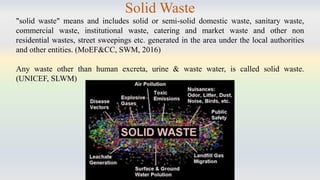
Solid Waste
"solid waste" means and includes solid or semi-solid domestic waste, sanitary waste,
commercial waste, institutional waste, catering and market waste and other non
residential wastes, street sweepings etc. generated in the area under the local authorities
and other entities. (MoEF&CC, SWM, 2016)
Any waste other than human excreta, urine & waste water, is called solid waste.
(UNICEF, SLWM)
Solid Waste in Rural Areas
Solid waste in rural areas generally includes
Kitchen Waste House Sweeping Waste Garden Waste cattle dung & waste from
cattle sheds
waste from markets & shopping areas Plastic Waste Paper Waste
* In rural areas most of the household contains organic wastes, with little quantity of
inorganic wastes and it is completely free from toxic wastes.
Importance of Solid Waste Management in Rural Areas
 Proper management of solid and liquid wastes is an important determinant of improved
sanitation in any community.
 The goals of sanitation fail miserably when solid and liquid waste management aspect is
not given proper attention to improve health and living environment of the community.
 Management of solid or liquid wastes in rural areas is much easier and profitable
business than in urban areas due to the fact that it is mostly organic in nature and does
not contain toxic compounds.
 Reduce environment pollution and make rural areas clean.
 Convert bio waste into energy for ensuring greater energy security at village level.
 Promote recycling and reuse of solid waste.
 Improper handling of solid waste is dangerous to health and environment. It can cause
contamination of water supplies and air pollution.
A number of waste prevention techniques are available, and they are
commonly summarized as popularly known as 4Rs: reduction, reuse,
recycling and recovery. To overcome the problem of solid wastes, following
steps need to be taken:
i. Wherever possible, waste reduction should be preferred.
ii. Every effort should be made to reuse produced wastes
iii. Recycling should be the third option for the wastes.
iv. There are several options for recycling. Such options should be
selected taking in view social and economical acceptability.
v. Attempts should be made to recover materials or energy from waste
which cannot be reduced, reused or recycled.
4R Concept in Solid Waste
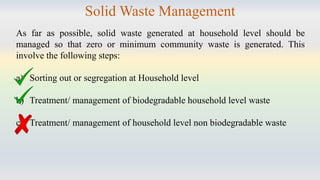
Solid Waste Management
As far as possible, solid waste generated at household level should be
managed so that zero or minimum community waste is generated. This
involve the following steps:
a) Sorting out or segregation at Household level
b) Treatment/ management of biodegradable household level waste
c) Treatment/ management of household level non biodegradable waste
Solid Waste Segregation at Household Level
 Household waste should be sorted out or segregated at the source i.e. at the household
level.
 This is to be done by generating awareness to sort out waste at the household level by
keeping bio degradable and non bio degradable waste in separate color bins of 5 to 10
liters capacity each(e.g. green color bin for bio degradable waste and blue bin for non
bio degradable waste )
 Reusable segregated non biodegradable waste may be reutilized at household level
The segregated waste should be Collet and
Transport Separately for Treatment
Management of biodegradable Waste at Household Level
 Composting is an organized method of producing compost manure. Compost is
particularly useful for organic matters.
 In rural areas there is higher percentage of organic matters making more applicability of
composting technology.
 Technology options for composting of organic wastes
 Pile Method of composting
 NADEP Method
 Bangalore method
 Indore method
 Coimbatore Method
 Vermi composting
 Thermophilic Composting
 Biogas Technology
 Composting is carried out in a simple manure pit or garbage pit (lined or unlined).
 In this process aerobic microorganisms oxidize organic compounds to carbon- dioxide
and oxides of nitrogen and carbon from organic compounds is used as a source of
energy, while nitrogen is recycled.
 In the composting process, due to exothermic reactions, temperature of mass rises. In
areas/regions with higher rainfall composting in over ground heaps is advisable.
 The factors affecting the composting process are: (a) Micro-organisms; (b) Moisture,
(c) Temperature and (d) Carbon/ Nitrogen (C/N) ratio
Solid Waste Composting
https://www.youtube.com/watch?v=kCIYZPeTgpI
 Vermi compost is a natural compost of organic wastes through
Earthworms, who take up organic wastes and after degradation and
digestion, convert such wastes in the form of granules, rich in nitrogen
content.
 Such vermin cast or vermin compost has good plant nutrients.
 This is a natural composting method being used in India and other
countries for centuries.
 However, in recent years there has been systematic methods developed
to enhance such composting by using improved methods and strains of
earthworms in rural as well as urban areas in India also.
Vermicomposting
a) Vermi compost is rich in all essential plant nutrients.
b) Vermi compost is easy to apply, handle and store and does not have
bad odour.
c) It improves soil structure, texture, aeration, and water holding capacity.
Vermi compost contains earthworm cocoon and increases the
population and activity of earthworm in the soil.
d) Vermi compost is free from pathogens, toxic elements, weed seeds etc.
e) Vermi compost minimizes the incidence of pest and diseases.
f) It enhances the decomposition of organic matter in soil.
g) It contains valuable vitamins, enzymes and hormones like auxins,
gibberellins etc.
Advantages of Vermicompost
https://www.youtube.com/watch?v=TCQfBMy-55E
Biogas Technology
 Animal dung along with human wastes can be effectively used for biogas generation
through on-site biogas plant linked with toilet.
 Biogas plant is important in providing sustainable energy sources in rural
communities. Generation and utilization of bioenergy has multiple advantages. It
helps improve sanitation, provide bioenergy at almost nil recurring expenditure and
finally slurry / effluent of biogas plant has plant nutrient value to be used for
agriculture purposes.
 Thus toilet linked biogas plant has additional benefits in terms of improving
sanitation.
 In villages where household wastes contain mainly organics, they are also suitable for
biogas generation. Such wastes can also be mixed in the same biogas plant to generate
biogas production.
 For family size biogas plant there are basically two designs (1) Floating drum type
popularly known as KVIC model and (2) Fixed dome type, popularly known as
Deenbandhu Model.
 This model is predominately found in India. It is
an underground fixed dome digester made up of
complete brick or RCC structure.
 It is a permanent structure having almost nil
operation and maintenance costs. There is no
separate gas holder, biogas is stored inside plant
through liquid displacement chamber.
 This design is suitable also for generation of
biogas from human wastes along with cow dung
and kitchen wastes.
 There is almost no effect of atmospheric variation
of temperature on biogas generation during winter
season.
Deenbandhu model
Importance Biogas Technology
 Biogas can be used for Cooking of 3-4 family members for two times a day
 Biogas can be used for illumination with the use mantle lamps. Mantle lamps (2nos.)
can be used for 6 hours per 24hrs. Such mantle lamps gives illumination equivalent to
4o watt bulb at 220 volt of electricity.
 Biogas technology also create manure which can be used in agricultural field.
 Use of Biogas helps to restrict the emission of CO2 in atmosphere.
 It brings extra revenue to the users.
References
1. MDWS guidelines, Manuscript prepared by Dr. P.K.Jha, Consultant, Sanitation &
WM, NRC, March, 2013
2. Solid and Liquid Waste Management in Rural Areas, A technical note, UNICEF
3. Guidelines on Solid and Liquid Waste Management- Asian Development Bank
4. YouTube videos
5. Google
Solid_Waste_Management_Processing and Treatment.pptx

Solid_Waste_Management_Processing and Treatment.pptx

  • 1.
    Solid Waste ManagementIn Rural Areas of India
  • 2.
    Solid Waste "solid waste"means and includes solid or semi-solid domestic waste, sanitary waste, commercial waste, institutional waste, catering and market waste and other non residential wastes, street sweepings etc. generated in the area under the local authorities and other entities. (MoEF&CC, SWM, 2016) Any waste other than human excreta, urine & waste water, is called solid waste. (UNICEF, SLWM)
  • 3.
    Solid Waste inRural Areas Solid waste in rural areas generally includes Kitchen Waste House Sweeping Waste Garden Waste cattle dung & waste from cattle sheds waste from markets & shopping areas Plastic Waste Paper Waste * In rural areas most of the household contains organic wastes, with little quantity of inorganic wastes and it is completely free from toxic wastes.
  • 4.
    Importance of SolidWaste Management in Rural Areas  Proper management of solid and liquid wastes is an important determinant of improved sanitation in any community.  The goals of sanitation fail miserably when solid and liquid waste management aspect is not given proper attention to improve health and living environment of the community.  Management of solid or liquid wastes in rural areas is much easier and profitable business than in urban areas due to the fact that it is mostly organic in nature and does not contain toxic compounds.  Reduce environment pollution and make rural areas clean.  Convert bio waste into energy for ensuring greater energy security at village level.  Promote recycling and reuse of solid waste.  Improper handling of solid waste is dangerous to health and environment. It can cause contamination of water supplies and air pollution.
  • 5.
    A number ofwaste prevention techniques are available, and they are commonly summarized as popularly known as 4Rs: reduction, reuse, recycling and recovery. To overcome the problem of solid wastes, following steps need to be taken: i. Wherever possible, waste reduction should be preferred. ii. Every effort should be made to reuse produced wastes iii. Recycling should be the third option for the wastes. iv. There are several options for recycling. Such options should be selected taking in view social and economical acceptability. v. Attempts should be made to recover materials or energy from waste which cannot be reduced, reused or recycled. 4R Concept in Solid Waste
  • 6.
    Solid Waste Management Asfar as possible, solid waste generated at household level should be managed so that zero or minimum community waste is generated. This involve the following steps: a) Sorting out or segregation at Household level b) Treatment/ management of biodegradable household level waste c) Treatment/ management of household level non biodegradable waste
  • 7.
    Solid Waste Segregationat Household Level  Household waste should be sorted out or segregated at the source i.e. at the household level.  This is to be done by generating awareness to sort out waste at the household level by keeping bio degradable and non bio degradable waste in separate color bins of 5 to 10 liters capacity each(e.g. green color bin for bio degradable waste and blue bin for non bio degradable waste )  Reusable segregated non biodegradable waste may be reutilized at household level The segregated waste should be Collet and Transport Separately for Treatment
  • 8.
    Management of biodegradableWaste at Household Level  Composting is an organized method of producing compost manure. Compost is particularly useful for organic matters.  In rural areas there is higher percentage of organic matters making more applicability of composting technology.  Technology options for composting of organic wastes  Pile Method of composting  NADEP Method  Bangalore method  Indore method  Coimbatore Method  Vermi composting  Thermophilic Composting  Biogas Technology
  • 9.
     Composting iscarried out in a simple manure pit or garbage pit (lined or unlined).  In this process aerobic microorganisms oxidize organic compounds to carbon- dioxide and oxides of nitrogen and carbon from organic compounds is used as a source of energy, while nitrogen is recycled.  In the composting process, due to exothermic reactions, temperature of mass rises. In areas/regions with higher rainfall composting in over ground heaps is advisable.  The factors affecting the composting process are: (a) Micro-organisms; (b) Moisture, (c) Temperature and (d) Carbon/ Nitrogen (C/N) ratio Solid Waste Composting
  • 10.
  • 11.
     Vermi compostis a natural compost of organic wastes through Earthworms, who take up organic wastes and after degradation and digestion, convert such wastes in the form of granules, rich in nitrogen content.  Such vermin cast or vermin compost has good plant nutrients.  This is a natural composting method being used in India and other countries for centuries.  However, in recent years there has been systematic methods developed to enhance such composting by using improved methods and strains of earthworms in rural as well as urban areas in India also. Vermicomposting
  • 12.
    a) Vermi compostis rich in all essential plant nutrients. b) Vermi compost is easy to apply, handle and store and does not have bad odour. c) It improves soil structure, texture, aeration, and water holding capacity. Vermi compost contains earthworm cocoon and increases the population and activity of earthworm in the soil. d) Vermi compost is free from pathogens, toxic elements, weed seeds etc. e) Vermi compost minimizes the incidence of pest and diseases. f) It enhances the decomposition of organic matter in soil. g) It contains valuable vitamins, enzymes and hormones like auxins, gibberellins etc. Advantages of Vermicompost
  • 13.
  • 14.
    Biogas Technology  Animaldung along with human wastes can be effectively used for biogas generation through on-site biogas plant linked with toilet.  Biogas plant is important in providing sustainable energy sources in rural communities. Generation and utilization of bioenergy has multiple advantages. It helps improve sanitation, provide bioenergy at almost nil recurring expenditure and finally slurry / effluent of biogas plant has plant nutrient value to be used for agriculture purposes.  Thus toilet linked biogas plant has additional benefits in terms of improving sanitation.  In villages where household wastes contain mainly organics, they are also suitable for biogas generation. Such wastes can also be mixed in the same biogas plant to generate biogas production.  For family size biogas plant there are basically two designs (1) Floating drum type popularly known as KVIC model and (2) Fixed dome type, popularly known as Deenbandhu Model.
  • 15.
     This modelis predominately found in India. It is an underground fixed dome digester made up of complete brick or RCC structure.  It is a permanent structure having almost nil operation and maintenance costs. There is no separate gas holder, biogas is stored inside plant through liquid displacement chamber.  This design is suitable also for generation of biogas from human wastes along with cow dung and kitchen wastes.  There is almost no effect of atmospheric variation of temperature on biogas generation during winter season. Deenbandhu model
  • 16.
    Importance Biogas Technology Biogas can be used for Cooking of 3-4 family members for two times a day  Biogas can be used for illumination with the use mantle lamps. Mantle lamps (2nos.) can be used for 6 hours per 24hrs. Such mantle lamps gives illumination equivalent to 4o watt bulb at 220 volt of electricity.  Biogas technology also create manure which can be used in agricultural field.  Use of Biogas helps to restrict the emission of CO2 in atmosphere.  It brings extra revenue to the users.
  • 17.
    References 1. MDWS guidelines,Manuscript prepared by Dr. P.K.Jha, Consultant, Sanitation & WM, NRC, March, 2013 2. Solid and Liquid Waste Management in Rural Areas, A technical note, UNICEF 3. Guidelines on Solid and Liquid Waste Management- Asian Development Bank 4. YouTube videos 5. Google