Terrestrial Ecosystem
Lydia R. Leonardo, DrPH
Professor Emeritus, UP Manila
Director, UE Office of Research Coordination
Professorial Lecturer,
Biomes
Regions of the world with similar climate
(weather, temperature), animals and
pants (flora and fauna)
Very large ecological areas on the earth’s
surface with fauna and flora adapting to
their environment
There may be many units of ecosystems
within one biome.
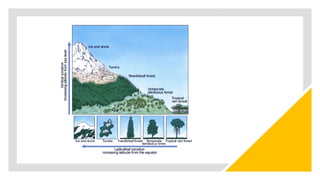
regions in the planet distinguished by
their climate and vegetation
Importance
of Biomes
Biomes have changed and
moved many times during the
history of the earth.
Recent widespread human
activities have altered
drastically these communities.
Conservation and preservation
of biomes should be ensured
for survival of humanity.
Various
Views on
Number of
Biomes
Five biomes namely aquatic, desert, forest,
grassland and tundra.
Eight biomes namely polar lands, boreal
(taiga) forest, tundra, temperate forest,
grasslands, desert, tropical forest and
mountain vegetation.
Ten biomes including rainforest, grassland,
desert, coniferous forest, deciduous forest,
desert shrub, Mediterranean, savannah,
tundra, mountains
Five Biomes
Aquatic – including freshwater, marine,
estuaries
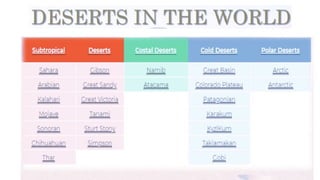
Desert – including hot and dry, semi-
arid, coastal and cold deserts
Forest – including rainforest, chaparral,
temperate and boreal (taiga) forest
Grassland – including savannah and
temperate grasslands
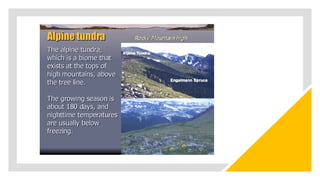
Tundra – including arctic and alpine
tundra
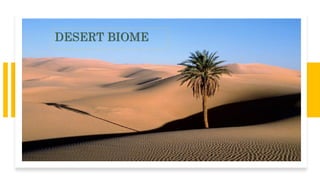
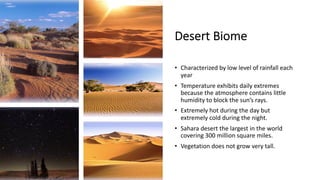
Desert Biome
• Characterized by low level of rainfall each
year
• Temperature exhibits daily extremes
because the atmosphere contains little
humidity to block the sun’s rays.
• Extremely hot during the day but
extremely cold during the night.
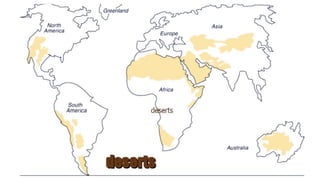
• Sahara desert the largest in the world
covering 300 million square miles.
• Vegetation does not grow very tall.
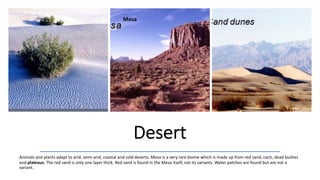
Desert
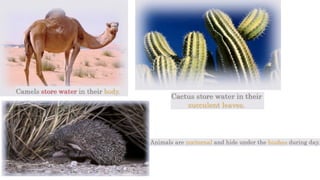
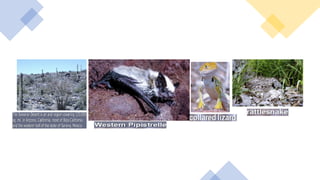
Animals and plants adapt to arid, semi-arid, coastal and cold deserts. Mesa is a very rare biome which is made up from red sand, cacti, dead bushes
and plateaus. The red sand is only one layer thick. Red sand is found in the Mesa itself, not its variants. Water patches are found but are not a
variant.
Mesa
Forests
Large geographical areas dominated by
large number of trees
Represent the largest and most diverse
biome
Trees –very important in balance of life as
they take in carbon dioxide and produce
oxygen
Tropical rainforest, temperate or
deciduous forest, boreal forest or taiga
Tropical
Rainforests
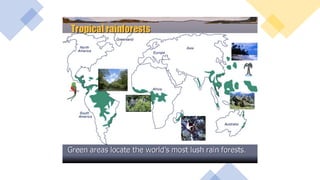
Characterized by high temperature and moist
habitat
Found near the earth’s equator
Occur where a mean monthly temperature of
between 200C and 280C is combined with an
annual rainfall of between 1.5 and 10 meters
evenly distributed throughout the year
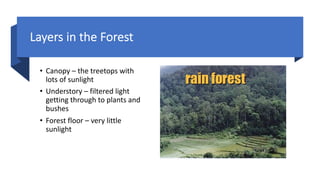
Layers in the Forest
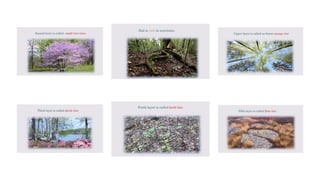
• Canopy – the treetops with
lots of sunlight
• Understory – filtered light
getting through to plants and
bushes
• Forest floor – very little
sunlight
Temperate
Forests
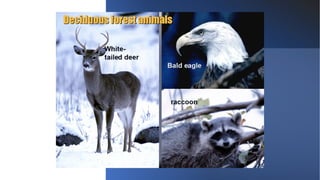
Forest biome with four distinct seasons
Temperature ranges from hot in summer to
extremely cold in winter.
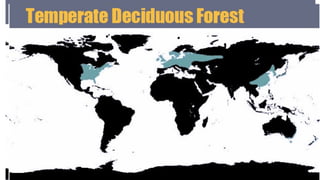
Found predominantly in the Northern
Hemisphere
Also described as temperate and humid biome
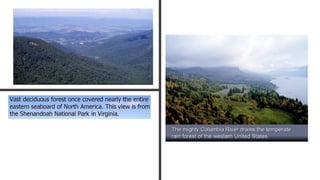
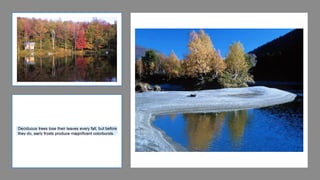
Characterized by deciduous trees
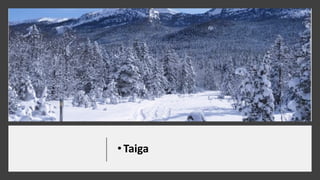
Taiga and Boreal Forest
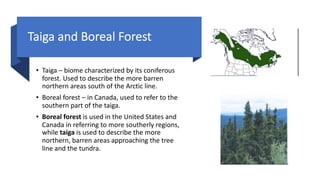
• Taiga – biome characterized by its coniferous
forest. Used to describe the more barren
northern areas south of the Arctic line.
• Boreal forest – in Canada, used to refer to the
southern part of the taiga.
• Boreal forest is used in the United States and
Canada in referring to more southerly regions,
while taiga is used to describe the more
northern, barren areas approaching the tree
line and the tundra.
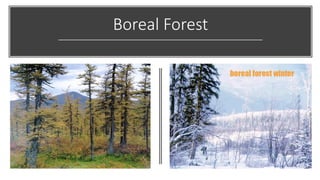
Boreal Forest
•Taiga
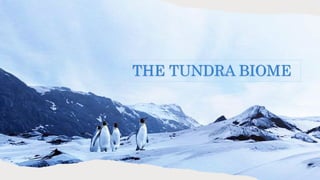
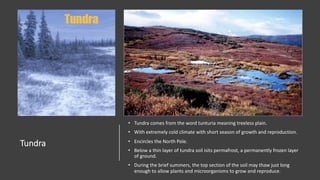
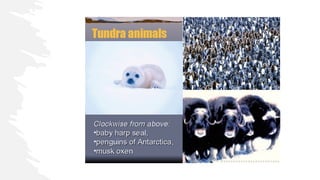
Tundra
• Tundra comes from the word tunturia meaning treeless plain.
• With extremely cold climate with short season of growth and reproduction.
• Encircles the North Pole.
• Below a thin layer of tundra soil isits permafrost, a permanently frozen layer
of ground.
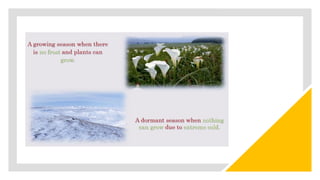
• During the brief summers, the top section of the soil may thaw just long
enough to allow plants and microorganisms to grow and reproduce.
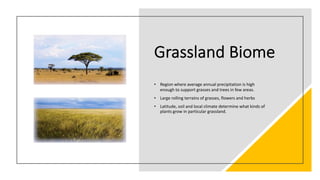
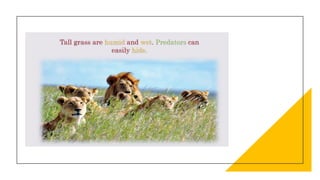
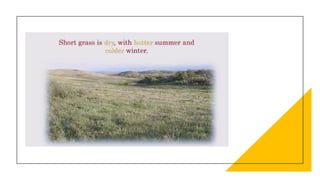
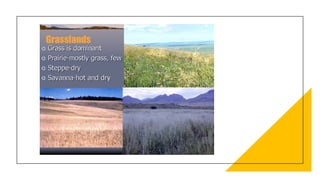
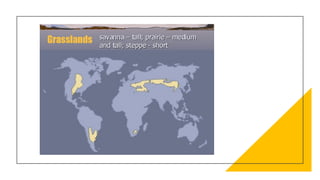
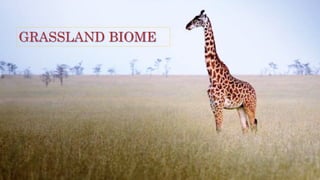
Grassland Biome
• Region where average annual precipitation is high
enough to support grasses and trees in few areas.
• Large rolling terrains of grasses, flowers and herbs
• Latitude, soil and local climate determine what kinds of
plants grow in particular grassland.
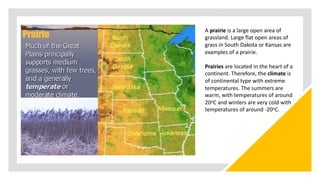
A prairie is a large open area of
grassland. Large flat open areas of
grass in South Dakota or Kansas are
examples of a prairie.
Prairies are located in the heart of a
continent. Therefore, the climate is
of continental type with extreme
temperatures. The summers are
warm, with temperatures of around
20oC and winters are very cold with
temperatures of around -20oC.
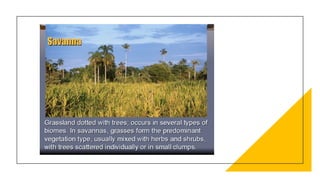
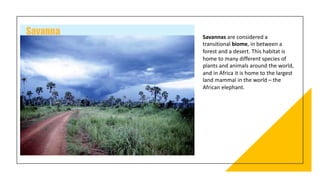
Savannas are considered a
transitional biome, in between a
forest and a desert. This habitat is
home to many different species of
plants and animals around the world,
and in Africa it is home to the largest
land mammal in the world – the
African elephant.
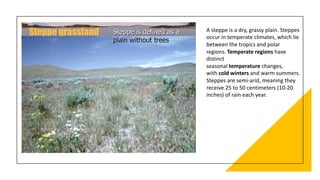
A steppe is a dry, grassy plain. Steppes
occur in temperate climates, which lie
between the tropics and polar
regions. Temperate regions have
distinct
seasonal temperature changes,
with cold winters and warm summers.
Steppes are semi-arid, meaning they
receive 25 to 50 centimeters (10-20
inches) of rain each year.
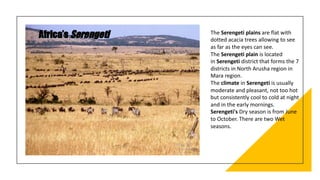
The Serengeti plains are flat with
dotted acacia trees allowing to see
as far as the eyes can see.
The Serengeti plain is located
in Serengeti district that forms the 7
districts in North Arusha region in
Mara region.
The climate in Serengeti is usually
moderate and pleasant, not too hot
but consistently cool to cold at night
and in the early mornings.
Serengeti's Dry season is from June
to October. There are two Wet
seasons.
Other
Terrestrial
Habitats
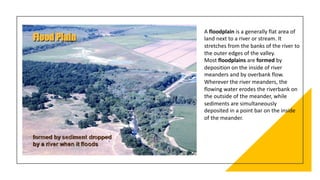
A floodplain is a generally flat area of
land next to a river or stream. It
stretches from the banks of the river to
the outer edges of the valley.
Most floodplains are formed by
deposition on the inside of river
meanders and by overbank flow.
Wherever the river meanders, the
flowing water erodes the riverbank on
the outside of the meander, while
sediments are simultaneously
deposited in a point bar on the inside
of the meander.
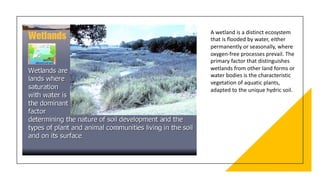
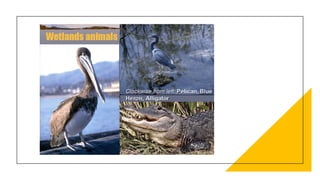
A wetland is a distinct ecosystem
that is flooded by water, either
permanently or seasonally, where
oxygen-free processes prevail. The
primary factor that distinguishes
wetlands from other land forms or
water bodies is the characteristic
vegetation of aquatic plants,
adapted to the unique hydric soil.
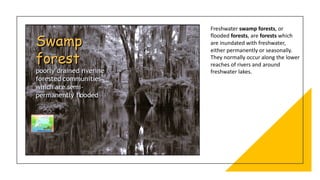
Freshwater swamp forests, or
flooded forests, are forests which
are inundated with freshwater,
either permanently or seasonally.
They normally occur along the lower
reaches of rivers and around
freshwater lakes.
Acknowledgement
Pictures, graphs and diagrams used in this presentation
have been adopted from Slideshare.
Thank you.

Terrestrial Ecosystem common in the worlds.pdf

  • 1.
    Terrestrial Ecosystem Lydia R.Leonardo, DrPH Professor Emeritus, UP Manila Director, UE Office of Research Coordination Professorial Lecturer,
  • 2.
    Biomes Regions of theworld with similar climate (weather, temperature), animals and pants (flora and fauna) Very large ecological areas on the earth’s surface with fauna and flora adapting to their environment There may be many units of ecosystems within one biome. regions in the planet distinguished by their climate and vegetation
  • 3.
    Importance of Biomes Biomes havechanged and moved many times during the history of the earth. Recent widespread human activities have altered drastically these communities. Conservation and preservation of biomes should be ensured for survival of humanity.
  • 4.
    Various Views on Number of Biomes Fivebiomes namely aquatic, desert, forest, grassland and tundra. Eight biomes namely polar lands, boreal (taiga) forest, tundra, temperate forest, grasslands, desert, tropical forest and mountain vegetation. Ten biomes including rainforest, grassland, desert, coniferous forest, deciduous forest, desert shrub, Mediterranean, savannah, tundra, mountains
  • 5.
    Five Biomes Aquatic –including freshwater, marine, estuaries Desert – including hot and dry, semi- arid, coastal and cold deserts Forest – including rainforest, chaparral, temperate and boreal (taiga) forest Grassland – including savannah and temperate grasslands Tundra – including arctic and alpine tundra
  • 7.
    Desert Biome • Characterizedby low level of rainfall each year • Temperature exhibits daily extremes because the atmosphere contains little humidity to block the sun’s rays. • Extremely hot during the day but extremely cold during the night. • Sahara desert the largest in the world covering 300 million square miles. • Vegetation does not grow very tall.
  • 8.
    Desert Animals and plantsadapt to arid, semi-arid, coastal and cold deserts. Mesa is a very rare biome which is made up from red sand, cacti, dead bushes and plateaus. The red sand is only one layer thick. Red sand is found in the Mesa itself, not its variants. Water patches are found but are not a variant. Mesa
  • 14.
    Forests Large geographical areasdominated by large number of trees Represent the largest and most diverse biome Trees –very important in balance of life as they take in carbon dioxide and produce oxygen Tropical rainforest, temperate or deciduous forest, boreal forest or taiga
  • 15.
    Tropical Rainforests Characterized by hightemperature and moist habitat Found near the earth’s equator Occur where a mean monthly temperature of between 200C and 280C is combined with an annual rainfall of between 1.5 and 10 meters evenly distributed throughout the year
  • 17.
    Layers in theForest • Canopy – the treetops with lots of sunlight • Understory – filtered light getting through to plants and bushes • Forest floor – very little sunlight
  • 21.
    Temperate Forests Forest biome withfour distinct seasons Temperature ranges from hot in summer to extremely cold in winter. Found predominantly in the Northern Hemisphere Also described as temperate and humid biome Characterized by deciduous trees
  • 27.
    Taiga and BorealForest • Taiga – biome characterized by its coniferous forest. Used to describe the more barren northern areas south of the Arctic line. • Boreal forest – in Canada, used to refer to the southern part of the taiga. • Boreal forest is used in the United States and Canada in referring to more southerly regions, while taiga is used to describe the more northern, barren areas approaching the tree line and the tundra.
  • 28.
  • 29.
  • 31.
    Tundra • Tundra comesfrom the word tunturia meaning treeless plain. • With extremely cold climate with short season of growth and reproduction. • Encircles the North Pole. • Below a thin layer of tundra soil isits permafrost, a permanently frozen layer of ground. • During the brief summers, the top section of the soil may thaw just long enough to allow plants and microorganisms to grow and reproduce.
  • 39.
    Grassland Biome • Regionwhere average annual precipitation is high enough to support grasses and trees in few areas. • Large rolling terrains of grasses, flowers and herbs • Latitude, soil and local climate determine what kinds of plants grow in particular grassland.
  • 44.
    A prairie isa large open area of grassland. Large flat open areas of grass in South Dakota or Kansas are examples of a prairie. Prairies are located in the heart of a continent. Therefore, the climate is of continental type with extreme temperatures. The summers are warm, with temperatures of around 20oC and winters are very cold with temperatures of around -20oC.
  • 47.
    Savannas are considereda transitional biome, in between a forest and a desert. This habitat is home to many different species of plants and animals around the world, and in Africa it is home to the largest land mammal in the world – the African elephant.
  • 48.
    A steppe isa dry, grassy plain. Steppes occur in temperate climates, which lie between the tropics and polar regions. Temperate regions have distinct seasonal temperature changes, with cold winters and warm summers. Steppes are semi-arid, meaning they receive 25 to 50 centimeters (10-20 inches) of rain each year.
  • 49.
    The Serengeti plainsare flat with dotted acacia trees allowing to see as far as the eyes can see. The Serengeti plain is located in Serengeti district that forms the 7 districts in North Arusha region in Mara region. The climate in Serengeti is usually moderate and pleasant, not too hot but consistently cool to cold at night and in the early mornings. Serengeti's Dry season is from June to October. There are two Wet seasons.
  • 50.
  • 51.
    A floodplain isa generally flat area of land next to a river or stream. It stretches from the banks of the river to the outer edges of the valley. Most floodplains are formed by deposition on the inside of river meanders and by overbank flow. Wherever the river meanders, the flowing water erodes the riverbank on the outside of the meander, while sediments are simultaneously deposited in a point bar on the inside of the meander.
  • 52.
    A wetland isa distinct ecosystem that is flooded by water, either permanently or seasonally, where oxygen-free processes prevail. The primary factor that distinguishes wetlands from other land forms or water bodies is the characteristic vegetation of aquatic plants, adapted to the unique hydric soil.
  • 54.
    Freshwater swamp forests,or flooded forests, are forests which are inundated with freshwater, either permanently or seasonally. They normally occur along the lower reaches of rivers and around freshwater lakes.
  • 55.
    Acknowledgement Pictures, graphs anddiagrams used in this presentation have been adopted from Slideshare.
  • 56.