Robotics Seminar
Biomimetic Robots
By
NIRMAL THOMAS
M.Tech Robotics
SRM UNIVERSITY
Confusing Terms
Biomimetic
 Bio-Inspired
 Bionic Robots

Biomimetic
Biomimetic refers to human-made processes,
substances, devices, or systems that imitate
nature.
 The art and science of designing and building
biomimetic apparatus is called biomimetic, and
is of special interest to researchers in
nanotechnology, robotics, artificial intelligence
(AI), the medical industry, and the military

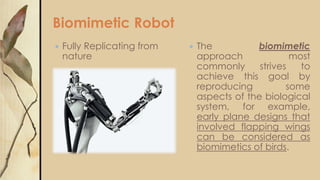
Biomimetic Robot


Fully Replicating from
nature



The
biomimetic
approach
most
commonly
strives
to
achieve this goal by
reproducing
some
aspects of the biological
system, for example,
early plane designs that
involved flapping wings
can be considered as
biomimetics of birds.
Bio-Inspired Robot
Bio-Inspired
This approach aims to
discover and capture an
essential
idea
that
underpins a biological
system, so that the same
idea can be implemented
technologically.


Taking the Idea
 Not Fully replicating it
 Inspired from Nature

Bionic Robots


biology + electronics

• Integrating Electro
Mechanical system to
living organisms
• Bionics usually means the
replacement or
enhancement of organs
or other body parts by
mechanical versions or
electrical add-ons
Which is Best?
•

•

•

These approaches are not mutually exclusive, i.e., in
many cases a biomimetic solution can provide the best
technological implementation of a bio-inspired design,
but a biomimetic solution is not always optimal from an
engineering prospective.
Fixed-wing aircraft turns out to be a more efficient
solution for carrying cargo than are designs that
replicate flapping wings of birds. Not too surprising,
perhaps, as typical birds did not evolve based on
capacity to carry heavy cargo across long distances.
All these approach has its own Advantage and
Disadvantage
History
387 BC Archytas of Tarentum allegedly built a
kind of flying machine, a wooden pigeon
balanced by a weight suspended from a
pulley, and set in motion by compressed air
escaping from a valve (Biomimetic)
 105 AD, Ts' ai Lun from China credited with
inventing paper, after watching a wasp create
its nest (Bio Inspiration)

When the real biomimetic Robot Came?


1970s,Robotic LOBSTER (designed by Joseph
Ayers, a biology professor)
Robotic Lobster


The actions of real lobsters have been
reverse-engineered and programmed into a
library of actions which give the robotic
lobster a similar behavior as the real ones.



They not only resemble its physical shape
and movements but the way its artificial
nervous
system
responds
to
variable
conditions in its environment- such as
temperature and heat.
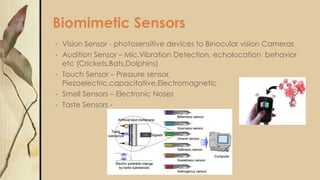
Biomimetic Sensors








Vision Sensor - photosensitive devices to Binocular vision Cameras
Audition Sensor – Mic,Vibration Detection, echolocation behavior
etc (Crickets,Bats,Dolphins)
Touch Sensor – Pressure sensor,
Piezoelectric,capacitative,Electromagnetic
Smell Sensors – Electronic Noses
Taste Sensors -
Actuators
Pneumatic Muscles
 Shape Memory alloys
 Conducting Polymers
 Hydraulic Actuators
 Magnetic Actuator

Where it is going ?


From Nature

Artificial Intelligence

Structure

Bio-Inspired Sensors


Bio-inspired Actuators

Combing these we are making biomimetic
robots….. Insects, Dragonfly's, Birds……..(Where)
………………………….. Humanoid Robots…….
which will perform as like Human
Locomotion's in Robots









Crawling (To move slowly on the hands and knees
or by dragging the body along the ground )
Walking (2Leg,4Leg)
Climbing
Swimming
Jumping
Flying
Grasping
drilling
Control Architecture
Self Learning Robots
 Evolving Robots
 Collective Robots (Swarm)

Current Advancement
FESTO Albatross
 PETMAN – Robotic Soldier (30 DOF)
 Resistive & Capacitive Skin

Applications
Defense (where the most funding goes…..)
 Entertainment (AZIMO by HONDA)
 Search and Rescue
 Underwater Research (95% oceans are still
mystery)
 Industrial Application (Human hand is the most
versatile)
 Nanotechnology
 Aerospace (Aerial Photography)

Reference
Handbook of Robotics – Springer
 Wikipedia
 Google
 Festo.com
 Boston Dynamics etc.

THANK YOU

Biomimetic robots

  • 1.
  • 2.
  • 3.
  • 4.
    Biomimetic Biomimetic refers tohuman-made processes, substances, devices, or systems that imitate nature.  The art and science of designing and building biomimetic apparatus is called biomimetic, and is of special interest to researchers in nanotechnology, robotics, artificial intelligence (AI), the medical industry, and the military 
  • 5.
    Biomimetic Robot  Fully Replicatingfrom nature  The biomimetic approach most commonly strives to achieve this goal by reproducing some aspects of the biological system, for example, early plane designs that involved flapping wings can be considered as biomimetics of birds.
  • 6.
    Bio-Inspired Robot Bio-Inspired This approachaims to discover and capture an essential idea that underpins a biological system, so that the same idea can be implemented technologically.  Taking the Idea  Not Fully replicating it  Inspired from Nature 
  • 7.
    Bionic Robots  biology +electronics • Integrating Electro Mechanical system to living organisms • Bionics usually means the replacement or enhancement of organs or other body parts by mechanical versions or electrical add-ons
  • 8.
    Which is Best? • • • Theseapproaches are not mutually exclusive, i.e., in many cases a biomimetic solution can provide the best technological implementation of a bio-inspired design, but a biomimetic solution is not always optimal from an engineering prospective. Fixed-wing aircraft turns out to be a more efficient solution for carrying cargo than are designs that replicate flapping wings of birds. Not too surprising, perhaps, as typical birds did not evolve based on capacity to carry heavy cargo across long distances. All these approach has its own Advantage and Disadvantage
  • 9.
    History 387 BC Archytasof Tarentum allegedly built a kind of flying machine, a wooden pigeon balanced by a weight suspended from a pulley, and set in motion by compressed air escaping from a valve (Biomimetic)  105 AD, Ts' ai Lun from China credited with inventing paper, after watching a wasp create its nest (Bio Inspiration) 
  • 10.
    When the realbiomimetic Robot Came?  1970s,Robotic LOBSTER (designed by Joseph Ayers, a biology professor)
  • 11.
    Robotic Lobster  The actionsof real lobsters have been reverse-engineered and programmed into a library of actions which give the robotic lobster a similar behavior as the real ones.  They not only resemble its physical shape and movements but the way its artificial nervous system responds to variable conditions in its environment- such as temperature and heat.
  • 12.
    Biomimetic Sensors      Vision Sensor- photosensitive devices to Binocular vision Cameras Audition Sensor – Mic,Vibration Detection, echolocation behavior etc (Crickets,Bats,Dolphins) Touch Sensor – Pressure sensor, Piezoelectric,capacitative,Electromagnetic Smell Sensors – Electronic Noses Taste Sensors -
  • 13.
    Actuators Pneumatic Muscles  ShapeMemory alloys  Conducting Polymers  Hydraulic Actuators  Magnetic Actuator 
  • 14.
    Where it isgoing ?  From Nature Artificial Intelligence Structure Bio-Inspired Sensors  Bio-inspired Actuators Combing these we are making biomimetic robots….. Insects, Dragonfly's, Birds……..(Where) ………………………….. Humanoid Robots……. which will perform as like Human
  • 15.
    Locomotion's in Robots         Crawling(To move slowly on the hands and knees or by dragging the body along the ground ) Walking (2Leg,4Leg) Climbing Swimming Jumping Flying Grasping drilling
  • 16.
    Control Architecture Self LearningRobots  Evolving Robots  Collective Robots (Swarm) 
  • 17.
    Current Advancement FESTO Albatross PETMAN – Robotic Soldier (30 DOF)  Resistive & Capacitive Skin 
  • 18.
    Applications Defense (where themost funding goes…..)  Entertainment (AZIMO by HONDA)  Search and Rescue  Underwater Research (95% oceans are still mystery)  Industrial Application (Human hand is the most versatile)  Nanotechnology  Aerospace (Aerial Photography) 
  • 20.
    Reference Handbook of Robotics– Springer  Wikipedia  Google  Festo.com  Boston Dynamics etc. 
  • 21.