Antepartum fetal
surveillance
-jason zachariah

1
Introduction:
• Majority of the fetal deaths(80%) occur in the antepartum
period.
• The major causes of deaths are: 1) chronic fetal hypoxia(IUGR)
2) maternal complications-diabetes, hypertension, infection
3)fetal congenital malformation 4) unexplained causes
• The primary objective of antenatal fetal assessment is to avoid
fetal death

2
Monitoring methods

3
Clinical monitoring:

4
Special invvestigations:

Early pregnancy
Biochemical Biophysical Cytogenetic
5
Biochemical:
• Maternal serum AFP
• Triple test
• Acetyl choline esterase test

6
AFP:
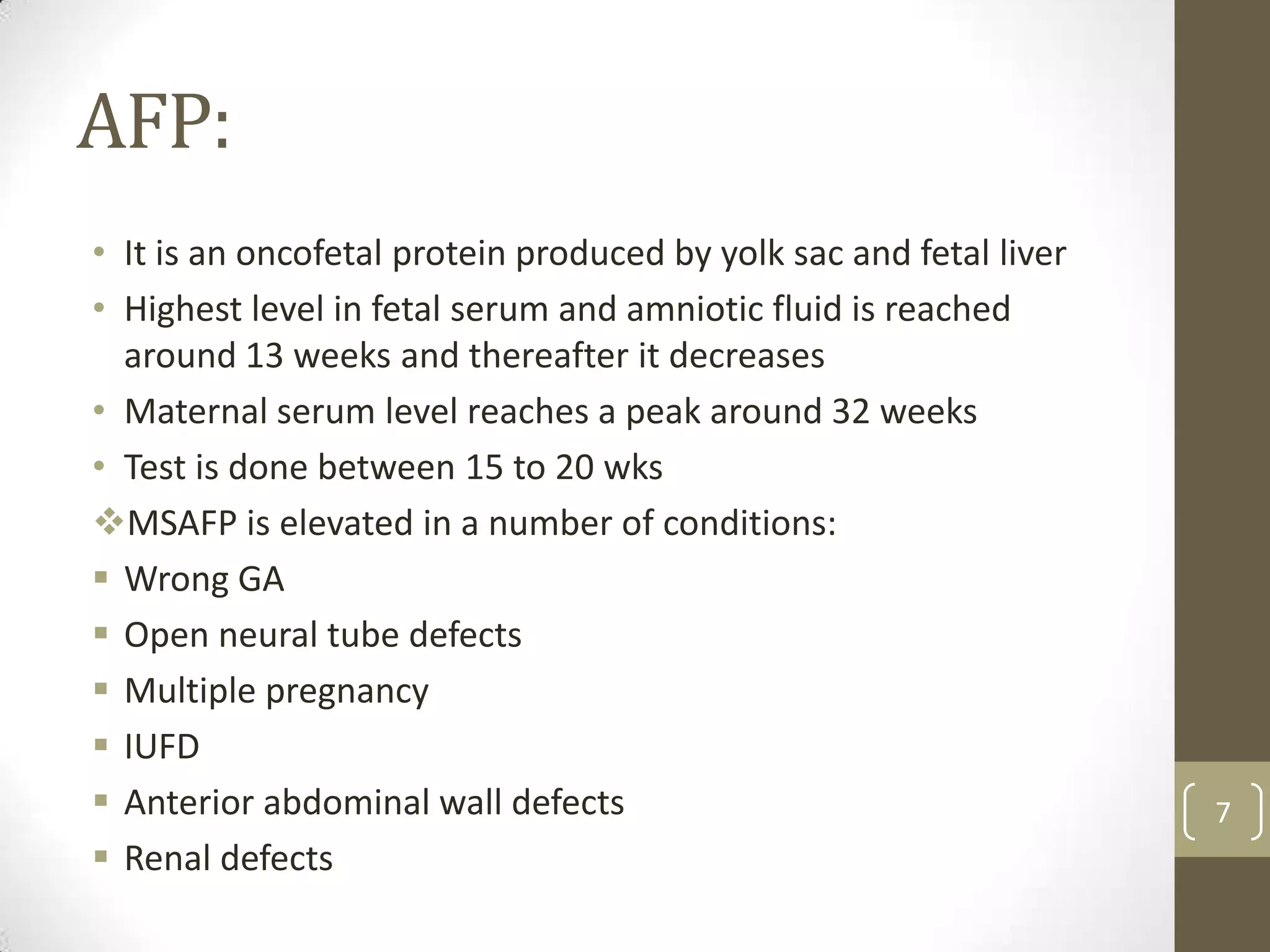
• It is an oncofetal protein produced by yolk sac and fetal liver
• Highest level in fetal serum and amniotic fluid is reached
around 13 weeks and thereafter it decreases
• Maternal serum level reaches a peak around 32 weeks
• Test is done between 15 to 20 wks
MSAFP is elevated in a number of conditions:
 Wrong GA
 Open neural tube defects
 Multiple pregnancy
 IUFD
 Anterior abdominal wall defects
 Renal defects

7
Triple test:
• Combined test which includes MSAFP,hCG and UE3
• It is used for the detection of Down’s syndrome

Acetyl choline esterase
• Elevated in open neural tube defects

8
Cytogenetic
• Amniocentesis
• Chorionic vilus sampling
• Cordocentesis

9
Amniocentesis
This procedure
involves tapping of
the amniotic sac
either for
diagnostic
purposes (to obtain
a sample) or for
therapeutic
purposes, under
ultrasonic
guidance.
10
Diagnostic indications
• Early months(15-20 wks)Sex linked disorders
Karyotyping
In born errors of metabolism
Neural tube defects
• Later months
Fetal maturity
Degree of fetal hemolysis in Rh sensitised mother
Meconium staining of liquor
11
Therapeutic indications:
• First half:
Abortion induction by instilling chemicals
Repeated decompression of uterus in acute hydramnios
• Second half
Decompression of uterus in unresponsive c/c hydramnios
Fetal transfusion
aminoinfusion

12
Chorionic villus sampling
• Prenatal diagnosis of genetic
disorders
• Carried out transcervically
between 10-12 weeks and
transabdominally from 10 wks till
term
• A few villi are collected from the
chorion frondosum under
ultrasonic guidance with the help
of a long maalaeble polyethylene
catheter introduced transcervically
along the extraovular space
• Provides diagnosis in 24 hours

13
• Complications: fetal loss, oromandibular limb deformities,
vaginal bleeding- higher when compared to amniocentesis
• False positives due to placental mosaics and maternal cell
contamination can occur. In such cases, amniocentesis to
confirm.
• Anti-D should be given to Rh-ve mother following procedure

14
Cordocentesis
• Percutaneous umbilical blood sampling
• All information obtained from
amniocentesis and CVS can be
obtained. In addition,
Fetal anemia, bleeding disorders,
hemoglobinopathies
Fetal infections-toxoplasmosis, viral
Fetal blood gas and acid base status- in
IUGR
Fetal therapy- in blood transfusion
15
Biophysical
• Ultrasonographic examination of fetus
CRL-smaller than GA-chr anomalies
Increased nuchal translucency
Absence of nasal bone

16
Antepartum surveillance-late
pregnancy
• Clinical
• Biochemical-mainlly to assess lung maturity
• biophysical

17
Biophysical tets
•
•
•
•
•
•
•
•

Fetal movement count
Cardiotocography
Nonstress test
Fetal biophysical profile
Doppler ultrasound
Vibroaccoustic stimulation
Contraction stress test
Amniotic fluid volume

18
Fetal movement count
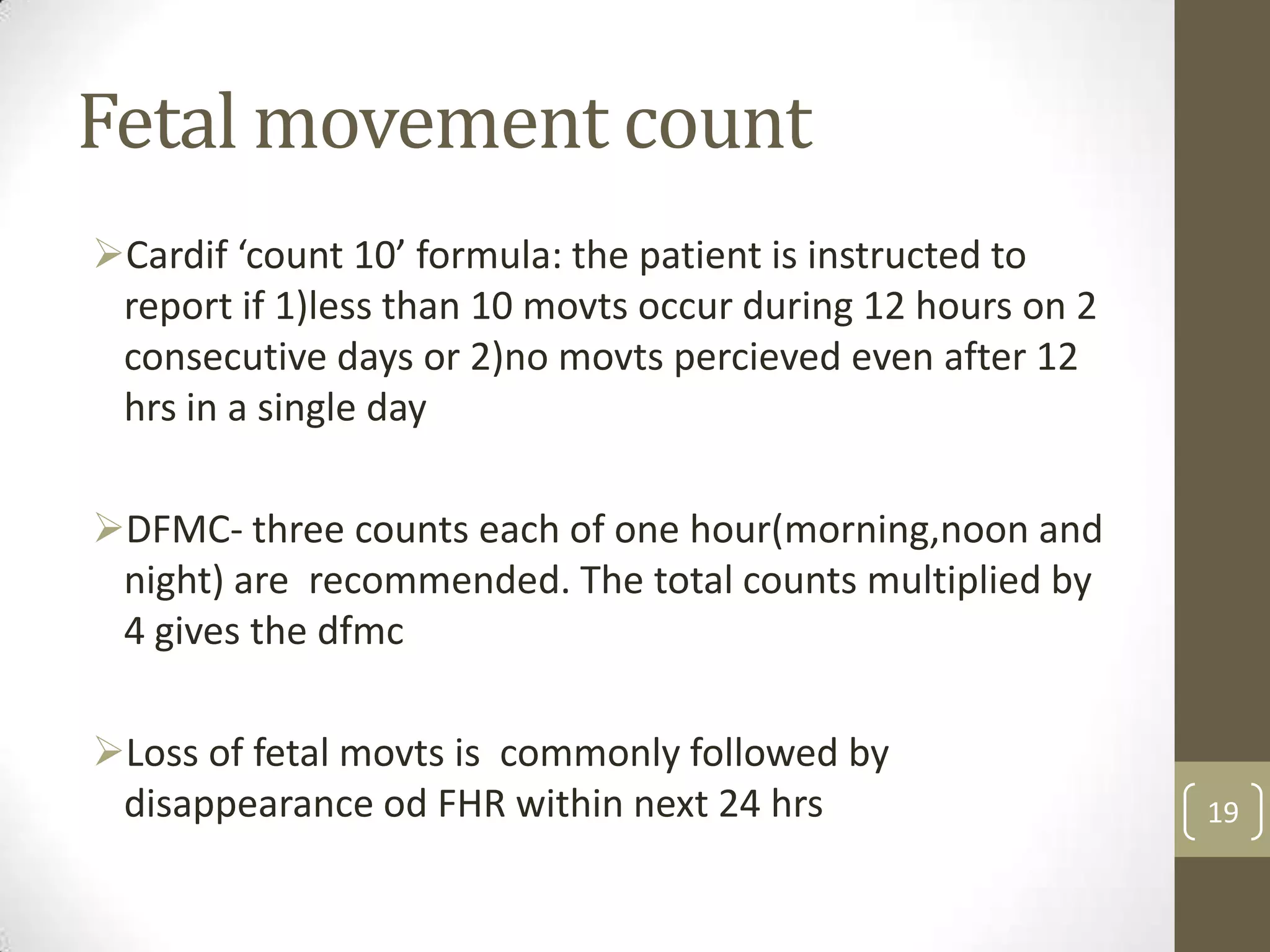
Cardif ‘count 10’ formula: the patient is instructed to
report if 1)less than 10 movts occur during 12 hours on 2
consecutive days or 2)no movts percieved even after 12
hrs in a single day

DFMC- three counts each of one hour(morning,noon and
night) are recommended. The total counts multiplied by
4 gives the dfmc
Loss of fetal movts is commonly followed by
disappearance od FHR within next 24 hrs

19
NST
• Currently most commonly used
• Utilises principle of Doppler ultrect
• An external ultrasound transducer for recording fetal heart
rate and tocodynamometer for recording uterine activity are
attached to maternal abdomen
• This test is based on the hypothesis that the heart rate of a
fetus that is not acidotic due to hypoxia will accelerate in
response to fetal movt

20
Reactive NST
• Presence of 2 or more fetal heart rate accelerations during a
20 min period, with each acceleration of 15 beats per min
lasting 15 sec or more, usually occurring simultaneously with
fetal movement. Tracing is extended to 40 mins before
commenting non reactive

21
Non reactive NST
• Usually associated with fetal hypoxia
• Other causes- sleep periods in fetus and GA<28 weeks
• Variable decelerations if non repetitive and brief are not
significant. But repetitive( atleast 3 in 10min) or prolonged
(more than 30 sec) variable decelerations are considered
abnormal

22
VAST
• An acoustic stimulator is placed on the maternal abdomen
and a stimulus applied for 1-2 sec. the basis is that the
external sound may stimulate the fetus provoking fetal heart
rate acceleration in cases thought to be non reactive. This is
termed startle response

23
Contraction stress test
• Also termed oxytocin challenge test
• This test is based upon the fact that the utero-placenttal
blood flow decreases markedly during uterine contractions.
• A normal fetus can withstand this hypoxic stress without
dirfficulty
• A fetus with acute or chronic problems will not be able to
withstand this decrease in qxygen supply and this will result in
late decelerations
• If atleast 3 spontaneous contractions lasting atleast 40 sec is
present in 10 mins, oxytocin stimulation is not needed
24
• If atleast 3 spontaneous contractions lasting atleast 40 sec is
present in 10 mins, oxytocin stimulation is not needed
• If not contractions are induced with oxytocin infusion
• This test gives an indication whether the fetus will withstand
the stress of labour
• Disadvantages-time consuming, invasive and can rarely cause
severe fetal hypoxia

25
Biophysical profile
• A set of 5 variables, which depends upon the integrity pf the
CNS, used to assess fetal well being
• It can be used to decide on the timing of delivery in high risk
cases such as IUGR
• A persistently low BPP is always associated with absent end
diastolic flow
• Normal variables are given a score of 2 each and abnormal
variables are given zero points
• Indication: Non reactive NST, High risk pregnancy
• Test frequency: weekly after a normal NST, twice weekly after
abnormal NST
26
Biophysical profile

27
BPP scoring, interpretation and
management
BPP score

interpretation

management

8-10

No fetal hypoxia

Repeat testing at weekly
interval or more

6

Suspect chronic asphyxia

If>36wks, deliver
If L/S<2.0, repeat test in
4-6 hours

4

Suspect chronic asphyxia

If>/= 36 wks, deliver
<32 wks-repeat testing in
4-6 hrs

0-2

Strongly suspect
asphyxia

Test for 120 mins-if
persistent score of </=4,
deliver regardless of GA
28
Modified BPP
• Consists of NST and USG determined AFI
• Considered abnormal if NST non reactive or AFI<5cm

29
Fetal cardiotocography
• A normal tracing after 32 weeks would show a baseline heart
rate of 110-150 bpm with an amplitude of baseline variability
5-25 bpm
• There should be 2 or more accelerations in a 20 min period
• There should be no decelerations or there may be early
deceleration of very short duration

30
USG
• IUGR can be diagnosed accurately with serial measurement of
BPD, AC, HC, FL and amniotic fluid volume.
• AC is the single best measurement of fetal nutrition status
• HC/AC ratio is elevation(>1) after 34 weeks should raise
suspicion of IUGR

31
Doppler ultrasound
velocimetry
• Doppler flow velocity wave forms are obtained from arterial
and venous beds in the fetus
• Arterial doppler wave form is helpful to assess downstream
vascular resistance. It is used to measure peak systolic(S),
diastolic(D) and mean (M) volumes
• From these values, S/D ratio, pulsatility index(PI=(S-D)/M), or
resistance index(RI=(S-D)/S)
• I

32
• In normal pregnancy, the S/D ratio, PI and RI decreases as GA
advances
• Higher values greater than 2 SDs above gestational age mean
indicates reduced diastolic velocities and increased placental
vascular resistance. These features point towrd adverse
pregnancy outcome

33
34
35
• Venous doppler parameter provides information about
cardiac forward function(cardiac compliance, contractility and
afterload).
• Fetuses with abnormal cardiac function show pulsatile flow in
the umbilical vein. Normal UV flow is monophasic

36
Antenatal doppler changes and the features
suggestive of a compromised fetus:
Vessel

Change

Pathophysiological Clinical
basis
significance

Umbilical
artery(UA)

Reduced or
absent end
diastolic flow

Failure of villous
trophoblast
invasion

Middle cerebrral
artery(MCA)

Increased diastolic Dilatation of
velocity,
cerebral vessels
Decresed S/D or
PI

“brain sparing’
effect in
response to
hypoxemia

Ductus venosus

High doppler
index
Absent or
reversed flow

Increased CVP

Fetal acidemia

Umbilical vein
(UV)

Increased doppler
index,
Pulsatile flow

Increased CVP or
decreased cardiac
compliance

Fetal acidemia

Increased
resistance in
fetoplacental
circulation-IUGR,
preeclampsia

37
Amniotic fluid volume
• An ntegral part of AFS in pregnancies complicated by IUGR and
pre-eclampia
• Decreased uteroplacental perfusion can result in reduced fetal
renal blood flow, decreased fetal urine production and
consequently oligohydramnios
• Oligohydramnios can be due to pre-eclampsia, IUGR, PROM
and fetal renal agenesis or urinary tract obstruction.
• 2 techniques
AFI
SDP
38
AFI
• It is calculated by dividing the uterus into 4 quadrants and
measuring the largest vertical pocket of liquor in each of the 4
quadrants.
• The sum of the 4 measurements is AFI in cm
• Range of 5-25 is considered normal
• <5 – significant oligohydramnios

39
SDP
• It is the depth of a single cord free pocket of amniotic fluid.
The normal range iss 2-8 cm. over 8cm is considered
polyhydramnios. Less than 2cm is considered oligohydramnios

40
Other tests in late pregnancy
• Tests for fetal lung maturity
• Assessment of severity of Rh isoimmunisation

41
References
•
•
•
•

D.C.Dutta’s textbook of obstetrics- 7th edition
Textbook of obstetrics- Sheila B
Mudaliar and Menon’s textbook of obstetrics
Google- for the images

42
43

Antepartum fetal surveillance

  • 1.
  • 2.
    Introduction: • Majority ofthe fetal deaths(80%) occur in the antepartum period. • The major causes of deaths are: 1) chronic fetal hypoxia(IUGR) 2) maternal complications-diabetes, hypertension, infection 3)fetal congenital malformation 4) unexplained causes • The primary objective of antenatal fetal assessment is to avoid fetal death 2
  • 3.
  • 4.
  • 5.
  • 6.
    Biochemical: • Maternal serumAFP • Triple test • Acetyl choline esterase test 6
  • 7.
    AFP: • It isan oncofetal protein produced by yolk sac and fetal liver • Highest level in fetal serum and amniotic fluid is reached around 13 weeks and thereafter it decreases • Maternal serum level reaches a peak around 32 weeks • Test is done between 15 to 20 wks MSAFP is elevated in a number of conditions:  Wrong GA  Open neural tube defects  Multiple pregnancy  IUFD  Anterior abdominal wall defects  Renal defects 7
  • 8.
    Triple test: • Combinedtest which includes MSAFP,hCG and UE3 • It is used for the detection of Down’s syndrome Acetyl choline esterase • Elevated in open neural tube defects 8
  • 9.
    Cytogenetic • Amniocentesis • Chorionicvilus sampling • Cordocentesis 9
  • 10.
    Amniocentesis This procedure involves tappingof the amniotic sac either for diagnostic purposes (to obtain a sample) or for therapeutic purposes, under ultrasonic guidance. 10
  • 11.
    Diagnostic indications • Earlymonths(15-20 wks)Sex linked disorders Karyotyping In born errors of metabolism Neural tube defects • Later months Fetal maturity Degree of fetal hemolysis in Rh sensitised mother Meconium staining of liquor 11
  • 12.
    Therapeutic indications: • Firsthalf: Abortion induction by instilling chemicals Repeated decompression of uterus in acute hydramnios • Second half Decompression of uterus in unresponsive c/c hydramnios Fetal transfusion aminoinfusion 12
  • 13.
    Chorionic villus sampling •Prenatal diagnosis of genetic disorders • Carried out transcervically between 10-12 weeks and transabdominally from 10 wks till term • A few villi are collected from the chorion frondosum under ultrasonic guidance with the help of a long maalaeble polyethylene catheter introduced transcervically along the extraovular space • Provides diagnosis in 24 hours 13
  • 14.
    • Complications: fetalloss, oromandibular limb deformities, vaginal bleeding- higher when compared to amniocentesis • False positives due to placental mosaics and maternal cell contamination can occur. In such cases, amniocentesis to confirm. • Anti-D should be given to Rh-ve mother following procedure 14
  • 15.
    Cordocentesis • Percutaneous umbilicalblood sampling • All information obtained from amniocentesis and CVS can be obtained. In addition, Fetal anemia, bleeding disorders, hemoglobinopathies Fetal infections-toxoplasmosis, viral Fetal blood gas and acid base status- in IUGR Fetal therapy- in blood transfusion 15
  • 16.
    Biophysical • Ultrasonographic examinationof fetus CRL-smaller than GA-chr anomalies Increased nuchal translucency Absence of nasal bone 16
  • 17.
    Antepartum surveillance-late pregnancy • Clinical •Biochemical-mainlly to assess lung maturity • biophysical 17
  • 18.
    Biophysical tets • • • • • • • • Fetal movementcount Cardiotocography Nonstress test Fetal biophysical profile Doppler ultrasound Vibroaccoustic stimulation Contraction stress test Amniotic fluid volume 18
  • 19.
    Fetal movement count Cardif‘count 10’ formula: the patient is instructed to report if 1)less than 10 movts occur during 12 hours on 2 consecutive days or 2)no movts percieved even after 12 hrs in a single day DFMC- three counts each of one hour(morning,noon and night) are recommended. The total counts multiplied by 4 gives the dfmc Loss of fetal movts is commonly followed by disappearance od FHR within next 24 hrs 19
  • 20.
    NST • Currently mostcommonly used • Utilises principle of Doppler ultrect • An external ultrasound transducer for recording fetal heart rate and tocodynamometer for recording uterine activity are attached to maternal abdomen • This test is based on the hypothesis that the heart rate of a fetus that is not acidotic due to hypoxia will accelerate in response to fetal movt 20
  • 21.
    Reactive NST • Presenceof 2 or more fetal heart rate accelerations during a 20 min period, with each acceleration of 15 beats per min lasting 15 sec or more, usually occurring simultaneously with fetal movement. Tracing is extended to 40 mins before commenting non reactive 21
  • 22.
    Non reactive NST •Usually associated with fetal hypoxia • Other causes- sleep periods in fetus and GA<28 weeks • Variable decelerations if non repetitive and brief are not significant. But repetitive( atleast 3 in 10min) or prolonged (more than 30 sec) variable decelerations are considered abnormal 22
  • 23.
    VAST • An acousticstimulator is placed on the maternal abdomen and a stimulus applied for 1-2 sec. the basis is that the external sound may stimulate the fetus provoking fetal heart rate acceleration in cases thought to be non reactive. This is termed startle response 23
  • 24.
    Contraction stress test •Also termed oxytocin challenge test • This test is based upon the fact that the utero-placenttal blood flow decreases markedly during uterine contractions. • A normal fetus can withstand this hypoxic stress without dirfficulty • A fetus with acute or chronic problems will not be able to withstand this decrease in qxygen supply and this will result in late decelerations • If atleast 3 spontaneous contractions lasting atleast 40 sec is present in 10 mins, oxytocin stimulation is not needed 24
  • 25.
    • If atleast3 spontaneous contractions lasting atleast 40 sec is present in 10 mins, oxytocin stimulation is not needed • If not contractions are induced with oxytocin infusion • This test gives an indication whether the fetus will withstand the stress of labour • Disadvantages-time consuming, invasive and can rarely cause severe fetal hypoxia 25
  • 26.
    Biophysical profile • Aset of 5 variables, which depends upon the integrity pf the CNS, used to assess fetal well being • It can be used to decide on the timing of delivery in high risk cases such as IUGR • A persistently low BPP is always associated with absent end diastolic flow • Normal variables are given a score of 2 each and abnormal variables are given zero points • Indication: Non reactive NST, High risk pregnancy • Test frequency: weekly after a normal NST, twice weekly after abnormal NST 26
  • 27.
  • 28.
    BPP scoring, interpretationand management BPP score interpretation management 8-10 No fetal hypoxia Repeat testing at weekly interval or more 6 Suspect chronic asphyxia If>36wks, deliver If L/S<2.0, repeat test in 4-6 hours 4 Suspect chronic asphyxia If>/= 36 wks, deliver <32 wks-repeat testing in 4-6 hrs 0-2 Strongly suspect asphyxia Test for 120 mins-if persistent score of </=4, deliver regardless of GA 28
  • 29.
    Modified BPP • Consistsof NST and USG determined AFI • Considered abnormal if NST non reactive or AFI<5cm 29
  • 30.
    Fetal cardiotocography • Anormal tracing after 32 weeks would show a baseline heart rate of 110-150 bpm with an amplitude of baseline variability 5-25 bpm • There should be 2 or more accelerations in a 20 min period • There should be no decelerations or there may be early deceleration of very short duration 30
  • 31.
    USG • IUGR canbe diagnosed accurately with serial measurement of BPD, AC, HC, FL and amniotic fluid volume. • AC is the single best measurement of fetal nutrition status • HC/AC ratio is elevation(>1) after 34 weeks should raise suspicion of IUGR 31
  • 32.
    Doppler ultrasound velocimetry • Dopplerflow velocity wave forms are obtained from arterial and venous beds in the fetus • Arterial doppler wave form is helpful to assess downstream vascular resistance. It is used to measure peak systolic(S), diastolic(D) and mean (M) volumes • From these values, S/D ratio, pulsatility index(PI=(S-D)/M), or resistance index(RI=(S-D)/S) • I 32
  • 33.
    • In normalpregnancy, the S/D ratio, PI and RI decreases as GA advances • Higher values greater than 2 SDs above gestational age mean indicates reduced diastolic velocities and increased placental vascular resistance. These features point towrd adverse pregnancy outcome 33
  • 34.
  • 35.
  • 36.
    • Venous dopplerparameter provides information about cardiac forward function(cardiac compliance, contractility and afterload). • Fetuses with abnormal cardiac function show pulsatile flow in the umbilical vein. Normal UV flow is monophasic 36
  • 37.
    Antenatal doppler changesand the features suggestive of a compromised fetus: Vessel Change Pathophysiological Clinical basis significance Umbilical artery(UA) Reduced or absent end diastolic flow Failure of villous trophoblast invasion Middle cerebrral artery(MCA) Increased diastolic Dilatation of velocity, cerebral vessels Decresed S/D or PI “brain sparing’ effect in response to hypoxemia Ductus venosus High doppler index Absent or reversed flow Increased CVP Fetal acidemia Umbilical vein (UV) Increased doppler index, Pulsatile flow Increased CVP or decreased cardiac compliance Fetal acidemia Increased resistance in fetoplacental circulation-IUGR, preeclampsia 37
  • 38.
    Amniotic fluid volume •An ntegral part of AFS in pregnancies complicated by IUGR and pre-eclampia • Decreased uteroplacental perfusion can result in reduced fetal renal blood flow, decreased fetal urine production and consequently oligohydramnios • Oligohydramnios can be due to pre-eclampsia, IUGR, PROM and fetal renal agenesis or urinary tract obstruction. • 2 techniques AFI SDP 38
  • 39.
    AFI • It iscalculated by dividing the uterus into 4 quadrants and measuring the largest vertical pocket of liquor in each of the 4 quadrants. • The sum of the 4 measurements is AFI in cm • Range of 5-25 is considered normal • <5 – significant oligohydramnios 39
  • 40.
    SDP • It isthe depth of a single cord free pocket of amniotic fluid. The normal range iss 2-8 cm. over 8cm is considered polyhydramnios. Less than 2cm is considered oligohydramnios 40
  • 41.
    Other tests inlate pregnancy • Tests for fetal lung maturity • Assessment of severity of Rh isoimmunisation 41
  • 42.
    References • • • • D.C.Dutta’s textbook ofobstetrics- 7th edition Textbook of obstetrics- Sheila B Mudaliar and Menon’s textbook of obstetrics Google- for the images 42
  • 43.

Editor's Notes

  • #5 Maternal weight gain- 1kg a fortnight. Excess weight could be due to preeclampsia