Environmental Science
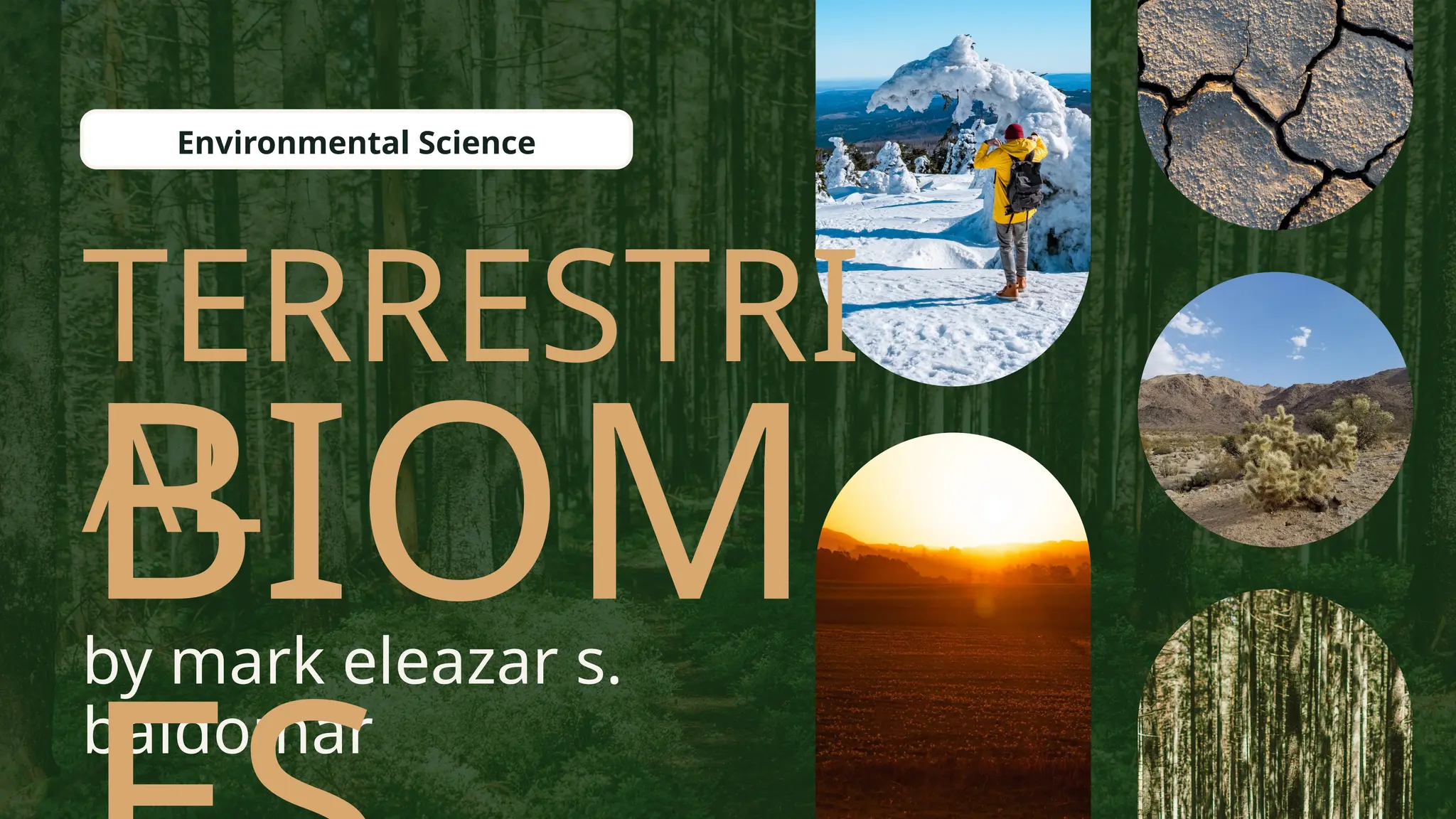
TERRESTRI
AL
by mark eleazar s.
baldomar
BIOM
LEARNING
OBJECTIVES
At the end of the lesson the learners will be able to:
Define what biomes are and identify the major
terrestrial biomes.
Describe the climate, vegetation, and animal life
of each biome.
Locate major biomes on a world map.
A biome is a large geographic area characterized by
specific climate conditions, plants, and animals. Biomes
can be found on land (terrestrial biomes) or in water
(aquatic biomes). It consists of a biological community that
has formed in response to its physical environment and
regional climate. Biomes may span more than one
continent. A biome encompasses multiple ecosystems
within its boundaries. Biomes have distinct climate
patterns because of differences in solar radiation.
WHAT IS BIOMES?
The tilt of the Earth causes variations in climate zones and the amount of sunlight
received in different regions, resulting in a variety of biomes across the planet
The Earth is tilted at an angle of about 23.5 degrees on its
axis. This tilt, combined with its orbit around the Sun,
causes different regions to receive varying amounts of
sunlight throughout the year. This results in distinct
climate zones that affects biomes
HOW EARTH'S TILT
AFFECTS BIOMES
• Tropical Climates: Near the equator, with high temperatures and heavy rainfall,
supporting lush rainforests.
• Dry Climates: North and south of the tropics, with low rainfall and high
temperatures, leading to deserts and steppes.
• Temperate/Continental Climates: North and south of dry zones, with moderate
temperatures and seasonal changes. Biomes include temperate forests and
grasslands, with extreme variations in continental regions.
• Polar Climates: In the Arctic and Antarctic, with cold temperatures and minimal
precipitation, featuring tundras and polar ice caps.
CLIMATE ZONES
1.TROPICAL
RAINFOREST
The tropical rainforest biome is characterized by its
dense, lush vegetation and high biodiversity, thriving
in regions with consistently warm temperatures and
heavy rainfall year-round. This biome supports a
complex ecosystem where a variety of plant and
animal species coexist, contributing to its role as a
vital component of the global climate system.
Climate: Warm, wet, with high rainfall.
Vegetation: Dense, with layers (canopy, understory).
Animals: High biodiversity (e.g., monkeys, birds).
Areas/Places: Amazon Basin (South America), Africa, Southeast
Asia.
Importance: Oxygen production, carbon storage.
2.
GRASSLAND/SA
VANNA
Grasslands, or savannas, are open ecosystems
dominated by grasses and occasional trees,
typically found in regions with seasonal rainfall and
warm temperatures. These biomes support a
diverse range of herbivores and predators, and
they play a crucial role in maintaining ecological
balance through their unique vegetation and fire
cycles.
Climate: Warm, with seasonal rainfall.
Vegetation: Grasses, scattered trees.
Animals: Large herbivores (e.g., elephants, lions).
Areas/Places: Africa, Brazil, Northern Australia.
Importance: Supports diverse wildlife and human
activities like grazing.
3. TEMPERATE
GRASSLAND
Temperate grasslands are expansive, open landscapes
dominated by grasses with minimal tree cover, shaped
by moderate rainfall and distinct seasonal shifts,
including hot summers and cold winters. These
ecosystems support diverse herbivore populations and
are valued for their fertile soils, making them key
regions for agriculture and livestock grazing.
Climate: Moderate, with seasonal droughts.
Vegetation: Grasses, few trees.
Animals: Herbivores (e.g., bison) and predators (e.g., wolves).
Areas/Places: Great Plains (USA), Pampas (Argentina), Steppes
(Eurasia).
Human Impact: Agriculture and farming.
4. DESERT
Deserts are the driest of all biomes, characterized
by extremely low precipitation, often less than 10
inches (25 cm) annually, resulting in sparse
vegetation and harsh living conditions. Despite their
dryness, deserts host specialized plants and animals
adapted to extreme temperatures and water
scarcity, contributing to unique and resilient
ecosystems.
Climate: Hot, dry, extreme temperatures.
Vegetation: Sparse, drought-resistant plants (e.g., cacti).
Animals: Adapted to conserve water (e.g., camels,
reptiles).
Areas/Places: Sahara, North America, Arabian Desert
Challenges: Water scarcity, extreme heat.
5.TEMPERATE
DECIDUOUS FOREST
Temperate deciduous forests are biomes
characterized by four distinct seasons—winter,
spring, summer, and fall—and moderate rainfall
throughout the year. These forests are dominated by
broadleaf trees that shed their leaves annually,
supporting a diverse array of wildlife and
contributing to rich, fertile soils through the
decomposition of organic matter.
Climate: Moderate, with distinct seasons.
Vegetation: Deciduous trees (e.g., oaks, maples) that shed
leaves.
Animals: Deer, squirrels, birds.
Areas/Places: Eastern United States, Europe, East Asia. Canada
6.TAIGA / CONIFEROUS
FOREST
Temperate coniferous forests, also known as temperate
evergreen forests, boreal forest, are characterized by
their dominance of coniferous trees such as pine, spruce,
and fir. These forests experience moderate climates with
cool to mild temperatures and relatively even precipitation
throughout the year, supporting a range of wildlife and
maintaining healthy, nutrient-rich soils.
Climate: Moderate, with cool to mild temperatures and
consistent precipitation.
Vegetation: Coniferous trees (e.g., pine, spruce, fir) with
evergreen needles.
Animals: Bears, deer, foxes, various bird species.
Areas/Places: Pacific Northwest of the United States, parts of
Canada, northern Europe.
6.TUNDRA
Tundra is the coldest of all the biomes, treeless biome
characterized by its short growing seasons, low
temperatures, and limited vegetation. It is found in the
Arctic regions and high mountain tops, where the
ground is often frozen or permafrost is present. Despite
its harsh conditions, the tundra supports a range of
specially adapted plants and animals, including mosses,
lichens, arctic foxes, and polar bears.
Climate: Coldest, with permafrost.
Vegetation: Low shrubs, mosses.
Animals: Arctic foxes, caribou. Polar Bears
Challenges: Fragile ecosystem, climate change effects.
HUMAN
IMPACT
ON
BIOMES
Deforestation: Clearing forests for
agriculture, urbanization.
Climate Change: Affecting
temperatures, rainfall patterns.
Conservation Efforts: Protecting
endangered biomes and species.
Terrestrial Biomes
THANK
YOU FOR
ATTENTIVE
LISTENING

Terrestrial Biomes - Environmental Science.pptx

  • 1.
  • 3.
    LEARNING OBJECTIVES At the endof the lesson the learners will be able to: Define what biomes are and identify the major terrestrial biomes. Describe the climate, vegetation, and animal life of each biome. Locate major biomes on a world map.
  • 4.
    A biome isa large geographic area characterized by specific climate conditions, plants, and animals. Biomes can be found on land (terrestrial biomes) or in water (aquatic biomes). It consists of a biological community that has formed in response to its physical environment and regional climate. Biomes may span more than one continent. A biome encompasses multiple ecosystems within its boundaries. Biomes have distinct climate patterns because of differences in solar radiation. WHAT IS BIOMES?
  • 5.
    The tilt ofthe Earth causes variations in climate zones and the amount of sunlight received in different regions, resulting in a variety of biomes across the planet
  • 6.
    The Earth istilted at an angle of about 23.5 degrees on its axis. This tilt, combined with its orbit around the Sun, causes different regions to receive varying amounts of sunlight throughout the year. This results in distinct climate zones that affects biomes HOW EARTH'S TILT AFFECTS BIOMES
  • 8.
    • Tropical Climates:Near the equator, with high temperatures and heavy rainfall, supporting lush rainforests. • Dry Climates: North and south of the tropics, with low rainfall and high temperatures, leading to deserts and steppes. • Temperate/Continental Climates: North and south of dry zones, with moderate temperatures and seasonal changes. Biomes include temperate forests and grasslands, with extreme variations in continental regions. • Polar Climates: In the Arctic and Antarctic, with cold temperatures and minimal precipitation, featuring tundras and polar ice caps. CLIMATE ZONES
  • 9.
    1.TROPICAL RAINFOREST The tropical rainforestbiome is characterized by its dense, lush vegetation and high biodiversity, thriving in regions with consistently warm temperatures and heavy rainfall year-round. This biome supports a complex ecosystem where a variety of plant and animal species coexist, contributing to its role as a vital component of the global climate system. Climate: Warm, wet, with high rainfall. Vegetation: Dense, with layers (canopy, understory). Animals: High biodiversity (e.g., monkeys, birds). Areas/Places: Amazon Basin (South America), Africa, Southeast Asia. Importance: Oxygen production, carbon storage.
  • 10.
    2. GRASSLAND/SA VANNA Grasslands, or savannas,are open ecosystems dominated by grasses and occasional trees, typically found in regions with seasonal rainfall and warm temperatures. These biomes support a diverse range of herbivores and predators, and they play a crucial role in maintaining ecological balance through their unique vegetation and fire cycles. Climate: Warm, with seasonal rainfall. Vegetation: Grasses, scattered trees. Animals: Large herbivores (e.g., elephants, lions). Areas/Places: Africa, Brazil, Northern Australia. Importance: Supports diverse wildlife and human activities like grazing.
  • 11.
    3. TEMPERATE GRASSLAND Temperate grasslandsare expansive, open landscapes dominated by grasses with minimal tree cover, shaped by moderate rainfall and distinct seasonal shifts, including hot summers and cold winters. These ecosystems support diverse herbivore populations and are valued for their fertile soils, making them key regions for agriculture and livestock grazing. Climate: Moderate, with seasonal droughts. Vegetation: Grasses, few trees. Animals: Herbivores (e.g., bison) and predators (e.g., wolves). Areas/Places: Great Plains (USA), Pampas (Argentina), Steppes (Eurasia). Human Impact: Agriculture and farming.
  • 12.
    4. DESERT Deserts arethe driest of all biomes, characterized by extremely low precipitation, often less than 10 inches (25 cm) annually, resulting in sparse vegetation and harsh living conditions. Despite their dryness, deserts host specialized plants and animals adapted to extreme temperatures and water scarcity, contributing to unique and resilient ecosystems. Climate: Hot, dry, extreme temperatures. Vegetation: Sparse, drought-resistant plants (e.g., cacti). Animals: Adapted to conserve water (e.g., camels, reptiles). Areas/Places: Sahara, North America, Arabian Desert Challenges: Water scarcity, extreme heat.
  • 13.
    5.TEMPERATE DECIDUOUS FOREST Temperate deciduousforests are biomes characterized by four distinct seasons—winter, spring, summer, and fall—and moderate rainfall throughout the year. These forests are dominated by broadleaf trees that shed their leaves annually, supporting a diverse array of wildlife and contributing to rich, fertile soils through the decomposition of organic matter. Climate: Moderate, with distinct seasons. Vegetation: Deciduous trees (e.g., oaks, maples) that shed leaves. Animals: Deer, squirrels, birds. Areas/Places: Eastern United States, Europe, East Asia. Canada
  • 14.
    6.TAIGA / CONIFEROUS FOREST Temperateconiferous forests, also known as temperate evergreen forests, boreal forest, are characterized by their dominance of coniferous trees such as pine, spruce, and fir. These forests experience moderate climates with cool to mild temperatures and relatively even precipitation throughout the year, supporting a range of wildlife and maintaining healthy, nutrient-rich soils. Climate: Moderate, with cool to mild temperatures and consistent precipitation. Vegetation: Coniferous trees (e.g., pine, spruce, fir) with evergreen needles. Animals: Bears, deer, foxes, various bird species. Areas/Places: Pacific Northwest of the United States, parts of Canada, northern Europe.
  • 15.
    6.TUNDRA Tundra is thecoldest of all the biomes, treeless biome characterized by its short growing seasons, low temperatures, and limited vegetation. It is found in the Arctic regions and high mountain tops, where the ground is often frozen or permafrost is present. Despite its harsh conditions, the tundra supports a range of specially adapted plants and animals, including mosses, lichens, arctic foxes, and polar bears. Climate: Coldest, with permafrost. Vegetation: Low shrubs, mosses. Animals: Arctic foxes, caribou. Polar Bears Challenges: Fragile ecosystem, climate change effects.
  • 18.
    HUMAN IMPACT ON BIOMES Deforestation: Clearing forestsfor agriculture, urbanization. Climate Change: Affecting temperatures, rainfall patterns. Conservation Efforts: Protecting endangered biomes and species.
  • 19.