By
Bipin Likhar
PLC
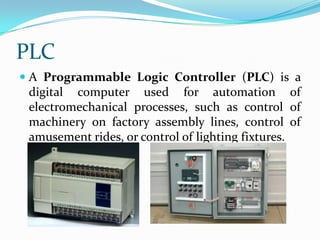
 A Programmable Logic Controller (PLC) is a
digital computer used for automation of
electromechanical processes, such as control of
machinery on factory assembly lines, control of
amusement rides, or control of lighting fixtures.
PLC was introduced in late 1960’s to remove relay’s based
system.
First commercial & successful Programmable Logic
Controllers was designed and developed by Modicon as a
relay replacer for General Motors.
Earlier, it was a machine with thousands of electronic
parts.
Later ,in late 1970’s,the microprocessor became reality &
greatly enhanced the role of PLC permitting it to evolve
form simply relay to the sophisticated system as it is today.
4
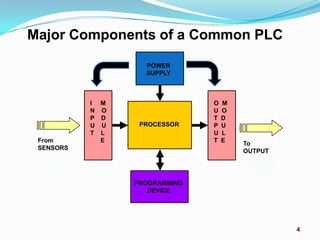
Major Components of a Common PLC
PROCESSOR
POWER
SUPPLY
I M
N O
P D
U U
T L
E
O M
U O
T D
P U
U L
T E
PROGRAMMING
DEVICE
From
SENSORS
Pushbuttons,
contacts,
limit switches,
etc.
To
OUTPUT
Solenoids,
contactors,
alarms
etc.
Major Components of PLC
 POWER SUPPLY
Provides the voltage needed to run the primary PLC components
 I/O MODULES
Provides signal conversion and isolation between the internal
logic level signals inside the PLC and the field’s high level signal.
 PROCESSOR
Provides intelligence to command and govern the activities of
the entire PLC systems.
 PROGRAMMING DEVICE
Used to enter the desired program that will determine the
sequence of operation and control of process equipment or
driven machine.
PLC Operation
Programming a PLC
 Ladder Logic
 Functional block diagram
 Structural text(similar to Pascal)
 Instruction list(similar to assembly language)
Why PLC ?....
• The controller is designed in modular form, so that sub-
assemblies could be removed easily for replacement or
repair.
• A PLC can work in the harsh and extreme conditions of the
industry where other systems such as a Micro-Controller
cannot.
• The system becomes reusable.
• The method used to program the controller is simple, so
that it can be easily understood by plant personnel.
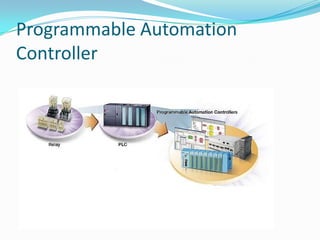
Programmable Automation
Controller
PAC
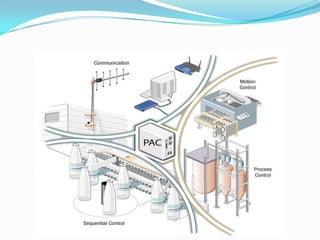
 PAC stands for Programmable Automation Controller.
 PLC is best suited for machine control but has limited
memory and a focus on discrete I/O with on/off
control.
 On the other hand , a PAC is geared more toward
complex automation system architectures composed
of a number of PC-based software applications
Features of PAC
 Composed of a number of PC-based software
applications
 Including HMI (human machine interface) functions
 Architecture based on Ladder logic
 Provide greater flexibility in programming
 Larger memory capacity
Advantages of PACs over PLCs
 More open architecture
 Modular design
 More analog I/O options
 Better process control capabilities
 More built in communication ports
 Programming over USB ports
 Tag based programming (one software package
capable of programming multiple models )
Thank You

Programmable Logic Controller

  • 1.
  • 2.
    PLC  A ProgrammableLogic Controller (PLC) is a digital computer used for automation of electromechanical processes, such as control of machinery on factory assembly lines, control of amusement rides, or control of lighting fixtures.
  • 3.
    PLC was introducedin late 1960’s to remove relay’s based system. First commercial & successful Programmable Logic Controllers was designed and developed by Modicon as a relay replacer for General Motors. Earlier, it was a machine with thousands of electronic parts. Later ,in late 1970’s,the microprocessor became reality & greatly enhanced the role of PLC permitting it to evolve form simply relay to the sophisticated system as it is today.
  • 4.
    4 Major Components ofa Common PLC PROCESSOR POWER SUPPLY I M N O P D U U T L E O M U O T D P U U L T E PROGRAMMING DEVICE From SENSORS Pushbuttons, contacts, limit switches, etc. To OUTPUT Solenoids, contactors, alarms etc.
  • 5.
    Major Components ofPLC  POWER SUPPLY Provides the voltage needed to run the primary PLC components  I/O MODULES Provides signal conversion and isolation between the internal logic level signals inside the PLC and the field’s high level signal.  PROCESSOR Provides intelligence to command and govern the activities of the entire PLC systems.  PROGRAMMING DEVICE Used to enter the desired program that will determine the sequence of operation and control of process equipment or driven machine.
  • 6.
  • 7.
    Programming a PLC Ladder Logic  Functional block diagram  Structural text(similar to Pascal)  Instruction list(similar to assembly language)
  • 8.
    Why PLC ?.... •The controller is designed in modular form, so that sub- assemblies could be removed easily for replacement or repair. • A PLC can work in the harsh and extreme conditions of the industry where other systems such as a Micro-Controller cannot. • The system becomes reusable. • The method used to program the controller is simple, so that it can be easily understood by plant personnel.
  • 9.
  • 10.
    PAC  PAC standsfor Programmable Automation Controller.  PLC is best suited for machine control but has limited memory and a focus on discrete I/O with on/off control.  On the other hand , a PAC is geared more toward complex automation system architectures composed of a number of PC-based software applications
  • 12.
    Features of PAC Composed of a number of PC-based software applications  Including HMI (human machine interface) functions  Architecture based on Ladder logic  Provide greater flexibility in programming  Larger memory capacity
  • 13.
    Advantages of PACsover PLCs  More open architecture  Modular design  More analog I/O options  Better process control capabilities  More built in communication ports  Programming over USB ports  Tag based programming (one software package capable of programming multiple models )
  • 14.