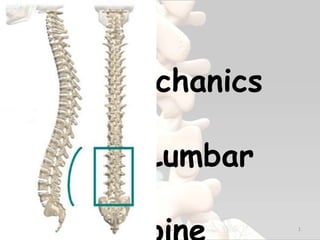
Biomechanics
Of Lumbar
1
• OSTEOLOGY
• ARTICULATIONS
• LIGAMENTS
• MUSCLES
• BLOOD SUPPLY
• NERVE SUPPLY
• KINEMATICS
• KINETICS
• PATHOMECHANICS
2
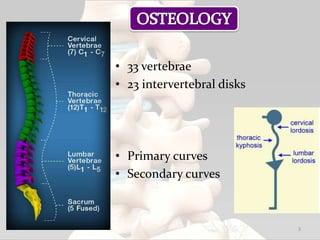
• 33 vertebrae
• 23 intervertebral disks
• Primary curves
• Secondary curves
3
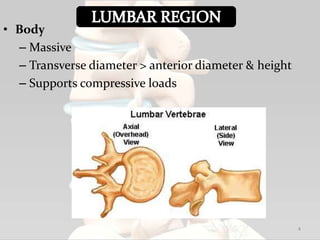
• Body
– Massive
– Transverse diameter > anterior diameter & height
– Supports compressive loads
4
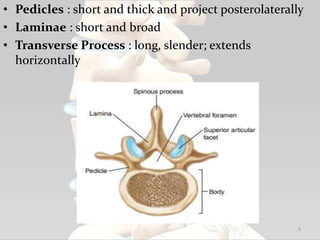
• Pedicles : short and thick and project posterolaterally
• Laminae : short and broad
• Transverse Process : long, slender; extends
horizontally
5
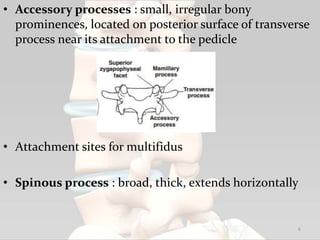
• Accessory processes : small, irregular bony
prominences, located on posterior surface of transverse
process near its attachment to the pedicle
• Attachment sites for multifidus
• Spinous process : broad, thick, extends horizontally
6
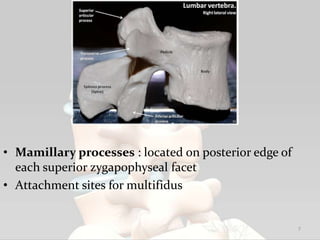
• Mamillary processes : located on posterior edge of
each superior zygapophyseal facet
• Attachment sites for multifidus
7
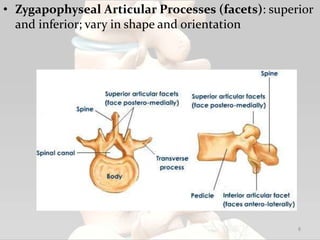
• Zygapophyseal Articular Processes (facets): superior
and inferior; vary in shape and orientation
8
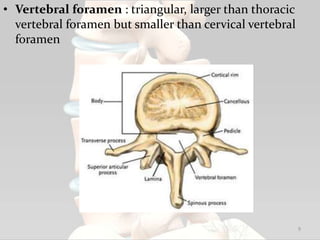
• Vertebral foramen : triangular, larger than thoracic
vertebral foramen but smaller than cervical vertebral
foramen
9
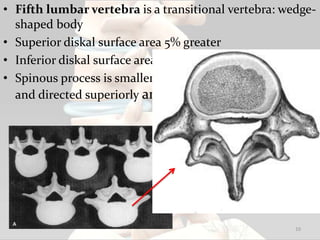
• Fifth lumbar vertebra is a transitional vertebra: wedge-
shaped body
• Superior diskal surface area 5% greater
• Inferior diskal surface area smaller
• Spinous process is smaller, transverse processes are large
and directed superiorly and posteriorly
10
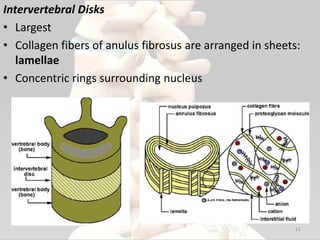
Intervertebral Disks
• Largest
• Collagen fibers of anulus fibrosus are arranged in sheets:
lamellae
• Concentric rings surrounding nucleus
11
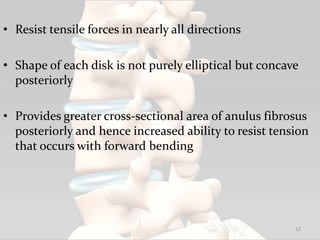
• Resist tensile forces in nearly all directions
• Shape of each disk is not purely elliptical but concave
posteriorly
• Provides greater cross-sectional area of anulus fibrosus
posteriorly and hence increased ability to resist tension
that occurs with forward bending
12
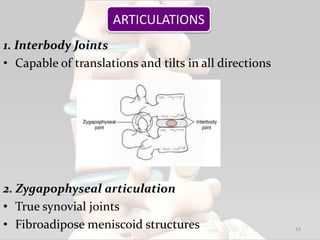
1. Interbody Joints
• Capable of translations and tilts in all directions
2. Zygapophyseal articulation
• True synovial joints
• Fibroadipose meniscoid structures 13
ARTICULATIONS
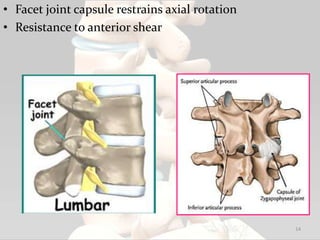
• Facet joint capsule restrains axial rotation
• Resistance to anterior shear
14
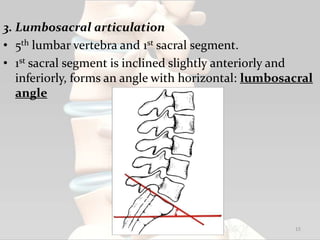
3. Lumbosacral articulation
• 5th lumbar vertebra and 1st sacral segment.
• 1st sacral segment is inclined slightly anteriorly and
inferiorly, forms an angle with horizontal: lumbosacral
angle
15
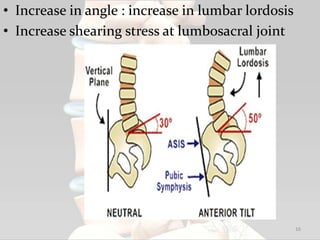
• Increase in angle : increase in lumbar lordosis
• Increase shearing stress at lumbosacral joint
16
17
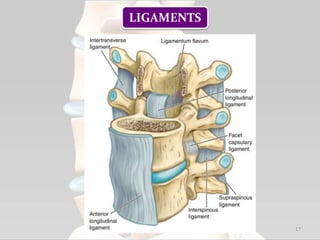
LIGAMENTS
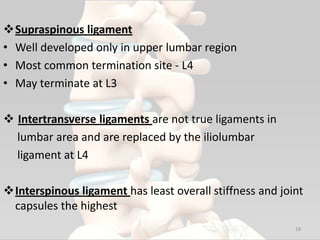
Supraspinous ligament
• Well developed only in upper lumbar region
• Most common termination site - L4
• May terminate at L3
 Intertransverse ligaments are not true ligaments in
lumbar area and are replaced by the iliolumbar
ligament at L4
Interspinous ligament has least overall stiffness and joint
capsules the highest
18
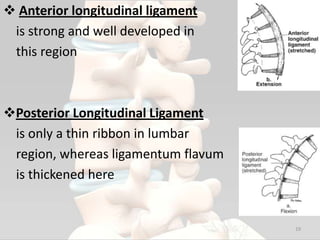
 Anterior longitudinal ligament
is strong and well developed in
this region
Posterior Longitudinal Ligament
is only a thin ribbon in lumbar
region, whereas ligamentum flavum
is thickened here
19
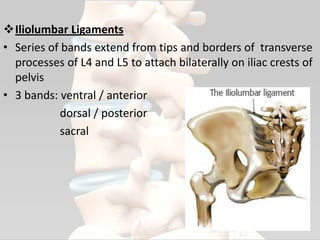
Iliolumbar Ligaments
• Series of bands extend from tips and borders of transverse
processes of L4 and L5 to attach bilaterally on iliac crests of
pelvis
• 3 bands: ventral / anterior
dorsal / posterior
sacral
20
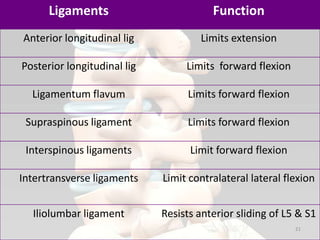
Ligaments Function
Anterior longitudinal lig Limits extension
Posterior longitudinal lig Limits forward flexion
Ligamentum flavum Limits forward flexion
Supraspinous ligament Limits forward flexion
Interspinous ligaments Limit forward flexion
Intertransverse ligaments Limit contralateral lateral flexion
Iliolumbar ligament Resists anterior sliding of L5 & S1
21
22
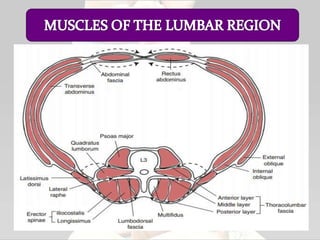
Muscles of lower spine region serve roles of :
• Producing and controlling movement of trunk
• Stabilizing trunk for motion of lower extremities
• Assist in attenuating extensive forces that affect this area
POSTERIOR MUSCLES
3 layers: superficial
intermediate
deep
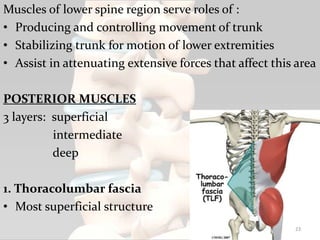
1. Thoracolumbar fascia
• Most superficial structure
23
3 layers: posterior, middle, and anterior
• Posterior layer : large, thick arises from spinous
processes and supraspinous ligaments of the thoracic,
lumbar, and sacral spines.
• Gives rise to latissimus dorsi cranially, travels caudally to
sacrum and ilium, and blends with fascia of
contralateral gluteus maximus
• Also gives rise to internal and external abdominal
oblique, and transversus abdominis
24
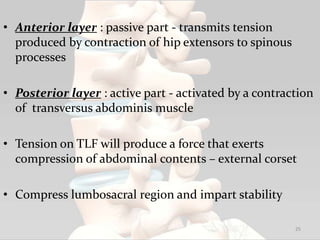
• Anterior layer : passive part - transmits tension
produced by contraction of hip extensors to spinous
processes
• Posterior layer : active part - activated by a contraction
of transversus abdominis muscle
• Tension on TLF will produce a force that exerts
compression of abdominal contents – external corset
• Compress lumbosacral region and impart stability
25
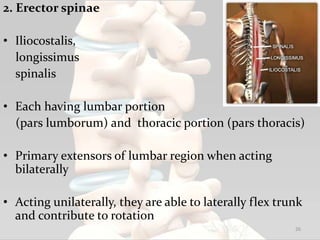
2. Erector spinae
• Iliocostalis,
longissimus
spinalis
• Each having lumbar portion
(pars lumborum) and thoracic portion (pars thoracis)
• Primary extensors of lumbar region when acting
bilaterally
• Acting unilaterally, they are able to laterally flex trunk
and contribute to rotation
26
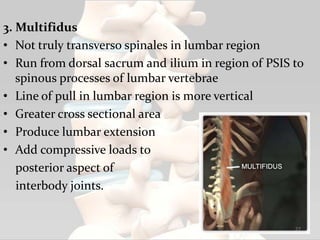
3. Multifidus
• Not truly transverso spinales in lumbar region
• Run from dorsal sacrum and ilium in region of PSIS to
spinous processes of lumbar vertebrae
• Line of pull in lumbar region is more vertical
• Greater cross sectional area
• Produce lumbar extension
• Add compressive loads to
posterior aspect of
interbody joints.
27
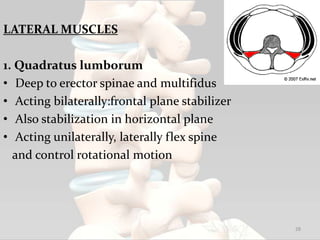
LATERAL MUSCLES
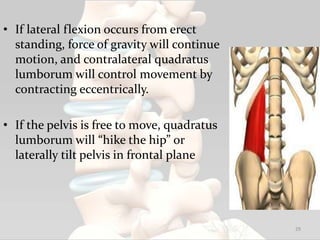
1. Quadratus lumborum
• Deep to erector spinae and multifidus
• Acting bilaterally:frontal plane stabilizer
• Also stabilization in horizontal plane
• Acting unilaterally, laterally flex spine
and control rotational motion
28
• If lateral flexion occurs from erect
standing, force of gravity will continue
motion, and contralateral quadratus
lumborum will control movement by
contracting eccentrically.
• If the pelvis is free to move, quadratus
lumborum will “hike the hip” or
laterally tilt pelvis in frontal plane
29
ANTERIOR MUSCLES
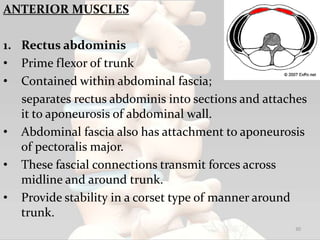
1. Rectus abdominis
• Prime flexor of trunk
• Contained within abdominal fascia;
separates rectus abdominis into sections and attaches
it to aponeurosis of abdominal wall.
• Abdominal fascia also has attachment to aponeurosis
of pectoralis major.
• These fascial connections transmit forces across
midline and around trunk.
• Provide stability in a corset type of manner around
trunk.
30
2. Abdominal wall
• External oblique, internal oblique, transversus
abdominis muscles
• Forms “hoop” with TLF posteriorly
• Stability to lumbo-pelvic region
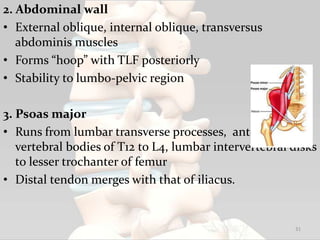
3. Psoas major
• Runs from lumbar transverse processes, anterolateral
vertebral bodies of T12 to L4, lumbar intervertebral disks
to lesser trochanter of femur
• Distal tendon merges with that of iliacus.
31
• Flexion of hip
• At lumbar spine, buttress forces of iliacus, which, when
activated, cause anterior ilial rotation and thus lumbar
spine extension
• Also provides stability to lumbar spine during hip
flexion activities by providing great amounts of lumbar
compression during activation
• Some anterior shear is also produced when it is activated
32
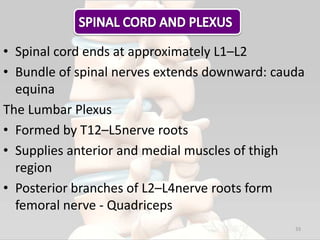
• Spinal cord ends at approximately L1–L2
• Bundle of spinal nerves extends downward: cauda
equina
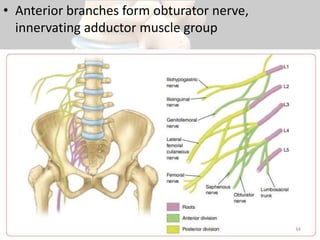
The Lumbar Plexus
• Formed by T12–L5nerve roots
• Supplies anterior and medial muscles of thigh
region
• Posterior branches of L2–L4nerve roots form
femoral nerve - Quadriceps
33
• Anterior branches form obturator nerve,
innervating adductor muscle group
34
• Four paired lumbar arteries that
arise directly from posterior aspect of aorta
• Venous system is valve less, draining internal and
external venous systems into the inferior venacava
35
• Sinuvertebral nerve - major sensory
nerve.
• Innervates : posterior longitudinal ligament,
superficial layer of annulus fibrosus,
blood vessels of epidural space,
anterior but not posterior dural space
(posterior dura is devoid of nerve endings),
dural sleeves surrounding spinal nerve roots,
and posterior vertebral periosteum.
36
37
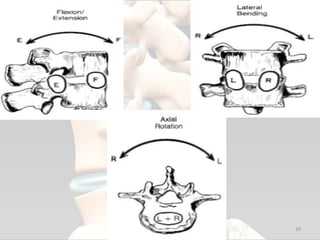
Movts available: flexion, extension, lateral flexion, and
rotation.
• Gliding- anterior to posterior, medial to lateral and
torsional
• Tilt- anterior to posterior, lateral directions
• Distraction and compression
38
39
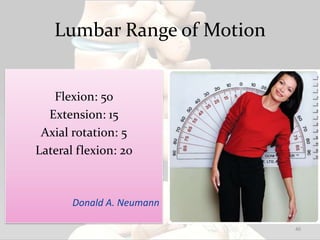
Lumbar Range of Motion
Flexion: 50
Extension: 15
Axial rotation: 5
Lateral flexion: 20
Donald A. Neumann
40
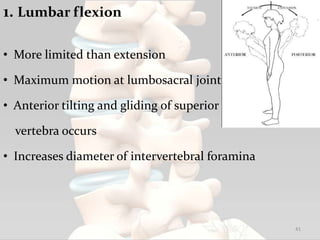
1. Lumbar flexion
• More limited than extension
• Maximum motion at lumbosacral joint
• Anterior tilting and gliding of superior
vertebra occurs
• Increases diameter of intervertebral foramina
41
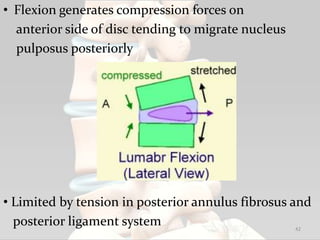
• Flexion generates compression forces on
anterior side of disc tending to migrate nucleus
pulposus posteriorly
• Limited by tension in posterior annulus fibrosus and
posterior ligament system 42
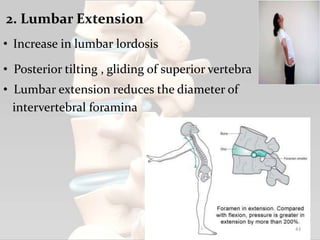
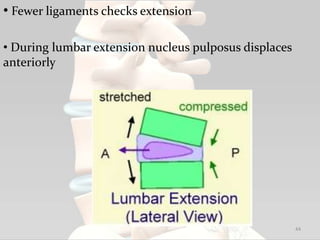
2. Lumbar Extension
• Increase in lumbar lordosis
• Posterior tilting , gliding of superior vertebra
• Lumbar extension reduces the diameter of
intervertebral foramina
43
• Fewer ligaments checks extension
• During lumbar extension nucleus pulposus displaces
anteriorly
44
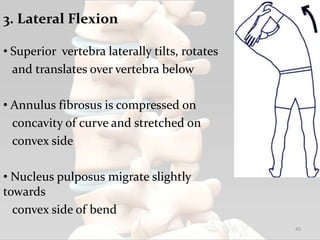
3. Lateral Flexion
• Superior vertebra laterally tilts, rotates
and translates over vertebra below
• Annulus fibrosus is compressed on
concavity of curve and stretched on
convex side
• Nucleus pulposus migrate slightly
towards
convex side of bend
45
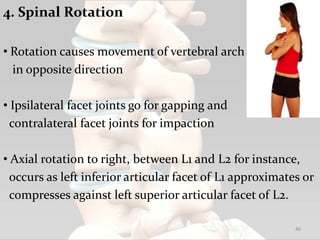
4. Spinal Rotation
• Rotation causes movement of vertebral arch
in opposite direction
• Ipsilateral facet joints go for gapping and
contralateral facet joints for impaction
• Axial rotation to right, between L1 and L2 for instance,
occurs as left inferior articular facet of L1 approximates or
compresses against left superior articular facet of L2.
46
• Limited due to shape of zygapophyseal joints
• Also restricted by tension created in stretched capsule of
apophyseal joints and stretched fibres within annulus
fibrosus
• Amount of rotation available at each vertebral level is
affected by position of lumbar spine.
47
• When flexed, ROM in rotation is less than when in
neutral position
• The posterior anulus fibrosus and PLL limit axial
rotation when spine is flexed
• The largest lateral flexion ROM and axial rotation
occurs between L2 and L3
48
SPINAL COUPLING
• Kinematic phenomenon in which movt of the spine in
one plane is associated with an automatic movt in
another plane
• Most consistent pattern involves an association between
axial rotation and lateral flexion
• With lateral flexion, pronounced flexion and slight
ipsilateral rotation occurs
• With axial rotation, however, substantial lateral flexion
in a contralateral direction occurs 49
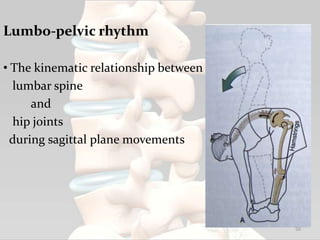
Lumbo-pelvic rhythm
• The kinematic relationship between
lumbar spine
and
hip joints
during sagittal plane movements
50
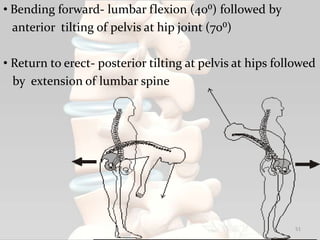
• Bending forward- lumbar flexion (40⁰) followed by
anterior tilting of pelvis at hip joint (70⁰)
• Return to erect- posterior tilting at pelvis at hips followed
by extension of lumbar spine
51
• Integration of motion of pelvis about hip joints with
motion of vertebral column:
- increases ROM available to total column
- reduces amount of flexibility required of lumbar region
• Hip motion:
- eliminates need for full lumbar flexion,
- protecting anulus fibrosus and posterior ligaments
from being fully lengthened
52
KINETICS
53
COMPRESSION
• Lumbar region provides support for weight
of upper part of body in static as well as in
dynamic situations
• Lumbar region must also withstand tremendous
compressive loads produced by muscle contraction
54
• Lumbosacral loads in erect standing posture in range of
0.82 to 1.18 times body weight
• During level walking in range of 1.41 to 2.07 times body
weight
• Changes in position of body will change location of LOG
and thus change forces acting on lumbar spine
• Lumbar interbody joints share 80% of load,
Zygapophyseal facet joints in axial compression share
20% of total load.
55
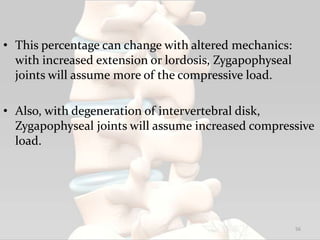
• This percentage can change with altered mechanics:
with increased extension or lordosis, Zygapophyseal
joints will assume more of the compressive load.
• Also, with degeneration of intervertebral disk,
Zygapophyseal joints will assume increased compressive
load.
56
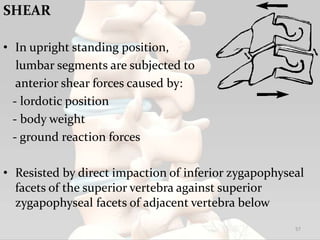
SHEAR
• In upright standing position,
lumbar segments are subjected to
anterior shear forces caused by:
- lordotic position
- body weight
- ground reaction forces
• Resisted by direct impaction of inferior zygapophyseal
facets of the superior vertebra against superior
zygapophyseal facets of adjacent vertebra below
57
• PLL is most heavily innervated while anterior, sacroiliac,
and interspinous ligaments receives nociceptive nerve
endings.
• The lumbar intervertebral discs are innervated
posteriorly by sinuvertebral nerves
• Laterally by branches of ventral rami and gray rami
communicate.
58
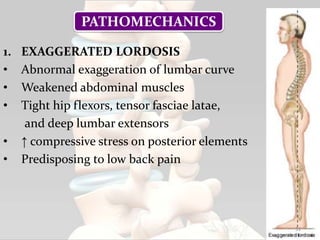
1. EXAGGERATED LORDOSIS
• Abnormal exaggeration of lumbar curve
• Weakened abdominal muscles
• Tight hip flexors, tensor fasciae latae,
and deep lumbar extensors
• ↑ compressive stress on posterior elements
• Predisposing to low back pain
59
PATHOMECHANICS
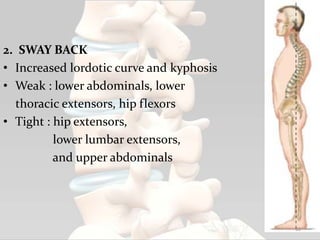
2. SWAY BACK
• Increased lordotic curve and kyphosis
• Weak : lower abdominals, lower
thoracic extensors, hip flexors
• Tight : hip extensors,
lower lumbar extensors,
and upper abdominals
60
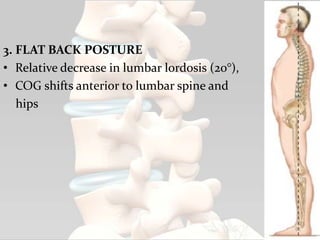
3. FLAT BACK POSTURE
• Relative decrease in lumbar lordosis (20°),
• COG shifts anterior to lumbar spine and
hips
61
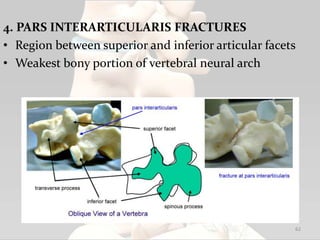
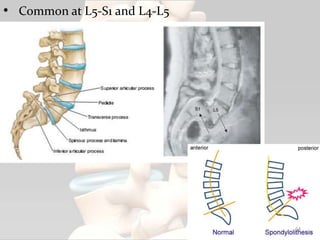
4. PARS INTERARTICULARIS FRACTURES
• Region between superior and inferior articular facets
• Weakest bony portion of vertebral neural arch
62
63
• Common at L5-S1 and L4-L5
64
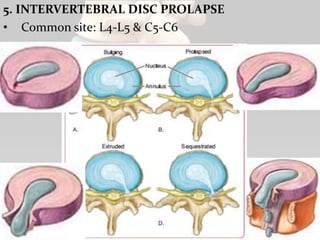
5. INTERVERTEBRAL DISC PROLAPSE
• Common site: L4-L5 & C5-C6
65
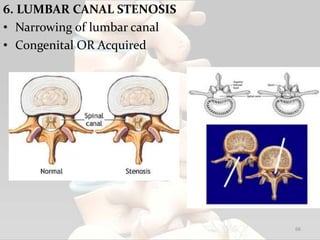
6. LUMBAR CANAL STENOSIS
• Narrowing of lumbar canal
• Congenital OR Acquired
66
7. LUMBAR FACET PATHOLOGY
• Subluxation or dislocation of facet,
Facet joint syndrome (i.e. inflammation),
Degeneration of the facet (i.e., arthritis)
8. LUMBAR CONTUSIONS, STRAINS, AND SPRAINS,
FRACTURES AND DISLOCATIONS
• 75 to 80% of population experiences low back pain
stemming from mechanical injury to muscles,
ligaments, or connective tissue
67
Doubts??
68
69
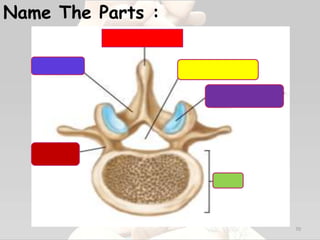
Name The Parts :
70
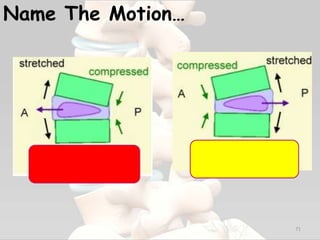
Name The Motion…
71
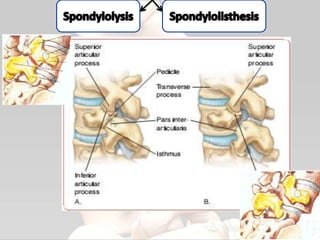
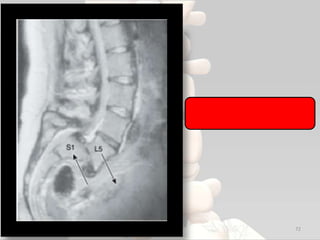
SPONDYLOLISTHESIS
72
73

biomechanicsoflumbarspine-140407134558-phpapp02 (2).pdf

  • 1.
  • 2.
    • OSTEOLOGY • ARTICULATIONS •LIGAMENTS • MUSCLES • BLOOD SUPPLY • NERVE SUPPLY • KINEMATICS • KINETICS • PATHOMECHANICS 2
  • 3.
    • 33 vertebrae •23 intervertebral disks • Primary curves • Secondary curves 3
  • 4.
    • Body – Massive –Transverse diameter > anterior diameter & height – Supports compressive loads 4
  • 5.
    • Pedicles :short and thick and project posterolaterally • Laminae : short and broad • Transverse Process : long, slender; extends horizontally 5
  • 6.
    • Accessory processes: small, irregular bony prominences, located on posterior surface of transverse process near its attachment to the pedicle • Attachment sites for multifidus • Spinous process : broad, thick, extends horizontally 6
  • 7.
    • Mamillary processes: located on posterior edge of each superior zygapophyseal facet • Attachment sites for multifidus 7
  • 8.
    • Zygapophyseal ArticularProcesses (facets): superior and inferior; vary in shape and orientation 8
  • 9.
    • Vertebral foramen: triangular, larger than thoracic vertebral foramen but smaller than cervical vertebral foramen 9
  • 10.
    • Fifth lumbarvertebra is a transitional vertebra: wedge- shaped body • Superior diskal surface area 5% greater • Inferior diskal surface area smaller • Spinous process is smaller, transverse processes are large and directed superiorly and posteriorly 10
  • 11.
    Intervertebral Disks • Largest •Collagen fibers of anulus fibrosus are arranged in sheets: lamellae • Concentric rings surrounding nucleus 11
  • 12.
    • Resist tensileforces in nearly all directions • Shape of each disk is not purely elliptical but concave posteriorly • Provides greater cross-sectional area of anulus fibrosus posteriorly and hence increased ability to resist tension that occurs with forward bending 12
  • 13.
    1. Interbody Joints •Capable of translations and tilts in all directions 2. Zygapophyseal articulation • True synovial joints • Fibroadipose meniscoid structures 13 ARTICULATIONS
  • 14.
    • Facet jointcapsule restrains axial rotation • Resistance to anterior shear 14
  • 15.
    3. Lumbosacral articulation •5th lumbar vertebra and 1st sacral segment. • 1st sacral segment is inclined slightly anteriorly and inferiorly, forms an angle with horizontal: lumbosacral angle 15
  • 16.
    • Increase inangle : increase in lumbar lordosis • Increase shearing stress at lumbosacral joint 16
  • 17.
  • 18.
    Supraspinous ligament • Welldeveloped only in upper lumbar region • Most common termination site - L4 • May terminate at L3  Intertransverse ligaments are not true ligaments in lumbar area and are replaced by the iliolumbar ligament at L4 Interspinous ligament has least overall stiffness and joint capsules the highest 18
  • 19.
     Anterior longitudinalligament is strong and well developed in this region Posterior Longitudinal Ligament is only a thin ribbon in lumbar region, whereas ligamentum flavum is thickened here 19
  • 20.
    Iliolumbar Ligaments • Seriesof bands extend from tips and borders of transverse processes of L4 and L5 to attach bilaterally on iliac crests of pelvis • 3 bands: ventral / anterior dorsal / posterior sacral 20
  • 21.
    Ligaments Function Anterior longitudinallig Limits extension Posterior longitudinal lig Limits forward flexion Ligamentum flavum Limits forward flexion Supraspinous ligament Limits forward flexion Interspinous ligaments Limit forward flexion Intertransverse ligaments Limit contralateral lateral flexion Iliolumbar ligament Resists anterior sliding of L5 & S1 21
  • 22.
  • 23.
    Muscles of lowerspine region serve roles of : • Producing and controlling movement of trunk • Stabilizing trunk for motion of lower extremities • Assist in attenuating extensive forces that affect this area POSTERIOR MUSCLES 3 layers: superficial intermediate deep 1. Thoracolumbar fascia • Most superficial structure 23
  • 24.
    3 layers: posterior,middle, and anterior • Posterior layer : large, thick arises from spinous processes and supraspinous ligaments of the thoracic, lumbar, and sacral spines. • Gives rise to latissimus dorsi cranially, travels caudally to sacrum and ilium, and blends with fascia of contralateral gluteus maximus • Also gives rise to internal and external abdominal oblique, and transversus abdominis 24
  • 25.
    • Anterior layer: passive part - transmits tension produced by contraction of hip extensors to spinous processes • Posterior layer : active part - activated by a contraction of transversus abdominis muscle • Tension on TLF will produce a force that exerts compression of abdominal contents – external corset • Compress lumbosacral region and impart stability 25
  • 26.
    2. Erector spinae •Iliocostalis, longissimus spinalis • Each having lumbar portion (pars lumborum) and thoracic portion (pars thoracis) • Primary extensors of lumbar region when acting bilaterally • Acting unilaterally, they are able to laterally flex trunk and contribute to rotation 26
  • 27.
    3. Multifidus • Nottruly transverso spinales in lumbar region • Run from dorsal sacrum and ilium in region of PSIS to spinous processes of lumbar vertebrae • Line of pull in lumbar region is more vertical • Greater cross sectional area • Produce lumbar extension • Add compressive loads to posterior aspect of interbody joints. 27
  • 28.
    LATERAL MUSCLES 1. Quadratuslumborum • Deep to erector spinae and multifidus • Acting bilaterally:frontal plane stabilizer • Also stabilization in horizontal plane • Acting unilaterally, laterally flex spine and control rotational motion 28
  • 29.
    • If lateralflexion occurs from erect standing, force of gravity will continue motion, and contralateral quadratus lumborum will control movement by contracting eccentrically. • If the pelvis is free to move, quadratus lumborum will “hike the hip” or laterally tilt pelvis in frontal plane 29
  • 30.
    ANTERIOR MUSCLES 1. Rectusabdominis • Prime flexor of trunk • Contained within abdominal fascia; separates rectus abdominis into sections and attaches it to aponeurosis of abdominal wall. • Abdominal fascia also has attachment to aponeurosis of pectoralis major. • These fascial connections transmit forces across midline and around trunk. • Provide stability in a corset type of manner around trunk. 30
  • 31.
    2. Abdominal wall •External oblique, internal oblique, transversus abdominis muscles • Forms “hoop” with TLF posteriorly • Stability to lumbo-pelvic region 3. Psoas major • Runs from lumbar transverse processes, anterolateral vertebral bodies of T12 to L4, lumbar intervertebral disks to lesser trochanter of femur • Distal tendon merges with that of iliacus. 31
  • 32.
    • Flexion ofhip • At lumbar spine, buttress forces of iliacus, which, when activated, cause anterior ilial rotation and thus lumbar spine extension • Also provides stability to lumbar spine during hip flexion activities by providing great amounts of lumbar compression during activation • Some anterior shear is also produced when it is activated 32
  • 33.
    • Spinal cordends at approximately L1–L2 • Bundle of spinal nerves extends downward: cauda equina The Lumbar Plexus • Formed by T12–L5nerve roots • Supplies anterior and medial muscles of thigh region • Posterior branches of L2–L4nerve roots form femoral nerve - Quadriceps 33
  • 34.
    • Anterior branchesform obturator nerve, innervating adductor muscle group 34
  • 35.
    • Four pairedlumbar arteries that arise directly from posterior aspect of aorta • Venous system is valve less, draining internal and external venous systems into the inferior venacava 35
  • 36.
    • Sinuvertebral nerve- major sensory nerve. • Innervates : posterior longitudinal ligament, superficial layer of annulus fibrosus, blood vessels of epidural space, anterior but not posterior dural space (posterior dura is devoid of nerve endings), dural sleeves surrounding spinal nerve roots, and posterior vertebral periosteum. 36
  • 37.
  • 38.
    Movts available: flexion,extension, lateral flexion, and rotation. • Gliding- anterior to posterior, medial to lateral and torsional • Tilt- anterior to posterior, lateral directions • Distraction and compression 38
  • 39.
  • 40.
    Lumbar Range ofMotion Flexion: 50 Extension: 15 Axial rotation: 5 Lateral flexion: 20 Donald A. Neumann 40
  • 41.
    1. Lumbar flexion •More limited than extension • Maximum motion at lumbosacral joint • Anterior tilting and gliding of superior vertebra occurs • Increases diameter of intervertebral foramina 41
  • 42.
    • Flexion generatescompression forces on anterior side of disc tending to migrate nucleus pulposus posteriorly • Limited by tension in posterior annulus fibrosus and posterior ligament system 42
  • 43.
    2. Lumbar Extension •Increase in lumbar lordosis • Posterior tilting , gliding of superior vertebra • Lumbar extension reduces the diameter of intervertebral foramina 43
  • 44.
    • Fewer ligamentschecks extension • During lumbar extension nucleus pulposus displaces anteriorly 44
  • 45.
    3. Lateral Flexion •Superior vertebra laterally tilts, rotates and translates over vertebra below • Annulus fibrosus is compressed on concavity of curve and stretched on convex side • Nucleus pulposus migrate slightly towards convex side of bend 45
  • 46.
    4. Spinal Rotation •Rotation causes movement of vertebral arch in opposite direction • Ipsilateral facet joints go for gapping and contralateral facet joints for impaction • Axial rotation to right, between L1 and L2 for instance, occurs as left inferior articular facet of L1 approximates or compresses against left superior articular facet of L2. 46
  • 47.
    • Limited dueto shape of zygapophyseal joints • Also restricted by tension created in stretched capsule of apophyseal joints and stretched fibres within annulus fibrosus • Amount of rotation available at each vertebral level is affected by position of lumbar spine. 47
  • 48.
    • When flexed,ROM in rotation is less than when in neutral position • The posterior anulus fibrosus and PLL limit axial rotation when spine is flexed • The largest lateral flexion ROM and axial rotation occurs between L2 and L3 48
  • 49.
    SPINAL COUPLING • Kinematicphenomenon in which movt of the spine in one plane is associated with an automatic movt in another plane • Most consistent pattern involves an association between axial rotation and lateral flexion • With lateral flexion, pronounced flexion and slight ipsilateral rotation occurs • With axial rotation, however, substantial lateral flexion in a contralateral direction occurs 49
  • 50.
    Lumbo-pelvic rhythm • Thekinematic relationship between lumbar spine and hip joints during sagittal plane movements 50
  • 51.
    • Bending forward-lumbar flexion (40⁰) followed by anterior tilting of pelvis at hip joint (70⁰) • Return to erect- posterior tilting at pelvis at hips followed by extension of lumbar spine 51
  • 52.
    • Integration ofmotion of pelvis about hip joints with motion of vertebral column: - increases ROM available to total column - reduces amount of flexibility required of lumbar region • Hip motion: - eliminates need for full lumbar flexion, - protecting anulus fibrosus and posterior ligaments from being fully lengthened 52
  • 53.
  • 54.
    COMPRESSION • Lumbar regionprovides support for weight of upper part of body in static as well as in dynamic situations • Lumbar region must also withstand tremendous compressive loads produced by muscle contraction 54
  • 55.
    • Lumbosacral loadsin erect standing posture in range of 0.82 to 1.18 times body weight • During level walking in range of 1.41 to 2.07 times body weight • Changes in position of body will change location of LOG and thus change forces acting on lumbar spine • Lumbar interbody joints share 80% of load, Zygapophyseal facet joints in axial compression share 20% of total load. 55
  • 56.
    • This percentagecan change with altered mechanics: with increased extension or lordosis, Zygapophyseal joints will assume more of the compressive load. • Also, with degeneration of intervertebral disk, Zygapophyseal joints will assume increased compressive load. 56
  • 57.
    SHEAR • In uprightstanding position, lumbar segments are subjected to anterior shear forces caused by: - lordotic position - body weight - ground reaction forces • Resisted by direct impaction of inferior zygapophyseal facets of the superior vertebra against superior zygapophyseal facets of adjacent vertebra below 57
  • 58.
    • PLL ismost heavily innervated while anterior, sacroiliac, and interspinous ligaments receives nociceptive nerve endings. • The lumbar intervertebral discs are innervated posteriorly by sinuvertebral nerves • Laterally by branches of ventral rami and gray rami communicate. 58
  • 59.
    1. EXAGGERATED LORDOSIS •Abnormal exaggeration of lumbar curve • Weakened abdominal muscles • Tight hip flexors, tensor fasciae latae, and deep lumbar extensors • ↑ compressive stress on posterior elements • Predisposing to low back pain 59 PATHOMECHANICS
  • 60.
    2. SWAY BACK •Increased lordotic curve and kyphosis • Weak : lower abdominals, lower thoracic extensors, hip flexors • Tight : hip extensors, lower lumbar extensors, and upper abdominals 60
  • 61.
    3. FLAT BACKPOSTURE • Relative decrease in lumbar lordosis (20°), • COG shifts anterior to lumbar spine and hips 61
  • 62.
    4. PARS INTERARTICULARISFRACTURES • Region between superior and inferior articular facets • Weakest bony portion of vertebral neural arch 62
  • 63.
  • 64.
    • Common atL5-S1 and L4-L5 64
  • 65.
    5. INTERVERTEBRAL DISCPROLAPSE • Common site: L4-L5 & C5-C6 65
  • 66.
    6. LUMBAR CANALSTENOSIS • Narrowing of lumbar canal • Congenital OR Acquired 66
  • 67.
    7. LUMBAR FACETPATHOLOGY • Subluxation or dislocation of facet, Facet joint syndrome (i.e. inflammation), Degeneration of the facet (i.e., arthritis) 8. LUMBAR CONTUSIONS, STRAINS, AND SPRAINS, FRACTURES AND DISLOCATIONS • 75 to 80% of population experiences low back pain stemming from mechanical injury to muscles, ligaments, or connective tissue 67
  • 68.
  • 69.
  • 70.
  • 71.
  • 72.
  • 73.