BASIC DISTILLATION EQUIPMENT AND OPERATION
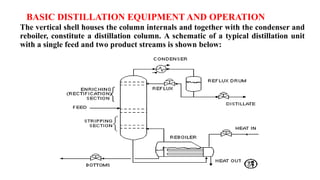
The vertical shell houses the column internals and together with the condenser and
reboiler, constitute a distillation column. A schematic of a typical distillation unit
with a single feed and two product streams is shown below:
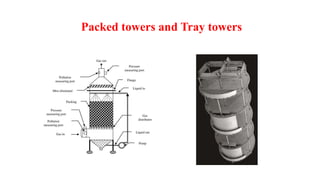
Packed towers and Tray towers
 In chemical processing, a packed bed is a hollow tube, pipe, or other vessel that is filled with a
packing material.
 The packing can be randomly filled with small objects like Raschig rings or else it can be a
specifically designed structured packing.
 Packed beds may also contain catalyst particles or adsorbents such as zeolite pellets, granular
activated carbon, etc.
 The purpose of a packed bed is typically to improve contact between two phases in a chemical or
similar process.
 Packed beds can be used in a chemical reactor, a distillation process, or a scrubber, but packed
beds have also been used to store heat in chemical plants.
 In this case, hot gases are allowed to escape through a vessel that is packed with a refractory
material until the packing is hot. Air or other cool gas is then fed back to the plant through the
hot bed, thereby pre-heating the air or gas feed.
Packed towers
Packing - Basic Requirements
chemically inert to the fluids
 strong but without excessive weight
contain adequate passages (void volume) for both streams without excessive
liquid hold-up or pressure drop
provide good contact between the liquid and the gas.
reasonable in cost
1.4.2 Types of packing
1) Random Packing
2) Structured Packing
Random packing
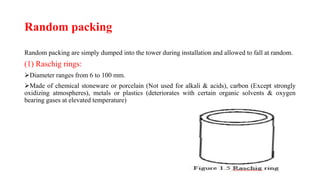
Random packing are simply dumped into the tower during installation and allowed to fall at random.
(1) Raschig rings:
Diameter ranges from 6 to 100 mm.
Made of chemical stoneware or porcelain (Not used for alkali & acids), carbon (Except strongly
oxidizing atmospheres), metals or plastics (deteriorates with certain organic solvents & oxygen
bearing gases at elevated temperature)
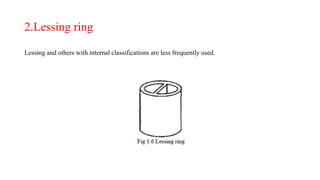
2.Lessing ring
Lessing and others with internal classifications are less frequently used.
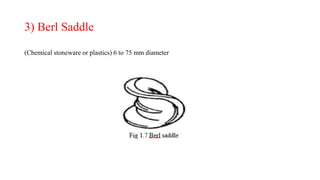
3) Berl Saddle
(Chemical stoneware or plastics) 6 to 75 mm diameter
4) Intalox saddle
(Chemical stoneware or plastics) 6 to 75 mm diameter
5) Tellerette
(Plastics & metals)
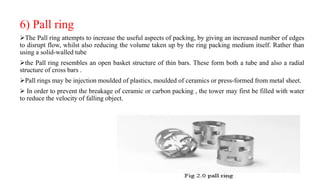
6) Pall ring
The Pall ring attempts to increase the useful aspects of packing, by giving an increased number of edges
to disrupt flow, whilst also reducing the volume taken up by the ring packing medium itself. Rather than
using a solid-walled tube
the Pall ring resembles an open basket structure of thin bars. These form both a tube and also a radial
structure of cross bars .
Pall rings may be injection moulded of plastics, moulded of ceramics or press-formed from metal sheet.
 In order to prevent the breakage of ceramic or carbon packing , the tower may first be filled with water
to reduce the velocity of falling object.
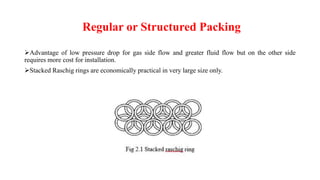
Regular or Structured Packing
Advantage of low pressure drop for gas side flow and greater fluid flow but on the other side
requires more cost for installation.
Stacked Raschig rings are economically practical in very large size only.
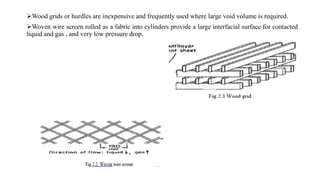
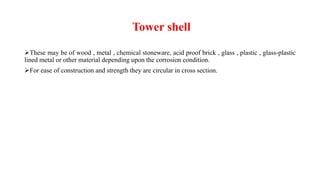
Wood grids or hurdles are inexpensive and frequently used where large void volume is required.
Woven wire screen rolled as a fabric into cylinders provide a large interfacial surface for contacted
liquid and gas , and very low pressure drop.
Tower shell
These may be of wood , metal , chemical stoneware, acid proof brick , glass , plastic , glass-plastic
lined metal or other material depending upon the corrosion condition.
For ease of construction and strength they are circular in cross section.
Packing support
Every packed bed will need a support.
Two critical factors to be considered in the design of a packing support are:
It must physically retain and support the packed bed under operating conditions in the column
including but not limited to packing type and size, design temperature, bed depth, operating liquid
holdup, material of construction, corrosion allowance, material build up in the bed and surge
conditions.
It must have a high percentage of free area to allow unrestricted counter current flow of down
coming liquid and upward flowing vapour .
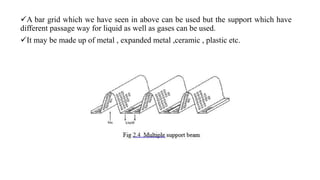
A bar grid which we have seen in above can be used but the support which have
different passage way for liquid as well as gases can be used.
It may be made up of metal , expanded metal ,ceramic , plastic etc.
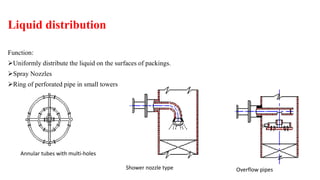
Liquid distribution
Function:
Uniformly distribute the liquid on the surfaces of packings.
Spray Nozzles
Ring of perforated pipe in small towers
Annular tubes with multi-holes
Shower nozzle type Overflow pipes
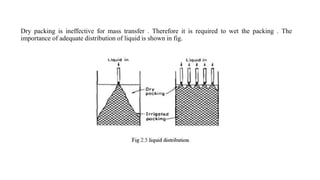
Dry packing is ineffective for mass transfer . Therefore it is required to wet the packing . The
importance of adequate distribution of liquid is shown in fig.
Choice of Tray tower vs. Packed tower
The choice between a tray and packed tower for a particular application can only be made with
complete assurance by costing each design.
 However, this will not always be worthwhile, or necessary, and the choice can usually be made, on
the basis of experience by considering main advantages and disadvantages of each type; which are
listed below:
If the liquid causes fouling, or contains solids, it is easier to make provision for cleaning in a tray
tower; man ways can be installed on the trays. With small diameter towers it may be cheaper to use
packing and replace the packing when it becomes fouled.
For corrosive liquids a packed tower will usually be cheaper than the equivalent plate tower.
The liquid hold-up is appreciably lower in a packed tower than a plate tower . This can be
important when the inventory of toxic or flammable liquids needs to be kept as small as possible for
safety reasons.
Plate towers can be designed to handle a wider range of liquid and gas flow-rates than packed
towers.
Packed towers are not suitable for very low liquid rates.
The efficiency of a tray can be predicted with more certainty than the equivalent term for packing
(HETP or HTU).
Plate towers can be designed with more assurance than packed towers. There is always some doubt
that good liquid distribution can be maintained throughout a packed tower under all operating
conditions, particularly in large towers.
It is easier to make provision for the withdrawal of side-streams from tray towers; coils can be
installed on the trays.
Costs: packed column tends are less expensive than plate column for small column diameter (<0.6
m).
For foaming liquid: handling of foaming liquid in packed column is more appropriate because of
the relatively low degree of agitation by the gas.
Working under stressed conditions of temperature variations and pressure: the packing elements
are easily breakable.
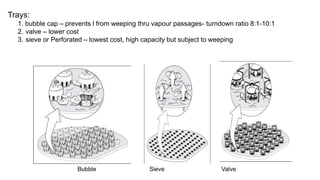
Bubble Sieve Valve
Trays:
1. bubble cap – prevents l from weeping thru vapour passages- turndown ratio 8:1-10:1
2. valve – lower cost
3. sieve or Perforated – lowest cost, high capacity but subject to weeping
Trays and Plates
The terms "trays" and "plates" are used interchangeably. There are many types of tray designs,
but the most common ones are :
Bubble cap trays
A bubble cap tray has riser or chimney fitted over each hole,
and a cap that covers the riser.
 The cap is mounted so that there is a space between riser and
cap to allow the passage of vapour.
 Vapour rises through the chimney and is directed downward
by the cap, finally discharging through slots in the cap, and
finally bubbling through the liquid on the tray.
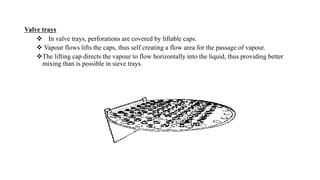
Valve trays
 In valve trays, perforations are covered by liftable caps.
 Vapour flows lifts the caps, thus self creating a flow area for the passage of vapour.
The lifting cap directs the vapour to flow horizontally into the liquid, thus providing better
mixing than is possible in sieve trays.
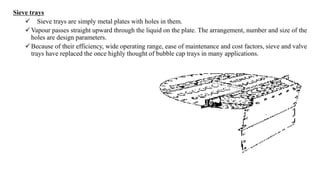
Sieve trays
 Sieve trays are simply metal plates with holes in them.
Vapour passes straight upward through the liquid on the plate. The arrangement, number and size of the
holes are design parameters.
Because of their efficiency, wide operating range, ease of maintenance and cost factors, sieve and valve
trays have replaced the once highly thought of bubble cap trays in many applications.
Basic distillation equipment and operation

Basic distillation equipment and operation

  • 1.
    BASIC DISTILLATION EQUIPMENTAND OPERATION The vertical shell houses the column internals and together with the condenser and reboiler, constitute a distillation column. A schematic of a typical distillation unit with a single feed and two product streams is shown below:
  • 2.
    Packed towers andTray towers
  • 3.
     In chemicalprocessing, a packed bed is a hollow tube, pipe, or other vessel that is filled with a packing material.  The packing can be randomly filled with small objects like Raschig rings or else it can be a specifically designed structured packing.  Packed beds may also contain catalyst particles or adsorbents such as zeolite pellets, granular activated carbon, etc.  The purpose of a packed bed is typically to improve contact between two phases in a chemical or similar process.  Packed beds can be used in a chemical reactor, a distillation process, or a scrubber, but packed beds have also been used to store heat in chemical plants.  In this case, hot gases are allowed to escape through a vessel that is packed with a refractory material until the packing is hot. Air or other cool gas is then fed back to the plant through the hot bed, thereby pre-heating the air or gas feed. Packed towers
  • 4.
    Packing - BasicRequirements chemically inert to the fluids  strong but without excessive weight contain adequate passages (void volume) for both streams without excessive liquid hold-up or pressure drop provide good contact between the liquid and the gas. reasonable in cost
  • 5.
    1.4.2 Types ofpacking 1) Random Packing 2) Structured Packing
  • 6.
    Random packing Random packingare simply dumped into the tower during installation and allowed to fall at random. (1) Raschig rings: Diameter ranges from 6 to 100 mm. Made of chemical stoneware or porcelain (Not used for alkali & acids), carbon (Except strongly oxidizing atmospheres), metals or plastics (deteriorates with certain organic solvents & oxygen bearing gases at elevated temperature)
  • 7.
    2.Lessing ring Lessing andothers with internal classifications are less frequently used.
  • 8.
    3) Berl Saddle (Chemicalstoneware or plastics) 6 to 75 mm diameter
  • 9.
    4) Intalox saddle (Chemicalstoneware or plastics) 6 to 75 mm diameter
  • 10.
  • 11.
    6) Pall ring ThePall ring attempts to increase the useful aspects of packing, by giving an increased number of edges to disrupt flow, whilst also reducing the volume taken up by the ring packing medium itself. Rather than using a solid-walled tube the Pall ring resembles an open basket structure of thin bars. These form both a tube and also a radial structure of cross bars . Pall rings may be injection moulded of plastics, moulded of ceramics or press-formed from metal sheet.  In order to prevent the breakage of ceramic or carbon packing , the tower may first be filled with water to reduce the velocity of falling object.
  • 12.
    Regular or StructuredPacking Advantage of low pressure drop for gas side flow and greater fluid flow but on the other side requires more cost for installation. Stacked Raschig rings are economically practical in very large size only.
  • 13.
    Wood grids orhurdles are inexpensive and frequently used where large void volume is required. Woven wire screen rolled as a fabric into cylinders provide a large interfacial surface for contacted liquid and gas , and very low pressure drop.
  • 14.
    Tower shell These maybe of wood , metal , chemical stoneware, acid proof brick , glass , plastic , glass-plastic lined metal or other material depending upon the corrosion condition. For ease of construction and strength they are circular in cross section.
  • 15.
    Packing support Every packedbed will need a support. Two critical factors to be considered in the design of a packing support are: It must physically retain and support the packed bed under operating conditions in the column including but not limited to packing type and size, design temperature, bed depth, operating liquid holdup, material of construction, corrosion allowance, material build up in the bed and surge conditions. It must have a high percentage of free area to allow unrestricted counter current flow of down coming liquid and upward flowing vapour .
  • 16.
    A bar gridwhich we have seen in above can be used but the support which have different passage way for liquid as well as gases can be used. It may be made up of metal , expanded metal ,ceramic , plastic etc.
  • 17.
    Liquid distribution Function: Uniformly distributethe liquid on the surfaces of packings. Spray Nozzles Ring of perforated pipe in small towers Annular tubes with multi-holes Shower nozzle type Overflow pipes
  • 18.
    Dry packing isineffective for mass transfer . Therefore it is required to wet the packing . The importance of adequate distribution of liquid is shown in fig.
  • 19.
    Choice of Traytower vs. Packed tower The choice between a tray and packed tower for a particular application can only be made with complete assurance by costing each design.  However, this will not always be worthwhile, or necessary, and the choice can usually be made, on the basis of experience by considering main advantages and disadvantages of each type; which are listed below: If the liquid causes fouling, or contains solids, it is easier to make provision for cleaning in a tray tower; man ways can be installed on the trays. With small diameter towers it may be cheaper to use packing and replace the packing when it becomes fouled. For corrosive liquids a packed tower will usually be cheaper than the equivalent plate tower. The liquid hold-up is appreciably lower in a packed tower than a plate tower . This can be important when the inventory of toxic or flammable liquids needs to be kept as small as possible for safety reasons.
  • 20.
    Plate towers canbe designed to handle a wider range of liquid and gas flow-rates than packed towers. Packed towers are not suitable for very low liquid rates. The efficiency of a tray can be predicted with more certainty than the equivalent term for packing (HETP or HTU). Plate towers can be designed with more assurance than packed towers. There is always some doubt that good liquid distribution can be maintained throughout a packed tower under all operating conditions, particularly in large towers. It is easier to make provision for the withdrawal of side-streams from tray towers; coils can be installed on the trays.
  • 21.
    Costs: packed columntends are less expensive than plate column for small column diameter (<0.6 m). For foaming liquid: handling of foaming liquid in packed column is more appropriate because of the relatively low degree of agitation by the gas. Working under stressed conditions of temperature variations and pressure: the packing elements are easily breakable.
  • 22.
    Bubble Sieve Valve Trays: 1.bubble cap – prevents l from weeping thru vapour passages- turndown ratio 8:1-10:1 2. valve – lower cost 3. sieve or Perforated – lowest cost, high capacity but subject to weeping
  • 23.
    Trays and Plates Theterms "trays" and "plates" are used interchangeably. There are many types of tray designs, but the most common ones are : Bubble cap trays A bubble cap tray has riser or chimney fitted over each hole, and a cap that covers the riser.  The cap is mounted so that there is a space between riser and cap to allow the passage of vapour.  Vapour rises through the chimney and is directed downward by the cap, finally discharging through slots in the cap, and finally bubbling through the liquid on the tray.
  • 24.
    Valve trays  Invalve trays, perforations are covered by liftable caps.  Vapour flows lifts the caps, thus self creating a flow area for the passage of vapour. The lifting cap directs the vapour to flow horizontally into the liquid, thus providing better mixing than is possible in sieve trays.
  • 25.
    Sieve trays  Sievetrays are simply metal plates with holes in them. Vapour passes straight upward through the liquid on the plate. The arrangement, number and size of the holes are design parameters. Because of their efficiency, wide operating range, ease of maintenance and cost factors, sieve and valve trays have replaced the once highly thought of bubble cap trays in many applications.