Bio-CNG
By
Er. T. AYISHA NAZIBA, Dr. S. PUGALENDHI
Bio-CNG
 Bio-CNG, or bio-compressed natural gas, is a
renewable and sustainable fuel derived from organic
waste sources through a process known as biomethane
production. It is a type of renewable natural gas (RNG)
that can be used as a substitute for conventional
compressed natural gas (CNG) derived from fossil
fuels. Bio-CNG offers environmental benefits by
reducing greenhouse gas emissions and promoting
circular economy principles
Productionof
Bio-CNG
 Biogas Production: Bio-CNG is produced from biogas,
which is generated through anaerobic digestion of organic
materials such as agricultural waste, food waste,
municipal solid waste, and wastewater sludge.
 Biogas Upgrading: Biogas undergoes a purification
process known as upgrading to remove impurities (such as
carbon dioxide and hydrogen sulfide) and increase
methane content, resulting in high-purity biomethane.
 Compression: The purified biomethane is compressed to
reduce its volume and increase its energy density, similar
to the process used for conventional CNG.
 Quality Control: Bio-CNG must meet quality
specifications (e.g., methane content, energy density, and
impurity levels) to ensure compatibility with CNG
infrastructure and vehicle engines.
Biogas
upgrading
 Biogas upgrading is a process that refines raw biogas
produced from anaerobic digestion into biomethane, a
high-quality renewable fuel suitable for injection into
natural gas pipelines, use as a transportation fuel, or
other applications. Upgrading removes impurities from
biogas, such as carbon dioxide (CO2), hydrogen sulfide
(H2S), water vapor, and trace contaminants, to
increase the methane (CH4) content and improve the
gas quality. Several techniques are used for biogas
upgrading, each offering unique advantages and
suitability depending on the scale of production,
desired methane purity, and specific requirements
WaterScrubbing
(PressureSwing
Absorption-PSA)
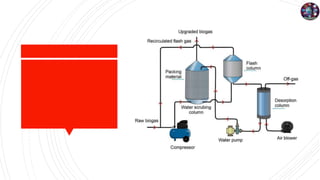
 Process Description: Water scrubbing, also known as
pressure swing absorption (PSA), is a commonly used
biogas upgrading technique.
 Operation: Biogas is passed through a water scrubber
column where CO2 and other impurities are absorbed
into the water.
 Methane Enrichment: After scrubbing, the methane-
rich gas is separated from the water and collected as
purified biomethane.
 Advantages: Simple operation, relatively low energy
consumption, and effective removal of CO2.
AmineScrubbing
(Chemical
Absorption)
 Process Description: Amine scrubbing involves using
chemical solvents (amines) to selectively absorb CO2
and H2S from biogas.
 Operation: Biogas is bubbled through an amine
solution, where CO2 and H2S are chemically captured
by the solvent.
 Methane Enrichment: The regenerated solvent
releases CO2 and H2S under controlled conditions,
leaving behind purified methane.
 Advantages: High purity methane output, suitable for
large-scale applications.
Membrane
Separation
 Process Description: Membrane separation uses semi-
permeable membranes to selectively separate methane
from CO2 and other gases based on molecular size and
properties.
 Operation: Biogas is pressurized and passed through
membrane modules, allowing methane to permeate
through while CO2 is retained.
 Methane Enrichment: The permeate side yields
purified biomethane, while the retentate contains
concentrated CO2.
 Advantages: Energy-efficient, compact system, suitable
for decentralized applications.
PressureSwing
Adsorption
(PSA)
 Process Description: PSA utilizes adsorbent materials
(such as activated carbon) to selectively adsorb CO2
and other impurities from biogas under pressure.
 Operation: Biogas is pressurized and fed through
adsorption columns containing specialized materials
that capture CO2.
 Methane Enrichment: After adsorption, the purified
methane is released by reducing the pressure,
regenerating the adsorbent for cyclic operation.
 Advantages: High purity methane output, suitable for
upgrading large volumes of biogas.
Cryogenic
Upgrading
 Process Description: Cryogenic upgrading involves
cooling biogas to cryogenic temperatures (-160°C to -
170°C) to condense CO2 and other impurities.
 Operation: CO2 and other components freeze and can
be separated from the purified methane, which
remains in a gaseous state.
 Methane Enrichment: The purified methane is
collected as biomethane, while the separated
impurities are either captured or vented.
 Advantages: Produces high-purity biomethane suitable
for injection into natural gas pipelines.
Biological
Upgrading
(Microbial
Methanation)
 Process Description: Biological upgrading involves
using microbial processes to convert CO2 in biogas into
methane.
 Operation: Biogas is exposed to specific
microorganisms under controlled conditions that
facilitate methane production from CO2.
 Methane Enrichment: Methane content in biogas
increases through biological conversion, leading to
enhanced biomethane quality.
 Advantages: Renewable process, operates at ambient
temperatures, suitable for small-scale applications.
Environmental
andSustainability
Benefits
 Reduced Greenhouse Gas Emissions: Bio-CNG is
considered carbon-neutral or even carbon-negative
because it recycles carbon dioxide (CO2) emitted
during combustion back into the biological cycle
through feedstock growth, offsetting fossil carbon
emissions.
 Waste Valorization: Bio-CNG production helps divert
organic waste from landfills, reducing methane
emissions from decomposing waste and contributing to
waste management and circular economy goals.
 Renewable Energy Source: Bio-CNG promotes the use
of renewable energy derived from biomass, supporting
energy independence and diversification of fuel
sources.
Applications
 Transportation Fuel: Bio-CNG can be used as a clean
and renewable fuel for compressed natural gas vehicles
(CNGVs), including buses, trucks, and cars.
 Urban Mobility: Bio-CNG-powered public
transportation fleets help reduce air pollution and
improve urban air quality in cities.
 Industrial and Commercial Use: Bio-CNG can be
utilized in industrial processes, heating applications,
and combined heat and power (CHP) systems.
 Electricity Generation: Biomethane can be used in gas-
fired power plants to generate electricity or as a
backup fuel for renewable energy systems.
Challenges
 Feedstock Availability: The availability and quality of
organic waste feedstock influence the scalability and
economics of bio-CNG production.
 Infrastructure Development: Expansion of bio-CNG
infrastructure, including biogas upgrading facilities
and refueling stations, is needed to support widespread
adoption.
 Market Acceptance: Continued policy support, financial
incentives, and awareness campaigns are essential to
promote bio-CNG as a viable alternative fuel.
THANK
YOU

Bio - CNG - a sustainable energy solution

  • 1.
    Bio-CNG By Er. T. AYISHANAZIBA, Dr. S. PUGALENDHI
  • 2.
    Bio-CNG  Bio-CNG, orbio-compressed natural gas, is a renewable and sustainable fuel derived from organic waste sources through a process known as biomethane production. It is a type of renewable natural gas (RNG) that can be used as a substitute for conventional compressed natural gas (CNG) derived from fossil fuels. Bio-CNG offers environmental benefits by reducing greenhouse gas emissions and promoting circular economy principles
  • 3.
    Productionof Bio-CNG  Biogas Production:Bio-CNG is produced from biogas, which is generated through anaerobic digestion of organic materials such as agricultural waste, food waste, municipal solid waste, and wastewater sludge.  Biogas Upgrading: Biogas undergoes a purification process known as upgrading to remove impurities (such as carbon dioxide and hydrogen sulfide) and increase methane content, resulting in high-purity biomethane.  Compression: The purified biomethane is compressed to reduce its volume and increase its energy density, similar to the process used for conventional CNG.  Quality Control: Bio-CNG must meet quality specifications (e.g., methane content, energy density, and impurity levels) to ensure compatibility with CNG infrastructure and vehicle engines.
  • 4.
    Biogas upgrading  Biogas upgradingis a process that refines raw biogas produced from anaerobic digestion into biomethane, a high-quality renewable fuel suitable for injection into natural gas pipelines, use as a transportation fuel, or other applications. Upgrading removes impurities from biogas, such as carbon dioxide (CO2), hydrogen sulfide (H2S), water vapor, and trace contaminants, to increase the methane (CH4) content and improve the gas quality. Several techniques are used for biogas upgrading, each offering unique advantages and suitability depending on the scale of production, desired methane purity, and specific requirements
  • 6.
    WaterScrubbing (PressureSwing Absorption-PSA)  Process Description:Water scrubbing, also known as pressure swing absorption (PSA), is a commonly used biogas upgrading technique.  Operation: Biogas is passed through a water scrubber column where CO2 and other impurities are absorbed into the water.  Methane Enrichment: After scrubbing, the methane- rich gas is separated from the water and collected as purified biomethane.  Advantages: Simple operation, relatively low energy consumption, and effective removal of CO2.
  • 7.
    AmineScrubbing (Chemical Absorption)  Process Description:Amine scrubbing involves using chemical solvents (amines) to selectively absorb CO2 and H2S from biogas.  Operation: Biogas is bubbled through an amine solution, where CO2 and H2S are chemically captured by the solvent.  Methane Enrichment: The regenerated solvent releases CO2 and H2S under controlled conditions, leaving behind purified methane.  Advantages: High purity methane output, suitable for large-scale applications.
  • 8.
    Membrane Separation  Process Description:Membrane separation uses semi- permeable membranes to selectively separate methane from CO2 and other gases based on molecular size and properties.  Operation: Biogas is pressurized and passed through membrane modules, allowing methane to permeate through while CO2 is retained.  Methane Enrichment: The permeate side yields purified biomethane, while the retentate contains concentrated CO2.  Advantages: Energy-efficient, compact system, suitable for decentralized applications.
  • 9.
    PressureSwing Adsorption (PSA)  Process Description:PSA utilizes adsorbent materials (such as activated carbon) to selectively adsorb CO2 and other impurities from biogas under pressure.  Operation: Biogas is pressurized and fed through adsorption columns containing specialized materials that capture CO2.  Methane Enrichment: After adsorption, the purified methane is released by reducing the pressure, regenerating the adsorbent for cyclic operation.  Advantages: High purity methane output, suitable for upgrading large volumes of biogas.
  • 10.
    Cryogenic Upgrading  Process Description:Cryogenic upgrading involves cooling biogas to cryogenic temperatures (-160°C to - 170°C) to condense CO2 and other impurities.  Operation: CO2 and other components freeze and can be separated from the purified methane, which remains in a gaseous state.  Methane Enrichment: The purified methane is collected as biomethane, while the separated impurities are either captured or vented.  Advantages: Produces high-purity biomethane suitable for injection into natural gas pipelines.
  • 11.
    Biological Upgrading (Microbial Methanation)  Process Description:Biological upgrading involves using microbial processes to convert CO2 in biogas into methane.  Operation: Biogas is exposed to specific microorganisms under controlled conditions that facilitate methane production from CO2.  Methane Enrichment: Methane content in biogas increases through biological conversion, leading to enhanced biomethane quality.  Advantages: Renewable process, operates at ambient temperatures, suitable for small-scale applications.
  • 12.
    Environmental andSustainability Benefits  Reduced GreenhouseGas Emissions: Bio-CNG is considered carbon-neutral or even carbon-negative because it recycles carbon dioxide (CO2) emitted during combustion back into the biological cycle through feedstock growth, offsetting fossil carbon emissions.  Waste Valorization: Bio-CNG production helps divert organic waste from landfills, reducing methane emissions from decomposing waste and contributing to waste management and circular economy goals.  Renewable Energy Source: Bio-CNG promotes the use of renewable energy derived from biomass, supporting energy independence and diversification of fuel sources.
  • 13.
    Applications  Transportation Fuel:Bio-CNG can be used as a clean and renewable fuel for compressed natural gas vehicles (CNGVs), including buses, trucks, and cars.  Urban Mobility: Bio-CNG-powered public transportation fleets help reduce air pollution and improve urban air quality in cities.  Industrial and Commercial Use: Bio-CNG can be utilized in industrial processes, heating applications, and combined heat and power (CHP) systems.  Electricity Generation: Biomethane can be used in gas- fired power plants to generate electricity or as a backup fuel for renewable energy systems.
  • 14.
    Challenges  Feedstock Availability:The availability and quality of organic waste feedstock influence the scalability and economics of bio-CNG production.  Infrastructure Development: Expansion of bio-CNG infrastructure, including biogas upgrading facilities and refueling stations, is needed to support widespread adoption.  Market Acceptance: Continued policy support, financial incentives, and awareness campaigns are essential to promote bio-CNG as a viable alternative fuel.
  • 15.