
HKUST EVNG Seminar series
o   ptimum Biomass Drying for Combustion – A Modeling Approach


                                    Tesfaldet G
                                   tgaa@ust.hk
                                March-11-2013
Contents
• Biomass Types
• Biomass to Energy Routes
• Biomass drying for heating value Enhancement-Modeling
  and optimization
• Results
• Discussions
• Future work
Biomass Types
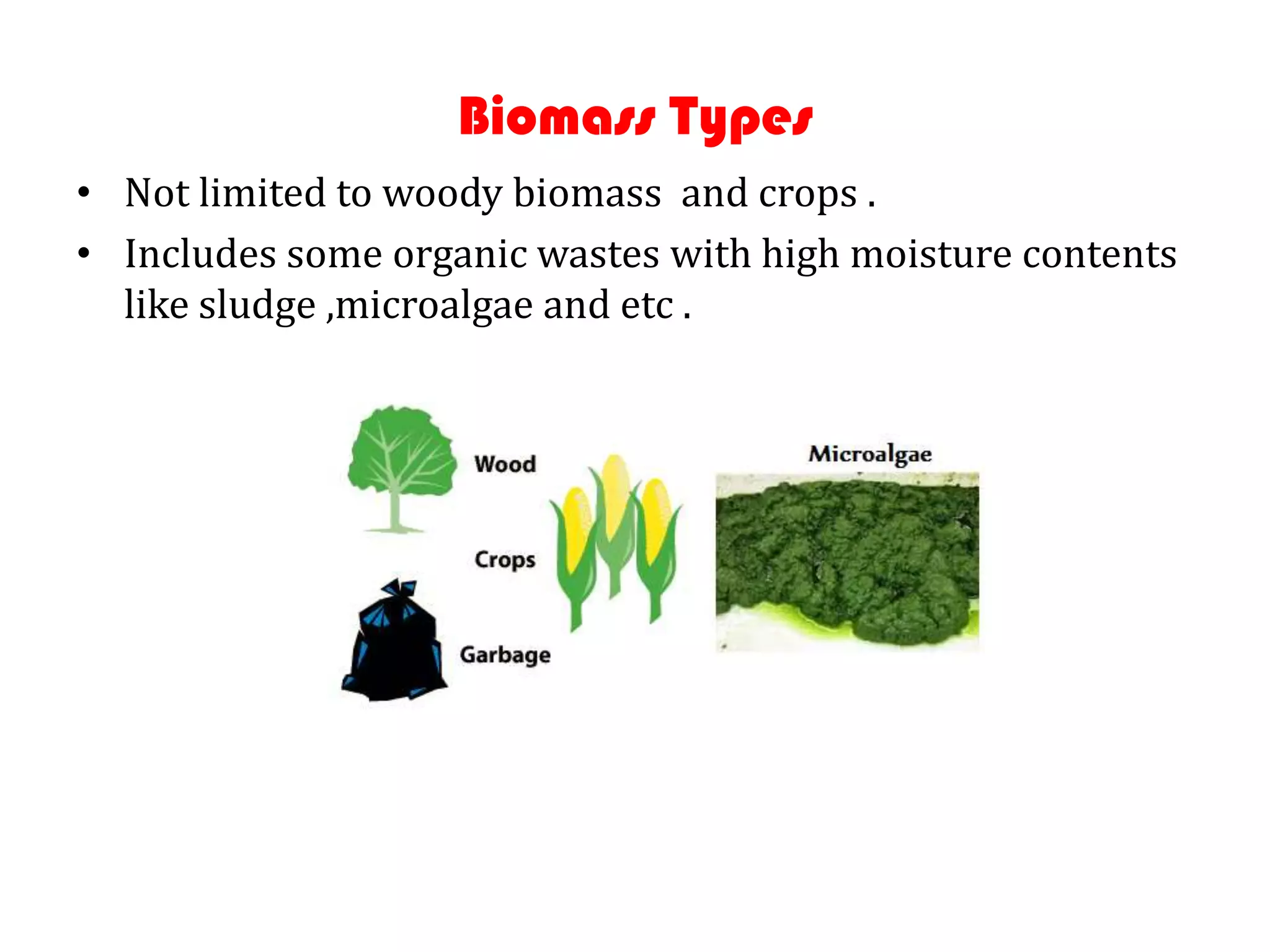
• Not limited to woody biomass and crops .
• Includes some organic wastes with high moisture contents
  like sludge ,microalgae and etc .
Biomass to Energy Routes


•While biomass with moisture levels of 55 - 65wt% can sustain
combustion, the optimum moisture content is 10wt% - 15wt%.


                           http://www.toyo-eng.co.jp/en/product_line/environment/baiomass/index.html
Why Drying?
• Burning biomass with high moisture content :
       •   reduces the combustion temperature
       •   incomplete combustion
       •   undesirable reaction products
       •   requires a large amount of auxiliary fuel to make it combustible

• Drying of biomass:
   – Can increase the combustion efficiency, reduce pollution and improve
     operation.
• BUT
   – Drying of biomass is an expensive process that requires huge capital
     investment and energy input.
• Therefore ,the level of drying should be optimized.
Biomass Drying for combustion-Modeling
GOAL

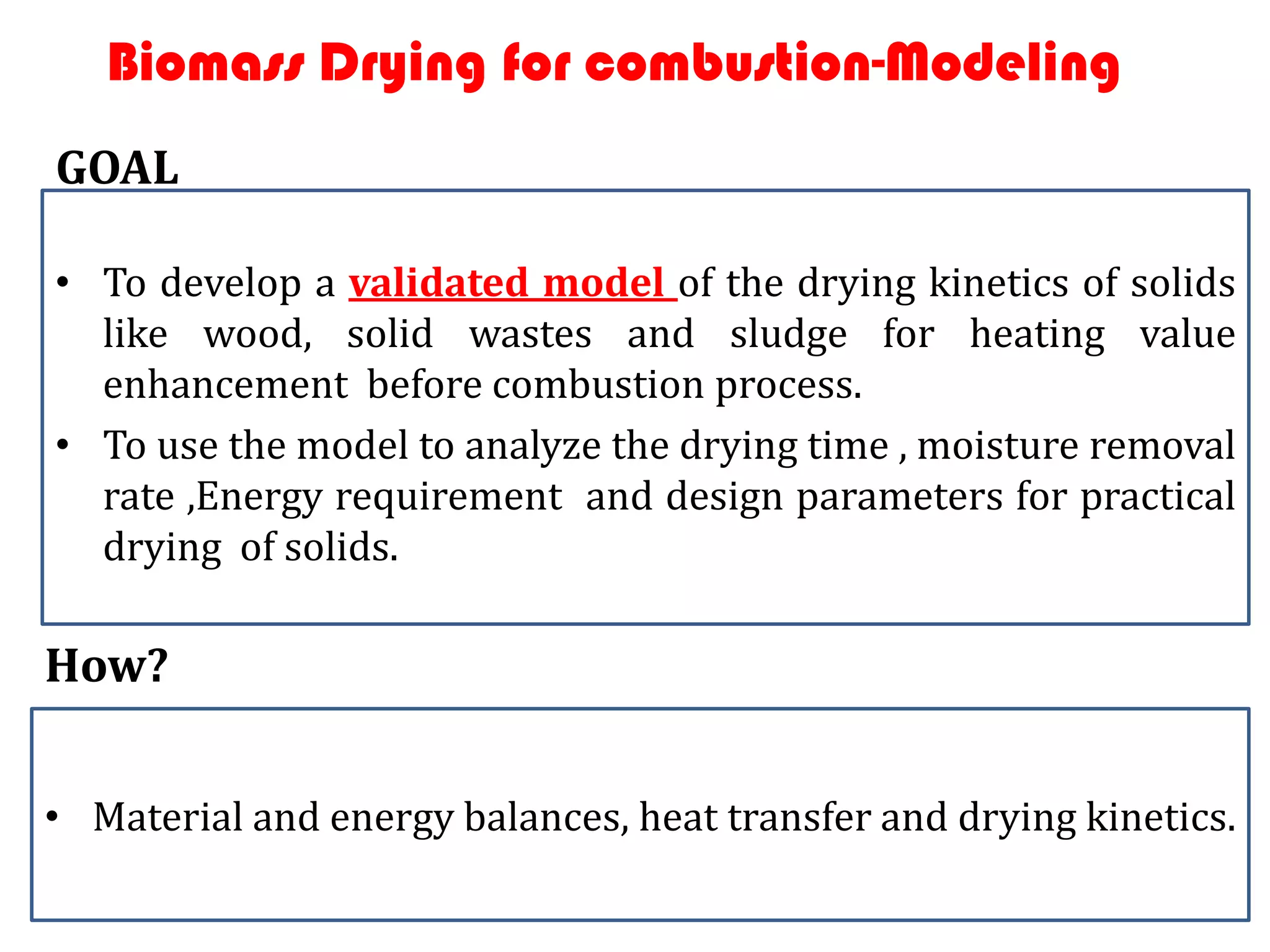
• To develop a validated model of the drying kinetics of solids
  like wood, solid wastes and sludge for heating value
  enhancement before combustion process.
• To use the model to analyze the drying time , moisture removal
  rate ,Energy requirement and design parameters for practical
  drying of solids.

How?


• Material and energy balances, heat transfer and drying kinetics.
Drying process

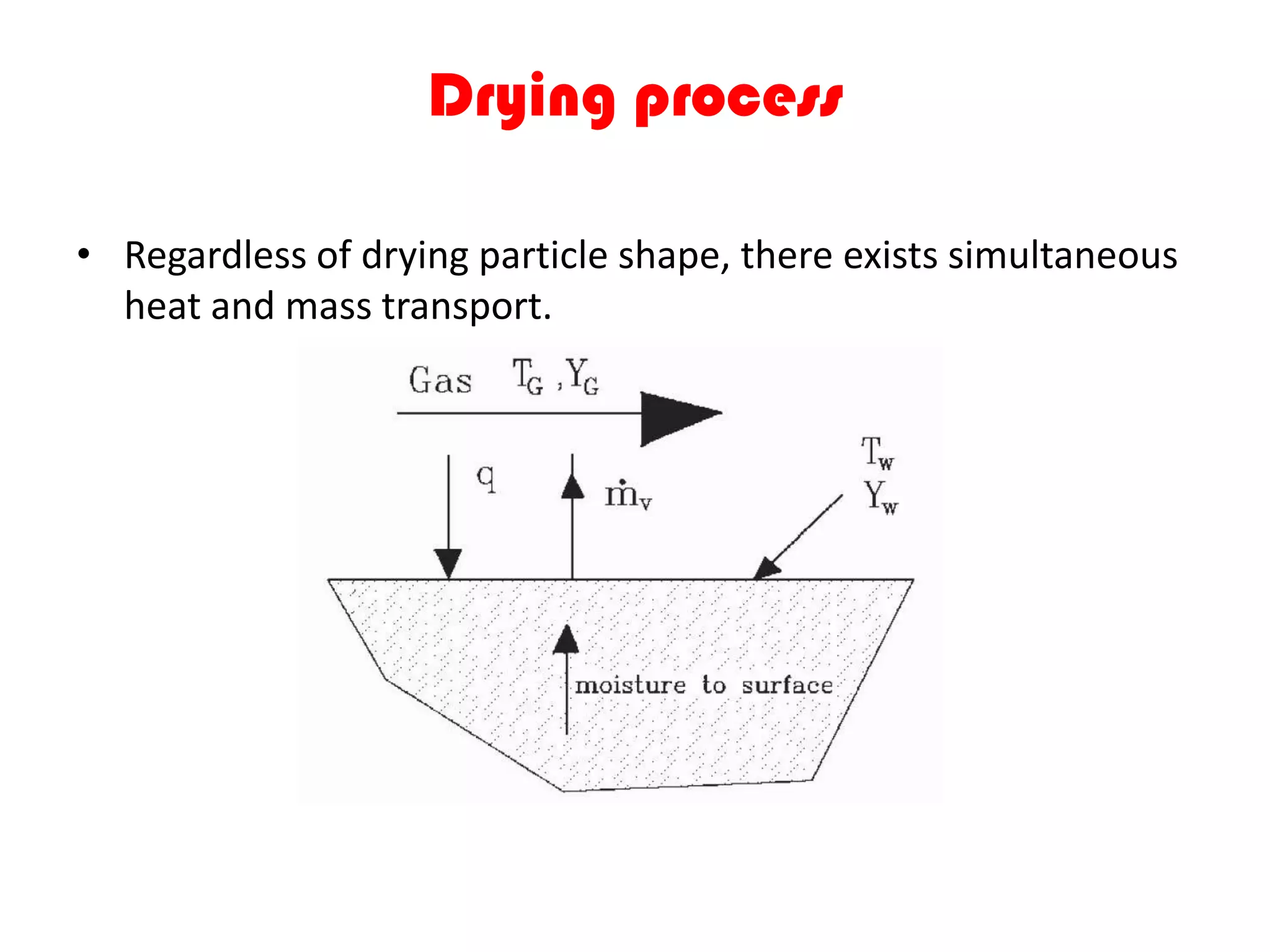
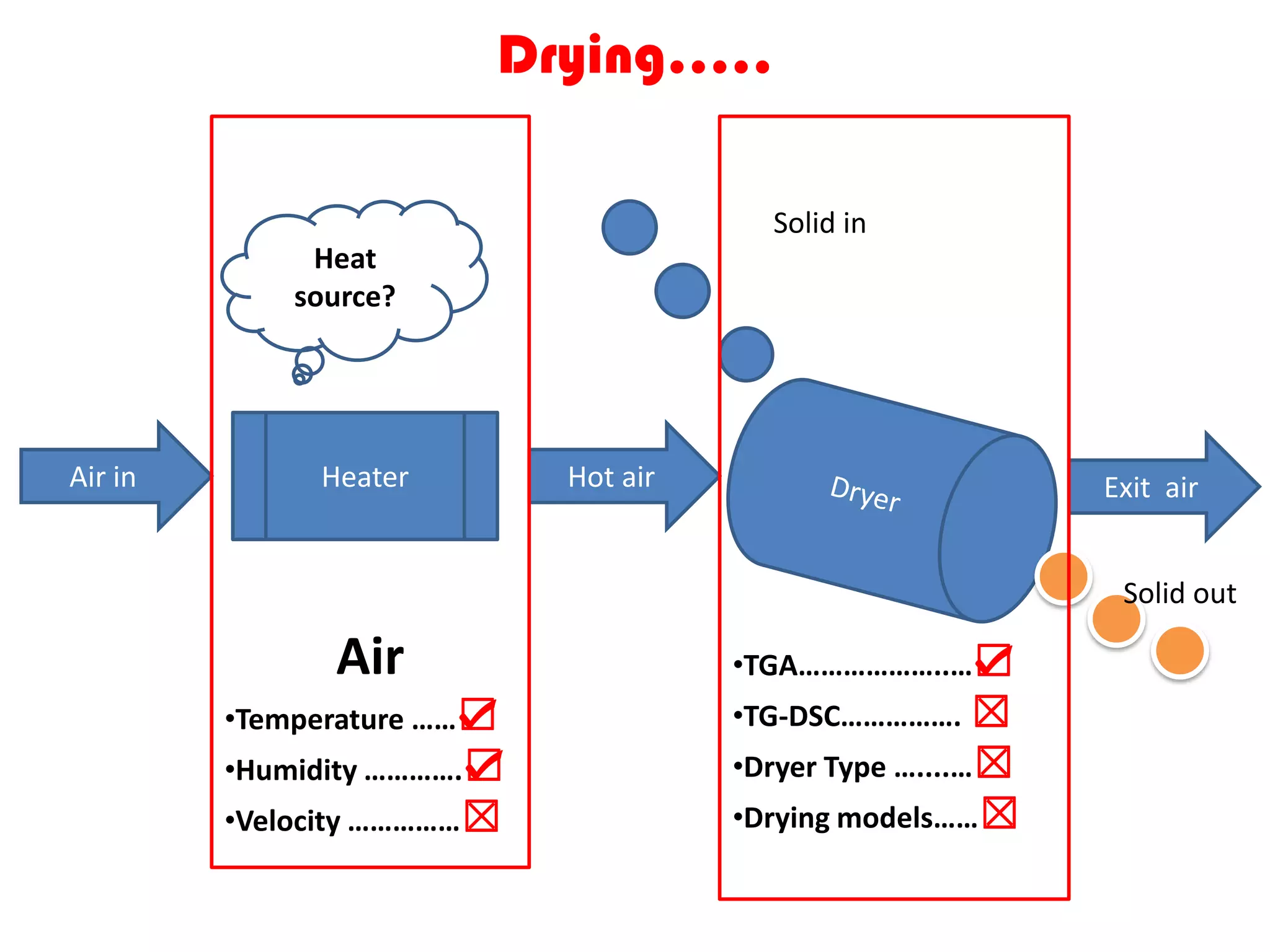
• Regardless of drying particle shape, there exists simultaneous
  heat and mass transport.
Drying…..

                                        Solid in
              Heat
             source?


Air in        Heater        Hot air                         Exit air


                                                             Solid out

               Air                    •TGA………………..…☑
         •Temperature ……☑             •TG-DSC……………. ☒
         •Humidity ………….☑             •Dryer Type …....…☒
         •Velocity ……………☒             •Drying models……☒
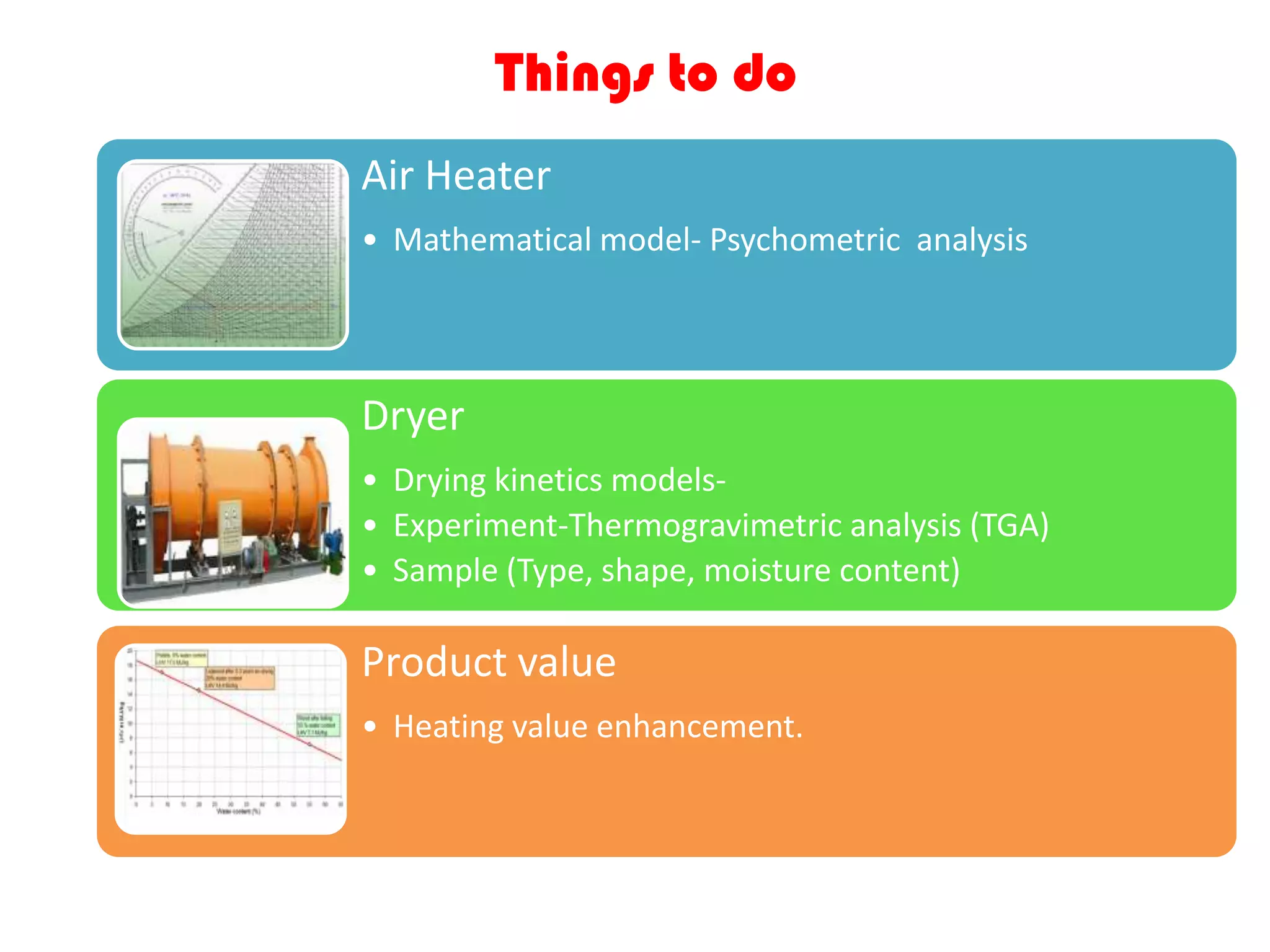
Things to do
Air Heater
• Mathematical model- Psychometric analysis


Dryer
• Drying kinetics models-
• Experiment-Thermogravimetric analysis (TGA)
• Sample (Type, shape, moisture content)

Product value
• Heating value enhancement.
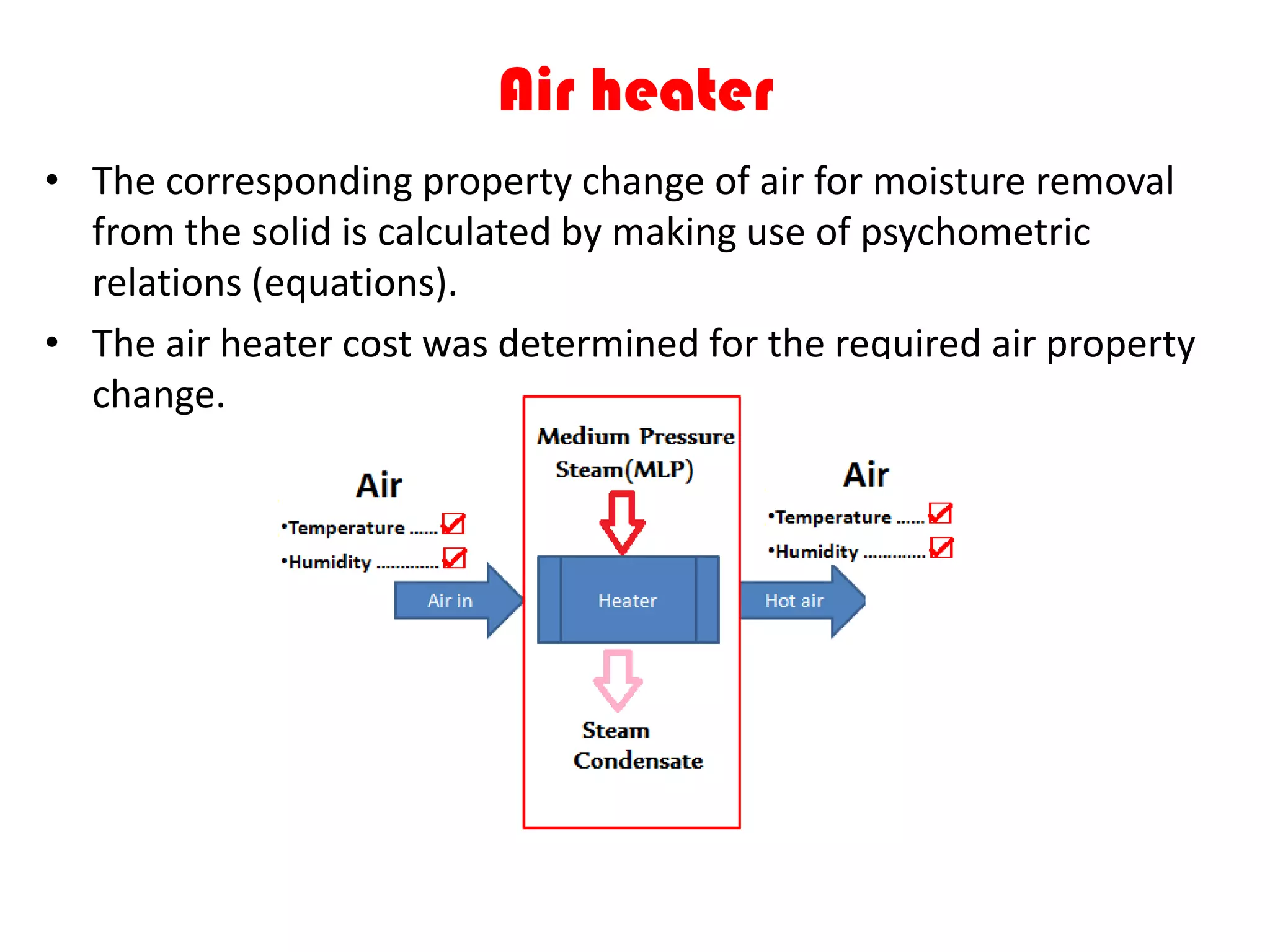
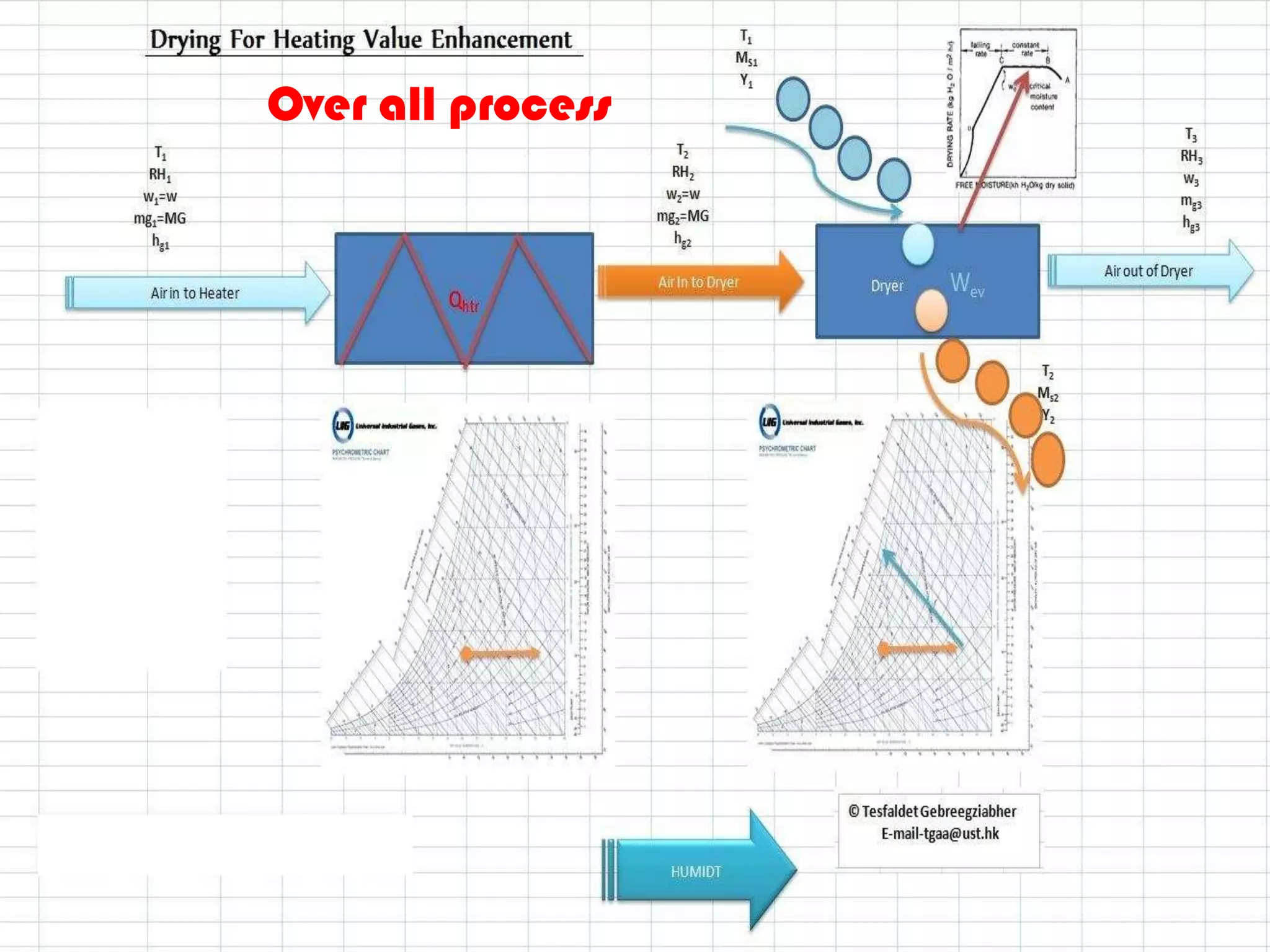
Air heater
• The corresponding property change of air for moisture removal
  from the solid is calculated by making use of psychometric
  relations (equations).
• The air heater cost was determined for the required air property
  change.
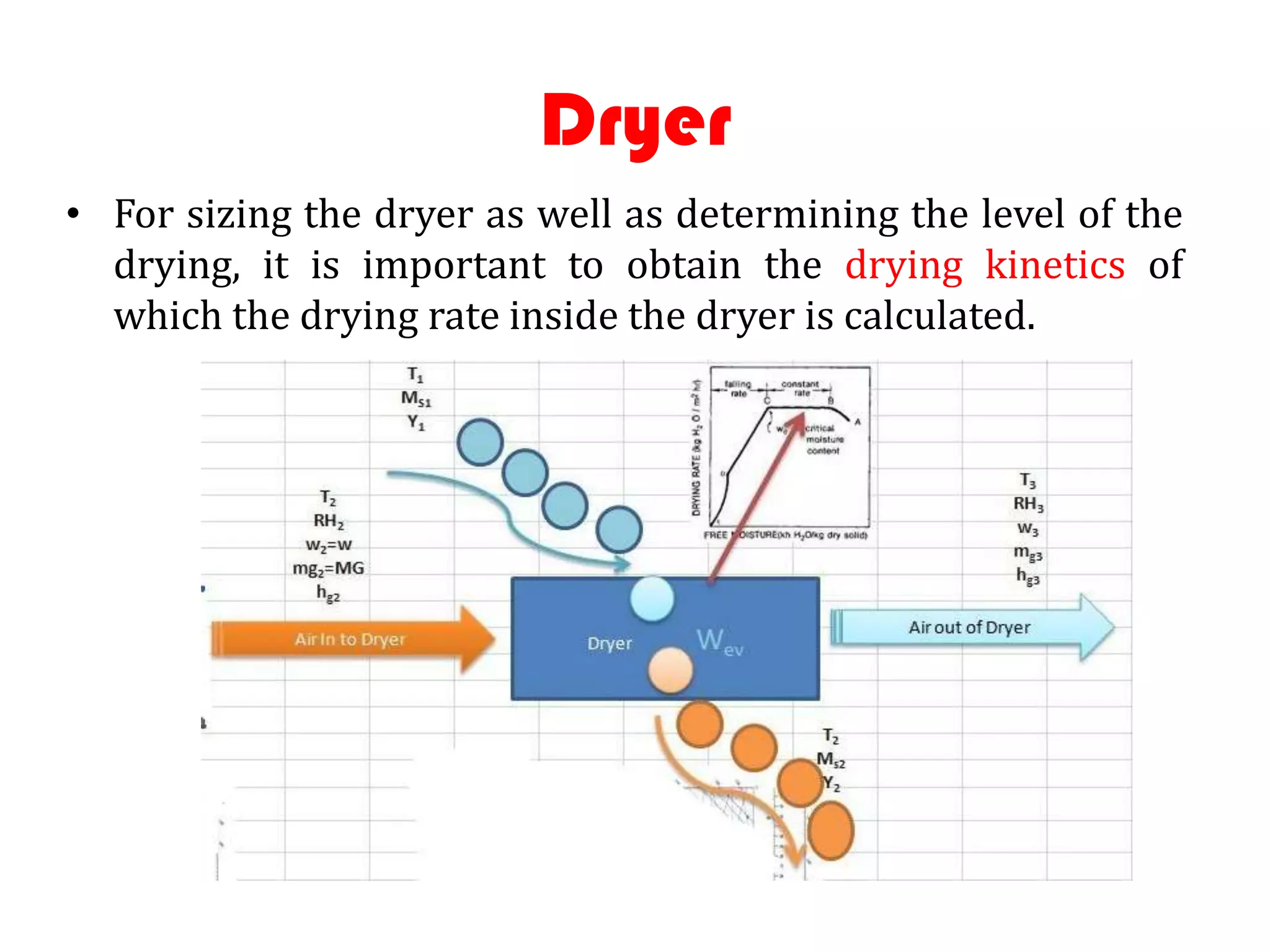
Dryer
• For sizing the dryer as well as determining the level of the
  drying, it is important to obtain the drying kinetics of
  which the drying rate inside the dryer is calculated.
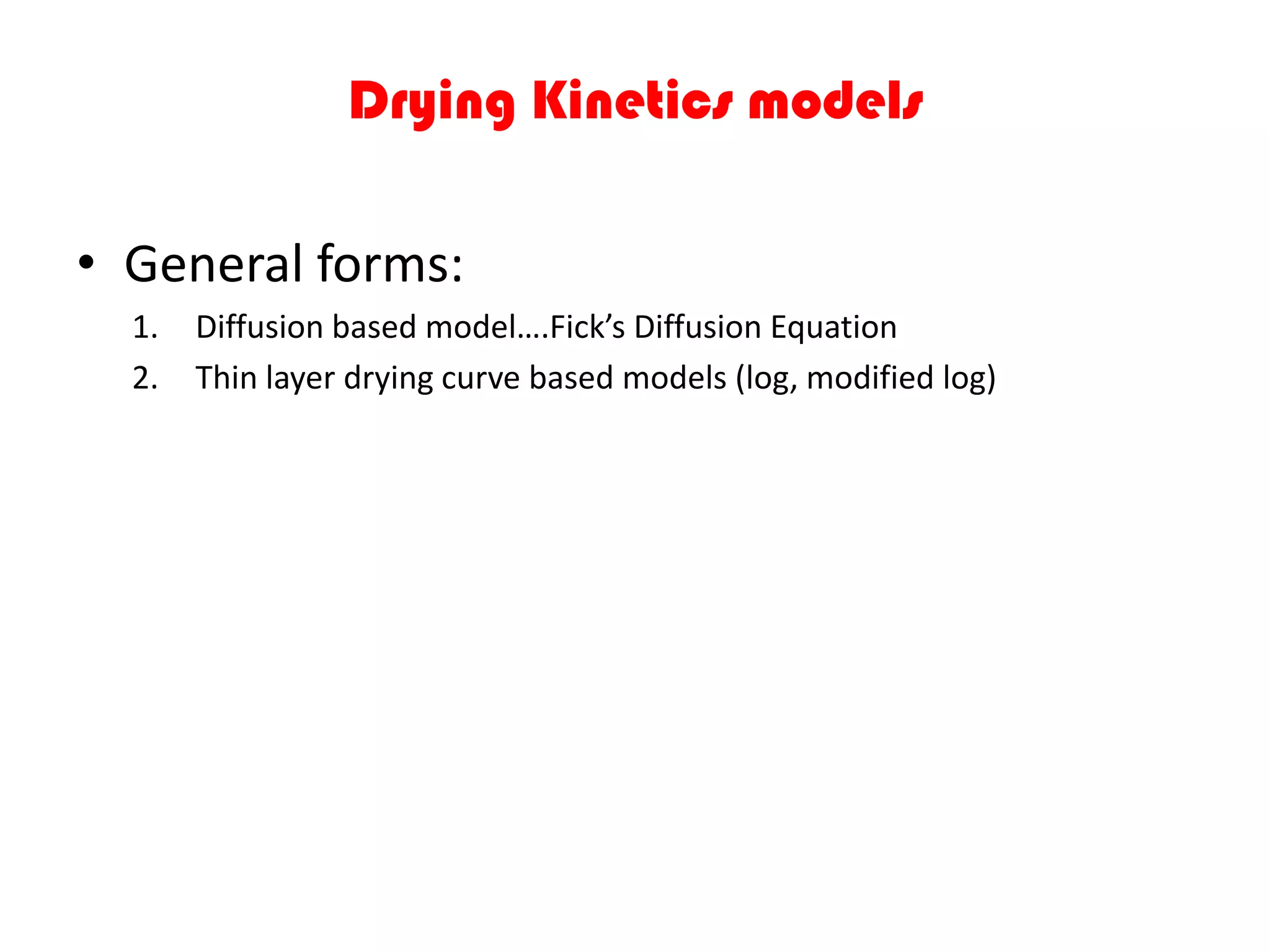
Drying Kinetics models

• General forms:
  1.   Diffusion based model….Fick’s Diffusion Equation
  2.   Thin layer drying curve based models (log, modified log)
L
Fick’s Diffusion Equation


                                rc


                                rs
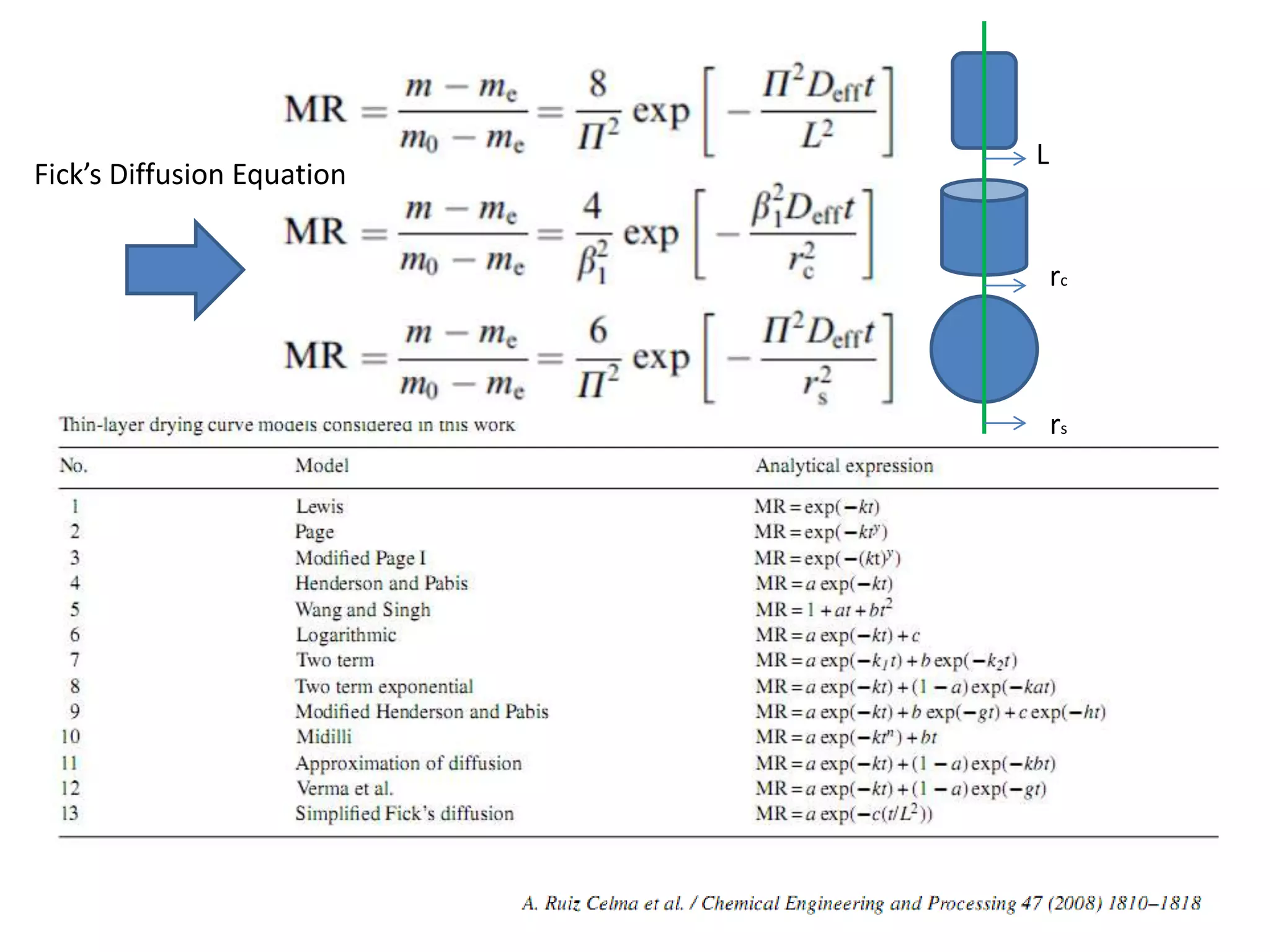
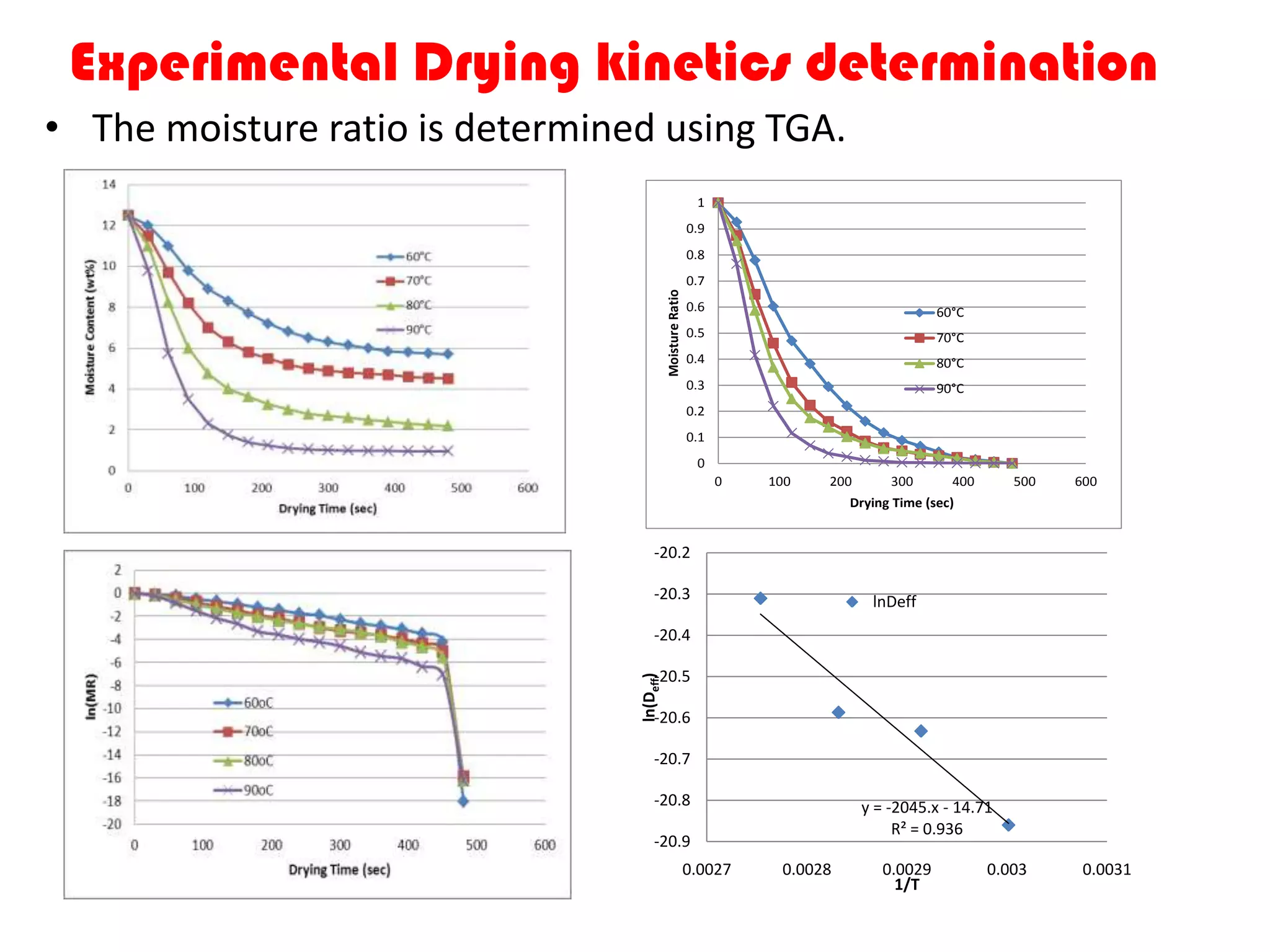
Experimental Drying kinetics determination
• The moisture ratio is determined using TGA.
                                                              1
                                                             0.9
                                                             0.8
                                                             0.7


                                            Moisture Ratio
                                                             0.6                               60°C
                                                             0.5                               70°C
                                                             0.4                               80°C
                                                             0.3                               90°C
                                                             0.2
                                                             0.1
                                                              0
                                                                   0   100   200       300       400      500   600
                                                                                 Drying Time (sec)


                                      -20.2

                                      -20.3                                         lnDeff
                                      -20.4

                                      -20.5
                                 ln(Deff)


                                      -20.6

                                      -20.7

                                      -20.8                                        y = -2045.x - 14.71
                                                                                        R² = 0.936
                                      -20.9
                                                             0.0027     0.0028        0.0029           0.003     0.0031
                                                                                        1/T
The product value

• Monetary value gained upon drying.
Over all process
Objective Function
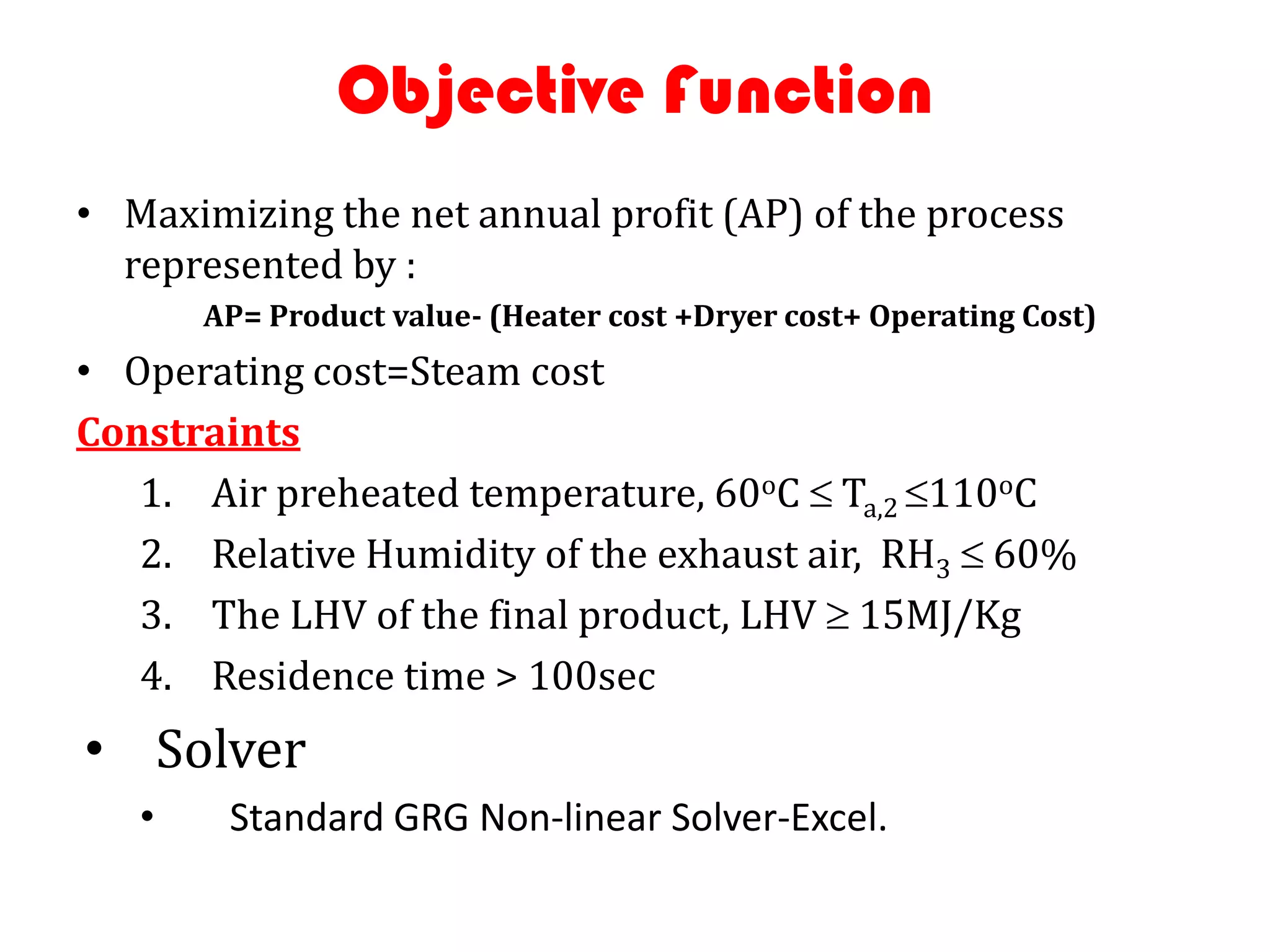
• Maximizing the net annual profit (AP) of the process
  represented by :
       AP= Product value- (Heater cost +Dryer cost+ Operating Cost)
• Operating cost=Steam cost
Constraints
   1. Air preheated temperature, 60oC Ta,2 110oC
   2. Relative Humidity of the exhaust air, RH3 60%
   3. The LHV of the final product, LHV 15MJ/Kg
   4. Residence time > 100sec
• Solver
   •    Standard GRG Non-linear Solver-Excel.
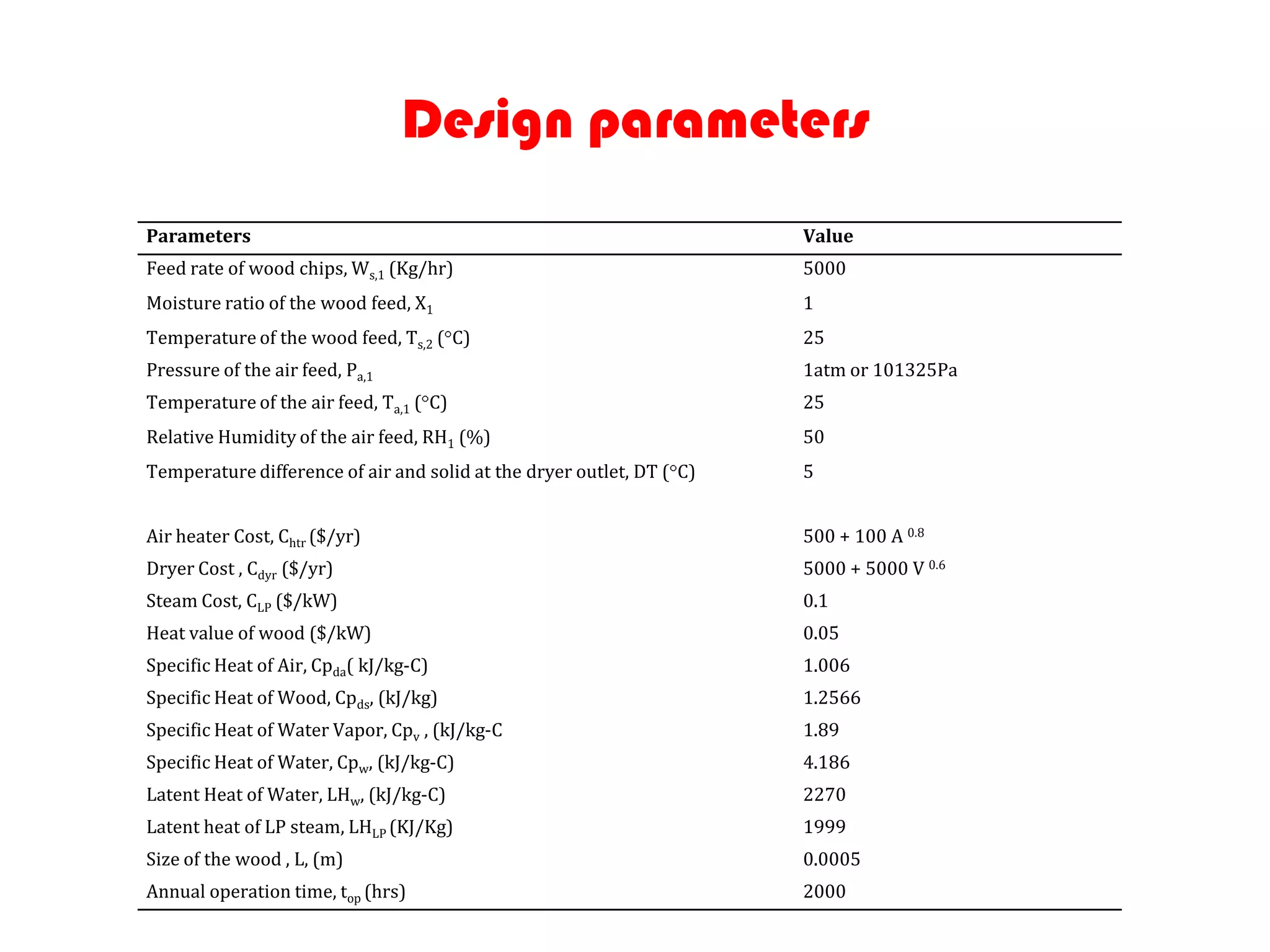
Design parameters
Parameters                                                             Value
Feed rate of wood chips, Ws,1 (Kg/hr)                                  5000
Moisture ratio of the wood feed, X1                                    1
Temperature of the wood feed, Ts,2 ( C)                                25
Pressure of the air feed, Pa,1                                         1atm or 101325Pa
Temperature of the air feed, Ta,1 ( C)                                 25
Relative Humidity of the air feed, RH1 (%)                             50
Temperature difference of air and solid at the dryer outlet, DT ( C)   5


Air heater Cost, Chtr ($/yr)                                           500 + 100 A 0.8
Dryer Cost , Cdyr ($/yr)                                               5000 + 5000 V 0.6
Steam Cost, CLP ($/kW)                                                 0.1
Heat value of wood ($/kW)                                              0.05
Specific Heat of Air, Cpda( kJ/kg-C)                                   1.006
Specific Heat of Wood, Cpds, (kJ/kg)                                   1.2566
Specific Heat of Water Vapor, Cpv , (kJ/kg-C                           1.89
Specific Heat of Water, Cpw, (kJ/kg-C)                                 4.186
Latent Heat of Water, LHw, (kJ/kg-C)                                   2270
Latent heat of LP steam, LHLP (KJ/Kg)                                  1999
Size of the wood , L, (m)                                              0.0005
Annual operation time, top (hrs)                                       2000
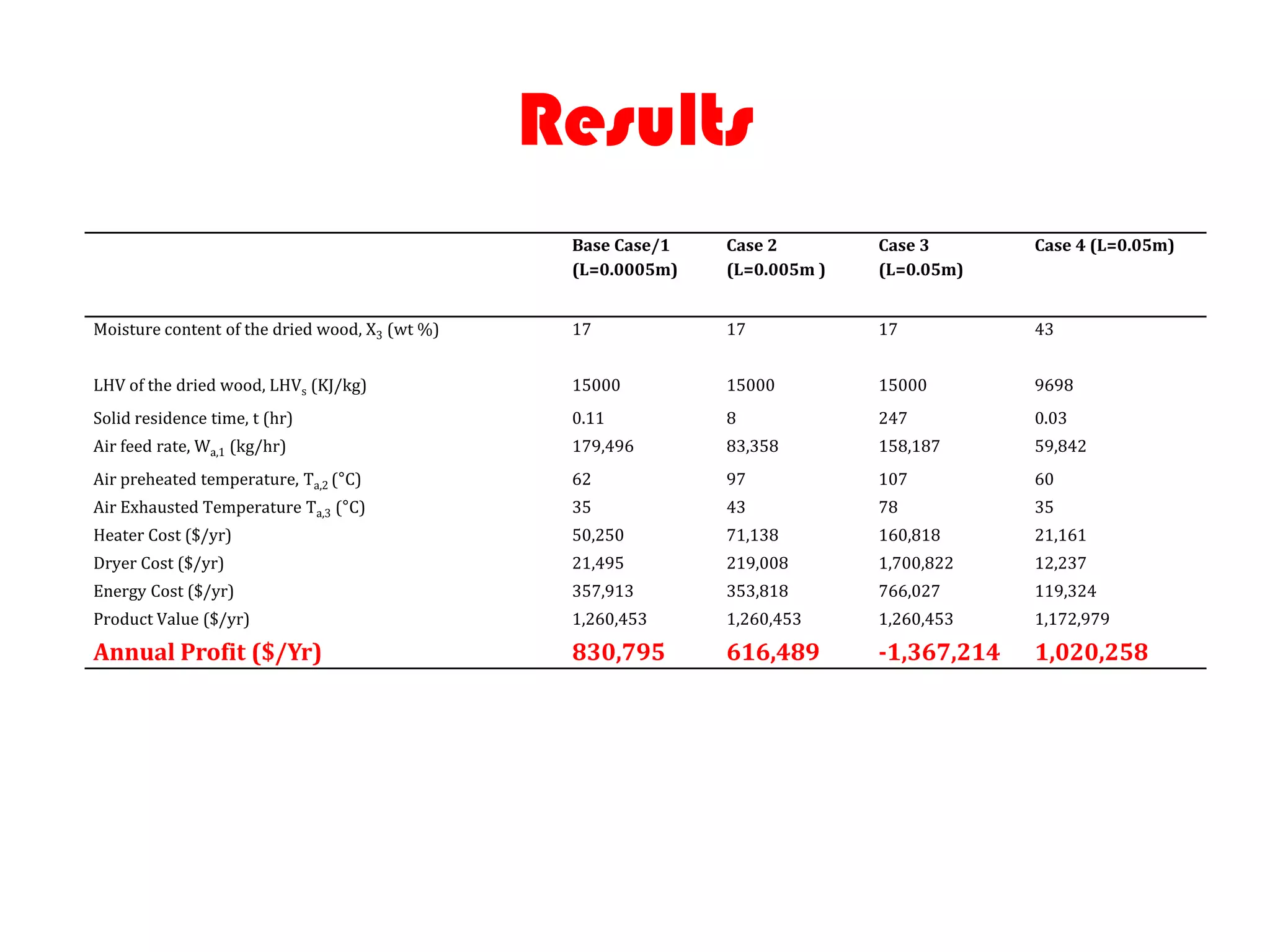
Results
                                                 Base Case/1   Case 2        Case 3       Case 4 (L=0.05m)
                                                 (L=0.0005m)   (L=0.005m )   (L=0.05m)


Moisture content of the dried wood, X3 (wt %)    17            17            17           43


LHV of the dried wood, LHVs (KJ/kg)              15000         15000         15000        9698
Solid residence time, t (hr)                     0.11          8             247          0.03
Air feed rate, Wa,1 (kg/hr)                      179,496       83,358        158,187      59,842
Air preheated temperature, Ta,2 (°C)             62            97            107          60
Air Exhausted Temperature Ta,3 (°C)              35            43            78           35
Heater Cost ($/yr)                               50,250        71,138        160,818      21,161
Dryer Cost ($/yr)                                21,495        219,008       1,700,822    12,237
Energy Cost ($/yr)                               357,913       353,818       766,027      119,324
Product Value ($/yr)                             1,260,453     1,260,453     1,260,453    1,172,979

Annual Profit ($/Yr)                             830,795       616,489       -1,367,214   1,020,258
Discussion
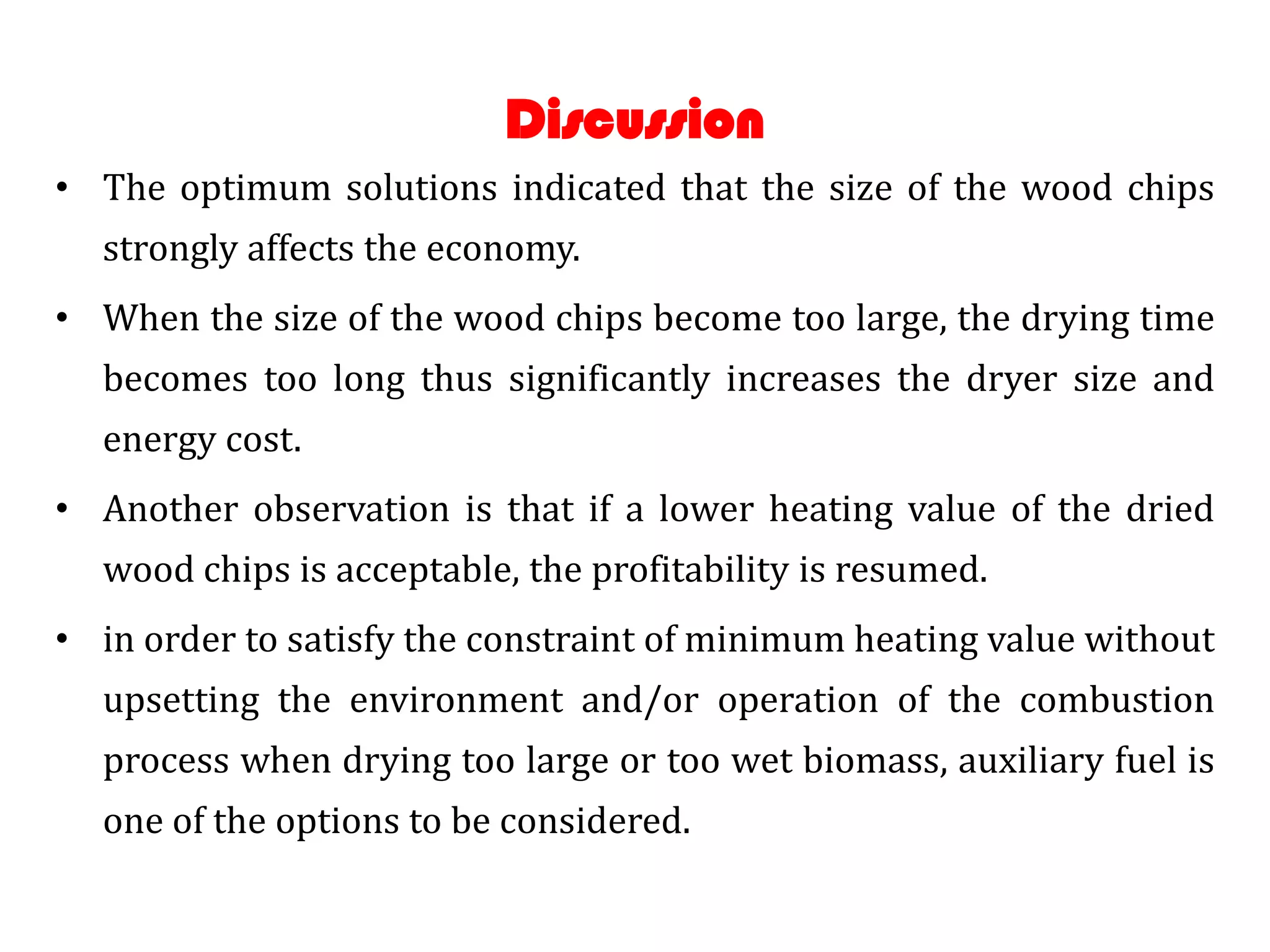
• The optimum solutions indicated that the size of the wood chips
  strongly affects the economy.
• When the size of the wood chips become too large, the drying time
  becomes too long thus significantly increases the dryer size and
  energy cost.
• Another observation is that if a lower heating value of the dried
  wood chips is acceptable, the profitability is resumed.
• in order to satisfy the constraint of minimum heating value without
  upsetting the environment and/or operation of the combustion
  process when drying too large or too wet biomass, auxiliary fuel is
  one of the options to be considered.
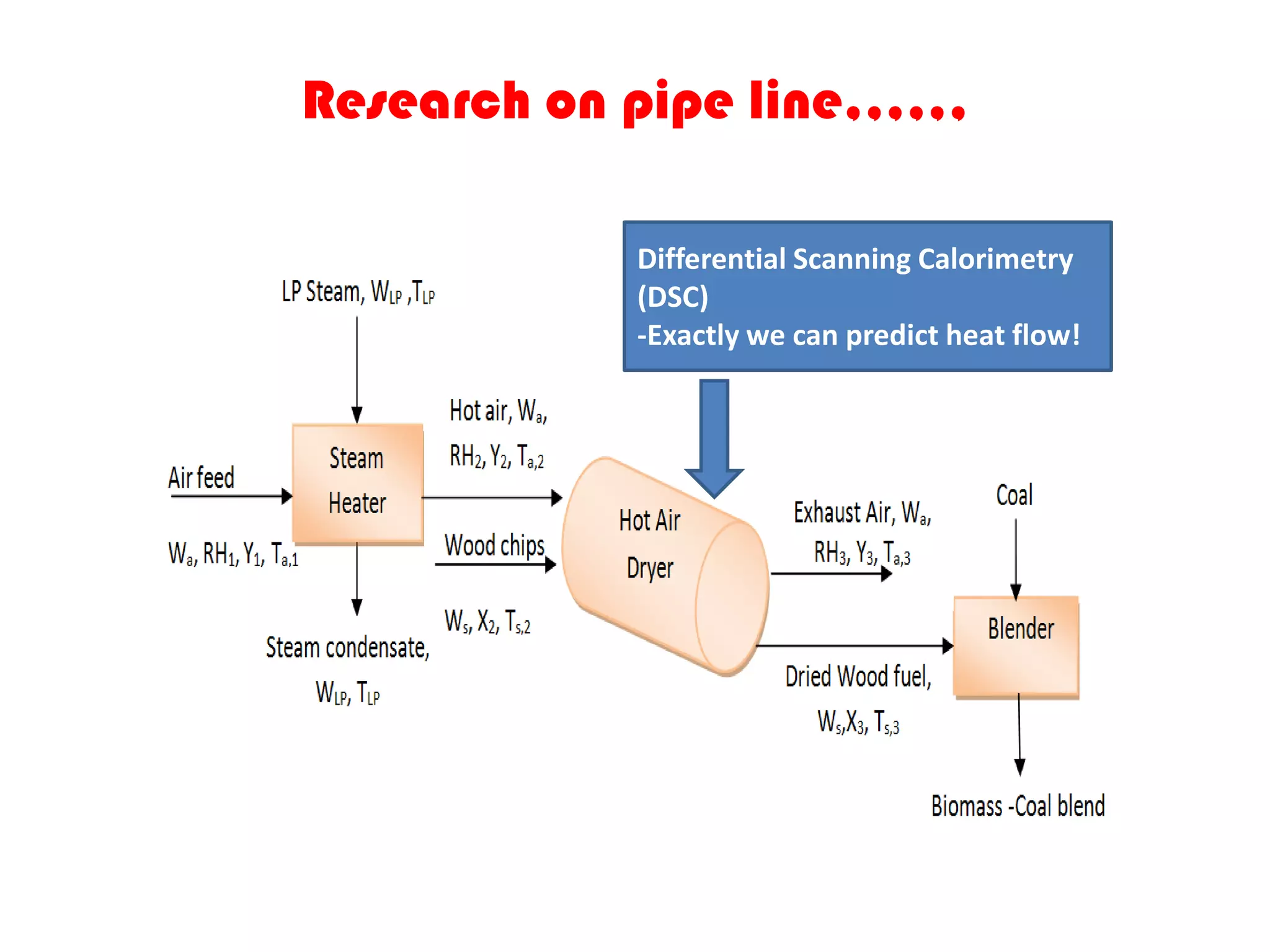
Research on pipe line,,,,,,

             Differential Scanning Calorimetry
             (DSC)
             -Exactly we can predict heat flow!
Thank you

  Go green!

Biomass drying for combustion

  • 1.
  • 2.
    o ptimum Biomass Drying for Combustion – A Modeling Approach Tesfaldet G tgaa@ust.hk March-11-2013
  • 4.
    Contents • Biomass Types •Biomass to Energy Routes • Biomass drying for heating value Enhancement-Modeling and optimization • Results • Discussions • Future work
  • 5.
    Biomass Types • Notlimited to woody biomass and crops . • Includes some organic wastes with high moisture contents like sludge ,microalgae and etc .
  • 6.
    Biomass to EnergyRoutes •While biomass with moisture levels of 55 - 65wt% can sustain combustion, the optimum moisture content is 10wt% - 15wt%. http://www.toyo-eng.co.jp/en/product_line/environment/baiomass/index.html
  • 7.
    Why Drying? • Burningbiomass with high moisture content : • reduces the combustion temperature • incomplete combustion • undesirable reaction products • requires a large amount of auxiliary fuel to make it combustible • Drying of biomass: – Can increase the combustion efficiency, reduce pollution and improve operation. • BUT – Drying of biomass is an expensive process that requires huge capital investment and energy input. • Therefore ,the level of drying should be optimized.
  • 8.
    Biomass Drying forcombustion-Modeling GOAL • To develop a validated model of the drying kinetics of solids like wood, solid wastes and sludge for heating value enhancement before combustion process. • To use the model to analyze the drying time , moisture removal rate ,Energy requirement and design parameters for practical drying of solids. How? • Material and energy balances, heat transfer and drying kinetics.
  • 9.
    Drying process • Regardlessof drying particle shape, there exists simultaneous heat and mass transport.
  • 10.
    Drying….. Solid in Heat source? Air in Heater Hot air Exit air Solid out Air •TGA………………..…☑ •Temperature ……☑ •TG-DSC……………. ☒ •Humidity ………….☑ •Dryer Type …....…☒ •Velocity ……………☒ •Drying models……☒
  • 11.
    Things to do AirHeater • Mathematical model- Psychometric analysis Dryer • Drying kinetics models- • Experiment-Thermogravimetric analysis (TGA) • Sample (Type, shape, moisture content) Product value • Heating value enhancement.
  • 12.
    Air heater • Thecorresponding property change of air for moisture removal from the solid is calculated by making use of psychometric relations (equations). • The air heater cost was determined for the required air property change.
  • 13.
    Dryer • For sizingthe dryer as well as determining the level of the drying, it is important to obtain the drying kinetics of which the drying rate inside the dryer is calculated.
  • 14.
    Drying Kinetics models •General forms: 1. Diffusion based model….Fick’s Diffusion Equation 2. Thin layer drying curve based models (log, modified log)
  • 15.
  • 16.
    Experimental Drying kineticsdetermination • The moisture ratio is determined using TGA. 1 0.9 0.8 0.7 Moisture Ratio 0.6 60°C 0.5 70°C 0.4 80°C 0.3 90°C 0.2 0.1 0 0 100 200 300 400 500 600 Drying Time (sec) -20.2 -20.3 lnDeff -20.4 -20.5 ln(Deff) -20.6 -20.7 -20.8 y = -2045.x - 14.71 R² = 0.936 -20.9 0.0027 0.0028 0.0029 0.003 0.0031 1/T
  • 17.
    The product value •Monetary value gained upon drying.
  • 18.
  • 19.
    Objective Function • Maximizingthe net annual profit (AP) of the process represented by : AP= Product value- (Heater cost +Dryer cost+ Operating Cost) • Operating cost=Steam cost Constraints 1. Air preheated temperature, 60oC Ta,2 110oC 2. Relative Humidity of the exhaust air, RH3 60% 3. The LHV of the final product, LHV 15MJ/Kg 4. Residence time > 100sec • Solver • Standard GRG Non-linear Solver-Excel.
  • 20.
    Design parameters Parameters Value Feed rate of wood chips, Ws,1 (Kg/hr) 5000 Moisture ratio of the wood feed, X1 1 Temperature of the wood feed, Ts,2 ( C) 25 Pressure of the air feed, Pa,1 1atm or 101325Pa Temperature of the air feed, Ta,1 ( C) 25 Relative Humidity of the air feed, RH1 (%) 50 Temperature difference of air and solid at the dryer outlet, DT ( C) 5 Air heater Cost, Chtr ($/yr) 500 + 100 A 0.8 Dryer Cost , Cdyr ($/yr) 5000 + 5000 V 0.6 Steam Cost, CLP ($/kW) 0.1 Heat value of wood ($/kW) 0.05 Specific Heat of Air, Cpda( kJ/kg-C) 1.006 Specific Heat of Wood, Cpds, (kJ/kg) 1.2566 Specific Heat of Water Vapor, Cpv , (kJ/kg-C 1.89 Specific Heat of Water, Cpw, (kJ/kg-C) 4.186 Latent Heat of Water, LHw, (kJ/kg-C) 2270 Latent heat of LP steam, LHLP (KJ/Kg) 1999 Size of the wood , L, (m) 0.0005 Annual operation time, top (hrs) 2000
  • 21.
    Results Base Case/1 Case 2 Case 3 Case 4 (L=0.05m) (L=0.0005m) (L=0.005m ) (L=0.05m) Moisture content of the dried wood, X3 (wt %) 17 17 17 43 LHV of the dried wood, LHVs (KJ/kg) 15000 15000 15000 9698 Solid residence time, t (hr) 0.11 8 247 0.03 Air feed rate, Wa,1 (kg/hr) 179,496 83,358 158,187 59,842 Air preheated temperature, Ta,2 (°C) 62 97 107 60 Air Exhausted Temperature Ta,3 (°C) 35 43 78 35 Heater Cost ($/yr) 50,250 71,138 160,818 21,161 Dryer Cost ($/yr) 21,495 219,008 1,700,822 12,237 Energy Cost ($/yr) 357,913 353,818 766,027 119,324 Product Value ($/yr) 1,260,453 1,260,453 1,260,453 1,172,979 Annual Profit ($/Yr) 830,795 616,489 -1,367,214 1,020,258
  • 22.
    Discussion • The optimumsolutions indicated that the size of the wood chips strongly affects the economy. • When the size of the wood chips become too large, the drying time becomes too long thus significantly increases the dryer size and energy cost. • Another observation is that if a lower heating value of the dried wood chips is acceptable, the profitability is resumed. • in order to satisfy the constraint of minimum heating value without upsetting the environment and/or operation of the combustion process when drying too large or too wet biomass, auxiliary fuel is one of the options to be considered.
  • 24.
    Research on pipeline,,,,,, Differential Scanning Calorimetry (DSC) -Exactly we can predict heat flow!
  • 25.
    Thank you Go green!