
BIOLOGY FORM 4 
CHAPTER 7 
RESPIRATION PART 2
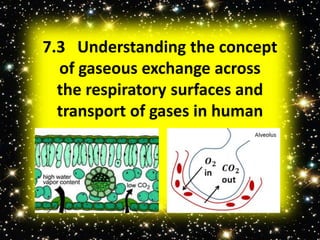
7.3 Understanding the concept 
of gaseous exchange across 
the respiratory surfaces and 
transport of gases in human
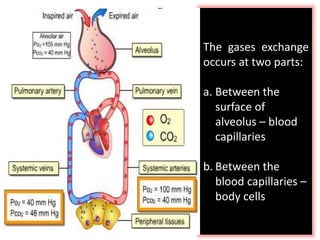
The gases exchange 
occurs at two parts: 
a. Between the 
surface of 
alveolus – blood 
capillaries 
b. Between the 
blood capillaries – 
body cells
IN THE LUNGS
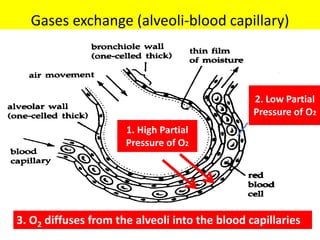
Gases exchange (alveoli-blood capillary) 
1. High Partial 
Pressure of O2 
2. Low Partial 
Pressure of O2 
3. O2 diffuses from the alveoli into the blood capillaries
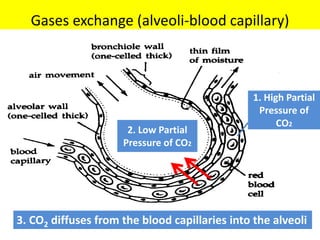
Gases exchange (alveoli-blood capillary) 
2. Low Partial 
Pressure of CO2 
1. High Partial 
Pressure of 
CO2 
3. CO2 diffuses from the blood capillaries into the alveoli
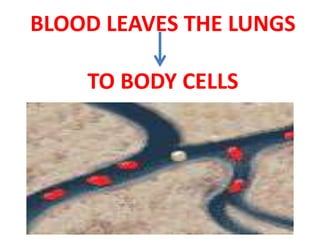
BLOOD LEAVES THE LUNGS 
TO BODY CELLS
The Transport of Respiratory Gases in Humans 
a) Transport of O2 from lungs to body cell 
1. O2 is transported from alveoli to the 
body cells for cellular respiration 
2. O2 combines with a pigment called 
haemoglobin in the red blood cells 
3. O2 is carried in the form of 
oxyhaemoglobin to all parts of the body: 
Haemoglobin + O2 → Oxyhaemoglobin
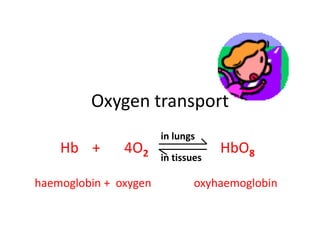
Oxygen transport 
in lungs 
Hb + 4O2 HbO8 
in tissues 
haemoglobin + oxygen oxyhaemoglobin
BLOOD REACHES 
THE CELL
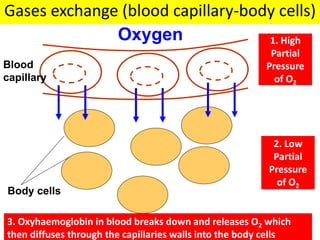
Gases exchange (blood capillary-body cells) 
Oxygen 
Blood 
capillary 
Body cells 
1. High 
Partial 
Pressure 
of O2 
2. Low 
Partial 
Pressure 
of O2 
3. Oxyhaemoglobin in blood breaks down and releases O2 which 
then diffuses through the capillaries walls into the body cells
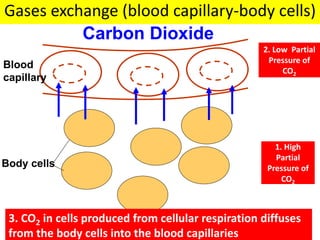
Gases exchange (blood capillary-body cells) 
Carbon Dioxide 
Blood 
capillary 
Body cells 
2. Low Partial 
Pressure of 
CO2 
1. High 
Partial 
Pressure of 
CO2 
3. CO2 in cells produced from cellular respiration diffuses 
from the body cells into the blood capillaries
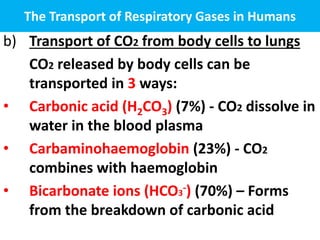
The Transport of Respiratory Gases in Humans 
b) Transport of CO2 from body cells to lungs 
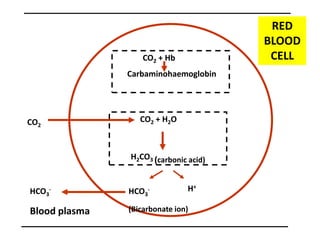
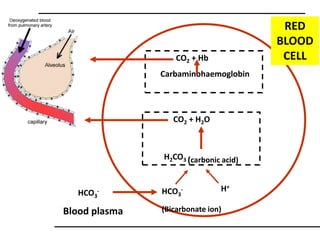
CO2 released by body cells can be 
transported in 3 ways: 
• Carbonic acid (H2CO3) (7%) - CO2 dissolve in 
water in the blood plasma 
• Carbaminohaemoglobin (23%) - CO2 
combines with haemoglobin 
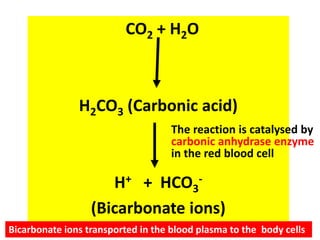
• Bicarbonate ions (HCO3-) (70%) – Forms 
from the breakdown of carbonic acid
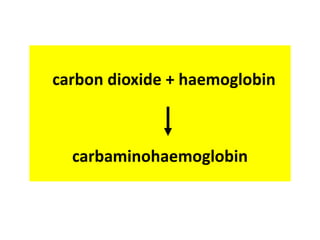
carbon dioxide + haemoglobin 
carbaminohaemoglobin
CO2 + H2O 
H2CO3 (Carbonic acid) 
The reaction is catalysed by 
carbonic anhydrase enzyme 
in the red blood cell 
H+ + HCO3 
- 
(Bicarbonate ions) 
Bicarbonate ions transported in the blood plasma to the body cells
CO2 + Hb 
Carbaminohaemoglobin 
CO2 + H2O 
H2CO3 (carbonic acid) 
- 
HCO3 
H+ 
(Bicarbonate ion) 
- 
Blood plasma 
RED 
BLOOD 
CELL 
CO2 
HCO3
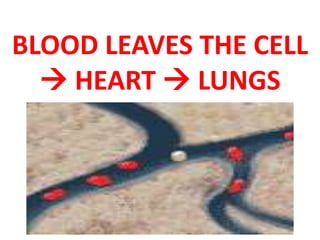
BLOOD LEAVES THE CELL 
 HEART  LUNGS
BLOOD REACHES 
THE LUNGS
CO2 + Hb 
Carbaminohaemoglobin 
CO2 + H2O 
H2CO3 (carbonic acid) 
- 
HCO3 
H+ 
(Bicarbonate ion) 
- 
Blood plasma 
RED 
BLOOD 
CELL 
HCO3
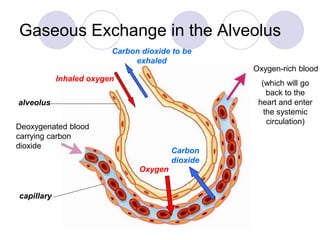
Gaseous Exchange in the Alveolus 
alveolus 
Deoxygenated blood 
carrying carbon 
dioxide 
Oxygen-rich blood 
Carbon dioxide to be 
Oxygen 
Carbon 
dioxide 
(which will go 
back to the 
heart and enter 
the systemic 
circulation) 
Inhaled oxygen 
exhaled 
capillary
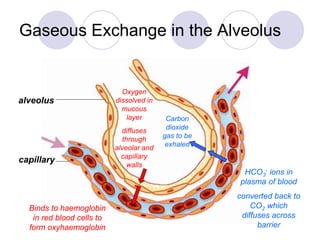
Gaseous Exchange in the Alveolus 
Oxygen 
dissolved in 
mucous 
layer 
diffuses 
through 
alveolar and 
capillary 
walls 
alveolus 
capillary 
Carbon 
dioxide 
gas to be 
exhaled 
Binds to haemoglobin 
in red blood cells to 
form oxyhaemoglobin 
HCO3 
- ions in 
plasma of blood 
converted back to 
CO2 which 
diffuses across 
barrier
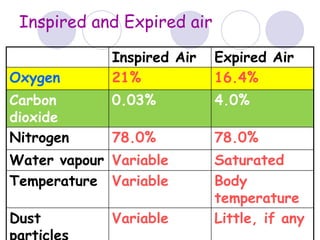
The composition of inhaled 
and exhaled air
Inspired and Expired air 
Inspired Air Expired Air 
Oxygen 21% 16.4% 
Carbon 
0.03% 4.0% 
dioxide 
Nitrogen 78.0% 78.0% 
Water vapour Variable Saturated 
Temperature Variable Body 
temperature 
Dust 
particles 
Variable Little, if any
Compare the Oxygen 
Content of Inhaled & 
Exhaled Air
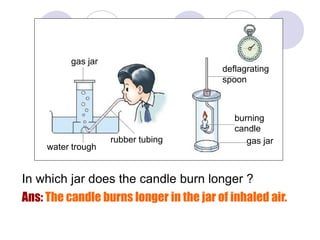
deflagrating 
spoon 
burning 
candle 
gas jar 
gas jar 
water trough 
rubber tubing 
In which jar does the candle burn longer ? 
Ans: The candle burns longer in the jar of inhaled air.
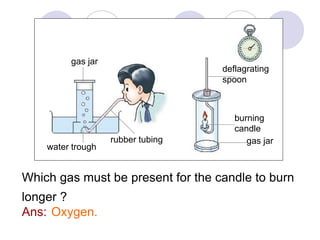
deflagrating 
spoon 
burning 
candle 
gas jar 
gas jar 
water trough 
rubber tubing 
Which gas must be present for the candle to burn 
longer ? 
Ans: Oxygen.
burning 
candle 
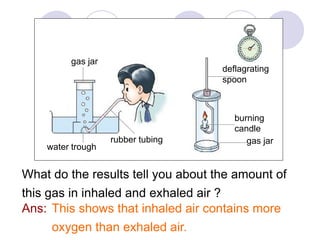
What do the results tell you about the amount of 
this gas in inhaled and exhaled air ? 
This shows that inhaled air contains more 
oxygen than exhaled air. 
Ans: 
deflagrating 
spoon 
gas jar 
water trough 
rubber tubing 
gas jar
burning 
candle 
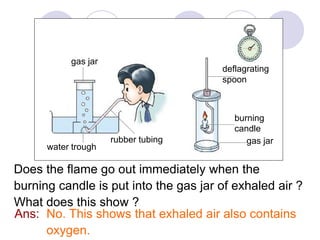
Does the flame go out immediately when the 
burning candle is put into the gas jar of exhaled air ? 
What does this show ? 
No. This shows that exhaled air also contains 
oxygen. 
Ans: 
deflagrating 
spoon 
gas jar 
water trough 
rubber tubing 
gas jar
Compare the Carbon Dioxide 
Content of Inhaled & Exhaled 
Air
A B 
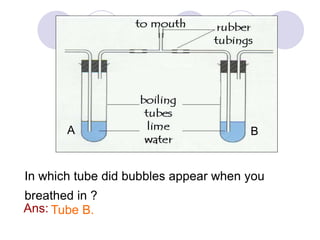
In which tube did bubbles appear when you 
breathed in ? 
Ans: Tube B.
A B 
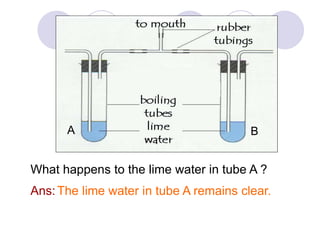
What happens to the lime water in tube A ? 
Ans:The lime water in tube A remains clear.
A B 
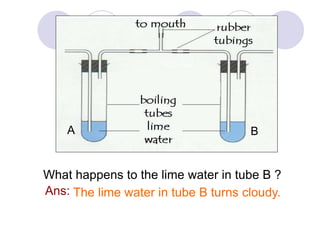
What happens to the lime water in tube B ? 
Ans: The lime water in tube B turns cloudy.
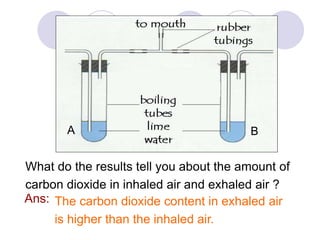
What do the results tell you about the amount of 
carbon dioxide in inhaled air and exhaled air ? 
The carbon dioxide content in exhaled air 
is higher than the inhaled air. 
Ans: 
A B
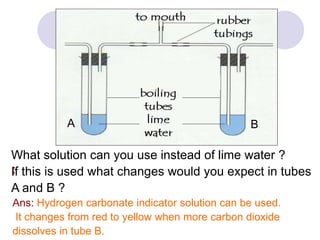
What solution can you use instead of lime water ? 
If : 
this is used what changes would you expect in tubes 
A and B ? 
Ans: Hydrogen carbonate indicator solution can be used. 
It changes from red to yellow when more carbon dioxide 
dissolves in tube B. 
A B
J TUBE EXPERIMENT
7.4 
Understanding the regulatory 
mechanism in respiration
Control of breathing
Breathing 
is an involuntary function of the CNS 
a respiratory / breathing center in the 
medulla oblongata [part of brain stem] : 
 establishes basic breathing pattern 
Brain stem Spinal cord
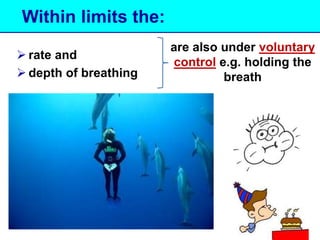
Within limits the: 
 rate and 
 depth of breathing 
are also under voluntary 
control e.g. holding the 
breath
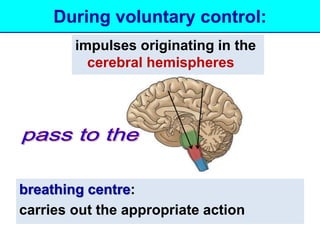
During voluntary control: 
impulses originating in the 
cerebral hemispheres 
breathing centre: 
carries out the appropriate action
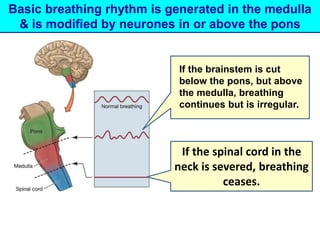
Basic breathing rhythm is generated in the medulla 
& is modified by neurones in or above the pons 
If the brainstem is cut 
below the pons, but above 
the medulla, breathing 
continues but is irregular. 
If the spinal cord in the 
neck is severed, breathing 
ceases.
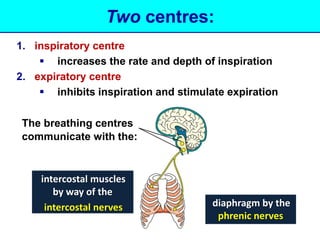
Two centres: 
1. inspiratory centre 
 increases the rate and depth of inspiration 
2. expiratory centre 
 inhibits inspiration and stimulate expiration 
The breathing centres 
intercostal muscles 
by way of the 
intercostal nerves diaphragm by the 
phrenic nerves 
communicate with the:
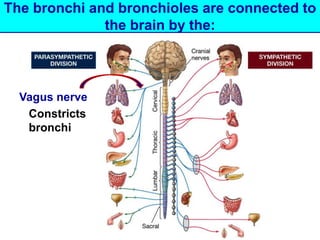
The bronchi and bronchioles are connected to 
the brain by the: 
Vagus nerve 
Constricts 
bronchi
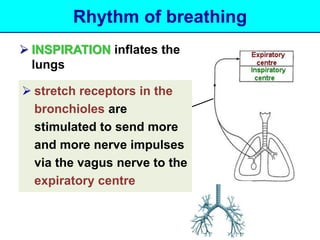
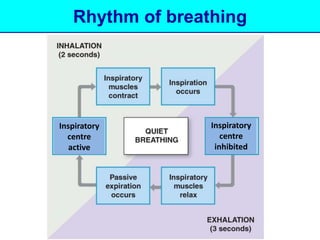
Rhythm of breathing 
 INSPIRATION inflates the 
lungs 
 stretch receptors in the 
bronchioles are 
stimulated to send more 
and more nerve impulses 
via the vagus nerve to the 
expiratory centre
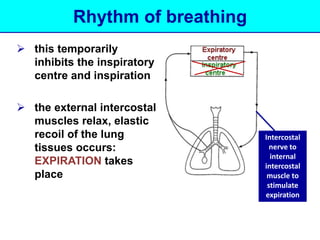
Rhythm of breathing 
 this temporarily 
inhibits the inspiratory 
centre and inspiration 
 the external intercostal 
muscles relax, elastic 
recoil of the lung 
tissues occurs: 
EXPIRATION takes 
place 
Intercostal 
nerve to 
internal 
intercostal 
muscle to 
stimulate 
expiration
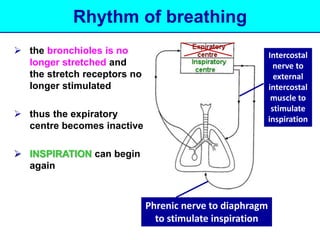
Rhythm of breathing 
 the bronchioles is no 
longer stretched and 
the stretch receptors no 
longer stimulated 
 thus the expiratory 
centre becomes inactive 
 INSPIRATION can begin 
again 
Phrenic nerve to diaphragm 
to stimulate inspiration 
Intercostal 
nerve to 
external 
intercostal 
muscle to 
stimulate 
inspiration
Rhythm of breathing 
Inspiratory 
centre 
active 
Inspiratory 
centre 
inhibited
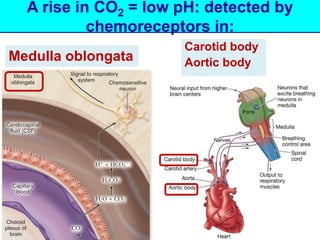
A rise in CO2 = low pH: detected by 
chemoreceptors in: 
Medulla oblongata 
Carotid body 
Aortic body
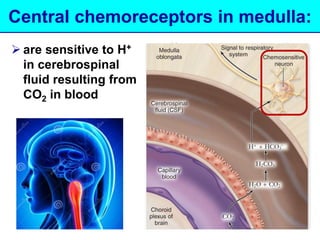
Central chemoreceptors in medulla: 
 are sensitive to H+ 
in cerebrospinal 
fluid resulting from 
CO2 in blood
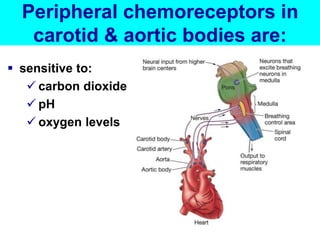
Peripheral chemoreceptors in 
carotid & aortic bodies are: 
 sensitive to: 
 carbon dioxide 
 pH 
 oxygen levels
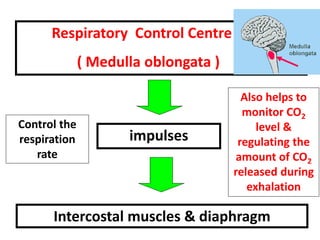
Respiratory Control Centre 
( Medulla oblongata ) 
impulses 
Also helps to 
monitor CO2 
level & 
regulating the 
amount of CO2 
released during 
exhalation 
Control the 
respiration 
rate 
Intercostal muscles & diaphragm
REGULATION OF CO2 LEVELS
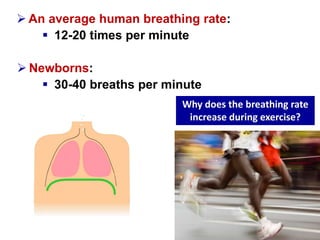
 An average human breathing rate: 
 12-20 times per minute 
 Newborns: 
 30-40 breaths per minute 
Why does the breathing rate 
increase during exercise?
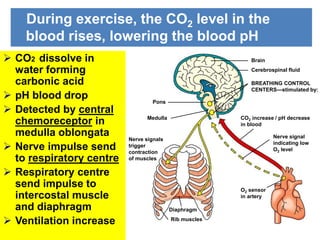
During exercise, the CO2 level in the 
blood rises, lowering the blood pH 
Brain 
Cerebrospinal fluid 
BREATHING CONTROL 
CENTERS—stimulated by: 
CO2 increase / pH decrease 
in blood 
Nerve signal 
indicating low 
O2 level 
O2 sensor 
in artery 
Pons 
Medulla 
Nerve signals 
trigger 
contraction 
of muscles 
Diaphragm 
Rib muscles 
 CO2 dissolve in 
water forming 
carbonic acid 
 pH blood drop 
 Detected by central 
chemoreceptor in 
medulla oblongata 
 Nerve impulse send 
to respiratory centre 
 Respiratory centre 
send impulse to 
intercostal muscle 
and diaphragm 
 Ventilation increase
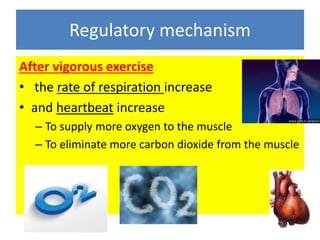
Regulatory mechanism 
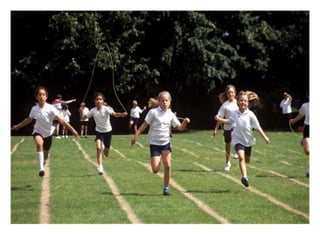
After vigorous exercise 
• the rate of respiration increase 
• and heartbeat increase 
– To supply more oxygen to the muscle 
– To eliminate more carbon dioxide from the muscle
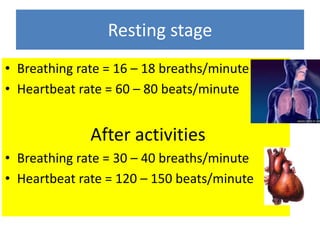
Resting stage 
• Breathing rate = 16 – 18 breaths/minute 
• Heartbeat rate = 60 – 80 beats/minute 
After activities 
• Breathing rate = 30 – 40 breaths/minute 
• Heartbeat rate = 120 – 150 beats/minute
CO2 
Water 
Carbonic acid pH 
Central chemoreceptor 
[medulla oblongata] 
Impulse 
Respiratory centre 
Detected by 
Impulse 
Intercostals muscle diaphragm 
Ventilation faster CO2 eliminate faster
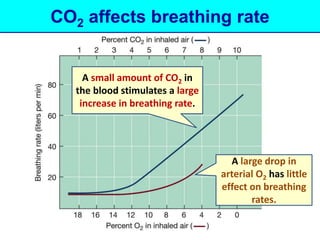
CO2 affects breathing rate 
A large drop in 
arterial O2 has little 
effect on breathing 
rates. 
A small amount of CO2 in 
the blood stimulates a large 
increase in breathing rate.
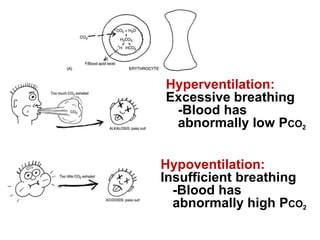
Hyperventilation: 
Excessive breathing 
-Blood has 
abnormally low PCO2 
Hypoventilation: 
Insufficient breathing 
-Blood has 
abnormally high PCO2
Q: Correlate the rate of respiration with 
the rate of heart beat 
• During vigorous exercise, the muscle require 
more O2 and glucose to release more energy 
during cellular respiration. Therefore, the rate of 
respiration increases 
• In order to supply more O2, the rate and depth of 
breathing increases 
• This means the breathing rate increases (no. of 
breath per minute) 
• At the same time, the heartbeat rate increases to 
pump more blood into circulation
Q: Correlate the rate of respiration with 
the rate of heart beat 
• This enable more O2 and glucose to be 
supplied for cellular respiration and for more 
CO2 to be removed from the cells 
• The ventilation rate also increases 
• Rate of ventilation is the rate of gases 
exchange between the alveoli and blood 
capillaries
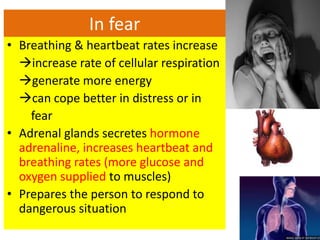
In fear 
• Breathing & heartbeat rates increase 
increase rate of cellular respiration 
generate more energy 
can cope better in distress or in 
fear 
• Adrenal glands secretes hormone 
adrenaline, increases heartbeat and 
breathing rates (more glucose and 
oxygen supplied to muscles) 
• Prepares the person to respond to 
dangerous situation
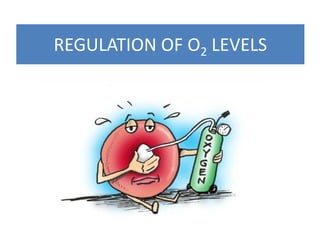
REGULATION OF O2 LEVELS
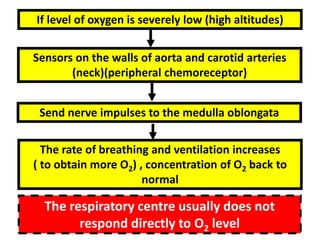
If level of oxygen is severely low (high altitudes) 
Sensors on the walls of aorta and carotid arteries 
(neck)(peripheral chemoreceptor) 
Send nerve impulses to the medulla oblongata 
The rate of breathing and ventilation increases 
( to obtain more O2) , concentration of O2 back to 
normal 
The respiratory centre usually does not 
respond directly to O2 level
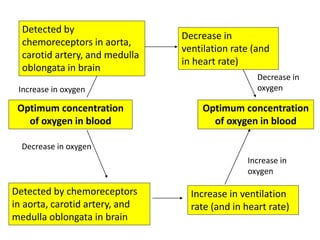
Detected by 
chemoreceptors in aorta, 
carotid artery, and medulla 
oblongata in brain 
Increase in oxygen 
Optimum concentration 
of oxygen in blood 
Decrease in 
ventilation rate (and 
in heart rate) 
Decrease in 
oxygen 
Optimum concentration 
of oxygen in blood 
Decrease in oxygen 
Detected by chemoreceptors 
in aorta, carotid artery, and 
medulla oblongata in brain 
Increase in 
oxygen 
Increase in ventilation 
rate (and in heart rate)
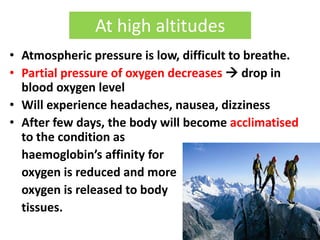
At high altitudes 
• Atmospheric pressure is low, difficult to breathe. 
• Partial pressure of oxygen decreases  drop in 
blood oxygen level 
• Will experience headaches, nausea, dizziness 
• After few days, the body will become acclimatised 
to the condition as 
haemoglobin’s affinity for 
oxygen is reduced and more 
oxygen is released to body 
tissues.
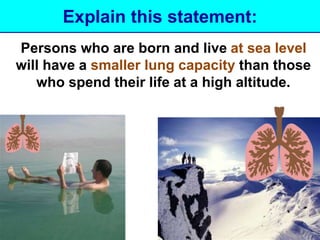
Explain this statement: 
Persons who are born and live at sea level 
will have a smaller lung capacity than those 
who spend their life at a high altitude.
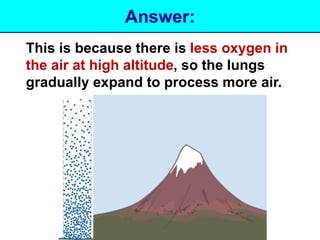
Answer: 
This is because there is less oxygen in 
the air at high altitude, so the lungs 
gradually expand to process more air.
6.5 
Realising the importance of 
maintaining 
a healthy respiratory system
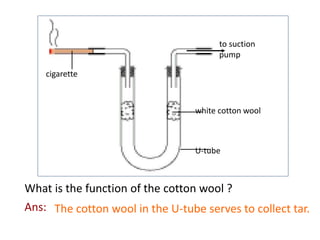
To show the presence 
of Tar in Cigarette 
Smoke
to suction 
pump 
white cotton wool 
U-tube 
cigarette 
What is the function of the cotton wool ? 
The c Ans: otton wool in the U-tube serves to collect tar.
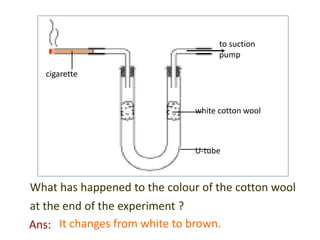
to suction 
pump 
white cotton wool 
U-tube 
cigarette 
What has happened to the colour of the cotton wool 
at the end of the experiment ? 
Ans: It changes from white to brown.
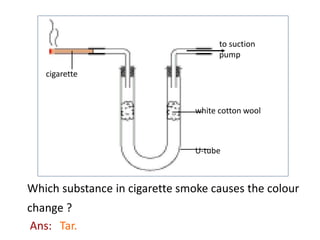
to suction 
pump 
white cotton wool 
U-tube 
cigarette 
Which substance in cigarette smoke causes the colour 
change ? 
Ans: Tar.
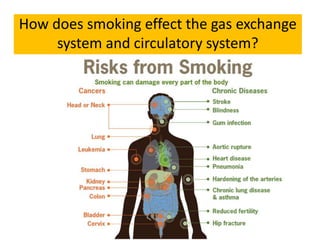
How does smoking effect the gas exchange 
system and circulatory system?
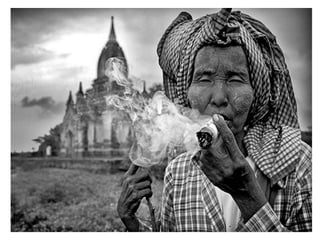
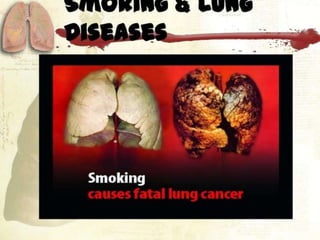
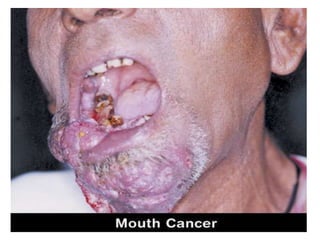
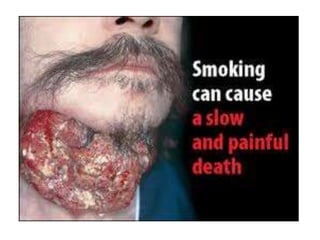
• Smoking contributes to the following lung 
conditions: 
– Lung Cancer 
– Chronic Bronchitis 
– Emphysema 
• Smoking also contributes to: 
– coronary heart disease 
– Ulcers of the stomach and duodenum
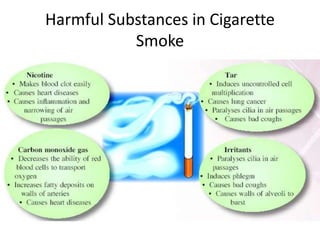
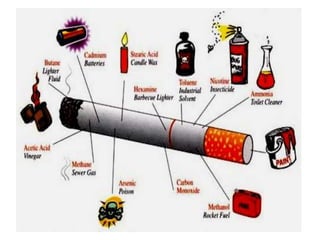
Harmful Substances in Cigarette 
Smoke
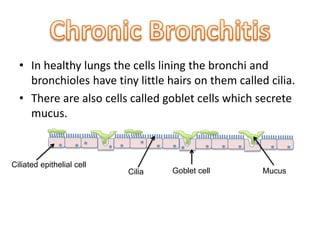
• In healthy lungs the cells lining the bronchi and 
bronchioles have tiny little hairs on them called cilia. 
• There are also cells called goblet cells which secrete 
mucus. 
Ciliated epithelial cell 
Cilia Goblet cell Mucus
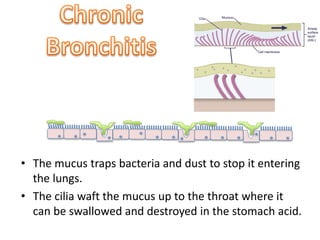
• The mucus traps bacteria and dust to stop it entering 
the lungs. 
• The cilia waft the mucus up to the throat where it 
can be swallowed and destroyed in the stomach acid.
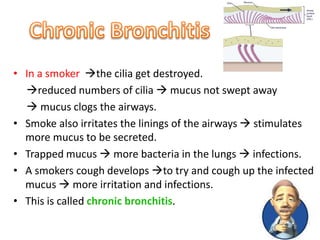
• In a smoker the cilia get destroyed. 
reduced numbers of cilia  mucus not swept away 
 mucus clogs the airways. 
• Smoke also irritates the linings of the airways  stimulates 
more mucus to be secreted. 
• Trapped mucus  more bacteria in the lungs  infections. 
• A smokers cough develops to try and cough up the infected 
mucus  more irritation and infections. 
• This is called chronic bronchitis.
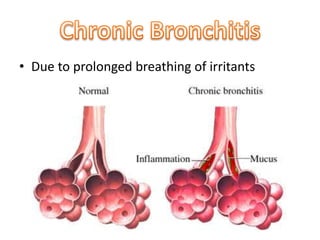
• Due to prolonged breathing of irritants
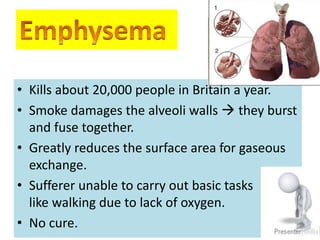
• Kills about 20,000 people in Britain a year. 
• Smoke damages the alveoli walls  they burst 
and fuse together. 
• Greatly reduces the surface area for gaseous 
exchange. 
• Sufferer unable to carry out basic tasks 
like walking due to lack of oxygen. 
• No cure.
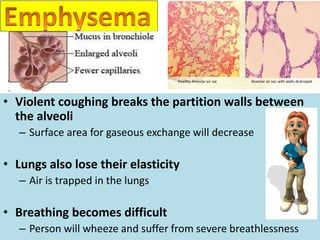
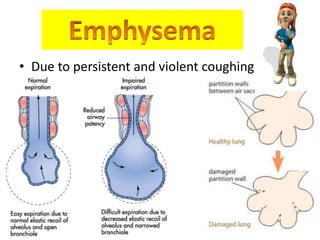
• Violent coughing breaks the partition walls between 
the alveoli 
– Surface area for gaseous exchange will decrease 
• Lungs also lose their elasticity 
– Air is trapped in the lungs 
• Breathing becomes difficult 
– Person will wheeze and suffer from severe breathlessness
• Due to persistent and violent coughing
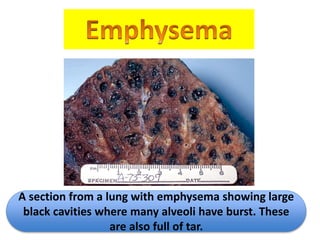
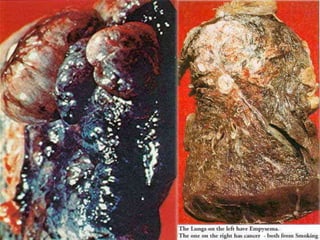
A section from a lung with emphysema showing large 
black cavities where many alveoli have burst. These 
are also full of tar.
http://www.flickr.com/photos/pulmonary_pathology 
/ 
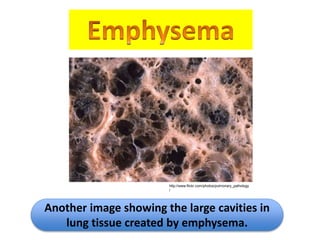
Another image showing the large cavities in 
lung tissue created by emphysema.
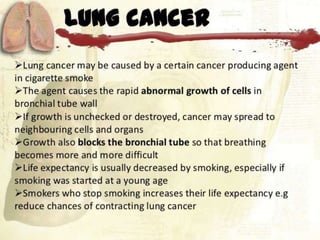
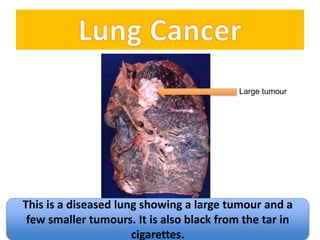
This is a diseased lung showing a large tumour and a 
few smaller tumours. It is also black from the tar in 
cigarettes. 
Large tumour
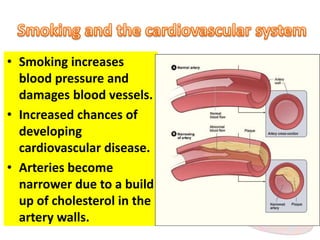
• Smoking increases 
blood pressure and 
damages blood vessels. 
• Increased chances of 
developing 
cardiovascular disease. 
• Arteries become 
narrower due to a build 
up of cholesterol in the 
artery walls.
• More likely to get 
blood clots. 
• Lead to a heart 
attack / stroke.
What is Passive Smoking?
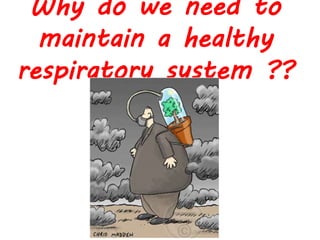
Why do we need to 
maintain a healthy 
respiratory system ??
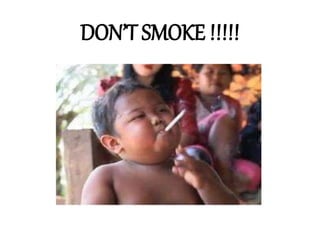
DON’T SMOKE !!!!!
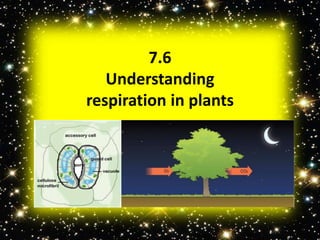
7.6 
Understanding 
respiration in plants
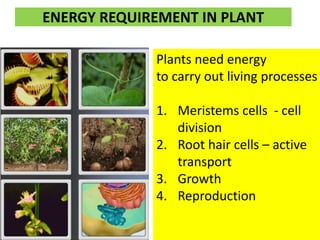
ENERGY REQUIREMENT IN PLANT 
Plants need energy 
to carry out living processes 
1. Meristems cells - cell 
division 
2. Root hair cells – active 
transport 
3. Growth 
4. Reproduction
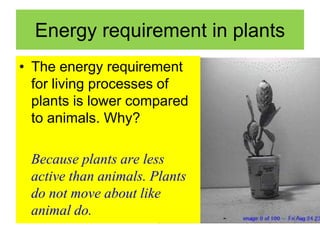
Energy requirement in plants 
• The energy requirement 
for living processes of 
plants is lower compared 
to animals. Why? 
Because plants are less 
active than animals. Plants 
do not move about like 
animal do.
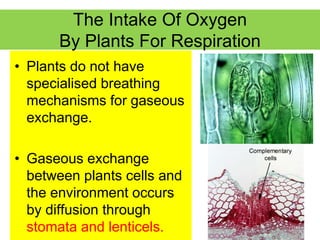
The Intake Of Oxygen 
By Plants For Respiration 
• Plants do not have 
specialised breathing 
mechanisms for gaseous 
exchange. 
• Gaseous exchange 
between plants cells and 
the environment occurs 
by diffusion through 
stomata and lenticels.
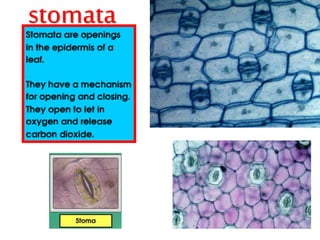
stomata
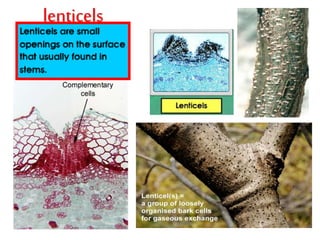
lenticels
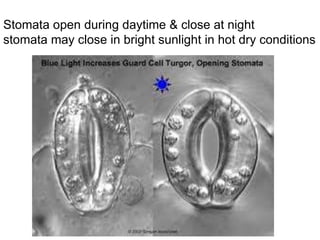
Stomata open during daytime & close at night 
stomata may close in bright sunlight in hot dry conditions
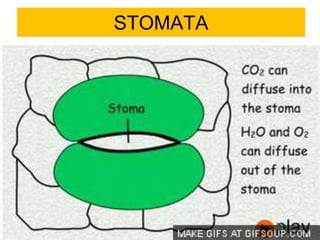
STOMATA
Upper 
epidermis 
Lower 
epidermis 
Cuticle 
Palisade 
mesophyll 
Vascular 
bundle 
Xylem 
Phloem 
Spongy 
mesophyll 
Air 
space 
stoma 
O2 
CO2
Gaseous Exchange in Plants 
–depends on the rates of photosynthesis 
& respiration 
- at daytime with light, stomata open 
photosynthetic rate > respiration rate 
CO2 absorbed
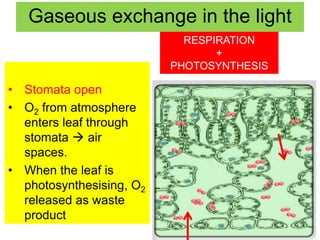
Gaseous exchange in the light 
• Stomata open 
• O2 from atmosphere 
enters leaf through 
stomata  air 
spaces. 
• When the leaf is 
photosynthesising, O2 
released as waste 
product 
RESPIRATION 
+ 
PHOTOSYNTHESIS
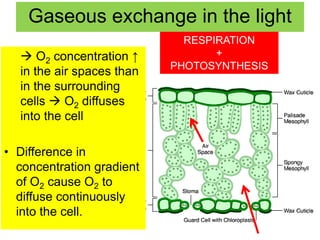
Gaseous exchange in the light 
 O2 concentration ↑ 
in the air spaces than 
in the surrounding 
cells  O2 diffuses 
into the cell 
• Difference in 
concentration gradient 
of O2 cause O2 to 
diffuse continuously 
into the cell. 
RESPIRATION 
+ 
PHOTOSYNTHESIS
Gaseous Exchange in Plants 
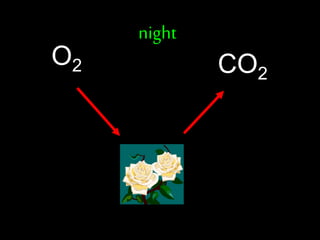
- at night with stomata closed, 
∵ no photosynthesis carried out, 
only respiration occurred 
O2 absorbed
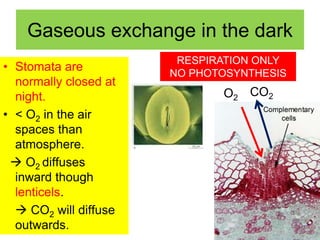
Gaseous exchange in the dark 
• Stomata are 
normally closed at 
night. 
• < O2 in the air 
spaces than 
atmosphere. 
 O2 diffuses 
inward though 
lenticels. 
 CO2 will diffuse 
outwards. 
RESPIRATION ONLY 
NO PHOTOSYNTHESIS 
O2 CO2
AEROBIC AND ANAEROBIC RESPIRATION IN PLANTS 
2 Types of respiration in plants : 
a) aerobic 
b) anaerobic
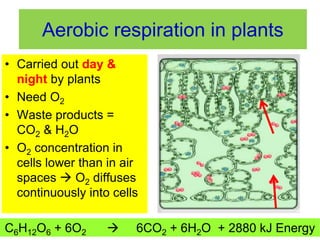
Aerobic respiration in plants 
• Carried out day & 
night by plants 
• Need O2 
• Waste products = 
CO2 & H2O 
• O2 concentration in 
cells lower than in air 
spaces  O2 diffuses 
continuously into cells 
C6H12O6 + 6O2 
 6CO2 + 6H2O + 2880 kJ Energy
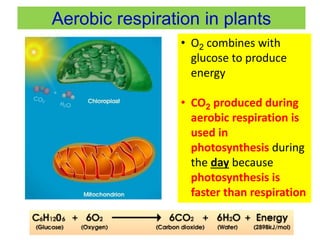
Aerobic respiration in plants 
• O2 combines with 
glucose to produce 
energy 
• CO2 produced during 
aerobic respiration is 
used in 
photosynthesis during 
the day because 
photosynthesis is 
faster than respiration
Anaerobic respiration in plants 
• Yeast respires anaerobically to produce alcohol 
(alcoholic fermentation).
Anaerobic respiration in plants 
• For short periods. 
• During flooding, plants 
can survive for several 
days completely 
submerged in water. 
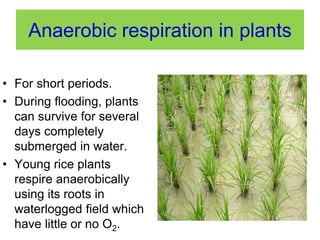
• Young rice plants 
respire anaerobically 
using its roots in 
waterlogged field which 
have little or no O2.
Anaerobic respiration in plants 
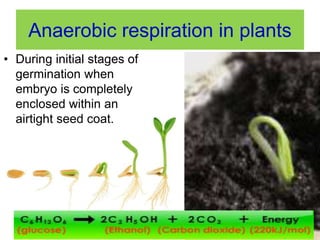
• During initial stages of 
germination when 
embryo is completely 
enclosed within an 
airtight seed coat.
Aerobic & Anaerobic Respiration 
in Plants. 
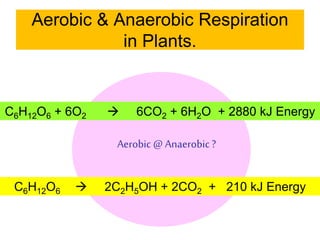
C6H12O6 + 6O2 
 6CO2 + 6H2O + 2880 kJ Energy 
C6H12O6 
Aerobic @ Anaerobic ? 
 2C2H5OH + 2CO2 + 210 kJ Energy
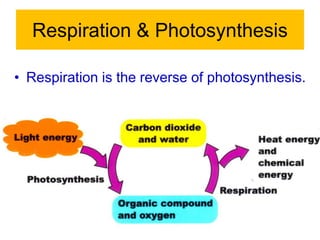
Respiration & Photosynthesis 
• Respiration is the reverse of photosynthesis.
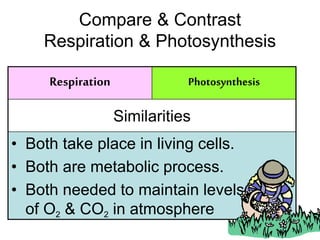
Compare & Contrast 
Respiration & Photosynthesis 
Respiration Photosynthesis 
Similarities 
• Both take place in living cells. 
• Both are metabolic process. 
• Both needed to maintain levels 
of O2 & CO2 in atmosphere
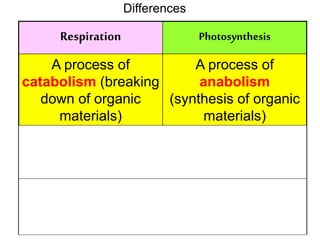
Differences 
Respiration Photosynthesis 
A process of 
catabolism (breaking 
down of organic 
materials) 
A process of 
anabolism 
(synthesis of organic 
materials) 
Occurs in all living 
cells 
Occurs in cells 
containing 
chlorophyll. 
Take place in the 
presence / absence 
of light 
Takes place only in 
the presence of light
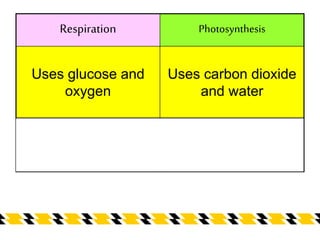
Respiration Photosynthesis 
Uses glucose and 
oxygen 
Uses carbon dioxide 
and water 
Produces carbon 
dioxide and water 
Produces glucose 
and oxygen
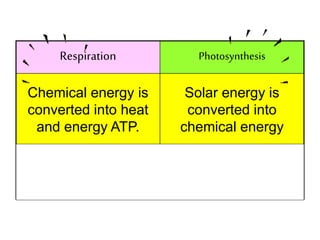
Respiration Photosynthesis 
Chemical energy is 
converted into heat 
and energy ATP. 
Solar energy is 
converted into 
chemical energy 
Cell loses weight Cell gains weight
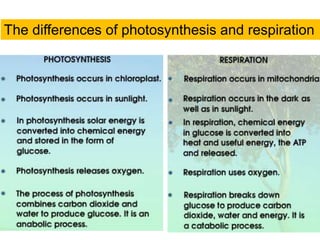
The differences of photosynthesis and respiration
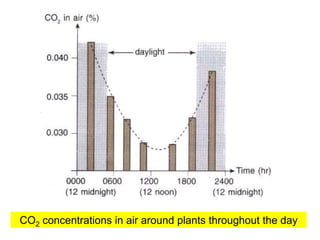
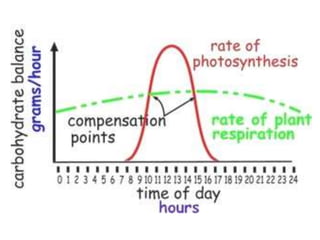
CO2 concentrations in air around plants throughout the day
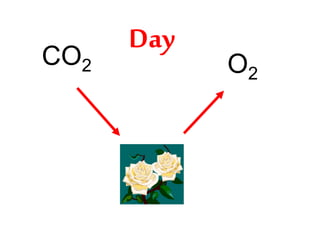
Day 
CO2 O2
night 
O2 CO2
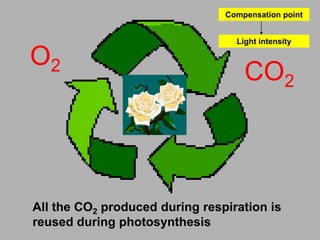
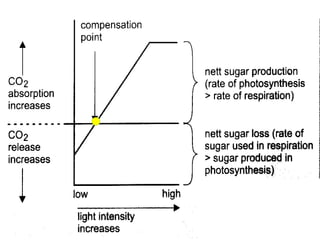
Compensation point 
Light intensity 
O2 CO2 
All the CO2 produced during respiration is 
reused during photosynthesis
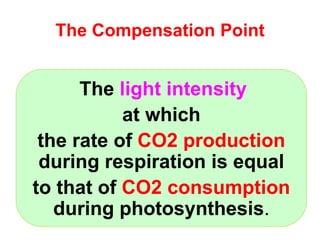
The Compensation Point 
The light intensity 
at which 
the rate of CO2 production 
during respiration is equal 
to that of CO2 consumption 
during photosynthesis.
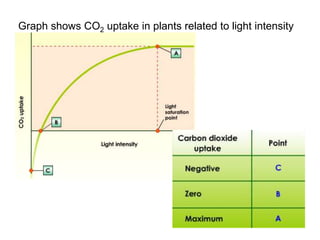
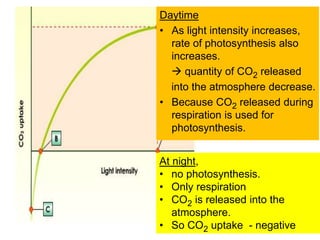
Graph shows CO2 uptake in plants related to light intensity
Daytime 
• As light intensity increases, 
rate of photosynthesis also 
increases. 
 quantity of CO2 released 
into the atmosphere decrease. 
• Because CO2 released during 
respiration is used for 
photosynthesis. 
At night, 
• no photosynthesis. 
• Only respiration 
• CO2 is released into the 
atmosphere. 
• So CO2 uptake - negative
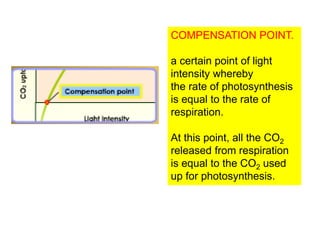
COMPENSATION POINT. 
a certain point of light 
intensity whereby 
the rate of photosynthesis 
is equal to the rate of 
respiration. 
At this point, all the CO2 
released from respiration 
is equal to the CO2 used 
up for photosynthesis.
If the rate of photosynthesis and the rate of 
respiration remained at compensation point: 
• The plant would not be able to store 
food. 
• There would be no growth and 
development in green plants. 
• No oxygen released into the 
atmosphere to sustain living things.
THE END
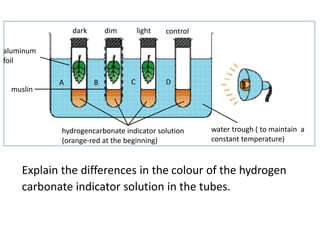
To study the Effect of Light 
Intensity on Carbon Dioxide 
Exchange in Plants
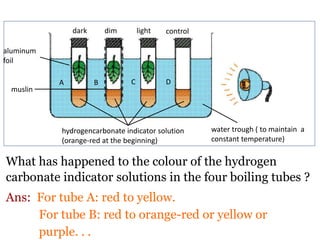
water trough ( to maintain a 
constant temperature) 
dark dim light control 
A B C D 
hydrogencarbonate indicator solution 
(orange-red at the beginning) 
What has happened to the colour of the hydrogen 
carbonate indicator solutions in the four boiling tubes ? 
Ans: For tube A: red to yellow. 
For tube B: red to orange-red or yellow or 
purple. . . 
aluminum 
foil 
muslin
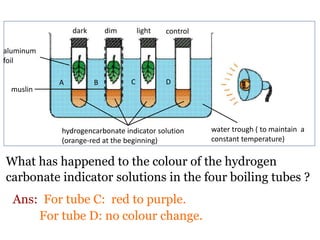
Ans: For tube C: red to purple. 
For tube D: no colour change. 
water trough ( to maintain a 
constant temperature) 
dark dim light control 
A B C D 
hydrogencarbonate indicator solution 
(orange-red at the beginning) 
aluminum 
foil 
muslin 
What has happened to the colour of the hydrogen 
carbonate indicator solutions in the four boiling tubes ?
water trough ( to maintain a 
constant temperature) 
dark dim light control 
A B C D 
hydrogencarbonate indicator solution 
(orange-red at the beginning) 
aluminum 
foil 
muslin 
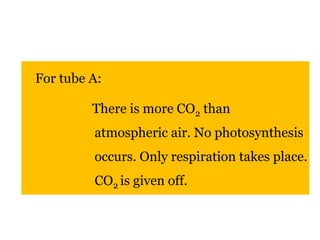
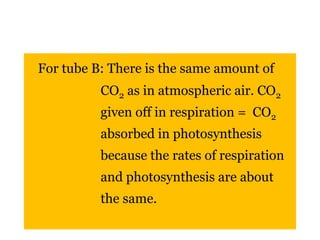
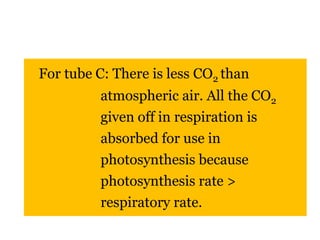
Explain the differences in the colour of the hydrogen 
carbonate indicator solution in the tubes.
For tube A: 
There is more CO2 than 
atmospheric air. No photosynthesis 
occurs. Only respiration takes place. 
CO2 is given off.
For tube B: There is the same amount of 
CO2 as in atmospheric air. CO2 
given off in respiration = CO2 
absorbed in photosynthesis 
because the rates of respiration 
and photosynthesis are about 
the same.
For tube C: There is less CO2 than 
atmospheric air. All the CO2 
given off in respiration is 
absorbed for use in 
photosynthesis because 
photosynthesis rate > 
respiratory rate.
For tube D: This is the control. 
Photosynthesis and 
respiration do not occur 
because there is no leaf.
water trough ( to maintain a 
constant temperature) 
dark dim light control 
A B C D 
hydrogencarbonate indicator solution 
(orange-red at the beginning) 
aluminum 
foil 
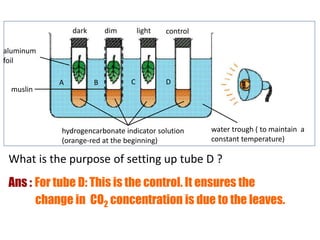
What is the purpose of setting up tube D ? 
Ans : For tube D: This is the control. It ensures the 
change in CO2 concentration is due to the leaves. 
muslin
water trough ( to maintain a 
constant temperature) 
dark dim light control 
A B C D 
hydrogencarbonate indicator solution 
(orange-red at the beginning) 
aluminum 
foil 
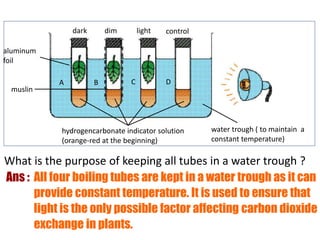
What is the purpose of keeping all tubes in a water trough ? 
Ans : All four boiling tubes are kept in a water trough as it can 
provide constant temperature. It is used to ensure that 
light is the only possible factor affecting carbon dioxide 
exchange in plants. 
muslin
water trough ( to maintain a 
constant temperature) 
dark dim light control 
A B C D 
hydrogencarbonate indicator solution 
(orange-red at the beginning) 
aluminum 
foil 
muslin 
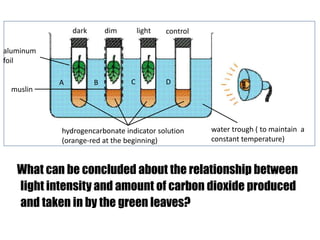
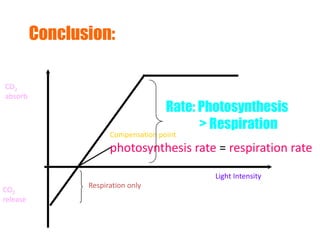
What can be concluded about the relationship between 
light intensity and amount of carbon dioxide produced 
and taken in by the green leaves?
Light Intensity 
CO2 
absorb 
CO2 
release 
Compensation point 
photosynthesis rate = respiration rate 
Respiration only 
Rate: Photosynthesis 
> Respiration 
Conclusion:

BIOLOGY FORM 4 CHAPTER 7 - RESPIRATION PART 2

  • 1.
    BIOLOGY FORM 4 CHAPTER 7 RESPIRATION PART 2
  • 2.
    7.3 Understanding theconcept of gaseous exchange across the respiratory surfaces and transport of gases in human
  • 3.
    The gases exchange occurs at two parts: a. Between the surface of alveolus – blood capillaries b. Between the blood capillaries – body cells
  • 4.
  • 5.
    Gases exchange (alveoli-bloodcapillary) 1. High Partial Pressure of O2 2. Low Partial Pressure of O2 3. O2 diffuses from the alveoli into the blood capillaries
  • 6.
    Gases exchange (alveoli-bloodcapillary) 2. Low Partial Pressure of CO2 1. High Partial Pressure of CO2 3. CO2 diffuses from the blood capillaries into the alveoli
  • 7.
    BLOOD LEAVES THELUNGS TO BODY CELLS
  • 8.
    The Transport ofRespiratory Gases in Humans a) Transport of O2 from lungs to body cell 1. O2 is transported from alveoli to the body cells for cellular respiration 2. O2 combines with a pigment called haemoglobin in the red blood cells 3. O2 is carried in the form of oxyhaemoglobin to all parts of the body: Haemoglobin + O2 → Oxyhaemoglobin
  • 9.
    Oxygen transport inlungs Hb + 4O2 HbO8 in tissues haemoglobin + oxygen oxyhaemoglobin
  • 10.
  • 11.
    Gases exchange (bloodcapillary-body cells) Oxygen Blood capillary Body cells 1. High Partial Pressure of O2 2. Low Partial Pressure of O2 3. Oxyhaemoglobin in blood breaks down and releases O2 which then diffuses through the capillaries walls into the body cells
  • 12.
    Gases exchange (bloodcapillary-body cells) Carbon Dioxide Blood capillary Body cells 2. Low Partial Pressure of CO2 1. High Partial Pressure of CO2 3. CO2 in cells produced from cellular respiration diffuses from the body cells into the blood capillaries
  • 13.
    The Transport ofRespiratory Gases in Humans b) Transport of CO2 from body cells to lungs CO2 released by body cells can be transported in 3 ways: • Carbonic acid (H2CO3) (7%) - CO2 dissolve in water in the blood plasma • Carbaminohaemoglobin (23%) - CO2 combines with haemoglobin • Bicarbonate ions (HCO3-) (70%) – Forms from the breakdown of carbonic acid
  • 14.
    carbon dioxide +haemoglobin carbaminohaemoglobin
  • 15.
    CO2 + H2O H2CO3 (Carbonic acid) The reaction is catalysed by carbonic anhydrase enzyme in the red blood cell H+ + HCO3 - (Bicarbonate ions) Bicarbonate ions transported in the blood plasma to the body cells
  • 16.
    CO2 + Hb Carbaminohaemoglobin CO2 + H2O H2CO3 (carbonic acid) - HCO3 H+ (Bicarbonate ion) - Blood plasma RED BLOOD CELL CO2 HCO3
  • 17.
    BLOOD LEAVES THECELL  HEART  LUNGS
  • 18.
  • 19.
    CO2 + Hb Carbaminohaemoglobin CO2 + H2O H2CO3 (carbonic acid) - HCO3 H+ (Bicarbonate ion) - Blood plasma RED BLOOD CELL HCO3
  • 20.
    Gaseous Exchange inthe Alveolus alveolus Deoxygenated blood carrying carbon dioxide Oxygen-rich blood Carbon dioxide to be Oxygen Carbon dioxide (which will go back to the heart and enter the systemic circulation) Inhaled oxygen exhaled capillary
  • 21.
    Gaseous Exchange inthe Alveolus Oxygen dissolved in mucous layer diffuses through alveolar and capillary walls alveolus capillary Carbon dioxide gas to be exhaled Binds to haemoglobin in red blood cells to form oxyhaemoglobin HCO3 - ions in plasma of blood converted back to CO2 which diffuses across barrier
  • 22.
    The composition ofinhaled and exhaled air
  • 23.
    Inspired and Expiredair Inspired Air Expired Air Oxygen 21% 16.4% Carbon 0.03% 4.0% dioxide Nitrogen 78.0% 78.0% Water vapour Variable Saturated Temperature Variable Body temperature Dust particles Variable Little, if any
  • 24.
    Compare the Oxygen Content of Inhaled & Exhaled Air
  • 26.
    deflagrating spoon burning candle gas jar gas jar water trough rubber tubing In which jar does the candle burn longer ? Ans: The candle burns longer in the jar of inhaled air.
  • 27.
    deflagrating spoon burning candle gas jar gas jar water trough rubber tubing Which gas must be present for the candle to burn longer ? Ans: Oxygen.
  • 28.
    burning candle Whatdo the results tell you about the amount of this gas in inhaled and exhaled air ? This shows that inhaled air contains more oxygen than exhaled air. Ans: deflagrating spoon gas jar water trough rubber tubing gas jar
  • 29.
    burning candle Doesthe flame go out immediately when the burning candle is put into the gas jar of exhaled air ? What does this show ? No. This shows that exhaled air also contains oxygen. Ans: deflagrating spoon gas jar water trough rubber tubing gas jar
  • 30.
    Compare the CarbonDioxide Content of Inhaled & Exhaled Air
  • 31.
    A B Inwhich tube did bubbles appear when you breathed in ? Ans: Tube B.
  • 32.
    A B Whathappens to the lime water in tube A ? Ans:The lime water in tube A remains clear.
  • 33.
    A B Whathappens to the lime water in tube B ? Ans: The lime water in tube B turns cloudy.
  • 34.
    What do theresults tell you about the amount of carbon dioxide in inhaled air and exhaled air ? The carbon dioxide content in exhaled air is higher than the inhaled air. Ans: A B
  • 35.
    What solution canyou use instead of lime water ? If : this is used what changes would you expect in tubes A and B ? Ans: Hydrogen carbonate indicator solution can be used. It changes from red to yellow when more carbon dioxide dissolves in tube B. A B
  • 36.
  • 37.
    7.4 Understanding theregulatory mechanism in respiration
  • 38.
  • 39.
    Breathing is aninvoluntary function of the CNS a respiratory / breathing center in the medulla oblongata [part of brain stem] :  establishes basic breathing pattern Brain stem Spinal cord
  • 40.
    Within limits the:  rate and  depth of breathing are also under voluntary control e.g. holding the breath
  • 41.
    During voluntary control: impulses originating in the cerebral hemispheres breathing centre: carries out the appropriate action
  • 42.
    Basic breathing rhythmis generated in the medulla & is modified by neurones in or above the pons If the brainstem is cut below the pons, but above the medulla, breathing continues but is irregular. If the spinal cord in the neck is severed, breathing ceases.
  • 43.
    Two centres: 1.inspiratory centre  increases the rate and depth of inspiration 2. expiratory centre  inhibits inspiration and stimulate expiration The breathing centres intercostal muscles by way of the intercostal nerves diaphragm by the phrenic nerves communicate with the:
  • 44.
    The bronchi andbronchioles are connected to the brain by the: Vagus nerve Constricts bronchi
  • 45.
    Rhythm of breathing  INSPIRATION inflates the lungs  stretch receptors in the bronchioles are stimulated to send more and more nerve impulses via the vagus nerve to the expiratory centre
  • 46.
    Rhythm of breathing  this temporarily inhibits the inspiratory centre and inspiration  the external intercostal muscles relax, elastic recoil of the lung tissues occurs: EXPIRATION takes place Intercostal nerve to internal intercostal muscle to stimulate expiration
  • 47.
    Rhythm of breathing  the bronchioles is no longer stretched and the stretch receptors no longer stimulated  thus the expiratory centre becomes inactive  INSPIRATION can begin again Phrenic nerve to diaphragm to stimulate inspiration Intercostal nerve to external intercostal muscle to stimulate inspiration
  • 48.
    Rhythm of breathing Inspiratory centre active Inspiratory centre inhibited
  • 49.
    A rise inCO2 = low pH: detected by chemoreceptors in: Medulla oblongata Carotid body Aortic body
  • 50.
    Central chemoreceptors inmedulla:  are sensitive to H+ in cerebrospinal fluid resulting from CO2 in blood
  • 51.
    Peripheral chemoreceptors in carotid & aortic bodies are:  sensitive to:  carbon dioxide  pH  oxygen levels
  • 52.
    Respiratory Control Centre ( Medulla oblongata ) impulses Also helps to monitor CO2 level & regulating the amount of CO2 released during exhalation Control the respiration rate Intercostal muscles & diaphragm
  • 53.
  • 54.
     An averagehuman breathing rate:  12-20 times per minute  Newborns:  30-40 breaths per minute Why does the breathing rate increase during exercise?
  • 56.
    During exercise, theCO2 level in the blood rises, lowering the blood pH Brain Cerebrospinal fluid BREATHING CONTROL CENTERS—stimulated by: CO2 increase / pH decrease in blood Nerve signal indicating low O2 level O2 sensor in artery Pons Medulla Nerve signals trigger contraction of muscles Diaphragm Rib muscles  CO2 dissolve in water forming carbonic acid  pH blood drop  Detected by central chemoreceptor in medulla oblongata  Nerve impulse send to respiratory centre  Respiratory centre send impulse to intercostal muscle and diaphragm  Ventilation increase
  • 57.
    Regulatory mechanism Aftervigorous exercise • the rate of respiration increase • and heartbeat increase – To supply more oxygen to the muscle – To eliminate more carbon dioxide from the muscle
  • 58.
    Resting stage •Breathing rate = 16 – 18 breaths/minute • Heartbeat rate = 60 – 80 beats/minute After activities • Breathing rate = 30 – 40 breaths/minute • Heartbeat rate = 120 – 150 beats/minute
  • 59.
    CO2 Water Carbonicacid pH Central chemoreceptor [medulla oblongata] Impulse Respiratory centre Detected by Impulse Intercostals muscle diaphragm Ventilation faster CO2 eliminate faster
  • 60.
    CO2 affects breathingrate A large drop in arterial O2 has little effect on breathing rates. A small amount of CO2 in the blood stimulates a large increase in breathing rate.
  • 61.
    Hyperventilation: Excessive breathing -Blood has abnormally low PCO2 Hypoventilation: Insufficient breathing -Blood has abnormally high PCO2
  • 62.
    Q: Correlate therate of respiration with the rate of heart beat • During vigorous exercise, the muscle require more O2 and glucose to release more energy during cellular respiration. Therefore, the rate of respiration increases • In order to supply more O2, the rate and depth of breathing increases • This means the breathing rate increases (no. of breath per minute) • At the same time, the heartbeat rate increases to pump more blood into circulation
  • 63.
    Q: Correlate therate of respiration with the rate of heart beat • This enable more O2 and glucose to be supplied for cellular respiration and for more CO2 to be removed from the cells • The ventilation rate also increases • Rate of ventilation is the rate of gases exchange between the alveoli and blood capillaries
  • 64.
    In fear •Breathing & heartbeat rates increase increase rate of cellular respiration generate more energy can cope better in distress or in fear • Adrenal glands secretes hormone adrenaline, increases heartbeat and breathing rates (more glucose and oxygen supplied to muscles) • Prepares the person to respond to dangerous situation
  • 65.
  • 66.
    If level ofoxygen is severely low (high altitudes) Sensors on the walls of aorta and carotid arteries (neck)(peripheral chemoreceptor) Send nerve impulses to the medulla oblongata The rate of breathing and ventilation increases ( to obtain more O2) , concentration of O2 back to normal The respiratory centre usually does not respond directly to O2 level
  • 67.
    Detected by chemoreceptorsin aorta, carotid artery, and medulla oblongata in brain Increase in oxygen Optimum concentration of oxygen in blood Decrease in ventilation rate (and in heart rate) Decrease in oxygen Optimum concentration of oxygen in blood Decrease in oxygen Detected by chemoreceptors in aorta, carotid artery, and medulla oblongata in brain Increase in oxygen Increase in ventilation rate (and in heart rate)
  • 68.
    At high altitudes • Atmospheric pressure is low, difficult to breathe. • Partial pressure of oxygen decreases  drop in blood oxygen level • Will experience headaches, nausea, dizziness • After few days, the body will become acclimatised to the condition as haemoglobin’s affinity for oxygen is reduced and more oxygen is released to body tissues.
  • 69.
    Explain this statement: Persons who are born and live at sea level will have a smaller lung capacity than those who spend their life at a high altitude.
  • 70.
    Answer: This isbecause there is less oxygen in the air at high altitude, so the lungs gradually expand to process more air.
  • 71.
    6.5 Realising theimportance of maintaining a healthy respiratory system
  • 73.
    To show thepresence of Tar in Cigarette Smoke
  • 74.
    to suction pump white cotton wool U-tube cigarette What is the function of the cotton wool ? The c Ans: otton wool in the U-tube serves to collect tar.
  • 75.
    to suction pump white cotton wool U-tube cigarette What has happened to the colour of the cotton wool at the end of the experiment ? Ans: It changes from white to brown.
  • 76.
    to suction pump white cotton wool U-tube cigarette Which substance in cigarette smoke causes the colour change ? Ans: Tar.
  • 77.
    How does smokingeffect the gas exchange system and circulatory system?
  • 78.
    • Smoking contributesto the following lung conditions: – Lung Cancer – Chronic Bronchitis – Emphysema • Smoking also contributes to: – coronary heart disease – Ulcers of the stomach and duodenum
  • 79.
    Harmful Substances inCigarette Smoke
  • 80.
    • In healthylungs the cells lining the bronchi and bronchioles have tiny little hairs on them called cilia. • There are also cells called goblet cells which secrete mucus. Ciliated epithelial cell Cilia Goblet cell Mucus
  • 81.
    • The mucustraps bacteria and dust to stop it entering the lungs. • The cilia waft the mucus up to the throat where it can be swallowed and destroyed in the stomach acid.
  • 82.
    • In asmoker the cilia get destroyed. reduced numbers of cilia  mucus not swept away  mucus clogs the airways. • Smoke also irritates the linings of the airways  stimulates more mucus to be secreted. • Trapped mucus  more bacteria in the lungs  infections. • A smokers cough develops to try and cough up the infected mucus  more irritation and infections. • This is called chronic bronchitis.
  • 83.
    • Due toprolonged breathing of irritants
  • 84.
    • Kills about20,000 people in Britain a year. • Smoke damages the alveoli walls  they burst and fuse together. • Greatly reduces the surface area for gaseous exchange. • Sufferer unable to carry out basic tasks like walking due to lack of oxygen. • No cure.
  • 85.
    • Violent coughingbreaks the partition walls between the alveoli – Surface area for gaseous exchange will decrease • Lungs also lose their elasticity – Air is trapped in the lungs • Breathing becomes difficult – Person will wheeze and suffer from severe breathlessness
  • 86.
    • Due topersistent and violent coughing
  • 87.
    A section froma lung with emphysema showing large black cavities where many alveoli have burst. These are also full of tar.
  • 88.
    http://www.flickr.com/photos/pulmonary_pathology / Anotherimage showing the large cavities in lung tissue created by emphysema.
  • 90.
    This is adiseased lung showing a large tumour and a few smaller tumours. It is also black from the tar in cigarettes. Large tumour
  • 94.
    • Smoking increases blood pressure and damages blood vessels. • Increased chances of developing cardiovascular disease. • Arteries become narrower due to a build up of cholesterol in the artery walls.
  • 95.
    • More likelyto get blood clots. • Lead to a heart attack / stroke.
  • 97.
  • 98.
    Why do weneed to maintain a healthy respiratory system ??
  • 101.
  • 102.
  • 103.
    ENERGY REQUIREMENT INPLANT Plants need energy to carry out living processes 1. Meristems cells - cell division 2. Root hair cells – active transport 3. Growth 4. Reproduction
  • 104.
    Energy requirement inplants • The energy requirement for living processes of plants is lower compared to animals. Why? Because plants are less active than animals. Plants do not move about like animal do.
  • 105.
    The Intake OfOxygen By Plants For Respiration • Plants do not have specialised breathing mechanisms for gaseous exchange. • Gaseous exchange between plants cells and the environment occurs by diffusion through stomata and lenticels.
  • 106.
  • 107.
  • 108.
    Stomata open duringdaytime & close at night stomata may close in bright sunlight in hot dry conditions
  • 109.
  • 110.
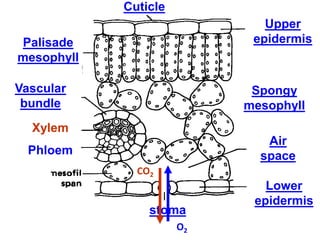
    Upper epidermis Lower epidermis Cuticle Palisade mesophyll Vascular bundle Xylem Phloem Spongy mesophyll Air space stoma O2 CO2
  • 111.
    Gaseous Exchange inPlants –depends on the rates of photosynthesis & respiration - at daytime with light, stomata open photosynthetic rate > respiration rate CO2 absorbed
  • 112.
    Gaseous exchange inthe light • Stomata open • O2 from atmosphere enters leaf through stomata  air spaces. • When the leaf is photosynthesising, O2 released as waste product RESPIRATION + PHOTOSYNTHESIS
  • 113.
    Gaseous exchange inthe light  O2 concentration ↑ in the air spaces than in the surrounding cells  O2 diffuses into the cell • Difference in concentration gradient of O2 cause O2 to diffuse continuously into the cell. RESPIRATION + PHOTOSYNTHESIS
  • 114.
    Gaseous Exchange inPlants - at night with stomata closed, ∵ no photosynthesis carried out, only respiration occurred O2 absorbed
  • 115.
    Gaseous exchange inthe dark • Stomata are normally closed at night. • < O2 in the air spaces than atmosphere.  O2 diffuses inward though lenticels.  CO2 will diffuse outwards. RESPIRATION ONLY NO PHOTOSYNTHESIS O2 CO2
  • 116.
    AEROBIC AND ANAEROBICRESPIRATION IN PLANTS 2 Types of respiration in plants : a) aerobic b) anaerobic
  • 117.
    Aerobic respiration inplants • Carried out day & night by plants • Need O2 • Waste products = CO2 & H2O • O2 concentration in cells lower than in air spaces  O2 diffuses continuously into cells C6H12O6 + 6O2  6CO2 + 6H2O + 2880 kJ Energy
  • 118.
    Aerobic respiration inplants • O2 combines with glucose to produce energy • CO2 produced during aerobic respiration is used in photosynthesis during the day because photosynthesis is faster than respiration
  • 119.
    Anaerobic respiration inplants • Yeast respires anaerobically to produce alcohol (alcoholic fermentation).
  • 120.
    Anaerobic respiration inplants • For short periods. • During flooding, plants can survive for several days completely submerged in water. • Young rice plants respire anaerobically using its roots in waterlogged field which have little or no O2.
  • 121.
    Anaerobic respiration inplants • During initial stages of germination when embryo is completely enclosed within an airtight seed coat.
  • 122.
    Aerobic & AnaerobicRespiration in Plants. C6H12O6 + 6O2  6CO2 + 6H2O + 2880 kJ Energy C6H12O6 Aerobic @ Anaerobic ?  2C2H5OH + 2CO2 + 210 kJ Energy
  • 123.
    Respiration & Photosynthesis • Respiration is the reverse of photosynthesis.
  • 124.
    Compare & Contrast Respiration & Photosynthesis Respiration Photosynthesis Similarities • Both take place in living cells. • Both are metabolic process. • Both needed to maintain levels of O2 & CO2 in atmosphere
  • 125.
    Differences Respiration Photosynthesis A process of catabolism (breaking down of organic materials) A process of anabolism (synthesis of organic materials) Occurs in all living cells Occurs in cells containing chlorophyll. Take place in the presence / absence of light Takes place only in the presence of light
  • 126.
    Respiration Photosynthesis Usesglucose and oxygen Uses carbon dioxide and water Produces carbon dioxide and water Produces glucose and oxygen
  • 127.
    Respiration Photosynthesis Chemicalenergy is converted into heat and energy ATP. Solar energy is converted into chemical energy Cell loses weight Cell gains weight
  • 128.
    The differences ofphotosynthesis and respiration
  • 130.
    CO2 concentrations inair around plants throughout the day
  • 131.
  • 132.
  • 133.
    Compensation point Lightintensity O2 CO2 All the CO2 produced during respiration is reused during photosynthesis
  • 134.
    The Compensation Point The light intensity at which the rate of CO2 production during respiration is equal to that of CO2 consumption during photosynthesis.
  • 135.
    Graph shows CO2uptake in plants related to light intensity
  • 137.
    Daytime • Aslight intensity increases, rate of photosynthesis also increases.  quantity of CO2 released into the atmosphere decrease. • Because CO2 released during respiration is used for photosynthesis. At night, • no photosynthesis. • Only respiration • CO2 is released into the atmosphere. • So CO2 uptake - negative
  • 138.
    COMPENSATION POINT. acertain point of light intensity whereby the rate of photosynthesis is equal to the rate of respiration. At this point, all the CO2 released from respiration is equal to the CO2 used up for photosynthesis.
  • 140.
    If the rateof photosynthesis and the rate of respiration remained at compensation point: • The plant would not be able to store food. • There would be no growth and development in green plants. • No oxygen released into the atmosphere to sustain living things.
  • 141.
  • 142.
    To study theEffect of Light Intensity on Carbon Dioxide Exchange in Plants
  • 143.
    water trough (to maintain a constant temperature) dark dim light control A B C D hydrogencarbonate indicator solution (orange-red at the beginning) What has happened to the colour of the hydrogen carbonate indicator solutions in the four boiling tubes ? Ans: For tube A: red to yellow. For tube B: red to orange-red or yellow or purple. . . aluminum foil muslin
  • 144.
    Ans: For tubeC: red to purple. For tube D: no colour change. water trough ( to maintain a constant temperature) dark dim light control A B C D hydrogencarbonate indicator solution (orange-red at the beginning) aluminum foil muslin What has happened to the colour of the hydrogen carbonate indicator solutions in the four boiling tubes ?
  • 145.
    water trough (to maintain a constant temperature) dark dim light control A B C D hydrogencarbonate indicator solution (orange-red at the beginning) aluminum foil muslin Explain the differences in the colour of the hydrogen carbonate indicator solution in the tubes.
  • 146.
    For tube A: There is more CO2 than atmospheric air. No photosynthesis occurs. Only respiration takes place. CO2 is given off.
  • 147.
    For tube B:There is the same amount of CO2 as in atmospheric air. CO2 given off in respiration = CO2 absorbed in photosynthesis because the rates of respiration and photosynthesis are about the same.
  • 148.
    For tube C:There is less CO2 than atmospheric air. All the CO2 given off in respiration is absorbed for use in photosynthesis because photosynthesis rate > respiratory rate.
  • 149.
    For tube D:This is the control. Photosynthesis and respiration do not occur because there is no leaf.
  • 150.
    water trough (to maintain a constant temperature) dark dim light control A B C D hydrogencarbonate indicator solution (orange-red at the beginning) aluminum foil What is the purpose of setting up tube D ? Ans : For tube D: This is the control. It ensures the change in CO2 concentration is due to the leaves. muslin
  • 151.
    water trough (to maintain a constant temperature) dark dim light control A B C D hydrogencarbonate indicator solution (orange-red at the beginning) aluminum foil What is the purpose of keeping all tubes in a water trough ? Ans : All four boiling tubes are kept in a water trough as it can provide constant temperature. It is used to ensure that light is the only possible factor affecting carbon dioxide exchange in plants. muslin
  • 152.
    water trough (to maintain a constant temperature) dark dim light control A B C D hydrogencarbonate indicator solution (orange-red at the beginning) aluminum foil muslin What can be concluded about the relationship between light intensity and amount of carbon dioxide produced and taken in by the green leaves?
  • 153.
    Light Intensity CO2 absorb CO2 release Compensation point photosynthesis rate = respiration rate Respiration only Rate: Photosynthesis > Respiration Conclusion: