POOJA SINGH
RESPIRATORY ORGANS
• Lower invertebrates like sponges, coelenterates,
flatworms, etc., exchange O2 with CO2 by simple
diffusion over their entire body surface.
• Earthworms use their moist cuticle
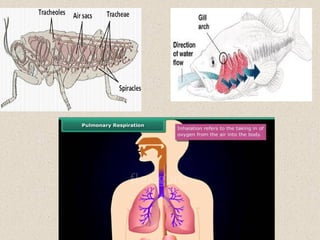
• insects have a network of tubes (tracheal tubes) to
transport atmospheric air within the body.
• Special vascularised structures called gills (branchial
respiration) are used by most of the aquatic
arthropods and molluscs
• vascularised bags called lungs (pulmonary
respiration) are used by the terrestrial forms for the
exchange of gases.
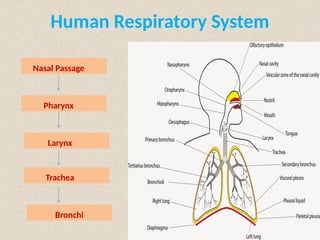
Human Respiratory System
Nasal Passage
Pharynx
Larynx
Trachea
Bronchi
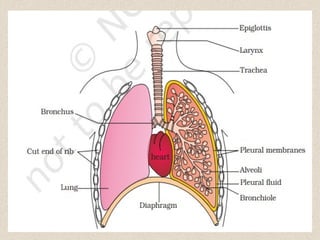
• During swallowing glottis can be covered by a thin
elastic cartilaginous flap called epiglottis to prevent
the entry of food into the larynx.
• Each bronchi undergoes repeated divisions to form
the secondary and tertiary bronchi and bronchioles
ending up in very thin terminal bronchioles.
• The tracheae, primary, secondary and tertiary
bronchi, and initial bronchioles are supported by
incomplete cartilaginous rings.
• Each terminal bronchiole gives rise to a number of
very thin, irregular-walled and vascularised bag-like
structures called alveoli.
• The branching network of bronchi, bronchioles and
alveoli comprise the lungs
• lungs are covered by a double layered pleura,
with pleural fluid between them.
• It reduces friction on the lung-surface
• The part starting with the external nostrils up to
the terminal bronchioles constitute the
conducting part
• alveoli and their ducts form the respiratory or
exchange part of the respiratory system.
• The conducting part transports the atmospheric
air to the alveoli
• Exchange part is the site of actual diffusion of O2
and CO2 between blood and atmospheric air.
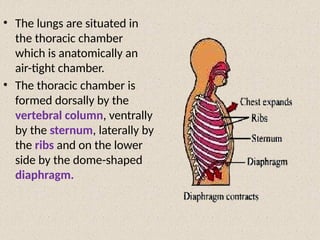
• The lungs are situated in
the thoracic chamber
which is anatomically an
air-tight chamber.
• The thoracic chamber is
formed dorsally by the
vertebral column, ventrally
by the sternum, laterally by
the ribs and on the lower
side by the dome-shaped
diaphragm.
• Respiration involves the following steps:
• Breathing or pulmonary ventilation by which
atmospheric air is drawn in and CO2 rich alveolar
air is released out.
• Diffusion of gases (O2 and CO2 ) across alveolar
membrane.
• Transport of gases by the blood.
• Diffusion of O2 and CO2 between blood and
tissues.
• Utilisation of O2 by the cells for catabolic reactions
and resultant release of CO2
MECHANISM OF BREATHING
• Breathing involves two stages : inspiration during
which atmospheric air is drawn in and expiration
by which the alveolar air is released out
• Inspiration can occur if the pressure within the
lungs (intra-pulmonary pressure) is less than the
atmospheric pressure, i.e., there is a negative
pressure in the lungs with respect to atmospheric
pressure
• Expiration takes place when the intra-pulmonary
pressure is higher than the atmospheric pressure
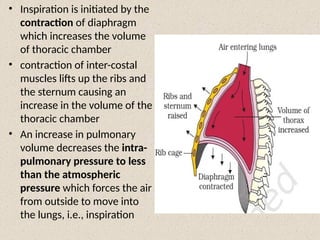
• Inspiration is initiated by the
contraction of diaphragm
which increases the volume
of thoracic chamber
• contraction of inter-costal
muscles lifts up the ribs and
the sternum causing an
increase in the volume of the
thoracic chamber
• An increase in pulmonary
volume decreases the intra-
pulmonary pressure to less
than the atmospheric
pressure which forces the air
from outside to move into
the lungs, i.e., inspiration
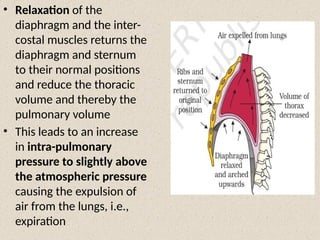
• Relaxation of the
diaphragm and the inter-
costal muscles returns the
diaphragm and sternum
to their normal positions
and reduce the thoracic
volume and thereby the
pulmonary volume
• This leads to an increase
in intra-pulmonary
pressure to slightly above
the atmospheric pressure
causing the expulsion of
air from the lungs, i.e.,
expiration
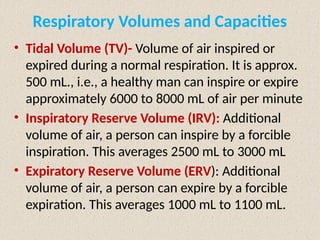
Respiratory Volumes and Capacities
• Tidal Volume (TV)- Volume of air inspired or
expired during a normal respiration. It is approx.
500 mL., i.e., a healthy man can inspire or expire
approximately 6000 to 8000 mL of air per minute
• Inspiratory Reserve Volume (IRV): Additional
volume of air, a person can inspire by a forcible
inspiration. This averages 2500 mL to 3000 mL
• Expiratory Reserve Volume (ERV): Additional
volume of air, a person can expire by a forcible
expiration. This averages 1000 mL to 1100 mL.
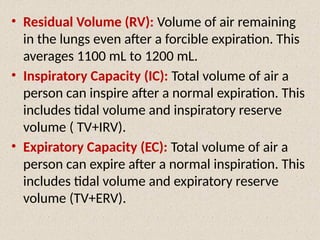
• Residual Volume (RV): Volume of air remaining
in the lungs even after a forcible expiration. This
averages 1100 mL to 1200 mL.
• Inspiratory Capacity (IC): Total volume of air a
person can inspire after a normal expiration. This
includes tidal volume and inspiratory reserve
volume ( TV+IRV).
• Expiratory Capacity (EC): Total volume of air a
person can expire after a normal inspiration. This
includes tidal volume and expiratory reserve
volume (TV+ERV).
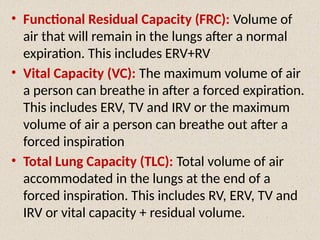
• Functional Residual Capacity (FRC): Volume of
air that will remain in the lungs after a normal
expiration. This includes ERV+RV
• Vital Capacity (VC): The maximum volume of air
a person can breathe in after a forced expiration.
This includes ERV, TV and IRV or the maximum
volume of air a person can breathe out after a
forced inspiration
• Total Lung Capacity (TLC): Total volume of air
accommodated in the lungs at the end of a
forced inspiration. This includes RV, ERV, TV and
IRV or vital capacity + residual volume.
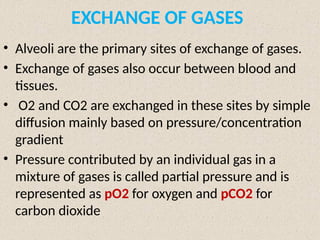
EXCHANGE OF GASES
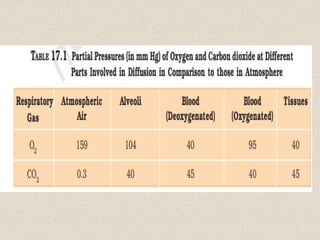
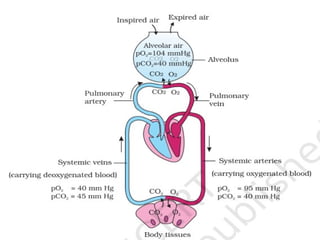
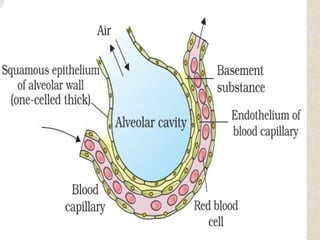
• Alveoli are the primary sites of exchange of gases.
• Exchange of gases also occur between blood and
tissues.
• O2 and CO2 are exchanged in these sites by simple
diffusion mainly based on pressure/concentration
gradient
• Pressure contributed by an individual gas in a
mixture of gases is called partial pressure and is
represented as pO2 for oxygen and pCO2 for
carbon dioxide
TRANSPORT OF GASES
• About 97 per cent of O2 is transported by RBCs
in the blood.
• The remaining 3 per cent of O2 is carried in a
dissolved state through the plasma.
• Nearly 20-25 per cent of CO2 is transported by
RBCs whereas 70 per cent of it is carried as
bicarbonate ions
• About 7 per cent of CO2 is carried in a dissolved
state through plasma
Transport of Oxygen
• Haemoglobin is a red coloured iron containing
pigment present in the RBCs.
• O2 can bind with haemoglobin in to form
oxyhaemoglobin.
• Each haemoglobin molecule can carry a
maximum of four molecules of O2 .
• Binding of oxygen with haemoglobin is primarily
related to partial pressure of O2 .
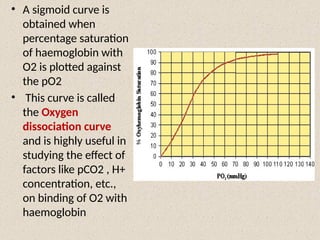
• A sigmoid curve is
obtained when
percentage saturation
of haemoglobin with
O2 is plotted against
the pO2
• This curve is called
the Oxygen
dissociation curve
and is highly useful in
studying the effect of
factors like pCO2 , H+
concentration, etc.,
on binding of O2 with
haemoglobin
• In the alveoli, where there is
high pO2
low pCO2
 lesser H+ concentration
lower temperature
• the factors are all favourable for the formation of
oxyhaemoglobin,
• whereas in the tissues, where
low pO2
high pCO2
high H+ concentration
higher temperature exist
• the conditions are favourable for dissociation of
oxygen from the oxyhaemoglobin.
• This clearly indicates that O2 gets bound to
haemoglobin in the lung surface and gets
dissociated at the tissues.
• Every 100 ml of oxygenated blood can deliver
around 5 ml of O2 to the tissues under normal
physiological conditions.
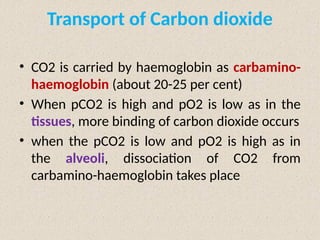
Transport of Carbon dioxide
• CO2 is carried by haemoglobin as carbamino-
haemoglobin (about 20-25 per cent)
• When pCO2 is high and pO2 is low as in the
tissues, more binding of carbon dioxide occurs
• when the pCO2 is low and pO2 is high as in
the alveoli, dissociation of CO2 from
carbamino-haemoglobin takes place
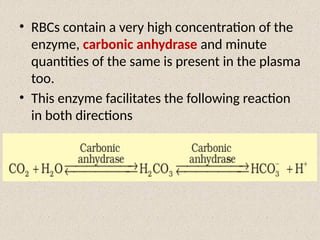
• RBCs contain a very high concentration of the
enzyme, carbonic anhydrase and minute
quantities of the same is present in the plasma
too.
• This enzyme facilitates the following reaction
in both directions
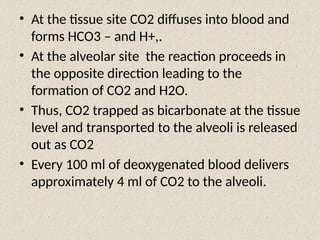
• At the tissue site CO2 diffuses into blood and
forms HCO3 – and H+,.
• At the alveolar site the reaction proceeds in
the opposite direction leading to the
formation of CO2 and H2O.
• Thus, CO2 trapped as bicarbonate at the tissue
level and transported to the alveoli is released
out as CO2
• Every 100 ml of deoxygenated blood delivers
approximately 4 ml of CO2 to the alveoli.
REGULATION OF RESPIRATION
• A specialised centre present in the medulla
region of the brain called respiratory rhythm
centre is primarily responsible for respiratory
regulation
• Another centre present in the pons region of the
brain called pneumotaxic centre can moderate
the functions of the respiratory rhythm centre
• Receptors associated with aortic arch and
carotid artery also can recognise changes in CO2
and H+ concentration and send necessary signals
to the rhythm centre for remedial actions.
DISORDERS OF RESPIRATORY SYSTEM
• Asthma is a difficulty in breathing causing wheezing due to
inflammation of bronchi and bronchioles.
• Emphysema is a chronic disorder in which alveolar walls
are damaged due to which respiratory surface is
decreased
• One of the major causes of this is cigarette smoking
• Occupational Respiratory Disorders- In certain industries,
especially those involving grinding or stone-breaking, so
much dust is produced
• Long exposure can give rise to inflammation leading to
fibrosis (proliferation of fibrous tissues) and thus causing
serious lung damage
• Workers in such industries should wear protective masks.

BREATHING PPT.pptx respiratory systemmmmm

  • 1.
  • 2.
    RESPIRATORY ORGANS • Lowerinvertebrates like sponges, coelenterates, flatworms, etc., exchange O2 with CO2 by simple diffusion over their entire body surface. • Earthworms use their moist cuticle • insects have a network of tubes (tracheal tubes) to transport atmospheric air within the body. • Special vascularised structures called gills (branchial respiration) are used by most of the aquatic arthropods and molluscs • vascularised bags called lungs (pulmonary respiration) are used by the terrestrial forms for the exchange of gases.
  • 4.
    Human Respiratory System NasalPassage Pharynx Larynx Trachea Bronchi
  • 5.
    • During swallowingglottis can be covered by a thin elastic cartilaginous flap called epiglottis to prevent the entry of food into the larynx. • Each bronchi undergoes repeated divisions to form the secondary and tertiary bronchi and bronchioles ending up in very thin terminal bronchioles. • The tracheae, primary, secondary and tertiary bronchi, and initial bronchioles are supported by incomplete cartilaginous rings. • Each terminal bronchiole gives rise to a number of very thin, irregular-walled and vascularised bag-like structures called alveoli. • The branching network of bronchi, bronchioles and alveoli comprise the lungs
  • 7.
    • lungs arecovered by a double layered pleura, with pleural fluid between them. • It reduces friction on the lung-surface • The part starting with the external nostrils up to the terminal bronchioles constitute the conducting part • alveoli and their ducts form the respiratory or exchange part of the respiratory system. • The conducting part transports the atmospheric air to the alveoli • Exchange part is the site of actual diffusion of O2 and CO2 between blood and atmospheric air.
  • 8.
    • The lungsare situated in the thoracic chamber which is anatomically an air-tight chamber. • The thoracic chamber is formed dorsally by the vertebral column, ventrally by the sternum, laterally by the ribs and on the lower side by the dome-shaped diaphragm.
  • 9.
    • Respiration involvesthe following steps: • Breathing or pulmonary ventilation by which atmospheric air is drawn in and CO2 rich alveolar air is released out. • Diffusion of gases (O2 and CO2 ) across alveolar membrane. • Transport of gases by the blood. • Diffusion of O2 and CO2 between blood and tissues. • Utilisation of O2 by the cells for catabolic reactions and resultant release of CO2
  • 10.
    MECHANISM OF BREATHING •Breathing involves two stages : inspiration during which atmospheric air is drawn in and expiration by which the alveolar air is released out • Inspiration can occur if the pressure within the lungs (intra-pulmonary pressure) is less than the atmospheric pressure, i.e., there is a negative pressure in the lungs with respect to atmospheric pressure • Expiration takes place when the intra-pulmonary pressure is higher than the atmospheric pressure
  • 11.
    • Inspiration isinitiated by the contraction of diaphragm which increases the volume of thoracic chamber • contraction of inter-costal muscles lifts up the ribs and the sternum causing an increase in the volume of the thoracic chamber • An increase in pulmonary volume decreases the intra- pulmonary pressure to less than the atmospheric pressure which forces the air from outside to move into the lungs, i.e., inspiration
  • 12.
    • Relaxation ofthe diaphragm and the inter- costal muscles returns the diaphragm and sternum to their normal positions and reduce the thoracic volume and thereby the pulmonary volume • This leads to an increase in intra-pulmonary pressure to slightly above the atmospheric pressure causing the expulsion of air from the lungs, i.e., expiration
  • 13.
    Respiratory Volumes andCapacities • Tidal Volume (TV)- Volume of air inspired or expired during a normal respiration. It is approx. 500 mL., i.e., a healthy man can inspire or expire approximately 6000 to 8000 mL of air per minute • Inspiratory Reserve Volume (IRV): Additional volume of air, a person can inspire by a forcible inspiration. This averages 2500 mL to 3000 mL • Expiratory Reserve Volume (ERV): Additional volume of air, a person can expire by a forcible expiration. This averages 1000 mL to 1100 mL.
  • 14.
    • Residual Volume(RV): Volume of air remaining in the lungs even after a forcible expiration. This averages 1100 mL to 1200 mL. • Inspiratory Capacity (IC): Total volume of air a person can inspire after a normal expiration. This includes tidal volume and inspiratory reserve volume ( TV+IRV). • Expiratory Capacity (EC): Total volume of air a person can expire after a normal inspiration. This includes tidal volume and expiratory reserve volume (TV+ERV).
  • 15.
    • Functional ResidualCapacity (FRC): Volume of air that will remain in the lungs after a normal expiration. This includes ERV+RV • Vital Capacity (VC): The maximum volume of air a person can breathe in after a forced expiration. This includes ERV, TV and IRV or the maximum volume of air a person can breathe out after a forced inspiration • Total Lung Capacity (TLC): Total volume of air accommodated in the lungs at the end of a forced inspiration. This includes RV, ERV, TV and IRV or vital capacity + residual volume.
  • 16.
    EXCHANGE OF GASES •Alveoli are the primary sites of exchange of gases. • Exchange of gases also occur between blood and tissues. • O2 and CO2 are exchanged in these sites by simple diffusion mainly based on pressure/concentration gradient • Pressure contributed by an individual gas in a mixture of gases is called partial pressure and is represented as pO2 for oxygen and pCO2 for carbon dioxide
  • 20.
    TRANSPORT OF GASES •About 97 per cent of O2 is transported by RBCs in the blood. • The remaining 3 per cent of O2 is carried in a dissolved state through the plasma. • Nearly 20-25 per cent of CO2 is transported by RBCs whereas 70 per cent of it is carried as bicarbonate ions • About 7 per cent of CO2 is carried in a dissolved state through plasma
  • 21.
    Transport of Oxygen •Haemoglobin is a red coloured iron containing pigment present in the RBCs. • O2 can bind with haemoglobin in to form oxyhaemoglobin. • Each haemoglobin molecule can carry a maximum of four molecules of O2 . • Binding of oxygen with haemoglobin is primarily related to partial pressure of O2 .
  • 22.
    • A sigmoidcurve is obtained when percentage saturation of haemoglobin with O2 is plotted against the pO2 • This curve is called the Oxygen dissociation curve and is highly useful in studying the effect of factors like pCO2 , H+ concentration, etc., on binding of O2 with haemoglobin
  • 23.
    • In thealveoli, where there is high pO2 low pCO2  lesser H+ concentration lower temperature • the factors are all favourable for the formation of oxyhaemoglobin,
  • 24.
    • whereas inthe tissues, where low pO2 high pCO2 high H+ concentration higher temperature exist • the conditions are favourable for dissociation of oxygen from the oxyhaemoglobin. • This clearly indicates that O2 gets bound to haemoglobin in the lung surface and gets dissociated at the tissues. • Every 100 ml of oxygenated blood can deliver around 5 ml of O2 to the tissues under normal physiological conditions.
  • 25.
    Transport of Carbondioxide • CO2 is carried by haemoglobin as carbamino- haemoglobin (about 20-25 per cent) • When pCO2 is high and pO2 is low as in the tissues, more binding of carbon dioxide occurs • when the pCO2 is low and pO2 is high as in the alveoli, dissociation of CO2 from carbamino-haemoglobin takes place
  • 26.
    • RBCs containa very high concentration of the enzyme, carbonic anhydrase and minute quantities of the same is present in the plasma too. • This enzyme facilitates the following reaction in both directions
  • 27.
    • At thetissue site CO2 diffuses into blood and forms HCO3 – and H+,. • At the alveolar site the reaction proceeds in the opposite direction leading to the formation of CO2 and H2O. • Thus, CO2 trapped as bicarbonate at the tissue level and transported to the alveoli is released out as CO2 • Every 100 ml of deoxygenated blood delivers approximately 4 ml of CO2 to the alveoli.
  • 28.
    REGULATION OF RESPIRATION •A specialised centre present in the medulla region of the brain called respiratory rhythm centre is primarily responsible for respiratory regulation • Another centre present in the pons region of the brain called pneumotaxic centre can moderate the functions of the respiratory rhythm centre • Receptors associated with aortic arch and carotid artery also can recognise changes in CO2 and H+ concentration and send necessary signals to the rhythm centre for remedial actions.
  • 29.
    DISORDERS OF RESPIRATORYSYSTEM • Asthma is a difficulty in breathing causing wheezing due to inflammation of bronchi and bronchioles. • Emphysema is a chronic disorder in which alveolar walls are damaged due to which respiratory surface is decreased • One of the major causes of this is cigarette smoking • Occupational Respiratory Disorders- In certain industries, especially those involving grinding or stone-breaking, so much dust is produced • Long exposure can give rise to inflammation leading to fibrosis (proliferation of fibrous tissues) and thus causing serious lung damage • Workers in such industries should wear protective masks.