Biological Safety Cabinet
 This equipment is designed for controlling aerosols

and microparticles associated with toxic or infectious
biological material in laboratories in activities.
 Main purposes of biological safety cabinet,
1.
2.
3.

To protect the worker from risks associated with the management of
potentially infectious biological material.
To protect the sample being analyzed from becoming contaminated.
To protect the environment
Theory of operation
 The biological safety cabinet has a front glass window of

adjustable height, a ventilation system with an electrical
motor, a ventilator and a set of ducts which while
functioning, generate a negative pressure condition inside
the cabinet.
 Five main types of safety cabinets which utilize different air
flow directions.
1.
2.
3.
4.
5.

Class І Type A
Class II Type A
Class II Type B1
Class II Type B2
Class II Type B3
Installation
 A laboratory area protected from air currents from

windows or air-conditioning systems.
 An electrical connection equipped with a ground pole.
 There must be free space for placing the feet and its
height must be adequate.
General maintenance
Weekly

Monthly

 Decontaminate the work

 Clean the exterior

surface and the interior
surfaces of the cabinet with
70% ethanol.
 Clean the front glass door and
the surface of the ultraviolet
lamp, using a mild detergent.

surfaces, especially the front
and the upper part using a
piece of damp cloth in order
to remove the dust.
 Disinfect the surface of the
lower compartment with 70%
Ethanol or a suitable
disinfecting solution.
 Verify the state of the service
valves.
General maintenance
Annually
 Check the intensity of the UV

lamp with a radiometer.
 Test the state of the
fluorescent lamp
Functional evaluation
Electrical
 Voltage, Amperage
 Motor/ventilator

 Illumination –
Fluorescent, Ultraviolet
 Alarms
 Switches, Electrical outlet, cables
and connectors

 Verification of operation
temperature. Verify noise level and

vibration.
 the operational hours of the lamps
and their light intensity. Requires a
radiometer.
 Testing of state and calibration.
 Control of state and integrity
 quality of the contact and available
voltages
Functional evaluation
Physical
 State of filters and pre-filters

 There must be no leaks, in

 Seals/gaskets

 There must be no leaks.

 Sliding window

 Must be able to be moved

the filtering material or in the
seals.

smoothly and possible to stop
at the selected positions.
Functional evaluation
Operational
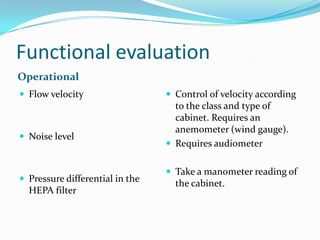
 Flow velocity

 Noise level

 Pressure differential in the

HEPA filter

 Control of velocity according

to the class and type of
cabinet. Requires an
anemometer (wind gauge).
 Requires audiometer
 Take a manometer reading of

the cabinet.
Functional evaluation
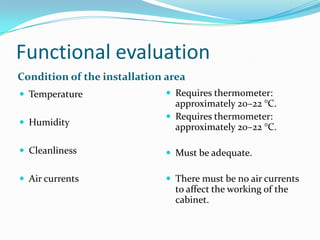
Condition of the installation area
 Temperature
 Humidity

 Requires thermometer:

approximately 20–22 °C.
 Requires thermometer:
approximately 20–22 °C.

 Cleanliness

 Must be adequate.

 Air currents

 There must be no air currents

to affect the working of the
cabinet.
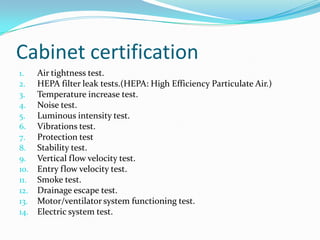
Cabinet certification
1.
2.
3.
4.
5.
6.
7.
8.
9.
10.
11.
12.
13.
14.

Air tightness test.
HEPA filter leak tests.(HEPA: High Efficiency Particulate Air.)
Temperature increase test.
Noise test.
Luminous intensity test.
Vibrations test.
Protection test
Stability test.
Vertical flow velocity test.
Entry flow velocity test.
Smoke test.
Drainage escape test.
Motor/ventilator system functioning test.
Electric system test.
 End of Biological Safety Cabinet.

Biological safety cabinet

  • 1.
    Biological Safety Cabinet This equipment is designed for controlling aerosols and microparticles associated with toxic or infectious biological material in laboratories in activities.  Main purposes of biological safety cabinet, 1. 2. 3. To protect the worker from risks associated with the management of potentially infectious biological material. To protect the sample being analyzed from becoming contaminated. To protect the environment
  • 2.
    Theory of operation The biological safety cabinet has a front glass window of adjustable height, a ventilation system with an electrical motor, a ventilator and a set of ducts which while functioning, generate a negative pressure condition inside the cabinet.  Five main types of safety cabinets which utilize different air flow directions. 1. 2. 3. 4. 5. Class І Type A Class II Type A Class II Type B1 Class II Type B2 Class II Type B3
  • 3.
    Installation  A laboratoryarea protected from air currents from windows or air-conditioning systems.  An electrical connection equipped with a ground pole.  There must be free space for placing the feet and its height must be adequate.
  • 4.
    General maintenance Weekly Monthly  Decontaminatethe work  Clean the exterior surface and the interior surfaces of the cabinet with 70% ethanol.  Clean the front glass door and the surface of the ultraviolet lamp, using a mild detergent. surfaces, especially the front and the upper part using a piece of damp cloth in order to remove the dust.  Disinfect the surface of the lower compartment with 70% Ethanol or a suitable disinfecting solution.  Verify the state of the service valves.
  • 5.
    General maintenance Annually  Checkthe intensity of the UV lamp with a radiometer.  Test the state of the fluorescent lamp
  • 6.
    Functional evaluation Electrical  Voltage,Amperage  Motor/ventilator  Illumination – Fluorescent, Ultraviolet  Alarms  Switches, Electrical outlet, cables and connectors  Verification of operation temperature. Verify noise level and vibration.  the operational hours of the lamps and their light intensity. Requires a radiometer.  Testing of state and calibration.  Control of state and integrity  quality of the contact and available voltages
  • 7.
    Functional evaluation Physical  Stateof filters and pre-filters  There must be no leaks, in  Seals/gaskets  There must be no leaks.  Sliding window  Must be able to be moved the filtering material or in the seals. smoothly and possible to stop at the selected positions.
  • 8.
    Functional evaluation Operational  Flowvelocity  Noise level  Pressure differential in the HEPA filter  Control of velocity according to the class and type of cabinet. Requires an anemometer (wind gauge).  Requires audiometer  Take a manometer reading of the cabinet.
  • 9.
    Functional evaluation Condition ofthe installation area  Temperature  Humidity  Requires thermometer: approximately 20–22 °C.  Requires thermometer: approximately 20–22 °C.  Cleanliness  Must be adequate.  Air currents  There must be no air currents to affect the working of the cabinet.
  • 10.
    Cabinet certification 1. 2. 3. 4. 5. 6. 7. 8. 9. 10. 11. 12. 13. 14. Air tightnesstest. HEPA filter leak tests.(HEPA: High Efficiency Particulate Air.) Temperature increase test. Noise test. Luminous intensity test. Vibrations test. Protection test Stability test. Vertical flow velocity test. Entry flow velocity test. Smoke test. Drainage escape test. Motor/ventilator system functioning test. Electric system test.
  • 11.
     End ofBiological Safety Cabinet.