
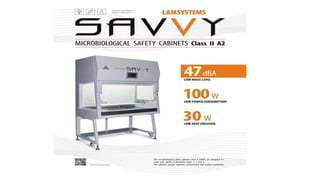





BIOLOGICAL SAFETY
CABINET
BIOINSTRUMENTATI
ON
MAKERERE UNIVERSITY
COLLEGE OF HEALTH SCIENCES
MUYANJA JONAH
B.sc in BIOMEDICAL ENGINEERING
Email: munjojonah@gmail.com
Tweeter: @jonahmunjo
KAMPALA, UGANDA
OVERVIEW
Biological Safety Cabinet
Introduction
Purposes of the equipment
Operation Principles
Summary of biological safety types
Installation requirements
Routine Maintenance
Functional evaluation of biological safety cabinets
Trouble shooting
INTRODUCTION
This equipment is designed for controlling aerosols and micro-particles associated with managing
potentially toxic or infectious biological material in laboratories in activities such as centrifugation,
agitation, pipetting, and opening of pressurized containers. Safety cabinets have been designed to protect
the user, the environment and the sample manipulated using appropriate ventilation conditions. They are
also known as Laminar flow cabinets and/or biosafety cabinets.
PURPOSES OF THE
EQUIPMENT
The biological safety cabinet is used for the following:
1. To protect the worker from risks associated with the management of potentially
infectious biological material.
2. To protect the sample being analyzed from becoming contaminated.
3. To protect the environment
The cabinets are used for routine work related to pathogens (parasites, bacteria, virus,
fungus),cell culture and under very precise conditions, the management of toxic agents.
OPERATION PRINCIPLES
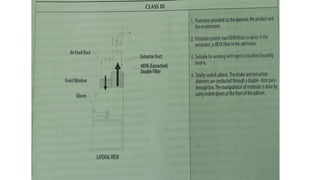
The biological safety cabinet is a chamber generally constructed of steel. It has a front
glass window of adjustable height, a ventilation system with an electrical motor, a
ventilation and a set of ducts which while functioning, generate a negative pressure
condition inside the cabinet. This forces the air to flow from inside the cabinet through
the front opening to generate a curtain of air protecting the operator, Internally, the air
is conducted through a series of grids and ducts to be finally treated in HEPA filter.
Depending on the design of the cabinet, the air is recycled inside the laboratory or
extruded and renewed in diverse proportions.
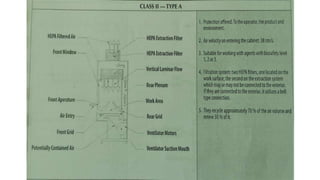
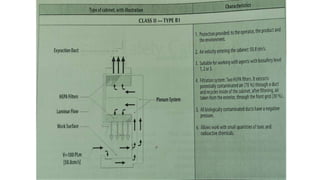
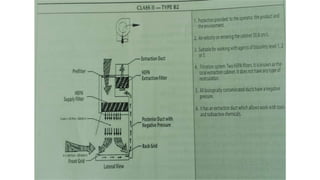
SUMMARY OF BIOLOGICAL
SAFETY CABINET TYPES
INSTALLATION
REQUIREMENTS
The following are requirements for a cabinet to function adequately:
1. A laboratory area protected from air currents from windows or air-conditioning systems.
2. An electrical connection equipped with the respective control and safety elements; the electrical outlet with a
ground pole.
3. A leveled and firm table designed for supporting the weigh of the cabinet and allowing the operator to work
comfortably.
4. The floor on which it is located must be flat and leveled.
5. The free space around the cabinet recommended by the manufacturer must be respected.
6. Type B cabinets must have an extraction duct equipped with the following required control devices; regulating
valves that allow the flow of air to be isolated and regulated.
7. Gas connections must be in the immediate vicinity of the cabinet in order to facilitate the connection to the
service valves.
ROUTINE
MAINTENANCE
General maintenance required for the biological safety cabinet is for the most part simple to perform.
The routines and frequencies are shown below:
Frequency: Weekly
 Decontaminate the work surface and the interior surfaces of the cabinet with 70% ethanol.
 Clean the front glass door and the surface of the ultraviolet lamp, using a domestic cleaning solution.
 Verify the precision of the manometer’s reading indicating any fall in pressure flowing through the
HEPA filter. Register the date and the reading in the cabinet’s log book.
Frequency: Monthly
 Clean the exterior surfaces, especially the front and the upper part using a piece of damp cloth in order
to remove the dust.
 Disinfect the surface of the lower compartment with 70% Ethanol or a suitable disinfecting solution.
 Verify the state of the service valves
 Do the tasks due on a weekly basis.
Frequency: Annually
Check the intensity of the UV lamp with a radiometer, substitute it if necessary
Test the state of the fluorescent lamp. Substitute it if necessary
Perform the tasks due on a monthly basis.
Removal of the work surface
For the removal of the work surface the following procedure is required:
Decontaminate the surface before removing it.
Loosen and remove the attachment screws located on the front part of the work surface
Loosen, but do not remove the attachment screws located on the back part.
Decontaminate the interior part of the work surface.
To assemble it, perform the activities described in steps 2,3, and 4 in reverse order.
Changing of the ultraviolet lamp
In order to change the ultraviolet lamp, the manufacturer’s instructions must be followed. In general the
following procedures are done:
Turn on the cabinet and leave it for 5 minutes
Raise the front window to its maximum position
Decontaminate the interior surfaces and the UV lamp
Disconnect the electrical feed to the cabinet
Disconnect the UV tube from its connectors turning it 90 degrees. Next install the spare part with the
same characteristic as the original.
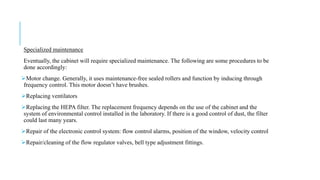
Specialized maintenance
Eventually, the cabinet will require specialized maintenance. The following are some procedures to be
done accordingly:
Motor change. Generally, it uses maintenance-free sealed rollers and function by inducing through
frequency control. This motor doesn’t have brushes.
Replacing ventilators
Replacing the HEPA filter. The replacement frequency depends on the use of the cabinet and the
system of environmental control installed in the laboratory. If there is a good control of dust, the filter
could last many years.
Repair of the electronic control system: flow control alarms, position of the window, velocity control
Repair/cleaning of the flow regulator valves, bell type adjustment fittings.
REFERENCES
1. Maintenance manual for laboratory equipments, WHO, Geneva
2nd.Edition, 2008.
2. Cheesborough, Monica, District Laboratory practice in Tropical
countries, part 1, Tropical Health Technology, UK, 2005.
3. Primary containment for Biohazards: Selection, Installation and use
of Biological safety Cabinets, Washington DC U.S.A Department of
Health services, Center for Disease Control and Prevention and
National Institute of Health, 2nd. Edition, 2000.
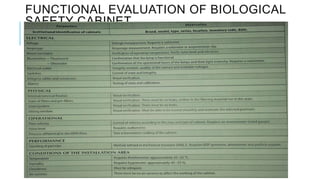
FUNCTIONAL EVALUATION OF BIOLOGICAL
SAFETY CABINET
TROUBLE
SHOOTING

Bio-safety Cabinet

  • 1.
  • 3.
    MAKERERE UNIVERSITY COLLEGE OFHEALTH SCIENCES MUYANJA JONAH B.sc in BIOMEDICAL ENGINEERING Email: munjojonah@gmail.com Tweeter: @jonahmunjo KAMPALA, UGANDA
  • 4.
    OVERVIEW Biological Safety Cabinet Introduction Purposesof the equipment Operation Principles Summary of biological safety types Installation requirements Routine Maintenance Functional evaluation of biological safety cabinets Trouble shooting
  • 5.
    INTRODUCTION This equipment isdesigned for controlling aerosols and micro-particles associated with managing potentially toxic or infectious biological material in laboratories in activities such as centrifugation, agitation, pipetting, and opening of pressurized containers. Safety cabinets have been designed to protect the user, the environment and the sample manipulated using appropriate ventilation conditions. They are also known as Laminar flow cabinets and/or biosafety cabinets.
  • 6.
    PURPOSES OF THE EQUIPMENT Thebiological safety cabinet is used for the following: 1. To protect the worker from risks associated with the management of potentially infectious biological material. 2. To protect the sample being analyzed from becoming contaminated. 3. To protect the environment The cabinets are used for routine work related to pathogens (parasites, bacteria, virus, fungus),cell culture and under very precise conditions, the management of toxic agents.
  • 7.
    OPERATION PRINCIPLES The biologicalsafety cabinet is a chamber generally constructed of steel. It has a front glass window of adjustable height, a ventilation system with an electrical motor, a ventilation and a set of ducts which while functioning, generate a negative pressure condition inside the cabinet. This forces the air to flow from inside the cabinet through the front opening to generate a curtain of air protecting the operator, Internally, the air is conducted through a series of grids and ducts to be finally treated in HEPA filter. Depending on the design of the cabinet, the air is recycled inside the laboratory or extruded and renewed in diverse proportions.
  • 8.
  • 14.
    INSTALLATION REQUIREMENTS The following arerequirements for a cabinet to function adequately: 1. A laboratory area protected from air currents from windows or air-conditioning systems. 2. An electrical connection equipped with the respective control and safety elements; the electrical outlet with a ground pole. 3. A leveled and firm table designed for supporting the weigh of the cabinet and allowing the operator to work comfortably. 4. The floor on which it is located must be flat and leveled. 5. The free space around the cabinet recommended by the manufacturer must be respected. 6. Type B cabinets must have an extraction duct equipped with the following required control devices; regulating valves that allow the flow of air to be isolated and regulated. 7. Gas connections must be in the immediate vicinity of the cabinet in order to facilitate the connection to the service valves.
  • 15.
    ROUTINE MAINTENANCE General maintenance requiredfor the biological safety cabinet is for the most part simple to perform. The routines and frequencies are shown below: Frequency: Weekly  Decontaminate the work surface and the interior surfaces of the cabinet with 70% ethanol.  Clean the front glass door and the surface of the ultraviolet lamp, using a domestic cleaning solution.  Verify the precision of the manometer’s reading indicating any fall in pressure flowing through the HEPA filter. Register the date and the reading in the cabinet’s log book. Frequency: Monthly  Clean the exterior surfaces, especially the front and the upper part using a piece of damp cloth in order to remove the dust.  Disinfect the surface of the lower compartment with 70% Ethanol or a suitable disinfecting solution.  Verify the state of the service valves  Do the tasks due on a weekly basis.
  • 16.
    Frequency: Annually Check theintensity of the UV lamp with a radiometer, substitute it if necessary Test the state of the fluorescent lamp. Substitute it if necessary Perform the tasks due on a monthly basis. Removal of the work surface For the removal of the work surface the following procedure is required: Decontaminate the surface before removing it. Loosen and remove the attachment screws located on the front part of the work surface Loosen, but do not remove the attachment screws located on the back part. Decontaminate the interior part of the work surface. To assemble it, perform the activities described in steps 2,3, and 4 in reverse order.
  • 17.
    Changing of theultraviolet lamp In order to change the ultraviolet lamp, the manufacturer’s instructions must be followed. In general the following procedures are done: Turn on the cabinet and leave it for 5 minutes Raise the front window to its maximum position Decontaminate the interior surfaces and the UV lamp Disconnect the electrical feed to the cabinet Disconnect the UV tube from its connectors turning it 90 degrees. Next install the spare part with the same characteristic as the original.
  • 18.
    Specialized maintenance Eventually, thecabinet will require specialized maintenance. The following are some procedures to be done accordingly: Motor change. Generally, it uses maintenance-free sealed rollers and function by inducing through frequency control. This motor doesn’t have brushes. Replacing ventilators Replacing the HEPA filter. The replacement frequency depends on the use of the cabinet and the system of environmental control installed in the laboratory. If there is a good control of dust, the filter could last many years. Repair of the electronic control system: flow control alarms, position of the window, velocity control Repair/cleaning of the flow regulator valves, bell type adjustment fittings.
  • 19.
    REFERENCES 1. Maintenance manualfor laboratory equipments, WHO, Geneva 2nd.Edition, 2008. 2. Cheesborough, Monica, District Laboratory practice in Tropical countries, part 1, Tropical Health Technology, UK, 2005. 3. Primary containment for Biohazards: Selection, Installation and use of Biological safety Cabinets, Washington DC U.S.A Department of Health services, Center for Disease Control and Prevention and National Institute of Health, 2nd. Edition, 2000.
  • 20.
    FUNCTIONAL EVALUATION OFBIOLOGICAL SAFETY CABINET
  • 21.