Natural Selection I:
Artificial Selection
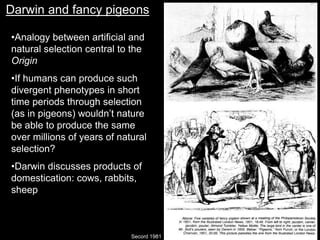
Darwin and fancy pigeons
Secord 1981
•Analogy between artificial and
natural selection central to the
Origin
•If humans can produce such
divergent phenotypes in short
time periods through selection
(as in pigeons) wouldn’t nature
be able to produce the same
over millions of years of natural
selection?
•Darwin discusses products of
domestication: cows, rabbits,
sheep
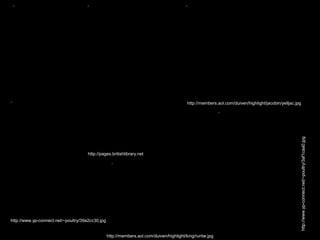
English Carriers
http://pages.britishlibrary.net
http://members.aol.com/duiven/highlight/jacobin/yelljac.jpg
Jacobin
Fantail
http://www.yp-connect.net/~poultry/39a2cc30.jpg
Runt
http://members.aol.com/duiven/highlight/king/runtw.jpg
Pouter
http://www.yp-connect.net/~poultry/3af1caa0.jpg
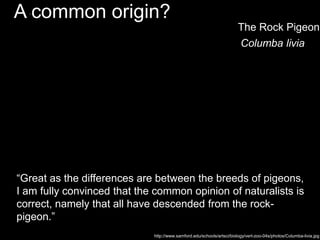
A common origin?
http://www.samford.edu/schools/artsci/biology/vert-zoo-04s/photos/Columba-livia.jpg
Columba livia
The Rock Pigeon
“Great as the differences are between the breeds of pigeons,
I am fully convinced that the common opinion of naturalists is
correct, namely that all have descended from the rock-
pigeon.”
A common origin?
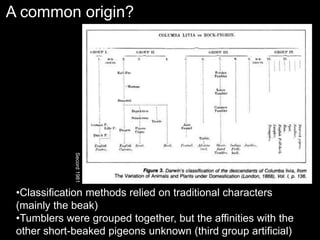
•Classification methods relied on traditional characters
(mainly the beak)
•Tumblers were grouped together, but the affinities with the
other short-beaked pigeons unknown (third group artificial)
Secord
1981
A common origin?
•If fancy types were produced by crossing, the number of wild
progenitors would at least be 7 or 8, most of which would be
extinct
•The fancy pigeons bear a fundamental similarity to the rock
pigeon-both in habits and general structure-that they share with
no other bird
•All the domestic pigeons can be intercrossed, producing fertile
offspring
•If the distinct ancestral species had existed originally, men
would have chosen a very strangely modified set of birds,
different from all existing members of the family
•None of the domesticated forms have returned to their natural
state, as would be expected if close to their wild progenitors
•The ancestral species would have to be capable of
domestication, an unusual property
Secord
1981
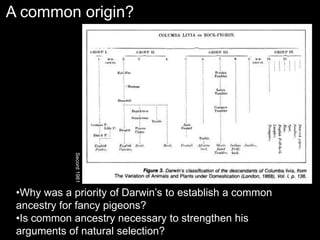
•Why was a priority of Darwin’s to establish a common
ancestry for fancy pigeons?
•Is common ancestry necessary to strengthen his
arguments of natural selection?
A common origin?
The process of selection
Secord 1981
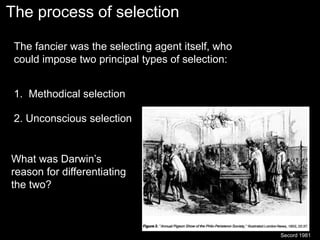
The fancier was the selecting agent itself, who
could impose two principal types of selection:
1. Methodical selection
2. Unconscious selection
What was Darwin’s
reason for differentiating
the two?
Artificial selection as an analogy
The argument that artificial selection is analogous
to natural selection is a key component of the
Origin of Species, The Descent of Man, and
Variation of Animals and Plants Under
Domestication
•Darwin’s artificial selection
analogy argued by many
historians and philosophers as
just an analogy to aid in
explaining the parallels with
natural selection
Artificial selection as an analogy
The argument that artificial selection is analogous
to natural selection is a key component of the
Origin of Species, The Descent of Man, and
Variation of Animals and Plants Under
Domestication
•Wilner (2006) argues artificial
selection should be conceived
as a multifaceted experiment.
•Traditional experiment: lead to
theories of natural selection.
•Non-traditional: disclosed the
nature of hereditary variation
Darwin’s hopeful monsters
http://www.dailymail.co.uk
Darwin frequently referred to the results of artificial
selection as “monstrous”
•Many portray this as
an indication of the
irrelevance of artificial
selection to natural
phenomena
Darwin’s hopeful monsters
“The circumstances under which
our domestic productions are
reared are widely different. . . In
conformity with this, all our
domesticated productions, with
the rarest exceptions, vary far
more than natural species.”
-Darwin (1896)
Wilner (2006) views Darwin’s use of “monstrous”
in an experimental sense. Darwin’s “monstrous”
refers to the degree of artificiality in the breeders’
experiment. Experiments uncover the nature of
the elements, often with very artificial treatments.
Is artificial selection analogous to natural
selection?
•Does artificial selection mimic natural selection to
any degree?
•Degree of selection pressure
•Methodical vs unintentional selection
•Convergent evolution
•What would be concrete evidence?
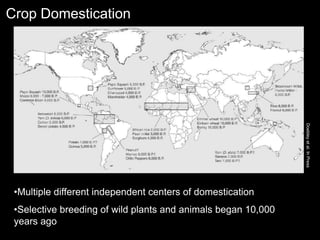
Crop Domestication
•Multiple different independent centers of domestication
•Selective breeding of wild plants and animals began 10,000
years ago
Doebley
et
al.
In
Press
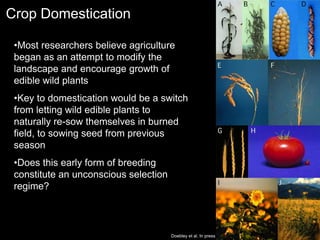
Crop Domestication
Doebley et al. In press.
•Most researchers believe agriculture
began as an attempt to modify the
landscape and encourage growth of
edible wild plants
•Key to domestication would be a switch
from letting wild edible plants to
naturally re-sow themselves in burned
field, to sowing seed from previous
season
•Does this early form of breeding
constitute an unconscious selection
regime?
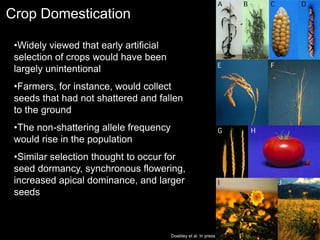
Crop Domestication
Doebley et al. In press.
•Widely viewed that early artificial
selection of crops would have been
largely unintentional
•Farmers, for instance, would collect
seeds that had not shattered and fallen
to the ground
•The non-shattering allele frequency
would rise in the population
•Similar selection thought to occur for
seed dormancy, synchronous flowering,
increased apical dominance, and larger
seeds
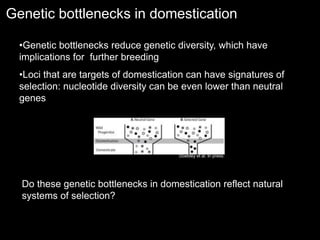
Genetic bottlenecks in domestication
Doebley et al. In press.
•Genetic bottlenecks reduce genetic diversity, which have
implications for further breeding
•Loci that are targets of domestication can have signatures of
selection: nucleotide diversity can be even lower than neutral
genes
Do these genetic bottlenecks in domestication reflect natural
systems of selection?
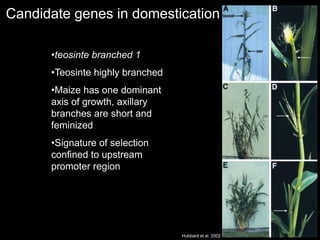
Candidate genes in domestication
Hubbard et al. 2002
•teosinte branched 1
•Teosinte highly branched
•Maize has one dominant
axis of growth, axillary
branches are short and
feminized
•Signature of selection
confined to upstream
promoter region
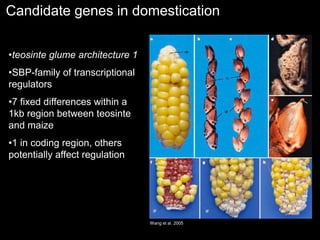
Candidate genes in domestication
•teosinte glume architecture 1
•SBP-family of transcriptional
regulators
•7 fixed differences within a
1kb region between teosinte
and maize
•1 in coding region, others
potentially affect regulation
Wang et al. 2005
Candidate genes in domestication
•Signatures of positive selection show the a
cauliflower gene carrying a nonsense mutation is
segregating in broccoli, wild cabbage, kale, and
cauliflower. A floral regulatory locus
Many genes implicated in domestication are shown to be
involved in gene regulation or in regulatory regions
themselves. Does this follow a similar pattern to natural
systems?
Vollbrecht et al. 2005
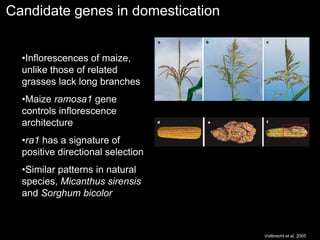
•Inflorescences of maize,
unlike those of related
grasses lack long branches
•Maize ramosa1 gene
controls inflorescence
architecture
•ra1 has a signature of
positive directional selection
•Similar patterns in natural
species, Micanthus sirensis
and Sorghum bicolor
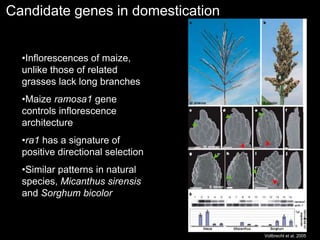
Candidate genes in domestication
Vollbrecht et al. 2005
•Inflorescences of maize,
unlike those of related
grasses lack long branches
•Maize ramosa1 gene
controls inflorescence
architecture
•ra1 has a signature of
positive directional selection
•Similar patterns in natural
species, Micanthus sirensis
and Sorghum bicolor
Developmental constraint in dog domestication
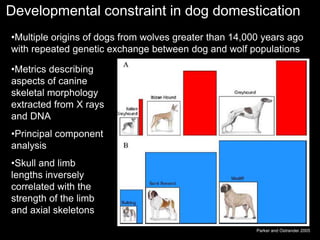
•Multiple origins of dogs from wolves greater than 14,000 years ago
with repeated genetic exchange between dog and wolf populations
Parker and Ostrander 2005
•Metrics describing
aspects of canine
skeletal morphology
extracted from X rays
and DNA
•Principal component
analysis
•Skull and limb
lengths inversely
correlated with the
strength of the limb
and axial skeletons
Convergent evolution in dog domestication
•Dogs can read human
communicative gestures
(ie.pointing) better in comparison
than wolves
•Unclear if this ability is a result of
direct selection or a by-product of
selection against fear and
aggression towards humans
•Experimental population of fox kits
bred over 45 years to approach
humans fearlessly and non-
aggressively
•As skillful as dog puppies in
human gestures and more skillful
than a second control population of
fox kits
Experimental evolution in E. coli
http://www.msu.edu/~lenski/photoinlab.jpg
•>30,000 generations starting
from a clonal line
•Serial transfer regime,
populations diluted 1:100 each
day into 10ml
•6.6 generations per day
•Homogeneous environment
•Replicate populations
•Samples from each generation
stored for further genetic
analysis
Experimental evolution in E. coli
http://www.msu.edu/~lenski/photoinlab.jpg
“We emphasize that our
experiments employ natural
selection, and not artificial
selection as practiced by
breeders and many
experimentalists”
True?
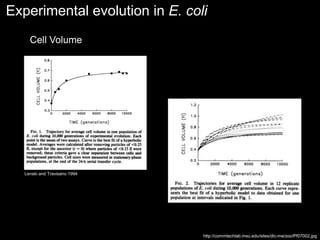
Experimental evolution in E. coli
http://commtechlab.msu.edu/sites/dlc-me/zoo/Pf07002.jpg
Lenski and Travisano 1994
Cell Volume
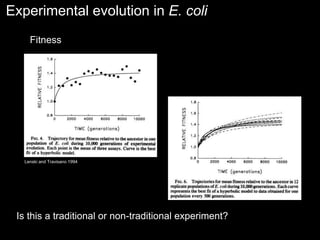
Experimental evolution in E. coli
Lenski and Travisano 1994
Fitness
Is this a traditional or non-traditional experiment?
Experimental evolution in E. coli
Other findings:
•Pleiotropic effects of fitness mutations. Both postitive and negative.
•Two ecologically and morphologically distinct types evolved: L and S
by generation 6,000 and persisted for more than 12,000 generations
after. Phylogenetic analysis of over 200 clones indicates that S was
monophyletic. Fitness experiments indicate both lineages continued
to evolve which contributed to their general frequencies over time.
Different species.
•Parallel changes in DNA topology between populations. Mutations in
topA and fis, which control DNA supercoiling.
•Parallel changes in gene expression from growth in a glucose-limited
medium. Expression of 59 genes had changed significantly in the
same direction in two selected populations. A mutation in a regulator
spoT produced many of these expression differences.
Experimental evolution in E. coli
Some mutation facts about E. coli:
•After 10,000 generations, each pop. Underwent 7.5 X 10¹¹
replications
•Mutation rate: 2.5 X 10⁻³ mutations per genome replication
•Each pop. Experienced 2 X 10⁹ mutations
•With 5 X10⁶ bp per genome and three alternative point mutations at
each bp, this translates to >100 occurrences of every point mutation
in the whole genome
Conclusions
Is artificial selection analogous to natural selection?
Can artificial selection be used as evidence for evolution?
References
Doebley, J.F., Gaut, B.S., Smith, B.D. In press. The molecular genetics of crop domestication.
Evans, L.T. 1984. Darwin’s use of the analogy between artificial and natural selection. Journal of the History of Biology. 17:
113-140.
Gould, S.J. 1991. What the immaculate pigeon teaches the burdened mind. Natural History. 100: 12-21.
Hare, B., Plyusnina, I., Ignacio, N., Schepina, O., Stepika, A., Wrangham, R., Trut, L. 2005. Social cognitive evolution in
captive foxes is a correlated by-product of experimental domestication. Curr Biol. 15: 226-230.
Hubbard, L., McSteen, jP., Doebley, J., and Hake, S. 2002. Expression patterns and mutant phenotype of teosinte branched1
correlate with growth suppression in maize and tewosinte. Genetics. 162: 1927-1935.
Lenski, R. and Travisano, M. 1994. Dyanmics of adaptation and diversification: A 10,000 generation experiment with bacterial
populations. Proc. Natl. Acad. Sci USA. 91: 6808-6814.
Parker, H.G. and Ostrander, E.A. 2005. Canine genomics and genetics: running with the pack. PLOS. 1: 507-513.
Purugganan, M.D., Boyles, A.L., Suddith, J.I. 2000. Variation and selection at the cauliflower florwal homeotic gene
accompanying the evolution of domesticated Brassica oleracea. Genetcs. 155:855-862.
Ruse, M. 1975. Charles darwin and artificial selection. J. Hist. Ideas. 36: 339-350.
Secord, J.A. 1981. Nature’s fancy: Charles Darwin and the breeding of pigeons. ISIS. 72: 163-186.
Vilà, C., Savolainen, P., Maldonado, J.E., Amorin, I.R., Rice, J.E. Honeycutt, R.L., Crandall, K.A., Lundeberg, J., Wayne, R.K.
1997. Science. 276: 1687-1689.
Vollbrecht, E. and Sigmon, B. 2005. Amazing grass: developmental genetics of maize domestication. Biochemical Society
Transactions. 33: 1502-1506.
Vollbrecht, E., Springer, P.S., Goh, L., Buckler, E.S. IV, Martienssen, R. 2005. Architecture of floral branch systems in maize
and related grasses. Nature. 436: 1119-1126.
Wang, H., Nussbaum-Wagler, T., Li, B., Zhao, Q., Vigourous, Y., Faller, M., Bomblies, K., Lukens, L., Doelbey, J. 2005. The
origin of naked grans of maize. Nature. 436: 714-719.
Wilner, E. 2006. Darwin’s artificial selection as an experiment. Stud Hist Philos Biol Biomed Sci. 37: 26-40.
Wright, S.I., Bi, I.V., Schroeder, S.G., Yamasaki, M., Doebley, J.F., McMullen, M.D., Gaut, B.S. 2005. The effects of artificial
selection on the maize genome. Science. 308: 1310-1314.

ArtificialSelection.ppt

  • 1.
  • 2.
    Darwin and fancypigeons Secord 1981 •Analogy between artificial and natural selection central to the Origin •If humans can produce such divergent phenotypes in short time periods through selection (as in pigeons) wouldn’t nature be able to produce the same over millions of years of natural selection? •Darwin discusses products of domestication: cows, rabbits, sheep
  • 3.
  • 4.
    A common origin? http://www.samford.edu/schools/artsci/biology/vert-zoo-04s/photos/Columba-livia.jpg Columbalivia The Rock Pigeon “Great as the differences are between the breeds of pigeons, I am fully convinced that the common opinion of naturalists is correct, namely that all have descended from the rock- pigeon.”
  • 5.
    A common origin? •Classificationmethods relied on traditional characters (mainly the beak) •Tumblers were grouped together, but the affinities with the other short-beaked pigeons unknown (third group artificial) Secord 1981
  • 6.
    A common origin? •Iffancy types were produced by crossing, the number of wild progenitors would at least be 7 or 8, most of which would be extinct •The fancy pigeons bear a fundamental similarity to the rock pigeon-both in habits and general structure-that they share with no other bird •All the domestic pigeons can be intercrossed, producing fertile offspring •If the distinct ancestral species had existed originally, men would have chosen a very strangely modified set of birds, different from all existing members of the family •None of the domesticated forms have returned to their natural state, as would be expected if close to their wild progenitors •The ancestral species would have to be capable of domestication, an unusual property
  • 7.
    Secord 1981 •Why was apriority of Darwin’s to establish a common ancestry for fancy pigeons? •Is common ancestry necessary to strengthen his arguments of natural selection? A common origin?
  • 8.
    The process ofselection Secord 1981 The fancier was the selecting agent itself, who could impose two principal types of selection: 1. Methodical selection 2. Unconscious selection What was Darwin’s reason for differentiating the two?
  • 9.
    Artificial selection asan analogy The argument that artificial selection is analogous to natural selection is a key component of the Origin of Species, The Descent of Man, and Variation of Animals and Plants Under Domestication •Darwin’s artificial selection analogy argued by many historians and philosophers as just an analogy to aid in explaining the parallels with natural selection
  • 10.
    Artificial selection asan analogy The argument that artificial selection is analogous to natural selection is a key component of the Origin of Species, The Descent of Man, and Variation of Animals and Plants Under Domestication •Wilner (2006) argues artificial selection should be conceived as a multifaceted experiment. •Traditional experiment: lead to theories of natural selection. •Non-traditional: disclosed the nature of hereditary variation
  • 11.
    Darwin’s hopeful monsters http://www.dailymail.co.uk Darwinfrequently referred to the results of artificial selection as “monstrous” •Many portray this as an indication of the irrelevance of artificial selection to natural phenomena
  • 12.
    Darwin’s hopeful monsters “Thecircumstances under which our domestic productions are reared are widely different. . . In conformity with this, all our domesticated productions, with the rarest exceptions, vary far more than natural species.” -Darwin (1896) Wilner (2006) views Darwin’s use of “monstrous” in an experimental sense. Darwin’s “monstrous” refers to the degree of artificiality in the breeders’ experiment. Experiments uncover the nature of the elements, often with very artificial treatments.
  • 13.
    Is artificial selectionanalogous to natural selection? •Does artificial selection mimic natural selection to any degree? •Degree of selection pressure •Methodical vs unintentional selection •Convergent evolution •What would be concrete evidence?
  • 14.
    Crop Domestication •Multiple differentindependent centers of domestication •Selective breeding of wild plants and animals began 10,000 years ago Doebley et al. In Press
  • 15.
    Crop Domestication Doebley etal. In press. •Most researchers believe agriculture began as an attempt to modify the landscape and encourage growth of edible wild plants •Key to domestication would be a switch from letting wild edible plants to naturally re-sow themselves in burned field, to sowing seed from previous season •Does this early form of breeding constitute an unconscious selection regime?
  • 16.
    Crop Domestication Doebley etal. In press. •Widely viewed that early artificial selection of crops would have been largely unintentional •Farmers, for instance, would collect seeds that had not shattered and fallen to the ground •The non-shattering allele frequency would rise in the population •Similar selection thought to occur for seed dormancy, synchronous flowering, increased apical dominance, and larger seeds
  • 17.
    Genetic bottlenecks indomestication Doebley et al. In press. •Genetic bottlenecks reduce genetic diversity, which have implications for further breeding •Loci that are targets of domestication can have signatures of selection: nucleotide diversity can be even lower than neutral genes Do these genetic bottlenecks in domestication reflect natural systems of selection?
  • 18.
    Candidate genes indomestication Hubbard et al. 2002 •teosinte branched 1 •Teosinte highly branched •Maize has one dominant axis of growth, axillary branches are short and feminized •Signature of selection confined to upstream promoter region
  • 19.
    Candidate genes indomestication •teosinte glume architecture 1 •SBP-family of transcriptional regulators •7 fixed differences within a 1kb region between teosinte and maize •1 in coding region, others potentially affect regulation Wang et al. 2005
  • 20.
    Candidate genes indomestication •Signatures of positive selection show the a cauliflower gene carrying a nonsense mutation is segregating in broccoli, wild cabbage, kale, and cauliflower. A floral regulatory locus Many genes implicated in domestication are shown to be involved in gene regulation or in regulatory regions themselves. Does this follow a similar pattern to natural systems?
  • 21.
    Vollbrecht et al.2005 •Inflorescences of maize, unlike those of related grasses lack long branches •Maize ramosa1 gene controls inflorescence architecture •ra1 has a signature of positive directional selection •Similar patterns in natural species, Micanthus sirensis and Sorghum bicolor Candidate genes in domestication
  • 22.
    Candidate genes indomestication Vollbrecht et al. 2005 •Inflorescences of maize, unlike those of related grasses lack long branches •Maize ramosa1 gene controls inflorescence architecture •ra1 has a signature of positive directional selection •Similar patterns in natural species, Micanthus sirensis and Sorghum bicolor
  • 23.
    Developmental constraint indog domestication •Multiple origins of dogs from wolves greater than 14,000 years ago with repeated genetic exchange between dog and wolf populations Parker and Ostrander 2005 •Metrics describing aspects of canine skeletal morphology extracted from X rays and DNA •Principal component analysis •Skull and limb lengths inversely correlated with the strength of the limb and axial skeletons
  • 24.
    Convergent evolution indog domestication •Dogs can read human communicative gestures (ie.pointing) better in comparison than wolves •Unclear if this ability is a result of direct selection or a by-product of selection against fear and aggression towards humans •Experimental population of fox kits bred over 45 years to approach humans fearlessly and non- aggressively •As skillful as dog puppies in human gestures and more skillful than a second control population of fox kits
  • 25.
    Experimental evolution inE. coli http://www.msu.edu/~lenski/photoinlab.jpg •>30,000 generations starting from a clonal line •Serial transfer regime, populations diluted 1:100 each day into 10ml •6.6 generations per day •Homogeneous environment •Replicate populations •Samples from each generation stored for further genetic analysis
  • 26.
    Experimental evolution inE. coli http://www.msu.edu/~lenski/photoinlab.jpg “We emphasize that our experiments employ natural selection, and not artificial selection as practiced by breeders and many experimentalists” True?
  • 27.
    Experimental evolution inE. coli http://commtechlab.msu.edu/sites/dlc-me/zoo/Pf07002.jpg Lenski and Travisano 1994 Cell Volume
  • 28.
    Experimental evolution inE. coli Lenski and Travisano 1994 Fitness Is this a traditional or non-traditional experiment?
  • 29.
    Experimental evolution inE. coli Other findings: •Pleiotropic effects of fitness mutations. Both postitive and negative. •Two ecologically and morphologically distinct types evolved: L and S by generation 6,000 and persisted for more than 12,000 generations after. Phylogenetic analysis of over 200 clones indicates that S was monophyletic. Fitness experiments indicate both lineages continued to evolve which contributed to their general frequencies over time. Different species. •Parallel changes in DNA topology between populations. Mutations in topA and fis, which control DNA supercoiling. •Parallel changes in gene expression from growth in a glucose-limited medium. Expression of 59 genes had changed significantly in the same direction in two selected populations. A mutation in a regulator spoT produced many of these expression differences.
  • 30.
    Experimental evolution inE. coli Some mutation facts about E. coli: •After 10,000 generations, each pop. Underwent 7.5 X 10¹¹ replications •Mutation rate: 2.5 X 10⁻³ mutations per genome replication •Each pop. Experienced 2 X 10⁹ mutations •With 5 X10⁶ bp per genome and three alternative point mutations at each bp, this translates to >100 occurrences of every point mutation in the whole genome
  • 31.
    Conclusions Is artificial selectionanalogous to natural selection? Can artificial selection be used as evidence for evolution?
  • 32.
    References Doebley, J.F., Gaut,B.S., Smith, B.D. In press. The molecular genetics of crop domestication. Evans, L.T. 1984. Darwin’s use of the analogy between artificial and natural selection. Journal of the History of Biology. 17: 113-140. Gould, S.J. 1991. What the immaculate pigeon teaches the burdened mind. Natural History. 100: 12-21. Hare, B., Plyusnina, I., Ignacio, N., Schepina, O., Stepika, A., Wrangham, R., Trut, L. 2005. Social cognitive evolution in captive foxes is a correlated by-product of experimental domestication. Curr Biol. 15: 226-230. Hubbard, L., McSteen, jP., Doebley, J., and Hake, S. 2002. Expression patterns and mutant phenotype of teosinte branched1 correlate with growth suppression in maize and tewosinte. Genetics. 162: 1927-1935. Lenski, R. and Travisano, M. 1994. Dyanmics of adaptation and diversification: A 10,000 generation experiment with bacterial populations. Proc. Natl. Acad. Sci USA. 91: 6808-6814. Parker, H.G. and Ostrander, E.A. 2005. Canine genomics and genetics: running with the pack. PLOS. 1: 507-513. Purugganan, M.D., Boyles, A.L., Suddith, J.I. 2000. Variation and selection at the cauliflower florwal homeotic gene accompanying the evolution of domesticated Brassica oleracea. Genetcs. 155:855-862. Ruse, M. 1975. Charles darwin and artificial selection. J. Hist. Ideas. 36: 339-350. Secord, J.A. 1981. Nature’s fancy: Charles Darwin and the breeding of pigeons. ISIS. 72: 163-186. Vilà, C., Savolainen, P., Maldonado, J.E., Amorin, I.R., Rice, J.E. Honeycutt, R.L., Crandall, K.A., Lundeberg, J., Wayne, R.K. 1997. Science. 276: 1687-1689. Vollbrecht, E. and Sigmon, B. 2005. Amazing grass: developmental genetics of maize domestication. Biochemical Society Transactions. 33: 1502-1506. Vollbrecht, E., Springer, P.S., Goh, L., Buckler, E.S. IV, Martienssen, R. 2005. Architecture of floral branch systems in maize and related grasses. Nature. 436: 1119-1126. Wang, H., Nussbaum-Wagler, T., Li, B., Zhao, Q., Vigourous, Y., Faller, M., Bomblies, K., Lukens, L., Doelbey, J. 2005. The origin of naked grans of maize. Nature. 436: 714-719. Wilner, E. 2006. Darwin’s artificial selection as an experiment. Stud Hist Philos Biol Biomed Sci. 37: 26-40. Wright, S.I., Bi, I.V., Schroeder, S.G., Yamasaki, M., Doebley, J.F., McMullen, M.D., Gaut, B.S. 2005. The effects of artificial selection on the maize genome. Science. 308: 1310-1314.