1
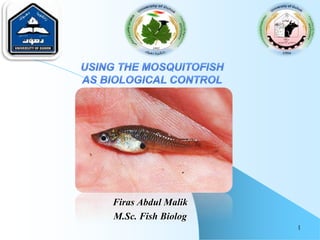
Firas Abdul Malik
M.Sc. Fish Biolog
Introduction:
The side effects of insecticide which are used for
controlling the vectors of human diseases are in increase.
Manipulating or introducing a predator into the ecosystem
may provide sustained biological control of pest populations
(Ayala et al., 2007). Biological control of mosquitoes is an
important component. Naturally there are several predators of
these insect both as larvae and adults (Shannon & Paul ,
2011). Some larval predators include several species of
beetles, fish, birds and bats. (Gerald et al., 2012). Mosquito
Fish (Gambusia affinis) are a great way to reduce mosquito
populations before they become a problem such as
transferring malaria disease. Gambusia can be introduced into
streams, lakes, irrigation systems, drainage systems, sloughs,
ponds, reservoirs, cisterns, shallow wells, animal watering
troughs, and seepage areas (Purcell, et al., 2010).
2
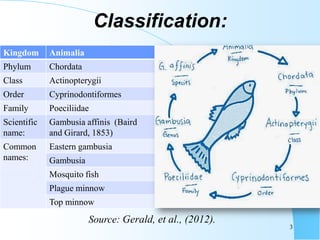
Classification:
3
AnimaliaKingdom
ChordataPhylum
ActinopterygiiClass
CyprinodontiformesOrder
PoeciliidaeFamily
Gambusia affinis (Baird
and Girard, 1853)
Scientific
name:
Eastern gambusiaCommon
names: Gambusia
Mosquito fish
Plague minnow
Top minnow
Source: Gerald, et al., (2012).
Mosquito fish have large heads that are flattened
on the upper surface, and their eyes are large relative
to their bodies . The female is bigger than the male
both in length and girth. (Gerald et al., 2012).
Mosquito fish do not lay eggs, they give birth to
well-developed active young. Consequently only
one pregnant female is needed to start a new
population. The anal fin on adult females resembles
the dorsal fin while the male has a modified anal-fin
(bottom) for sperm transfer. This pointed fin is
referred to as a gonopodium and is used to deposit
sperm inside the female. (FAO, 2008). 4
Fish Description:
Fish External Anatomy:
5
Gonopodium
Figure(1): male & female distinguish.
Source: Boyer et al., (2008).
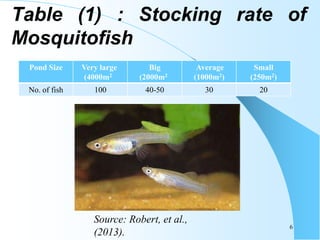
Table (1) : Stocking rate of
Mosquitofish
6
Small
(250m2)
Average
(1000m2)
Big
(2000m2
Very large
(4000m2
Pond Size
203040-50100No. of fish
Source: Robert, et al.,
(2013).
Mosquito fish are hardy. They can survive in
waters with:
1. Low levels of dissolved oxygen,
2. High salinities (up twice that of sea water) and
3. Temperatures (between 0.5-42˚C).
4. Most common in lower reaches of streams.
5. They prefer brackish water with little to no flow
(static waters) such as vegetated ponds and lakes,
backwaters and quiet pools of streams. (Preston et al.,
2012)
6. The fry are independent from birth and often seek
refuge among submerging vegetation.
Ecology & life history:
7
1. Size at birth: (0.8) cm male, (0.9)
cm female.
2. Reproductive strategy:
ovoviviparous (live bearers).
3. Sexual maturity: male (43-62)
days. Female (21-28) days.
4. Brood: 300 fry, usually less than
60.
5. Brood replications: up to (5
broods/year) under favorable
conditions.
6. Gestation period: (16-28) day.
7. Lifespan: 1-1.5 year.
Reproduction of fish
8
Figure(2): male gonopodium.
9
Video (1): Mosquito fish.
9
Mosquito Fish Care
When you get your fish home, you will need to acclimate the fish to their
new pond (or other site) by placing the container with fish directly into the
water for 10-15 minutes or until the pond water and the container's water are
near the same temperature. Then release the fish.
These fish are opportunistic feeders in that they eat just about anything.
During the warmer months they usually do not need supplemental feeding.
However, if there is no natural food present (i.e. new pond), some artificial
food, such as crushed dry food will be necessary for fish survival. (Purcell, et
al., 2012).
Mosquito fish prefer temperatures between (25-30˚C) , and are often found
in the shallow un shaded region of a pond. Algae in limited amounts will not
harm fish but may become unsightly. Most pet stores have or can secure for
you a preparation with directions for use in fish pools to control algae.(Gerald
et al., 2012)
These hardy fish should survive through several seasons and reproduce you
for your help in mosquito control.
10
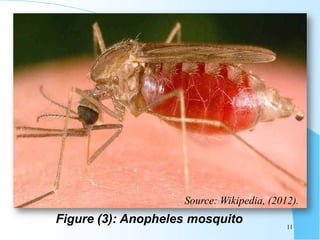
Figure (3): Anopheles mosquito 11
Source: Wikipedia, (2012).
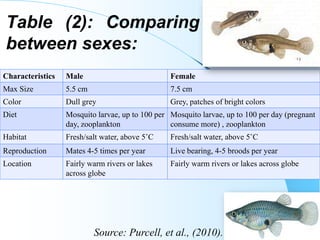
Table (2): Comparing
between sexes:
Characteristics Male Female
Max Size 5.5 cm 7.5 cm
Color Dull grey Grey, patches of bright colors
Diet Mosquito larvae, up to 100 per
day, zooplankton
Mosquito larvae, up to 100 per day (pregnant
consume more) , zooplankton
Habitat Fresh/salt water, above 5˚C Fresh/salt water, above 5˚C
Reproduction Mates 4-5 times per year Live bearing, 4-5 broods per year
Location Fairly warm rivers or lakes
across globe
Fairly warm rivers or lakes across globe
12
Source: Purcell, et al., (2010).
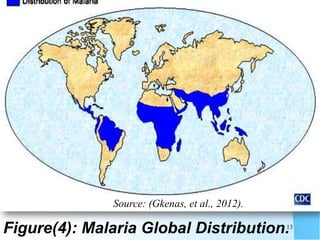
Figure(4): Malaria Global Distribution.
Source: (Gkenas, et al., 2012).
13
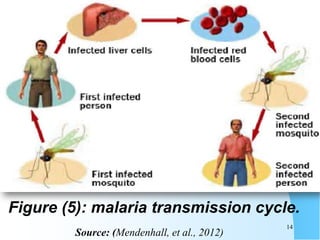
Figure (5): malaria transmission cycle.
Source: (Mendenhall, et al., 2012)
14
Fish adaptation:
1. Larvivorous fish.
2. Very easily adaptable.
3. Mosquitofish are particularly difficult to control.
4. Very fecund, they disperse rapidly through
connected stream networks, and they are still
commonly used as a biological control agent for
mosquitoes. (Gerald, et al., 2012).
15
Disadvantages of mosquito fish:
1. Aggressive feeders.
2. Frequently attack native fish, nipping at their
eyes and fins.
3. Gambusia also competes with native fish for
food & space. (Alcaraz, & García, 2008).
4. Have been known to eat native fish eggs.
5. A single gambusia female produces several
broods a year which can reach sexual maturity in
as little as 3-4 weeks. (Robert, et al., 2013).
16
17
Mortalities by Malaria annually.
Source: (Preston, et al., 2012).
Conclusion
Therefore, this method of controlling mosquitoes
contribute a lot of beneficial effects to us especially to the
major problems which involve mosquitoes harmful effects
to humans such as:
1. Nuisance mosquitoes: bother people around homes or
in parks and creational areas. (Gkenas, et al., 2012).
2. Economically important: mosquitoes reduce real
estate values, adversely affect tourism and related
business interests, or negatively impact livestock or
poultry production. (Robert, et al., 2013).
3. Public health: is the focus when mosquitoes are
vectors, or transmitters, of infectious diseases. Such as
malaria . 18
Alcaraz, C. and García, B. E. (2008). Salinity mediates the competitive interactions between
invasive mosquitofish and an endangered fish. Oecologia 155, 205-213.
Ayala, J. R.; Rader, R. B.; Belk, M. C. and Schaalje, G. B. (2007). Ground-truthing the impact of
invasive species: spatiotemporal overlap between native least chub and introduced western
mosquitofish. Biological Invasions 9, 857-869.
Bonney, B. (2013). Responses of Gambusia affinis to Changes in Hydrologic Regimes in Waller
Creek, Texas -Department of Marine Science-College of Natural Sciences-
ben_bonney@yahoo.com. Pdf pp77-80.
Boyer, M. C.; Muhlfeld, C. C. and Allendorf, F. W. (2008). Rainbow trout (Oncorhynchus
mykiss) invasion and the spread of hybridisation with native westslope cutthroat trout
(Oncorhynchus clarkii lewisi). Canadian Journal of Fisheries and Aquatic Sciences 65,
658-669.
Food and Agriculture Organisation of the United Nations (FAO) (2008). Cultured Aquatic
Species Information Programme – Cyprinus carpio (Linnaeus, 1758).
http://www.fao.org/fishery/ culturedspecies/Cyprinus_carpio.
Gerald, M.; Cynthia, H.; Mieu, N.; Stephen, S.; Gregory, T.; Michael, C. and Claudia, R. (2012).
The use of Gambusia to control mosquito larvae in abandoned swimming pools: The New
Orleans experience. New Orleans Mosquito, Termite, and Rodent Control Board:73pp.
Gkenas, C.; Oikonomou, A.; Economou, A.; Kiosse, F. and Leonardos, I..(2012). “Life History
Pattern and Feeding Habits of the Invasive Mosquitofish, Gambusia Holbrooki, in Lake
Pamvotis (Nw Greece).” [In English]. Journal of Biological Research-Thessaloniki :121-
36.
19
References:
Mendenhall, C. D.; Daily, G. C. and Ehrlich, P. R.. (2012).“Improving Estimates of Biodiversity
Loss.” Biological Conservation 151, no. 1 :32-34.
Preston, D. L., Henderson, J. S. and Johnson, P. T. J.. (2012). “Community Ecology of
Invasions: Direct and Indirect Effects of Multiple Invasive Species on Aquatic
Communities.” Ecology 93, no. 6 : 1254-61.
Purcell, K. M.; Klerks, P. L. and Leberg, P. L. (2010). Adaptation to sea level rise: Does local
adaptation influence the demography of coastal fish populations? J. Fish Biol. 77(6): 1209–
1218. doi:10. 1111/j.1095-8649.2010.02727.x. PMID:21039500.
Purcell, K. M.; Ling, N.; and Stockwell, C.A.(2012). Evaluation of the introduction history and
genetic diversity of a serially introduced fish population in New Zealand. Biological
Invasions 14:2057-2065.
Robert, D.; Jeffrey D.; Douglas, G.; Claudia, O. and Michael, R.(2013). Gambusia
affinis effectiveness in New Jersey. Proceedings of the Eighty-Third Annual Meeting of the
New Jersey Mosquito Control Association, Inc.6pp.
Shannon, B. M. and Paul, L. L. (2011). Influence of environmental stress on age- and size-at-
maturity: genetic and plastic responses of coastal marsh fishes to changing salinities Can. J.
Fish. Aquatic. Sci. Vol. 68.
Wikipedia. (2012). Mosquito. Available from: http://en.wikipedia.org/wiki/Mosquaito .
http://www.ryanphotographic.com/poecilidae.htm.
http://catalog.digitalarchives.tw/Exhibition/Detail.jsp?OID=14711.
http://www.bio.txstate.edu/~tbonner/txfishes/gambusia%20affinis.htm. 20
References:
21
2222

Biological Control

  • 1.
  • 2.
    Introduction: The side effectsof insecticide which are used for controlling the vectors of human diseases are in increase. Manipulating or introducing a predator into the ecosystem may provide sustained biological control of pest populations (Ayala et al., 2007). Biological control of mosquitoes is an important component. Naturally there are several predators of these insect both as larvae and adults (Shannon & Paul , 2011). Some larval predators include several species of beetles, fish, birds and bats. (Gerald et al., 2012). Mosquito Fish (Gambusia affinis) are a great way to reduce mosquito populations before they become a problem such as transferring malaria disease. Gambusia can be introduced into streams, lakes, irrigation systems, drainage systems, sloughs, ponds, reservoirs, cisterns, shallow wells, animal watering troughs, and seepage areas (Purcell, et al., 2010). 2
  • 3.
    Classification: 3 AnimaliaKingdom ChordataPhylum ActinopterygiiClass CyprinodontiformesOrder PoeciliidaeFamily Gambusia affinis (Baird andGirard, 1853) Scientific name: Eastern gambusiaCommon names: Gambusia Mosquito fish Plague minnow Top minnow Source: Gerald, et al., (2012).
  • 4.
    Mosquito fish havelarge heads that are flattened on the upper surface, and their eyes are large relative to their bodies . The female is bigger than the male both in length and girth. (Gerald et al., 2012). Mosquito fish do not lay eggs, they give birth to well-developed active young. Consequently only one pregnant female is needed to start a new population. The anal fin on adult females resembles the dorsal fin while the male has a modified anal-fin (bottom) for sperm transfer. This pointed fin is referred to as a gonopodium and is used to deposit sperm inside the female. (FAO, 2008). 4 Fish Description:
  • 5.
    Fish External Anatomy: 5 Gonopodium Figure(1):male & female distinguish. Source: Boyer et al., (2008).
  • 6.
    Table (1) :Stocking rate of Mosquitofish 6 Small (250m2) Average (1000m2) Big (2000m2 Very large (4000m2 Pond Size 203040-50100No. of fish Source: Robert, et al., (2013).
  • 7.
    Mosquito fish arehardy. They can survive in waters with: 1. Low levels of dissolved oxygen, 2. High salinities (up twice that of sea water) and 3. Temperatures (between 0.5-42˚C). 4. Most common in lower reaches of streams. 5. They prefer brackish water with little to no flow (static waters) such as vegetated ponds and lakes, backwaters and quiet pools of streams. (Preston et al., 2012) 6. The fry are independent from birth and often seek refuge among submerging vegetation. Ecology & life history: 7
  • 8.
    1. Size atbirth: (0.8) cm male, (0.9) cm female. 2. Reproductive strategy: ovoviviparous (live bearers). 3. Sexual maturity: male (43-62) days. Female (21-28) days. 4. Brood: 300 fry, usually less than 60. 5. Brood replications: up to (5 broods/year) under favorable conditions. 6. Gestation period: (16-28) day. 7. Lifespan: 1-1.5 year. Reproduction of fish 8 Figure(2): male gonopodium.
  • 9.
  • 10.
    Mosquito Fish Care Whenyou get your fish home, you will need to acclimate the fish to their new pond (or other site) by placing the container with fish directly into the water for 10-15 minutes or until the pond water and the container's water are near the same temperature. Then release the fish. These fish are opportunistic feeders in that they eat just about anything. During the warmer months they usually do not need supplemental feeding. However, if there is no natural food present (i.e. new pond), some artificial food, such as crushed dry food will be necessary for fish survival. (Purcell, et al., 2012). Mosquito fish prefer temperatures between (25-30˚C) , and are often found in the shallow un shaded region of a pond. Algae in limited amounts will not harm fish but may become unsightly. Most pet stores have or can secure for you a preparation with directions for use in fish pools to control algae.(Gerald et al., 2012) These hardy fish should survive through several seasons and reproduce you for your help in mosquito control. 10
  • 11.
    Figure (3): Anophelesmosquito 11 Source: Wikipedia, (2012).
  • 12.
    Table (2): Comparing betweensexes: Characteristics Male Female Max Size 5.5 cm 7.5 cm Color Dull grey Grey, patches of bright colors Diet Mosquito larvae, up to 100 per day, zooplankton Mosquito larvae, up to 100 per day (pregnant consume more) , zooplankton Habitat Fresh/salt water, above 5˚C Fresh/salt water, above 5˚C Reproduction Mates 4-5 times per year Live bearing, 4-5 broods per year Location Fairly warm rivers or lakes across globe Fairly warm rivers or lakes across globe 12 Source: Purcell, et al., (2010).
  • 13.
    Figure(4): Malaria GlobalDistribution. Source: (Gkenas, et al., 2012). 13
  • 14.
    Figure (5): malariatransmission cycle. Source: (Mendenhall, et al., 2012) 14
  • 15.
    Fish adaptation: 1. Larvivorousfish. 2. Very easily adaptable. 3. Mosquitofish are particularly difficult to control. 4. Very fecund, they disperse rapidly through connected stream networks, and they are still commonly used as a biological control agent for mosquitoes. (Gerald, et al., 2012). 15
  • 16.
    Disadvantages of mosquitofish: 1. Aggressive feeders. 2. Frequently attack native fish, nipping at their eyes and fins. 3. Gambusia also competes with native fish for food & space. (Alcaraz, & García, 2008). 4. Have been known to eat native fish eggs. 5. A single gambusia female produces several broods a year which can reach sexual maturity in as little as 3-4 weeks. (Robert, et al., 2013). 16
  • 17.
    17 Mortalities by Malariaannually. Source: (Preston, et al., 2012).
  • 18.
    Conclusion Therefore, this methodof controlling mosquitoes contribute a lot of beneficial effects to us especially to the major problems which involve mosquitoes harmful effects to humans such as: 1. Nuisance mosquitoes: bother people around homes or in parks and creational areas. (Gkenas, et al., 2012). 2. Economically important: mosquitoes reduce real estate values, adversely affect tourism and related business interests, or negatively impact livestock or poultry production. (Robert, et al., 2013). 3. Public health: is the focus when mosquitoes are vectors, or transmitters, of infectious diseases. Such as malaria . 18
  • 19.
    Alcaraz, C. andGarcía, B. E. (2008). Salinity mediates the competitive interactions between invasive mosquitofish and an endangered fish. Oecologia 155, 205-213. Ayala, J. R.; Rader, R. B.; Belk, M. C. and Schaalje, G. B. (2007). Ground-truthing the impact of invasive species: spatiotemporal overlap between native least chub and introduced western mosquitofish. Biological Invasions 9, 857-869. Bonney, B. (2013). Responses of Gambusia affinis to Changes in Hydrologic Regimes in Waller Creek, Texas -Department of Marine Science-College of Natural Sciences- ben_bonney@yahoo.com. Pdf pp77-80. Boyer, M. C.; Muhlfeld, C. C. and Allendorf, F. W. (2008). Rainbow trout (Oncorhynchus mykiss) invasion and the spread of hybridisation with native westslope cutthroat trout (Oncorhynchus clarkii lewisi). Canadian Journal of Fisheries and Aquatic Sciences 65, 658-669. Food and Agriculture Organisation of the United Nations (FAO) (2008). Cultured Aquatic Species Information Programme – Cyprinus carpio (Linnaeus, 1758). http://www.fao.org/fishery/ culturedspecies/Cyprinus_carpio. Gerald, M.; Cynthia, H.; Mieu, N.; Stephen, S.; Gregory, T.; Michael, C. and Claudia, R. (2012). The use of Gambusia to control mosquito larvae in abandoned swimming pools: The New Orleans experience. New Orleans Mosquito, Termite, and Rodent Control Board:73pp. Gkenas, C.; Oikonomou, A.; Economou, A.; Kiosse, F. and Leonardos, I..(2012). “Life History Pattern and Feeding Habits of the Invasive Mosquitofish, Gambusia Holbrooki, in Lake Pamvotis (Nw Greece).” [In English]. Journal of Biological Research-Thessaloniki :121- 36. 19 References:
  • 20.
    Mendenhall, C. D.;Daily, G. C. and Ehrlich, P. R.. (2012).“Improving Estimates of Biodiversity Loss.” Biological Conservation 151, no. 1 :32-34. Preston, D. L., Henderson, J. S. and Johnson, P. T. J.. (2012). “Community Ecology of Invasions: Direct and Indirect Effects of Multiple Invasive Species on Aquatic Communities.” Ecology 93, no. 6 : 1254-61. Purcell, K. M.; Klerks, P. L. and Leberg, P. L. (2010). Adaptation to sea level rise: Does local adaptation influence the demography of coastal fish populations? J. Fish Biol. 77(6): 1209– 1218. doi:10. 1111/j.1095-8649.2010.02727.x. PMID:21039500. Purcell, K. M.; Ling, N.; and Stockwell, C.A.(2012). Evaluation of the introduction history and genetic diversity of a serially introduced fish population in New Zealand. Biological Invasions 14:2057-2065. Robert, D.; Jeffrey D.; Douglas, G.; Claudia, O. and Michael, R.(2013). Gambusia affinis effectiveness in New Jersey. Proceedings of the Eighty-Third Annual Meeting of the New Jersey Mosquito Control Association, Inc.6pp. Shannon, B. M. and Paul, L. L. (2011). Influence of environmental stress on age- and size-at- maturity: genetic and plastic responses of coastal marsh fishes to changing salinities Can. J. Fish. Aquatic. Sci. Vol. 68. Wikipedia. (2012). Mosquito. Available from: http://en.wikipedia.org/wiki/Mosquaito . http://www.ryanphotographic.com/poecilidae.htm. http://catalog.digitalarchives.tw/Exhibition/Detail.jsp?OID=14711. http://www.bio.txstate.edu/~tbonner/txfishes/gambusia%20affinis.htm. 20 References:
  • 21.
  • 22.