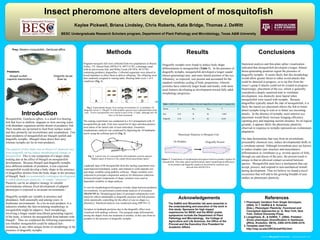


Research Poster
- 1. Mosquitofish, Gambusia affinis,is a small live-bearing fish that lives in shallow, stagnant or slow-moving water, with abundant vegetation mostly absent of predatory fish. Their mouths are up-turned to feed from surface waters and they primarily eat invertebrates and zooplankton. Two main predators of mosquitofish are bluegill sunfish and dragonfly nymphs. Bluegill chase down their prey whereas nymphs are lie-in-wait predators. The purpose of this study was to observe if chemical cues from dragonfly larvae induce morphological change in mosquitofish. This is one component of a larger study looking also at the affect of bluegill on mosquitofish development. Because bluegill and dragonfly nymphs have different methods of predation, it was expected mosquitofish would develop a body shape in the presence of dragonflies distinct from the body shape in the presence of bluegill. Such environmentally-contingent development is called phenotypic plasticity, or simply “plasticity”.1 Plasticity can be an adaptive strategy in variable environments whereas fixed development of adapted phenotypes is expected in invariant environments.1 Dragonfly nymphs are variable in presence and abundance, both seasonally and among years, in freshwater environments. As a lie-in-wait predator, it is unknown whether the fast-swimming morphology in mosquitofish might be adaptive. Such morphology, involving a longer caudal area (thrust generating region) of the body, is known for mosquitofish from habitats with bluegill.2 Thus we conducted the following experiment to test whether mosquitofish could be induced fast- swimming or any other unique forms of morphology in the presence of dragonfly nymphs. Methods Conclusions Insect pheromone alters development of mosquitofish Kaylee Pickwell, Briana Lindsley, Chris Roberts, Katie Bridge, Thomas J. DeWitt BESC Undergraduate Research Scholars program, Department of Plant Pathology and Microbiology, Texas A&M University Pregnant mosquito fish were collected from two populations in Brazos Valley, TX: Hensel Park (30 36.6’N, 96 17.6’W), a drainage canal⁰ ⁰ with no piscivorous fish, and White Creek (30°36'N, 96°21'W) containing predatory dragonflies. Collected organisms were placed in brood chambers to allow them to deliver offspring. The offspring were then randomly assigned to rearing tanks. Rearing tanks were 1 of 4 conditions (Fig. 1). ×3 Fig.1. Experimental design. Four rearing environments (A, no predators; B, dragonfly larvae; C, bluegill; D, both predator species) were replicated three times each. Twelve mosquitofish were reared in each of the 12 tanks, although only 90 have so far been measured. The rearing experiment was conducted in a 4x3 arrangement with 12 mosquitofish per tank. Fish were reared for 63 days and then pictures were taken of the lateral side of each individual. Geometric morphometric analysis was conducted by digitizing the 10 landmarks below using the software tpsUtil (Fig. 2). Introduction Results Fig. 2. Lateral view of a mosquitofish with landmarks used for analysis. Shaded region of interest is the caudal (thrust-generating) region.2 BA C D Prey: Western mosquitofish, Gambusia affinis Predators: Bluegill sunfish, Dragonfly larvae Lepomis macrochirus Anax sp. 1.Phenotypic Variation from Single Genotypes. (2004). In T. DeWitt & S. Scheiner (Eds.), Phenotypic Plasticity: Functional and Conceptual Approaches (p. 2). New York, New York: Oxford University Press. 2.Langerhans, B., & DeWitt, T. (2004). Predator- driven phenotypic diversification in Gambusia affinis. Evolution, 58(10), 2305–2318-2305–2318. 3.Template used from http://osp.ua.edu/URCAnewFAQ.html ReferencesAcknowledgements The DeWitt and Winemiller lab were essential in the understanding and execution of the work in this study. Sponsors for high impact experiences for BESC and the BESC poster symposium include the Department of Plant Pathology and Microbiology, the College of Agriculture and Life Sciences, the Office of the Provost and the Executive Vice President for Academic Affairs. Statistical analysis and thin-plate spline visualization indicated that mosquitofish developed a longer, thinner thrust-generating posterior region the presence of dragonfly nymphs. It seems likely that this morphology would allow greater thrust to either avoid attacks that could be detected in progress, or to rip free from the insect’s grasp if attacks could not be evaded in progress. Surprisingly, placement of the eye, which is generally considered a deeply canalized trait in vertebrate development, was distinctly more lateral when mosquitofish were reared with nymphs. Because dragonflies typically attack the side of mosquitofish, it is likely the lateral eye placement allows the fish to better detect nymphs lying in wait or to better see oncoming attacks. In the absence of nymphs, more anterior eye placement would likely increase foraging efficiency (spotting prey and targeting suction streams). So on logical grounds, it appears likely the phenotypic plasticity observed in response to nymphs represents an evolutionary adaptation. Our data demonstrate that cues from an invertebrate, presumably chemical cues, induce developmental shifts in a vertebrate animal. Although invertebrate prey are known to induce trophic (jaw structure and musculature) differentiation in vertebrates (e.g. several species of fish), through use and disuse of the jaws, the present result is unique in that no physical contact occurred between species. Mosquitofish must have a mechanism that can accept, process, and respond to non-mechanical stimuli during development. Thus we believe we found a novel occurrence that will add to the growing breadth of case studies on phenotypic plasticity. Landmark data of 90 mosquitofish from the rearing experiment were superimposed (translated, scaled, and rotated) to yield separate size and shape variables using tpsRelw software. Shape variables were subjected to principal components analysis for dimension reduction. Sixteen principal components of shape variation were used as dependent variables in shape analysis. To test for morphological divergence in body shape between predatory environments, we performed a multivariate analysis of covariance (MANCOVA). Morphological data (16 principal components) were tested for effects attributable to dragonfly presence and fish presence while statistically controlling for the affect of size on shape (i.e. allometry). Statistical analysis was conducted using JMP Pro 12. Variation in landmark positions due to the dragonfly effect were visualized with tpsRegr software. This program maps deformations among the shapes from one treatment to another, in this case from no predator to the presence of dragonfly nymphs. Phenotypic Plasticity in Mosquito Fish Figure 3. Visualization of morphological divergence between predator regimes for mosquitofish. Thin-plate spline transformations depict morphological differences in no predator and dragonfly regimes as described by canonical axes derived from MANCOVA. Table 1. MANCOVA results for the effects of size and dragonflies on body shape in mosquito fish. Source F dfnum dfdenom P Size 5.20 16 63 <.0001 Dragonfly 2.16 16 63 0.016 No Predator Dragonfly Present Dragonfly nymphs were found to induce body shape differentiation in mosquitofish (Table 1). In the presence of dragonfly nymphs, mosquitofish developed a longer caudal (thrust-generating) area .and more lateral position of the eye. Allometry, as expected, was present and accounted for the standard vertebrate scaling of body proportions, wherein juveniles have relatively larger heads and trunks, with more axial features developing as development toward fully adult morphology progresses.