ts
The Clownfish is a type of fish that lives in salt water
habitats. It have a few ocean predators, but their greatest
threat is humans (Rhyne, et al. 2012). People who catch
clownfish and keep them as pets in aquariums are making
a mistake (Timm, et al. 2008, Fish base, 2012). In
captivity, the clownfish can live 5 years only but in wild
they live about 10 years (Hill & Scott, 2012, Bonin, 2012).
Typically very bright, orange fish that have three white
stripes, one at the head, middle and tail (Brainard, 2012).
The males tend to be significantly smaller than the
females. If you look really closely, you may notice that
there are thin black lines around the white stripes (Ferrari
, et al. 2012). Also, the tips of their fins have a thin black
rounded stripe (Shaye, et al. 2012).
Introduction:
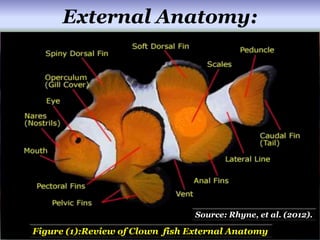
External Anatomy:
Source: Rhyne, et al. (2012).
Figure (1):Review of Clown fish External Anatomy
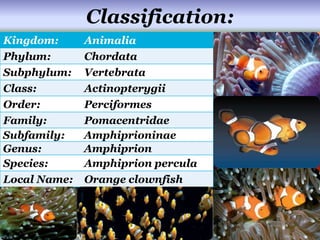
Kingdom: Animalia
Phylum: Chordata
Subphylum: Vertebrata
Class: Actinopterygii
Order: Perciformes
Family: Pomacentridae
Subfamily: Amphiprioninae
Genus: Amphiprion
Species: Amphiprion percula
Local Name: Orange clownfish
Classification:
Common Clown fish types:
Ocellaris ClownfishTrue Percula Clownfish
Cinnamon ClownfishPink Skunk ClownfishBlack and White Ocellaris Clownfish
Clarkii ClownfishBlack Saddle Back ClownfishFiji Barberi Clownfish
Maroon ClownfishTomato Clownfish
1. Life Span : 6-10 years.
2. Max size: (15 cm).
3. pH : 8 - 8.4.
4. Temperature : (24- 28 C).
5. Salinity: (1.020 - 1.026 ppt).
6. Habitat: Warm waters.
7. Food: algae, zooplankton, worms,
and small crustaceans.
8. Reproduction:. Female can lay
up to 1000 eggs at a time and they
hatch in about 7 days.
Clown fish characteristics :
Algae
Zooplankton
Crustacean & worms
Video (1): Clown fish behavior in cold waters.
Source: Prosek, (2010).
1. Clown fish are poor swimmers and never
venture far from their host anemone.
2. Fascinating ability of the Clown fish to switch
sex. This Fact makes this fish even more of a rarity.
3. Male take care of the young till they reach sexual
maturity.
4. They are generally very peaceful, but may become
territorial and fight. When they are born.
Clown fish facts:
Distribution of Clownfish:
Figure (2): You can find Clown fish in the these zones. They live in
the Warmer waters of the Pacific Ocean and Indian Ocean. They
are also found in northwest Australia, southeast Asia, Japan and
Malaysia.
Source: A. I. M. S., (2012).
Commensalism: one benefits, one
is unaffected.
Clown fish
gets
protection
Anemone is
unaffected
Clown fish & anemone:
Source: Prosek , (2010).
Video (2): Clown Fish & anemone relationship.
Source: (Ferrari , et al. 2012).
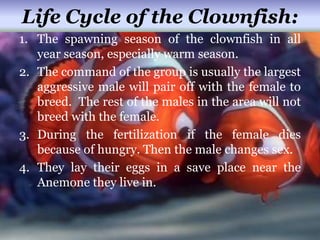
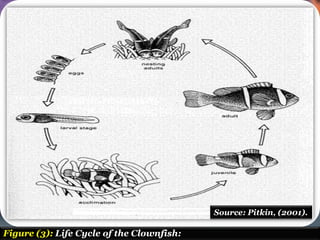
1. The spawning season of the clownfish in all
year season, especially warm season.
2. The command of the group is usually the largest
aggressive male will pair off with the female to
breed. The rest of the males in the area will not
breed with the female.
3. During the fertilization if the female dies
because of hungry. Then the male changes sex.
4. They lay their eggs in a save place near the
Anemone they live in.
Life Cycle of the Clownfish:
Source: Pitkin, (2001).
Figure (3): Life Cycle of the Clownfish:
Source: Saenz, et al. (2011).
Video (3): Clown Fish changing sex.
Source: Saenz, et al. (2011).
Video (4): Clown Fish mating.
Figure (5): Top 20 marine aquarium fish imported into the United States.
Source: Rhyne et al. (2012).
References
Australian Institute of Marine Science. (2012). Hoskyn Island’s Reef: intensive
surveys--trends in fish abundance. Retrieved August 15, 2012, from
http://data.aims.gov.au/reefpage2/rpdetail.jsp?fullReefID=23080S&sampleT
ype=FISH.
Bonin, M. C. (2012). Specializing on vulnerable habitat: Acropora selectivity
among damselfish recruits and the risk of bleaching-induced habitat loss. Coral
Reefs 31:287-297.
Brainard, R. E., C. Birkeland, C. M. Eakin, P. Mcelhany, M. W. Miller, M.
Patterson, and G. A. Piniak. (2012). Status Review Report of 82 Candidate
Coral Species Petitioned Under the U.S. Endangered Species Act. U.S. Dep.
Commerce, NOAA Tech. Memo., NOAA-TMNMFS- PIFSC-27, 530 p. + 1
Appendix. Page Russell The Journal Of The Bertrand RussellArchives.
Ferrari, M. C. O., R. P. Manassa, D. L. Dixson, P. L. Munday, M. I. McCormick, M.
G. Meekan, A. Sih, and D. P. Chivers. (2012). Effects of ocean acidification on
learning in coral reef fishes. PloS One 7:e31478.
Fish base. (2012). Orange clown fish. A page with clownfish facts.
Hill, R., & Scott, A.. (2012). The influence of irradiance on the severity of thermal
bleaching in sea anemones that host anemone fish. Coral Reefs 31:273-284.
Pitkin, L. (2001). Coral Fish. Smithsonian Institution Press, Washington, D.C.
References
Prosek, J. (2010). Beautiful friendship. National Geographic Magazine,
http://ngm.nationalgeographic.com/print/2010/01/clownfish/prosek-text.
Rhyne, A. L., M. F. Tlusty, P. J. Schofield, L. Kaufman, J. A. Morris, and A. W.
Bruckner. (2012). Revealing the appetite of the marine aquarium fish trade:
the volume and biodiversity of fish imported into the United States. PloS One
7:e35808.
Saenz-Agudelo, P., G. P. Jones, S. R. Thorrold, and S. Planes.( 2011). Detrimental
effects of host anemone bleaching on anemone fish populations. Coral Reefs
30:497-506.
Shaye, W., Miyoko, S., and Patrick, D.(2012). PETITION TO LIST EIGHT
SPECIES OF POMACENTRID REEF FISH, INCLUDING THE ORANGE
CLOWNFISH AND SEVEN DAMSELFISH, AS THREATENED OR
ENDANGERED UNDER THE U.S. ENDANGERED SPECIES ACT. Center for
Biological Diversity.351 California Street, Suite 600 San Francisco, CA 94104.
p:90.
Timm, J., M. Figiel, and M. Kochzius. (2008). Contrasting patterns in species
boundaries and evolution of anemone fishes (Amphiprioninae, Pomacentridae)
in the centre of marine biodiversity. Molecular Phylogenetics and Evolution
49:268-76.
Clown fish

Clown fish

  • 1.
  • 2.
    The Clownfish isa type of fish that lives in salt water habitats. It have a few ocean predators, but their greatest threat is humans (Rhyne, et al. 2012). People who catch clownfish and keep them as pets in aquariums are making a mistake (Timm, et al. 2008, Fish base, 2012). In captivity, the clownfish can live 5 years only but in wild they live about 10 years (Hill & Scott, 2012, Bonin, 2012). Typically very bright, orange fish that have three white stripes, one at the head, middle and tail (Brainard, 2012). The males tend to be significantly smaller than the females. If you look really closely, you may notice that there are thin black lines around the white stripes (Ferrari , et al. 2012). Also, the tips of their fins have a thin black rounded stripe (Shaye, et al. 2012). Introduction:
  • 3.
    External Anatomy: Source: Rhyne,et al. (2012). Figure (1):Review of Clown fish External Anatomy
  • 4.
    Kingdom: Animalia Phylum: Chordata Subphylum:Vertebrata Class: Actinopterygii Order: Perciformes Family: Pomacentridae Subfamily: Amphiprioninae Genus: Amphiprion Species: Amphiprion percula Local Name: Orange clownfish Classification:
  • 5.
    Common Clown fishtypes: Ocellaris ClownfishTrue Percula Clownfish Cinnamon ClownfishPink Skunk ClownfishBlack and White Ocellaris Clownfish Clarkii ClownfishBlack Saddle Back ClownfishFiji Barberi Clownfish Maroon ClownfishTomato Clownfish
  • 6.
    1. Life Span: 6-10 years. 2. Max size: (15 cm). 3. pH : 8 - 8.4. 4. Temperature : (24- 28 C). 5. Salinity: (1.020 - 1.026 ppt). 6. Habitat: Warm waters. 7. Food: algae, zooplankton, worms, and small crustaceans. 8. Reproduction:. Female can lay up to 1000 eggs at a time and they hatch in about 7 days. Clown fish characteristics : Algae Zooplankton Crustacean & worms
  • 7.
    Video (1): Clownfish behavior in cold waters. Source: Prosek, (2010).
  • 8.
    1. Clown fishare poor swimmers and never venture far from their host anemone. 2. Fascinating ability of the Clown fish to switch sex. This Fact makes this fish even more of a rarity. 3. Male take care of the young till they reach sexual maturity. 4. They are generally very peaceful, but may become territorial and fight. When they are born. Clown fish facts:
  • 9.
    Distribution of Clownfish: Figure(2): You can find Clown fish in the these zones. They live in the Warmer waters of the Pacific Ocean and Indian Ocean. They are also found in northwest Australia, southeast Asia, Japan and Malaysia. Source: A. I. M. S., (2012).
  • 10.
    Commensalism: one benefits,one is unaffected. Clown fish gets protection Anemone is unaffected Clown fish & anemone: Source: Prosek , (2010).
  • 11.
    Video (2): ClownFish & anemone relationship. Source: (Ferrari , et al. 2012).
  • 12.
    1. The spawningseason of the clownfish in all year season, especially warm season. 2. The command of the group is usually the largest aggressive male will pair off with the female to breed. The rest of the males in the area will not breed with the female. 3. During the fertilization if the female dies because of hungry. Then the male changes sex. 4. They lay their eggs in a save place near the Anemone they live in. Life Cycle of the Clownfish:
  • 13.
    Source: Pitkin, (2001). Figure(3): Life Cycle of the Clownfish:
  • 14.
    Source: Saenz, etal. (2011). Video (3): Clown Fish changing sex.
  • 15.
    Source: Saenz, etal. (2011). Video (4): Clown Fish mating.
  • 16.
    Figure (5): Top20 marine aquarium fish imported into the United States. Source: Rhyne et al. (2012).
  • 17.
    References Australian Institute ofMarine Science. (2012). Hoskyn Island’s Reef: intensive surveys--trends in fish abundance. Retrieved August 15, 2012, from http://data.aims.gov.au/reefpage2/rpdetail.jsp?fullReefID=23080S&sampleT ype=FISH. Bonin, M. C. (2012). Specializing on vulnerable habitat: Acropora selectivity among damselfish recruits and the risk of bleaching-induced habitat loss. Coral Reefs 31:287-297. Brainard, R. E., C. Birkeland, C. M. Eakin, P. Mcelhany, M. W. Miller, M. Patterson, and G. A. Piniak. (2012). Status Review Report of 82 Candidate Coral Species Petitioned Under the U.S. Endangered Species Act. U.S. Dep. Commerce, NOAA Tech. Memo., NOAA-TMNMFS- PIFSC-27, 530 p. + 1 Appendix. Page Russell The Journal Of The Bertrand RussellArchives. Ferrari, M. C. O., R. P. Manassa, D. L. Dixson, P. L. Munday, M. I. McCormick, M. G. Meekan, A. Sih, and D. P. Chivers. (2012). Effects of ocean acidification on learning in coral reef fishes. PloS One 7:e31478. Fish base. (2012). Orange clown fish. A page with clownfish facts. Hill, R., & Scott, A.. (2012). The influence of irradiance on the severity of thermal bleaching in sea anemones that host anemone fish. Coral Reefs 31:273-284. Pitkin, L. (2001). Coral Fish. Smithsonian Institution Press, Washington, D.C.
  • 18.
    References Prosek, J. (2010).Beautiful friendship. National Geographic Magazine, http://ngm.nationalgeographic.com/print/2010/01/clownfish/prosek-text. Rhyne, A. L., M. F. Tlusty, P. J. Schofield, L. Kaufman, J. A. Morris, and A. W. Bruckner. (2012). Revealing the appetite of the marine aquarium fish trade: the volume and biodiversity of fish imported into the United States. PloS One 7:e35808. Saenz-Agudelo, P., G. P. Jones, S. R. Thorrold, and S. Planes.( 2011). Detrimental effects of host anemone bleaching on anemone fish populations. Coral Reefs 30:497-506. Shaye, W., Miyoko, S., and Patrick, D.(2012). PETITION TO LIST EIGHT SPECIES OF POMACENTRID REEF FISH, INCLUDING THE ORANGE CLOWNFISH AND SEVEN DAMSELFISH, AS THREATENED OR ENDANGERED UNDER THE U.S. ENDANGERED SPECIES ACT. Center for Biological Diversity.351 California Street, Suite 600 San Francisco, CA 94104. p:90. Timm, J., M. Figiel, and M. Kochzius. (2008). Contrasting patterns in species boundaries and evolution of anemone fishes (Amphiprioninae, Pomacentridae) in the centre of marine biodiversity. Molecular Phylogenetics and Evolution 49:268-76.