ECTOPARASITES DISEASES
IN
FISHES
PARASITES
 an organism which lives in or on another organism (its
host) and benefits by deriving nutrients at the other's
expense
 TWO TYPES:
 1) ECTOPARASITES -live outside the body
2)ENDOPARASITES- live inside the body
How do you recognise that a fish
might be ill?
 Colour may fade out / change
 Body shape, condition and / or behaviour will be abnormal
 The fish may refuse to feed or overfeed and trailing faeces
appear at vent.
 Condition of the fins and gills will deteriorate. Fins may be
clamped close to body.
 The fish may not keep its swimming position.
 There may be signs of growths or abnormalities injuries,
What are the causes of fish
disease?
 Bad water quality
 Inappropriate diet
 Temperature (too high or too low)
 Stress
 Bullying
 Viral diseases
 Fungal infections
 Bacterial infections
 Parasites
FISH LOUSE( argulus)
 fish louse is a flattened creature about as
large as a water flea belonging to the
branchiura or gill tails, a group of the
crustacea.
 Eight legs- for swim
 Small fish –like tail- which acts like rubber.
 Two large suckers for attaching to the skin of its
host.
 The colour of the fish louse ranges from light
green to greenish yellow and brown.
 If parasites is well fed its colour will be darker
due to filling with the blood of the host.
REMOVING or TREAMENT
 By forceps
 Rubbing over the skin of the fishes head
to tail.
 Dosage of the chemicals.
 Because of their size, older stages of Argulus can be
diagnosed with the naked eye.
 The parasites are visible moving on the host or
swimming in the water
 The parasite can also be identified on a wet mount of
the affected tissue. Captured fish should be examined
quickly because Argulus may rapidly leave the fish
once it is disturbed or removed from the water
Individual
adult and
late stage
juvenile
Argulus are
easily seen
with the
unaided eye
Heavily infested
koi. Note
readily visible
oval parasites in
throat (ventral)
area of head, as
well as others
scattered
throughout the
body.
First stage
Argulus
larvae
(metanaupli
us).
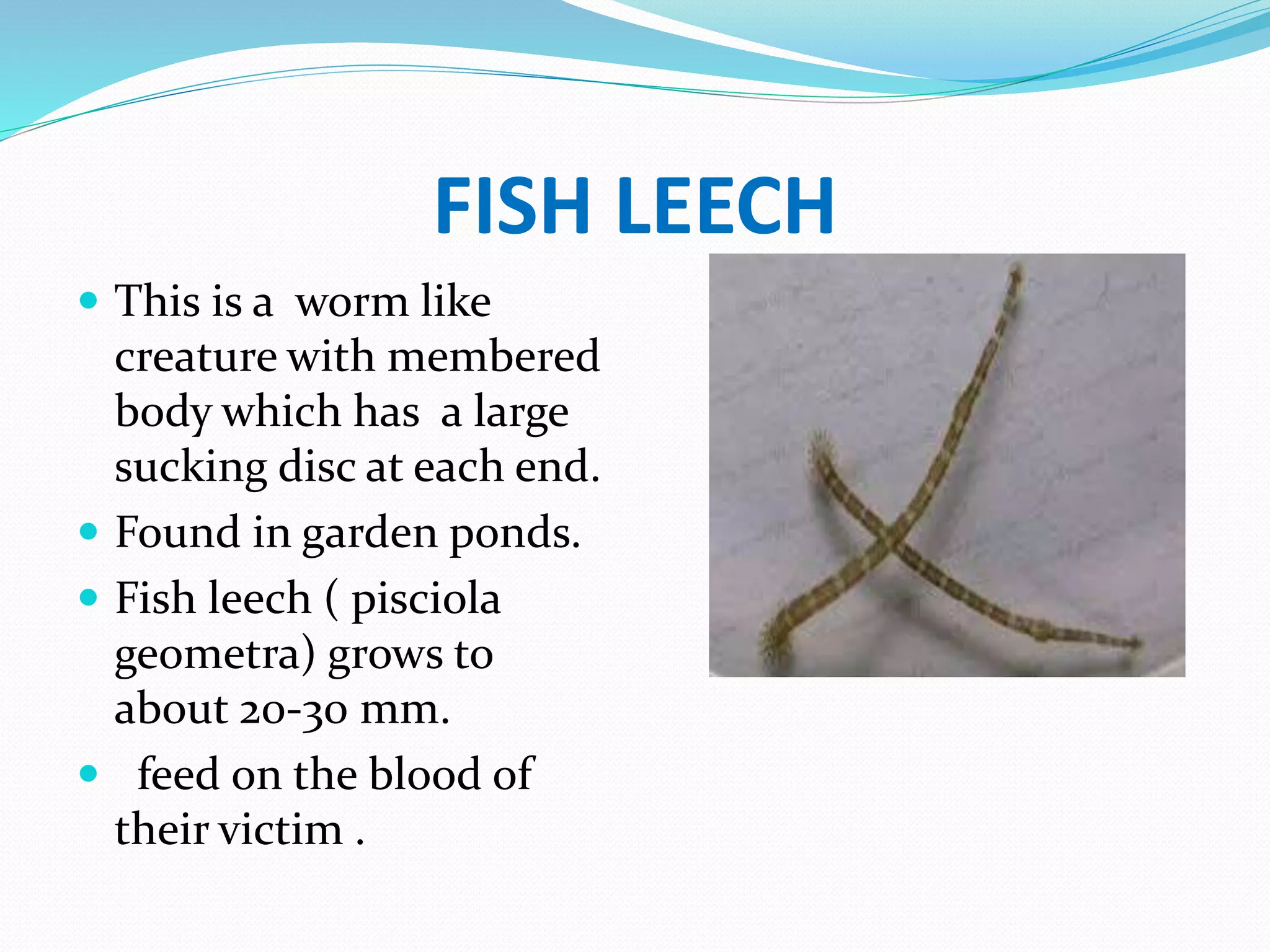
FISH LEECH
 This is a worm like
creature with membered
body which has a large
sucking disc at each end.
 Found in garden ponds.
 Fish leech ( pisciola
geometra) grows to
about 20-30 mm.
 feed on the blood of
their victim .
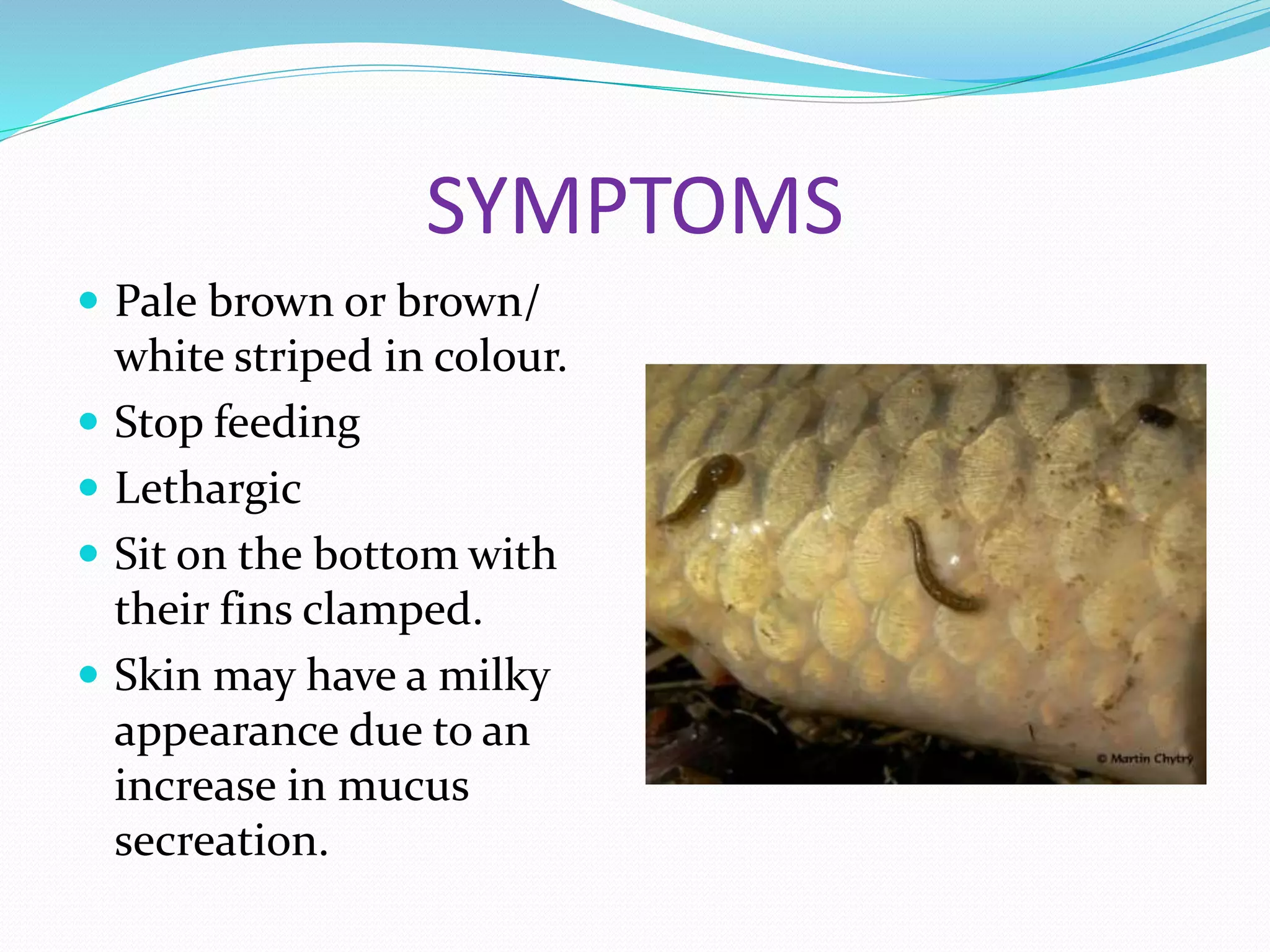
SYMPTOMS
 Pale brown or brown/
white striped in colour.
 Stop feeding
 Lethargic
 Sit on the bottom with
their fins clamped.
 Skin may have a milky
appearance due to an
increase in mucus
secreation.
TREATMENT
 Best treatment is to place the fish in a 2 % salt solution
at first become restless ,but this will do no harm.
 Remove by use of forceps .
 Move the fish from to an quarantine tank .salt may be
added to aid recovery and reduce the rise of secondary
infections.
 Leave the pond empty of fish for about a month to
break life cycle.
Cause
 Trematode (flatworm / flukes) parasites,
caught by direct contact with contaminated
fish, free swimming larval stages can attach
to the bottom and side of housing. Flukes
attach themselves to the body and eat skin /
gill tissue and blood.
Gill flukes and skin flukes (Dactylogyrus)&
Gyrodactylus)
Symptoms
 The gills may move rapidly and fish may gasp at
the water surface.
 The fish may scrape itself against objects.
 Colours fade as damaged areas are covered in
mucus.
 The skin may redden in places.
 The fins may become ragged.
 Lethargic
 Stop feeding
Treatment
 These parasites can be treated with a
formalin based medicine.
 Potassium permangante
 Use salth bath for individual fish.
Cause
 The crustacean parasite Lernaea it
can grow up to 12mm.Usually
brought in by non quarantined fish.
Symptoms
 Whitish-green threads hang out of
the fish’s skin, with an inflamed area
or ulcer at the point of their
attachment.
Anchor Worm (Lernaea)
Treatment
 The water can be treated with insecticide. The
adult parasite can be removed manually and the
wound treated with antiseptic to prevent bacterial
infection
 Removed by using forceps
 In ponds permanganate treatment is the only way
short of a complete clean out .
Cause
 Protozoan parasite either free swimming in
the water or carried in with new fish or plants.
 Fish under stress from bad water conditions
are more susceptible.
Symptoms
 The fish’s skin and fins are covered in tiny
white spots
 A badly affected fish may make rapid gill
movements
Itch or White Spot Disease (Ichthyophthirius)
Treatment
 Remove plants and the activated carbon from
filters as they can affect / be affected by the
medicine
.
 Treat with a methylene blue based medicine which
kills the free swimming larval stage.
Fungus are multicelluar, spore producing
organisms that live off other
organisms, and dead matter, some are parasitic.
 Fungal spores are commonly found in aquarium water.
 Healthy fish have a protective mucus covering which
can prevent infection by fungal spores.
Fungal infections: What is a fungus?
Cause
 Aquatic fungi e.g. Saprolegnia. Fish that are in poor health
and have damaged mucus membranes through bad water
quality, rough handling, fighting or physical injury are
more prone to infection. Fungus can be a secondary
infection to other conditions.
Symptoms
 Grey white or brown cotton wool like growths
on the skin or fins.
Fish fungus
Treatment
 Medicines containing malachite green can be
used and
 salt baths help recovery.
Cause
 A number of different bacteria including
Aeromonas and Pseudomonas. These could
be transmitted from other infected fish,
and /or bad water conditions.
Symptoms
 Open sores and ulcers, reddening of fins and vent, may
lose their appetite and colour may change.
Ulcer Disease & Haemorrhagic
Septicaemia
Treatment
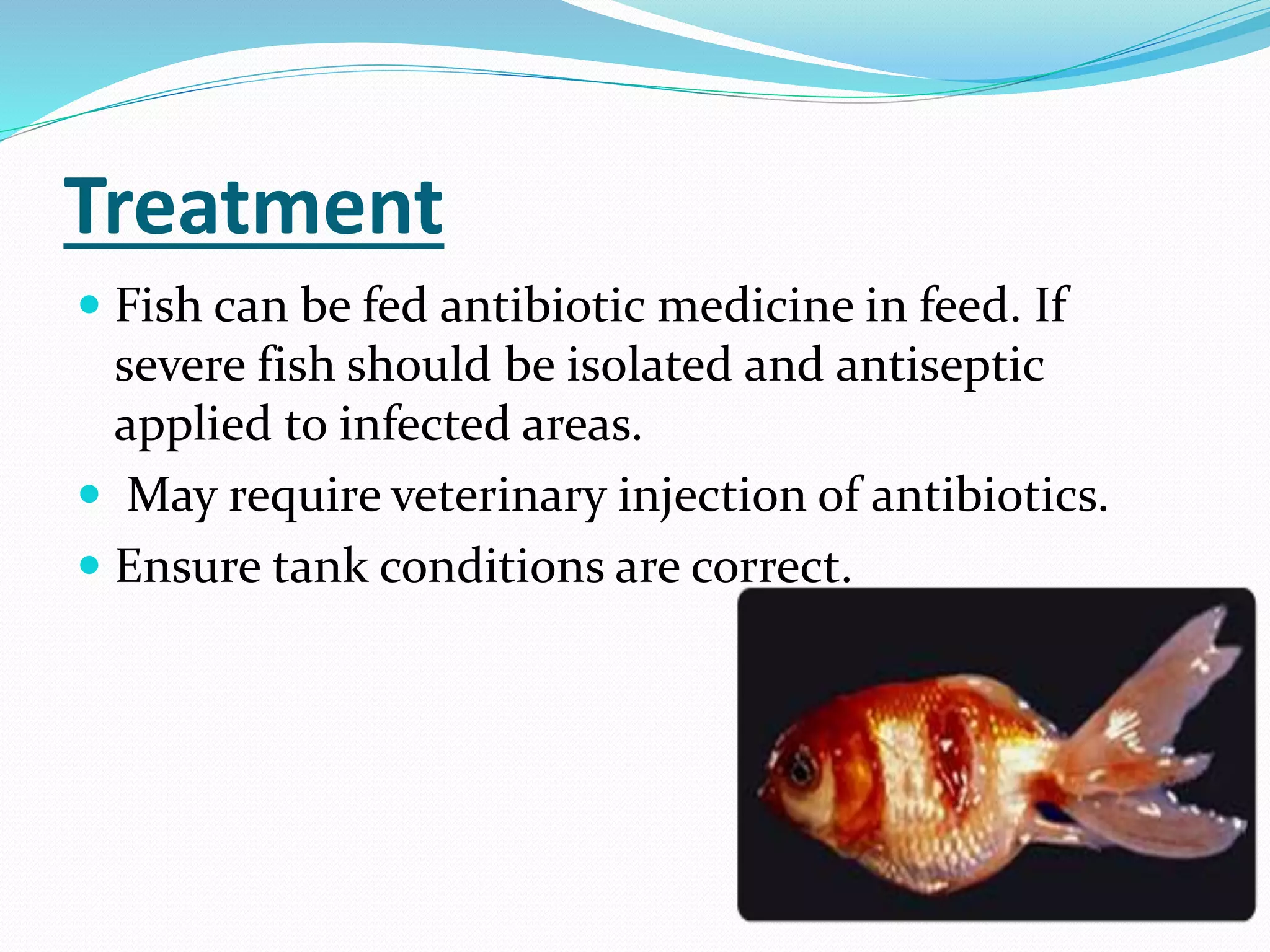
 Fish can be fed antibiotic medicine in feed. If
severe fish should be isolated and antiseptic
applied to infected areas.
 May require veterinary injection of antibiotics.
 Ensure tank conditions are correct.
 Bacteria are microscopic single celled organisms that can
reproduce rapidly.
 They are naturally present in aquarium water.
 Fish in good health kept in good water conditions can fight
bacterial infections.
 A poor diet lacking in sufficient protein, fatty acids and
vitamins can reduce fish resistance to such disease.
Bacterial Infections : What are Bacteria?
Cause
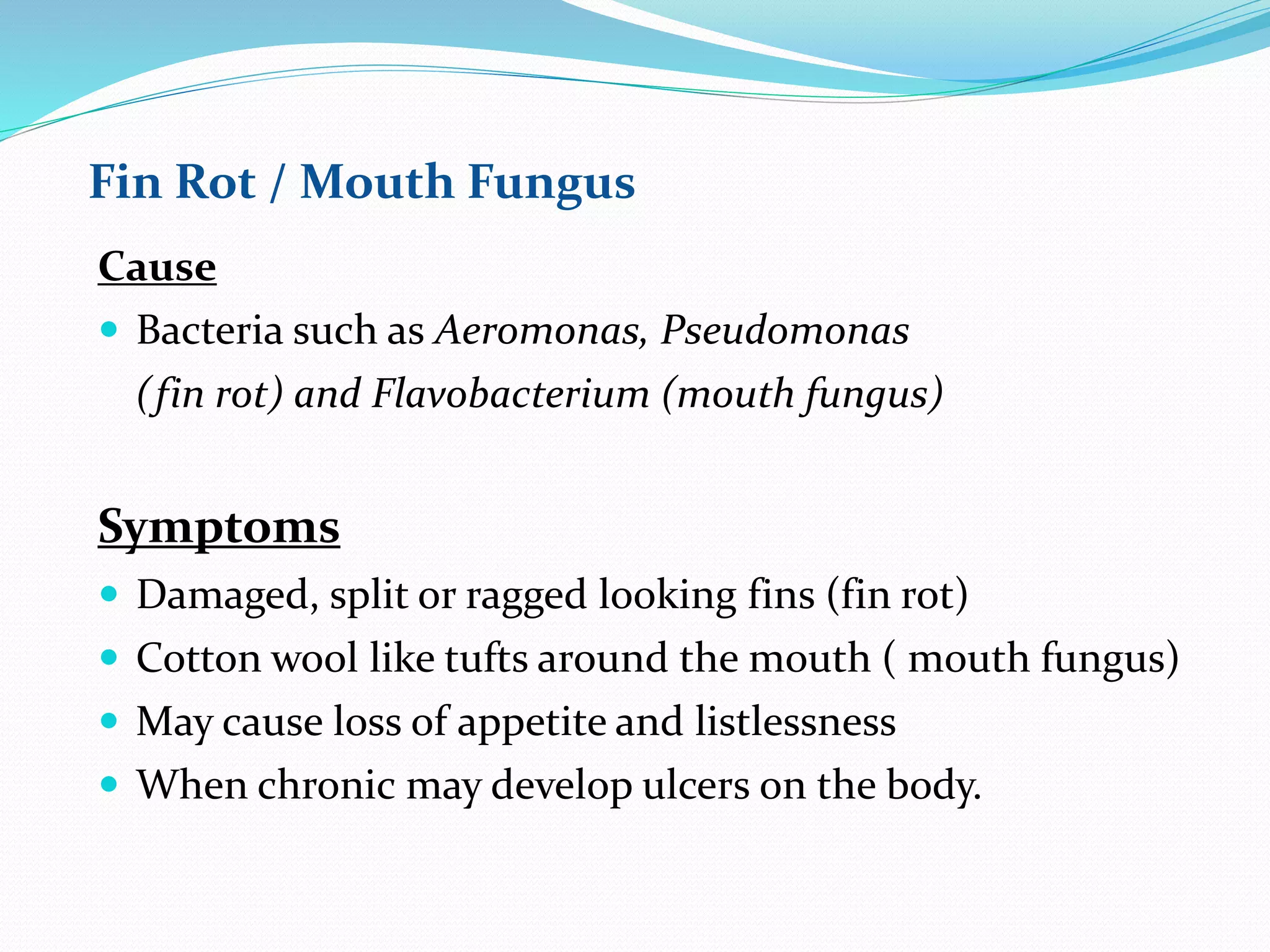
 Bacteria such as Aeromonas, Pseudomonas
(fin rot) and Flavobacterium (mouth fungus)
Symptoms
 Damaged, split or ragged looking fins (fin rot)
 Cotton wool like tufts around the mouth ( mouth fungus)
 May cause loss of appetite and listlessness
 When chronic may develop ulcers on the body.
Fin Rot / Mouth Fungus
Treatment
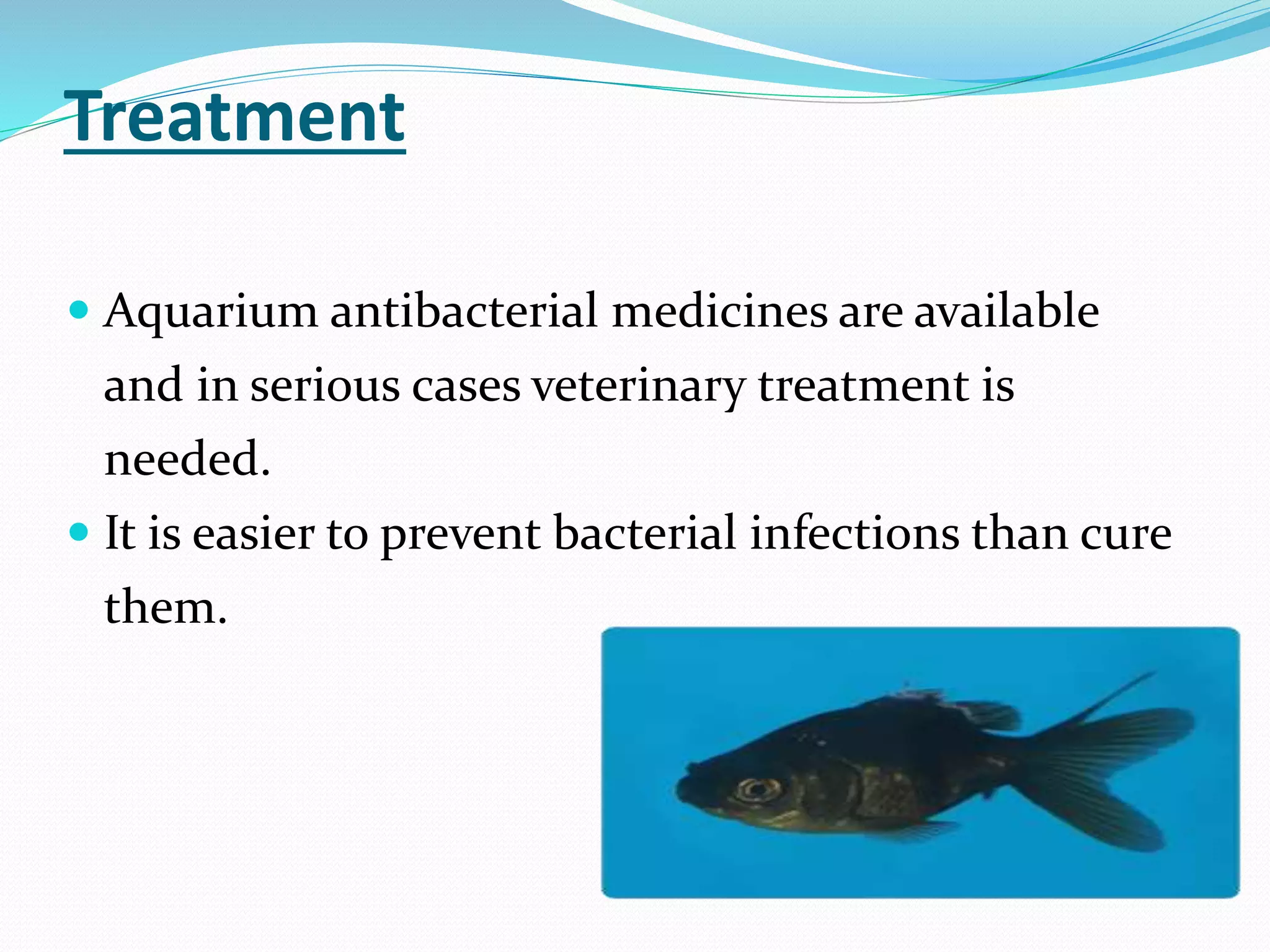
 Aquarium antibacterial medicines are available
and in serious cases veterinary treatment is
needed.
 It is easier to prevent bacterial infections than cure
them.
 A virus is a microscopic organism that can only
reproduce by inhabiting host cells and using the
genetic material in the cells of a host.
 Healthy fish that have a balanced diet and good
water conditions have strong immune systems to
fight off such infections.
Viral infections: What is a virus?
Causes
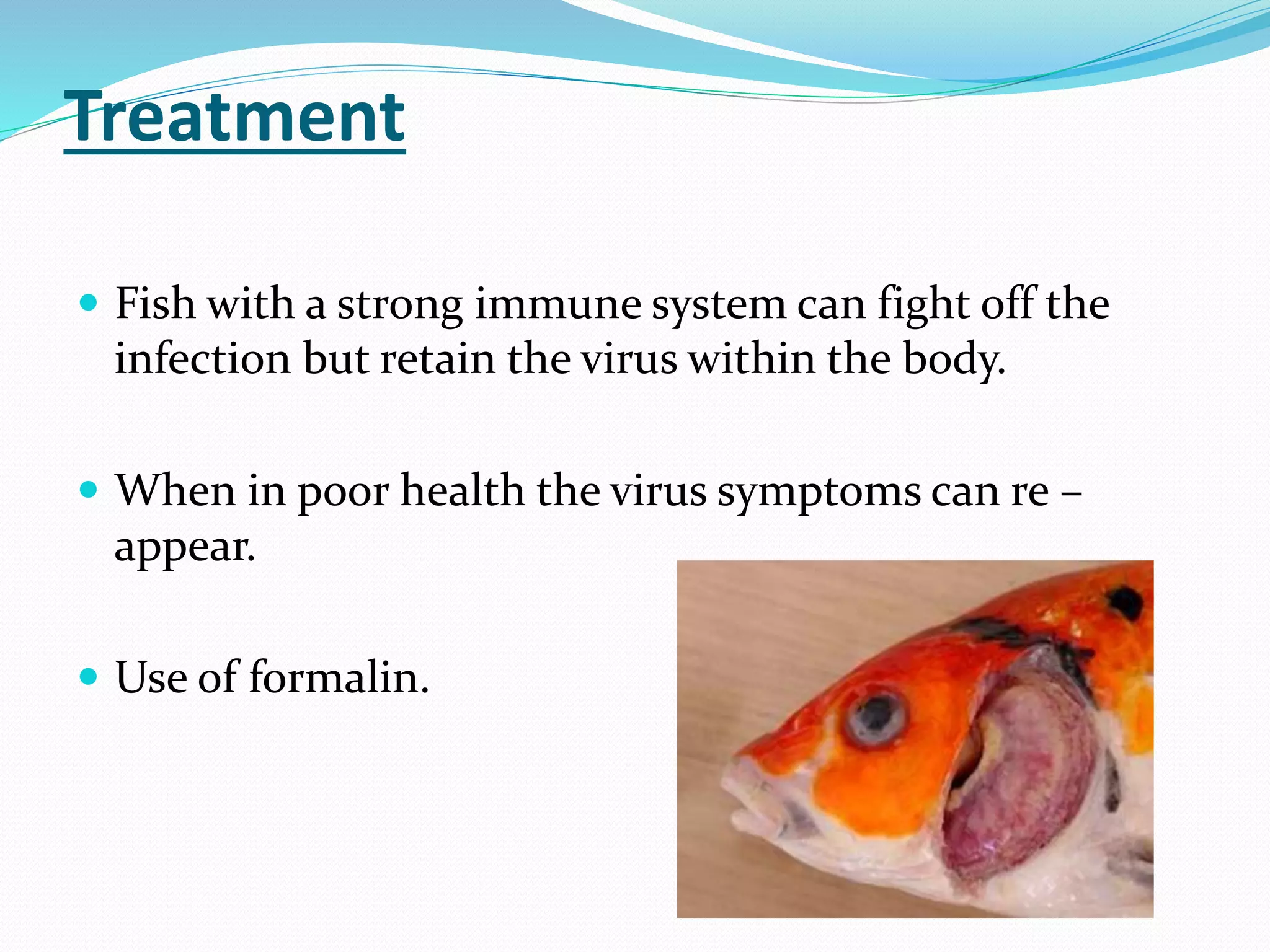
 A herpes virus
Symptoms
 Causes growths that are white or grey in colour and look
like melted candle wax.
 Red and white patches appearing on gills
 Bleeding gills
 Sunken eyes
 Pale patches.
Cyprinid Herpes Virus
Treatment
 Fish with a strong immune system can fight off the
infection but retain the virus within the body.
 When in poor health the virus symptoms can re –
appear.
 Use of formalin.
Cause
 A viral infection caused by Rhabdovirus carpio.
Symptoms
 Darkening of skin, pale gills, pop eye, protruding vent,
bleeding in gills skin and eyes. Lethargy, abnormal
swimming positions, sitting on bottom of the tank.
Spring Viremia of Carp: this is a notifiable
disease
Fish species affected
 common carp
 northern pike
 bluegill
 largemouth bass
 koi
 goldfish
 bighead carp
 silver carp
 grass carp
 crucian carp
 Provide an appropriate well filtered tank with suitable
water conditions for the species, i.e. correct temperature,
pH, water hardness, low nitrate levels etc.
 Provide appropriate diet and décor to meet species needs.
 House only suitable species together, make sure they are
compatible and not likely to bully or eat each other.
 Only select healthy looking fish to add to the tank and do
not overstock.
 Quarantine new fish to ensure they are healthy before
introducing them to an established tank.
 Sterilize décor and clean new plants to ensure they are not
carrying parasite eggs / larvae.
How do you prevent disease and parasites affecting fish?
ectoparasites disease in fish

ectoparasites disease in fish

  • 1.
  • 2.
    PARASITES  an organismwhich lives in or on another organism (its host) and benefits by deriving nutrients at the other's expense  TWO TYPES:  1) ECTOPARASITES -live outside the body 2)ENDOPARASITES- live inside the body
  • 3.
    How do yourecognise that a fish might be ill?  Colour may fade out / change  Body shape, condition and / or behaviour will be abnormal  The fish may refuse to feed or overfeed and trailing faeces appear at vent.  Condition of the fins and gills will deteriorate. Fins may be clamped close to body.  The fish may not keep its swimming position.  There may be signs of growths or abnormalities injuries,
  • 4.
    What are thecauses of fish disease?  Bad water quality  Inappropriate diet  Temperature (too high or too low)  Stress  Bullying  Viral diseases  Fungal infections  Bacterial infections  Parasites
  • 5.
    FISH LOUSE( argulus) fish louse is a flattened creature about as large as a water flea belonging to the branchiura or gill tails, a group of the crustacea.  Eight legs- for swim
  • 6.
     Small fish–like tail- which acts like rubber.  Two large suckers for attaching to the skin of its host.  The colour of the fish louse ranges from light green to greenish yellow and brown.  If parasites is well fed its colour will be darker due to filling with the blood of the host.
  • 7.
    REMOVING or TREAMENT By forceps  Rubbing over the skin of the fishes head to tail.  Dosage of the chemicals.
  • 8.
     Because oftheir size, older stages of Argulus can be diagnosed with the naked eye.  The parasites are visible moving on the host or swimming in the water  The parasite can also be identified on a wet mount of the affected tissue. Captured fish should be examined quickly because Argulus may rapidly leave the fish once it is disturbed or removed from the water
  • 9.
    Individual adult and late stage juvenile Argulusare easily seen with the unaided eye
  • 10.
    Heavily infested koi. Note readilyvisible oval parasites in throat (ventral) area of head, as well as others scattered throughout the body.
  • 11.
  • 12.
    FISH LEECH  Thisis a worm like creature with membered body which has a large sucking disc at each end.  Found in garden ponds.  Fish leech ( pisciola geometra) grows to about 20-30 mm.  feed on the blood of their victim .
  • 13.
    SYMPTOMS  Pale brownor brown/ white striped in colour.  Stop feeding  Lethargic  Sit on the bottom with their fins clamped.  Skin may have a milky appearance due to an increase in mucus secreation.
  • 14.
    TREATMENT  Best treatmentis to place the fish in a 2 % salt solution at first become restless ,but this will do no harm.  Remove by use of forceps .  Move the fish from to an quarantine tank .salt may be added to aid recovery and reduce the rise of secondary infections.  Leave the pond empty of fish for about a month to break life cycle.
  • 15.
    Cause  Trematode (flatworm/ flukes) parasites, caught by direct contact with contaminated fish, free swimming larval stages can attach to the bottom and side of housing. Flukes attach themselves to the body and eat skin / gill tissue and blood. Gill flukes and skin flukes (Dactylogyrus)& Gyrodactylus)
  • 16.
    Symptoms  The gillsmay move rapidly and fish may gasp at the water surface.  The fish may scrape itself against objects.  Colours fade as damaged areas are covered in mucus.  The skin may redden in places.  The fins may become ragged.  Lethargic  Stop feeding
  • 17.
    Treatment  These parasitescan be treated with a formalin based medicine.  Potassium permangante  Use salth bath for individual fish.
  • 18.
    Cause  The crustaceanparasite Lernaea it can grow up to 12mm.Usually brought in by non quarantined fish. Symptoms  Whitish-green threads hang out of the fish’s skin, with an inflamed area or ulcer at the point of their attachment. Anchor Worm (Lernaea)
  • 19.
    Treatment  The watercan be treated with insecticide. The adult parasite can be removed manually and the wound treated with antiseptic to prevent bacterial infection  Removed by using forceps  In ponds permanganate treatment is the only way short of a complete clean out .
  • 20.
    Cause  Protozoan parasiteeither free swimming in the water or carried in with new fish or plants.  Fish under stress from bad water conditions are more susceptible. Symptoms  The fish’s skin and fins are covered in tiny white spots  A badly affected fish may make rapid gill movements Itch or White Spot Disease (Ichthyophthirius)
  • 21.
    Treatment  Remove plantsand the activated carbon from filters as they can affect / be affected by the medicine .  Treat with a methylene blue based medicine which kills the free swimming larval stage.
  • 22.
    Fungus are multicelluar,spore producing organisms that live off other organisms, and dead matter, some are parasitic.  Fungal spores are commonly found in aquarium water.  Healthy fish have a protective mucus covering which can prevent infection by fungal spores. Fungal infections: What is a fungus?
  • 23.
    Cause  Aquatic fungie.g. Saprolegnia. Fish that are in poor health and have damaged mucus membranes through bad water quality, rough handling, fighting or physical injury are more prone to infection. Fungus can be a secondary infection to other conditions. Symptoms  Grey white or brown cotton wool like growths on the skin or fins. Fish fungus
  • 24.
    Treatment  Medicines containingmalachite green can be used and  salt baths help recovery.
  • 25.
    Cause  A numberof different bacteria including Aeromonas and Pseudomonas. These could be transmitted from other infected fish, and /or bad water conditions. Symptoms  Open sores and ulcers, reddening of fins and vent, may lose their appetite and colour may change. Ulcer Disease & Haemorrhagic Septicaemia
  • 26.
    Treatment  Fish canbe fed antibiotic medicine in feed. If severe fish should be isolated and antiseptic applied to infected areas.  May require veterinary injection of antibiotics.  Ensure tank conditions are correct.
  • 27.
     Bacteria aremicroscopic single celled organisms that can reproduce rapidly.  They are naturally present in aquarium water.  Fish in good health kept in good water conditions can fight bacterial infections.  A poor diet lacking in sufficient protein, fatty acids and vitamins can reduce fish resistance to such disease. Bacterial Infections : What are Bacteria?
  • 28.
    Cause  Bacteria suchas Aeromonas, Pseudomonas (fin rot) and Flavobacterium (mouth fungus) Symptoms  Damaged, split or ragged looking fins (fin rot)  Cotton wool like tufts around the mouth ( mouth fungus)  May cause loss of appetite and listlessness  When chronic may develop ulcers on the body. Fin Rot / Mouth Fungus
  • 29.
    Treatment  Aquarium antibacterialmedicines are available and in serious cases veterinary treatment is needed.  It is easier to prevent bacterial infections than cure them.
  • 30.
     A virusis a microscopic organism that can only reproduce by inhabiting host cells and using the genetic material in the cells of a host.  Healthy fish that have a balanced diet and good water conditions have strong immune systems to fight off such infections. Viral infections: What is a virus?
  • 31.
    Causes  A herpesvirus Symptoms  Causes growths that are white or grey in colour and look like melted candle wax.  Red and white patches appearing on gills  Bleeding gills  Sunken eyes  Pale patches. Cyprinid Herpes Virus
  • 32.
    Treatment  Fish witha strong immune system can fight off the infection but retain the virus within the body.  When in poor health the virus symptoms can re – appear.  Use of formalin.
  • 33.
    Cause  A viralinfection caused by Rhabdovirus carpio. Symptoms  Darkening of skin, pale gills, pop eye, protruding vent, bleeding in gills skin and eyes. Lethargy, abnormal swimming positions, sitting on bottom of the tank. Spring Viremia of Carp: this is a notifiable disease
  • 34.
    Fish species affected common carp  northern pike  bluegill  largemouth bass  koi  goldfish  bighead carp  silver carp  grass carp  crucian carp
  • 35.
     Provide anappropriate well filtered tank with suitable water conditions for the species, i.e. correct temperature, pH, water hardness, low nitrate levels etc.  Provide appropriate diet and décor to meet species needs.  House only suitable species together, make sure they are compatible and not likely to bully or eat each other.  Only select healthy looking fish to add to the tank and do not overstock.  Quarantine new fish to ensure they are healthy before introducing them to an established tank.  Sterilize décor and clean new plants to ensure they are not carrying parasite eggs / larvae. How do you prevent disease and parasites affecting fish?