BIOGRAPHIA LITERARIA
Chapter # 14
Presented by:
Haleema Bibi (BSF 1700340)
Wajiha Tanvir (BSF 1700392)
Nimra Kanwal (BSF 1700649)
Madiha Tahir (BSF 1700408)
Nida Khan (BSF 1700566)
Jawairia Mehmood (BSF 1700264)
BIOGRAPHY OF S.T.COLERIDGE:
 1772-1834
 Born in Devon in 1772
 He was English Romantic poet
 Influential in the founding and development of English poetry.
 He was a poet as well as a notable literary critic
 In 1798, he and Wordsworth published volume of poetry “Lyrical Ballads”
 Later he was interested in the work of philosopher Immanuel Kant
 As he says in his Biographia Literaria Ch 1,
“No man was ever yet a great Poet, without being at the same time a
profound philosopher"
 One of his famous work on literary criticism is “Biographia Literaria”
 Significant theoretical works
 It is concerned with
 the form of poetry,
 genius of the poet and
 relationship to philosophy
 Died in Highgate, near London on July 25, 1834.
BIOGRAPHIA LITERARIA:
 It has two portions:
 First portion is from chapter 1-13
 It contained primarily metaphysical enquiry and discussions according to his plan
in which he says:
"My metaphysical works as my life, and in my life".
 Second portion is from chapter 14-22
 It contained an examination of Wordsworth's theories of the language and subject-
matter of the poetry.
SYNOPSIS OF CHAPTER 14:
 Points discussed in Chapter 14 are:
 Two cardinal points
 Coleridge view about Wordsworth's poetical style
 Difference between poetry and prose
CHAPTER 14
Paragraph 1:
 Two cardinal points of poetry
 The first cardinal point is;
 The power of exciting the sympathy of the reader by a faithful adherence to the truth
of nature.
 In such poems subjects were to be choose from ordinary life.
 Characters and incidents were to be real.
 According to Coleridge;
“The sudden charm, with accidents of light and shade, which moon-light or sun-
set diffused over a known and familiar landscape, appeared to represent the
practicability of combining both"
 The second cardinal point is;
 The power of giving the interest of novelty by the modifying colors of
imagination.
 In this type of poetry, incidents and agents were to be supernatural.
 With the help of imagination nature will be dealt by poet.
 Coleridge says;
"The excellence aimed at was to consist in the interesting of the affections by the
dramatic truth of such emotions as would naturally accompany such situations
supposing them real".
 Real here means supernatural power.
 Examples: Daffodils (William Wordsworth)
Kubla Khan (S.T.Coleridge)
Analysis
 First person pronoun is used by Coleridge to introduce himself.
e.g: During the first year that Mr. Wordsworth and I were neighbours……..
 Mr. Wordsworth in the first line is William Wordsworth.
 He is close friend to Coleridge.
 A fellow Romantic poet
 Published the influential volume of poetry- Lyrical Ballad.
 "Daffodils" and "Tintern Abbey“
 Natural imagery and contrast is used
e.g: moonlight and sunset.
Over to Wajiha Tanvir
Analysis of Paragraph#2,3
Lyrical Ballads
 A collection of poems by William Wordsworth and Samuel Taylor Coleridge,
in 1798.
 In First edition:19 poems by Wordsworth and 4 poems by Coleridge.
 Second edition and Preface.
 One of the main themes is the return of the original state of nature.
 Lyrical: links the poems with ancient rustic bards and lends an air of spontaneity.
Ballads: an oral mode of story telling used by common people.
 Lyrical Ballads real and supernatural.
Samuel Taylor Coleridge endeavors
 To deal with: “Persons and characters supernatural, or at least romantic”
 Romantic Features find ample impression in his work: Imagination, love of
Middle Ages, Supernaturalism and Humanitarianism.
 According to Bowra, :
“Coleridge’s poem of all English Romantic masterpieces are the most unusual
and the most Romantic”
 In Samuel C. Chews words:
“His effort was to live constantly in the world of imagination above and beyond
the sensuous phenomenal world”
Mr. Wordsworth’s Objective
“To give the charm of novelty to things of everyday, and to excite a feeling
analogous to the supernatural by awakening the minds attention from lethargy of
custom and directing it to loveliness and wonders of the world before us.”
 He said that:
“All good poetry is the spontaneous overflow of powerful feelings.”
 According to Scott James:
“For him the plot, or situation is not the first thing. It is the feeling that matters.”
Wordsworth • Tried to super-naturalize “Naturalism”
Coleridge • Tried to naturalize “supernaturalism”
Willing Suspension of Disbelief
 A formula for justifying the use of non realistic element in literature.
 If a writer could infuse human interest and semblance of truth into a fantastic
tale like shadows of imagination, the reader would suspend judgement concerning
the implausibility of the narrative.
 Supernatural poems in way that they would be believable for the reader and able
to evoke genuine emotions in the reader.
 According to Richard Sha:
“One is not merely seduced by supernatural but one must willingly suspend one’s
skepticism.”
Coleridge use of Supernaturalism
 Romantic and Supernatural poetry : The Ancient Mariner, The Dark Ladie and
Christabel.
 The Ancient Mariner: Supernatural realm ; willing suspension of disbelief ;
Ancient Mariner’s tale.
 Its simple, ballad forms, exquisite imagery, the sweet harmony of its verse and the
aptness of its phraseology.
 Christabel : Victims malignant supernatural identity; horror; magic realism ;
willing suspension of disbelief
 Like Ancient Mariner it is written in homely and simple diction and in a style
which is spontaneous and effortless
Mr. Wordsworth Industry
 Writing style of Wordsworth :in his own character, impassioned, lofty and
sustained diction, subjects from the nature rejected usual ornament and extra
colloquial style of poems.
 Language of ordinary real life.
 Peculiar business of poetry - to produce pleasurable interest.
 Preface of second edition - extension of this style to poetry of all kinds ; rejection
of vicious and indefensible all phrases and forms of style not part of language of
real life.
 Presence of original genius.
 Strong criticism against Wordsworth’s view expressed in the Preface.
Literary devices
 Aesthetic allusion
Example: as a product of willing suspension of dis-belief.
 Paradox
Example: We have eyes yet see not, ears that hear not.
Over to Nimra Kanwal
Paragraph no. 4
 Critics discovered “meanness of language and inanity of thought” in
Wordsworth’ poems. But years after years increased the number of Wordsworth
admirers.
 Works of Wordsworth were not only praised in lower classes, but chiefly among
the young men of strong meditative minds of all classes.
Coleridge views towards Wordsworth’s
poetic creed
 S.T Coleridge did not fully agree with Wordsworth’s views in his ‘second edition of
Preface’.
“ to be read or not at the reader’s choice.”
 Preface to second edition: a transition line between Neoclassical and Romantic age.
 Wordsworth did not announced any change in his poetic creed.
 Coleridge objects to several parts of Wordsworth's Preface as;
“ erroneous in principle, as contradictory both to the parts of the same preface
and to author's own practice in the greater number of poems themselves.”
 On the other hand, Coleridge has the view that;
“ I had been honored more than I deserve by the frequent conjunction of my
name with his.”
Paragraph 5
 the function of philosophical disquisition consists in just ‘distinction’ ( distinction
is not division).
 to obtain adequate notions of truth, a poet must use ‘Technical Process of
Philosophy’:
 “ involves separating the distinguishable parts, and then making similarities
and dissimilarities, and at the end it must show unity in which they actually co-
exist.”
Difference between prose and poetry by
Coleridge
 A poem contains the ‘same element’ as the prose, but the difference lies in their
different combinations, in consequence of a different object composed.
 “Words in their best order, is prose, and best words in their best order, is poetry,
by S. T. Coleridge.
 difference in the object will be because of the difference of combination.
 A poem may also differ from prose by meter, rhym, or by both
( poem has meter and rhym while prose do not have).
 it is also possible that the recollection of any given facts or observations
by artificial arrangements will result to a poem, e.g;
 Prose;
“ there are total thirty days in September, April, June and
November.”
Poetry;
“Thirty days hath September
April, June, and November”
 poetry also differ from prose because it has pleasurable end, but prose do
not give such end and rhythm.
Over to Madiha Tahir
Analysis of Paragraph 6 & 7
 Coleridge : A difference of object and content supplies an additional ground of
distinction between poetry and prose.
 Immediate purpose and ultimate end
 He explains his view point by various writing, it's immediate purpose and ultimate
end.
 The immediate purpose of poetry is the communication of pleasure.
Prose
 An immediate purpose of prose is the communication of truth.
 In scientific and historical composition, immediate purpose is to convey the truth.
 But prose work (romances and novels) give pleasure as the immediate purpose
and truth (either moral or intellectual) may an ultimate end.
Poem
Definition of poem
 “A poem is that species of composition which is opposed to works of science
by proposing for it's immediate object pleasure, not truth”.
"Would then the mere super addition of meter ,with or
without rhyme , entitle these to the name of
poems?"
Name of Poem
 Then he said that if meter is wonderfully added in the other parts of composition
then it should also harmonize with it.
 Every part of composition like meter, diction, topic, subject, theme ,background
and rhyme must also harmonize with wholeness of the composition.
 There is also an element of organic unity. Organic unity means that all parts of
poem must fit together as the parts of an organism fit together, if you remove one
part, an organism dies.
 And then that composition should take form of a poem or deserve the name of
poem.
 Thus a poem differs from a work of scientific prose in having as it's immediate
object pleasure and not truth.
 It differs from other kinds of writing: because of their immediate object. In poem,
the pleasure, we take from the whole work is compatible with, and even led up to
by, the pleasure we take in each component part.
Literary Devices
 Adjectives used – Ultimate, Immediate
 Contrast – Poem and Prose
Over to Nida Khan
Analysis of Paragraph 8:
Legitimate Poem:
 A proper poem must be one “whose parts mutually support and
explain each other”
 All in their proportion harmonizing each other
 Supporting the purpose
 Known influence of metrical arrangement
View points of Philosophical Critics:
 A poem cannot be called a poem, If
 It is a series of striking lines or distich(couplet)
 Absorb readers whole attention to itself
 Disjoins it from its context
 Makes it a separate whole, instead of harmonizing part
 An un-sustained composition
 Reader collect rapidly the general result
 Un-attracted by general parts
 Reader should be carried forward not
 By curiosity
 Or by desire to arrive at final solution
 But by pleasurable activity of mind excited by the journey itself
 Like the path of sound through air
 Retrogressive movement-at every step reader pauses and goes
backward which collects the force to again carries him onward
 Precipitandus est liber spiritus says Petronius Arbiter most
happily
 The free spirit of the epic poet must be hurried onward
Paragraph 9
 Poetical Style:
 Poetry of highest kind may exist without metre
 And even without distinguishes objects of a poem
 Writings of Plato, Bishop Taylor and The Theoria Sacra of Burnet
 First chapter of Isaiah in poetry asserts that truth and also the pleasure was the
immediate object of Prophet
 Whatever specific import attach to the word, poetry, there will be
found involved in it
 Poem of any length neither can be nor ought to be, all poetry
 If harmonious whole is to be produced, the remaining part must be
reserved in keeping with the poetry
 Excite a more continuous and equal attention than the language of
prose aims at
 Whether in the form of speech or written
Literary Devices:
 Personal Pronoun:
 First personal pronoun (I) e.g I must leave his opinion uncontroverted
 Simile:
 e.g Like the path of sound through air
 Literary References:
 Petronius Arbiter-Roman courtier during the reign of Nero
 Bishop Taylor -Author of famous work, Holy Living and Holy Dying
 Thomas Burnet- Thomas Burnet, a Yorkshire divine and master of the Charter-house.
 Plato
 Other Language: Latin
 E.g: Precipitandus est liber spiritus
Over to Jawairia Mehmood
Paragraph 10
Nature of poetry
 Coleridge’s view about nature of poetry lies in fancy and imagination.
 Poetic genius distinguishes poet and poetry.
 Poetic genius modifies images, thoughts, and emotions of poet’s mind.
 In order to know what poetry is, it is essential to examine the qualities and functions of a
poet.
Fancy and imagination
 In 18th century literary theory, fancy and imagination was regarded
as a mode of memory.
 Coleridge considered these two concepts to be distinct and widely
different faculties.
Coleridge’s concept of fancy and
imagination
 According to him:
“ Fancy is the process of bringing together of images dissimilar in the main object from its
sources.”
 Fancy in Coleridge’s eyes: for tasks that were “passive” and “mechanical.”
 Coleridge’s views about imagination:
“Imaginative processes sometimes adds additional properties to an object or sometimes
abstracts from it some of its properties.”
Fancy and imagination
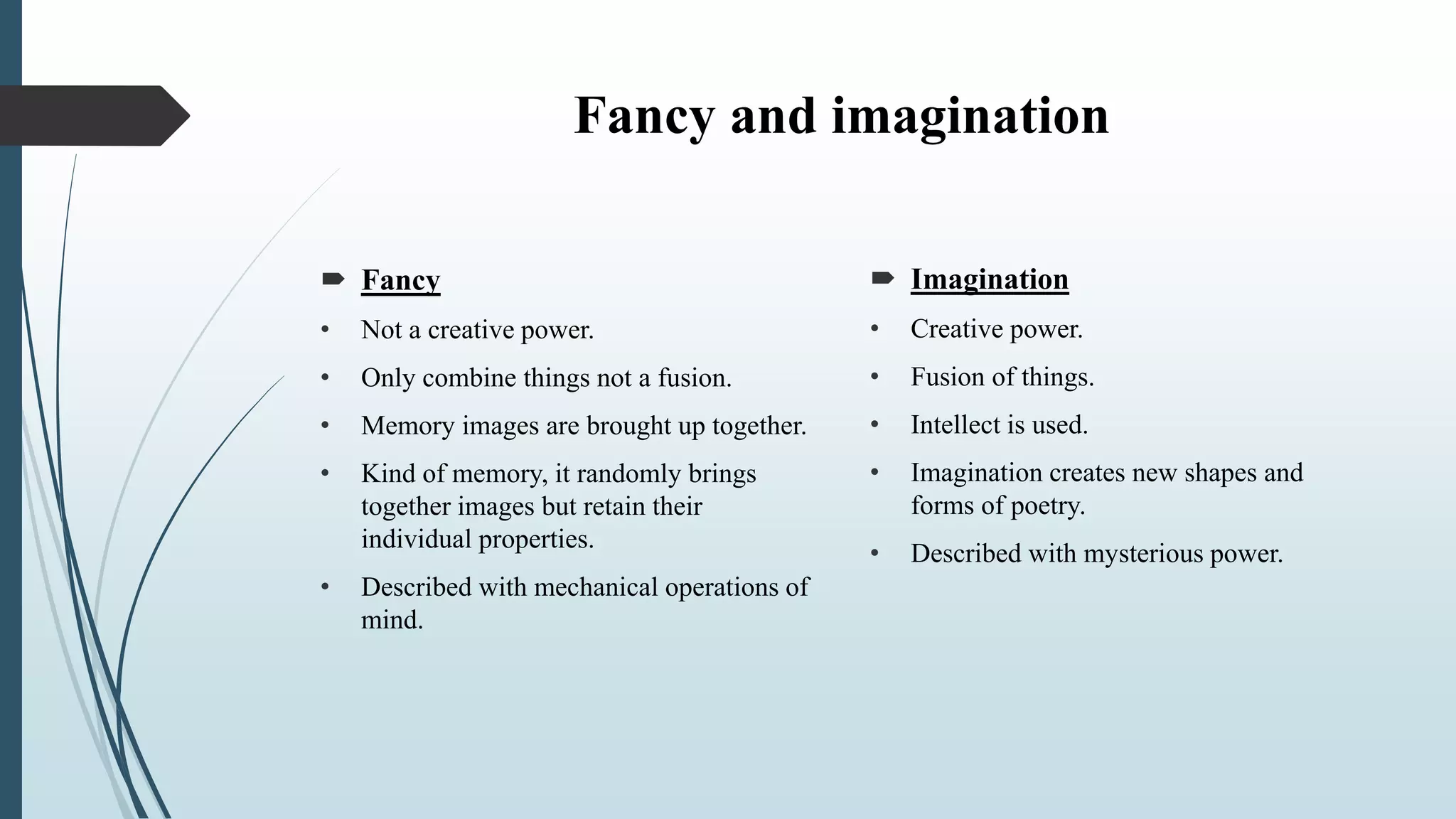
 Imagination
• Creative power.
• Fusion of things.
• Intellect is used.
• Imagination creates new shapes and
forms of poetry.
• Described with mysterious power.
 Fancy
• Not a creative power.
• Only combine things not a fusion.
• Memory images are brought up together.
• Kind of memory, it randomly brings
together images but retain their
individual properties.
• Described with mechanical operations of
mind.
Types of imagination
Primary imagination
Necessary imagination.
Presents man’s ability to
learn from nature.
the primary imagination a
divine quality, namely the
creation of the self.
It is the intrinsic quality of
the poet that makes him or
her a Creator
Secondary imagination
Represent superior
faculty.
Key attribute is free and
deliberate will.
The secondary
imagination is an echo of
the primary.
It co-exists with the conscious
will.
Poet in ideal perfection
 Poet in, ideal perfection, brings whole soul into activity according to worth and
dignity.
 He creates organic whole by blending tone and spirit of unity by magical power
i.e. imagination.
Paragraph 11
Balance of opposite qualities
 This imagination in action by will and understanding reveals itself in balance of
opposite qualities.
 When this blending of opposites(nature and artificial) occurs, it is subordinate to
nature;
 Manner subordinates to matter
 Poet’s admire subordinates to sympathy with poetry.
Poetry
 Good sense is body to poetic genius,
 Fancy is its dress,
 Motion is its life, and
 Imagination is the soul.
 When all these are combined, forms a graceful and intelligent whole i.e. poetry.
Literary Devices
 Inter-texual references:
Verses of his poem “Nosce Teipsum” By Sir John Davies, The Ancient Mariner, The Dark
Ladie.
 Reference:
Latin Phrase “laxis effertur habenis” meaning “is borne onwards with loose reins” i.e. it is
carried onwards with loose governance i.e. by using secondary imagination it reveals in
balance.
 Metaphors:
Metaphor is to refer to something without using “as” or “like”
Here good sense is refered to body of poetry, fancy its drapery e.t.c.
 Symbolism:
Here “graceful and intelligent whole” is symbolizing “poetry”
Conclusion
 The difference between poem and poetry is not given in clear terms. Even John Shawcross
writes in his “Biographia Literaria with Aesthetical Essays” that :
“this distinction between poem and poetry is not clear, and instead of defining he proceeds to
describe poet, and from the poet he proceeds to enumerate the characteristics of imagination”
 Poetry for Coleridge is an activity of the poet’s mind, and a poem is merely one of the
forms of its expression, a verbal expression of that activity.
 As David Daiches points out “ Poetry for Coleridge is a wider category than a poem ,poetry
is a kind of activity, for him poetry is not confined to those who employ metrical language
or even to those who employ language of any kind.”
References
 https://www.sjsu.edu/faculty/harris/StudentProjects/Laset/BiogrNotes.htm
 https://www.slideshare.net/dilipbarad/samuel-coleridge-biographia-literaria-ch-14
 Coleridge.S.T. Biographia Literaria. latest edition. Kitab Mahal,Lahore.
 Singh.T.A History of English Literature. Latest edition.New Kitab Mahal
publishers,Lahore.
THANK YOU

Biographia literaria chapter14

  • 1.
    BIOGRAPHIA LITERARIA Chapter #14 Presented by: Haleema Bibi (BSF 1700340) Wajiha Tanvir (BSF 1700392) Nimra Kanwal (BSF 1700649) Madiha Tahir (BSF 1700408) Nida Khan (BSF 1700566) Jawairia Mehmood (BSF 1700264)
  • 2.
    BIOGRAPHY OF S.T.COLERIDGE: 1772-1834  Born in Devon in 1772  He was English Romantic poet  Influential in the founding and development of English poetry.  He was a poet as well as a notable literary critic  In 1798, he and Wordsworth published volume of poetry “Lyrical Ballads”  Later he was interested in the work of philosopher Immanuel Kant
  • 3.
     As hesays in his Biographia Literaria Ch 1, “No man was ever yet a great Poet, without being at the same time a profound philosopher"  One of his famous work on literary criticism is “Biographia Literaria”  Significant theoretical works  It is concerned with  the form of poetry,  genius of the poet and  relationship to philosophy  Died in Highgate, near London on July 25, 1834.
  • 4.
    BIOGRAPHIA LITERARIA:  Ithas two portions:  First portion is from chapter 1-13  It contained primarily metaphysical enquiry and discussions according to his plan in which he says: "My metaphysical works as my life, and in my life".  Second portion is from chapter 14-22  It contained an examination of Wordsworth's theories of the language and subject- matter of the poetry.
  • 5.
    SYNOPSIS OF CHAPTER14:  Points discussed in Chapter 14 are:  Two cardinal points  Coleridge view about Wordsworth's poetical style  Difference between poetry and prose
  • 6.
    CHAPTER 14 Paragraph 1: Two cardinal points of poetry  The first cardinal point is;  The power of exciting the sympathy of the reader by a faithful adherence to the truth of nature.  In such poems subjects were to be choose from ordinary life.  Characters and incidents were to be real.
  • 7.
     According toColeridge; “The sudden charm, with accidents of light and shade, which moon-light or sun- set diffused over a known and familiar landscape, appeared to represent the practicability of combining both"  The second cardinal point is;  The power of giving the interest of novelty by the modifying colors of imagination.  In this type of poetry, incidents and agents were to be supernatural.  With the help of imagination nature will be dealt by poet.
  • 8.
     Coleridge says; "Theexcellence aimed at was to consist in the interesting of the affections by the dramatic truth of such emotions as would naturally accompany such situations supposing them real".  Real here means supernatural power.  Examples: Daffodils (William Wordsworth) Kubla Khan (S.T.Coleridge)
  • 9.
    Analysis  First personpronoun is used by Coleridge to introduce himself. e.g: During the first year that Mr. Wordsworth and I were neighbours……..  Mr. Wordsworth in the first line is William Wordsworth.  He is close friend to Coleridge.  A fellow Romantic poet  Published the influential volume of poetry- Lyrical Ballad.  "Daffodils" and "Tintern Abbey“  Natural imagery and contrast is used e.g: moonlight and sunset.
  • 10.
  • 11.
    Analysis of Paragraph#2,3 LyricalBallads  A collection of poems by William Wordsworth and Samuel Taylor Coleridge, in 1798.  In First edition:19 poems by Wordsworth and 4 poems by Coleridge.  Second edition and Preface.  One of the main themes is the return of the original state of nature.  Lyrical: links the poems with ancient rustic bards and lends an air of spontaneity. Ballads: an oral mode of story telling used by common people.  Lyrical Ballads real and supernatural.
  • 12.
    Samuel Taylor Coleridgeendeavors  To deal with: “Persons and characters supernatural, or at least romantic”  Romantic Features find ample impression in his work: Imagination, love of Middle Ages, Supernaturalism and Humanitarianism.  According to Bowra, : “Coleridge’s poem of all English Romantic masterpieces are the most unusual and the most Romantic”  In Samuel C. Chews words: “His effort was to live constantly in the world of imagination above and beyond the sensuous phenomenal world”
  • 13.
    Mr. Wordsworth’s Objective “Togive the charm of novelty to things of everyday, and to excite a feeling analogous to the supernatural by awakening the minds attention from lethargy of custom and directing it to loveliness and wonders of the world before us.”  He said that: “All good poetry is the spontaneous overflow of powerful feelings.”  According to Scott James: “For him the plot, or situation is not the first thing. It is the feeling that matters.”
  • 14.
    Wordsworth • Triedto super-naturalize “Naturalism” Coleridge • Tried to naturalize “supernaturalism”
  • 15.
    Willing Suspension ofDisbelief  A formula for justifying the use of non realistic element in literature.  If a writer could infuse human interest and semblance of truth into a fantastic tale like shadows of imagination, the reader would suspend judgement concerning the implausibility of the narrative.  Supernatural poems in way that they would be believable for the reader and able to evoke genuine emotions in the reader.  According to Richard Sha: “One is not merely seduced by supernatural but one must willingly suspend one’s skepticism.”
  • 16.
    Coleridge use ofSupernaturalism  Romantic and Supernatural poetry : The Ancient Mariner, The Dark Ladie and Christabel.  The Ancient Mariner: Supernatural realm ; willing suspension of disbelief ; Ancient Mariner’s tale.  Its simple, ballad forms, exquisite imagery, the sweet harmony of its verse and the aptness of its phraseology.  Christabel : Victims malignant supernatural identity; horror; magic realism ; willing suspension of disbelief  Like Ancient Mariner it is written in homely and simple diction and in a style which is spontaneous and effortless
  • 17.
    Mr. Wordsworth Industry Writing style of Wordsworth :in his own character, impassioned, lofty and sustained diction, subjects from the nature rejected usual ornament and extra colloquial style of poems.  Language of ordinary real life.  Peculiar business of poetry - to produce pleasurable interest.  Preface of second edition - extension of this style to poetry of all kinds ; rejection of vicious and indefensible all phrases and forms of style not part of language of real life.  Presence of original genius.  Strong criticism against Wordsworth’s view expressed in the Preface.
  • 18.
    Literary devices  Aestheticallusion Example: as a product of willing suspension of dis-belief.  Paradox Example: We have eyes yet see not, ears that hear not.
  • 19.
  • 20.
    Paragraph no. 4 Critics discovered “meanness of language and inanity of thought” in Wordsworth’ poems. But years after years increased the number of Wordsworth admirers.  Works of Wordsworth were not only praised in lower classes, but chiefly among the young men of strong meditative minds of all classes.
  • 21.
    Coleridge views towardsWordsworth’s poetic creed  S.T Coleridge did not fully agree with Wordsworth’s views in his ‘second edition of Preface’. “ to be read or not at the reader’s choice.”  Preface to second edition: a transition line between Neoclassical and Romantic age.  Wordsworth did not announced any change in his poetic creed.
  • 22.
     Coleridge objectsto several parts of Wordsworth's Preface as; “ erroneous in principle, as contradictory both to the parts of the same preface and to author's own practice in the greater number of poems themselves.”  On the other hand, Coleridge has the view that; “ I had been honored more than I deserve by the frequent conjunction of my name with his.”
  • 23.
    Paragraph 5  thefunction of philosophical disquisition consists in just ‘distinction’ ( distinction is not division).  to obtain adequate notions of truth, a poet must use ‘Technical Process of Philosophy’:  “ involves separating the distinguishable parts, and then making similarities and dissimilarities, and at the end it must show unity in which they actually co- exist.”
  • 24.
    Difference between proseand poetry by Coleridge  A poem contains the ‘same element’ as the prose, but the difference lies in their different combinations, in consequence of a different object composed.  “Words in their best order, is prose, and best words in their best order, is poetry, by S. T. Coleridge.  difference in the object will be because of the difference of combination.
  • 25.
     A poemmay also differ from prose by meter, rhym, or by both ( poem has meter and rhym while prose do not have).  it is also possible that the recollection of any given facts or observations by artificial arrangements will result to a poem, e.g;  Prose; “ there are total thirty days in September, April, June and November.” Poetry; “Thirty days hath September April, June, and November”  poetry also differ from prose because it has pleasurable end, but prose do not give such end and rhythm.
  • 26.
  • 27.
    Analysis of Paragraph6 & 7  Coleridge : A difference of object and content supplies an additional ground of distinction between poetry and prose.  Immediate purpose and ultimate end  He explains his view point by various writing, it's immediate purpose and ultimate end.  The immediate purpose of poetry is the communication of pleasure.
  • 28.
    Prose  An immediatepurpose of prose is the communication of truth.  In scientific and historical composition, immediate purpose is to convey the truth.  But prose work (romances and novels) give pleasure as the immediate purpose and truth (either moral or intellectual) may an ultimate end.
  • 29.
    Poem Definition of poem “A poem is that species of composition which is opposed to works of science by proposing for it's immediate object pleasure, not truth”. "Would then the mere super addition of meter ,with or without rhyme , entitle these to the name of poems?"
  • 30.
    Name of Poem Then he said that if meter is wonderfully added in the other parts of composition then it should also harmonize with it.  Every part of composition like meter, diction, topic, subject, theme ,background and rhyme must also harmonize with wholeness of the composition.  There is also an element of organic unity. Organic unity means that all parts of poem must fit together as the parts of an organism fit together, if you remove one part, an organism dies.  And then that composition should take form of a poem or deserve the name of poem.
  • 31.
     Thus apoem differs from a work of scientific prose in having as it's immediate object pleasure and not truth.  It differs from other kinds of writing: because of their immediate object. In poem, the pleasure, we take from the whole work is compatible with, and even led up to by, the pleasure we take in each component part. Literary Devices  Adjectives used – Ultimate, Immediate  Contrast – Poem and Prose
  • 32.
  • 33.
    Analysis of Paragraph8: Legitimate Poem:  A proper poem must be one “whose parts mutually support and explain each other”  All in their proportion harmonizing each other  Supporting the purpose  Known influence of metrical arrangement
  • 34.
    View points ofPhilosophical Critics:  A poem cannot be called a poem, If  It is a series of striking lines or distich(couplet)  Absorb readers whole attention to itself  Disjoins it from its context  Makes it a separate whole, instead of harmonizing part  An un-sustained composition  Reader collect rapidly the general result
  • 35.
     Un-attracted bygeneral parts  Reader should be carried forward not  By curiosity  Or by desire to arrive at final solution  But by pleasurable activity of mind excited by the journey itself  Like the path of sound through air
  • 36.
     Retrogressive movement-atevery step reader pauses and goes backward which collects the force to again carries him onward  Precipitandus est liber spiritus says Petronius Arbiter most happily  The free spirit of the epic poet must be hurried onward
  • 37.
    Paragraph 9  PoeticalStyle:  Poetry of highest kind may exist without metre  And even without distinguishes objects of a poem  Writings of Plato, Bishop Taylor and The Theoria Sacra of Burnet  First chapter of Isaiah in poetry asserts that truth and also the pleasure was the immediate object of Prophet
  • 38.
     Whatever specificimport attach to the word, poetry, there will be found involved in it  Poem of any length neither can be nor ought to be, all poetry  If harmonious whole is to be produced, the remaining part must be reserved in keeping with the poetry  Excite a more continuous and equal attention than the language of prose aims at  Whether in the form of speech or written
  • 39.
    Literary Devices:  PersonalPronoun:  First personal pronoun (I) e.g I must leave his opinion uncontroverted  Simile:  e.g Like the path of sound through air  Literary References:  Petronius Arbiter-Roman courtier during the reign of Nero  Bishop Taylor -Author of famous work, Holy Living and Holy Dying  Thomas Burnet- Thomas Burnet, a Yorkshire divine and master of the Charter-house.  Plato  Other Language: Latin  E.g: Precipitandus est liber spiritus
  • 40.
  • 41.
    Paragraph 10 Nature ofpoetry  Coleridge’s view about nature of poetry lies in fancy and imagination.  Poetic genius distinguishes poet and poetry.  Poetic genius modifies images, thoughts, and emotions of poet’s mind.  In order to know what poetry is, it is essential to examine the qualities and functions of a poet.
  • 42.
    Fancy and imagination In 18th century literary theory, fancy and imagination was regarded as a mode of memory.  Coleridge considered these two concepts to be distinct and widely different faculties.
  • 43.
    Coleridge’s concept offancy and imagination  According to him: “ Fancy is the process of bringing together of images dissimilar in the main object from its sources.”  Fancy in Coleridge’s eyes: for tasks that were “passive” and “mechanical.”  Coleridge’s views about imagination: “Imaginative processes sometimes adds additional properties to an object or sometimes abstracts from it some of its properties.”
  • 44.
    Fancy and imagination Imagination • Creative power. • Fusion of things. • Intellect is used. • Imagination creates new shapes and forms of poetry. • Described with mysterious power.  Fancy • Not a creative power. • Only combine things not a fusion. • Memory images are brought up together. • Kind of memory, it randomly brings together images but retain their individual properties. • Described with mechanical operations of mind.
  • 45.
    Types of imagination Primaryimagination Necessary imagination. Presents man’s ability to learn from nature. the primary imagination a divine quality, namely the creation of the self. It is the intrinsic quality of the poet that makes him or her a Creator Secondary imagination Represent superior faculty. Key attribute is free and deliberate will. The secondary imagination is an echo of the primary. It co-exists with the conscious will.
  • 46.
    Poet in idealperfection  Poet in, ideal perfection, brings whole soul into activity according to worth and dignity.  He creates organic whole by blending tone and spirit of unity by magical power i.e. imagination.
  • 47.
    Paragraph 11 Balance ofopposite qualities  This imagination in action by will and understanding reveals itself in balance of opposite qualities.  When this blending of opposites(nature and artificial) occurs, it is subordinate to nature;  Manner subordinates to matter  Poet’s admire subordinates to sympathy with poetry.
  • 48.
    Poetry  Good senseis body to poetic genius,  Fancy is its dress,  Motion is its life, and  Imagination is the soul.  When all these are combined, forms a graceful and intelligent whole i.e. poetry.
  • 49.
    Literary Devices  Inter-texualreferences: Verses of his poem “Nosce Teipsum” By Sir John Davies, The Ancient Mariner, The Dark Ladie.  Reference: Latin Phrase “laxis effertur habenis” meaning “is borne onwards with loose reins” i.e. it is carried onwards with loose governance i.e. by using secondary imagination it reveals in balance.  Metaphors: Metaphor is to refer to something without using “as” or “like” Here good sense is refered to body of poetry, fancy its drapery e.t.c.  Symbolism: Here “graceful and intelligent whole” is symbolizing “poetry”
  • 50.
    Conclusion  The differencebetween poem and poetry is not given in clear terms. Even John Shawcross writes in his “Biographia Literaria with Aesthetical Essays” that : “this distinction between poem and poetry is not clear, and instead of defining he proceeds to describe poet, and from the poet he proceeds to enumerate the characteristics of imagination”  Poetry for Coleridge is an activity of the poet’s mind, and a poem is merely one of the forms of its expression, a verbal expression of that activity.  As David Daiches points out “ Poetry for Coleridge is a wider category than a poem ,poetry is a kind of activity, for him poetry is not confined to those who employ metrical language or even to those who employ language of any kind.”
  • 51.
    References  https://www.sjsu.edu/faculty/harris/StudentProjects/Laset/BiogrNotes.htm  https://www.slideshare.net/dilipbarad/samuel-coleridge-biographia-literaria-ch-14 Coleridge.S.T. Biographia Literaria. latest edition. Kitab Mahal,Lahore.  Singh.T.A History of English Literature. Latest edition.New Kitab Mahal publishers,Lahore. THANK YOU