Neuromorphic Computing
- An intro to building brains
What is Neuromorphic computing?
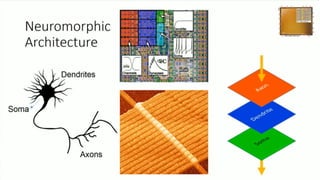
"Neuromorphic engineering, also known as neuromorphic computing
started as a concept developed by Carver Mead in the late 1980s,
describing the use of very-large-scale integration (VLSI) systems
containing electronic analogue circuits to mimic neurobiological
architectures present in the nervous system."
simply put...
"Neuromorphic engineering is a new emerging
interdisciplinary field which takes inspiration from
biology, physics, mathematics, computer science and engineering to
design hardware/physical models of neural and sensory systems."
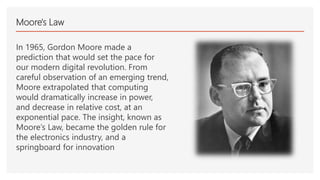
Moore's Law
In 1965, Gordon Moore made a
prediction that would set the pace for
our modern digital revolution. From
careful observation of an emerging trend,
Moore extrapolated that computing
would dramatically increase in power,
and decrease in relative cost, at an
exponential pace. The insight, known as
Moore’s Law, became the golden rule for
the electronics industry, and a
springboard for innovation
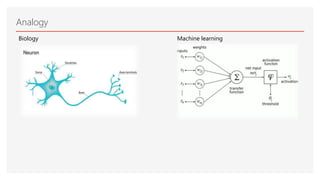
Analogy
Biology Machine learning
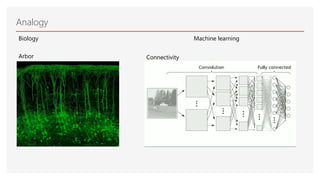
Analogy
Biology Machine learning
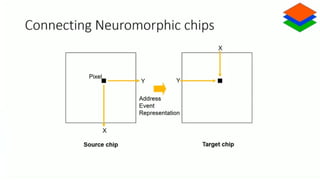
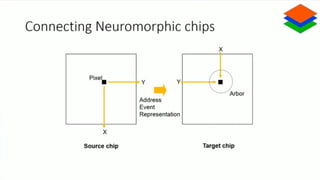
Arbor Connectivity
Analogies
Biology
• Neuron
• Arbor
• Scale
1. ~100B Neurons
2. ~100T connections
Machine learning
• Neuron/Filter/Feature extractor
• Connectivity
• Scale ???
Analogies
Biology
• Neuron
• Arbor
• Power
• ~20W
Machine learning
• Neuron/Filter/Feature extractor
• Connectivity
• Power ???
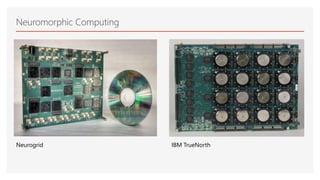
Neuromorphic Computing
Neurogrid IBM TrueNorth
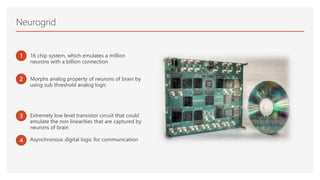
Neurogrid
1 16 chip system, which emulates a million
neurons with a billion connection
2 Morphs analog property of neurons of brain by
using sub threshold analog logic
3 Extremely low level transistor circuit that could
emulate the non linearities that are captured by
neurons of brain
4 Asynchronous digital logic for communication
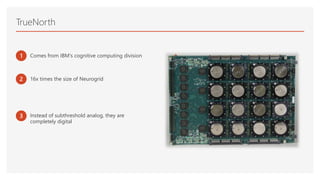
TrueNorth
1 Comes from IBM's cognitive computing division
2 16x times the size of Neurogrid
3 Instead of subthreshold analog, they are
completely digital
Reference
1 Ben Varkey Benjamin ; Peiran Gao
; Emmett McQuinn ; Swadesh Choudhary
; Anand R. Chandrasekaran ; Jean-Marie
Bussat ; Rodrigo Alvarez-Icaza ; John V.
Arthur ; Paul A. Merolla ; Kwabena Boahen -
Neurogrid: A Mixed-Analog-Digital
Multichip System for Large-Scale Neural
Simulations - Stanford University
2 Wen Ma: Mohammed A. Zidan - Neuromorphic
computing with memristive devices - Springer
journal
Thank you

Neuromorphic computing

  • 1.
    Neuromorphic Computing - Anintro to building brains
  • 2.
    What is Neuromorphiccomputing? "Neuromorphic engineering, also known as neuromorphic computing started as a concept developed by Carver Mead in the late 1980s, describing the use of very-large-scale integration (VLSI) systems containing electronic analogue circuits to mimic neurobiological architectures present in the nervous system."
  • 3.
    simply put... "Neuromorphic engineeringis a new emerging interdisciplinary field which takes inspiration from biology, physics, mathematics, computer science and engineering to design hardware/physical models of neural and sensory systems."
  • 4.
    Moore's Law In 1965,Gordon Moore made a prediction that would set the pace for our modern digital revolution. From careful observation of an emerging trend, Moore extrapolated that computing would dramatically increase in power, and decrease in relative cost, at an exponential pace. The insight, known as Moore’s Law, became the golden rule for the electronics industry, and a springboard for innovation
  • 5.
  • 6.
  • 7.
    Analogies Biology • Neuron • Arbor •Scale 1. ~100B Neurons 2. ~100T connections Machine learning • Neuron/Filter/Feature extractor • Connectivity • Scale ???
  • 8.
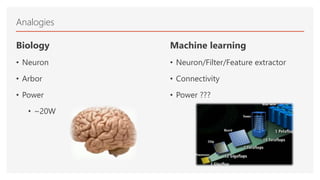
    Analogies Biology • Neuron • Arbor •Power • ~20W Machine learning • Neuron/Filter/Feature extractor • Connectivity • Power ???
  • 9.
  • 10.
    Neurogrid 1 16 chipsystem, which emulates a million neurons with a billion connection 2 Morphs analog property of neurons of brain by using sub threshold analog logic 3 Extremely low level transistor circuit that could emulate the non linearities that are captured by neurons of brain 4 Asynchronous digital logic for communication
  • 11.
    TrueNorth 1 Comes fromIBM's cognitive computing division 2 16x times the size of Neurogrid 3 Instead of subthreshold analog, they are completely digital
  • 21.
    Reference 1 Ben VarkeyBenjamin ; Peiran Gao ; Emmett McQuinn ; Swadesh Choudhary ; Anand R. Chandrasekaran ; Jean-Marie Bussat ; Rodrigo Alvarez-Icaza ; John V. Arthur ; Paul A. Merolla ; Kwabena Boahen - Neurogrid: A Mixed-Analog-Digital Multichip System for Large-Scale Neural Simulations - Stanford University 2 Wen Ma: Mohammed A. Zidan - Neuromorphic computing with memristive devices - Springer journal
  • 22.