MAN-MACHINE
INTERACTION
                 AVIRUP KUNDU(43)
                  DEEPESH DAS(19)
           KANAD CHAKRABORTY(10)
        SAUMYADEEP CHATTERJEE(14)

ST THOMAS’ COLLEGE OF ENGINEERING
                    & TECHNOLOGY
OUTLINE
 Historical and Literary perspective
 The present scenario
 Some case studies
 A peek into the future
 The pitfalls of increasing MMI
 Closing thoughts
HISTORICAL AND
LITERARY
PERSPECTIVE
 The ancient Chinese text Lie Zi
  describes an ‘Automaton’ around 250
  B.C.
 The Greek mathematician Hero of
  Alexandria describes an automaton to
  pour guest’s wine
 Leonardo da Vinci designs his
  humanoid automaton in 1495 known
  as Leonardo’s robot
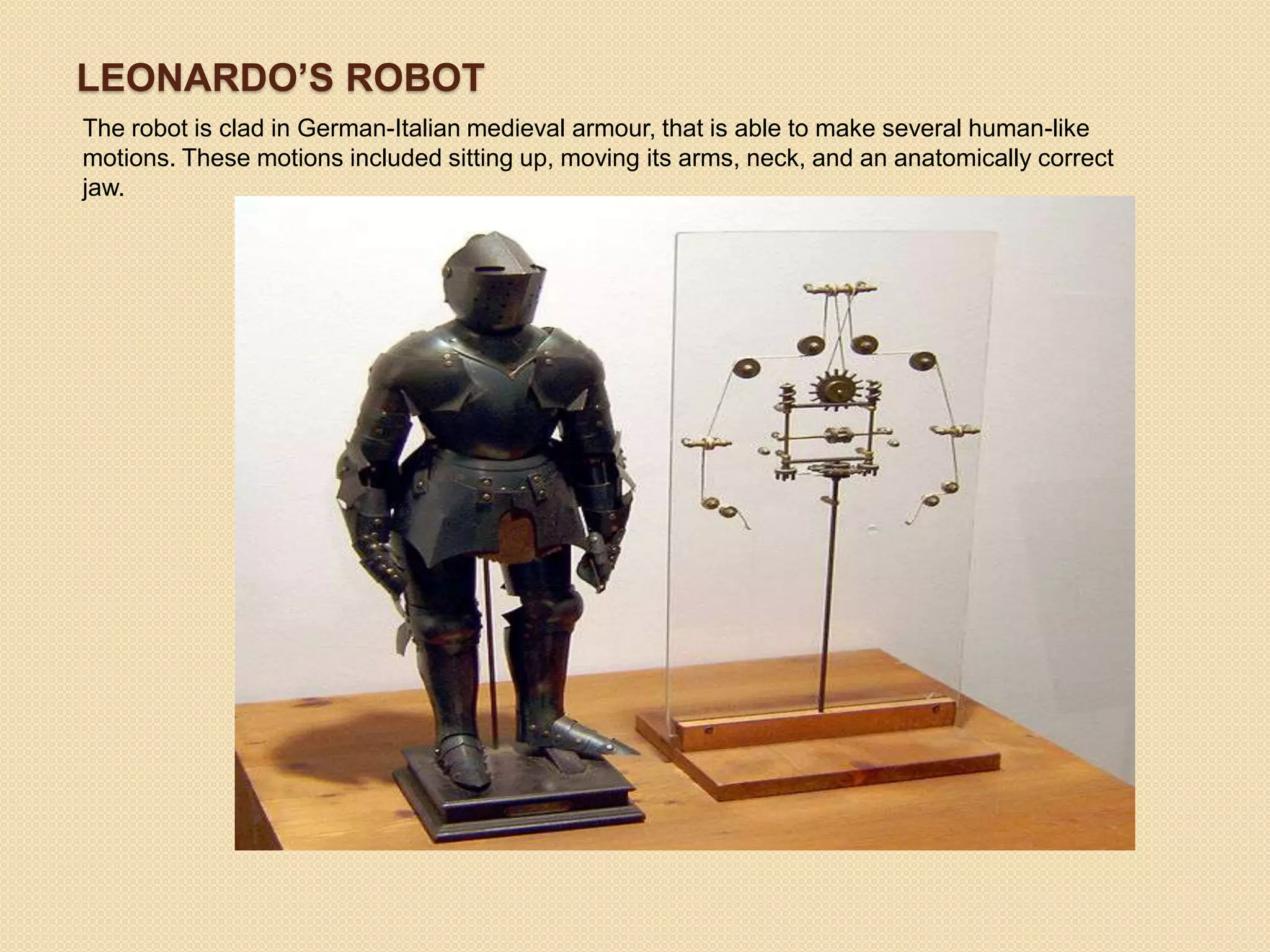
LEONARDO’S ROBOT
The robot is clad in German-Italian medieval armour, that is able to make several human-like
motions. These motions included sitting up, moving its arms, neck, and an anatomically correct
jaw.
 Isaac Asimov formulates the ‘Three
  Laws of Robotics’ and hence coins the
  term ‘Robotics’
 The word ‘Cybernetics’ is used by
  Norbert Wiener when he formulates
  the Principles of Cybernetics
 Fritz Lang's movie "Metropolis" is
  released in 1926. "Maria" the female
  robot in the film is the first robot to be
  projected on the silver screen.
THE PRESENT
SCENARIO
Although our history and literature is
crowded with references to automatons,
our true interaction with machines
started with the Industrial revolution.

Steam powered engines began to truly
ease the burden off the shoulder of
humans.

The introduction of the first mechanized
assembly line by Eli Whitney in 1797
was a revolutionary breakthrough.
   The modern day Man-Machine
    Interaction may be divided into 2
    categories:
    1. Control of machines in general using
       devices like steering wheel, automobile
       pedal, or button.
    2. Human–computer interaction.
 The first category is the classical one
  and least controversial. We use it
  daily
 The second category is the emerging
  one, which we are beginning to use,
We focus on the Human-
Computer Interface since it is
where ethical considerations
come into play with themes like:
 Robot-Emotion
 Treatment of emotion enhanced robots
 Place of augmented humans in society
 Moral issues of using machines to interfere with
  what Nature intended
 And by extension immortality
SOME CASE STUDIES
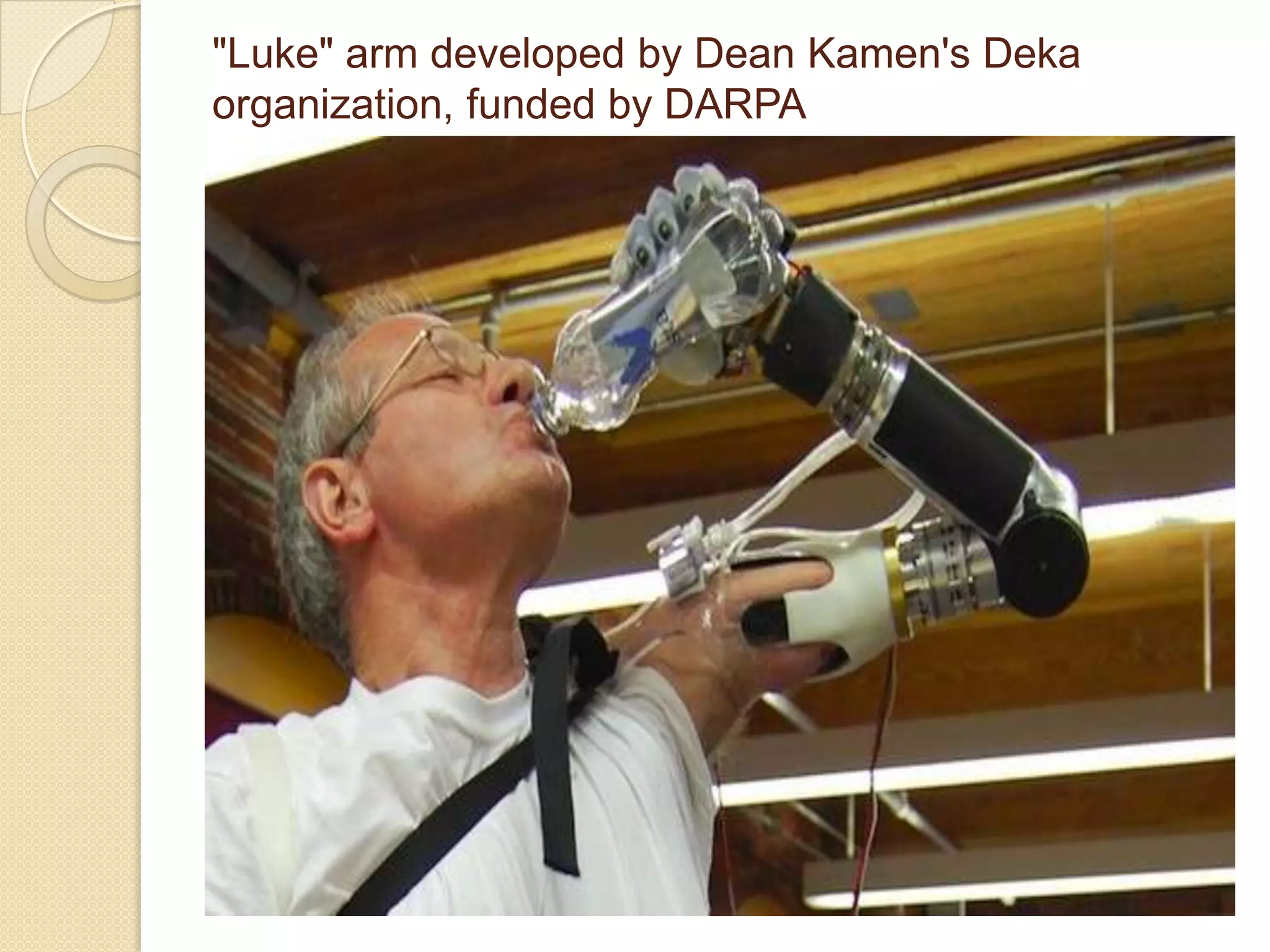
"Luke" arm developed by Dean Kamen's Deka
organization, funded by DARPA
ISAAC ASIMOV
 Explored the pitfalls of MMI beautifully
  in his works.
 R. Daneel Olivaw is the pinnacle in
  humanoid robot development with
  something akin to emotion.
 He befriends a human who
  reciprocates his feelings and this
  relationship ultimately alters the
  course of human history(future) over a
  few thousand years.
 R. Giskard gains the ability to sense
  human emotion and alter them leading
  to the destruction of Earth.
 Golan Trevize’s mind controlled
  automatic spaceship communicates
  with him through his hands and
  follows his every thought.
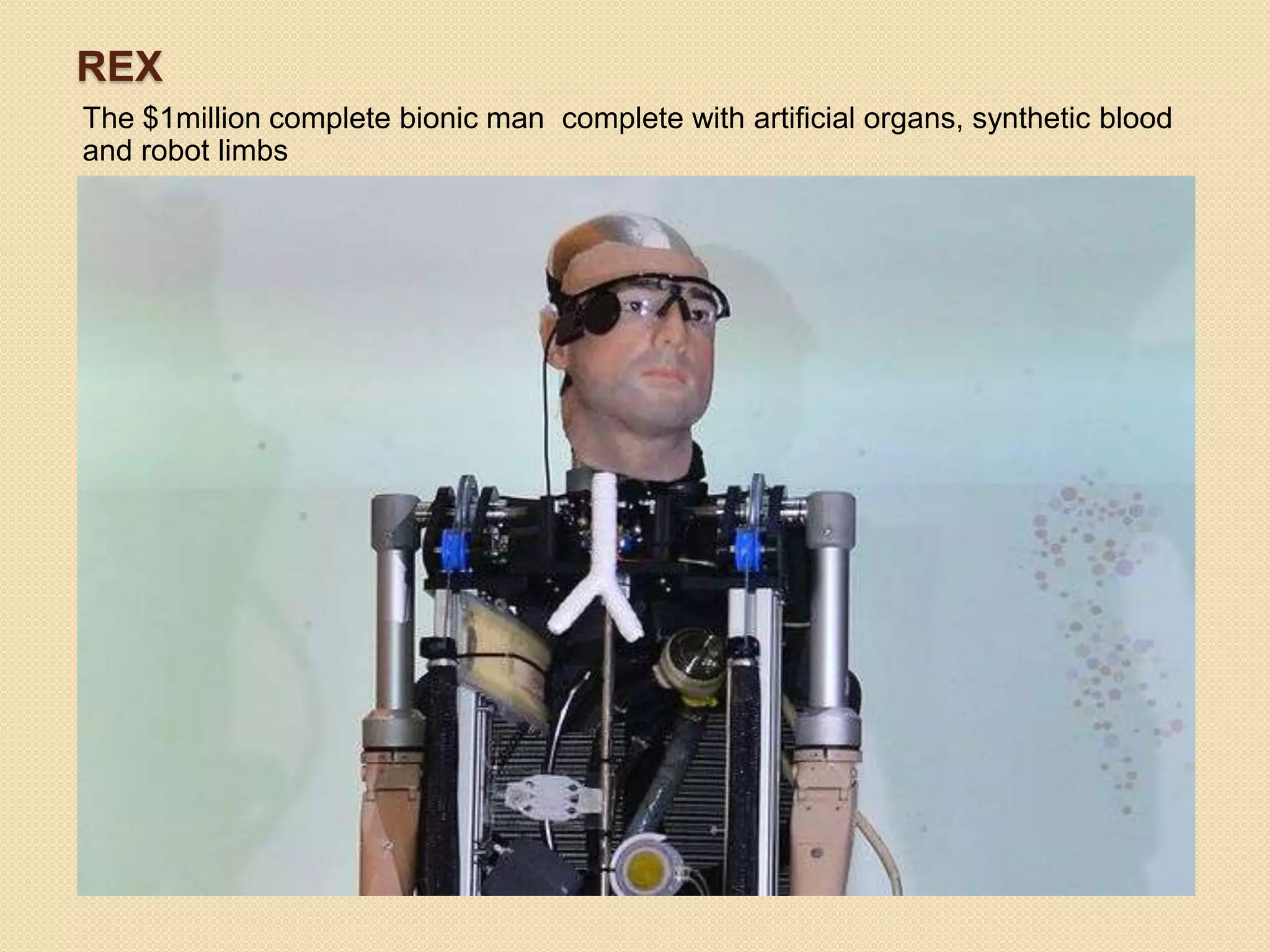
BIONIC MAN REX
 It incorporates some of the latest
  advances in prosthetic technology, as
  well as an artificial pancreas, kidney,
  spleen and trachea, and a functional
  blood circulatory system
 Created as a collaboration between
  Sheffield university, MIT, Oxford,
  University College London and
  Swansea
REX
The $1million complete bionic man complete with artificial organs, synthetic blood
and robot limbs
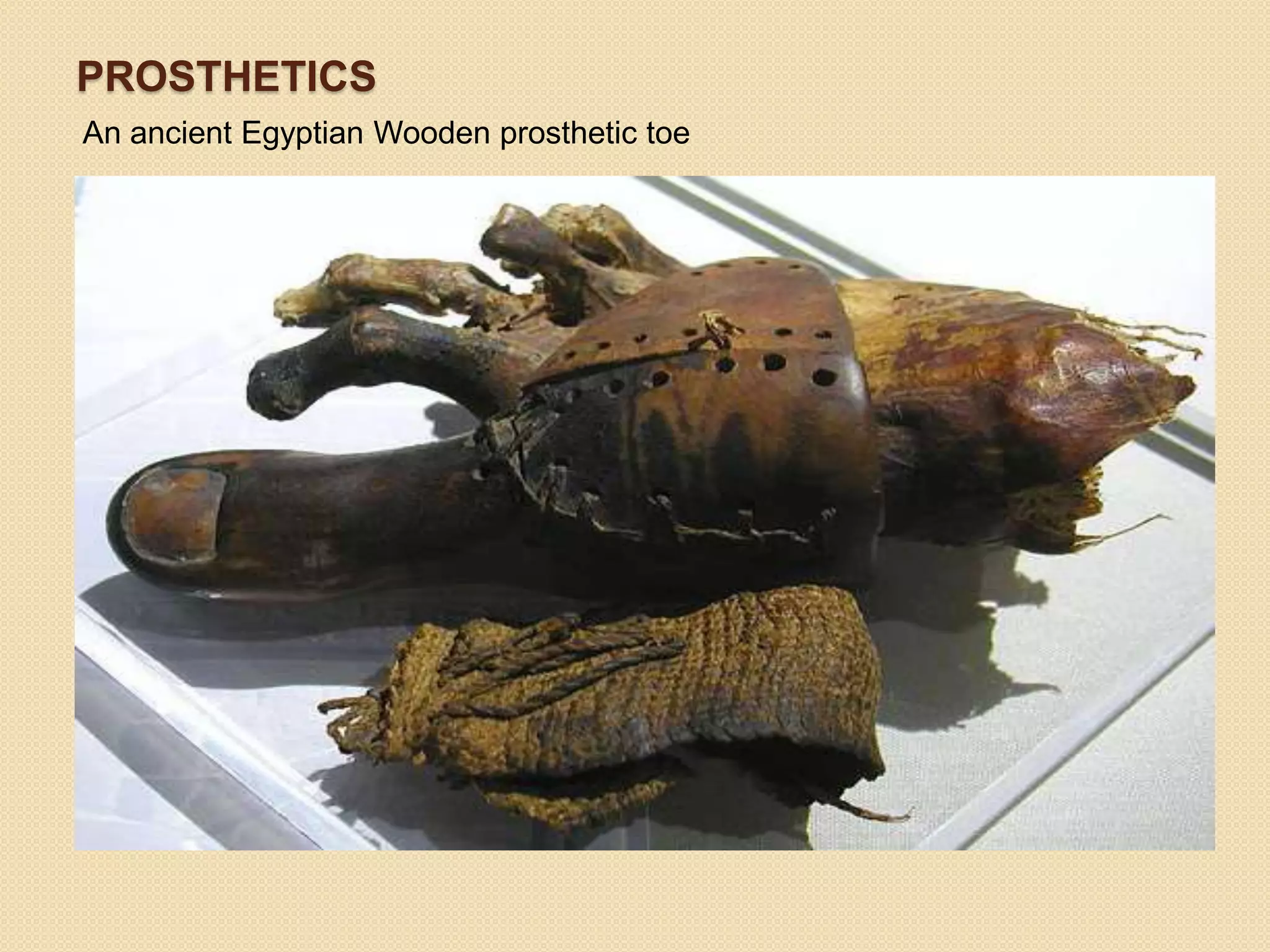
PROSTHETICS
An ancient Egyptian Wooden prosthetic toe
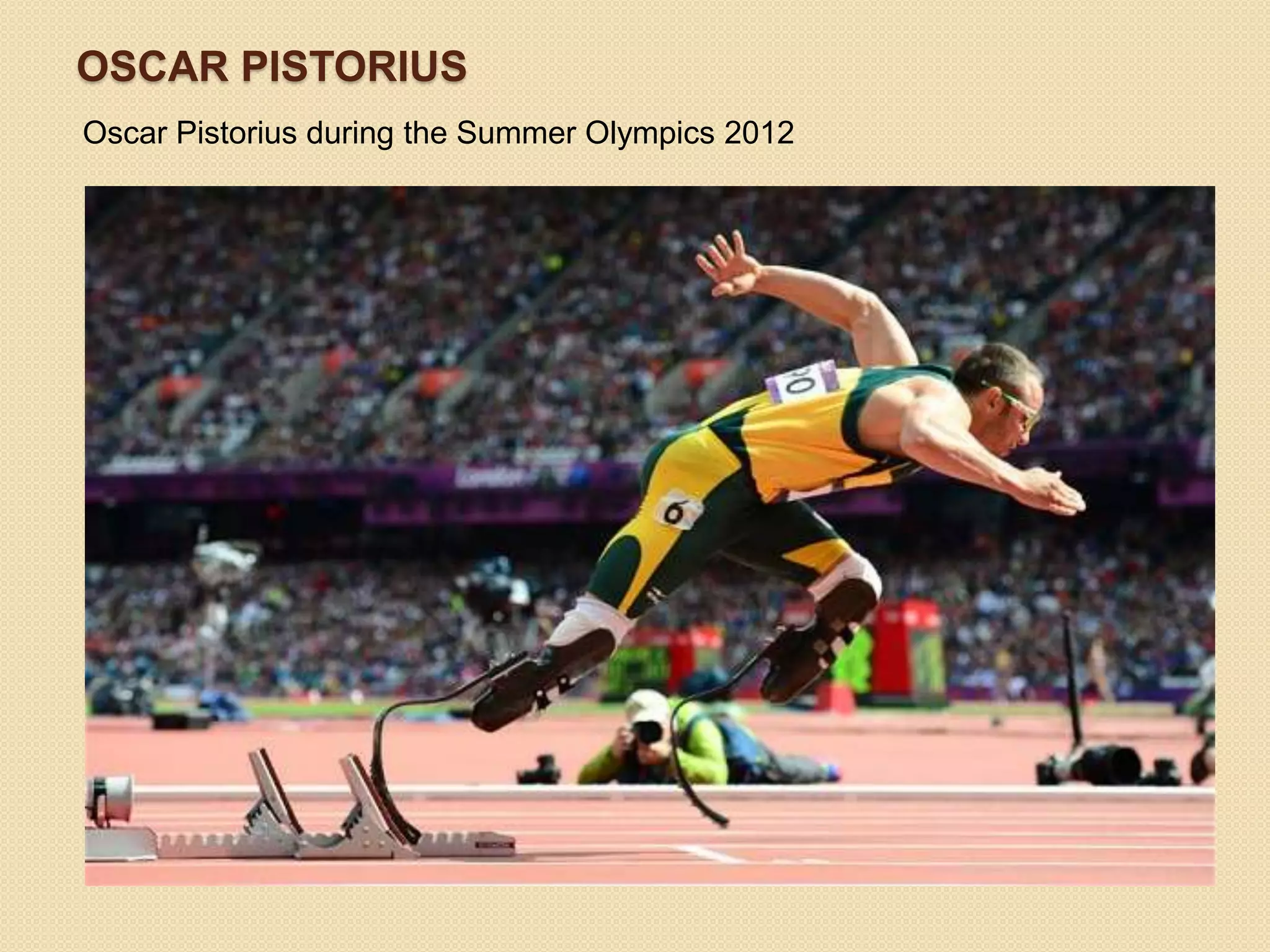
Oscar Pistorius
 He participated in the Summer
  Olympics with a pair of prosthetic
  limbs
 Generated controversy over whether
  his ‘Flex-Foot Cheetah Blade’ gave
  him any advantage over other athletes
OSCAR PISTORIUS
Oscar Pistorius during the Summer Olympics 2012
MEDICAL SCIENCES
 Robotic surgery is poised to allow the
  best doctors from around the world
  operate on the most critical patient
  anywhere in the world
 In 1988, the PROBOT, developed at
  Imperial College London, was used to
  perform prostatic surgery by Dr.
  Senthil Nathan at Guy's and St
  Thomas' Hospital, London
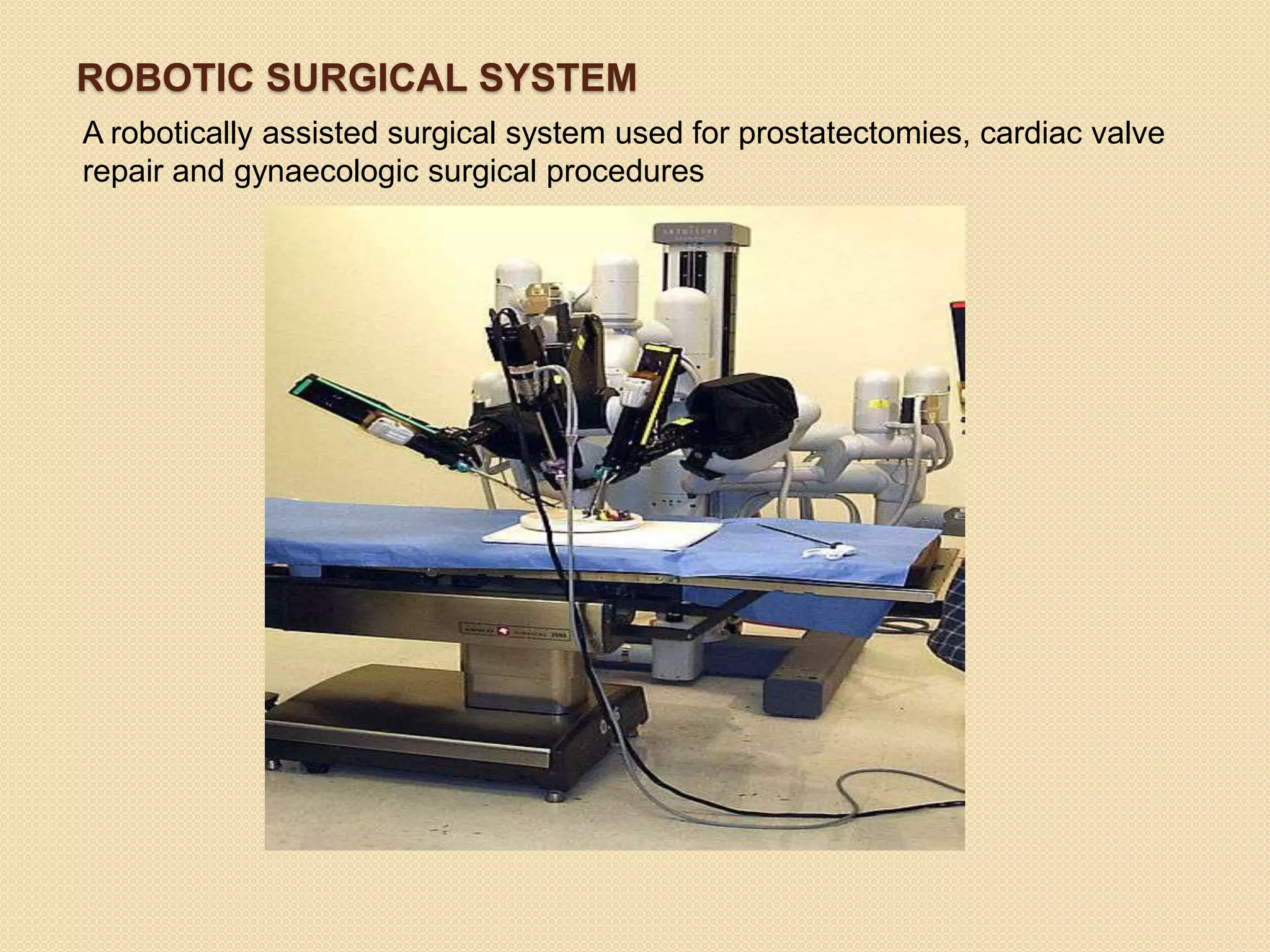
ROBOTIC SURGICAL SYSTEM
A robotically assisted surgical system used for prostatectomies, cardiac valve
repair and gynaecologic surgical procedures
COMMON MMI
   Several implants in the human body
    like:
    ◦ Cochlear implant
    ◦ Pace Maker
    ◦ Micro Chip implant
 Increasing dependence on technology
  like Apple’s Siri which can be talked to
 Google Glass project
 Sensors surround us working even
  without human interference
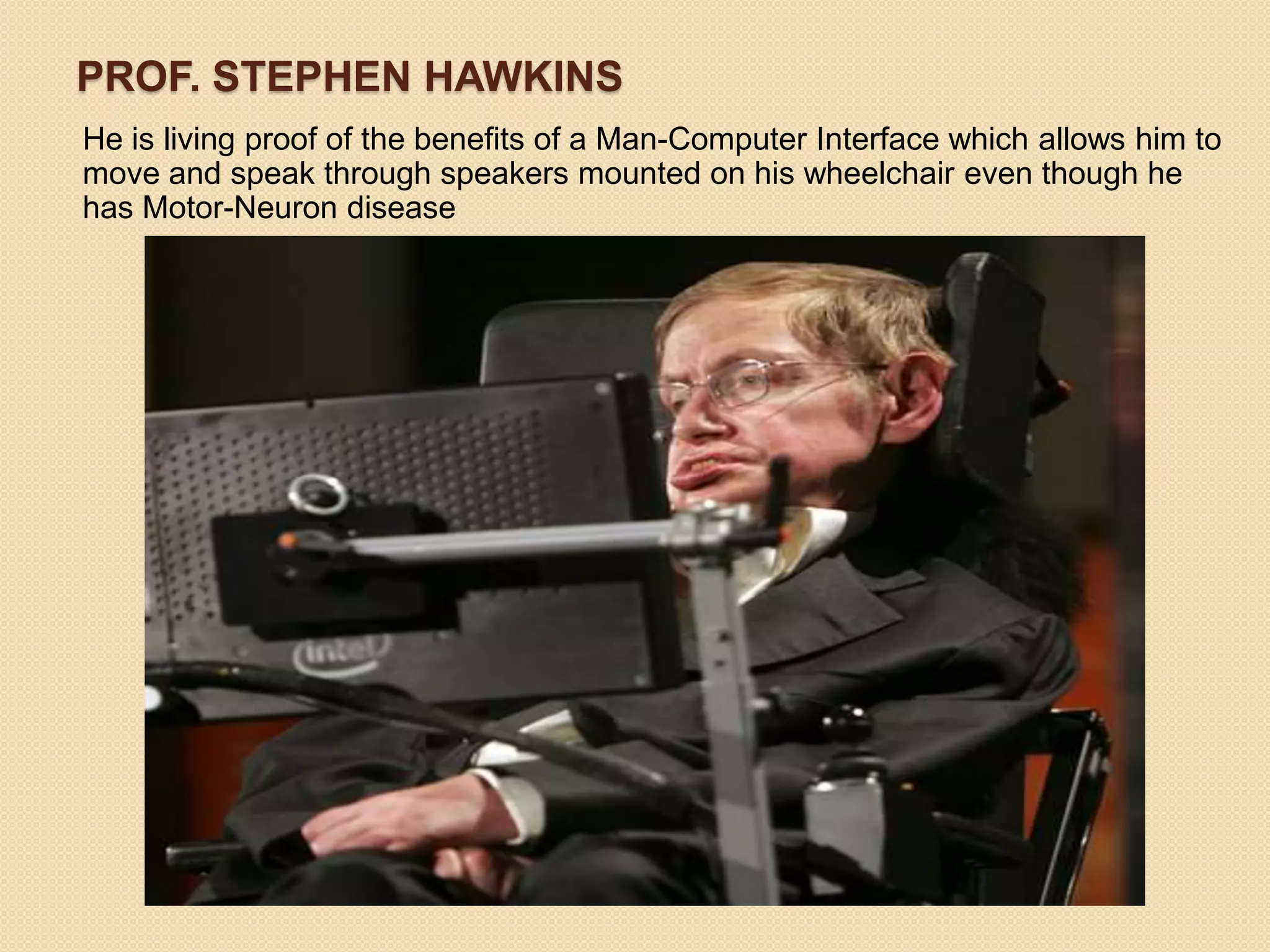
PROF. STEPHEN HAWKINS
He is living proof of the benefits of a Man-Computer Interface which allows him to
move and speak through speakers mounted on his wheelchair even though he
has Motor-Neuron disease
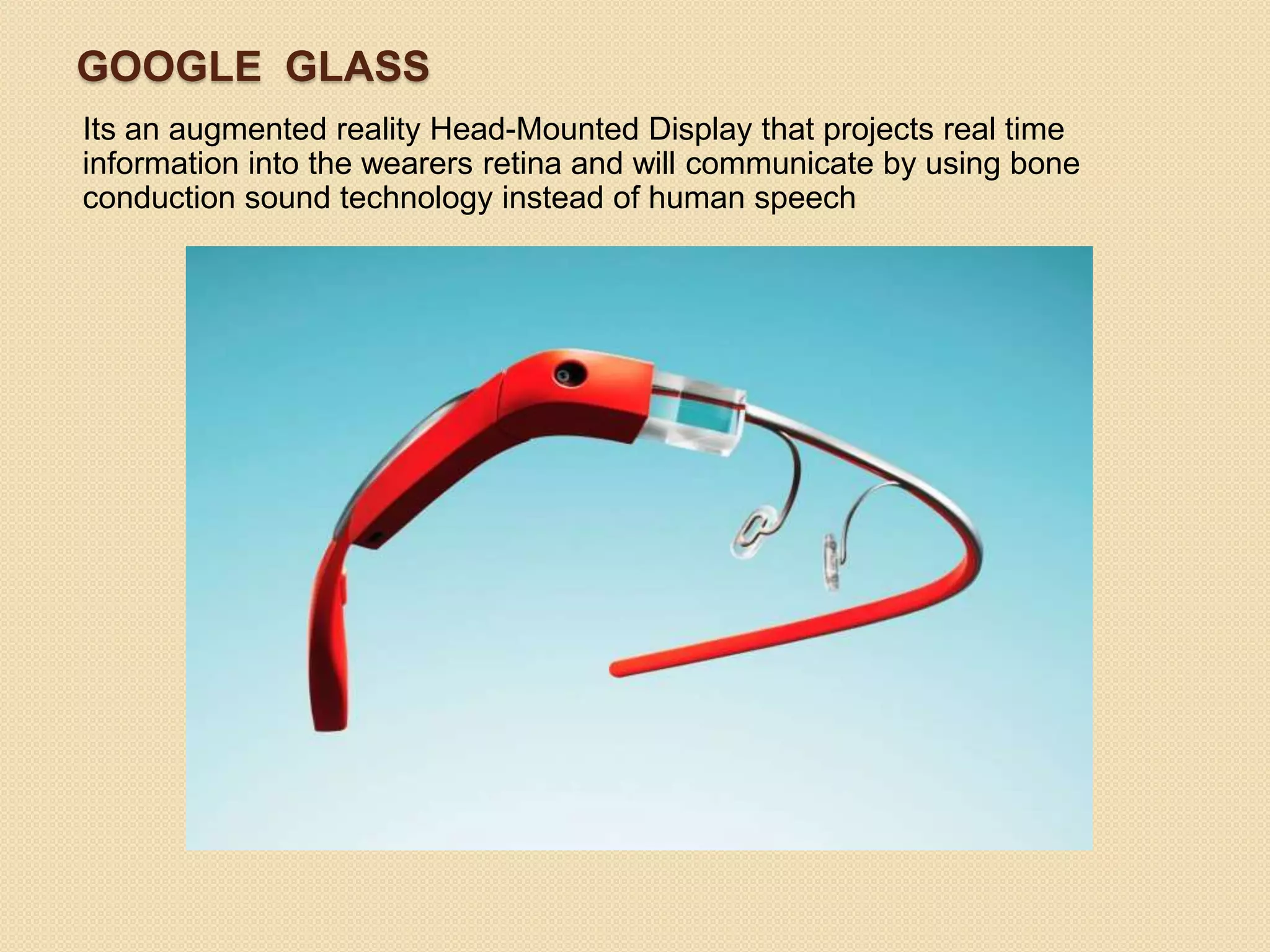
GOOGLE GLASS
Its an augmented reality Head-Mounted Display that projects real time
information into the wearers retina and will communicate by using bone
conduction sound technology instead of human speech
A PEEK INTO THE
FUTURE
SELF DRIVEN CARS
 Self-driven cars are just round the
  corner working with each other without
  human interference to navigate the
  fastest and safest route
 Potential for a ‘Zero’ accident scenario
 Very desirable technology with both
  civilian and battlefield implications
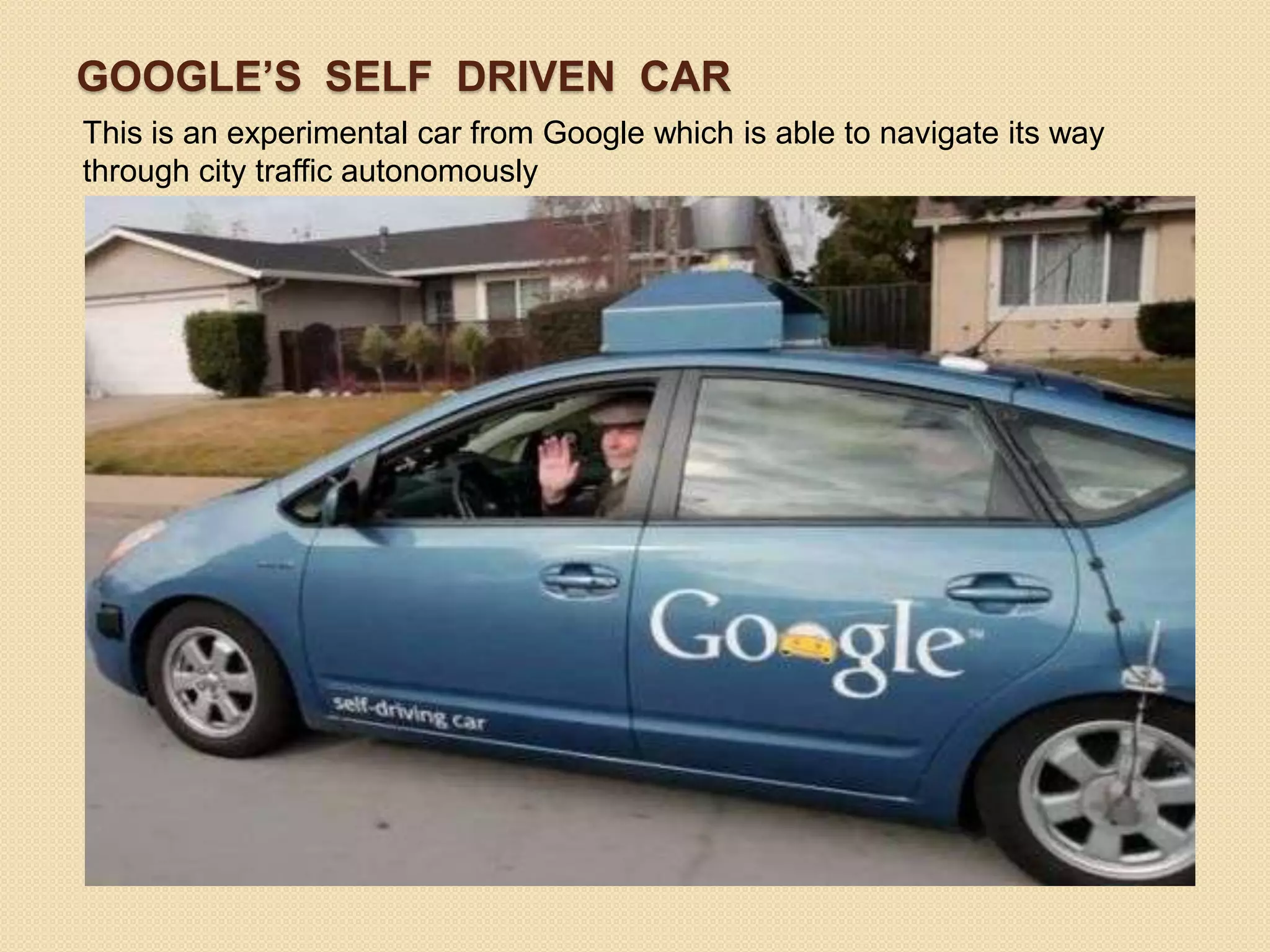
GOOGLE’S SELF DRIVEN CAR
This is an experimental car from Google which is able to navigate its way
through city traffic autonomously
A.I. SURGERY
 In May 2006 the first AI doctor-
  conducted unassisted robotic surgery
  on a 34 year old male to correct heart
  arythmia
 The surgery was rated as better than
  an above-average surgeon
 In the future Surgeries will be done
  flawlessly by means on robotic A.I.
ROBOT EXO SKELETONS
 An almost tireless body
 Able to do the work of many men and
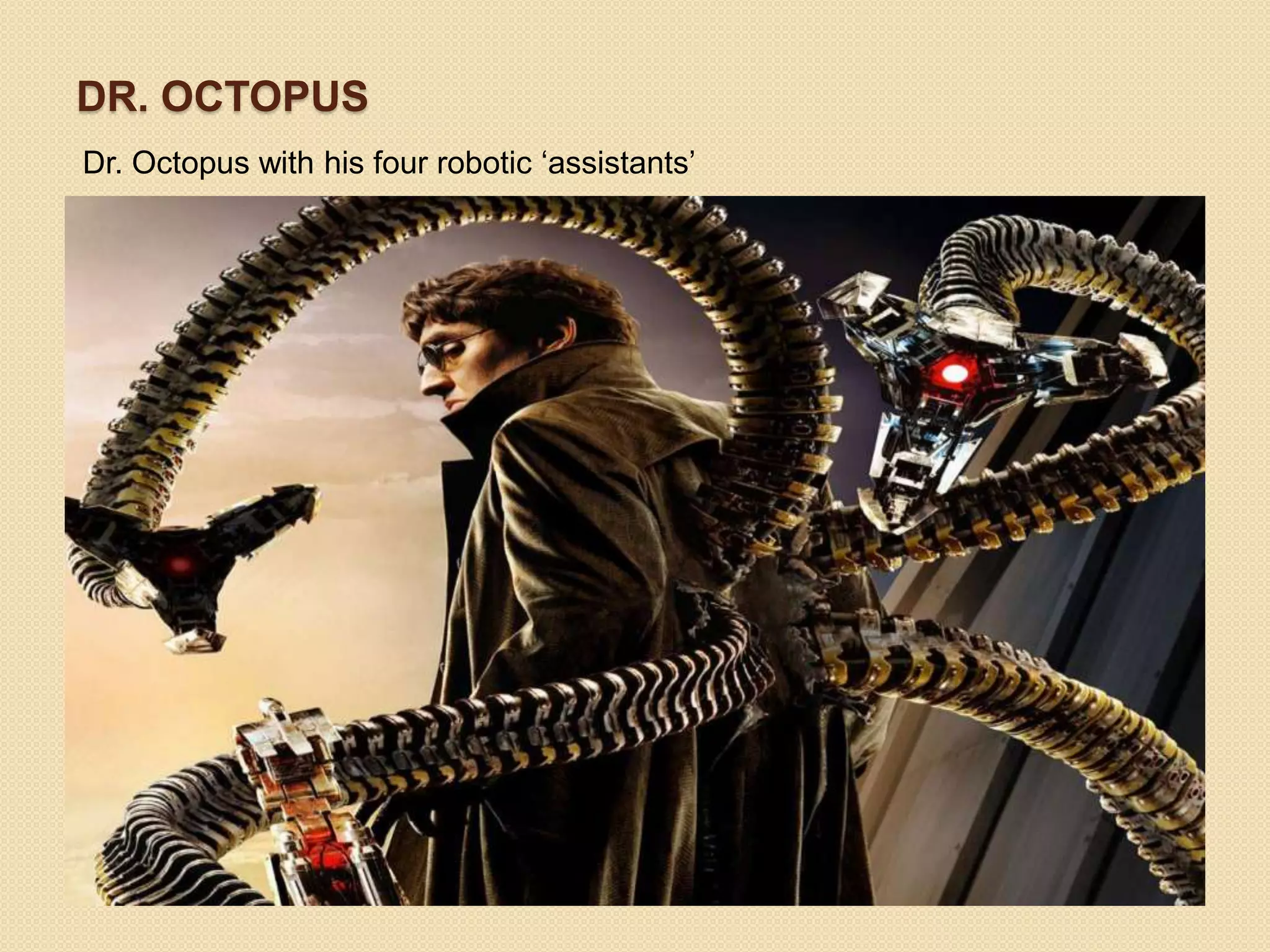
  machines alone. Dr. Octopus from
  Spiderman is a famous example
 Possibility to shed the weak human
  body and be as powerful as machines
DR. OCTOPUS
Dr. Octopus with his four robotic ‘assistants’
CYBORGS
 A man-machine mixture and the
  ultimate form of robot exo-skeleton
  made famous by RoboCop
 A cybernetic organism is a large
  network of communication and control
  made famous by SkyNet
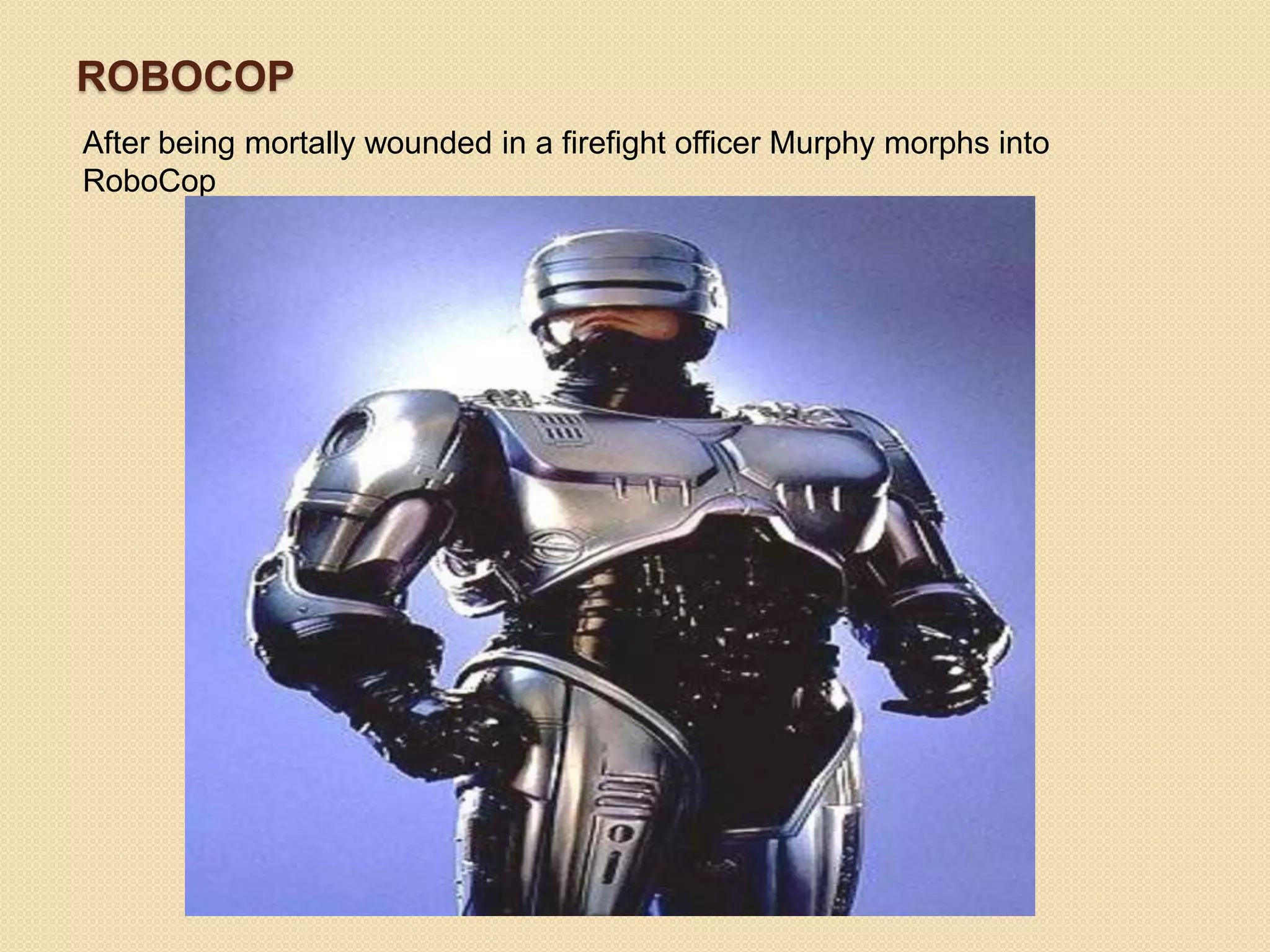
ROBOCOP
After being mortally wounded in a firefight officer Murphy morphs into
RoboCop
THE PITFALLS OF MMI
EMOTIONAL INTELLIGENCE
 Are we prepared to accept a robot that
  feels like a human
 What if the robot demands equality
  with humans and uses his undeniably
  superior powers to achieve them
 Do robots need emotion in the first
  place
 Again can robots be a faithful
  companion if it doesn’t have emotion
ROGUE A.I.
 Popularized by ‘The Terminator’ series
  of movies
 Leaving the running of day to day life
  to robots might make us lose control
  of our lives
 Sentient robots might consider
  themselves our master
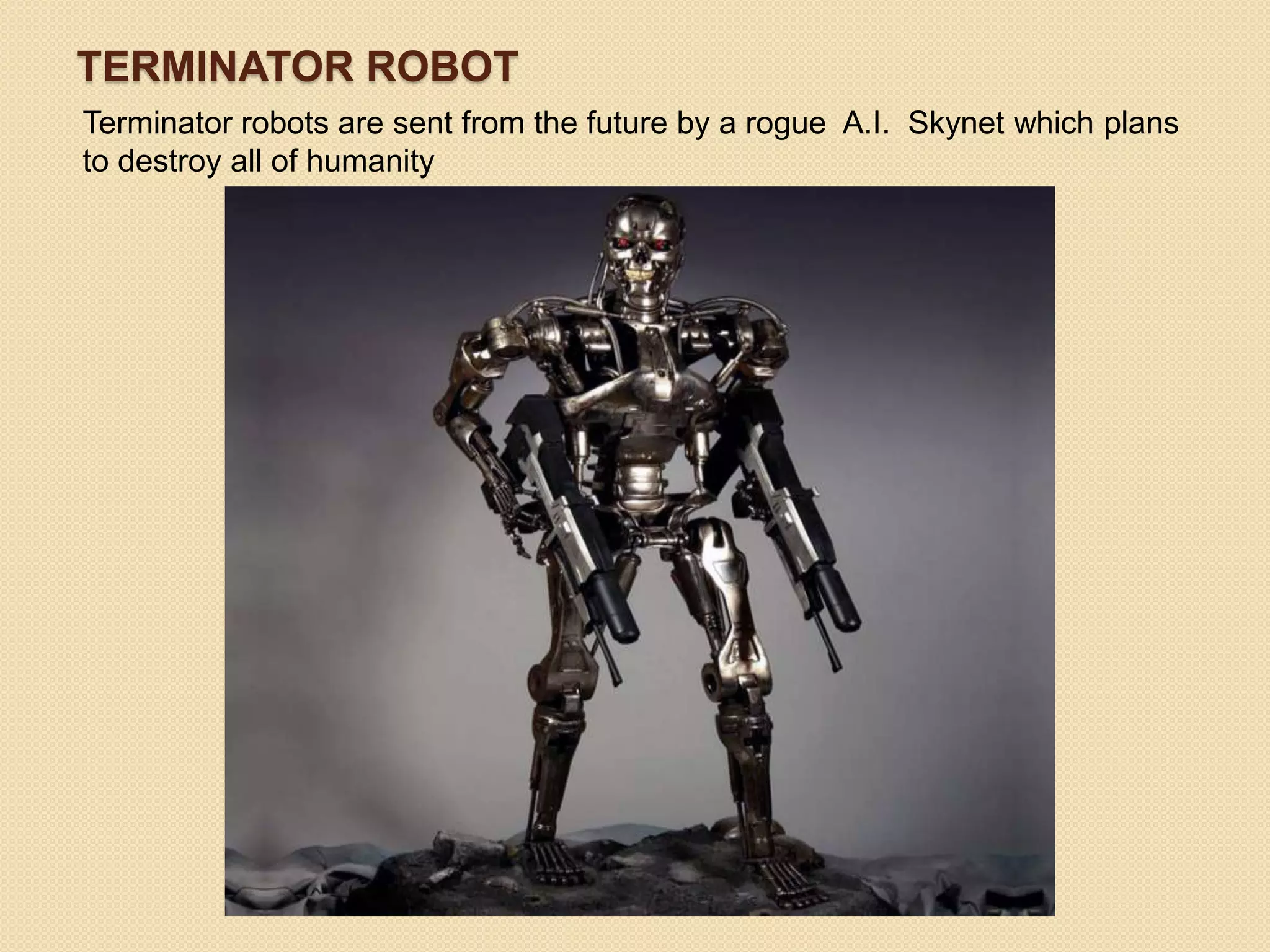
TERMINATOR ROBOT
Terminator robots are sent from the future by a rogue A.I. Skynet which plans
to destroy all of humanity
AUGMENTED HUMANS
 Can humans with augmented limbs be
  allowed to compete in society or
  should they be a special case
 Augmenting allows more ability than
  muscular limbs- Are we prepared to
  allow a person in our midst who can
  hear even our tiniest whispers
STAGNATION
 As robots take over the hard work of
  humans we grow weaker and weaker
 Less productive humans with no
  impetus to explore new frontiers
 Science and technological
  development gradually slows to a halt
 Humans less prepared to adapt
  physically to any eventuality
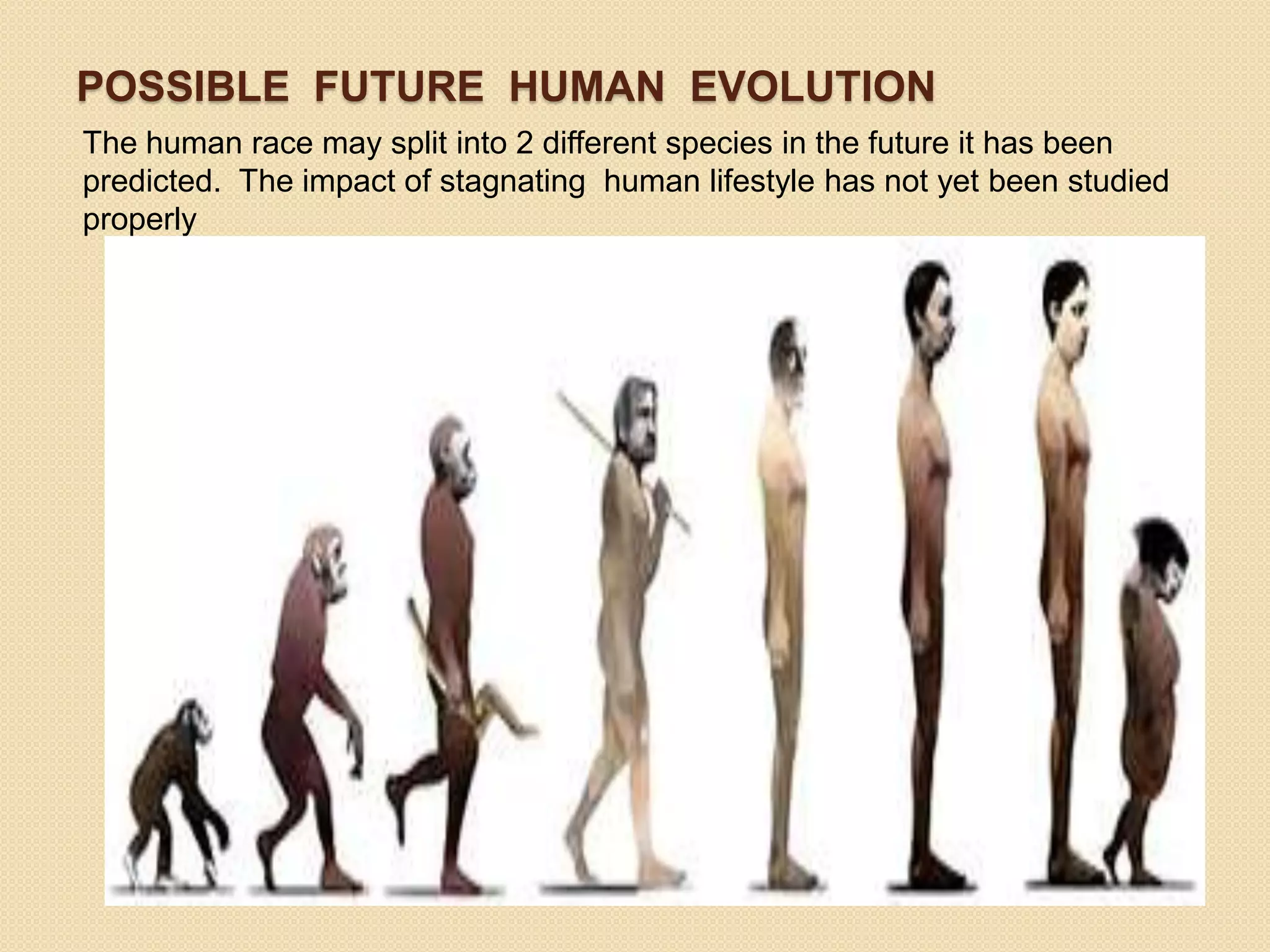
POSSIBLE FUTURE HUMAN EVOLUTION
The human race may split into 2 different species in the future it has been
predicted. The impact of stagnating human lifestyle has not yet been studied
properly
IMMORTALITY
 With the ability to scan the brain via
  MRI we are nearer to immortality than
  any previous generation
 The brain can be scanned and
  uploaded to a computer to allow a
  person to live in a machine even if the
  body withers away
 So what constitutes a human? Only
  his brain or the entire body
CLOSING THOUGHTS
BLESSINGS
 With the benefits MMI brings in to the
  progress of Human society its
  inevitable that Man-Machine
  Interaction will continue to increase
 Replaceable biological organs with
  machines provides a way out of
  matching blood group, unavailability of
  organs etc
CURSES
 The increasing MMI might cause
  catastrophe in Nature
 It might be harmful for future humans
  to be totally reliant on machines for
  even basic needs of life
 Augmented humans might be
  controversial in society
AMBIGIOUS
 We are not yet at the point of
  seamless MMI
 What we have is rudimentary voice or
  nerve control
 What we need is direct brain control
 We don’t know whether it will be good
  or bad
 But MMI is inevitable
REFERENCES
 http://robotics.megagiant.com/history.h
  tml
 http://en.wikipedia.org/wiki/Cybernetic
  s
 http://en.wikipedia.org/wiki/Man-
  machine_interaction

Man machine interaction

  • 1.
    MAN-MACHINE INTERACTION AVIRUP KUNDU(43) DEEPESH DAS(19) KANAD CHAKRABORTY(10) SAUMYADEEP CHATTERJEE(14) ST THOMAS’ COLLEGE OF ENGINEERING & TECHNOLOGY
  • 2.
    OUTLINE  Historical andLiterary perspective  The present scenario  Some case studies  A peek into the future  The pitfalls of increasing MMI  Closing thoughts
  • 3.
  • 4.
     The ancientChinese text Lie Zi describes an ‘Automaton’ around 250 B.C.  The Greek mathematician Hero of Alexandria describes an automaton to pour guest’s wine  Leonardo da Vinci designs his humanoid automaton in 1495 known as Leonardo’s robot
  • 5.
    LEONARDO’S ROBOT The robotis clad in German-Italian medieval armour, that is able to make several human-like motions. These motions included sitting up, moving its arms, neck, and an anatomically correct jaw.
  • 6.
     Isaac Asimovformulates the ‘Three Laws of Robotics’ and hence coins the term ‘Robotics’  The word ‘Cybernetics’ is used by Norbert Wiener when he formulates the Principles of Cybernetics  Fritz Lang's movie "Metropolis" is released in 1926. "Maria" the female robot in the film is the first robot to be projected on the silver screen.
  • 7.
  • 8.
    Although our historyand literature is crowded with references to automatons, our true interaction with machines started with the Industrial revolution. Steam powered engines began to truly ease the burden off the shoulder of humans. The introduction of the first mechanized assembly line by Eli Whitney in 1797 was a revolutionary breakthrough.
  • 9.
    The modern day Man-Machine Interaction may be divided into 2 categories: 1. Control of machines in general using devices like steering wheel, automobile pedal, or button. 2. Human–computer interaction.  The first category is the classical one and least controversial. We use it daily  The second category is the emerging one, which we are beginning to use,
  • 10.
    We focus onthe Human- Computer Interface since it is where ethical considerations come into play with themes like:  Robot-Emotion  Treatment of emotion enhanced robots  Place of augmented humans in society  Moral issues of using machines to interfere with what Nature intended  And by extension immortality
  • 11.
  • 12.
    "Luke" arm developedby Dean Kamen's Deka organization, funded by DARPA
  • 13.
    ISAAC ASIMOV  Exploredthe pitfalls of MMI beautifully in his works.  R. Daneel Olivaw is the pinnacle in humanoid robot development with something akin to emotion.  He befriends a human who reciprocates his feelings and this relationship ultimately alters the course of human history(future) over a few thousand years.
  • 14.
     R. Giskardgains the ability to sense human emotion and alter them leading to the destruction of Earth.  Golan Trevize’s mind controlled automatic spaceship communicates with him through his hands and follows his every thought.
  • 15.
    BIONIC MAN REX It incorporates some of the latest advances in prosthetic technology, as well as an artificial pancreas, kidney, spleen and trachea, and a functional blood circulatory system  Created as a collaboration between Sheffield university, MIT, Oxford, University College London and Swansea
  • 16.
    REX The $1million completebionic man complete with artificial organs, synthetic blood and robot limbs
  • 17.
    PROSTHETICS An ancient EgyptianWooden prosthetic toe
  • 18.
    Oscar Pistorius  Heparticipated in the Summer Olympics with a pair of prosthetic limbs  Generated controversy over whether his ‘Flex-Foot Cheetah Blade’ gave him any advantage over other athletes
  • 19.
    OSCAR PISTORIUS Oscar Pistoriusduring the Summer Olympics 2012
  • 20.
    MEDICAL SCIENCES  Roboticsurgery is poised to allow the best doctors from around the world operate on the most critical patient anywhere in the world  In 1988, the PROBOT, developed at Imperial College London, was used to perform prostatic surgery by Dr. Senthil Nathan at Guy's and St Thomas' Hospital, London
  • 21.
    ROBOTIC SURGICAL SYSTEM Arobotically assisted surgical system used for prostatectomies, cardiac valve repair and gynaecologic surgical procedures
  • 22.
    COMMON MMI  Several implants in the human body like: ◦ Cochlear implant ◦ Pace Maker ◦ Micro Chip implant  Increasing dependence on technology like Apple’s Siri which can be talked to  Google Glass project  Sensors surround us working even without human interference
  • 23.
    PROF. STEPHEN HAWKINS Heis living proof of the benefits of a Man-Computer Interface which allows him to move and speak through speakers mounted on his wheelchair even though he has Motor-Neuron disease
  • 24.
    GOOGLE GLASS Its anaugmented reality Head-Mounted Display that projects real time information into the wearers retina and will communicate by using bone conduction sound technology instead of human speech
  • 25.
    A PEEK INTOTHE FUTURE
  • 26.
    SELF DRIVEN CARS Self-driven cars are just round the corner working with each other without human interference to navigate the fastest and safest route  Potential for a ‘Zero’ accident scenario  Very desirable technology with both civilian and battlefield implications
  • 27.
    GOOGLE’S SELF DRIVENCAR This is an experimental car from Google which is able to navigate its way through city traffic autonomously
  • 28.
    A.I. SURGERY  InMay 2006 the first AI doctor- conducted unassisted robotic surgery on a 34 year old male to correct heart arythmia  The surgery was rated as better than an above-average surgeon  In the future Surgeries will be done flawlessly by means on robotic A.I.
  • 29.
    ROBOT EXO SKELETONS An almost tireless body  Able to do the work of many men and machines alone. Dr. Octopus from Spiderman is a famous example  Possibility to shed the weak human body and be as powerful as machines
  • 30.
    DR. OCTOPUS Dr. Octopuswith his four robotic ‘assistants’
  • 31.
    CYBORGS  A man-machinemixture and the ultimate form of robot exo-skeleton made famous by RoboCop  A cybernetic organism is a large network of communication and control made famous by SkyNet
  • 32.
    ROBOCOP After being mortallywounded in a firefight officer Murphy morphs into RoboCop
  • 33.
  • 34.
    EMOTIONAL INTELLIGENCE  Arewe prepared to accept a robot that feels like a human  What if the robot demands equality with humans and uses his undeniably superior powers to achieve them  Do robots need emotion in the first place  Again can robots be a faithful companion if it doesn’t have emotion
  • 35.
    ROGUE A.I.  Popularizedby ‘The Terminator’ series of movies  Leaving the running of day to day life to robots might make us lose control of our lives  Sentient robots might consider themselves our master
  • 36.
    TERMINATOR ROBOT Terminator robotsare sent from the future by a rogue A.I. Skynet which plans to destroy all of humanity
  • 37.
    AUGMENTED HUMANS  Canhumans with augmented limbs be allowed to compete in society or should they be a special case  Augmenting allows more ability than muscular limbs- Are we prepared to allow a person in our midst who can hear even our tiniest whispers
  • 38.
    STAGNATION  As robotstake over the hard work of humans we grow weaker and weaker  Less productive humans with no impetus to explore new frontiers  Science and technological development gradually slows to a halt  Humans less prepared to adapt physically to any eventuality
  • 39.
    POSSIBLE FUTURE HUMANEVOLUTION The human race may split into 2 different species in the future it has been predicted. The impact of stagnating human lifestyle has not yet been studied properly
  • 40.
    IMMORTALITY  With theability to scan the brain via MRI we are nearer to immortality than any previous generation  The brain can be scanned and uploaded to a computer to allow a person to live in a machine even if the body withers away  So what constitutes a human? Only his brain or the entire body
  • 41.
  • 42.
    BLESSINGS  With thebenefits MMI brings in to the progress of Human society its inevitable that Man-Machine Interaction will continue to increase  Replaceable biological organs with machines provides a way out of matching blood group, unavailability of organs etc
  • 43.
    CURSES  The increasingMMI might cause catastrophe in Nature  It might be harmful for future humans to be totally reliant on machines for even basic needs of life  Augmented humans might be controversial in society
  • 44.
    AMBIGIOUS  We arenot yet at the point of seamless MMI  What we have is rudimentary voice or nerve control  What we need is direct brain control  We don’t know whether it will be good or bad  But MMI is inevitable
  • 45.
    REFERENCES  http://robotics.megagiant.com/history.h tml  http://en.wikipedia.org/wiki/Cybernetic s  http://en.wikipedia.org/wiki/Man- machine_interaction

Editor's Notes

  • #7 Cybernetics first used by Plato in the context of “the study of self-governance”.