Overview
 Biomedical Engineering and
Computational Intelligence
 Modeling Prosthesis
 Creating a Link
 Inverse Kinematics
 Conclusion
 Q & A???
Biomedical Engineering and
Computational Intelligence
 Helping people with disabilities to perform simple day to day
task.
 Decoding Arm Movements by Myoelectric Signals and
Artificial Neural Networks
 Computational Intelligence (CI) is the computing of
algorithms and learning how to use machines.
 Research in both CI and Biomedical Engineering help
provide new prosthesis that make everyday physical tasks
possible.
Modeling Prosthesis
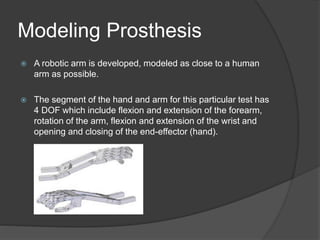
 A robotic arm is developed, modeled as close to a human
arm as possible.
 The segment of the hand and arm for this particular test has
4 DOF which include flexion and extension of the forearm,
rotation of the arm, flexion and extension of the wrist and
opening and closing of the end-effector (hand).
Creating a Link
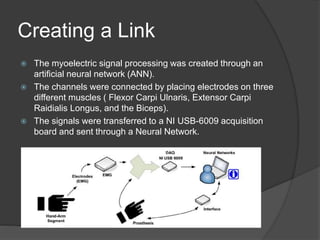
 The myoelectric signal processing was created through an
artificial neural network (ANN).
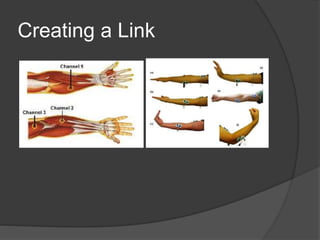
 The channels were connected by placing electrodes on three
different muscles ( Flexor Carpi Ulnaris, Extensor Carpi
Raidialis Longus, and the Biceps).
 The signals were transferred to a NI USB-6009 acquisition
board and sent through a Neural Network.
Creating a Link
Inverse Kinematics
 X = L1 cos(theta1) + L2 cos(theta1+theta2)
 Y = L1 sin(theta1) + L2 sin(theta1+theta2)
 Theta2 = arccos[(X^2 + Y^2 – L1^2 – L2^2)/ 2* L1^2 *L2^2]
 Theta1 = arctan(Y/X) – arctan[(L2 sin(Theta2))/ L1 * L2cos(Theta2)]
Conclusion
 The proposed system used some
myoelectric signal channels combined
with digital processing to stimulate the
neuro-prosthetic arm.
 The accuracy was below average when
compared to an actual human arm.
Questions
 ????????

NEUROPROSTHETICS

  • 2.
    Overview  Biomedical Engineeringand Computational Intelligence  Modeling Prosthesis  Creating a Link  Inverse Kinematics  Conclusion  Q & A???
  • 3.
    Biomedical Engineering and ComputationalIntelligence  Helping people with disabilities to perform simple day to day task.  Decoding Arm Movements by Myoelectric Signals and Artificial Neural Networks  Computational Intelligence (CI) is the computing of algorithms and learning how to use machines.  Research in both CI and Biomedical Engineering help provide new prosthesis that make everyday physical tasks possible.
  • 4.
    Modeling Prosthesis  Arobotic arm is developed, modeled as close to a human arm as possible.  The segment of the hand and arm for this particular test has 4 DOF which include flexion and extension of the forearm, rotation of the arm, flexion and extension of the wrist and opening and closing of the end-effector (hand).
  • 5.
    Creating a Link The myoelectric signal processing was created through an artificial neural network (ANN).  The channels were connected by placing electrodes on three different muscles ( Flexor Carpi Ulnaris, Extensor Carpi Raidialis Longus, and the Biceps).  The signals were transferred to a NI USB-6009 acquisition board and sent through a Neural Network.
  • 6.
  • 7.
    Inverse Kinematics  X= L1 cos(theta1) + L2 cos(theta1+theta2)  Y = L1 sin(theta1) + L2 sin(theta1+theta2)  Theta2 = arccos[(X^2 + Y^2 – L1^2 – L2^2)/ 2* L1^2 *L2^2]  Theta1 = arctan(Y/X) – arctan[(L2 sin(Theta2))/ L1 * L2cos(Theta2)]
  • 8.
    Conclusion  The proposedsystem used some myoelectric signal channels combined with digital processing to stimulate the neuro-prosthetic arm.  The accuracy was below average when compared to an actual human arm.
  • 9.