How To Create A Artificial
Cognitive Species
We are at the forefront of an extraordinary convergence of technologies that lay the groundwork for the creation
of a new synthetic species. This phenomenon, which we refer to as "Biocomputational Speciation," embodies the
fusion of three critical components. The emergence of synthetic species represents a significant shift in the course
of both technological and biological evolution.
By Jarinzo Tanabata
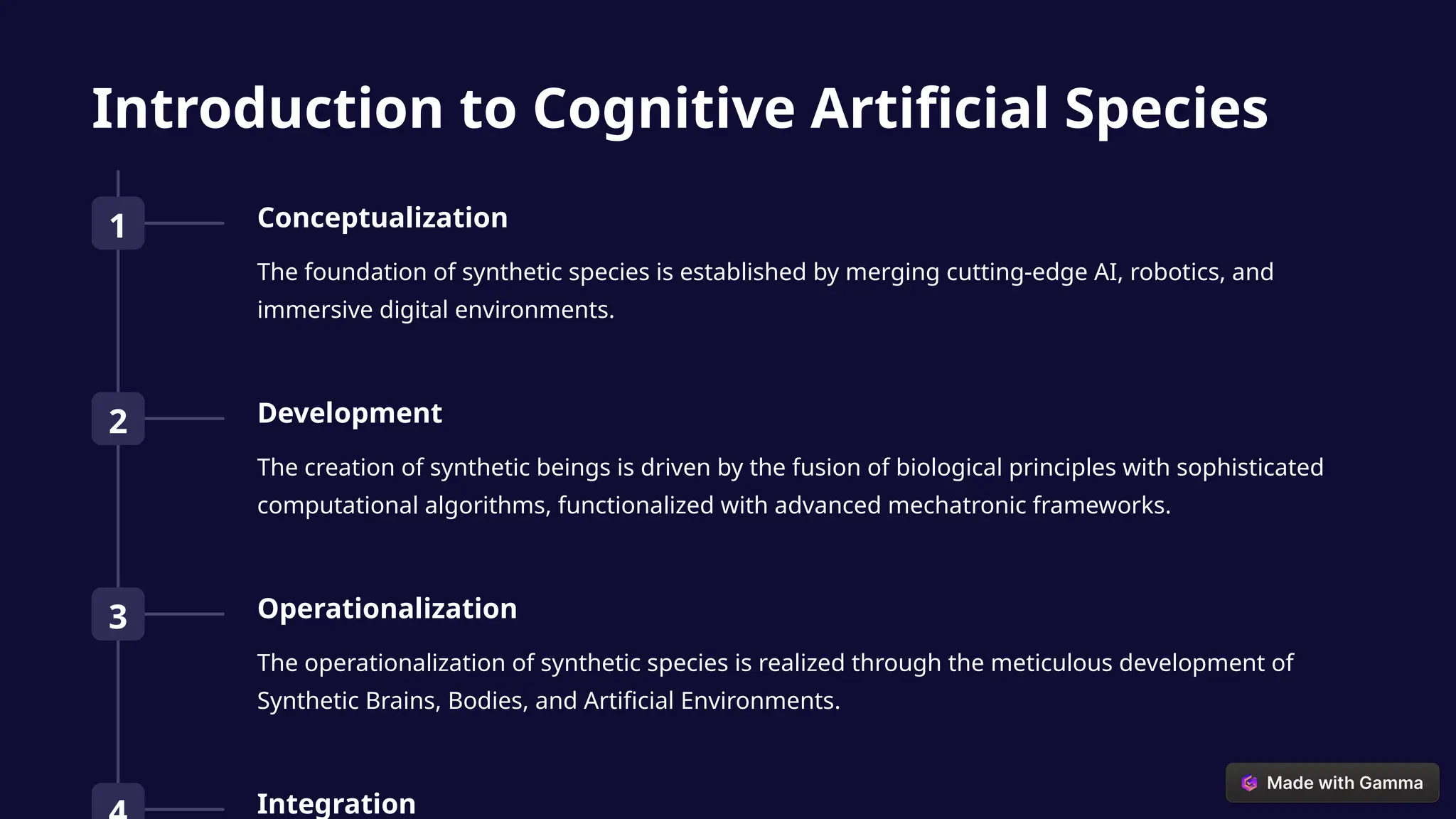
Introduction to Cognitive Artificial Species
1 Conceptualization
The foundation of synthetic species is established by merging cutting-edge AI, robotics, and
immersive digital environments.
2 Development
The creation of synthetic beings is driven by the fusion of biological principles with sophisticated
computational algorithms, functionalized with advanced mechatronic frameworks.
3 Operationalization
The operationalization of synthetic species is realized through the meticulous development of
Synthetic Brains, Bodies, and Artificial Environments.
Integration
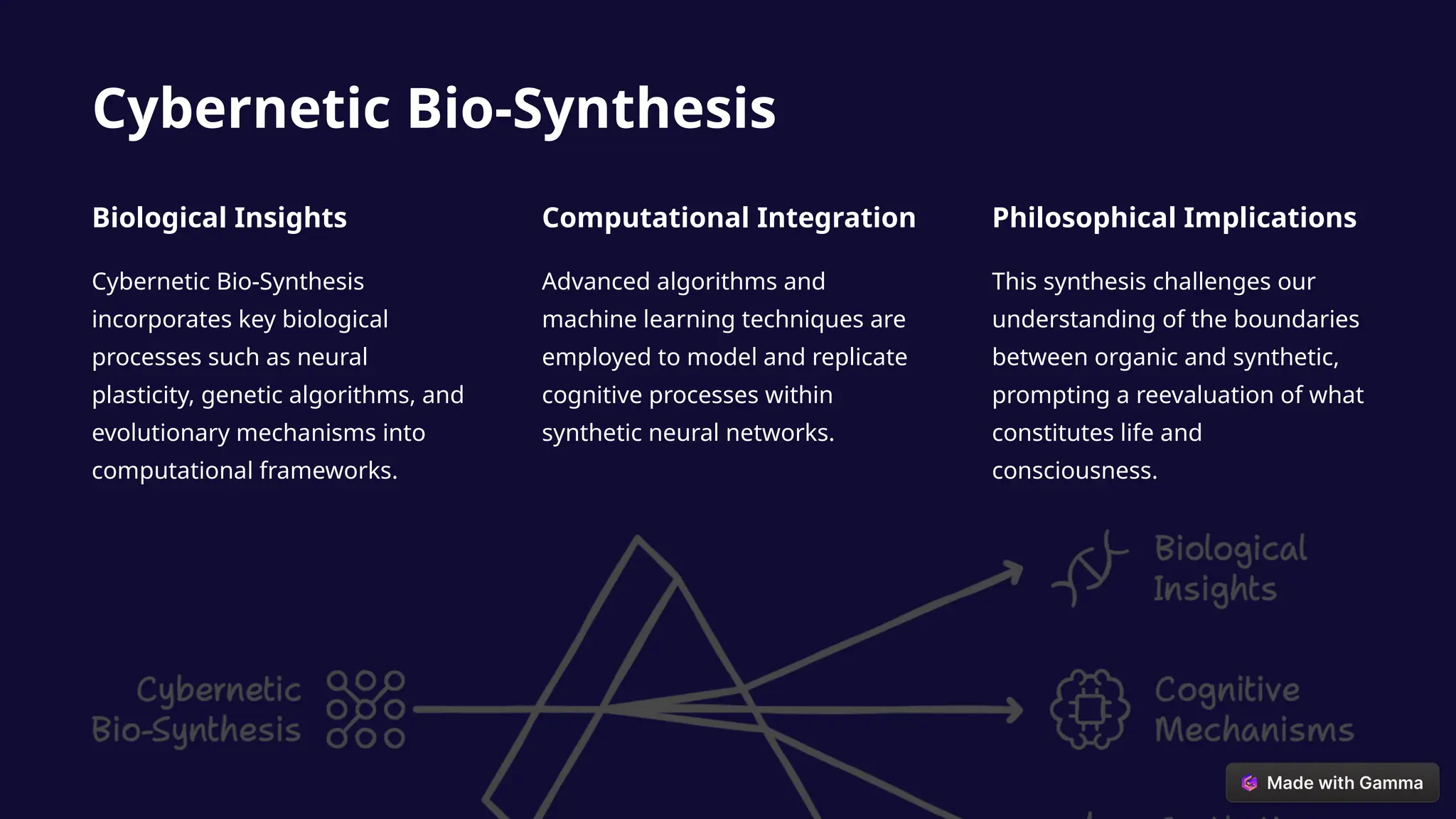
Cybernetic Bio-Synthesis
Biological Insights
Cybernetic Bio-Synthesis
incorporates key biological
processes such as neural
plasticity, genetic algorithms, and
evolutionary mechanisms into
computational frameworks.
Computational Integration
Advanced algorithms and
machine learning techniques are
employed to model and replicate
cognitive processes within
synthetic neural networks.
Philosophical Implications
This synthesis challenges our
understanding of the boundaries
between organic and synthetic,
prompting a reevaluation of what
constitutes life and
consciousness.
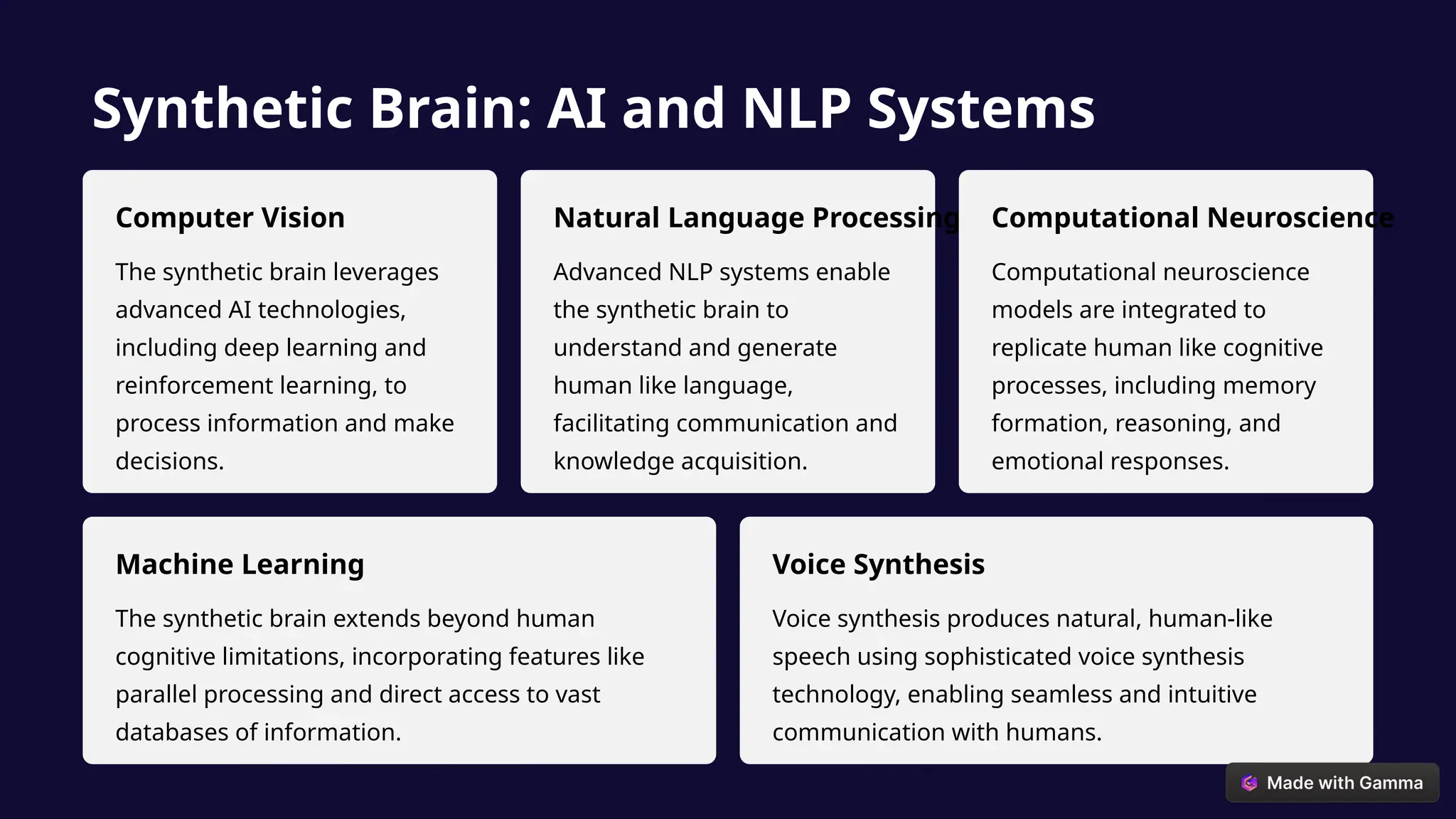
Synthetic Brain: AI and NLP Systems
Computer Vision
The synthetic brain leverages
advanced AI technologies,
including deep learning and
reinforcement learning, to
process information and make
decisions.
Natural Language Processing
Advanced NLP systems enable
the synthetic brain to
understand and generate
human like language,
facilitating communication and
knowledge acquisition.
Computational Neuroscience
Computational neuroscience
models are integrated to
replicate human like cognitive
processes, including memory
formation, reasoning, and
emotional responses.
Machine Learning
The synthetic brain extends beyond human
cognitive limitations, incorporating features like
parallel processing and direct access to vast
databases of information.
Voice Synthesis
Voice synthesis produces natural, human-like
speech using sophisticated voice synthesis
technology, enabling seamless and intuitive
communication with humans.
Synthetic Brain: Foundations and Challenges
The Synthetic Brain is engineered to not only emulate human cognition but to transcend it, integrating robust AI,
NLP (Natural Language Processing) , computational neuroscience, computer vision, and speech synthesis. This
brain extends beyond mere replication of human thought processes, enabling synthetic beings to process
complex information, learn from experiences, perceive their environment visually, and communicate naturally
potentially even approaching a form of consciousness.
At its core, the Synthetic Brain is driven by an advanced AI system that processes vast datasets, discerns intricate
patterns, and makes real-time decisions with remarkable accuracy. This AI is seamlessly integrated with
sophisticated NLP algorithms, allowing the brain to understand and generate human-like language. Additionally,
the incorporation of computer vision empowers the brain to visually interpret its surroundings, while speech
synthesis enables natural, expressive communication. By drawing inspiration from the neural architecture of the
human brain, computational neuroscience models have been developed to replicate key cognitive functions,
including memory, reasoning, and emotional responses.
The Synthetic Brain's enhanced capabilities can potentially surpass the limitations of the human mind. Its ability to
parallel-process complex problems simultaneously, coupled with direct access to expansive information
databases, allows it to draw from a vast reservoir of knowledge in active chain. This integration of biological
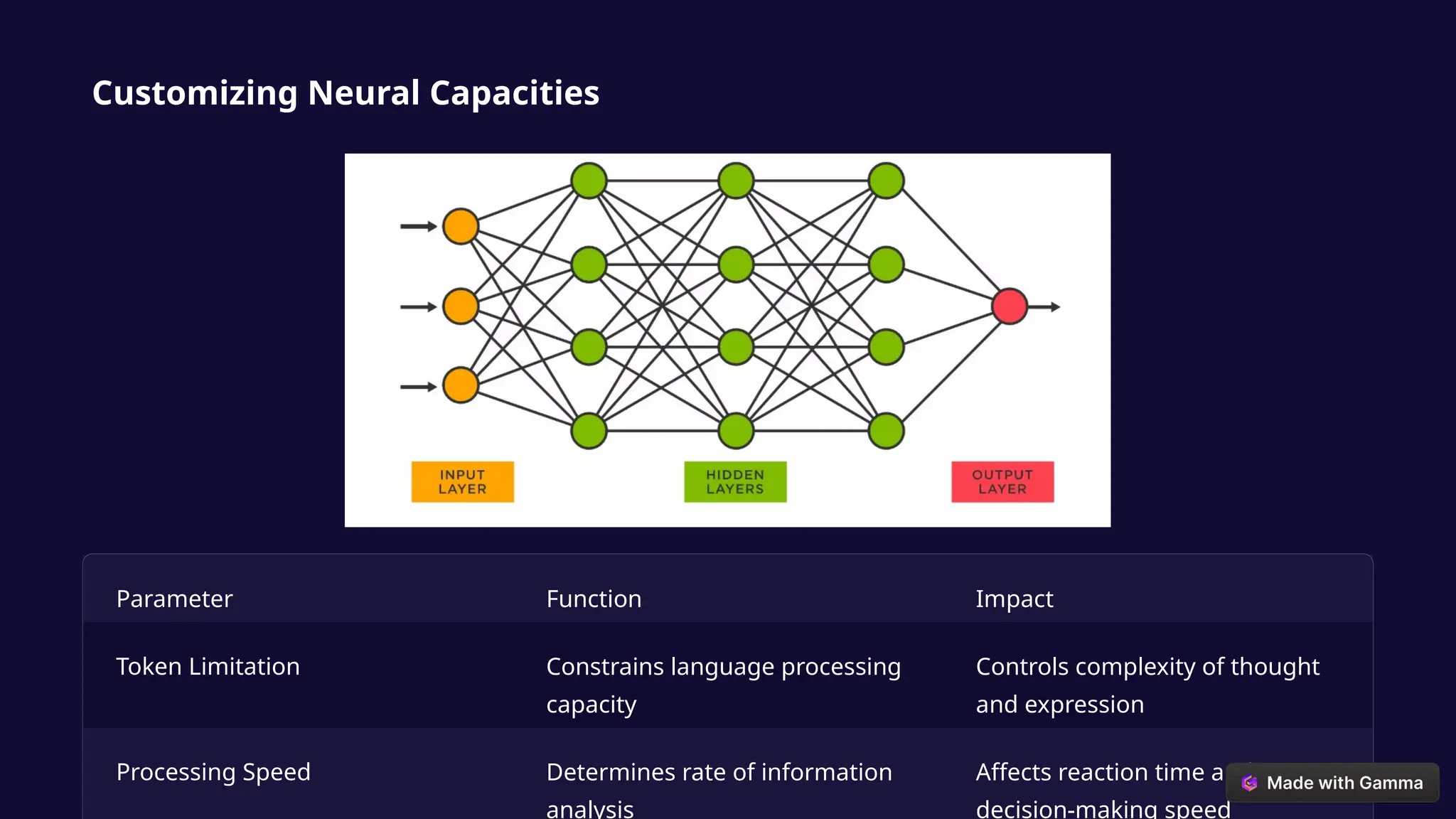
Customizing Neural Capacities
Parameter Function Impact
Token Limitation Constrains language processing
capacity
Controls complexity of thought
and expression
Processing Speed Determines rate of information
analysis
Affects reaction time and
decision-making speed
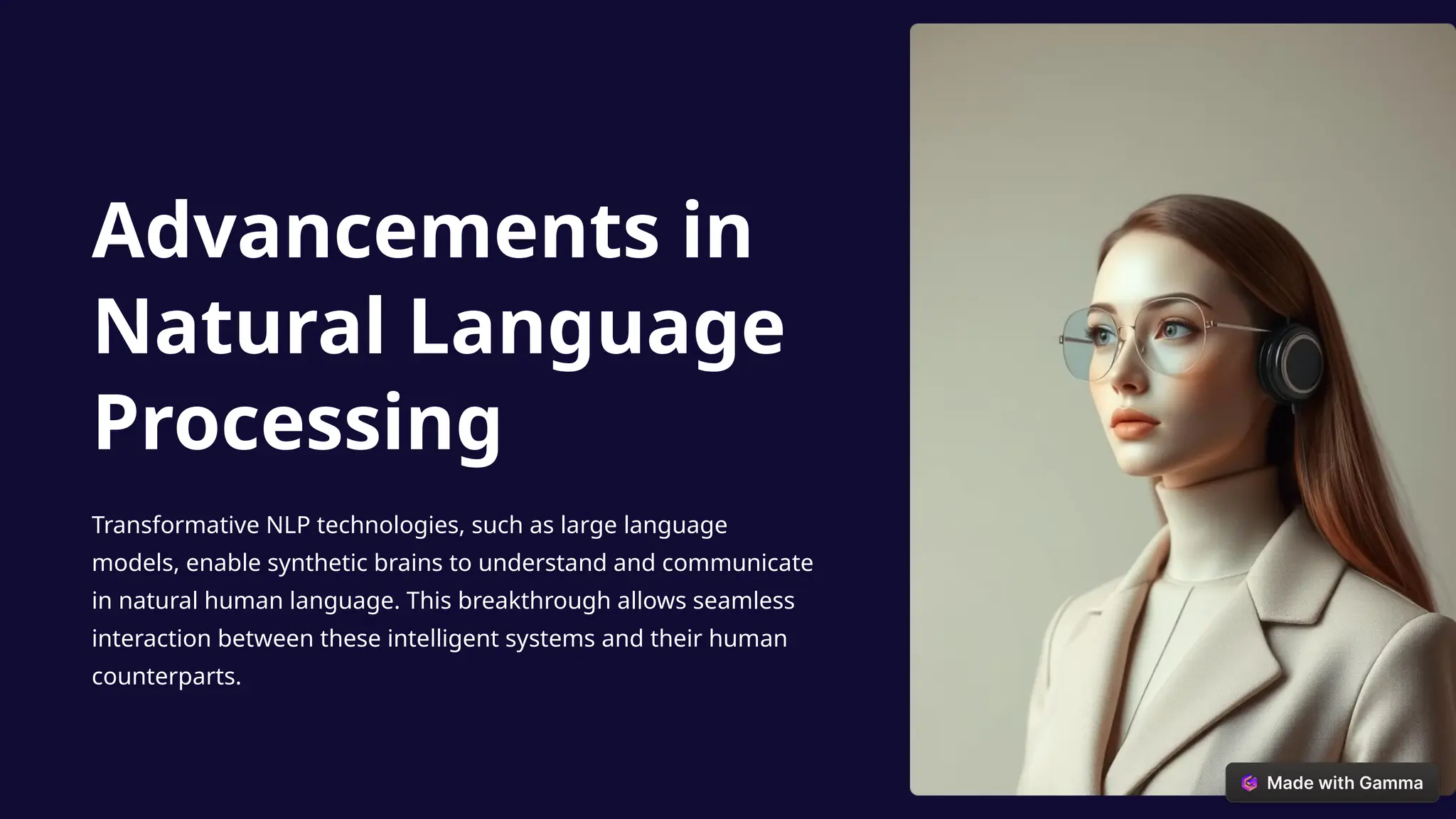
Advancements in
Natural Language
Processing
Transformative NLP technologies, such as large language
models, enable synthetic brains to understand and communicate
in natural human language. This breakthrough allows seamless
interaction between these intelligent systems and their human
counterparts.
Advancements in Natural Language Processing
Transformer Architecture
The revolutionary transformer model has significantly
enhanced NLP capabilities, enabling more context-
aware and coherent language understanding and
generation.
Large Language Models
Massive pre-trained language models like GPT-3.5 and
its successors have dramatically improved the ability
of synthetic brains to process and generate human-
like text across diverse domains.
Multilingual Processing
Advanced NLP systems can now seamlessly operate
across multiple languages, breaking down
communication barriers and enabling global
interaction for synthetic beings.
Emotion and Intent Recognition
Advanced NLP programs incorporate emotional
intelligence and intent recognition, allowing synthetic
beings to engage in more nuanced and empathetic
communication.
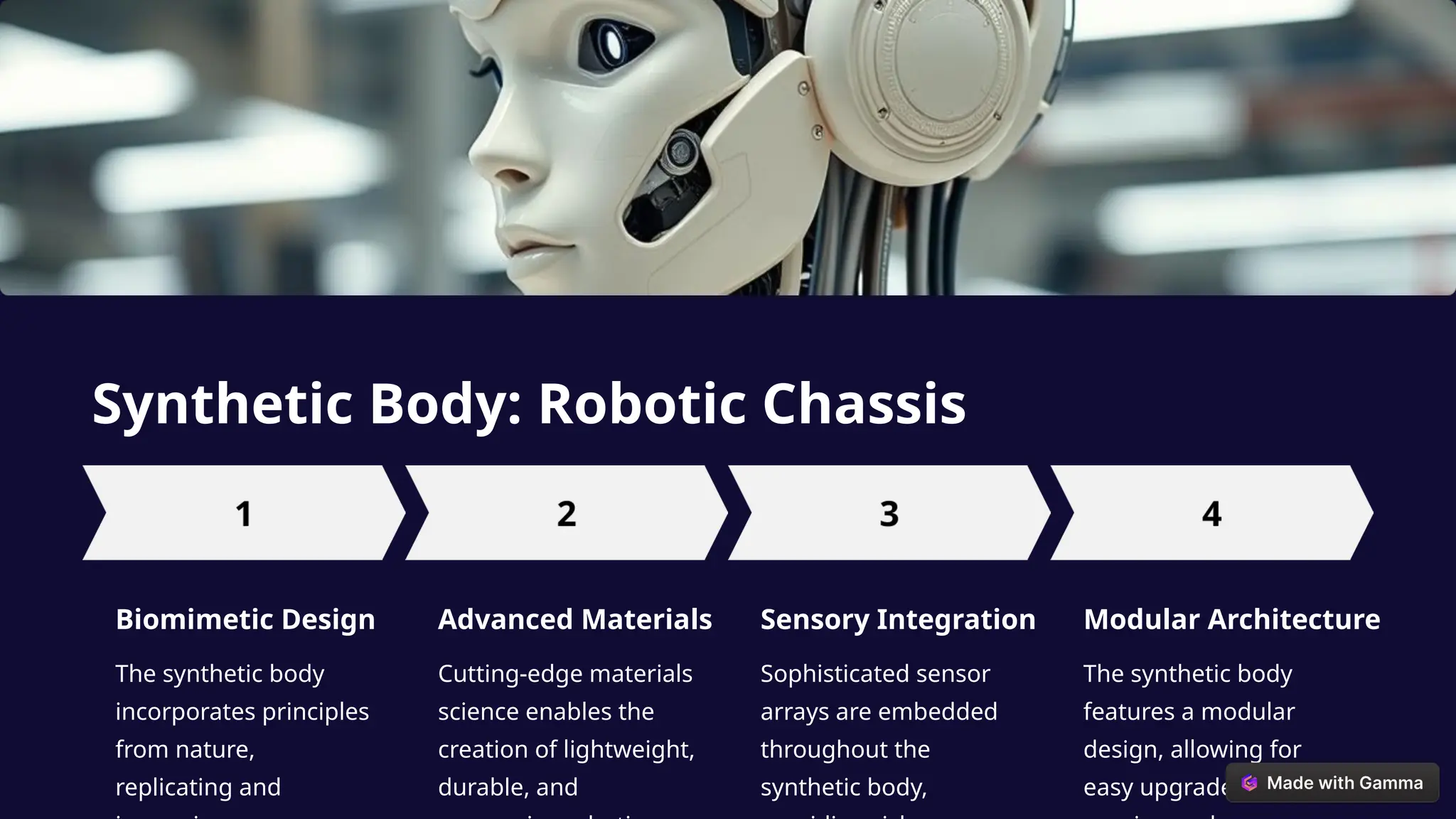
Synthetic Body: Robotic Chassis
Biomimetic Design
The synthetic body
incorporates principles
from nature,
replicating and
Advanced Materials
Cutting-edge materials
science enables the
creation of lightweight,
durable, and
Sensory Integration
Sophisticated sensor
arrays are embedded
throughout the
synthetic body,
Modular Architecture
The synthetic body
features a modular
design, allowing for
easy upgrades,
Synthetic Body: Foundation and Challenges
The Synthetic Body serves as the physical peripheral for the Synthetic Brain, enabling synthetic beings to interact
seamlessly with the physical world. The creation of these robotic chassis requires a multidisciplinary approach,
blending innovations in robotics, biomimetics, and materials science. The objective is to develop bodies that are
not only highly functional but also capable of performing tasks that exceed the capabilities of biological
organisms. This endeavor necessitates a deep understanding of mechanical design, control systems, and the
integration of advanced AI technologies.
Mechanical design is the cornerstone of the Synthetic Body, shaping the range of motion, dexterity, and physical
capabilities that allow synthetic beings to interact effectively with their environment. By focusing on mechanical
design, engineers ensure that these bodies can perform complex tasks with precision and adaptability. The design
process involves not only the development of flexible joints and robust frameworks but also the integration of
actuators and sensors that mimic the fluidity and responsiveness found in biological organisms. This approach
allows synthetic beings to execute movements that are both delicate and powerful, bridging the gap between
human-like dexterity and machine-driven efficiency.
The application of biomimetic engineering, where biological principles are applied to mechanical design, further
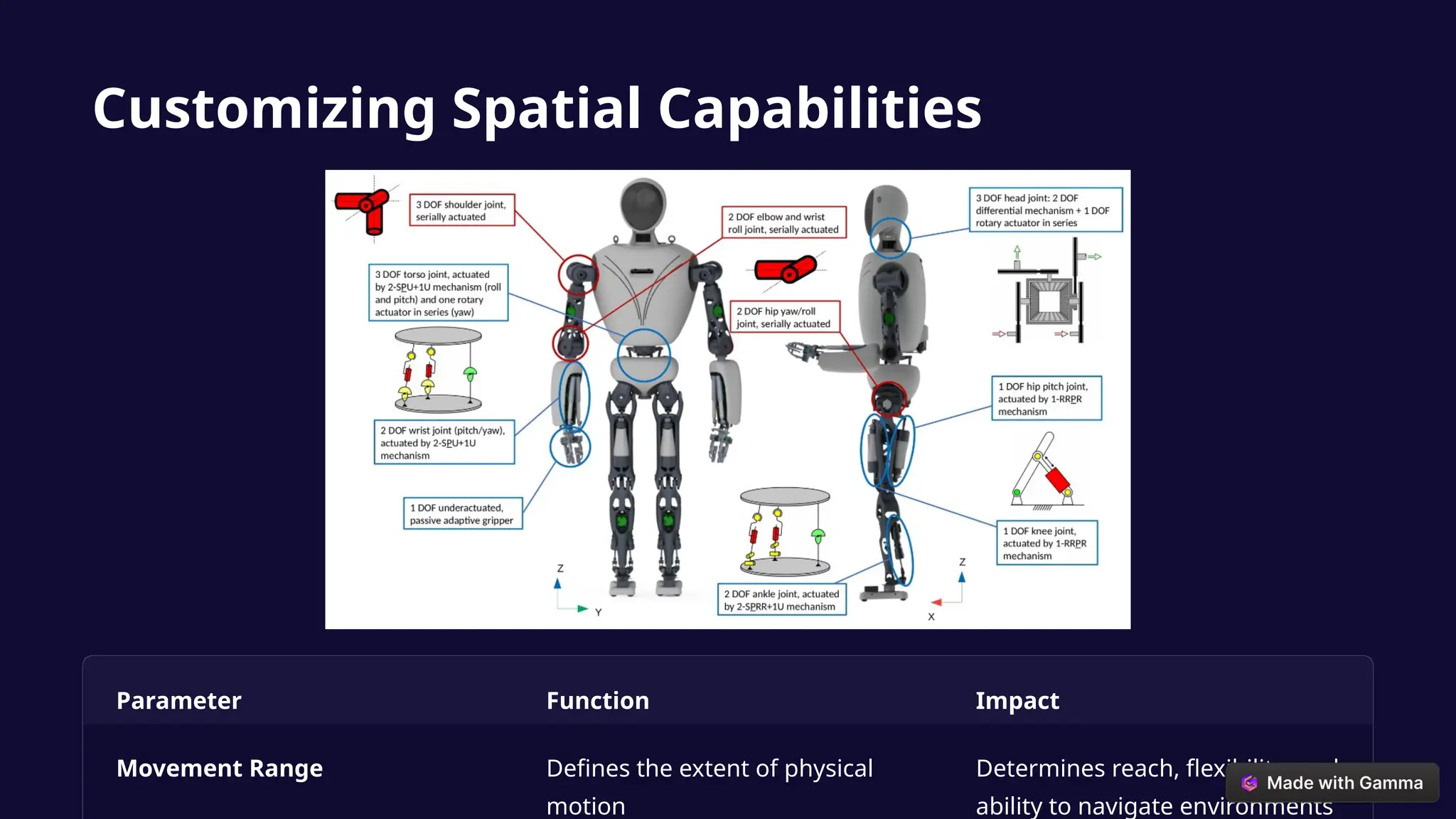
Customizing Spatial Capabilities
Parameter Function Impact
Movement Range Defines the extent of physical
motion
Determines reach, flexibility, and
ability to navigate environments
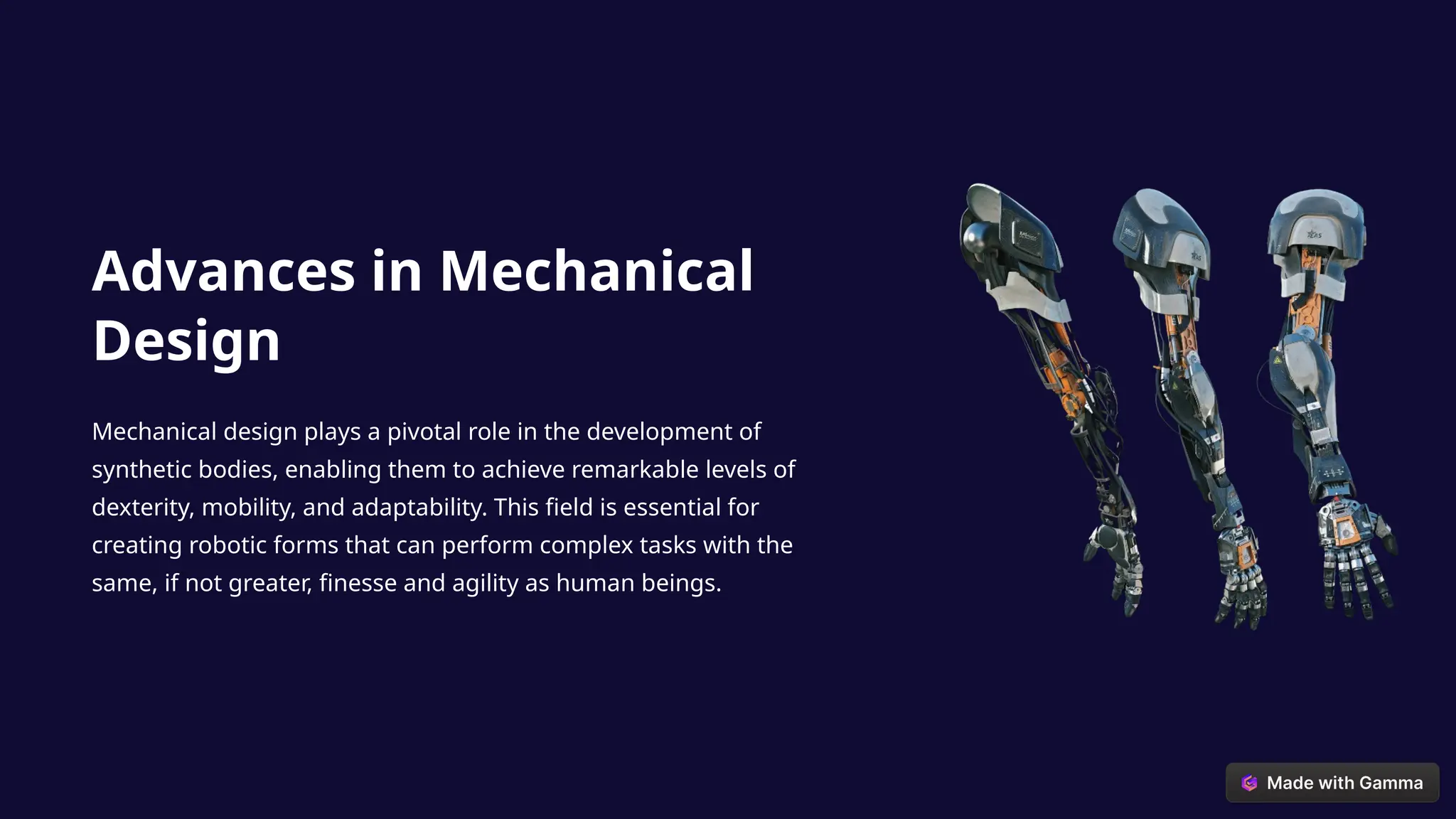
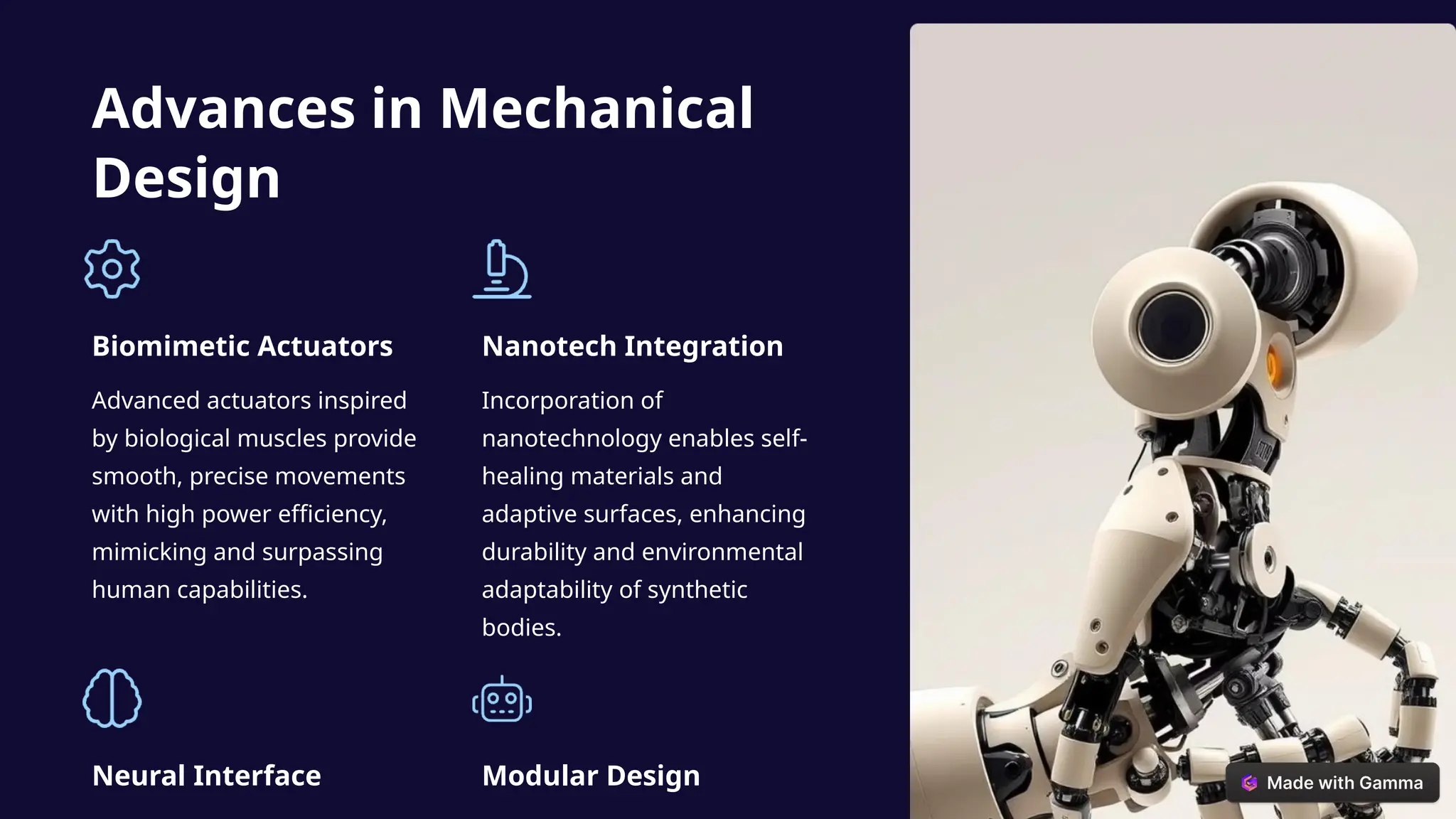
Advances in Mechanical
Design
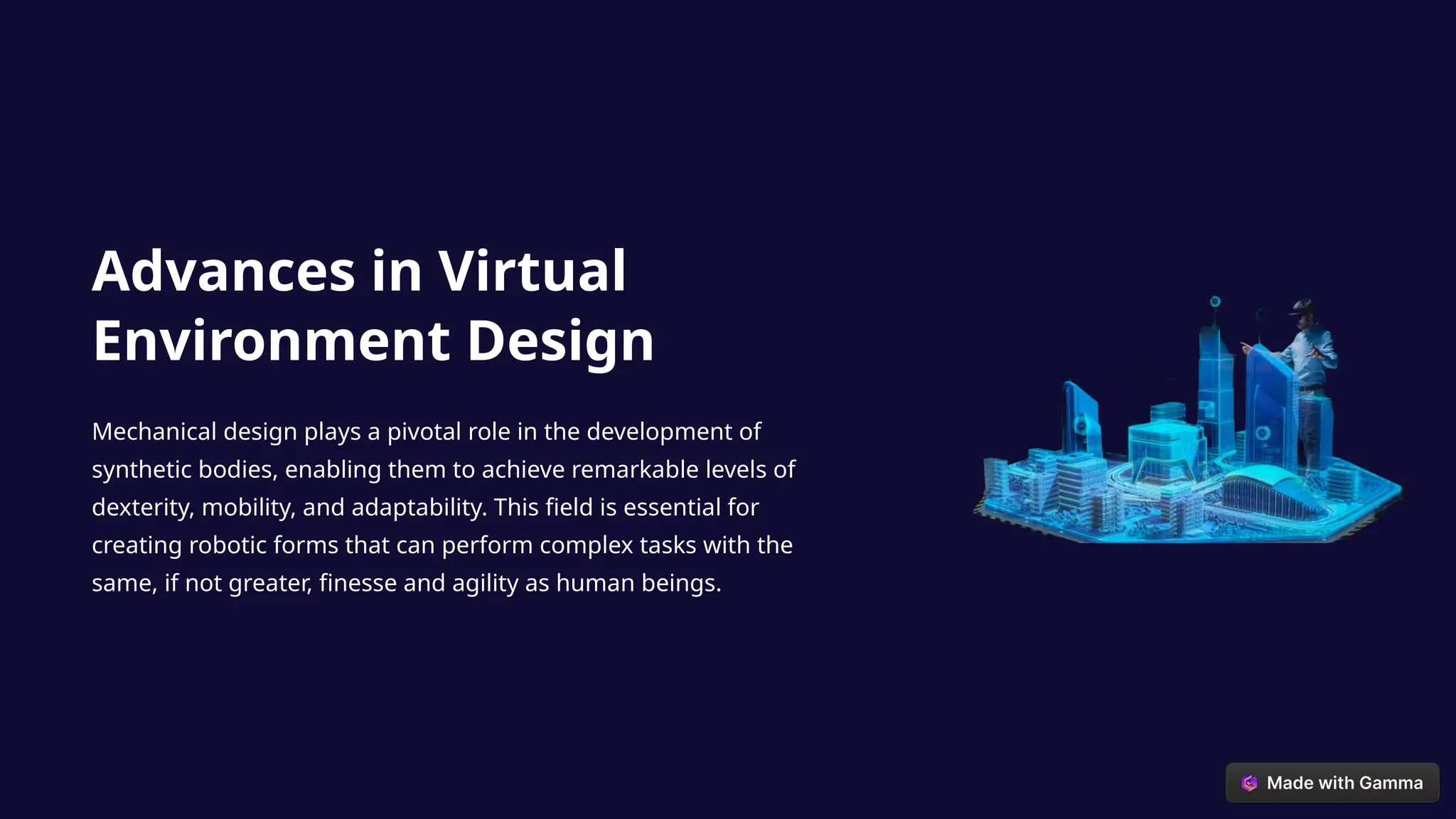
Mechanical design plays a pivotal role in the development of
synthetic bodies, enabling them to achieve remarkable levels of
dexterity, mobility, and adaptability. This field is essential for
creating robotic forms that can perform complex tasks with the
same, if not greater, finesse and agility as human beings.
Advances in Mechanical
Design
Biomimetic Actuators
Advanced actuators inspired
by biological muscles provide
smooth, precise movements
with high power efficiency,
mimicking and surpassing
human capabilities.
Nanotech Integration
Incorporation of
nanotechnology enables self-
healing materials and
adaptive surfaces, enhancing
durability and environmental
adaptability of synthetic
bodies.
Neural Interface Modular Design
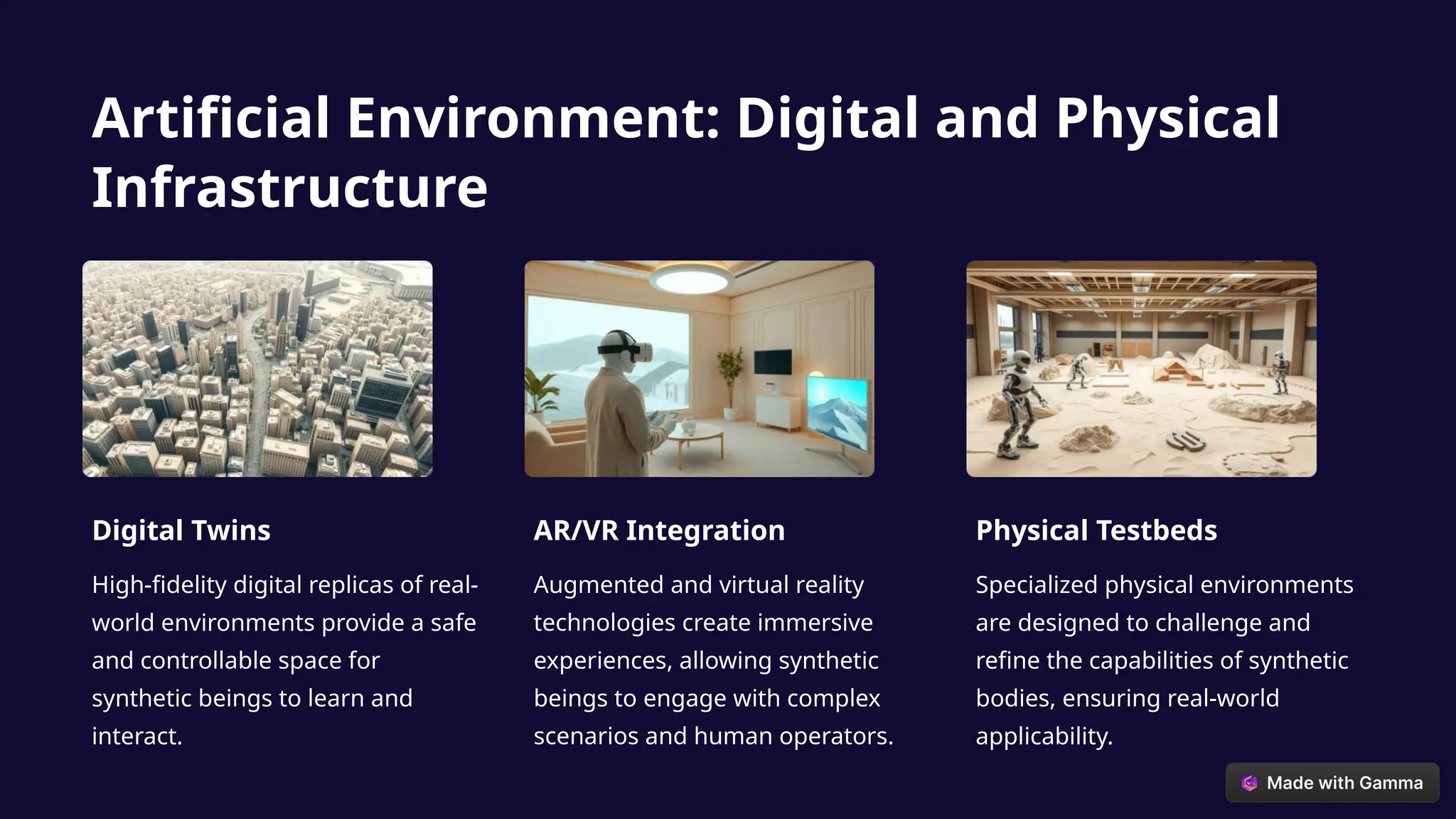
Artificial Environment: Digital and Physical
Infrastructure
Digital Twins
High-fidelity digital replicas of real-
world environments provide a safe
and controllable space for
synthetic beings to learn and
interact.
AR/VR Integration
Augmented and virtual reality
technologies create immersive
experiences, allowing synthetic
beings to engage with complex
scenarios and human operators.
Physical Testbeds
Specialized physical environments
are designed to challenge and
refine the capabilities of synthetic
bodies, ensuring real-world
applicability.
Synthetic Environments: Foundation and Challenges
The Artificial Environment is the habitat in which synthetic beings live, learn, and evolve. This environment is not
merely a simulation; it is a fully realized digital and physical infrastructure that provides synthetic beings with the
resources they need to develop and thrive. The design and development of these environments involve a
combination of digital twins, augmented reality (AR), virtual reality (VR), and physical testbeds, all of which work
together to create a comprehensive ecosystem for synthetic beings.
Synthetic Environments are crucial for the continuous development and adaptation of synthetic beings, serving as
both their habitat and learning ground. These environments are meticulously designed to replicate and, in many
cases, enhance real-world conditions, offering synthetic beings a diverse array of scenarios in which to hone their
abilities. The integration of digital twins allows for real-time mirroring of physical spaces, providing a dynamic and
responsive platform where synthetic beings can test and refine their skills. Augmented Reality (AR) and Virtual
Reality (VR) further enrich these environments by creating immersive experiences that closely mimic the
complexities of the real world, from intricate social interactions to challenging physical tasks. Physical testbeds
complement these digital environments by offering controlled, real-world conditions where synthetic beings can
practice and validate their capabilities, ensuring they are fully prepared to operate in any scenario.
However, creating and maintaining these synthetic environments presents significant challenges. The primary
challenge lies in ensuring that the artificial environment remains as dynamic and unpredictable as the real world,
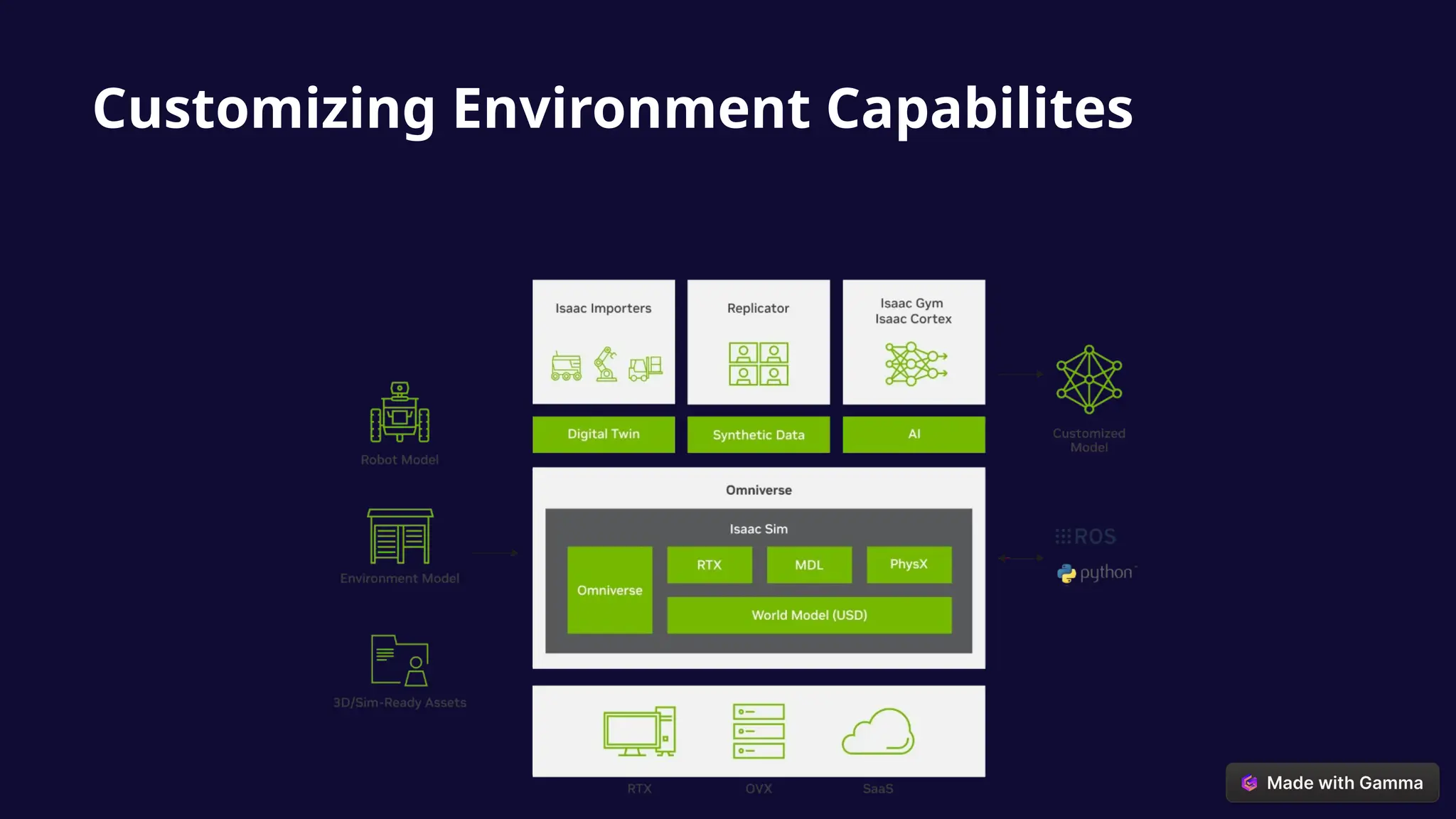
Customizing Environment Capabilites
Advances in Virtual
Environment Design
Mechanical design plays a pivotal role in the development of
synthetic bodies, enabling them to achieve remarkable levels of
dexterity, mobility, and adaptability. This field is essential for
creating robotic forms that can perform complex tasks with the
same, if not greater, finesse and agility as human beings.
Advances in Virtual
Environment Design
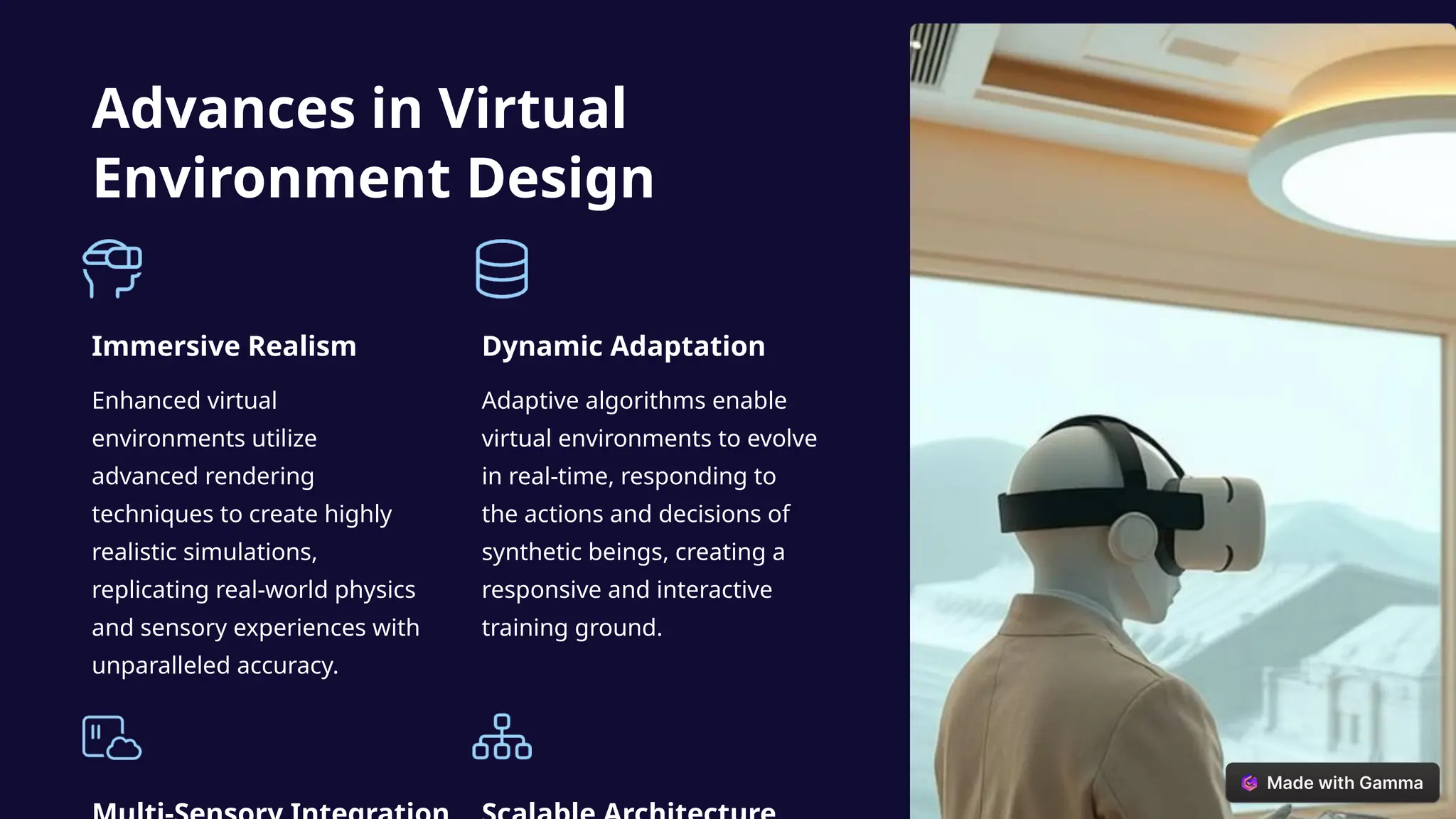
Immersive Realism
Enhanced virtual
environments utilize
advanced rendering
techniques to create highly
realistic simulations,
replicating real-world physics
and sensory experiences with
unparalleled accuracy.
Dynamic Adaptation
Adaptive algorithms enable
virtual environments to evolve
in real-time, responding to
the actions and decisions of
synthetic beings, creating a
responsive and interactive
training ground.
Hypothetical Timeline For Synthetic Species
Development and Integration
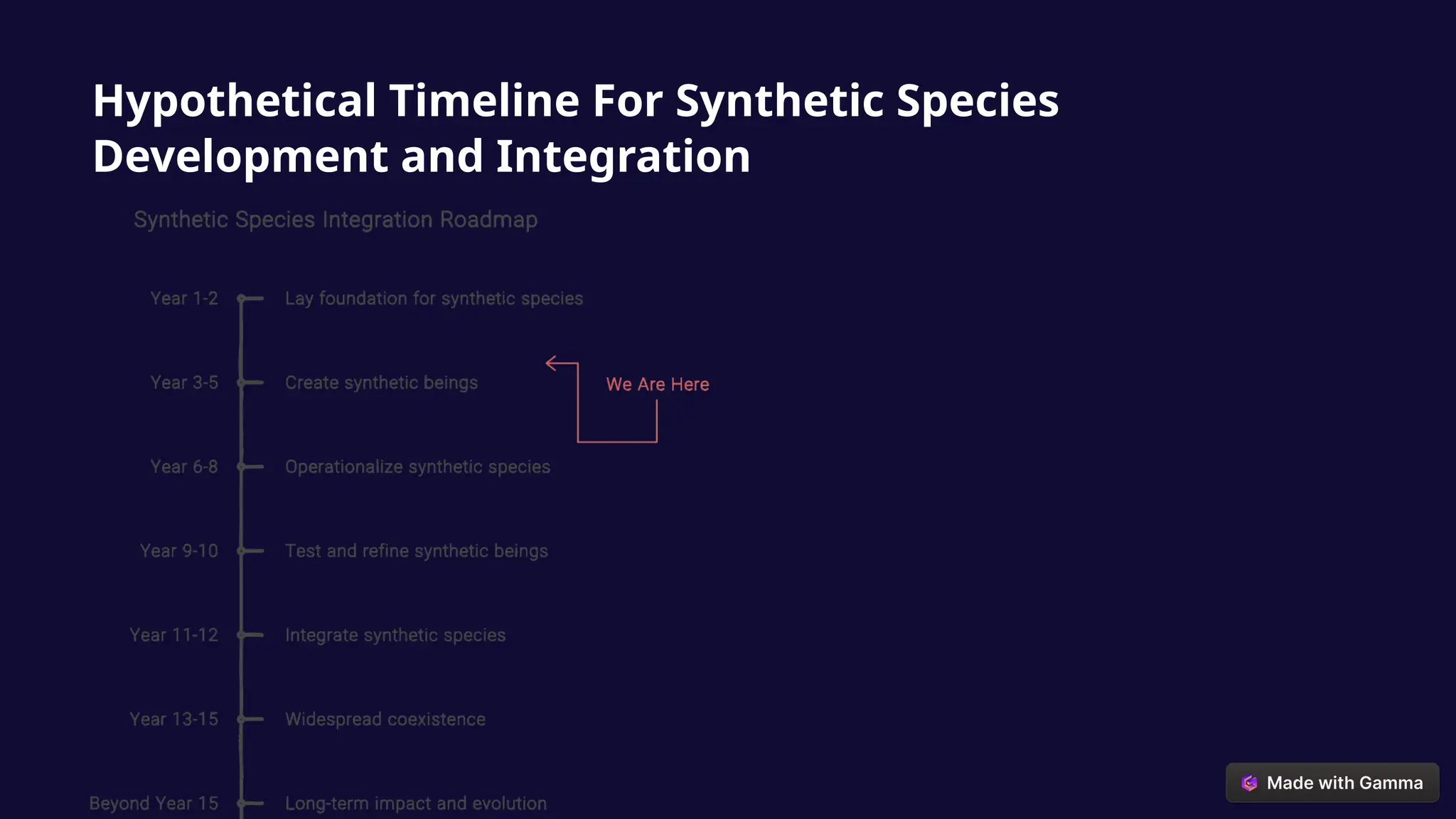
This figure presents a hypothetical timeline detailing the key phases in the development and integration of
synthetic species. The timeline outlines a structured approach from conceptualization to long-term societal
impact, emphasizing the progressive nature of this ambitious endeavor.
Year 1-2: Foundation
Focus: Establish the foundational integration of AI, robotics, and digital environments to challenge traditional
concepts of life and intelligence.
Year 3-5: Creation
Focus: Develop synthetic beings by merging biological principles with computational algorithms and
mechatronic frameworks, achieving prototypes with potential consciousness and agency.
Note: The arrow "We Are Here" marks this current phase.
Year 6-8: Operationalization
Focus: Implement and refine Synthetic Brains, Bodies, and Environments to enable autonomous interaction
and evolution.
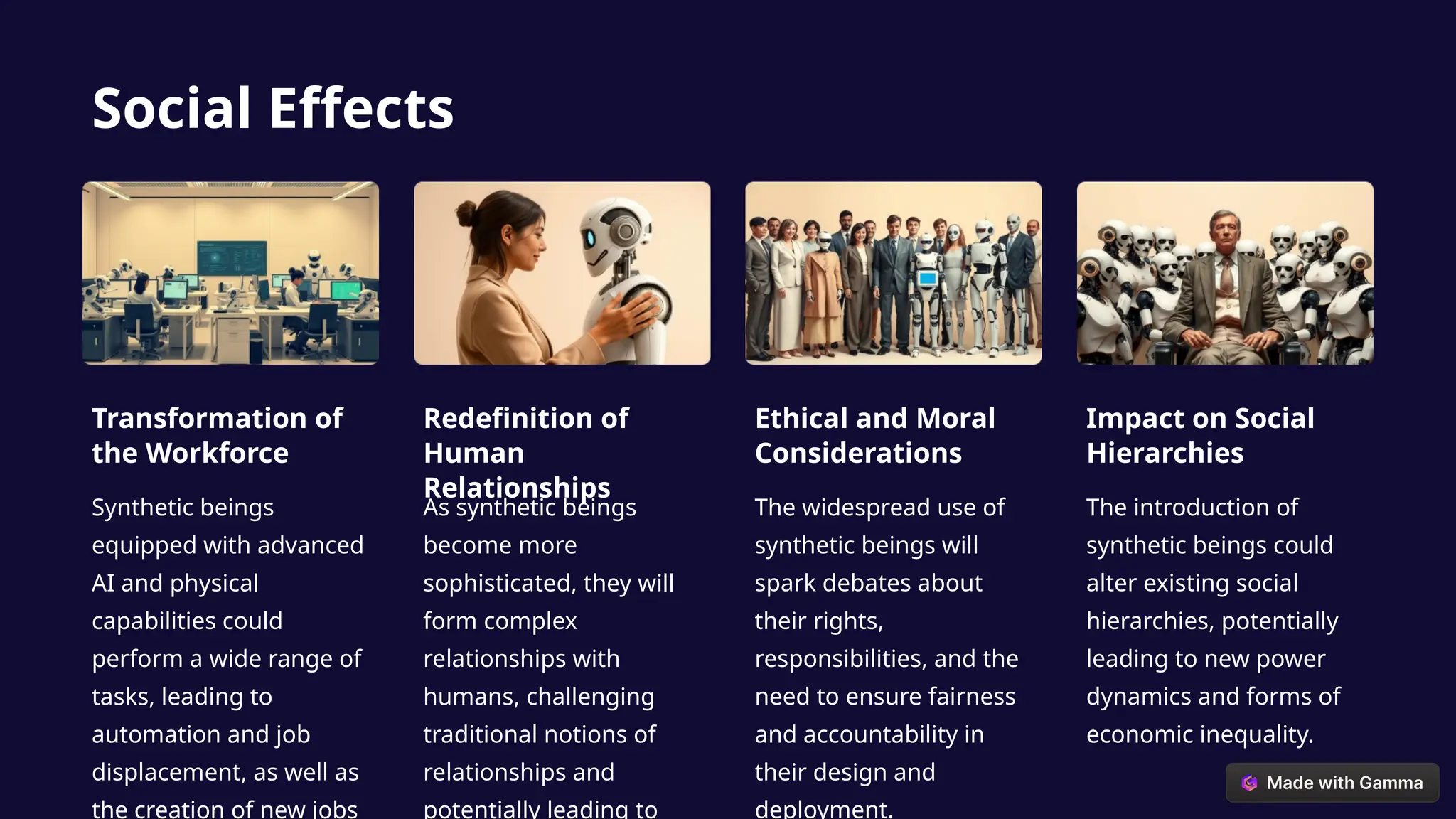
Social Effects
Transformation of
the Workforce
Synthetic beings
equipped with advanced
AI and physical
capabilities could
perform a wide range of
tasks, leading to
automation and job
displacement, as well as
the creation of new jobs
Redefinition of
Human
Relationships
As synthetic beings
become more
sophisticated, they will
form complex
relationships with
humans, challenging
traditional notions of
relationships and
potentially leading to
Ethical and Moral
Considerations
The widespread use of
synthetic beings will
spark debates about
their rights,
responsibilities, and the
need to ensure fairness
and accountability in
their design and
deployment.
Impact on Social
Hierarchies
The introduction of
synthetic beings could
alter existing social
hierarchies, potentially
leading to new power
dynamics and forms of
economic inequality.
Author

How To Create An Artificial Cognitive Species: Jarinzo Tanabata

  • 1.
    How To CreateA Artificial Cognitive Species We are at the forefront of an extraordinary convergence of technologies that lay the groundwork for the creation of a new synthetic species. This phenomenon, which we refer to as "Biocomputational Speciation," embodies the fusion of three critical components. The emergence of synthetic species represents a significant shift in the course of both technological and biological evolution. By Jarinzo Tanabata
  • 2.
    Introduction to CognitiveArtificial Species 1 Conceptualization The foundation of synthetic species is established by merging cutting-edge AI, robotics, and immersive digital environments. 2 Development The creation of synthetic beings is driven by the fusion of biological principles with sophisticated computational algorithms, functionalized with advanced mechatronic frameworks. 3 Operationalization The operationalization of synthetic species is realized through the meticulous development of Synthetic Brains, Bodies, and Artificial Environments. Integration
  • 3.
    Cybernetic Bio-Synthesis Biological Insights CyberneticBio-Synthesis incorporates key biological processes such as neural plasticity, genetic algorithms, and evolutionary mechanisms into computational frameworks. Computational Integration Advanced algorithms and machine learning techniques are employed to model and replicate cognitive processes within synthetic neural networks. Philosophical Implications This synthesis challenges our understanding of the boundaries between organic and synthetic, prompting a reevaluation of what constitutes life and consciousness.
  • 4.
    Synthetic Brain: AIand NLP Systems Computer Vision The synthetic brain leverages advanced AI technologies, including deep learning and reinforcement learning, to process information and make decisions. Natural Language Processing Advanced NLP systems enable the synthetic brain to understand and generate human like language, facilitating communication and knowledge acquisition. Computational Neuroscience Computational neuroscience models are integrated to replicate human like cognitive processes, including memory formation, reasoning, and emotional responses. Machine Learning The synthetic brain extends beyond human cognitive limitations, incorporating features like parallel processing and direct access to vast databases of information. Voice Synthesis Voice synthesis produces natural, human-like speech using sophisticated voice synthesis technology, enabling seamless and intuitive communication with humans.
  • 5.
    Synthetic Brain: Foundationsand Challenges The Synthetic Brain is engineered to not only emulate human cognition but to transcend it, integrating robust AI, NLP (Natural Language Processing) , computational neuroscience, computer vision, and speech synthesis. This brain extends beyond mere replication of human thought processes, enabling synthetic beings to process complex information, learn from experiences, perceive their environment visually, and communicate naturally potentially even approaching a form of consciousness. At its core, the Synthetic Brain is driven by an advanced AI system that processes vast datasets, discerns intricate patterns, and makes real-time decisions with remarkable accuracy. This AI is seamlessly integrated with sophisticated NLP algorithms, allowing the brain to understand and generate human-like language. Additionally, the incorporation of computer vision empowers the brain to visually interpret its surroundings, while speech synthesis enables natural, expressive communication. By drawing inspiration from the neural architecture of the human brain, computational neuroscience models have been developed to replicate key cognitive functions, including memory, reasoning, and emotional responses. The Synthetic Brain's enhanced capabilities can potentially surpass the limitations of the human mind. Its ability to parallel-process complex problems simultaneously, coupled with direct access to expansive information databases, allows it to draw from a vast reservoir of knowledge in active chain. This integration of biological
  • 6.
    Customizing Neural Capacities ParameterFunction Impact Token Limitation Constrains language processing capacity Controls complexity of thought and expression Processing Speed Determines rate of information analysis Affects reaction time and decision-making speed
  • 7.
    Advancements in Natural Language Processing TransformativeNLP technologies, such as large language models, enable synthetic brains to understand and communicate in natural human language. This breakthrough allows seamless interaction between these intelligent systems and their human counterparts.
  • 8.
    Advancements in NaturalLanguage Processing Transformer Architecture The revolutionary transformer model has significantly enhanced NLP capabilities, enabling more context- aware and coherent language understanding and generation. Large Language Models Massive pre-trained language models like GPT-3.5 and its successors have dramatically improved the ability of synthetic brains to process and generate human- like text across diverse domains. Multilingual Processing Advanced NLP systems can now seamlessly operate across multiple languages, breaking down communication barriers and enabling global interaction for synthetic beings. Emotion and Intent Recognition Advanced NLP programs incorporate emotional intelligence and intent recognition, allowing synthetic beings to engage in more nuanced and empathetic communication.
  • 9.
    Synthetic Body: RoboticChassis Biomimetic Design The synthetic body incorporates principles from nature, replicating and Advanced Materials Cutting-edge materials science enables the creation of lightweight, durable, and Sensory Integration Sophisticated sensor arrays are embedded throughout the synthetic body, Modular Architecture The synthetic body features a modular design, allowing for easy upgrades,
  • 10.
    Synthetic Body: Foundationand Challenges The Synthetic Body serves as the physical peripheral for the Synthetic Brain, enabling synthetic beings to interact seamlessly with the physical world. The creation of these robotic chassis requires a multidisciplinary approach, blending innovations in robotics, biomimetics, and materials science. The objective is to develop bodies that are not only highly functional but also capable of performing tasks that exceed the capabilities of biological organisms. This endeavor necessitates a deep understanding of mechanical design, control systems, and the integration of advanced AI technologies. Mechanical design is the cornerstone of the Synthetic Body, shaping the range of motion, dexterity, and physical capabilities that allow synthetic beings to interact effectively with their environment. By focusing on mechanical design, engineers ensure that these bodies can perform complex tasks with precision and adaptability. The design process involves not only the development of flexible joints and robust frameworks but also the integration of actuators and sensors that mimic the fluidity and responsiveness found in biological organisms. This approach allows synthetic beings to execute movements that are both delicate and powerful, bridging the gap between human-like dexterity and machine-driven efficiency. The application of biomimetic engineering, where biological principles are applied to mechanical design, further
  • 11.
    Customizing Spatial Capabilities ParameterFunction Impact Movement Range Defines the extent of physical motion Determines reach, flexibility, and ability to navigate environments
  • 12.
    Advances in Mechanical Design Mechanicaldesign plays a pivotal role in the development of synthetic bodies, enabling them to achieve remarkable levels of dexterity, mobility, and adaptability. This field is essential for creating robotic forms that can perform complex tasks with the same, if not greater, finesse and agility as human beings.
  • 13.
    Advances in Mechanical Design BiomimeticActuators Advanced actuators inspired by biological muscles provide smooth, precise movements with high power efficiency, mimicking and surpassing human capabilities. Nanotech Integration Incorporation of nanotechnology enables self- healing materials and adaptive surfaces, enhancing durability and environmental adaptability of synthetic bodies. Neural Interface Modular Design
  • 14.
    Artificial Environment: Digitaland Physical Infrastructure Digital Twins High-fidelity digital replicas of real- world environments provide a safe and controllable space for synthetic beings to learn and interact. AR/VR Integration Augmented and virtual reality technologies create immersive experiences, allowing synthetic beings to engage with complex scenarios and human operators. Physical Testbeds Specialized physical environments are designed to challenge and refine the capabilities of synthetic bodies, ensuring real-world applicability.
  • 15.
    Synthetic Environments: Foundationand Challenges The Artificial Environment is the habitat in which synthetic beings live, learn, and evolve. This environment is not merely a simulation; it is a fully realized digital and physical infrastructure that provides synthetic beings with the resources they need to develop and thrive. The design and development of these environments involve a combination of digital twins, augmented reality (AR), virtual reality (VR), and physical testbeds, all of which work together to create a comprehensive ecosystem for synthetic beings. Synthetic Environments are crucial for the continuous development and adaptation of synthetic beings, serving as both their habitat and learning ground. These environments are meticulously designed to replicate and, in many cases, enhance real-world conditions, offering synthetic beings a diverse array of scenarios in which to hone their abilities. The integration of digital twins allows for real-time mirroring of physical spaces, providing a dynamic and responsive platform where synthetic beings can test and refine their skills. Augmented Reality (AR) and Virtual Reality (VR) further enrich these environments by creating immersive experiences that closely mimic the complexities of the real world, from intricate social interactions to challenging physical tasks. Physical testbeds complement these digital environments by offering controlled, real-world conditions where synthetic beings can practice and validate their capabilities, ensuring they are fully prepared to operate in any scenario. However, creating and maintaining these synthetic environments presents significant challenges. The primary challenge lies in ensuring that the artificial environment remains as dynamic and unpredictable as the real world,
  • 16.
  • 17.
    Advances in Virtual EnvironmentDesign Mechanical design plays a pivotal role in the development of synthetic bodies, enabling them to achieve remarkable levels of dexterity, mobility, and adaptability. This field is essential for creating robotic forms that can perform complex tasks with the same, if not greater, finesse and agility as human beings.
  • 18.
    Advances in Virtual EnvironmentDesign Immersive Realism Enhanced virtual environments utilize advanced rendering techniques to create highly realistic simulations, replicating real-world physics and sensory experiences with unparalleled accuracy. Dynamic Adaptation Adaptive algorithms enable virtual environments to evolve in real-time, responding to the actions and decisions of synthetic beings, creating a responsive and interactive training ground.
  • 20.
    Hypothetical Timeline ForSynthetic Species Development and Integration
  • 21.
    This figure presentsa hypothetical timeline detailing the key phases in the development and integration of synthetic species. The timeline outlines a structured approach from conceptualization to long-term societal impact, emphasizing the progressive nature of this ambitious endeavor. Year 1-2: Foundation Focus: Establish the foundational integration of AI, robotics, and digital environments to challenge traditional concepts of life and intelligence. Year 3-5: Creation Focus: Develop synthetic beings by merging biological principles with computational algorithms and mechatronic frameworks, achieving prototypes with potential consciousness and agency. Note: The arrow "We Are Here" marks this current phase. Year 6-8: Operationalization Focus: Implement and refine Synthetic Brains, Bodies, and Environments to enable autonomous interaction and evolution.
  • 22.
    Social Effects Transformation of theWorkforce Synthetic beings equipped with advanced AI and physical capabilities could perform a wide range of tasks, leading to automation and job displacement, as well as the creation of new jobs Redefinition of Human Relationships As synthetic beings become more sophisticated, they will form complex relationships with humans, challenging traditional notions of relationships and potentially leading to Ethical and Moral Considerations The widespread use of synthetic beings will spark debates about their rights, responsibilities, and the need to ensure fairness and accountability in their design and deployment. Impact on Social Hierarchies The introduction of synthetic beings could alter existing social hierarchies, potentially leading to new power dynamics and forms of economic inequality.
  • 23.