Presented by
Sonali S Gadge
Assistant Professor
P R Patil Institute of Pharmacy, Talegaon (SP), Dist-wardha-442202.
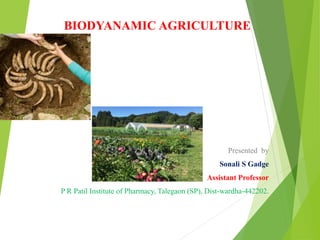
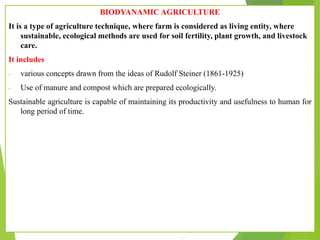
BIODYANAMIC AGRICULTURE
It is a type of agriculture technique, where farm is considered as living entity, where
sustainable, ecological methods are used for soil fertility, plant growth, and livestock
care.
It includes
- various concepts drawn from the ideas of Rudolf Steiner (1861-1925)
- Use of manure and compost which are prepared ecologically.
Sustainable agriculture is capable of maintaining its productivity and usefulness to human for
long period of time.
 Biodyanamic agriculture is environment friendly, resource-conserving, economical,
socially supportive and commercially competitive.
 These methods do not use any synthetic chemical fertilizers and pesticides.
 Biodyanamic farming involves greater earthworm population and less energy used for
production as compared with other farming.
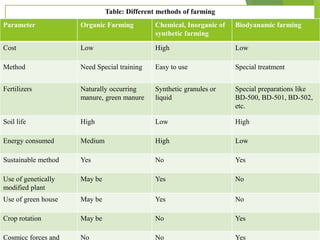
Table: Different methods of farming
Parameter Organic Farming Chemical, Inorganic of
synthetic farming
Biodyanamic farming
Cost Low High Low
Method Need Special training Easy to use Special treatment
Fertilizers Naturally occurring
manure, green manure
Synthetic granules or
liquid
Special preparations like
BD-500, BD-501, BD-502,
etc.
Soil life High Low High
Energy consumed Medium High Low
Sustainable method Yes No Yes
Use of genetically
modified plant
May be Yes No
Use of green house May be Yes No
Crop rotation May be No Yes
Cosmicc forces and No No Yes
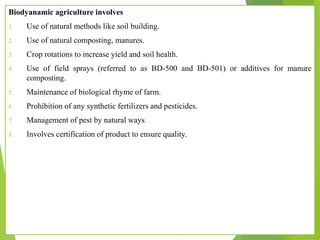
Biodyanamic agriculture involves
1. Use of natural methods like soil building.
2. Use of natural composting, manures.
3. Crop rotations to increase yield and soil health.
4. Use of field sprays (referred to as BD-500 and BD-501) or additives for manure
composting.
5. Maintenance of biological rhyme of farm.
6. Prohibition of any synthetic fertilizers and pesticides.
7. Management of pest by natural ways
8. Involves certification of product to ensure quality.
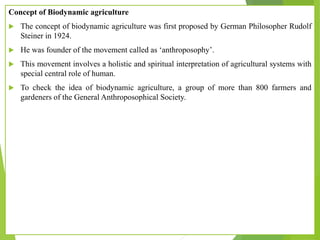
Concept of Biodynamic agriculture
 The concept of biodynamic agriculture was first proposed by German Philosopher Rudolf
Steiner in 1924.
 He was founder of the movement called as ‘anthroposophy’.
 This movement involves a holistic and spiritual interpretation of agricultural systems with
special central role of human.
 To check the idea of biodynamic agriculture, a group of more than 800 farmers and
gardeners of the General Anthroposophical Society.
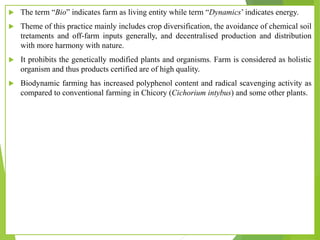
 The term “Bio” indicates farm as living entity while term “Dynamics’ indicates energy.
 Theme of this practice mainly includes crop diversification, the avoidance of chemical soil
tretaments and off-farm inputs generally, and decentralised production and distribution
with more harmony with nature.
 It prohibits the genetically modified plants and organisms. Farm is considered as holistic
organism and thus products certified are of high quality.
 Biodynamic farming has increased polyphenol content and radical scavenging activity as
compared to conventional farming in Chicory (Cichorium intybus) and some other plants.
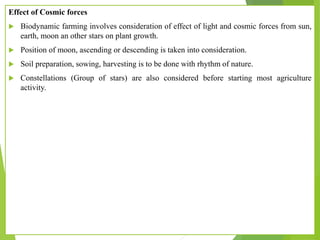
Effect of Cosmic forces
 Biodynamic farming involves consideration of effect of light and cosmic forces from sun,
earth, moon an other stars on plant growth.
 Position of moon, ascending or descending is taken into consideration.
 Soil preparation, sowing, harvesting is to be done with rhythm of nature.
 Constellations (Group of stars) are also considered before starting most agriculture
activity.
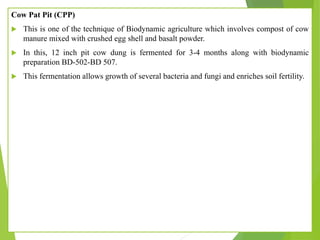
Cow Pat Pit (CPP)
 This is one of the technique of Biodynamic agriculture which involves compost of cow
manure mixed with crushed egg shell and basalt powder.
 In this, 12 inch pit cow dung is fermented for 3-4 months along with biodynamic
preparation BD-502-BD 507.
 This fermentation allows growth of several bacteria and fungi and enriches soil fertility.
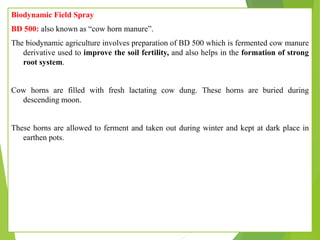
Biodynamic Field Spray
BD 500: also known as “cow horn manure”.
The biodynamic agriculture involves preparation of BD 500 which is fermented cow manure
derivative used to improve the soil fertility, and also helps in the formation of strong
root system.
Cow horns are filled with fresh lactating cow dung. These horns are buried during
descending moon.
These horns are allowed to ferment and taken out during winter and kept at dark place in
earthen pots.
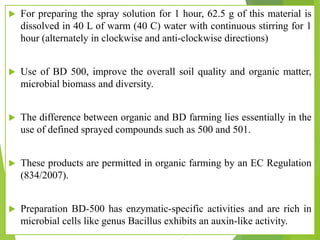
 For preparing the spray solution for 1 hour, 62.5 g of this material is
dissolved in 40 L of warm (40 C) water with continuous stirring for 1
hour (alternately in clockwise and anti-clockwise directions)
 Use of BD 500, improve the overall soil quality and organic matter,
microbial biomass and diversity.
 The difference between organic and BD farming lies essentially in the
use of defined sprayed compounds such as 500 and 501.
 These products are permitted in organic farming by an EC Regulation
(834/2007).
 Preparation BD-500 has enzymatic-specific activities and are rich in
microbial cells like genus Bacillus exhibits an auxin-like activity.
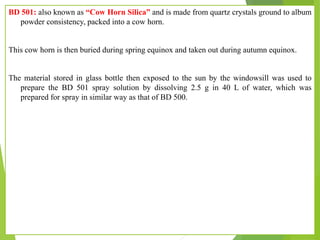
BD 501: also known as “Cow Horn Silica” and is made from quartz crystals ground to album
powder consistency, packed into a cow horn.
This cow horn is then buried during spring equinox and taken out during autumn equinox.
The material stored in glass bottle then exposed to the sun by the windowsill was used to
prepare the BD 501 spray solution by dissolving 2.5 g in 40 L of water, which was
prepared for spray in similar way as that of BD 500.
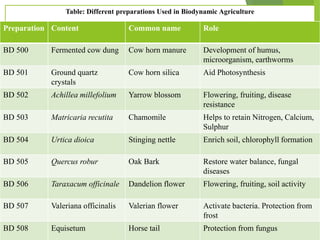
Table: Different preparations Used in Biodynamic Agriculture
Preparation Content Common name Role
BD 500 Fermented cow dung Cow horn manure Development of humus,
microorganism, earthworms
BD 501 Ground quartz
crystals
Cow horn silica Aid Photosynthesis
BD 502 Achillea millefolium Yarrow blossom Flowering, fruiting, disease
resistance
BD 503 Matricaria recutita Chamomile Helps to retain Nitrogen, Calcium,
Sulphur
BD 504 Urtica dioica Stinging nettle Enrich soil, chlorophyll formation
BD 505 Quercus robur Oak Bark Restore water balance, fungal
diseases
BD 506 Taraxacum officinale Dandelion flower Flowering, fruiting, soil activity
BD 507 Valeriana officinalis Valerian flower Activate bacteria. Protection from
frost
BD 508 Equisetum Horse tail Protection from fungus
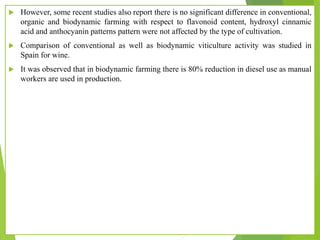
 However, some recent studies also report there is no significant difference in conventional,
organic and biodynamic farming with respect to flavonoid content, hydroxyl cinnamic
acid and anthocyanin patterns pattern were not affected by the type of cultivation.
 Comparison of conventional as well as biodynamic viticulture activity was studied in
Spain for wine.
 It was observed that in biodynamic farming there is 80% reduction in diesel use as manual
workers are used in production.
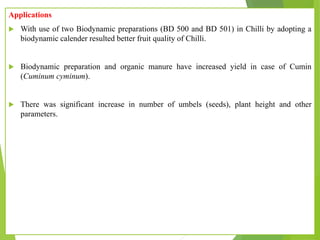
Applications
 With use of two Biodynamic preparations (BD 500 and BD 501) in Chilli by adopting a
biodynamic calender resulted better fruit quality of Chilli.
 Biodynamic preparation and organic manure have increased yield in case of Cumin
(Cuminum cyminum).
 There was significant increase in number of umbels (seeds), plant height and other
parameters.
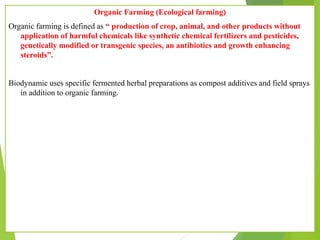
Organic Farming (Ecological farming)
Organic farming is defined as “ production of crop, animal, and other products without
application of harmful chemicals like synthetic chemical fertilizers and pesticides,
genetically modified or transgenic species, an antibiotics and growth enhancing
steroids”.
Biodynamic uses specific fermented herbal preparations as compost additives and field sprays
in addition to organic farming.
 Organic farming consists of several principles and practices, which are given by the
standards of International Federation of Organic Agriculture Movements (IFOAM) as the
principle of health, ecology and fairness and care.
 It does not involve chemicals right from seed production and even after post harvesting,
handling and storage.
 Product obtained is free from chemical fertilizers, herbicides and pesticides.
Aim behind Organic Farming
 Production of food of high quality in sufficient quantity.
 Minimization of all forms of pollution.
 Processing of producing renewable resources.
 Production of biodegradable organic products.
 Consideration of the wider social and ecological impact of the organic production.
 Maintenance of long-term fertility of soils.
 Maintain the genetic diversity of the plant and wildlife habitats.
 Promotion of the healthy use and proper care of water, water resources, all life therein.
 Use of local renewable resources in production systems.
 To encourage and enhance biological cycles within the farming system, involving
microorganisms, soil flora and fauna.
 Development of a valuable and sustainable aquatic ecosystem.
Effects of Organic farming
 Organic fertilizers known to improve biodiversity.
 Organic farming helps to improve soil quality and microbial biomass.
 Organic fertilizers have lower nutrient content and release of nutrient is
slow. So they are more effective for long term use.
 Bio-fertilizers contain microbial inoculants of living cells of
microorganism like bacteria, algae, fungi alone or combination which
increase crop productivity.
 Nitrogen fixing bacteria like Azotobacter, Azospirillum species are
nitrogen-fixing organisms, capable of forming an associative relationship
with the roots of several crops.
 Organic farming can act on plant growth directly through the production
of bio-control agents against soil-borne phytopathogens for better yield.
APPLICATIONS
 In one study, vermin composted with coir pith and coir pith composted with
microorganisms were used as a growth medium for growth of the medicinal plant
Andrographis paniculate. The results are helpful for the reclamation of soils from
industrial sites in a small scale nursery.
 Asparagus racemosus grown through organic farming using organic manures- cow dung,
compost and vermin compost without using mineral or chemical fertilizer showed
antioxidant activity and increase in the total phenol and total flavonoid content was
highest in the plants from vermin compost treated soil.
 Organically grown Thymus vulgaris was found to contain highest value of thymol.
 Treatment of Ocimum basillicum roots with rhizobacteria results in increased growth and
volatile oil.
 Organic farming of geranium results in increase in fresh weight and oil percentage.
 Organic farming of Marjoram (Majorana hortensis) along with treatment of bio-fertilizers
shown almost two-fold fresh weight as compared to control.
 Use of poultry manure has significantly increased the herbage, essential oil content and
dry matter yield in Java citronella.
 Morphological characteristics and essential oil content of German chamomile was found
improved with use of the vermin compost.
Biodyanamic Agriculture.pptx

Biodyanamic Agriculture.pptx

  • 1.
    Presented by Sonali SGadge Assistant Professor P R Patil Institute of Pharmacy, Talegaon (SP), Dist-wardha-442202. BIODYANAMIC AGRICULTURE
  • 2.
    BIODYANAMIC AGRICULTURE It isa type of agriculture technique, where farm is considered as living entity, where sustainable, ecological methods are used for soil fertility, plant growth, and livestock care. It includes - various concepts drawn from the ideas of Rudolf Steiner (1861-1925) - Use of manure and compost which are prepared ecologically. Sustainable agriculture is capable of maintaining its productivity and usefulness to human for long period of time.
  • 3.
     Biodyanamic agricultureis environment friendly, resource-conserving, economical, socially supportive and commercially competitive.  These methods do not use any synthetic chemical fertilizers and pesticides.  Biodyanamic farming involves greater earthworm population and less energy used for production as compared with other farming.
  • 4.
    Table: Different methodsof farming Parameter Organic Farming Chemical, Inorganic of synthetic farming Biodyanamic farming Cost Low High Low Method Need Special training Easy to use Special treatment Fertilizers Naturally occurring manure, green manure Synthetic granules or liquid Special preparations like BD-500, BD-501, BD-502, etc. Soil life High Low High Energy consumed Medium High Low Sustainable method Yes No Yes Use of genetically modified plant May be Yes No Use of green house May be Yes No Crop rotation May be No Yes Cosmicc forces and No No Yes
  • 5.
    Biodyanamic agriculture involves 1.Use of natural methods like soil building. 2. Use of natural composting, manures. 3. Crop rotations to increase yield and soil health. 4. Use of field sprays (referred to as BD-500 and BD-501) or additives for manure composting. 5. Maintenance of biological rhyme of farm. 6. Prohibition of any synthetic fertilizers and pesticides. 7. Management of pest by natural ways 8. Involves certification of product to ensure quality.
  • 6.
    Concept of Biodynamicagriculture  The concept of biodynamic agriculture was first proposed by German Philosopher Rudolf Steiner in 1924.  He was founder of the movement called as ‘anthroposophy’.  This movement involves a holistic and spiritual interpretation of agricultural systems with special central role of human.  To check the idea of biodynamic agriculture, a group of more than 800 farmers and gardeners of the General Anthroposophical Society.
  • 7.
     The term“Bio” indicates farm as living entity while term “Dynamics’ indicates energy.  Theme of this practice mainly includes crop diversification, the avoidance of chemical soil tretaments and off-farm inputs generally, and decentralised production and distribution with more harmony with nature.  It prohibits the genetically modified plants and organisms. Farm is considered as holistic organism and thus products certified are of high quality.  Biodynamic farming has increased polyphenol content and radical scavenging activity as compared to conventional farming in Chicory (Cichorium intybus) and some other plants.
  • 8.
    Effect of Cosmicforces  Biodynamic farming involves consideration of effect of light and cosmic forces from sun, earth, moon an other stars on plant growth.  Position of moon, ascending or descending is taken into consideration.  Soil preparation, sowing, harvesting is to be done with rhythm of nature.  Constellations (Group of stars) are also considered before starting most agriculture activity.
  • 9.
    Cow Pat Pit(CPP)  This is one of the technique of Biodynamic agriculture which involves compost of cow manure mixed with crushed egg shell and basalt powder.  In this, 12 inch pit cow dung is fermented for 3-4 months along with biodynamic preparation BD-502-BD 507.  This fermentation allows growth of several bacteria and fungi and enriches soil fertility.
  • 10.
    Biodynamic Field Spray BD500: also known as “cow horn manure”. The biodynamic agriculture involves preparation of BD 500 which is fermented cow manure derivative used to improve the soil fertility, and also helps in the formation of strong root system. Cow horns are filled with fresh lactating cow dung. These horns are buried during descending moon. These horns are allowed to ferment and taken out during winter and kept at dark place in earthen pots.
  • 11.
     For preparingthe spray solution for 1 hour, 62.5 g of this material is dissolved in 40 L of warm (40 C) water with continuous stirring for 1 hour (alternately in clockwise and anti-clockwise directions)  Use of BD 500, improve the overall soil quality and organic matter, microbial biomass and diversity.  The difference between organic and BD farming lies essentially in the use of defined sprayed compounds such as 500 and 501.  These products are permitted in organic farming by an EC Regulation (834/2007).  Preparation BD-500 has enzymatic-specific activities and are rich in microbial cells like genus Bacillus exhibits an auxin-like activity.
  • 12.
    BD 501: alsoknown as “Cow Horn Silica” and is made from quartz crystals ground to album powder consistency, packed into a cow horn. This cow horn is then buried during spring equinox and taken out during autumn equinox. The material stored in glass bottle then exposed to the sun by the windowsill was used to prepare the BD 501 spray solution by dissolving 2.5 g in 40 L of water, which was prepared for spray in similar way as that of BD 500.
  • 13.
    Table: Different preparationsUsed in Biodynamic Agriculture Preparation Content Common name Role BD 500 Fermented cow dung Cow horn manure Development of humus, microorganism, earthworms BD 501 Ground quartz crystals Cow horn silica Aid Photosynthesis BD 502 Achillea millefolium Yarrow blossom Flowering, fruiting, disease resistance BD 503 Matricaria recutita Chamomile Helps to retain Nitrogen, Calcium, Sulphur BD 504 Urtica dioica Stinging nettle Enrich soil, chlorophyll formation BD 505 Quercus robur Oak Bark Restore water balance, fungal diseases BD 506 Taraxacum officinale Dandelion flower Flowering, fruiting, soil activity BD 507 Valeriana officinalis Valerian flower Activate bacteria. Protection from frost BD 508 Equisetum Horse tail Protection from fungus
  • 14.
     However, somerecent studies also report there is no significant difference in conventional, organic and biodynamic farming with respect to flavonoid content, hydroxyl cinnamic acid and anthocyanin patterns pattern were not affected by the type of cultivation.  Comparison of conventional as well as biodynamic viticulture activity was studied in Spain for wine.  It was observed that in biodynamic farming there is 80% reduction in diesel use as manual workers are used in production.
  • 15.
    Applications  With useof two Biodynamic preparations (BD 500 and BD 501) in Chilli by adopting a biodynamic calender resulted better fruit quality of Chilli.  Biodynamic preparation and organic manure have increased yield in case of Cumin (Cuminum cyminum).  There was significant increase in number of umbels (seeds), plant height and other parameters.
  • 16.
    Organic Farming (Ecologicalfarming) Organic farming is defined as “ production of crop, animal, and other products without application of harmful chemicals like synthetic chemical fertilizers and pesticides, genetically modified or transgenic species, an antibiotics and growth enhancing steroids”. Biodynamic uses specific fermented herbal preparations as compost additives and field sprays in addition to organic farming.
  • 17.
     Organic farmingconsists of several principles and practices, which are given by the standards of International Federation of Organic Agriculture Movements (IFOAM) as the principle of health, ecology and fairness and care.  It does not involve chemicals right from seed production and even after post harvesting, handling and storage.  Product obtained is free from chemical fertilizers, herbicides and pesticides.
  • 18.
    Aim behind OrganicFarming  Production of food of high quality in sufficient quantity.  Minimization of all forms of pollution.  Processing of producing renewable resources.  Production of biodegradable organic products.  Consideration of the wider social and ecological impact of the organic production.
  • 19.
     Maintenance oflong-term fertility of soils.  Maintain the genetic diversity of the plant and wildlife habitats.  Promotion of the healthy use and proper care of water, water resources, all life therein.  Use of local renewable resources in production systems.  To encourage and enhance biological cycles within the farming system, involving microorganisms, soil flora and fauna.  Development of a valuable and sustainable aquatic ecosystem.
  • 20.
    Effects of Organicfarming  Organic fertilizers known to improve biodiversity.  Organic farming helps to improve soil quality and microbial biomass.  Organic fertilizers have lower nutrient content and release of nutrient is slow. So they are more effective for long term use.  Bio-fertilizers contain microbial inoculants of living cells of microorganism like bacteria, algae, fungi alone or combination which increase crop productivity.  Nitrogen fixing bacteria like Azotobacter, Azospirillum species are nitrogen-fixing organisms, capable of forming an associative relationship with the roots of several crops.  Organic farming can act on plant growth directly through the production of bio-control agents against soil-borne phytopathogens for better yield.
  • 21.
    APPLICATIONS  In onestudy, vermin composted with coir pith and coir pith composted with microorganisms were used as a growth medium for growth of the medicinal plant Andrographis paniculate. The results are helpful for the reclamation of soils from industrial sites in a small scale nursery.  Asparagus racemosus grown through organic farming using organic manures- cow dung, compost and vermin compost without using mineral or chemical fertilizer showed antioxidant activity and increase in the total phenol and total flavonoid content was highest in the plants from vermin compost treated soil.  Organically grown Thymus vulgaris was found to contain highest value of thymol.  Treatment of Ocimum basillicum roots with rhizobacteria results in increased growth and volatile oil.  Organic farming of geranium results in increase in fresh weight and oil percentage.  Organic farming of Marjoram (Majorana hortensis) along with treatment of bio-fertilizers shown almost two-fold fresh weight as compared to control.  Use of poultry manure has significantly increased the herbage, essential oil content and dry matter yield in Java citronella.  Morphological characteristics and essential oil content of German chamomile was found improved with use of the vermin compost.