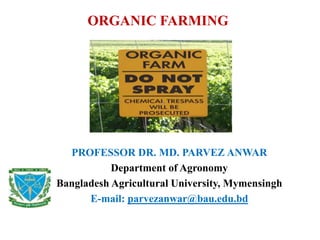
ORGANIC FARMING
PROFESSOR DR. MD. PARVEZ ANWAR
Department of Agronomy
Bangladesh Agricultural University, Mymensingh
E-mail: parvezanwar@bau.edu.bd
“FEED THE SOIL, NOT
THE PLANT”
A familiar refrain among organic farmers
FARMER
• One who runs a farm
• A person who owns, works on or operates an
agricultural enterprise, either commercially or
to sustain himself or his family
• A farmer is a knowledgeable (both local as
well as accumulated knowledge of forefathers)
person, a cultivator, and a manager who
manages his/her time and resources, both
physically and mentally, to put them to
production system to derive economic return
and social benefits.
ORGANIC FARMING
Numerous concepts are interchangeably
used to refer the concept of organic
farming:
• Organic agriculture
• Ecological farming
• Regenerative agriculture
• Biodynamic farming
• Alternative farming
• Organic biological farming
CONCEPT OF ORGANIC FARMING
According to International Federation of
Organic Agriculture Movement (IFOAM):
Organic farming is an agricultural classification
that promotes environmentally, socially and
economically sound production of food, fibre,
timber etc. In this system, maintenance of soil
fertility is considered as the key to successful
production.
“It avoids the use of chemo-synthetic fertilizers,
pesticides and pharmaceuticals. It also includes
social considerations”(IFOAM, 2005).
Organic farming is a production system which avoids or largely
excludes the use of synthetically compounded fertilizers,
pesticides, growth regulators and livestock feed additives. To the
maximum extent feasible, organic farming systems rely on crop
rotations, crop residues, animal manures, legumes, green manures,
off- farm organic wastes and aspects of biological pest control to
maintain soil productivity and tilth, to supply plant nutrients and
to control insects, weeds and other pests (As per USDA).
Organic agriculture is a holistic production management system
which promotes and enhances agro-ecosystem health, including
biodiversity, biological cycles, and soil biological activity. It
emphasizes the use of management practices in preference to the
use of off-farm inputs, taking into account that regional conditions
require locally adapted systems. This is accomplished by using,
where possible, agronomic, biological, and mechanical methods, as
opposed to using synthetic materials, to fulfill any specific function
within the system (AS per FAO/WHO).
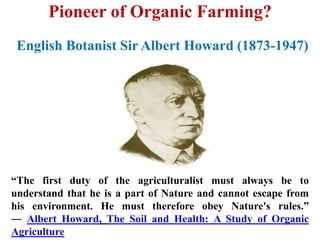
Pioneer of Organic Farming?
“The first duty of the agriculturalist must always be to
understand that he is a part of Nature and cannot escape from
his environment. He must therefore obey Nature's rules.”
― Albert Howard, The Soil and Health: A Study of Organic
Agriculture
English Botanist Sir Albert Howard (1873-1947)
When started?
Started during 1930s-1940s
Why started
As a reaction to agriculture’s growing
reliance on synthetic fertilizers
Current status?
As of 2011, worldwide about 37 million
hectares of land ( 0.9% of total farmland)
were cultivated organically which is more
than threefold compared to 1999
The AIMS of organic farming are
• To maintain long-term fertility of soil
• To effectively and economically utilize natural
resources
• To avoid all forms of pollution caused by agriculture
• To provide safe and quality agricultural products
TO PRODUCE AGRICULTURAL ENTERPRISES THAT
ARE SUSTAINABLE AND HARMONIOUS WITH THE
ENVIRONMENT
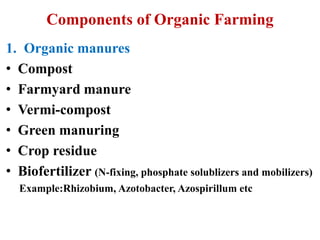
Components of Organic Farming
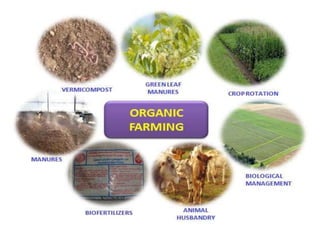
1. Organic manures
• Compost
• Farmyard manure
• Vermi-compost
• Green manuring
• Crop residue
• Biofertilizer (N-fixing, phosphate solublizers and mobilizers)
Example:Rhizobium, Azotobacter, Azospirillum etc
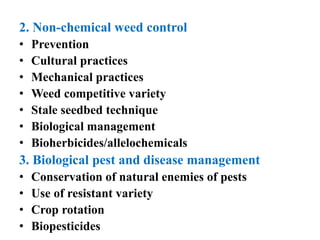
2. Non-chemical weed control
• Prevention
• Cultural practices
• Mechanical practices
• Weed competitive variety
• Stale seedbed technique
• Biological management
• Bioherbicides/allelochemicals
3. Biological pest and disease management
• Conservation of natural enemies of pests
• Use of resistant variety
• Crop rotation
• Biopesticides
Is organic farming a new technology???
Some principles of organic farming were
followed since the cultivation of crops in most
ancient civilizations. The origin of practices of
such as shifting cultivation, crop rotation, mixed
cropping, the use of manures, raw animal dung,
oil cakes and many others farming practices can
be traced to enrichment of soil fertility, which is
the aim of organic farming.
Answer: NO
DON’TS in organic farming
• Organic farming generally prohibits synthetic
pesticides, herbicides, fertilizers, sewage sludge,
antibiotics, growth hormones, GMOs (genetically
modified organisms) or animal cloning etc.
• Animals are never fed the by-products of other
animals, synthetic drugs and are not kept constantly
caged indoors, without access to fresh air, or
opportunities to socialize with other animals
• Processed organic foods do not contain chemical
preservatives or synthetic additives like colorings
and waxe, synthetic food processing aids,
ingredients, and ionizing radiation etc.
Basic tools of organic farming
• Organic farming promotes the use of crop
rotations and cover crops, and encourages
balanced host/predator relationships.
• Organic residues and nutrients produced on the
farm are recycled back to the soil.
• Cover crops and composted manure are used to
maintain soil organic matter and fertility.
• Preventative insect and disease control methods
are practiced, including crop rotation, improved
genetics and resistant varieties.
• Integrated pest and weed management, and soil
conservation systems are valuable tools of an
organic farm.
MERITS OF ORGANIC FARMING
1. Consumers’ benefits
• More nutritious: Organically grown foods are
dramatically superior in mineral content to that
grown by conventional method.
• Poison-free: Organic foods are free of health
hazardous chemicals
• More tasty: Organically produced fruits/ vegetables
are more tasty than conventionally grown ones.
• Food keeps longer: Organic foods are less susciptible
to rapid mold and rotting so can be stored longer.
2. Growers’ benefits
• Disease and pest resistance
• Weed competitiveness
• Drought resistance
• Lower input cost
• Added value/higher price of organic product
LIMITATIONS
• Relatively low productivity
• Intensive tillage
• No scope of planting GM crops
• Labor intensive/time consuming
• Requires special skills
• Unavailability of organic farming tools ( manures,
bioferlilizers, bioherbicides, weed competitie variety)
• Marginal/poor farmers always go for short-term benefits
• Lack of approaches to promote organic farming
• Inadequate marketing channels/facilities
Recommendations for adopting organic farming
• Establishment of commercial units to produce organic
fertilizers
• To increase availability of organic farming components like
biofertilizers, biopesticides etc
• Formation of organic farmers group
• Developing marketing channel/system for organic product
• Ensuring premium prices for organic prducts
• Building up farmers’ capacities through training, on-farm trials
• Formulation of “National Organic Policy”
• Emphasis on organic farming research
• Establishment of organic certification authority
• Media have to play roles to increase consumers’ awareness
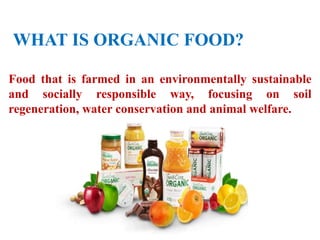
WHAT IS ORGANIC FOOD?
Food that is farmed in an environmentally sustainable
and socially responsible way, focusing on soil
regeneration, water conservation and animal welfare.
What is "Certified Organic"?
“Certified organic” is a term given to products
produced according to organic standards as certified by
one of the certifying bodies.
Farmers, processors and traders are each required to
maintain the organic integrity of the product and to
maintain a document trail for audit purposes.
Products from certified organic
farms are labeled and promoted
as “certified organic.”
Organic farming in Bangladesh
The meaning of organic farming to farmers of Bangladesh is a practice in
which farmers manage their farm based on natural resources.
• To supply essential plant nutrients, farmers use cow dung; different
composts; legumes; green manure; crop residues; bio-fertilizer (Azolla,
Rhizobium, Azotobacter, etc.); ash; rice barn and husk; poultry litter;
biogas-slurry; and slaughter house wastages etc.
• For weed management, farmers apply mechanical practices instead of
herbicides.
• For controlling insects and diseases, they use different non-chemical
measures such as: Integrated Pest Management; mechanical measures
(e.g. hand net, light trap etc.); biological control (e.g. rearing of
beneficial insects and pathogens); and biopesticides (e.g. Nimidicide,
tobacco powder, Bishkanthali extract, chilli dust etc).
• Organic farmers and consumers rely on different natural inputs rather
than toxic hormones and preservatives for ripening fruits and storing
their seeds and other harvested crops (Sarker, 2010).
The Bangladesh Organic Products Manufacturers Association (BOPMA)
THANK YOU

Organic Farming (1).ppt

  • 1.
    ORGANIC FARMING PROFESSOR DR.MD. PARVEZ ANWAR Department of Agronomy Bangladesh Agricultural University, Mymensingh E-mail: parvezanwar@bau.edu.bd
  • 2.
    “FEED THE SOIL,NOT THE PLANT” A familiar refrain among organic farmers
  • 3.
    FARMER • One whoruns a farm • A person who owns, works on or operates an agricultural enterprise, either commercially or to sustain himself or his family • A farmer is a knowledgeable (both local as well as accumulated knowledge of forefathers) person, a cultivator, and a manager who manages his/her time and resources, both physically and mentally, to put them to production system to derive economic return and social benefits.
  • 4.
    ORGANIC FARMING Numerous conceptsare interchangeably used to refer the concept of organic farming: • Organic agriculture • Ecological farming • Regenerative agriculture • Biodynamic farming • Alternative farming • Organic biological farming
  • 5.
    CONCEPT OF ORGANICFARMING According to International Federation of Organic Agriculture Movement (IFOAM): Organic farming is an agricultural classification that promotes environmentally, socially and economically sound production of food, fibre, timber etc. In this system, maintenance of soil fertility is considered as the key to successful production. “It avoids the use of chemo-synthetic fertilizers, pesticides and pharmaceuticals. It also includes social considerations”(IFOAM, 2005).
  • 6.
    Organic farming isa production system which avoids or largely excludes the use of synthetically compounded fertilizers, pesticides, growth regulators and livestock feed additives. To the maximum extent feasible, organic farming systems rely on crop rotations, crop residues, animal manures, legumes, green manures, off- farm organic wastes and aspects of biological pest control to maintain soil productivity and tilth, to supply plant nutrients and to control insects, weeds and other pests (As per USDA). Organic agriculture is a holistic production management system which promotes and enhances agro-ecosystem health, including biodiversity, biological cycles, and soil biological activity. It emphasizes the use of management practices in preference to the use of off-farm inputs, taking into account that regional conditions require locally adapted systems. This is accomplished by using, where possible, agronomic, biological, and mechanical methods, as opposed to using synthetic materials, to fulfill any specific function within the system (AS per FAO/WHO).
  • 7.
    Pioneer of OrganicFarming? “The first duty of the agriculturalist must always be to understand that he is a part of Nature and cannot escape from his environment. He must therefore obey Nature's rules.” ― Albert Howard, The Soil and Health: A Study of Organic Agriculture English Botanist Sir Albert Howard (1873-1947)
  • 8.
    When started? Started during1930s-1940s Why started As a reaction to agriculture’s growing reliance on synthetic fertilizers Current status? As of 2011, worldwide about 37 million hectares of land ( 0.9% of total farmland) were cultivated organically which is more than threefold compared to 1999
  • 9.
    The AIMS oforganic farming are • To maintain long-term fertility of soil • To effectively and economically utilize natural resources • To avoid all forms of pollution caused by agriculture • To provide safe and quality agricultural products TO PRODUCE AGRICULTURAL ENTERPRISES THAT ARE SUSTAINABLE AND HARMONIOUS WITH THE ENVIRONMENT
  • 10.
    Components of OrganicFarming 1. Organic manures • Compost • Farmyard manure • Vermi-compost • Green manuring • Crop residue • Biofertilizer (N-fixing, phosphate solublizers and mobilizers) Example:Rhizobium, Azotobacter, Azospirillum etc
  • 11.
    2. Non-chemical weedcontrol • Prevention • Cultural practices • Mechanical practices • Weed competitive variety • Stale seedbed technique • Biological management • Bioherbicides/allelochemicals 3. Biological pest and disease management • Conservation of natural enemies of pests • Use of resistant variety • Crop rotation • Biopesticides
  • 13.
    Is organic farminga new technology??? Some principles of organic farming were followed since the cultivation of crops in most ancient civilizations. The origin of practices of such as shifting cultivation, crop rotation, mixed cropping, the use of manures, raw animal dung, oil cakes and many others farming practices can be traced to enrichment of soil fertility, which is the aim of organic farming. Answer: NO
  • 14.
    DON’TS in organicfarming • Organic farming generally prohibits synthetic pesticides, herbicides, fertilizers, sewage sludge, antibiotics, growth hormones, GMOs (genetically modified organisms) or animal cloning etc. • Animals are never fed the by-products of other animals, synthetic drugs and are not kept constantly caged indoors, without access to fresh air, or opportunities to socialize with other animals • Processed organic foods do not contain chemical preservatives or synthetic additives like colorings and waxe, synthetic food processing aids, ingredients, and ionizing radiation etc.
  • 15.
    Basic tools oforganic farming • Organic farming promotes the use of crop rotations and cover crops, and encourages balanced host/predator relationships. • Organic residues and nutrients produced on the farm are recycled back to the soil. • Cover crops and composted manure are used to maintain soil organic matter and fertility. • Preventative insect and disease control methods are practiced, including crop rotation, improved genetics and resistant varieties. • Integrated pest and weed management, and soil conservation systems are valuable tools of an organic farm.
  • 16.
    MERITS OF ORGANICFARMING 1. Consumers’ benefits • More nutritious: Organically grown foods are dramatically superior in mineral content to that grown by conventional method. • Poison-free: Organic foods are free of health hazardous chemicals • More tasty: Organically produced fruits/ vegetables are more tasty than conventionally grown ones. • Food keeps longer: Organic foods are less susciptible to rapid mold and rotting so can be stored longer.
  • 17.
    2. Growers’ benefits •Disease and pest resistance • Weed competitiveness • Drought resistance • Lower input cost • Added value/higher price of organic product
  • 18.
    LIMITATIONS • Relatively lowproductivity • Intensive tillage • No scope of planting GM crops • Labor intensive/time consuming • Requires special skills • Unavailability of organic farming tools ( manures, bioferlilizers, bioherbicides, weed competitie variety) • Marginal/poor farmers always go for short-term benefits • Lack of approaches to promote organic farming • Inadequate marketing channels/facilities
  • 19.
    Recommendations for adoptingorganic farming • Establishment of commercial units to produce organic fertilizers • To increase availability of organic farming components like biofertilizers, biopesticides etc • Formation of organic farmers group • Developing marketing channel/system for organic product • Ensuring premium prices for organic prducts • Building up farmers’ capacities through training, on-farm trials • Formulation of “National Organic Policy” • Emphasis on organic farming research • Establishment of organic certification authority • Media have to play roles to increase consumers’ awareness
  • 20.
    WHAT IS ORGANICFOOD? Food that is farmed in an environmentally sustainable and socially responsible way, focusing on soil regeneration, water conservation and animal welfare.
  • 21.
    What is "CertifiedOrganic"? “Certified organic” is a term given to products produced according to organic standards as certified by one of the certifying bodies. Farmers, processors and traders are each required to maintain the organic integrity of the product and to maintain a document trail for audit purposes. Products from certified organic farms are labeled and promoted as “certified organic.”
  • 22.
    Organic farming inBangladesh The meaning of organic farming to farmers of Bangladesh is a practice in which farmers manage their farm based on natural resources. • To supply essential plant nutrients, farmers use cow dung; different composts; legumes; green manure; crop residues; bio-fertilizer (Azolla, Rhizobium, Azotobacter, etc.); ash; rice barn and husk; poultry litter; biogas-slurry; and slaughter house wastages etc. • For weed management, farmers apply mechanical practices instead of herbicides. • For controlling insects and diseases, they use different non-chemical measures such as: Integrated Pest Management; mechanical measures (e.g. hand net, light trap etc.); biological control (e.g. rearing of beneficial insects and pathogens); and biopesticides (e.g. Nimidicide, tobacco powder, Bishkanthali extract, chilli dust etc). • Organic farmers and consumers rely on different natural inputs rather than toxic hormones and preservatives for ripening fruits and storing their seeds and other harvested crops (Sarker, 2010). The Bangladesh Organic Products Manufacturers Association (BOPMA)
  • 23.