A SEMINAR ON
BIOFUELS FROM ALGAE
A
ALTERNATIVE SOURCE OF ENERGY
with
challenges and opportunities
By
Bhushan Bhusare
BIOFUELS
 Fuel is something that can be burned
to produce energy in the form of heat
or power. Fuels include coal, oil,
natural gas, and wood.
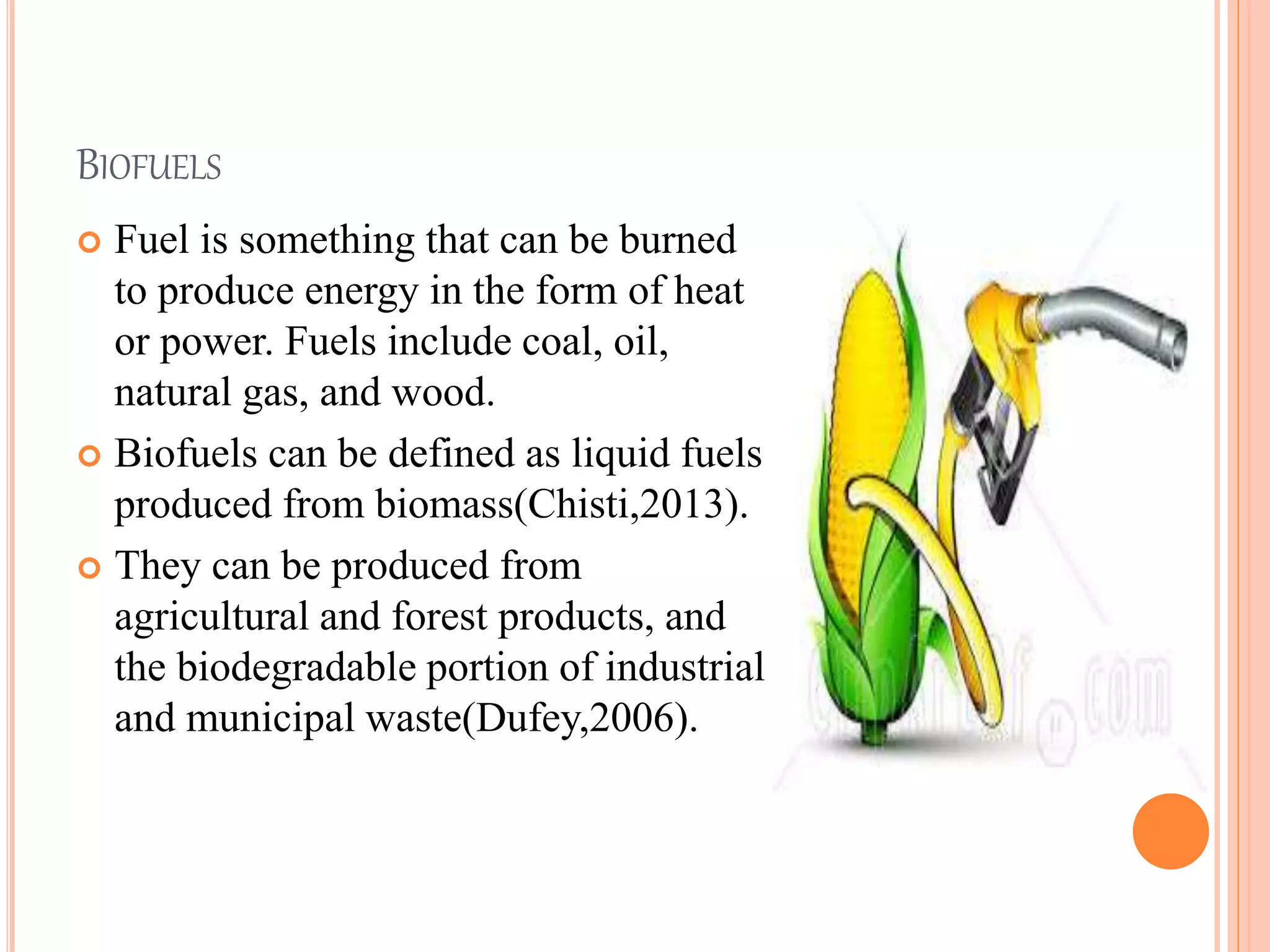
 Biofuels can be defined as liquid fuels
produced from biomass(Chisti,2013).
 They can be produced from
agricultural and forest products, and
the biodegradable portion of industrial
and municipal waste(Dufey,2006).
HISTORY OF BIOFUEL
 From 1978 to 1996 the U.S. Department of
Energy funded a program to develop
renewable transportation fuels from algae.
 The main focus of the program was known
as the Aquatic Species Program (or ASP).
 Production of biodiesel from high lipid-
content algae grown in ponds.
 Utilized waste CO2 from coal fired power
plants.
 First generation :-Bioethanol from starch
and sugar crop and biodiesel from oil crop.
 Second generation –Agricultural residues,
trees and grasses for production of
biodiesel.
(Department of Energy.
1996)
TYPES OF BIOFUEL
 Bioalcohol
 Use as Fuel
 More expensive than other
 Methanol, ethanol,butanol,
propanol are use in Bioalcohol
4
Fig.No. 1
AVIATION BIOFUEL
•Similar like kerosene
•There are 2 types: Jet A
and Jet B
•Use in Aeroplane
Fig.No. 2
BIODIESEL
•Pollution free
•Protect from global warming
•Made by green vegetable and corn
•Algae are also used
Fig no:3
SOLID BIOFUEL
 Made by solid material like wood
 Wood, sawdust, leaves,dried animal dung's are used
7
Fig No:4
WHAT IS ALGAE?
 Algae
 Simple plant
 Most live in water
 Photosynthetic
Capture light energy
Convert inorganic to organic matter
 Nonvascular
 Range from small, single-celled species to complex
multicellular species.
MAJOR GROUPS OF ALGAE
 Red Algae
 Benthic
 Macro
 Green Algae
 Chlorophyll a and b
 Plants
 Freshwater
 Brown Algae
 Benthic
 Macro
 Kelp
 Marine
 Diatoms
 Single celled
 Silica cell wall
 Blue Green Algae
 Vertical migration
 Fix N2 from air
 Freshwater
 Dinoflagellates
 Toxic; suck out O2
 Cause red tides
 Organic matter
CHEMICAL CONTENT-FOR BIOFUEL
 Algae are capable of the synthesis and accumulation of a
variety of high energy molecules, including fatty acids (FA)
and TAGs, the major feedstock for biodiesel production.
 Lipid content higher than 50% is frequently described in many
species, which represents one of the advantages of using
microalgae instead of vascular plants for biodiesel production.
(Chisti, 2007).
STORING THE SUN’S ENERGY
(PHOTOSYNTHESIS)
 What is needed
 Sunlight
 CO2
 Nutrients
 Storage of Energy
 Lipids and oils
 Carbohydrates
http://www.veggievan.org/downloads/articles/Biodiesel%20from%20Algae.pdf
ALAGAL BIOFUELS
13
“There is no magic-bullet fuel crop that can solve our energy woes
without harming the environment, says virtually every scientist
studying the issue. But most say that algae… comes closer than any
other plant…” National Geographic October, 2007
http://www-csgc.ucsd.edu/NEWSROOM/NEWSRELEASES/2009/AlgaeForBiofuels.html
WHY ALGAE
 Global energy demand is increase for fossil fuel but
it is not sustainable
 Global warming
 Alternative source of fuel which are carbon neutral
 If food crop used may be arising of food shortage
 Less oil yield from plants
 Plant lifecycle and time span
 Land problem for crops
 Labors and fertilizers
 Energy security
 foreign exchange savings
(Balat, 2009; Kan,2009; Yenikaya et al. 2009,
Demirbas, 2011)
 Algae can be used to make biodiesel
 Produces large amounts oil
 When compared to terrestrial crops grown for the same
purpose
Once harvested, this oil can be converted into fuels for
transportation, aviation or heating
 High growth rate and easy to grow
 Warm Seasons
Amphora sp.
Tetraselmis suecica
 Cold Seasons
Monoraphidium minutum
 Use of diatoms and green algae
• Algae does not compete for land and space with other
agricultural crops
• Algae can survive in water of high salt content and use
water that was previously deemed unusable.
• Algae Biodiesel is a good replacement for standard crop
Biodiesels like soy and canola.
• High yield per acre
• Up to 70% of algae biomass is usable oils (Chisti, 2007).
• Contains no sulphur therefore no SO2 emissions
(Hu et al. 2008; Johnson and Wen, 2009; Rodolfi et al. 2009;
Pokoo-Aikins, 2010;Singh and Gu, 2010; Liu etal. 2011 ).
• Mostly non toxic and highly biodegradable
• Adaptable anywhere even at great distances from water
• Help to solve dependence on fossil fuels
• Microalgae can generate as much as 40 times more oil per
acre than other plants used or biofuels (Schenk et al., 2008).
EXAMPLE OF ALGAE USED IN BIODIESEL
 Botryococcus braunii
 Converts 61% of its
biomass into oil
 Drops to only 31% oil
under stress
 Grows best between 22-
25
o
C (71-77
o
F)
www.kluyvercentre.nl/content/ documents/Verslag2biodieselBaarnschLyceum.pdf -
WHERE TO GROW IT
 Extensions onto our water treatment plants
 Clean up our waste and generate fuel
 Agriculture runoff
 Exploit the county’s many farms and vineyard.
For waste water treatment
 Chlorella vulgaris, Scenedesmus obliquus, Ourococcus
multisporus (Ji et al., 2013), Chaetoceros mulleri (Juan,
2006) and Tetraselmis suecica (Perez-Rama et al., 2002).
Microalga Oil content(mg/l/day)
Marine strains
Prophyridium cruentum 34.8
Tetraselmis suecica 27
Nannochloropsis 61
Isochrysis 37.7
Chaetoceros calcitrans 17.6
Freshwater strains
Chlorococcum 53.7
Scenedesmus 53.9
Chlorella 42.1
Scenedesmus quadricauda 35.1
Chlorella vulgaris 32.6
Some algal strains and lipid content for Biofuel production(Rodolfi et al.,
2009)
CULTIVATION
Two basic alternative for microalgae cultivations
 Open system (Ponds)
 Closed system (Bioreactor)
OPEN POND
 It carried out in shallow basins open to environments.
 Most common types-
 Raceway
 circular
 inclined
 mixed
Molina Grima et al., 1999
ADVANTAGES OF OPEN POND SYSTEMS
 Cultivation can be made directly in pond
 Operation and maintenance costs are relatively low
 Used in pilot projects partially funded by the government
 In wastewater treatment plants
 In commercial scale algal cultivation for the health food
market.
 Spirulina ,(Arthrospira platensis) ,Dunaliella salina, Chlorella
vulgaris and Haematococcus pluvialis (for astaxanthin)
production.
BIOREACTOR
 These are systems where the cultures are
enclosed in some transparent
recipient.
 Types :
 plastic bags,
 flat panels,
 tubes,
 According to (Suali and Sarbatly,
2012),Vertical tubes are among the
most popular system
 easy maintenance, high surface to
volume ratio Increased surface area
 Capital costs relatively more
expensive
 Haematococcus pluvialis
commercially in Hawaii and israil.
ADVANTAGES
 Resistance to contamination by wild algae strains or
herbivores.
 Artificial light can be provided by any regular light
source such as tungsten or fluorescent bulbs.
 A locally isolated strain of Nanno chloropsis showed a
higher growth rate, lipid productivity and different lipid
profile under blue light (470 nm) when compared with
growth under white, red (680 nm) or green (550 nm)
(Das et al., 2011b).
Photo Bio Reactor Systems
http://www.braziltexas.org/attachments/contentmanagers/1/1Thurmond_PDF_Presentation.pdf
A Photo-Bioreactor in Translucent
Tube from GreenFuels
Global Green Solutions/Vertigro Vertical Photo
Bioreactor System
PROS AND CONS OF PHOTOBIOREACTOR AND OPEN PONDS
Issue Photobioreactor Open Pond
Control of of culture conditions
pH, temp.,dissolved CO2
Easy Medium
Susceptibility to culture
contamination
Low High
Water evaporation Low High
Productivity per m2 High Medium
Energy input High Low
FROM BIOMASS TO BIODISEL
(Solix BioFuels. 2006)
PRODUCTION OF BIOFUEL FROM ALGAE
29
Romano(2009)
HARVESTING
 The choice of harvest method will vary depending on the ultimate use
of the biomass.
 Example-Neutraceutical products may require physical processes for
harvesting, thus avoiding chemical contamination, and maintaining the
product’s natural characteristics.
 Methods used for harvesting of algae
 Centrifugation
 Flocculation
 Filtration
 Sedimentation
 Biofilm formation
 Nanoforming technologies
(Chisti,2007)
 Centrifugation(Dassey and Theegala, 2013):-
Advantages :
 The method of choice in small scale
 It is highly effective
 Capable of harvesting all but the most fragile species.
Drawback :
 The method is too energy intensive.
 Flocculation
 Chemical flocculents Chitosan or
polyacrylamide,alum(aluminium potassium sulphates).
 Filtration:-
Most microalgae are too small to be effectively harvested this way
since their small size and extracellular material quickly clog filters
that have been tested.
Chlorell vulgaris and Scenedesmus Obliquus=2 to 10 µm
Phormidium sp.=1 to 3 µm
Dunaleilla Tertiolecta=9 to 11 µm
 Sedimentation/flotation:-
Merit :
 Some microalgal species have the peculiar properties of either
sedimenting or floating in the absence of sufficient mixing. While
this property could be used to advantage in a least an initial
dewatering process,
Demerit:
 the applicability of this method would require a high level of
species control during cultivation
 Biofilm formation:-
 simple mechanical harvesting was achieved by simply
unspooling and scraping the cotton ‘‘rope’’ fiber that was used
(Christenson and Sims, 2012).
 In another approach,algae were recovered by simple mechanical
scraping (Ozkan et al., 2012).
 Nanofarming:
 The process doesn't harm the algae like other methods being
developed, which helps reduce both production costs and the
production cycle.
TRANSESTERIFICATION
http://www.nrel.gov/docs/legosti/fy98/24190.
pdf
ALKALI-
SODIUM OR POTASSIUM HYDROXIDE
WHAT AFFECTS OIL PRODUCTION?
 Climate
 Cold weather reduces algae oil production
 Overcast days reduce sunlight and lower oil
production
OIL YIELD
Gallons of Oil per Acre per Year
 Corn . . . . . . . 15
 Soybeans . . . .48
 Safflower. . . . . 83
 Sunflower . . . 102
 Rapeseed. . . 127
 Oil Palm . . . . 635
 Algae…. .1850 [based on actual biomass yields]
 Algae . .5000-15000 [theoretical laboratory yield]
(Chisti, (2007) Biotechnology Advances 25 294–306).
OTHER USES
 Hydrogen
 Algae can be grown to produce hydrogen
Discovered first in 1939 by Hans Gaffrom
Late 1990’s it was found that if sulfur deprived,
algae will produce hydrogen
 Biomass
 Algae can be grown to produce biomass
Burned to produce heat and electricity
Can still produce greenhouse gases
38
BIOFUEL IN INDIA
 Oilgae
Company name Location
Oilgae Chennai
Abca biosolution pvt ltd(computer
controlled algae photobioreactor)
Punjab
Shirke energy Maharashtra
Biodiesel tech Kolkata
My neo energy Maharashtra
Growdiesel consortion Delhi
40
Sapphire Energy- Using algae to make fuels
southern new Mexico. A 300-acre integrated algal biorefinery . Making
jet fuel. he plan is to make 1 million gallons of diesel and jet fuel per
year by 2011
PetroAlgae facility in Fellsmere, Florida
41
42
DIESEL HYBRID-IN EUROPEAN UNION, SEPARATE
STANDARDS EXIST FOR BIODIESEL INTENDED FOR
VEHICLE USE (STANDARD EN 14214).
(Knothe, 2006).
WHY BIODIESEL
 Biodiesel is an acceptable alternative fuel for diesel
engine, due to its technical, environmental and strategic
advantages
 Biodegradability
 The characteristics of biodiesel reduce the emissions of
carbon monoxide (CO), hydrocarbons (HC) and
particulate matter (PM) in the exhaust gas as compared
with petroleum diesel, so is environmentally beneficial
(Knothe, 2005; Lapuerta et al., 2008).
CHALLENGES
 Isolate/select algal strains for mass cultures
 Manage ponds for algal species and culture stability
 Maximize overall algal biomass productivity
 Maximize C-storage products
 Demonstrate large-scale, low cost algal cultivation
 Develop low cost harvesting technologies •Processing
for biofuels and higher value co-products.
 Demonstrate waste treatment - nutrient recovery
 Photosynthesis limitation
 Light saturation
OPPORTUNITY
 Biomass is the leading renewable resource that can provide drop-in
fuel replacements utilizing existing infrastructure for light and
heavy duty vehicles and air transportation.
 Making the biofuel cheaper .
 Production of low cost bioreactor.
 Use of unused natural water resources for algal production.
 Genetically modified algae such as transformation studies.
 After lipid extraction use of remaining material for value added
product that may minimize cost of biodiesel.
 Grazing and contamination problem in open system.
 Phytological research .
REFERENCES
 Balat H (2009) Prospects of biofuels for a sustainable energy future:
a critical assessment. Energy Education Science and Technology
Part A, 24: 85-111.
 Briggs M (2008) Widescale Biodiesel Production from Algae.
University of New Hampshire Physics Department.
 Chisti Y (2007) Biodiesel from microalgae. Biotechnology Advances
25:294–306.
 Chisti Y (2013) Constraints to commercialization of algal fuels.
Journal of Biotechnology. Journal of Biotechnology 167:201–214.
 Demirbas MF, Balat M, Balat H (2011) Biowastes-to-biofuels. Energy
Conversion and Management. 52(4): 1815-1828. ISSN: 0196-8904.
 Department of Energy (1996) Office of Fuel Development. “Aquatic
Species Program”.
 Dufey A (2006) Biofuels production, trade and sustainable
development: emerging issues. International Institute for
Environment and Development, London.
 Enhanced Biofuels & Technologies Ltd. (2007) .
 Guiry MD, Blunden G (1991) Seaweed Resources in Europe: Uses
and Potential. John Wiley & Sons.
 Gustavo BL, Abdelaziz AEM, Patrick CH (2013) Algal biofuels:
Challenges and opportunities. Bioresource Technology 145:134–141.
 Hu Q, Sommerfeld M, Jarvis E, Ghirardi M, Posewitz M, Seibert M,
Darzins A (2008) Microalgal triacylglycerols as feedstocks for biofuel
production: perspectives and advances. The Plant Journal, 54: 621-
639. ISSN:0960-7412.
 Ji MK, Abou-Shanab RAI, Kim SH, Salama E, Lee SH, Kabra AN,
Lee YS, Hong S, Jeon BH (2013) Cultivation of microalgae species
in tertiary municipal wastewater supplemented with CO2 for nutrient
removal and biomass production.Ecological Engineering, 58:142-
148, ISSN 0925-8574.
 John S, Terri D, John B ,Paul R(1998) "A Look Back at the U.S. Department of
Energy's Aquatic Species Program-Bio-diesel from Algae, Closeout
Report.NREL/TP-580-24 .
 Johnson MB, Wen Z (2009) Production of biodiesel fuel forms the microalga
Schizochytrium limacinum by direct transesterification of algal biomass. Energy
Fuels, 23: 5179-5183.
 Juan (2006) Growth and physiological responses of Chaetoceros mulleri and
Dunaliella salina to different aquaculture wastewater. Nanjing Agricultura
 Kan A (2009) General characteristics of waste management: a review. Energy
Education.Science and Technology Part A, 23: 55:69.
 Knothe G, Dunn RO, Bagby MO (1997) Biodiesel: the use of vegetable oils and
their derivatives as alternative diesel fuels. ACS Symp Ser 666:172–208.
 Larkum A, Susan ED, John AR (2003) Photosynthesis In Algae. Boston: Kluwer
Academic Publishers.
 Liu J, Huang J,Sun Z, Zhong Y, Jiang Y,Chen F (2011) Differential lipid and fatty
acid profiles of photoautotrophic and heterotrophic Chlorella zofingiensis:
Assessment of algal oils for biodiesel production. Bioresource Technology, 102:
106-110.
 Molina GE (1999) Microalgae, mass culture methods. In: Flickinger MC,Drew
SW, editors. Encyclopedia of bioprocess technology: fermentation,biocatalysis
and bioseparation, 3:1753-1769.
 Mumford TF, Miura A (1988) Porphyra as food: cultivation and economics. p.87 —
117.
 NREL (2005) Cultivating Algae for Liquid Fuel Production.
 Paolo G, Barsanti L (2006) Algae : Anatomy, Biochemistry, and Biotechnology.
Boca Raton: Taylor & Francis.
 Pérez-Rama M,Alonso JA, López CH, Vaamonde ET (2002) Cadmium removal by
living cells of the marine microalga Tetraselmis suecica. Bioresource Technology,
84(3): 265-270. ISSN 0960-8524l College.
 Pokoo-Aikins G, Nadim A ,El-Halwagi ME, Mahalec V(2010) Design and analysis
of biodiesel production form algae grown through carbon sequestration. Clean
Technologies and Environmental Policy, 12(3): 239-254.
 Riesing A, Thomas F (2008) "Cultivating Algae for Liquid Fuel Production."
Permaculture Activist
 Rodolfi L, Zittelli GC, Bassi N,Padovani G, Biondi N, Tredici MR (2009) Microalgae
for oil: strain selection, induction of lipid synthesis and outdoor mass cultivation in a
low-cost photobioreactor. Biotechnology and Bioengineering, 102(1):100-112. DOI:
10.1002/bit.22033.
 Schenk PM, Hall SR, Stephens E, Marx UC, Mussgnug JH, Posten C, Kruse O,
Hankamer B(2008) Second generation biofuels: high-efficiency microalgae for
biodiesel production. Bioenerg. Res. 1, 20–43.
 Somerville C, Youngs H, Taylor C, Davis SC, Long SP (2010) Feedstocks for
Lignocellulosic Biofuels. Science.329:790-792.
 United Nations. Food and Agriculture Organization (1997) "Oil production."
Renewable biological systems for alternative sustainable energy production.
Osaka: Food and Agriculture Organization.
 Yenikaya C, Yaman H, Atar N, Eredogan Y ,Colak F (2009) Biomass resources and
decolorization of acidic dyes from aqueous solutions by biomass biosorption.
Energy Education Science and Technology Part A, 24: 1-13.
algal biofuels with challenges and opportunities

algal biofuels with challenges and opportunities

  • 1.
    A SEMINAR ON BIOFUELSFROM ALGAE A ALTERNATIVE SOURCE OF ENERGY with challenges and opportunities By Bhushan Bhusare
  • 2.
    BIOFUELS  Fuel issomething that can be burned to produce energy in the form of heat or power. Fuels include coal, oil, natural gas, and wood.  Biofuels can be defined as liquid fuels produced from biomass(Chisti,2013).  They can be produced from agricultural and forest products, and the biodegradable portion of industrial and municipal waste(Dufey,2006).
  • 3.
    HISTORY OF BIOFUEL From 1978 to 1996 the U.S. Department of Energy funded a program to develop renewable transportation fuels from algae.  The main focus of the program was known as the Aquatic Species Program (or ASP).  Production of biodiesel from high lipid- content algae grown in ponds.  Utilized waste CO2 from coal fired power plants.  First generation :-Bioethanol from starch and sugar crop and biodiesel from oil crop.  Second generation –Agricultural residues, trees and grasses for production of biodiesel. (Department of Energy. 1996)
  • 4.
    TYPES OF BIOFUEL Bioalcohol  Use as Fuel  More expensive than other  Methanol, ethanol,butanol, propanol are use in Bioalcohol 4 Fig.No. 1
  • 5.
    AVIATION BIOFUEL •Similar likekerosene •There are 2 types: Jet A and Jet B •Use in Aeroplane Fig.No. 2
  • 6.
    BIODIESEL •Pollution free •Protect fromglobal warming •Made by green vegetable and corn •Algae are also used Fig no:3
  • 7.
    SOLID BIOFUEL  Madeby solid material like wood  Wood, sawdust, leaves,dried animal dung's are used 7 Fig No:4
  • 8.
    WHAT IS ALGAE? Algae  Simple plant  Most live in water  Photosynthetic Capture light energy Convert inorganic to organic matter  Nonvascular  Range from small, single-celled species to complex multicellular species.
  • 9.
    MAJOR GROUPS OFALGAE  Red Algae  Benthic  Macro  Green Algae  Chlorophyll a and b  Plants  Freshwater  Brown Algae  Benthic  Macro  Kelp  Marine  Diatoms  Single celled  Silica cell wall  Blue Green Algae  Vertical migration  Fix N2 from air  Freshwater  Dinoflagellates  Toxic; suck out O2  Cause red tides  Organic matter
  • 10.
    CHEMICAL CONTENT-FOR BIOFUEL Algae are capable of the synthesis and accumulation of a variety of high energy molecules, including fatty acids (FA) and TAGs, the major feedstock for biodiesel production.  Lipid content higher than 50% is frequently described in many species, which represents one of the advantages of using microalgae instead of vascular plants for biodiesel production. (Chisti, 2007).
  • 11.
    STORING THE SUN’SENERGY (PHOTOSYNTHESIS)  What is needed  Sunlight  CO2  Nutrients  Storage of Energy  Lipids and oils  Carbohydrates http://www.veggievan.org/downloads/articles/Biodiesel%20from%20Algae.pdf
  • 12.
  • 13.
    13 “There is nomagic-bullet fuel crop that can solve our energy woes without harming the environment, says virtually every scientist studying the issue. But most say that algae… comes closer than any other plant…” National Geographic October, 2007 http://www-csgc.ucsd.edu/NEWSROOM/NEWSRELEASES/2009/AlgaeForBiofuels.html
  • 14.
    WHY ALGAE  Globalenergy demand is increase for fossil fuel but it is not sustainable  Global warming  Alternative source of fuel which are carbon neutral  If food crop used may be arising of food shortage  Less oil yield from plants  Plant lifecycle and time span  Land problem for crops  Labors and fertilizers  Energy security  foreign exchange savings (Balat, 2009; Kan,2009; Yenikaya et al. 2009, Demirbas, 2011)
  • 15.
     Algae canbe used to make biodiesel  Produces large amounts oil  When compared to terrestrial crops grown for the same purpose Once harvested, this oil can be converted into fuels for transportation, aviation or heating  High growth rate and easy to grow  Warm Seasons Amphora sp. Tetraselmis suecica  Cold Seasons Monoraphidium minutum  Use of diatoms and green algae
  • 16.
    • Algae doesnot compete for land and space with other agricultural crops • Algae can survive in water of high salt content and use water that was previously deemed unusable. • Algae Biodiesel is a good replacement for standard crop Biodiesels like soy and canola. • High yield per acre • Up to 70% of algae biomass is usable oils (Chisti, 2007). • Contains no sulphur therefore no SO2 emissions (Hu et al. 2008; Johnson and Wen, 2009; Rodolfi et al. 2009; Pokoo-Aikins, 2010;Singh and Gu, 2010; Liu etal. 2011 ).
  • 17.
    • Mostly nontoxic and highly biodegradable • Adaptable anywhere even at great distances from water • Help to solve dependence on fossil fuels • Microalgae can generate as much as 40 times more oil per acre than other plants used or biofuels (Schenk et al., 2008).
  • 18.
    EXAMPLE OF ALGAEUSED IN BIODIESEL  Botryococcus braunii  Converts 61% of its biomass into oil  Drops to only 31% oil under stress  Grows best between 22- 25 o C (71-77 o F) www.kluyvercentre.nl/content/ documents/Verslag2biodieselBaarnschLyceum.pdf -
  • 19.
    WHERE TO GROWIT  Extensions onto our water treatment plants  Clean up our waste and generate fuel  Agriculture runoff  Exploit the county’s many farms and vineyard. For waste water treatment  Chlorella vulgaris, Scenedesmus obliquus, Ourococcus multisporus (Ji et al., 2013), Chaetoceros mulleri (Juan, 2006) and Tetraselmis suecica (Perez-Rama et al., 2002).
  • 20.
    Microalga Oil content(mg/l/day) Marinestrains Prophyridium cruentum 34.8 Tetraselmis suecica 27 Nannochloropsis 61 Isochrysis 37.7 Chaetoceros calcitrans 17.6 Freshwater strains Chlorococcum 53.7 Scenedesmus 53.9 Chlorella 42.1 Scenedesmus quadricauda 35.1 Chlorella vulgaris 32.6 Some algal strains and lipid content for Biofuel production(Rodolfi et al., 2009)
  • 21.
    CULTIVATION Two basic alternativefor microalgae cultivations  Open system (Ponds)  Closed system (Bioreactor)
  • 22.
    OPEN POND  Itcarried out in shallow basins open to environments.  Most common types-  Raceway  circular  inclined  mixed Molina Grima et al., 1999
  • 23.
    ADVANTAGES OF OPENPOND SYSTEMS  Cultivation can be made directly in pond  Operation and maintenance costs are relatively low  Used in pilot projects partially funded by the government  In wastewater treatment plants  In commercial scale algal cultivation for the health food market.  Spirulina ,(Arthrospira platensis) ,Dunaliella salina, Chlorella vulgaris and Haematococcus pluvialis (for astaxanthin) production.
  • 24.
    BIOREACTOR  These aresystems where the cultures are enclosed in some transparent recipient.  Types :  plastic bags,  flat panels,  tubes,  According to (Suali and Sarbatly, 2012),Vertical tubes are among the most popular system  easy maintenance, high surface to volume ratio Increased surface area  Capital costs relatively more expensive  Haematococcus pluvialis commercially in Hawaii and israil.
  • 25.
    ADVANTAGES  Resistance tocontamination by wild algae strains or herbivores.  Artificial light can be provided by any regular light source such as tungsten or fluorescent bulbs.  A locally isolated strain of Nanno chloropsis showed a higher growth rate, lipid productivity and different lipid profile under blue light (470 nm) when compared with growth under white, red (680 nm) or green (550 nm) (Das et al., 2011b).
  • 26.
    Photo Bio ReactorSystems http://www.braziltexas.org/attachments/contentmanagers/1/1Thurmond_PDF_Presentation.pdf A Photo-Bioreactor in Translucent Tube from GreenFuels Global Green Solutions/Vertigro Vertical Photo Bioreactor System
  • 27.
    PROS AND CONSOF PHOTOBIOREACTOR AND OPEN PONDS Issue Photobioreactor Open Pond Control of of culture conditions pH, temp.,dissolved CO2 Easy Medium Susceptibility to culture contamination Low High Water evaporation Low High Productivity per m2 High Medium Energy input High Low
  • 28.
    FROM BIOMASS TOBIODISEL (Solix BioFuels. 2006)
  • 29.
    PRODUCTION OF BIOFUELFROM ALGAE 29 Romano(2009)
  • 30.
    HARVESTING  The choiceof harvest method will vary depending on the ultimate use of the biomass.  Example-Neutraceutical products may require physical processes for harvesting, thus avoiding chemical contamination, and maintaining the product’s natural characteristics.  Methods used for harvesting of algae  Centrifugation  Flocculation  Filtration  Sedimentation  Biofilm formation  Nanoforming technologies (Chisti,2007)
  • 31.
     Centrifugation(Dassey andTheegala, 2013):- Advantages :  The method of choice in small scale  It is highly effective  Capable of harvesting all but the most fragile species. Drawback :  The method is too energy intensive.  Flocculation  Chemical flocculents Chitosan or polyacrylamide,alum(aluminium potassium sulphates).
  • 32.
     Filtration:- Most microalgaeare too small to be effectively harvested this way since their small size and extracellular material quickly clog filters that have been tested. Chlorell vulgaris and Scenedesmus Obliquus=2 to 10 µm Phormidium sp.=1 to 3 µm Dunaleilla Tertiolecta=9 to 11 µm  Sedimentation/flotation:- Merit :  Some microalgal species have the peculiar properties of either sedimenting or floating in the absence of sufficient mixing. While this property could be used to advantage in a least an initial dewatering process, Demerit:  the applicability of this method would require a high level of species control during cultivation
  • 33.
     Biofilm formation:- simple mechanical harvesting was achieved by simply unspooling and scraping the cotton ‘‘rope’’ fiber that was used (Christenson and Sims, 2012).  In another approach,algae were recovered by simple mechanical scraping (Ozkan et al., 2012).  Nanofarming:  The process doesn't harm the algae like other methods being developed, which helps reduce both production costs and the production cycle.
  • 34.
  • 35.
    WHAT AFFECTS OILPRODUCTION?  Climate  Cold weather reduces algae oil production  Overcast days reduce sunlight and lower oil production
  • 36.
    OIL YIELD Gallons ofOil per Acre per Year  Corn . . . . . . . 15  Soybeans . . . .48  Safflower. . . . . 83  Sunflower . . . 102  Rapeseed. . . 127  Oil Palm . . . . 635  Algae…. .1850 [based on actual biomass yields]  Algae . .5000-15000 [theoretical laboratory yield] (Chisti, (2007) Biotechnology Advances 25 294–306).
  • 37.
    OTHER USES  Hydrogen Algae can be grown to produce hydrogen Discovered first in 1939 by Hans Gaffrom Late 1990’s it was found that if sulfur deprived, algae will produce hydrogen  Biomass  Algae can be grown to produce biomass Burned to produce heat and electricity Can still produce greenhouse gases
  • 38.
  • 39.
    BIOFUEL IN INDIA Oilgae Company name Location Oilgae Chennai Abca biosolution pvt ltd(computer controlled algae photobioreactor) Punjab Shirke energy Maharashtra Biodiesel tech Kolkata My neo energy Maharashtra Growdiesel consortion Delhi
  • 40.
    40 Sapphire Energy- Usingalgae to make fuels southern new Mexico. A 300-acre integrated algal biorefinery . Making jet fuel. he plan is to make 1 million gallons of diesel and jet fuel per year by 2011
  • 41.
    PetroAlgae facility inFellsmere, Florida 41
  • 42.
  • 43.
    DIESEL HYBRID-IN EUROPEANUNION, SEPARATE STANDARDS EXIST FOR BIODIESEL INTENDED FOR VEHICLE USE (STANDARD EN 14214). (Knothe, 2006).
  • 44.
    WHY BIODIESEL  Biodieselis an acceptable alternative fuel for diesel engine, due to its technical, environmental and strategic advantages  Biodegradability  The characteristics of biodiesel reduce the emissions of carbon monoxide (CO), hydrocarbons (HC) and particulate matter (PM) in the exhaust gas as compared with petroleum diesel, so is environmentally beneficial (Knothe, 2005; Lapuerta et al., 2008).
  • 45.
    CHALLENGES  Isolate/select algalstrains for mass cultures  Manage ponds for algal species and culture stability  Maximize overall algal biomass productivity  Maximize C-storage products  Demonstrate large-scale, low cost algal cultivation  Develop low cost harvesting technologies •Processing for biofuels and higher value co-products.  Demonstrate waste treatment - nutrient recovery  Photosynthesis limitation  Light saturation
  • 46.
    OPPORTUNITY  Biomass isthe leading renewable resource that can provide drop-in fuel replacements utilizing existing infrastructure for light and heavy duty vehicles and air transportation.  Making the biofuel cheaper .  Production of low cost bioreactor.  Use of unused natural water resources for algal production.  Genetically modified algae such as transformation studies.  After lipid extraction use of remaining material for value added product that may minimize cost of biodiesel.  Grazing and contamination problem in open system.  Phytological research .
  • 47.
    REFERENCES  Balat H(2009) Prospects of biofuels for a sustainable energy future: a critical assessment. Energy Education Science and Technology Part A, 24: 85-111.  Briggs M (2008) Widescale Biodiesel Production from Algae. University of New Hampshire Physics Department.  Chisti Y (2007) Biodiesel from microalgae. Biotechnology Advances 25:294–306.  Chisti Y (2013) Constraints to commercialization of algal fuels. Journal of Biotechnology. Journal of Biotechnology 167:201–214.  Demirbas MF, Balat M, Balat H (2011) Biowastes-to-biofuels. Energy Conversion and Management. 52(4): 1815-1828. ISSN: 0196-8904.  Department of Energy (1996) Office of Fuel Development. “Aquatic Species Program”.  Dufey A (2006) Biofuels production, trade and sustainable development: emerging issues. International Institute for Environment and Development, London.
  • 48.
     Enhanced Biofuels& Technologies Ltd. (2007) .  Guiry MD, Blunden G (1991) Seaweed Resources in Europe: Uses and Potential. John Wiley & Sons.  Gustavo BL, Abdelaziz AEM, Patrick CH (2013) Algal biofuels: Challenges and opportunities. Bioresource Technology 145:134–141.  Hu Q, Sommerfeld M, Jarvis E, Ghirardi M, Posewitz M, Seibert M, Darzins A (2008) Microalgal triacylglycerols as feedstocks for biofuel production: perspectives and advances. The Plant Journal, 54: 621- 639. ISSN:0960-7412.  Ji MK, Abou-Shanab RAI, Kim SH, Salama E, Lee SH, Kabra AN, Lee YS, Hong S, Jeon BH (2013) Cultivation of microalgae species in tertiary municipal wastewater supplemented with CO2 for nutrient removal and biomass production.Ecological Engineering, 58:142- 148, ISSN 0925-8574.
  • 49.
     John S,Terri D, John B ,Paul R(1998) "A Look Back at the U.S. Department of Energy's Aquatic Species Program-Bio-diesel from Algae, Closeout Report.NREL/TP-580-24 .  Johnson MB, Wen Z (2009) Production of biodiesel fuel forms the microalga Schizochytrium limacinum by direct transesterification of algal biomass. Energy Fuels, 23: 5179-5183.  Juan (2006) Growth and physiological responses of Chaetoceros mulleri and Dunaliella salina to different aquaculture wastewater. Nanjing Agricultura  Kan A (2009) General characteristics of waste management: a review. Energy Education.Science and Technology Part A, 23: 55:69.  Knothe G, Dunn RO, Bagby MO (1997) Biodiesel: the use of vegetable oils and their derivatives as alternative diesel fuels. ACS Symp Ser 666:172–208.  Larkum A, Susan ED, John AR (2003) Photosynthesis In Algae. Boston: Kluwer Academic Publishers.  Liu J, Huang J,Sun Z, Zhong Y, Jiang Y,Chen F (2011) Differential lipid and fatty acid profiles of photoautotrophic and heterotrophic Chlorella zofingiensis: Assessment of algal oils for biodiesel production. Bioresource Technology, 102: 106-110.  Molina GE (1999) Microalgae, mass culture methods. In: Flickinger MC,Drew SW, editors. Encyclopedia of bioprocess technology: fermentation,biocatalysis and bioseparation, 3:1753-1769.
  • 50.
     Mumford TF,Miura A (1988) Porphyra as food: cultivation and economics. p.87 — 117.  NREL (2005) Cultivating Algae for Liquid Fuel Production.  Paolo G, Barsanti L (2006) Algae : Anatomy, Biochemistry, and Biotechnology. Boca Raton: Taylor & Francis.  Pérez-Rama M,Alonso JA, López CH, Vaamonde ET (2002) Cadmium removal by living cells of the marine microalga Tetraselmis suecica. Bioresource Technology, 84(3): 265-270. ISSN 0960-8524l College.  Pokoo-Aikins G, Nadim A ,El-Halwagi ME, Mahalec V(2010) Design and analysis of biodiesel production form algae grown through carbon sequestration. Clean Technologies and Environmental Policy, 12(3): 239-254.  Riesing A, Thomas F (2008) "Cultivating Algae for Liquid Fuel Production." Permaculture Activist  Rodolfi L, Zittelli GC, Bassi N,Padovani G, Biondi N, Tredici MR (2009) Microalgae for oil: strain selection, induction of lipid synthesis and outdoor mass cultivation in a low-cost photobioreactor. Biotechnology and Bioengineering, 102(1):100-112. DOI: 10.1002/bit.22033.  Schenk PM, Hall SR, Stephens E, Marx UC, Mussgnug JH, Posten C, Kruse O, Hankamer B(2008) Second generation biofuels: high-efficiency microalgae for biodiesel production. Bioenerg. Res. 1, 20–43.  Somerville C, Youngs H, Taylor C, Davis SC, Long SP (2010) Feedstocks for Lignocellulosic Biofuels. Science.329:790-792.  United Nations. Food and Agriculture Organization (1997) "Oil production." Renewable biological systems for alternative sustainable energy production. Osaka: Food and Agriculture Organization.  Yenikaya C, Yaman H, Atar N, Eredogan Y ,Colak F (2009) Biomass resources and decolorization of acidic dyes from aqueous solutions by biomass biosorption. Energy Education Science and Technology Part A, 24: 1-13.