DNA Computing
Seminar on :
Seminar Outline
 Introduction: Why to switch to DNA Computing?
 Structure of DNA(DeoxyRibo Nucleic Acid).
 Bio-Chemical Operations on DNA, useful in
Computing.
 Adleman's Experiment.
 Advantages and Disadvantages of DNA Computing.
 Future Scenario.
Why Switch to DNA Computing
 In last few decades Electronics have invaded all walks
of life. Modern chips have 1 million Transistors per mm2.
 Miniaturization of Electronics Devices can not
continue – the laws of physics and nature will catch up soon
to impose limit on Silicon Chips.
 Uniqueness of DNA: Why DNA is computational Element?
 Extremely dense information.
 Enormous Parallelism.
 Highly energy efficient.
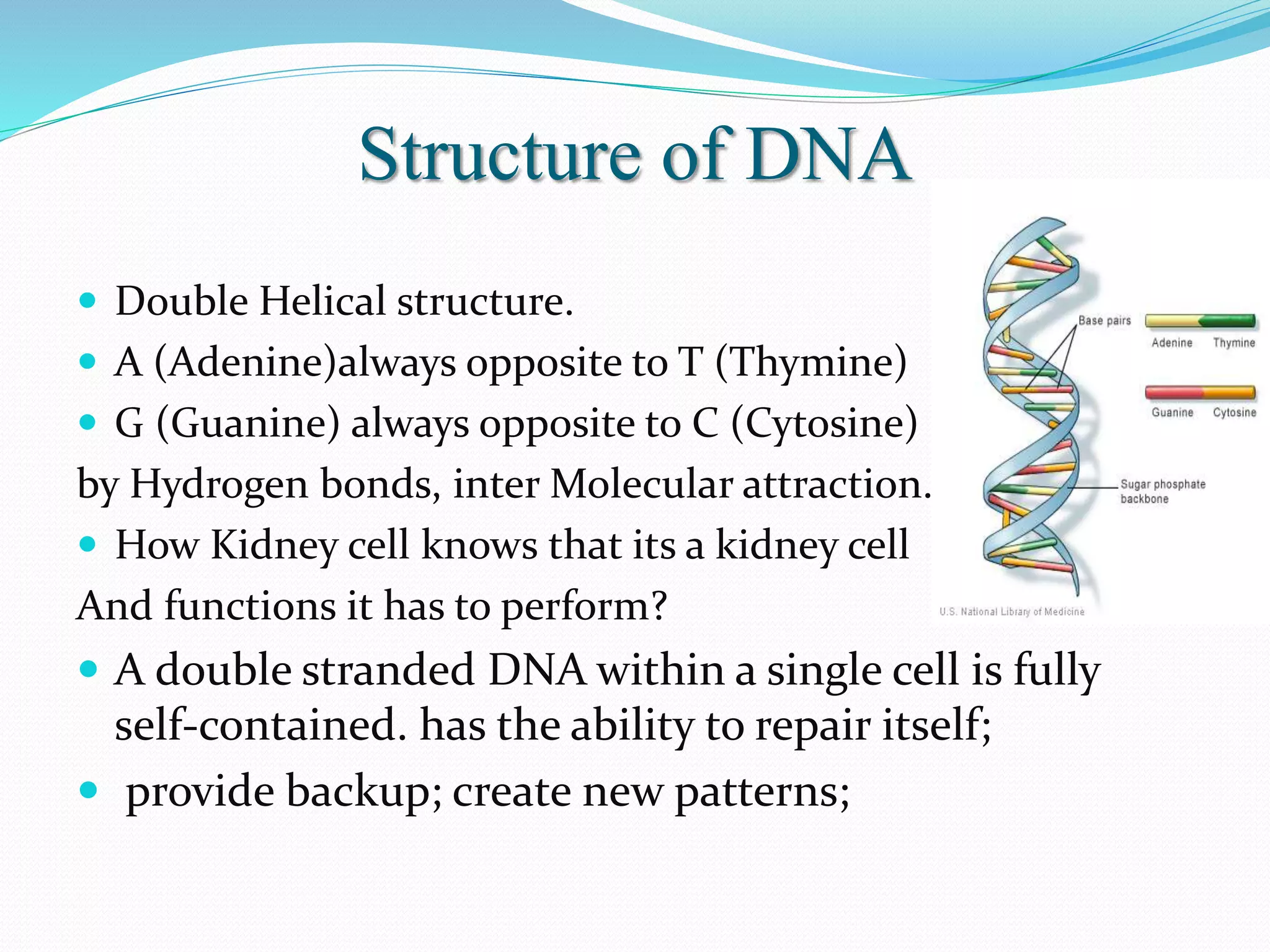
Structure of DNA
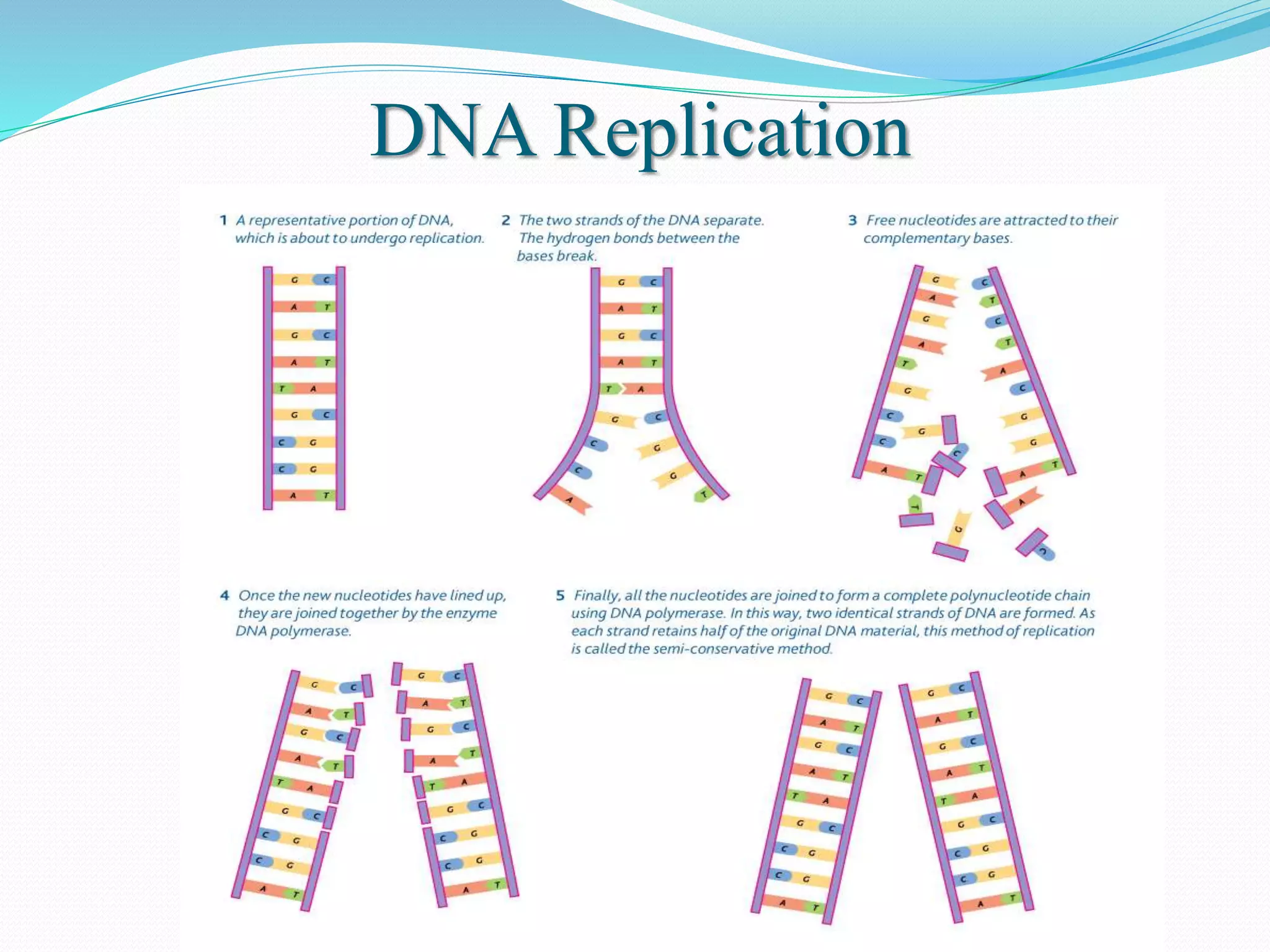
 Double Helical structure.
 A (Adenine)always opposite to T (Thymine)
 G (Guanine) always opposite to C (Cytosine)
by Hydrogen bonds, inter Molecular attraction.
 How Kidney cell knows that its a kidney cell
And functions it has to perform?
 A double stranded DNA within a single cell is fully
self-contained. has the ability to repair itself;
 provide backup; create new patterns;
DNA Replication
Bio-Chemical Operations on DNA
 Extraction: Given a test tube T and strand s, it is possible
to extract all the strands in T that contain ‘s’ as
substring.(Polymerase chain Reaction PCR).
 Annealing: It is possible to pair (anneal) and separate
(melt) two antiparallel and complementary single strands.
 Separation By Sequence: Allows to remove all DNA
strands that contain a desired sequence.(by generating
complement strands).Known as Watson- Crick Model. Also
Append, Detect.
Bio-Chemical Operations cont.
 Nucleases : Nucleases cut nucleic acids. use restriction
Enzymes. e.g., echerichia coli restriction enzyme cut DNA
after G in sequence.
 Ligases: Bind molecules together. Covalently bond two
strands into single.
 Electrophoresis: The negatively charged DNA move towards
anode with, shorter strands moving more quickly than longer.
 Separation By Length: Using Electrophoresis, contents of
test tube can be separated by increasing length.
Adleman’s Experiment
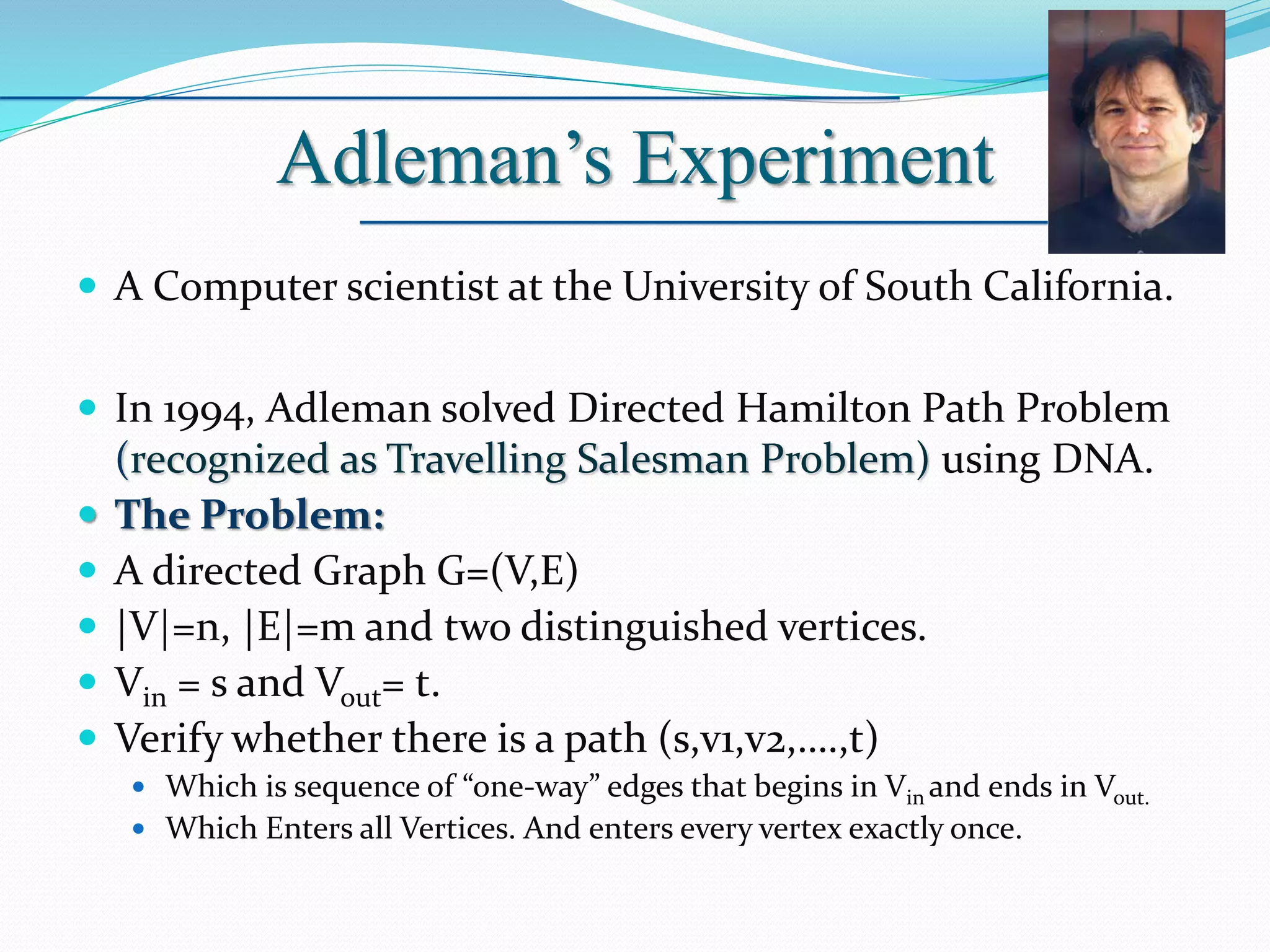
 A Computer scientist at the University of South California.
 In 1994, Adleman solved Directed Hamilton Path Problem
(recognized as Travelling Salesman Problem) using DNA.
 The Problem:
 A directed Graph G=(V,E)
 |V|=n, |E|=m and two distinguished vertices.
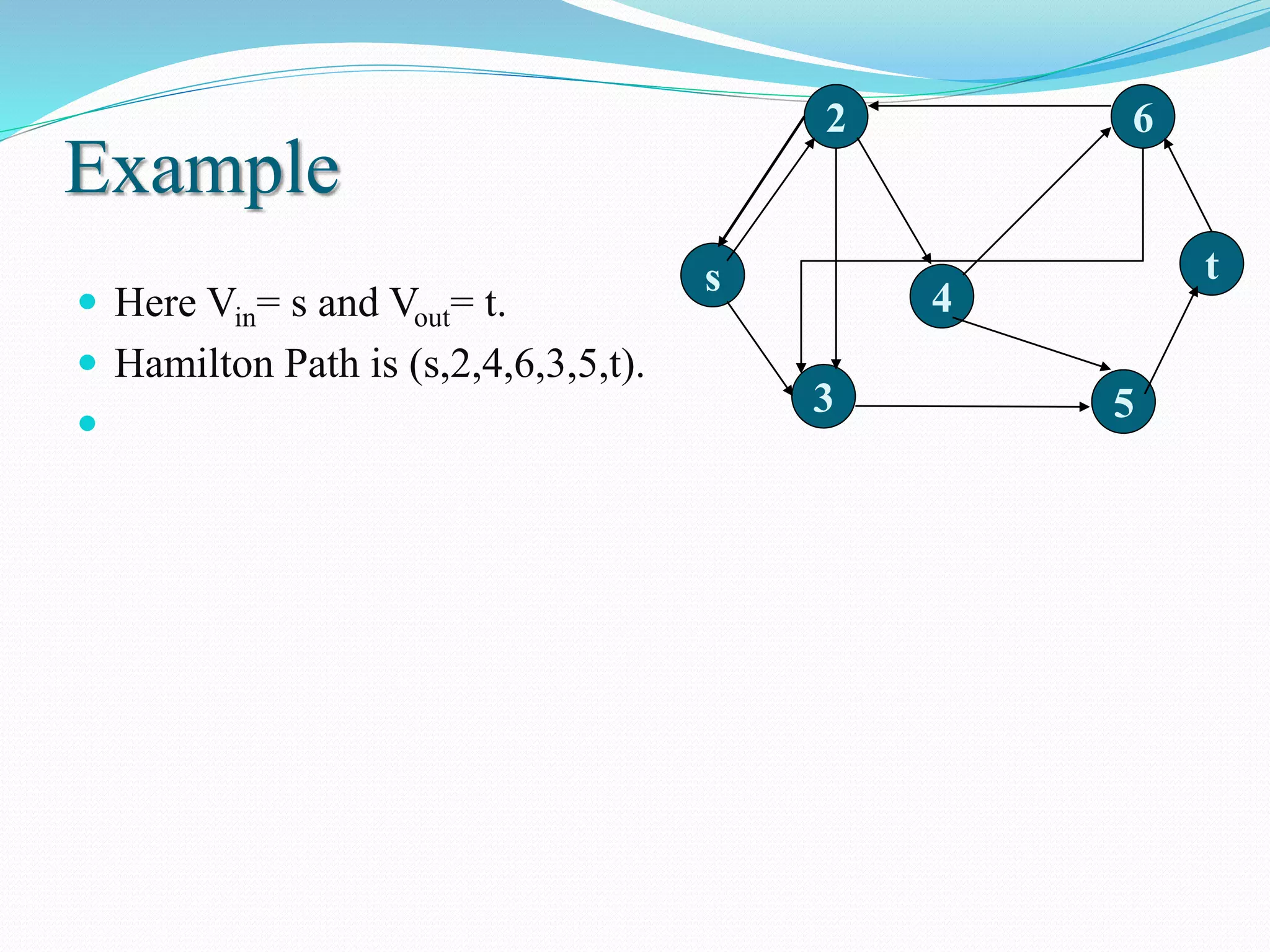
 Vin = s and Vout= t.
 Verify whether there is a path (s,v1,v2,….,t)
 Which is sequence of “one-way” edges that begins in Vin and ends in Vout.
 Which Enters all Vertices. And enters every vertex exactly once.
Example
 Here Vin= s and Vout= t.
 Hamilton Path is (s,2,4,6,3,5,t).

s
4
53
62
t
Algorithm of Adleman
1. Generate Random paths
2. From all paths created in step 1, keep only those that start at s
and end at t.
3. From all remaining paths, keep only those that visit exactly n
vertices.
4. From all remaining paths, keep only those that visit each vertex
at least once.
5. if any path remains, return “yes”; otherwise, return “no”.
Step 1.Random Path Generation
 Vertex Representation:
 Each vertex in graph is associated with a random 20-
mersequence of DNA denoted by Sv.
 For each such sequence generate its complement Sv.
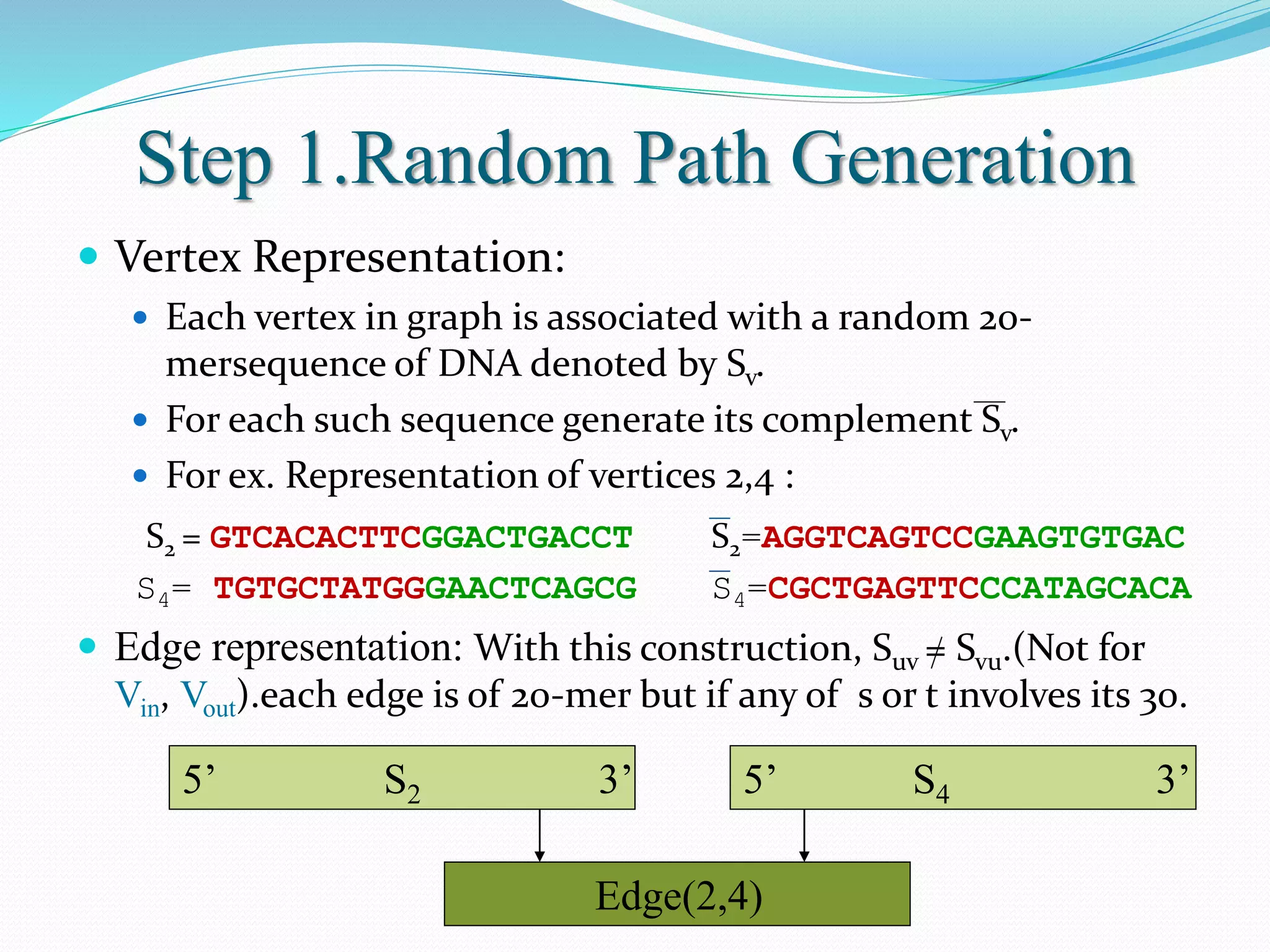
 For ex. Representation of vertices 2,4 :
S2 = GTCACACTTCGGACTGACCT S2=AGGTCAGTCCGAAGTGTGAC
S4= TGTGCTATGGGAACTCAGCG S4=CGCTGAGTTCCCATAGCACA
 Edge representation: With this construction, Suv = Svu.(Not for
Vin, Vout).each edge is of 20-mer but if any of s or t involves its 30.
5’ S2 3’ 5’ S4 3’
Edge(2,4)
Step 2:Keep Only those that start at s and end at t
 Product of step 1 is amplified by PCR(Polymerase Chain
Reaction: one way to amplify DNA) using primers Ss and St.
 By this, only those molecules encoding paths that begin
with vertex s and end with vertex t were amplified.
Step3:Keep Only those that visit exactly n vertices.
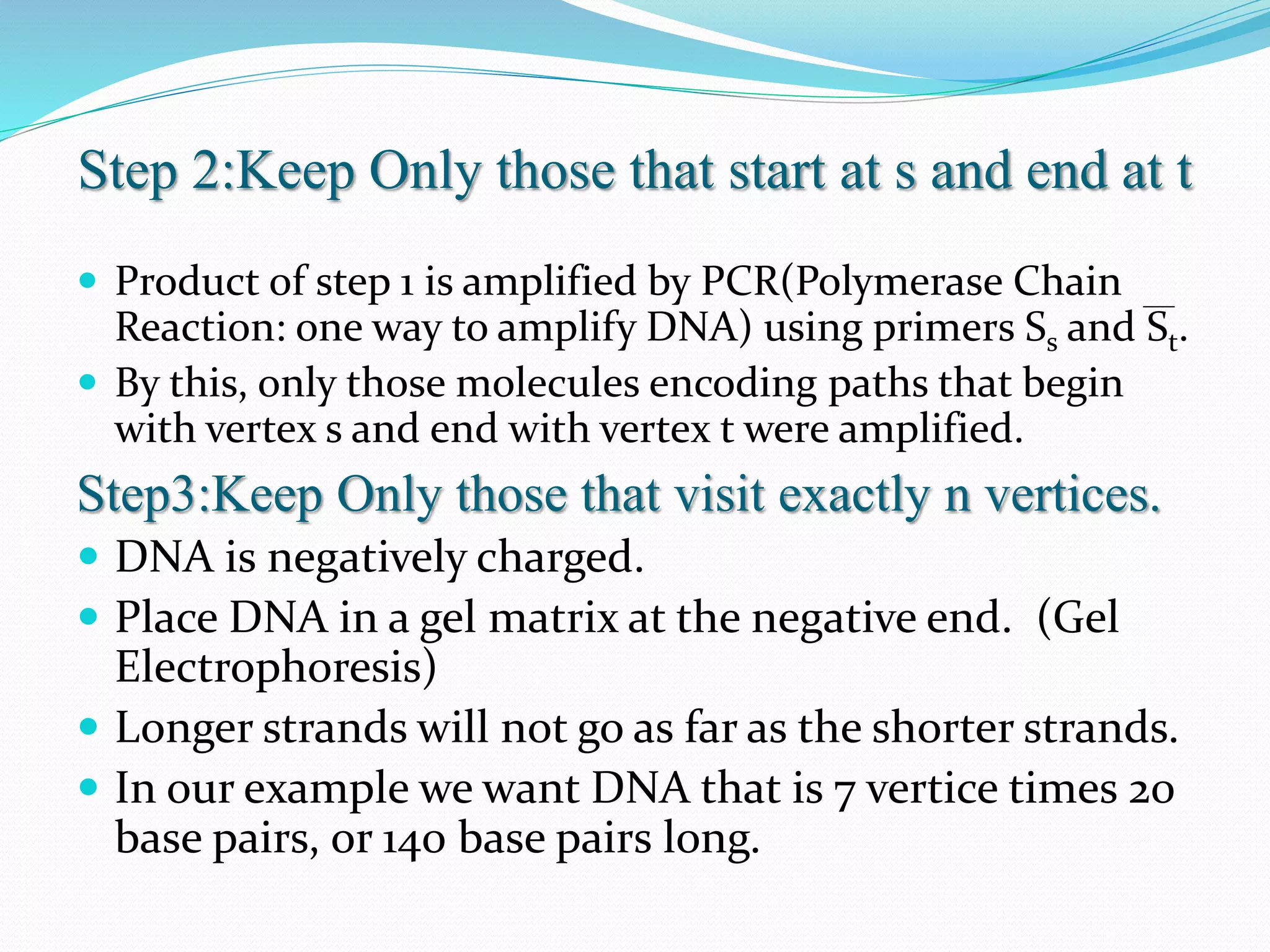
 DNA is negatively charged.
 Place DNA in a gel matrix at the negative end. (Gel
Electrophoresis)
 Longer strands will not go as far as the shorter strands.
 In our example we want DNA that is 7 vertice times 20
base pairs, or 140 base pairs long.
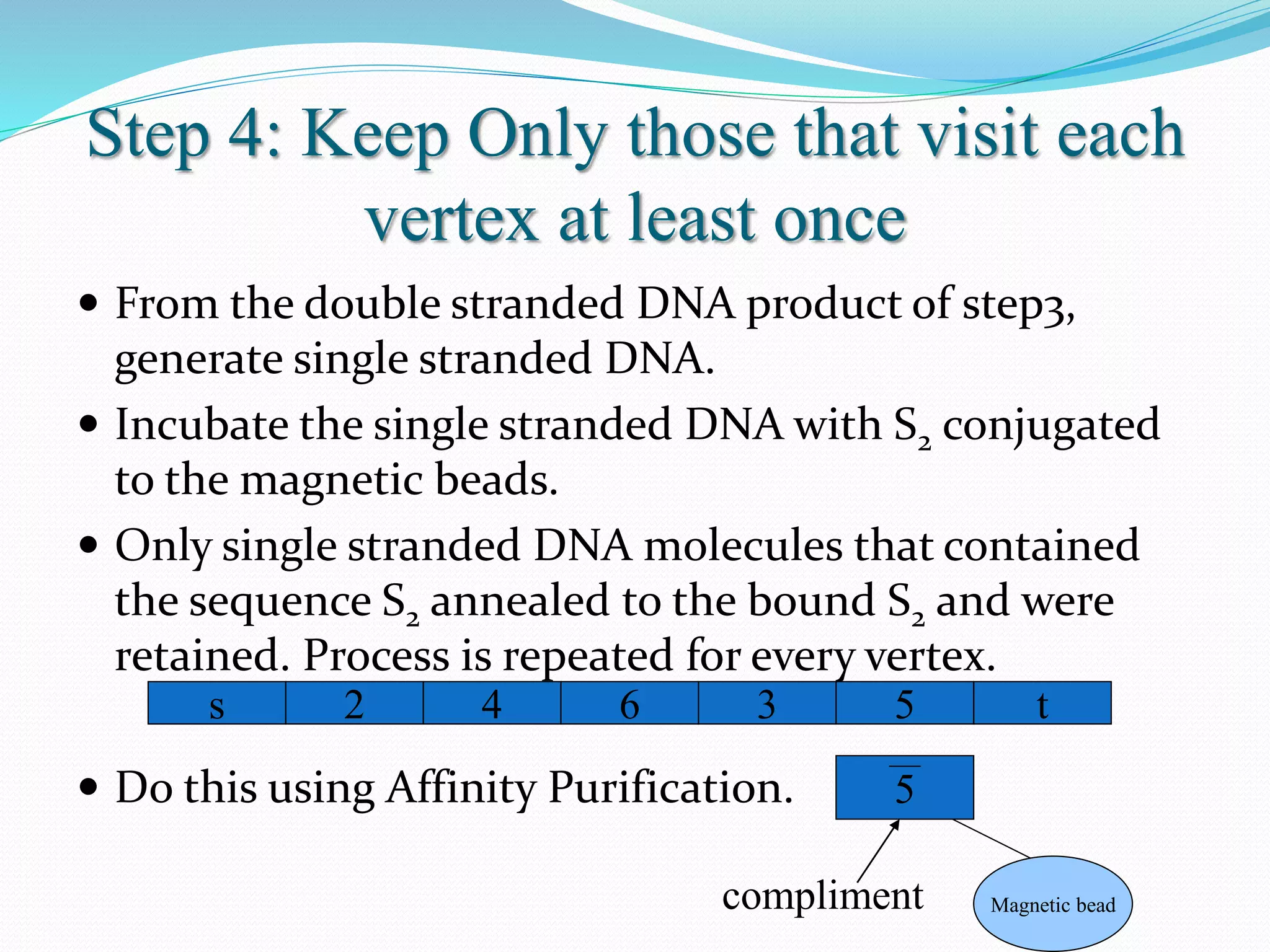
Step 4: Keep Only those that visit each
vertex at least once
 From the double stranded DNA product of step3,
generate single stranded DNA.
 Incubate the single stranded DNA with S2 conjugated
to the magnetic beads.
 Only single stranded DNA molecules that contained
the sequence S2 annealed to the bound S2 and were
retained. Process is repeated for every vertex.
 Do this using Affinity Purification.
s 2 t4 6 3 5
5
compliment Magnetic bead
Advantages and DNA Computers
 Parallelism: A Test Tube of DNA can contain trillions of DNA
strands . So each operation is carried out on all strands in test tube
Parallel!!!
 Low Power dissipation: 2 x 10¹⁹
operations per joule.
 Clean, Cheap and Available.
 Gigantic Memory Capacity: The 1 gram of DNA can hold
about 1x10¹⁴
MB of data.
 Bio-Ware: why not turn the living cell itself into a computer,
powered by its own metabolism.
 Suitable for N-P Hard problems: experiments have proved
that DNA Computers are suitable for solving complex
combinatorial problems. to break Data Encryption Standard(DES).
Disadvantages : Danger of Errors Possible
 Undesired Annealing:
 Partial Matches: A strand u could anneal with one that’s
similar to ū, but it is not the right one.
 Undesired matches between two shifted strands
 What would happen if a ‘good’ path were lost during one of the
extraction operations in step4?
-FALSE NEGATIVE!
-Adleman’s suggestion: to amplify the content of the test
tube.
 Hydrolyses: DNA Molecules Fracture and Gradually
turns into water.
Disadv. Cont. Size and Error Restrictions
 The computation time required to solve problems with a DNA
computer does not grow exponentially, but amount of DNA
required DOES.(for 200 cities will take wt of earth.)
 DNA computing involves a relatively large amount of error.
 As size of problem grows, probability of receiving incorrect
answer eventually becomes greater than probability of
receiving correct answer.
 Information Untransmittable: We can not make two strands
communicate with each other.
Future Scenario
 DNA Manipulation technology has rapidly improved
in recent years, and future advances may make DNA
computers more efficient.
 DNA computers are unlikely to feature word
processing, emailing and solitaire programs.
 Instead, their powerful computing power will be used
for areas of encryption, genetic programming,
language systems, and algorithms or by airlines
wanting to map more efficient routes. Hence better
applicable in only some promising areas.
References:
 Leonard M. Adleman, “Computing With DNA” Scientist southern
California American Aug. 1998
 Balaji Akula and James Cusick “Biological Computing
Fundamentals and Futures” Walters Kluwer Corporate Legal
Services New York, NY
 N. Lewis, P. Weinberger, 1995 “DNA Computing” JASON The
Mitre Corporation,
 Fulk, Kevin, 2003, “Biological Computing, ISRC Future
Technology Topic Brief”, Viewed on April 2009,
http://www.uhisrc.com/FTB/Biocomputing/FTBBioComp.pdf.
It will take years to develop a practical, workable DNA
computer.
But…Let’s all hope that this DREAM comes true!!!
Thank You!
Any Questions?

DNA computing seminar

  • 1.
  • 2.
    Seminar Outline  Introduction:Why to switch to DNA Computing?  Structure of DNA(DeoxyRibo Nucleic Acid).  Bio-Chemical Operations on DNA, useful in Computing.  Adleman's Experiment.  Advantages and Disadvantages of DNA Computing.  Future Scenario.
  • 3.
    Why Switch toDNA Computing  In last few decades Electronics have invaded all walks of life. Modern chips have 1 million Transistors per mm2.  Miniaturization of Electronics Devices can not continue – the laws of physics and nature will catch up soon to impose limit on Silicon Chips.  Uniqueness of DNA: Why DNA is computational Element?  Extremely dense information.  Enormous Parallelism.  Highly energy efficient.
  • 4.
    Structure of DNA Double Helical structure.  A (Adenine)always opposite to T (Thymine)  G (Guanine) always opposite to C (Cytosine) by Hydrogen bonds, inter Molecular attraction.  How Kidney cell knows that its a kidney cell And functions it has to perform?  A double stranded DNA within a single cell is fully self-contained. has the ability to repair itself;  provide backup; create new patterns;
  • 5.
  • 6.
    Bio-Chemical Operations onDNA  Extraction: Given a test tube T and strand s, it is possible to extract all the strands in T that contain ‘s’ as substring.(Polymerase chain Reaction PCR).  Annealing: It is possible to pair (anneal) and separate (melt) two antiparallel and complementary single strands.  Separation By Sequence: Allows to remove all DNA strands that contain a desired sequence.(by generating complement strands).Known as Watson- Crick Model. Also Append, Detect.
  • 7.
    Bio-Chemical Operations cont. Nucleases : Nucleases cut nucleic acids. use restriction Enzymes. e.g., echerichia coli restriction enzyme cut DNA after G in sequence.  Ligases: Bind molecules together. Covalently bond two strands into single.  Electrophoresis: The negatively charged DNA move towards anode with, shorter strands moving more quickly than longer.  Separation By Length: Using Electrophoresis, contents of test tube can be separated by increasing length.
  • 8.
    Adleman’s Experiment  AComputer scientist at the University of South California.  In 1994, Adleman solved Directed Hamilton Path Problem (recognized as Travelling Salesman Problem) using DNA.  The Problem:  A directed Graph G=(V,E)  |V|=n, |E|=m and two distinguished vertices.  Vin = s and Vout= t.  Verify whether there is a path (s,v1,v2,….,t)  Which is sequence of “one-way” edges that begins in Vin and ends in Vout.  Which Enters all Vertices. And enters every vertex exactly once.
  • 9.
    Example  Here Vin=s and Vout= t.  Hamilton Path is (s,2,4,6,3,5,t).  s 4 53 62 t
  • 10.
    Algorithm of Adleman 1.Generate Random paths 2. From all paths created in step 1, keep only those that start at s and end at t. 3. From all remaining paths, keep only those that visit exactly n vertices. 4. From all remaining paths, keep only those that visit each vertex at least once. 5. if any path remains, return “yes”; otherwise, return “no”.
  • 11.
    Step 1.Random PathGeneration  Vertex Representation:  Each vertex in graph is associated with a random 20- mersequence of DNA denoted by Sv.  For each such sequence generate its complement Sv.  For ex. Representation of vertices 2,4 : S2 = GTCACACTTCGGACTGACCT S2=AGGTCAGTCCGAAGTGTGAC S4= TGTGCTATGGGAACTCAGCG S4=CGCTGAGTTCCCATAGCACA  Edge representation: With this construction, Suv = Svu.(Not for Vin, Vout).each edge is of 20-mer but if any of s or t involves its 30. 5’ S2 3’ 5’ S4 3’ Edge(2,4)
  • 12.
    Step 2:Keep Onlythose that start at s and end at t  Product of step 1 is amplified by PCR(Polymerase Chain Reaction: one way to amplify DNA) using primers Ss and St.  By this, only those molecules encoding paths that begin with vertex s and end with vertex t were amplified. Step3:Keep Only those that visit exactly n vertices.  DNA is negatively charged.  Place DNA in a gel matrix at the negative end. (Gel Electrophoresis)  Longer strands will not go as far as the shorter strands.  In our example we want DNA that is 7 vertice times 20 base pairs, or 140 base pairs long.
  • 13.
    Step 4: KeepOnly those that visit each vertex at least once  From the double stranded DNA product of step3, generate single stranded DNA.  Incubate the single stranded DNA with S2 conjugated to the magnetic beads.  Only single stranded DNA molecules that contained the sequence S2 annealed to the bound S2 and were retained. Process is repeated for every vertex.  Do this using Affinity Purification. s 2 t4 6 3 5 5 compliment Magnetic bead
  • 14.
    Advantages and DNAComputers  Parallelism: A Test Tube of DNA can contain trillions of DNA strands . So each operation is carried out on all strands in test tube Parallel!!!  Low Power dissipation: 2 x 10¹⁹ operations per joule.  Clean, Cheap and Available.  Gigantic Memory Capacity: The 1 gram of DNA can hold about 1x1014 MB of data.  Bio-Ware: why not turn the living cell itself into a computer, powered by its own metabolism.  Suitable for N-P Hard problems: experiments have proved that DNA Computers are suitable for solving complex combinatorial problems. to break Data Encryption Standard(DES).
  • 15.
    Disadvantages : Dangerof Errors Possible  Undesired Annealing:  Partial Matches: A strand u could anneal with one that’s similar to ū, but it is not the right one.  Undesired matches between two shifted strands  What would happen if a ‘good’ path were lost during one of the extraction operations in step4? -FALSE NEGATIVE! -Adleman’s suggestion: to amplify the content of the test tube.  Hydrolyses: DNA Molecules Fracture and Gradually turns into water.
  • 16.
    Disadv. Cont. Sizeand Error Restrictions  The computation time required to solve problems with a DNA computer does not grow exponentially, but amount of DNA required DOES.(for 200 cities will take wt of earth.)  DNA computing involves a relatively large amount of error.  As size of problem grows, probability of receiving incorrect answer eventually becomes greater than probability of receiving correct answer.  Information Untransmittable: We can not make two strands communicate with each other.
  • 17.
    Future Scenario  DNAManipulation technology has rapidly improved in recent years, and future advances may make DNA computers more efficient.  DNA computers are unlikely to feature word processing, emailing and solitaire programs.  Instead, their powerful computing power will be used for areas of encryption, genetic programming, language systems, and algorithms or by airlines wanting to map more efficient routes. Hence better applicable in only some promising areas.
  • 18.
    References:  Leonard M.Adleman, “Computing With DNA” Scientist southern California American Aug. 1998  Balaji Akula and James Cusick “Biological Computing Fundamentals and Futures” Walters Kluwer Corporate Legal Services New York, NY  N. Lewis, P. Weinberger, 1995 “DNA Computing” JASON The Mitre Corporation,  Fulk, Kevin, 2003, “Biological Computing, ISRC Future Technology Topic Brief”, Viewed on April 2009, http://www.uhisrc.com/FTB/Biocomputing/FTBBioComp.pdf.
  • 19.
    It will takeyears to develop a practical, workable DNA computer. But…Let’s all hope that this DREAM comes true!!! Thank You! Any Questions?