Factors Affecting Bioavailability
Dr. Salman H. Rizvi
JR1
Dept. of Pharmacology
Dr. V. M. Govt. Medical College
Solapur
(08/08/2018)
Objectives:
– Bioavailability
– Bioequivalence
– Chemical Equivalence
– Pharmaceutical Equivalence
– Therapeutic Equivalence
– Clinical Equivalence
– Factors Affecting Bioavailability
• Pharmaceutical factors
• Pharmacological factors
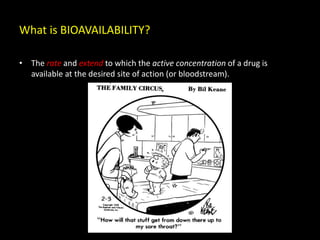
What is BIOAVAILABILITY?
• The rate and extend to which the active concentration of a drug is
available at the desired site of action (or bloodstream).
How does it differs from BIOEQUIVALENCE?
• If two or more, similar dosage forms of the same drug reach the blood
circulation at the same relative rate and extend, those are BIOEQUIVALENT
preparations of that generic drug.
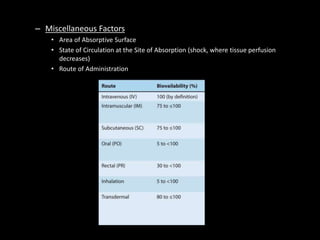
• Difference in bioavailability is usually seen with ORAL dosage forms,
bioavailability of I.V is 100%, I.M and S.C are assumed to be close to 100%.
• Differences of less than 25% in bioavailability among several formulations
of one drug will usually have no significant effect on clinical outcome,
hence such formulations can be called BIOEQUIALENT.
• Chemical Equivalence
– If two or more dosage forms of the same drug contains the same
labeled quantities of the drug as specified in Pharmacopoeia, these are
Chemical Equivalent drugs.
• Pharmaceutical Equivalence
– If the two or more Chemical Equivalent drug’s dosage forms also
contains other similar ingredients, e.g. excipients (binders), those
dosage forms are considered to be Pharmaceutical Equivalent.
• Therapeutic Equivalence
– If they provide an identical in vivo pharmacological response, as
measured by control of symptoms or disease and safety profile.
• Clinical Equivalence
– If one structurally different drug can provide the same clinical
response as another mechanically related drug, they are considered to
exhibit clinical equivalence.
What are the factors influencing BIOAVAILABILITY?
• Pharmaceutical factors
• Pharmacological factors
• Pharmaceutical Factors:
– It is expected that, bioavailability of drugs to be in this decreasing
order-
• Solutions > Suspension > Capsule > Tablet > Coated Tablet
The Pharmaceutical factors include:
– Particle Size
• The rate at which a drug is dissolved can be increased by increasing its surface area
by decreasing its PARTICLE SIZE.
– Salt Form
• The rate at which a particular salt dissolves differs from its parent compound.
• Salts of weakly acidic drugs are highly water soluble, free acidic drugs is
precipitated from these salts is micro crystalline form, which has a faster dissolution
rate and increases bioavailability.
– Crystal Forms
• The rate of absorption and bioavailability of a drug also depends on its crystalline
form.
• This is because amorphous forms dissolve faster compared to crystalline forms,
because no energy is needed to break up the crystalline lattice, thus increasing
their bioavailability.
– Water of Hydration
• Many drugs incorporate water to produce a crystalline form called hydrates.
• If water molecules are already present in a crystal structure, the tendency of the
crystal to attract additional water to initiate dissolution process is reduced,
compared to anhydrous forms.
– Nature of Excipients and Adjuvants
• These pharmacologically inert substances , (e.g starch, lactose, calcium sulfate,
gum) which are added as filling material or as binding agents or to obtain proper
granular size, have tremendous effects on bioavailability of drugs.
• Some of these excipients are wetting agents, which enhance solvent penetration
and ensures faster dissolution and in turn absorption.
• We should be particularly careful in drugs which follows zero order or mixed order
kinetics or have a low margin of safety.
– Degree of Ionisation
• Non-ionised, lipid soluble drugs are better absorbed, increasing their bioavailability,
compared to strongly acidic or strongly basic drugs or highly ionised drugs.
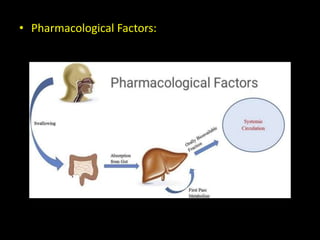
• Pharmacological Factors:
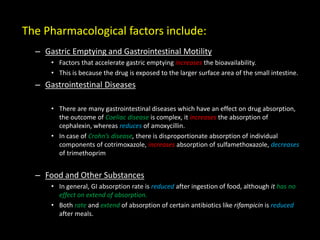
The Pharmacological factors include:
– Gastric Emptying and Gastrointestinal Motility
• Factors that accelerate gastric emptying increases the bioavailability.
• This is because the drug is exposed to the larger surface area of the small intestine.
– Gastrointestinal Diseases
• There are many gastrointestinal diseases which have an effect on drug absorption,
the outcome of Coeliac disease is complex, it increases the absorption of
cephalexin, whereas reduces of amoxycillin.
• In case of Crohn’s disease, there is disproportionate absorption of individual
components of cotrimoxazole, increases absorption of sulfamethoxazole, decreases
of trimethoprim
– Food and Other Substances
• In general, GI absorption rate is reduced after ingestion of food, although it has no
effect on extend of absorption.
• Both rate and extend of absorption of certain antibiotics like rifampicin is reduced
after meals.
• Absorption of tetracyclines is reduced if taken with milk because it forms poorly
absorbed complexes with calcium.
• Vit. C increases absorption of iron because it keeps it in it’s ferrous form.
– First Pass Metabolism
• It means that drug degradation occurs, reducing its bioavailability, when it passed
through GIT wall and then through portal system, before it reaches systemic
circulation.
– Drug-Drug Interactions
• Drug-drug interactions can also cause difference in bioavailability.
• Liquid paraffin decreases the bioavailability of fat soluble vitamins as it emulsifies
fat.
• Antacids reduces bioavailability of tetracyclines because it forms chelated complex.
– Pharmacogenetic Factors
• Large difference in bioavailability often occurs among humans due to
pharmacogenetic reasons.
• Slow and fast acetylators show increased and decreased bioavailability of isoniazid
respectively.
– Miscellaneous Factors
• Area of Absorptive Surface
• State of Circulation at the Site of Absorption (shock, where tissue perfusion
decreases)
• Route of Administration
References:
– Goodman L. S, Goodman & Gilman’s Pharmacological Basis
of Therapeutics, 13th Edition, New York; New Delhi,
TataMcGraw-Hill Education, 2017.
– Katzung B. G, Basic and Clinical Pharmacology, 14th Edition,
New York; New Delhi, TataMcGraw-Hill Education, 2017.
– Tripathi K.D, Essentials of Medical Pharmacology, 7th
Edition, New Delhi, Jaypee Brothers Publications, 2013.
– Sharma H. L, Principles of Pharmacology, 3rd Edition, New
Delhi, Paras Medical Publisher, 2018
Thank You!


Factors affecting bioavailability.

  • 1.
    Factors Affecting Bioavailability Dr.Salman H. Rizvi JR1 Dept. of Pharmacology Dr. V. M. Govt. Medical College Solapur (08/08/2018)
  • 2.
    Objectives: – Bioavailability – Bioequivalence –Chemical Equivalence – Pharmaceutical Equivalence – Therapeutic Equivalence – Clinical Equivalence – Factors Affecting Bioavailability • Pharmaceutical factors • Pharmacological factors
  • 3.
    What is BIOAVAILABILITY? •The rate and extend to which the active concentration of a drug is available at the desired site of action (or bloodstream).
  • 4.
    How does itdiffers from BIOEQUIVALENCE? • If two or more, similar dosage forms of the same drug reach the blood circulation at the same relative rate and extend, those are BIOEQUIVALENT preparations of that generic drug. • Difference in bioavailability is usually seen with ORAL dosage forms, bioavailability of I.V is 100%, I.M and S.C are assumed to be close to 100%. • Differences of less than 25% in bioavailability among several formulations of one drug will usually have no significant effect on clinical outcome, hence such formulations can be called BIOEQUIALENT.
  • 5.
    • Chemical Equivalence –If two or more dosage forms of the same drug contains the same labeled quantities of the drug as specified in Pharmacopoeia, these are Chemical Equivalent drugs. • Pharmaceutical Equivalence – If the two or more Chemical Equivalent drug’s dosage forms also contains other similar ingredients, e.g. excipients (binders), those dosage forms are considered to be Pharmaceutical Equivalent.
  • 6.
    • Therapeutic Equivalence –If they provide an identical in vivo pharmacological response, as measured by control of symptoms or disease and safety profile. • Clinical Equivalence – If one structurally different drug can provide the same clinical response as another mechanically related drug, they are considered to exhibit clinical equivalence.
  • 7.
    What are thefactors influencing BIOAVAILABILITY? • Pharmaceutical factors • Pharmacological factors
  • 8.
    • Pharmaceutical Factors: –It is expected that, bioavailability of drugs to be in this decreasing order- • Solutions > Suspension > Capsule > Tablet > Coated Tablet
  • 9.
    The Pharmaceutical factorsinclude: – Particle Size • The rate at which a drug is dissolved can be increased by increasing its surface area by decreasing its PARTICLE SIZE. – Salt Form • The rate at which a particular salt dissolves differs from its parent compound. • Salts of weakly acidic drugs are highly water soluble, free acidic drugs is precipitated from these salts is micro crystalline form, which has a faster dissolution rate and increases bioavailability. – Crystal Forms • The rate of absorption and bioavailability of a drug also depends on its crystalline form. • This is because amorphous forms dissolve faster compared to crystalline forms, because no energy is needed to break up the crystalline lattice, thus increasing their bioavailability.
  • 10.
    – Water ofHydration • Many drugs incorporate water to produce a crystalline form called hydrates. • If water molecules are already present in a crystal structure, the tendency of the crystal to attract additional water to initiate dissolution process is reduced, compared to anhydrous forms. – Nature of Excipients and Adjuvants • These pharmacologically inert substances , (e.g starch, lactose, calcium sulfate, gum) which are added as filling material or as binding agents or to obtain proper granular size, have tremendous effects on bioavailability of drugs. • Some of these excipients are wetting agents, which enhance solvent penetration and ensures faster dissolution and in turn absorption. • We should be particularly careful in drugs which follows zero order or mixed order kinetics or have a low margin of safety. – Degree of Ionisation • Non-ionised, lipid soluble drugs are better absorbed, increasing their bioavailability, compared to strongly acidic or strongly basic drugs or highly ionised drugs.
  • 11.
  • 12.
    The Pharmacological factorsinclude: – Gastric Emptying and Gastrointestinal Motility • Factors that accelerate gastric emptying increases the bioavailability. • This is because the drug is exposed to the larger surface area of the small intestine. – Gastrointestinal Diseases • There are many gastrointestinal diseases which have an effect on drug absorption, the outcome of Coeliac disease is complex, it increases the absorption of cephalexin, whereas reduces of amoxycillin. • In case of Crohn’s disease, there is disproportionate absorption of individual components of cotrimoxazole, increases absorption of sulfamethoxazole, decreases of trimethoprim – Food and Other Substances • In general, GI absorption rate is reduced after ingestion of food, although it has no effect on extend of absorption. • Both rate and extend of absorption of certain antibiotics like rifampicin is reduced after meals.
  • 13.
    • Absorption oftetracyclines is reduced if taken with milk because it forms poorly absorbed complexes with calcium. • Vit. C increases absorption of iron because it keeps it in it’s ferrous form. – First Pass Metabolism • It means that drug degradation occurs, reducing its bioavailability, when it passed through GIT wall and then through portal system, before it reaches systemic circulation. – Drug-Drug Interactions • Drug-drug interactions can also cause difference in bioavailability. • Liquid paraffin decreases the bioavailability of fat soluble vitamins as it emulsifies fat. • Antacids reduces bioavailability of tetracyclines because it forms chelated complex. – Pharmacogenetic Factors • Large difference in bioavailability often occurs among humans due to pharmacogenetic reasons. • Slow and fast acetylators show increased and decreased bioavailability of isoniazid respectively.
  • 14.
    – Miscellaneous Factors •Area of Absorptive Surface • State of Circulation at the Site of Absorption (shock, where tissue perfusion decreases) • Route of Administration
  • 15.
    References: – Goodman L.S, Goodman & Gilman’s Pharmacological Basis of Therapeutics, 13th Edition, New York; New Delhi, TataMcGraw-Hill Education, 2017. – Katzung B. G, Basic and Clinical Pharmacology, 14th Edition, New York; New Delhi, TataMcGraw-Hill Education, 2017. – Tripathi K.D, Essentials of Medical Pharmacology, 7th Edition, New Delhi, Jaypee Brothers Publications, 2013. – Sharma H. L, Principles of Pharmacology, 3rd Edition, New Delhi, Paras Medical Publisher, 2018
  • 16.