Transforming Lives and Landscapes with Trees
W E B I N AR
Value Chain Development and The Poor
June 17, 2021 / 11:00 – 12:00 PM EDT
PRESENTERS:
Jason Donovan, International Maize and Wheat Improvement Center(CIMMYT)
Dietmar Stoian, World Agroforestry (ICRAF)
Jon Hellin, International Rice Research Institute (IRRI)
MODERATOR:
Erwin Bulte, Wageningen University
DISCUSSANT:
Frank Place, CGIAR Research Program on
Policies, Institutions, and Markets (PIM)
Transforming Lives and Landscapes with Trees
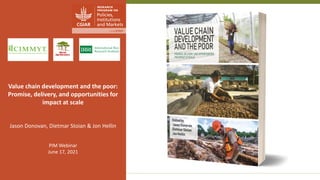
Value chain development and the poor:
Promise, delivery, and opportunities for
impact at scale
Jason Donovan, Dietmar Stoian & Jon Hellin
PIM Webinar
June 17, 2021
Transforming Lives and Landscapes with Trees
Rationale for the book
• Significant investments in value chain development (VCD) by donors, govts, private
sector since early 2000s
• Value chain concepts & approaches have expanded into other development areas: local
economic development, gender equity, health & nutrition, food systems, seed systems
• Need for critical reflection on what works (and what doesn’t)
• Fundamental questions unanswered: does VCD lead to …
➢ better access to markets for smallholders (inclusion)?
➢ increased value adding & more equitable benefit sharing?
➢ improved food security and gender equity?
➢ enhanced environmental sustainability?
• Strong interest in academia on value chains, but much less interest in VCD
• CGIAR has figured prominently in value chain discussions (last 5-10 years)
• Book brings together insights from researchers, including CGIAR, and practitioners on
how to achieve impact at scale
Transforming Lives and Landscapes with Trees
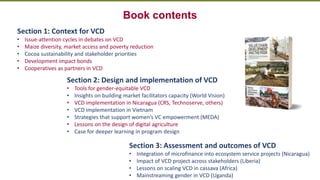
Book contents
Section 1: Context for VCD
• Issue-attention cycles in debates on VCD
• Maize diversity, market access and poverty reduction
• Cocoa sustainability and stakeholder priorities
• Development impact bonds
• Cooperatives as partners in VCD
Section 2: Design and implementation of VCD
• Tools for gender-equitable VCD
• Insights on building market facilitators capacity (World Vision)
• VCD implementation in Nicaragua (CRS, Technoserve, others)
• VCD implementation in Vietnam
• Strategies that support women’s VC empowerment (MEDA)
• Lessons on the design of digital agriculture
• Case for deeper learning in program design
Section 3: Assessment and outcomes of VCD
• Integration of microfinance into ecosystem service projects (Nicaragua)
• Impact of VCD project across stakeholders (Liberia)
• Lessons on scaling VCD in cassava (Africa)
• Mainstreaming gender in VCD (Uganda)
Transforming Lives and Landscapes with Trees
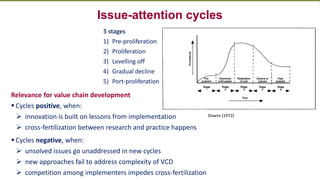
Issue-attention cycles
5 stages
1) Pre-proliferation
2) Proliferation
3) Levelling off
4) Gradual decline
5) Port-proliferation
Downs (1972)
Relevance for value chain development
▪ Cycles positive, when:
➢ innovation is built on lessons from implementation
➢ cross-fertilization between research and practice happens
▪ Cycles negative, when:
➢ unsolved issues go unaddressed in new cycles
➢ new approaches fail to address complexity of VCD
➢ competition among implementers impedes cross-fertilization
Transforming Lives and Landscapes with Trees
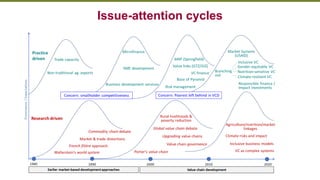
Issue-attention cycles
Transforming Lives and Landscapes with Trees
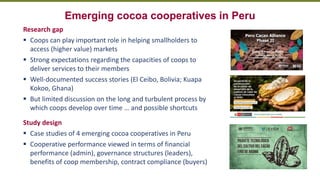
Emerging cocoa cooperatives in Peru
Research gap
▪ Coops can play important role in helping smallholders to
access (higher value) markets
▪ Strong expectations regarding the capacities of coops to
deliver services to their members
▪ Well-documented success stories (El Ceibo, Bolivia; Kuapa
Kokoo, Ghana)
▪ But limited discussion on the long and turbulent process by
which coops develop over time … and possible shortcuts
Study design
▪ Case studies of 4 emerging cocoa cooperatives in Peru
▪ Cooperative performance viewed in terms of financial
performance (admin), governance structures (leaders),
benefits of coop membership, contract compliance (buyers)
Transforming Lives and Landscapes with Trees
Emerging cocoa cooperatives in Peru
Findings
▪ Struggle to build close relations with buyers and members due to limited working capital and
access to finance
▪ Unable to offer higher cocoa prices to members (vis-à-vis traditional channel)
▪ Sales confined to a sole buyer & history of incomplete contracts
▪ Board engaged in day-to-day operations of coop or managers selected by projects
Implications
▪ Development programs that depend on coops for their implementation can't continue to
overlook poor business performance
▪ Value chain partners need stronger commitment to build 'soft assets' associated with
management and governance
▪ Government agencies and NGOs critical too, but need for better monitoring and learning cycles
▪ More private sector engagement—coop building isn't just the purview of NGOs
➔ coordinated interventions and joint risk sharing
Transforming Lives and Landscapes with Trees
VCD implementation in Nicaragua
Research gap
▪ Challenge to get design of VCD 'right': complex business environment,
multiple stakeholders, resource constraints by smallholders and SMEs
▪ Stakeholder needs likely to change during VCD implementation in response
to market conditions, buyer requirements, and livelihoods dynamics
▪ Considerable body of work by CGIAR and others to design VCD approaches
and tools (e.g. LINK, PMCA, 5Capitals, VC Knowledge Clearinghouse)
▪ Yet, we have limited insights regarding which approaches & tools are actually
used and what needs have yet to be covered (ongoing study by PIM)
Study design
▪ Case study of 4 interventions led by INGOs in high value ag sectors (dairy,
horticulture, coffee, cocoa)
▪ 28 interviews with buyers, NGO reps, coops
▪ Covering: overall approach and tools applied, partnerships, achievements,
challenges, perceptions on needs for improved VCD design + implementation
Transforming Lives and Landscapes with Trees
VCD implementation in Nicaragua
Findings
Despite complexity of context, NGOs applied a formulaic approach to VCD design:
▪ reliance on a single tool for design and implementation
▪ expected outcomes based on technical assistance and training
▪ local NGOs and coops with key roles in implementation (but limited oversight
and capacity upgrading)
▪ limited engagement with other chain actors, service providers, and researchers
Implications
Need for a broader approach to VCD, based on:
• combination of tools that account for multiple, context-specific needs of diverse
stakeholders
• deeper collaboration between key actors within and outside VC
• evidence-based reflection and learning
Opportunity
for CGIAR
Transforming Lives and Landscapes with Trees
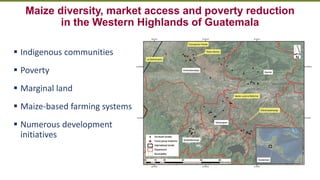
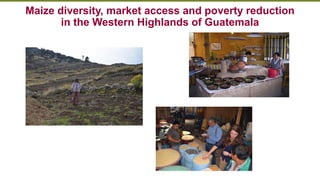
Maize diversity, market access and poverty reduction
in the Western Highlands of Guatemala
▪ Indigenous communities
▪ Poverty
▪ Marginal land
▪ Maize-based farming systems
▪ Numerous development
initiatives
Transforming Lives and Landscapes with Trees
Maize diversity, market access and poverty reduction
in the Western Highlands of Guatemala
Transforming Lives and Landscapes with Trees
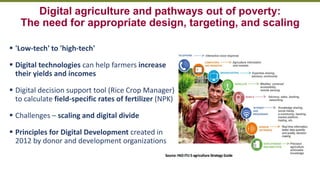
Digital agriculture and pathways out of poverty:
The need for appropriate design, targeting, and scaling
▪ 'Low-tech' to 'high-tech'
▪ Digital technologies can help farmers increase
their yields and incomes
▪ Digital decision support tool (Rice Crop Manager)
to calculate field-specific rates of fertilizer (NPK)
▪ Challenges – scaling and digital divide
▪ Principles for Digital Development created in
2012 by donor and development organizations
Transforming Lives and Landscapes with Trees
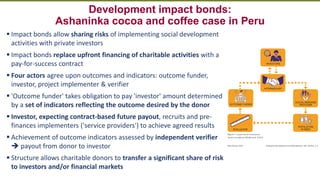
Development impact bonds:
Ashaninka cocoa and coffee case in Peru
▪ Impact bonds allow sharing risks of implementing social development
activities with private investors
▪ Impact bonds replace upfront financing of charitable activities with a
pay-for-success contract
▪ Four actors agree upon outcomes and indicators: outcome funder,
investor, project implementer & verifier
▪ 'Outcome funder' takes obligation to pay 'investor' amount determined
by a set of indicators reflecting the outcome desired by the donor
▪ Investor, expecting contract-based future payout, recruits and pre-
finances implementers ('service providers') to achieve agreed results
▪ Achievement of outcome indicators assessed by independent verifier
➔ payout from donor to investor
▪ Structure allows charitable donors to transfer a significant share of risk
to investors and/or financial markets
Transforming Lives and Landscapes with Trees
Development impact bonds:
Ashaninka cocoa and coffee case in Peru
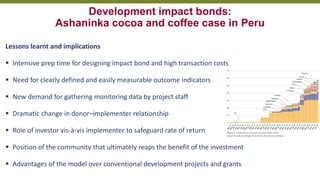
Lessons learnt and implications
▪ Intensive prep time for designing impact bond and high transaction costs
▪ Need for clearly defined and easily measurable outcome indicators
▪ New demand for gathering monitoring data by project staff
▪ Dramatic change in donor–implementer relationship
▪ Role of investor vis-à-vis implementer to safeguard rate of return
▪ Position of the community that ultimately reaps the benefit of the investment
▪ Advantages of the model over conventional development projects and grants
Transforming Lives and Landscapes with Trees
Fit for purpose?
Tools for gender–equitable value chain development
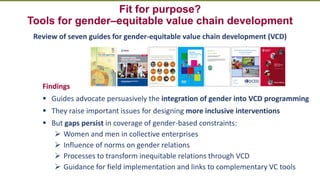
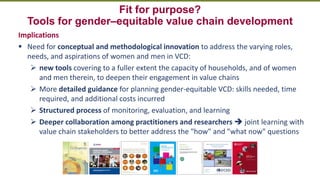
Review of seven guides for gender-equitable value chain development (VCD)
Findings
▪ Guides advocate persuasively the integration of gender into VCD programming
▪ They raise important issues for designing more inclusive interventions
▪ But gaps persist in coverage of gender-based constraints:
➢ Women and men in collective enterprises
➢ Influence of norms on gender relations
➢ Processes to transform inequitable relations through VCD
➢ Guidance for field implementation and links to complementary VC tools
Transforming Lives and Landscapes with Trees
Fit for purpose?
Tools for gender–equitable value chain development
Implications
▪ Need for conceptual and methodological innovation to address the varying roles,
needs, and aspirations of women and men in VCD:
➢ new tools covering to a fuller extent the capacity of households, and of women
and men therein, to deepen their engagement in value chains
➢ More detailed guidance for planning gender-equitable VCD: skills needed, time
required, and additional costs incurred
➢ Structured process of monitoring, evaluation, and learning
➢ Deeper collaboration among practitioners and researchers ➔ joint learning with
value chain stakeholders to better address the "how" and "what now" questions
Transforming Lives and Landscapes with Trees
Synthesis and implications
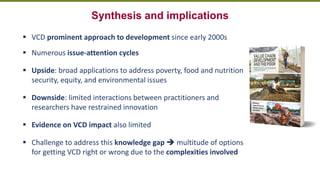
▪ VCD prominent approach to development since early 2000s
▪ Numerous issue-attention cycles
▪ Upside: broad applications to address poverty, food and nutrition
security, equity, and environmental issues
▪ Downside: limited interactions between practitioners and
researchers have restrained innovation
▪ Evidence on VCD impact also limited
▪ Challenge to address this knowledge gap ➔ multitude of options
for getting VCD right or wrong due to the complexities involved
Transforming Lives and Landscapes with Trees
Synthesis and implications
▪ 16 book chapters address this knowledge gap
▪ Unique perspectives on VCD from both practitioners and researchers
▪ Focus: field implementation, options for innovation in VCD design,
and potential for achieving broad-based and lasting impact
▪ Timely critique of current approaches, pointing at a variety of
options for conceptual and methodological innovation:
➢ reflexive learning
➢ new collaborative frameworks
➢ faster and more genuine innovation of VCD design and practice
➢ effective delivery of impact at scale
Transforming Lives and Landscapes with Trees
Thank you!
Emails:
j.donovan@cgiar.org
d.stoian@cgiar.org
j.hellin@cgiar.org
Book can be downloaded from
website of Practical Action
Transforming Lives and Landscapes with Trees
Q&A
Recoding of this webinar will be
available on the PIM website
shortly after the live event. All
registrants will receive a follow-
up email with the link to the
webinar materials (video,
presentation, podcast).
Previous PIM Webinars:
http://bit.ly/PIMwebinars
If you want to receive alerts about
future PIM Webinars, sign up here:
https://pim.cgiar.org/subscribe/
…and follow us on:
@PIM_CGIAR
@PIM.CGIAR

Value Chain Development and The Poor

  • 1.
    Transforming Lives andLandscapes with Trees W E B I N AR Value Chain Development and The Poor June 17, 2021 / 11:00 – 12:00 PM EDT PRESENTERS: Jason Donovan, International Maize and Wheat Improvement Center(CIMMYT) Dietmar Stoian, World Agroforestry (ICRAF) Jon Hellin, International Rice Research Institute (IRRI) MODERATOR: Erwin Bulte, Wageningen University DISCUSSANT: Frank Place, CGIAR Research Program on Policies, Institutions, and Markets (PIM)
  • 2.
    Transforming Lives andLandscapes with Trees Value chain development and the poor: Promise, delivery, and opportunities for impact at scale Jason Donovan, Dietmar Stoian & Jon Hellin PIM Webinar June 17, 2021
  • 3.
    Transforming Lives andLandscapes with Trees Rationale for the book • Significant investments in value chain development (VCD) by donors, govts, private sector since early 2000s • Value chain concepts & approaches have expanded into other development areas: local economic development, gender equity, health & nutrition, food systems, seed systems • Need for critical reflection on what works (and what doesn’t) • Fundamental questions unanswered: does VCD lead to … ➢ better access to markets for smallholders (inclusion)? ➢ increased value adding & more equitable benefit sharing? ➢ improved food security and gender equity? ➢ enhanced environmental sustainability? • Strong interest in academia on value chains, but much less interest in VCD • CGIAR has figured prominently in value chain discussions (last 5-10 years) • Book brings together insights from researchers, including CGIAR, and practitioners on how to achieve impact at scale
  • 4.
    Transforming Lives andLandscapes with Trees Book contents Section 1: Context for VCD • Issue-attention cycles in debates on VCD • Maize diversity, market access and poverty reduction • Cocoa sustainability and stakeholder priorities • Development impact bonds • Cooperatives as partners in VCD Section 2: Design and implementation of VCD • Tools for gender-equitable VCD • Insights on building market facilitators capacity (World Vision) • VCD implementation in Nicaragua (CRS, Technoserve, others) • VCD implementation in Vietnam • Strategies that support women’s VC empowerment (MEDA) • Lessons on the design of digital agriculture • Case for deeper learning in program design Section 3: Assessment and outcomes of VCD • Integration of microfinance into ecosystem service projects (Nicaragua) • Impact of VCD project across stakeholders (Liberia) • Lessons on scaling VCD in cassava (Africa) • Mainstreaming gender in VCD (Uganda)
  • 5.
    Transforming Lives andLandscapes with Trees Issue-attention cycles 5 stages 1) Pre-proliferation 2) Proliferation 3) Levelling off 4) Gradual decline 5) Port-proliferation Downs (1972) Relevance for value chain development ▪ Cycles positive, when: ➢ innovation is built on lessons from implementation ➢ cross-fertilization between research and practice happens ▪ Cycles negative, when: ➢ unsolved issues go unaddressed in new cycles ➢ new approaches fail to address complexity of VCD ➢ competition among implementers impedes cross-fertilization
  • 6.
    Transforming Lives andLandscapes with Trees Issue-attention cycles
  • 7.
    Transforming Lives andLandscapes with Trees Emerging cocoa cooperatives in Peru Research gap ▪ Coops can play important role in helping smallholders to access (higher value) markets ▪ Strong expectations regarding the capacities of coops to deliver services to their members ▪ Well-documented success stories (El Ceibo, Bolivia; Kuapa Kokoo, Ghana) ▪ But limited discussion on the long and turbulent process by which coops develop over time … and possible shortcuts Study design ▪ Case studies of 4 emerging cocoa cooperatives in Peru ▪ Cooperative performance viewed in terms of financial performance (admin), governance structures (leaders), benefits of coop membership, contract compliance (buyers)
  • 8.
    Transforming Lives andLandscapes with Trees Emerging cocoa cooperatives in Peru Findings ▪ Struggle to build close relations with buyers and members due to limited working capital and access to finance ▪ Unable to offer higher cocoa prices to members (vis-à-vis traditional channel) ▪ Sales confined to a sole buyer & history of incomplete contracts ▪ Board engaged in day-to-day operations of coop or managers selected by projects Implications ▪ Development programs that depend on coops for their implementation can't continue to overlook poor business performance ▪ Value chain partners need stronger commitment to build 'soft assets' associated with management and governance ▪ Government agencies and NGOs critical too, but need for better monitoring and learning cycles ▪ More private sector engagement—coop building isn't just the purview of NGOs ➔ coordinated interventions and joint risk sharing
  • 9.
    Transforming Lives andLandscapes with Trees VCD implementation in Nicaragua Research gap ▪ Challenge to get design of VCD 'right': complex business environment, multiple stakeholders, resource constraints by smallholders and SMEs ▪ Stakeholder needs likely to change during VCD implementation in response to market conditions, buyer requirements, and livelihoods dynamics ▪ Considerable body of work by CGIAR and others to design VCD approaches and tools (e.g. LINK, PMCA, 5Capitals, VC Knowledge Clearinghouse) ▪ Yet, we have limited insights regarding which approaches & tools are actually used and what needs have yet to be covered (ongoing study by PIM) Study design ▪ Case study of 4 interventions led by INGOs in high value ag sectors (dairy, horticulture, coffee, cocoa) ▪ 28 interviews with buyers, NGO reps, coops ▪ Covering: overall approach and tools applied, partnerships, achievements, challenges, perceptions on needs for improved VCD design + implementation
  • 10.
    Transforming Lives andLandscapes with Trees VCD implementation in Nicaragua Findings Despite complexity of context, NGOs applied a formulaic approach to VCD design: ▪ reliance on a single tool for design and implementation ▪ expected outcomes based on technical assistance and training ▪ local NGOs and coops with key roles in implementation (but limited oversight and capacity upgrading) ▪ limited engagement with other chain actors, service providers, and researchers Implications Need for a broader approach to VCD, based on: • combination of tools that account for multiple, context-specific needs of diverse stakeholders • deeper collaboration between key actors within and outside VC • evidence-based reflection and learning Opportunity for CGIAR
  • 11.
    Transforming Lives andLandscapes with Trees Maize diversity, market access and poverty reduction in the Western Highlands of Guatemala ▪ Indigenous communities ▪ Poverty ▪ Marginal land ▪ Maize-based farming systems ▪ Numerous development initiatives
  • 12.
    Transforming Lives andLandscapes with Trees Maize diversity, market access and poverty reduction in the Western Highlands of Guatemala
  • 13.
    Transforming Lives andLandscapes with Trees Digital agriculture and pathways out of poverty: The need for appropriate design, targeting, and scaling ▪ 'Low-tech' to 'high-tech' ▪ Digital technologies can help farmers increase their yields and incomes ▪ Digital decision support tool (Rice Crop Manager) to calculate field-specific rates of fertilizer (NPK) ▪ Challenges – scaling and digital divide ▪ Principles for Digital Development created in 2012 by donor and development organizations
  • 14.
    Transforming Lives andLandscapes with Trees Development impact bonds: Ashaninka cocoa and coffee case in Peru ▪ Impact bonds allow sharing risks of implementing social development activities with private investors ▪ Impact bonds replace upfront financing of charitable activities with a pay-for-success contract ▪ Four actors agree upon outcomes and indicators: outcome funder, investor, project implementer & verifier ▪ 'Outcome funder' takes obligation to pay 'investor' amount determined by a set of indicators reflecting the outcome desired by the donor ▪ Investor, expecting contract-based future payout, recruits and pre- finances implementers ('service providers') to achieve agreed results ▪ Achievement of outcome indicators assessed by independent verifier ➔ payout from donor to investor ▪ Structure allows charitable donors to transfer a significant share of risk to investors and/or financial markets
  • 15.
    Transforming Lives andLandscapes with Trees Development impact bonds: Ashaninka cocoa and coffee case in Peru Lessons learnt and implications ▪ Intensive prep time for designing impact bond and high transaction costs ▪ Need for clearly defined and easily measurable outcome indicators ▪ New demand for gathering monitoring data by project staff ▪ Dramatic change in donor–implementer relationship ▪ Role of investor vis-à-vis implementer to safeguard rate of return ▪ Position of the community that ultimately reaps the benefit of the investment ▪ Advantages of the model over conventional development projects and grants
  • 16.
    Transforming Lives andLandscapes with Trees Fit for purpose? Tools for gender–equitable value chain development Review of seven guides for gender-equitable value chain development (VCD) Findings ▪ Guides advocate persuasively the integration of gender into VCD programming ▪ They raise important issues for designing more inclusive interventions ▪ But gaps persist in coverage of gender-based constraints: ➢ Women and men in collective enterprises ➢ Influence of norms on gender relations ➢ Processes to transform inequitable relations through VCD ➢ Guidance for field implementation and links to complementary VC tools
  • 17.
    Transforming Lives andLandscapes with Trees Fit for purpose? Tools for gender–equitable value chain development Implications ▪ Need for conceptual and methodological innovation to address the varying roles, needs, and aspirations of women and men in VCD: ➢ new tools covering to a fuller extent the capacity of households, and of women and men therein, to deepen their engagement in value chains ➢ More detailed guidance for planning gender-equitable VCD: skills needed, time required, and additional costs incurred ➢ Structured process of monitoring, evaluation, and learning ➢ Deeper collaboration among practitioners and researchers ➔ joint learning with value chain stakeholders to better address the "how" and "what now" questions
  • 18.
    Transforming Lives andLandscapes with Trees Synthesis and implications ▪ VCD prominent approach to development since early 2000s ▪ Numerous issue-attention cycles ▪ Upside: broad applications to address poverty, food and nutrition security, equity, and environmental issues ▪ Downside: limited interactions between practitioners and researchers have restrained innovation ▪ Evidence on VCD impact also limited ▪ Challenge to address this knowledge gap ➔ multitude of options for getting VCD right or wrong due to the complexities involved
  • 19.
    Transforming Lives andLandscapes with Trees Synthesis and implications ▪ 16 book chapters address this knowledge gap ▪ Unique perspectives on VCD from both practitioners and researchers ▪ Focus: field implementation, options for innovation in VCD design, and potential for achieving broad-based and lasting impact ▪ Timely critique of current approaches, pointing at a variety of options for conceptual and methodological innovation: ➢ reflexive learning ➢ new collaborative frameworks ➢ faster and more genuine innovation of VCD design and practice ➢ effective delivery of impact at scale
  • 20.
    Transforming Lives andLandscapes with Trees Thank you! Emails: j.donovan@cgiar.org d.stoian@cgiar.org j.hellin@cgiar.org Book can be downloaded from website of Practical Action
  • 21.
    Transforming Lives andLandscapes with Trees Q&A Recoding of this webinar will be available on the PIM website shortly after the live event. All registrants will receive a follow- up email with the link to the webinar materials (video, presentation, podcast). Previous PIM Webinars: http://bit.ly/PIMwebinars If you want to receive alerts about future PIM Webinars, sign up here: https://pim.cgiar.org/subscribe/ …and follow us on: @PIM_CGIAR @PIM.CGIAR