Developmental Psychology
Development

•   Developmental psychology
    o   Studies maturation of human behavior over time
    o   Recent shift from adolescent studies to lifespan
        research

•   Maturation
    o   Individual growth/development biologically based
    o   What is the interaction between hereditary and
        environment?
Development
•   Infancy
    o   Newborns have simple adaptive reflexes
         •   Rooting reflex
         •   Tonic neck reflex
         •   Palmar grasp reflex
         •   Plantar reflex
    o   Motor reflexes develop during later critical periods
         •   Smiling, turning head, rolling over, crawling, walking
Piaget
•   Assimilation
       o   Occurs when new experiences are incorporated into
           existing schema
•   Accommodation
       o   Occurs by changing existing schemas to accommodate
           new information
       o   Can be a more difficult process
Piaget

•   Stages of Cognitive Development
    o   Cognitive schemas
    o   Emphasized how children’s mental abilities progress
        qualitatively on a fixed sequence of stages
    o   At each stage of development, children use a distinct
        type of thought to guide thinking
Piaget

•   Sensorimotor Stage (0 - 2 years)
    o   Earliest stage
    o   Child is completely egocentric
    o   No sense that objects are separate from themselves
    o   Learning occurs through use of hands and mouth
    o   Object permanence?
         •   The understanding an object continues to exist even
             when you can't see it or touch it
Piaget
•   Preoperational (2-7 years)
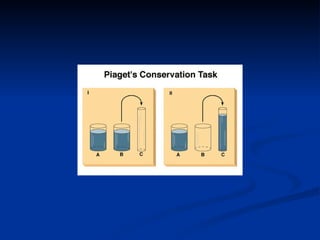
    o   Conserving number, length, amount, weight, and
        volume is difficult
    o   Perceptual impression chosen over logic
    o   Putting self in another person’s place is difficult
    o   Contradicting themselves is not a problem
    o   Language acquisition and symbolic thinking
Piaget

•   Concrete Operational (7-11 years)
    o   Thinking can be reversed and a sequence of changes can
        be held in the mind
    o
    ‘
        Awareness of other people’s viewpoints
    o   Appearance of systematic and logical reasoning
Piaget

•   Formal Operational (12+ years)
    o   Ability to recombine groups into fewer or broader
        categories develops
    o   Defining concepts using other abstract concepts is
        possible
    o   Can use analogies to understand concepts
    o   Independent, abstract thinking
    o   Can think about thinking
Development

•   Critical periods
    o   Genetically pre-determined maturation phases
    o   Periods of extremely high sensitivity to stimuli from
        environment that shape future development
    o   Victor of Aveyron/L'Enfant Sauvage (1799)
    o   Calrson et al. (1987) visual deprivation in monkeys
Development
•   Imprinting
    o   Duckling studies (Lorenz)
         •   Hatching appears to be a critical period for ducklings
         •   1st large moving object they see becomes imprinted as the
             mother
    o   Early animal imprinting with humans = good pets
    o   Harlow’s rhesus monkeys
Development

•   Parenting styles
       o   Authoritative
       o   Authoritarian
       o   Permissive
       o   Uninvolved
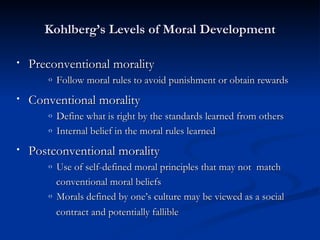
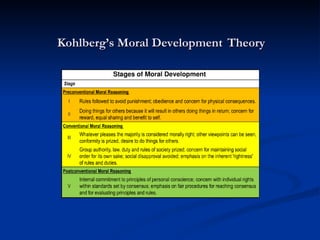
Kohlberg’s Levels of Moral Development

•   Preconventional morality
       o   Follow moral rules to avoid punishment or obtain rewards
•   Conventional morality
       o   Define what is right by the standards learned from others
       o   Internal belief in the moral rules learned
•   Postconventional morality
       o   Use of self-defined moral principles that may not match
           conventional moral beliefs
       o   Morals defined by one’s culture may be viewed as a social
           contract and potentially fallible
Kohlberg’s Moral Development Theory
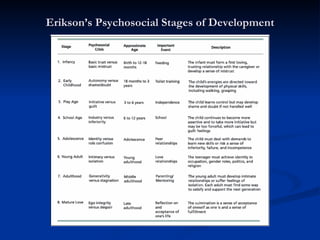
Erikson’s Psychosocial Stages of Development
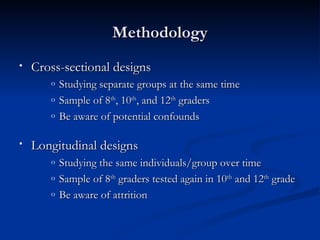
Methodology
•   Cross-sectional designs
       o   Studying separate groups at the same time
       o   Sample of 8th, 10th, and 12th graders
       o   Be aware of potential confounds

•   Longitudinal designs
       o   Studying the same individuals/group over time
       o   Sample of 8th graders tested again in 10th and 12th grade
       o   Be aware of attrition
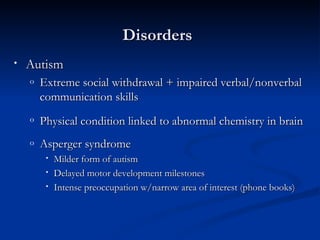
Disorders
•   Autism
    o   Extreme social withdrawal + impaired verbal/nonverbal
        communication skills
    o   Physical condition linked to abnormal chemistry in brain
    o   Asperger syndrome
         •   Milder form of autism
         •   Delayed motor development milestones
         •   Intense preoccupation w/narrow area of interest (phone books)
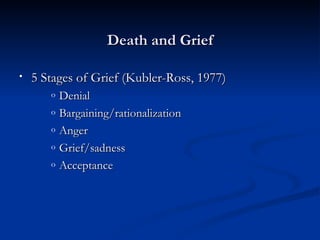
Death and Grief

•   5 Stages of Grief (Kubler-Ross, 1977)
       o   Denial
       o   Bargaining/rationalization
       o   Anger
       o   Grief/sadness
       o   Acceptance

Modules 10-12 PowerPoint Slides

  • 1.
  • 2.
    Development • Developmental psychology o Studies maturation of human behavior over time o Recent shift from adolescent studies to lifespan research • Maturation o Individual growth/development biologically based o What is the interaction between hereditary and environment?
  • 3.
    Development • Infancy o Newborns have simple adaptive reflexes • Rooting reflex • Tonic neck reflex • Palmar grasp reflex • Plantar reflex o Motor reflexes develop during later critical periods • Smiling, turning head, rolling over, crawling, walking
  • 5.
    Piaget • Assimilation o Occurs when new experiences are incorporated into existing schema • Accommodation o Occurs by changing existing schemas to accommodate new information o Can be a more difficult process
  • 6.
    Piaget • Stages of Cognitive Development o Cognitive schemas o Emphasized how children’s mental abilities progress qualitatively on a fixed sequence of stages o At each stage of development, children use a distinct type of thought to guide thinking
  • 7.
    Piaget • Sensorimotor Stage (0 - 2 years) o Earliest stage o Child is completely egocentric o No sense that objects are separate from themselves o Learning occurs through use of hands and mouth o Object permanence? • The understanding an object continues to exist even when you can't see it or touch it
  • 8.
    Piaget • Preoperational (2-7 years) o Conserving number, length, amount, weight, and volume is difficult o Perceptual impression chosen over logic o Putting self in another person’s place is difficult o Contradicting themselves is not a problem o Language acquisition and symbolic thinking
  • 9.
    Piaget • Concrete Operational (7-11 years) o Thinking can be reversed and a sequence of changes can be held in the mind o ‘ Awareness of other people’s viewpoints o Appearance of systematic and logical reasoning
  • 11.
    Piaget • Formal Operational (12+ years) o Ability to recombine groups into fewer or broader categories develops o Defining concepts using other abstract concepts is possible o Can use analogies to understand concepts o Independent, abstract thinking o Can think about thinking
  • 12.
    Development • Critical periods o Genetically pre-determined maturation phases o Periods of extremely high sensitivity to stimuli from environment that shape future development o Victor of Aveyron/L'Enfant Sauvage (1799) o Calrson et al. (1987) visual deprivation in monkeys
  • 13.
    Development • Imprinting o Duckling studies (Lorenz) • Hatching appears to be a critical period for ducklings • 1st large moving object they see becomes imprinted as the mother o Early animal imprinting with humans = good pets o Harlow’s rhesus monkeys
  • 15.
    Development • Parenting styles o Authoritative o Authoritarian o Permissive o Uninvolved
  • 16.
    Kohlberg’s Levels ofMoral Development • Preconventional morality o Follow moral rules to avoid punishment or obtain rewards • Conventional morality o Define what is right by the standards learned from others o Internal belief in the moral rules learned • Postconventional morality o Use of self-defined moral principles that may not match conventional moral beliefs o Morals defined by one’s culture may be viewed as a social contract and potentially fallible
  • 17.
  • 18.
  • 19.
    Methodology • Cross-sectional designs o Studying separate groups at the same time o Sample of 8th, 10th, and 12th graders o Be aware of potential confounds • Longitudinal designs o Studying the same individuals/group over time o Sample of 8th graders tested again in 10th and 12th grade o Be aware of attrition
  • 20.
    Disorders • Autism o Extreme social withdrawal + impaired verbal/nonverbal communication skills o Physical condition linked to abnormal chemistry in brain o Asperger syndrome • Milder form of autism • Delayed motor development milestones • Intense preoccupation w/narrow area of interest (phone books)
  • 21.
    Death and Grief • 5 Stages of Grief (Kubler-Ross, 1977) o Denial o Bargaining/rationalization o Anger o Grief/sadness o Acceptance