Research-Based Teaching &
Learning in the 21st. Century
Principles of Teaching II
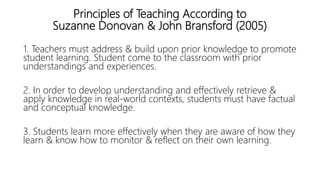
Principles of Teaching According to
Suzanne Donovan & John Bransford (2005)
1. Teachers must address & build upon prior knowledge to promote
student learning. Student come to the classroom with prior
understandings and experiences.
2. In order to develop understanding and effectively retrieve &
apply knowledge in real-world contexts, students must have factual
and conceptual knowledge.
3. Students learn more effectively when they are aware of how they
learn & know how to monitor & reflect on their own learning.
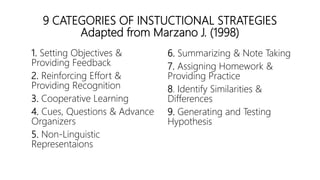
9 CATEGORIES OF INSTUCTIONAL STRATEGIES
Adapted from Marzano J. (1998)
1. Setting Objectives &
Providing Feedback
2. Reinforcing Effort &
Providing Recognition
3. Cooperative Learning
4. Cues, Questions & Advance
Organizers
5. Non-Linguistic
Representaions
6. Summarizing & Note Taking
7. Assigning Homework &
Providing Practice
8. Identify Similarities &
Differences
9. Generating and Testing
Hypothesis
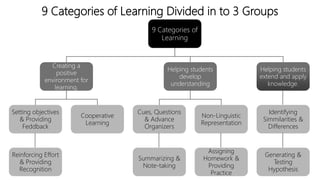
9 Categories of Learning Divided in to 3 Groups
9 Categories of
Learning
Creating a
positive
environment for
learning.
Helping students
develop
understanding
Helping students
extend and apply
knowledge.
Setting objectives
& Providing
Feddback
Cues, Questions
& Advance
Organizers
Non-Linguistic
Representation
Identifying
Simmilarities &
Differences
Assigning
Homework &
Providing
Practice
Summarizing &
Note-taking
Reinforcing Effort
& Providing
Recognition
Generating &
Testing
Hypothesis
Cooperative
Learning
CREATING THE ENVIRONMENT
FOR LEARNING
CREATING THE ENVIRONMENT FOR LEARNING
I. SETTING OBJECTIVES
- Set the Learning objectives that are specific but not
restrictive.
- Communicate the learning objectives to students &
parents.
- Connect the learning objectives to previous and future .
learning.
- Engage students in setting personal learning objectives.
CREATING THE ENVIRONMENT FOR LEARNING
II. PROVIDING FEEDBACK
- to make students undestand what was correct &
incorrect & to make clear what students need to do next.
- Provide feedback in time to meet students' needs.
- Feedback should be criterion-referenced.
- Engage students in the feedback process.
CREATING THE ENVIRONMENT FOR LEARNING
III. REINFORCING EFFORT
IV. PROVIDING RECOGNITION
- Promote a mastery-goal orientation
- Provide praise that is specific & aligned with expected
performance & behavior.
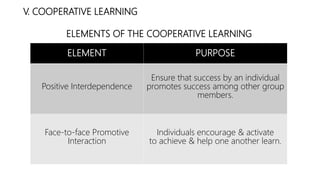
V. COOPERATIVE LEARNING
ELEMENT PURPOSE
Positive Interdependence
Ensure that success by an individual
promotes success among other group
members.
Face-to-face Promotive
Interaction
Individuals encourage & activate
to achieve & help one another learn.
ELEMENTS OF THE COOPERATIVE LEARNING
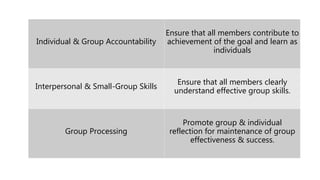
Individual & Group Accountability
Ensure that all members contribute to
achievement of the goal and learn as
individuals
Interpersonal & Small-Group Skills
Ensure that all members clearly
understand effective group skills.
Group Processing
Promote group & individual
reflection for maintenance of group
effectiveness & success.
HELPING STUDENTS
DEVELOP UNDERSTANDING
HELPING STUDENTS DEVELOP UNDERSTANDING
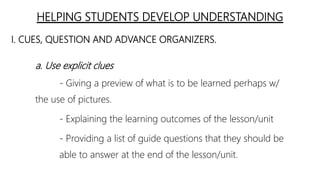
I. CUES, QUESTION AND ADVANCE ORGANIZERS.
a. Use explicit clues
- Giving a preview of what is to be learned perhaps w/
the use of pictures.
- Explaining the learning outcomes of the lesson/unit
- Providing a list of guide questions that they should be
able to answer at the end of the lesson/unit.
HELPING STUDENTS DEVELOP UNDERSTANDING
I. CUES, QUESTION AND ADVANCE ORGANIZERS.
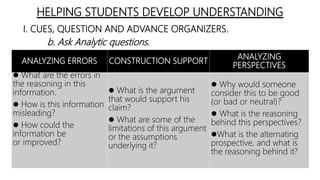
b. Ask Analytic questions.
ANALYZING ERRORS CONSTRUCTION SUPPORT
ANALYZING
PERSPECTIVES
 What are the errors in
the reasoning in this
information.
 How is this information
misleading?
 How could the
information be
or improved?
 What is the argument
that would support his
claim?
 What are some of the
limitations of this argument
or the assumptions
underlying it?
 Why would someone
consider this to be good
(or bad or neutral)?
 What is the reasoning
behind this perspectives?
What is the alternating
prospective, and what is
the reasoning behind it?
HELPING STUDENTS DEVELOP UNDERSTANDING
I. CUES, QUESTION AND ADVANCE ORGANIZERS.
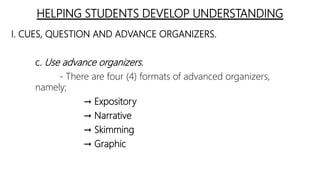
c. Use advance organizers.
- There are four (4) formats of advanced organizers,
namely;
→ Expository
→ Narrative
→ Skimming
→ Graphic
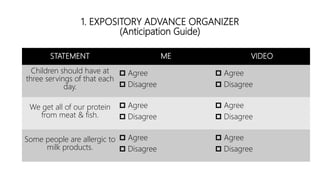
1. EXPOSITORY ADVANCE ORGANIZER
(Anticipation Guide)
STATEMENT ME VIDEO
Children should have at
three servings of that each
day.
 Agree
 Disagree
 Agree
 Disagree
We get all of our protein
from meat & fish.
 Agree
 Disagree
 Agree
 Disagree
Some people are allergic to
milk products.
 Agree
 Disagree
 Agree
 Disagree
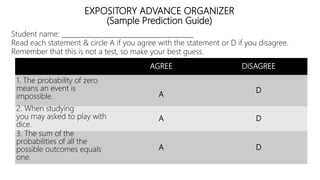
EXPOSITORY ADVANCE ORGANIZER
(Sample Prediction Guide)
AGREE DISAGREE
1. The probability of zero
means an event is
impossible. A
D
2. When studying
you may asked to play with
dice.
A D
3. The sum of the
probabilities of all the
possible outcomes equals
one.
A D
Student name: ________________________________________
Read each statement & circle A if you agree with the statement or D if you disagree.
Remember that this is not a test, so make your best guess.
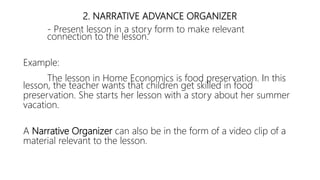
2. NARRATIVE ADVANCE ORGANIZER
- Present lesson in a story form to make relevant
connection to the lesson.
Example:
The lesson in Home Economics is food preservation. In this
lesson, the teacher wants that children get skilled in food
preservation. She starts her lesson with a story about her summer
vacation.
A Narrative Organizer can also be in the form of a video clip of a
material relevant to the lesson.
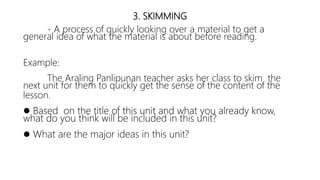
3. SKIMMING
- A process of quickly looking over a material to get a
general idea of what the material is about before reading.
Example:
The Araling Panlipunan teacher asks her class to skim the
next unit for them to quickly get the sense of the content of the
lesson.
 Based on the title of this unit and what you already know,
what do you think will be included in this unit?
 What are the major ideas in this unit?
HELPING STUDENTS DEVELOP UNDERSTANDING
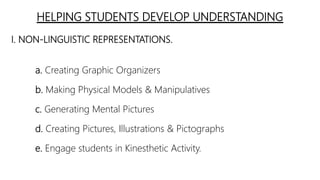
I. NON-LINGUISTIC REPRESENTATIONS.
a. Creating Graphic Organizers
b. Making Physical Models & Manipulatives
c. Generating Mental Pictures
d. Creating Pictures, Illustrations & Pictographs
e. Engage students in Kinesthetic Activity.
HELPING STUDENTS DEVELOP UNDERSTANDING
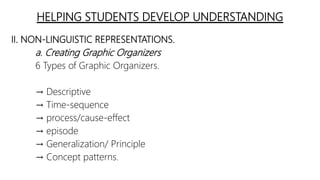
II. NON-LINGUISTIC REPRESENTATIONS.
a. Creating Graphic Organizers
6 Types of Graphic Organizers.
→ Descriptive
→ Time-sequence
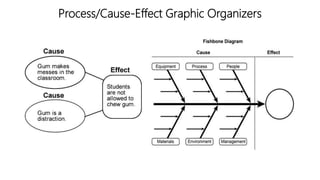
→ process/cause-effect
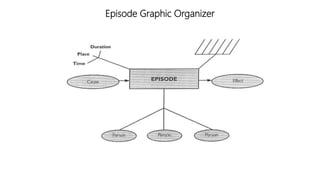
→ episode
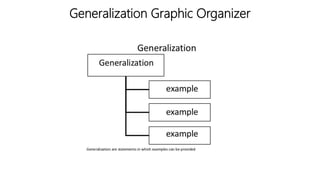
→ Generalization/ Principle
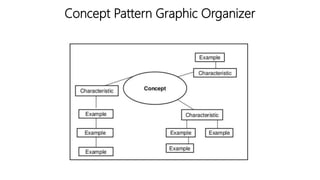
→ Concept patterns.
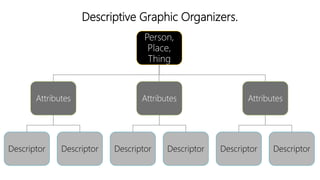
Descriptive Graphic Organizers.
Person,
Place,
Thing
Attributes Attributes Attributes
Descriptor Descriptor Descriptor Descriptor Descriptor Descriptor
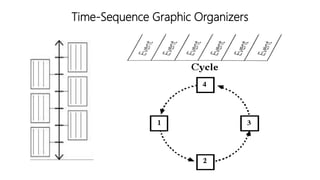
Time-Sequence Graphic Organizers
Process/Cause-Effect Graphic Organizers
Episode Graphic Organizer
Generalization Graphic Organizer
Concept Pattern Graphic Organizer
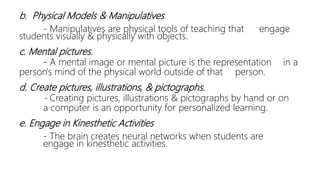
b. Physical Models & Manipulatives
- Manipulatives are physical tools of teaching that engage
students visually & physically with objects.
c. Mental pictures.
- A mental image or mental picture is the representation in a
person's mind of the physical world outside of that person.
d. Create pictures, illustrations, & pictographs.
- Creating pictures, illustrations & pictographs by hand or on
a computer is an opportunity for personalized learning.
e. Engage in Kinesthetic Activities
- The brain creates neural networks when students are
engage in kinesthetic activities.
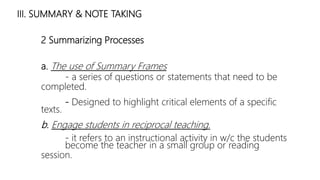
III. SUMMARY & NOTE TAKING
2 Summarizing Processes
a. The use of Summary Frames
- a series of questions or statements that need to be
completed.
- Designed to highlight critical elements of a specific
texts.
b. Engage students in reciprocal teaching.
- it refers to an instructional activity in w/c the students
become the teacher in a small group or reading
session.
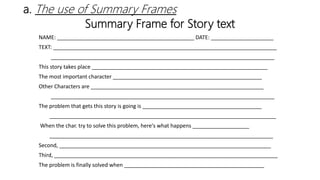
a. The use of Summary Frames
Summary Frame for Story text
NAME: ______________________________________________ DATE: _____________________
TEXT: ___________________________________________________________________________
___________________________________________________________________________
This story takes place ___________________________________________________________
The most important character __________________________________________________
Other Characters are __________________________________________________________
___________________________________________________________________________
The problem that gets this story is going is ________________________________________
____________________________________________________________________________
When the char. try to solve this problem, here's what happens ___________________
___________________________________________________________________________
Second, _______________________________________________________________________
Third, ___________________________________________________________________________
The problem is finally solved when _______________________________________________
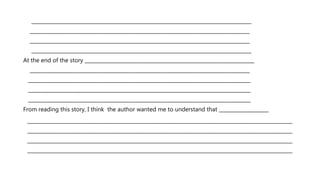
________________________________________________________________________________________
________________________________________________________________________________________
________________________________________________________________________________________
________________________________________________________________________________________
At the end of the story ____________________________________________________________________
________________________________________________________________________________________
_________________________________________________________________________________________
_________________________________________________________________________________________
_________________________________________________________________________________________
From reading this story, I think the author wanted me to understand that ____________________
_________________________________________________________________________________________
_________________________________________________________________________________________
_________________________________________________________________________________________
_________________________________________________________________________________________
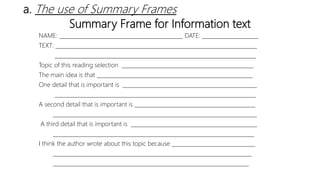
a. The use of Summary Frames
Summary Frame for Information text
NAME: ______________________________________________ DATE: _____________________
TEXT: ___________________________________________________________________________
___________________________________________________________________________
Topic of this reading selection _________________________________________________
The main idea is that __________________________________________________________
One detail that is important is __________________________________________________
___________________________________________________________________________
A second detail that is important is _____________________________________________
____________________________________________________________________________
A third detail that is important is _______________________________________________
___________________________________________________________________________
I think the author wrote about this topic because _______________________________
__________________________________________________________________________
_________________________________________________________________________
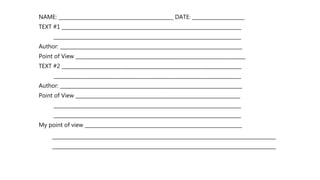
NAME: ______________________________________________ DATE: _____________________
TEXT #1 ________________________________________________________________________
___________________________________________________________________________
Author: _________________________________________________________________________
Point of View ____________________________________________________________________
TEXT #2 ________________________________________________________________________
___________________________________________________________________________
Author: _________________________________________________________________________
Point of View __________________________________________________________________
___________________________________________________________________________
___________________________________________________________________________
My point of view _______________________________________________________________
___________________________________________________________________________
___________________________________________________________________________
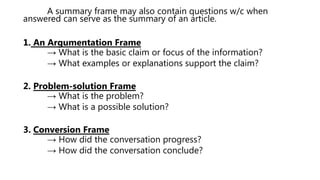
A summary frame may also contain questions w/c when
answered can serve as the summary of an article.
1. An Argumentation Frame
→ What is the basic claim or focus of the information?
→ What examples or explanations support the claim?
2. Problem-solution Frame
→ What is the problem?
→ What is a possible solution?
3. Conversion Frame
→ How did the conversation progress?
→ How did the conversation conclude?
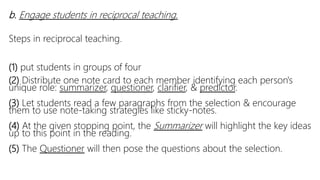
b. Engage students in reciprocal teaching.
Steps in reciprocal teaching.
(1) put students in groups of four
(2) Distribute one note card to each member identifying each person's
unique role: summarizer, questioner, clarifier, & predictor.
(3) Let students read a few paragraphs from the selection & encourage
them to use note-taking strategies like sticky-notes.
(4) At the given stopping point, the Summarizer will highlight the key ideas
up to this point in the reading.
(5) The Questioner will then pose the questions about the selection.
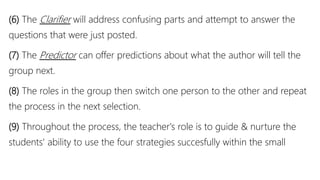
(6) The Clarifier will address confusing parts and attempt to answer the
questions that were just posted.
(7) The Predictor can offer predictions about what the author will tell the
group next.
(8) The roles in the group then switch one person to the other and repeat
the process in the next selection.
(9) Throughout the process, the teacher's role is to guide & nurture the
students' ability to use the four strategies succesfully within the small
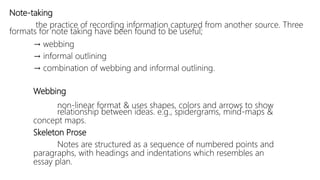
Note-taking
the practice of recording information captured from another source. Three
formats for note taking have been found to be useful;
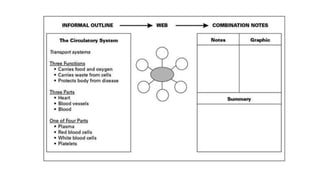
→ webbing
→ informal outlining
→ combination of webbing and informal outlining.
Webbing
non-linear format & uses shapes, colors and arrows to show
relationship between ideas. e.g., spidergrams, mind-maps &
concept maps.
Skeleton Prose
Notes are structured as a sequence of numbered points and
paragraphs, with headings and indentations which resembles an
essay plan.
IV. ASSIGNING HOMEWORK AND PROVIDING PRACTICE.
To ensure homeworks work.
1. Design homeworks that provide students with opportunities to
practice skills & processes.
2. Provide feedback on homework.
3. Homeworks should be aligned to the learning outcomes &
objectives.
HELPING STUDENTS EXTEND &
APPLY KNOWLEDGE.
2 RESEARCH-BASED STRATEGIES ON
EXTENDING & APPLYING KNOWLDGE
A. Identifying similarities and differences
● Comparing ● Classifying
● Creating Metaphors ● Creating Analogies
● Comparing
showing similarities & differences.
● Classifying
the process of organizing groups & labeling them
according to their similarities.
● Creating Metaphors
the process of identifying a general or basic pattern in a
specific topic & then finding another topic that appears to
be quite different but has the same general pattern.
● Creating Analogies
the process of indetifying relationships between pairs of
concepts or between relationships.
B. Generating and testing Hypothesis.
Research-Based Teaching in the 21st. Century

Research-Based Teaching in the 21st. Century

  • 1.
    Research-Based Teaching & Learningin the 21st. Century Principles of Teaching II
  • 2.
    Principles of TeachingAccording to Suzanne Donovan & John Bransford (2005) 1. Teachers must address & build upon prior knowledge to promote student learning. Student come to the classroom with prior understandings and experiences. 2. In order to develop understanding and effectively retrieve & apply knowledge in real-world contexts, students must have factual and conceptual knowledge. 3. Students learn more effectively when they are aware of how they learn & know how to monitor & reflect on their own learning.
  • 3.
    9 CATEGORIES OFINSTUCTIONAL STRATEGIES Adapted from Marzano J. (1998) 1. Setting Objectives & Providing Feedback 2. Reinforcing Effort & Providing Recognition 3. Cooperative Learning 4. Cues, Questions & Advance Organizers 5. Non-Linguistic Representaions 6. Summarizing & Note Taking 7. Assigning Homework & Providing Practice 8. Identify Similarities & Differences 9. Generating and Testing Hypothesis
  • 4.
    9 Categories ofLearning Divided in to 3 Groups 9 Categories of Learning Creating a positive environment for learning. Helping students develop understanding Helping students extend and apply knowledge. Setting objectives & Providing Feddback Cues, Questions & Advance Organizers Non-Linguistic Representation Identifying Simmilarities & Differences Assigning Homework & Providing Practice Summarizing & Note-taking Reinforcing Effort & Providing Recognition Generating & Testing Hypothesis Cooperative Learning
  • 5.
  • 6.
    CREATING THE ENVIRONMENTFOR LEARNING I. SETTING OBJECTIVES - Set the Learning objectives that are specific but not restrictive. - Communicate the learning objectives to students & parents. - Connect the learning objectives to previous and future . learning. - Engage students in setting personal learning objectives.
  • 7.
    CREATING THE ENVIRONMENTFOR LEARNING II. PROVIDING FEEDBACK - to make students undestand what was correct & incorrect & to make clear what students need to do next. - Provide feedback in time to meet students' needs. - Feedback should be criterion-referenced. - Engage students in the feedback process.
  • 8.
    CREATING THE ENVIRONMENTFOR LEARNING III. REINFORCING EFFORT IV. PROVIDING RECOGNITION - Promote a mastery-goal orientation - Provide praise that is specific & aligned with expected performance & behavior.
  • 9.
    V. COOPERATIVE LEARNING ELEMENTPURPOSE Positive Interdependence Ensure that success by an individual promotes success among other group members. Face-to-face Promotive Interaction Individuals encourage & activate to achieve & help one another learn. ELEMENTS OF THE COOPERATIVE LEARNING
  • 10.
    Individual & GroupAccountability Ensure that all members contribute to achievement of the goal and learn as individuals Interpersonal & Small-Group Skills Ensure that all members clearly understand effective group skills. Group Processing Promote group & individual reflection for maintenance of group effectiveness & success.
  • 11.
  • 12.
    HELPING STUDENTS DEVELOPUNDERSTANDING I. CUES, QUESTION AND ADVANCE ORGANIZERS. a. Use explicit clues - Giving a preview of what is to be learned perhaps w/ the use of pictures. - Explaining the learning outcomes of the lesson/unit - Providing a list of guide questions that they should be able to answer at the end of the lesson/unit.
  • 13.
    HELPING STUDENTS DEVELOPUNDERSTANDING I. CUES, QUESTION AND ADVANCE ORGANIZERS. b. Ask Analytic questions. ANALYZING ERRORS CONSTRUCTION SUPPORT ANALYZING PERSPECTIVES  What are the errors in the reasoning in this information.  How is this information misleading?  How could the information be or improved?  What is the argument that would support his claim?  What are some of the limitations of this argument or the assumptions underlying it?  Why would someone consider this to be good (or bad or neutral)?  What is the reasoning behind this perspectives? What is the alternating prospective, and what is the reasoning behind it?
  • 14.
    HELPING STUDENTS DEVELOPUNDERSTANDING I. CUES, QUESTION AND ADVANCE ORGANIZERS. c. Use advance organizers. - There are four (4) formats of advanced organizers, namely; → Expository → Narrative → Skimming → Graphic
  • 15.
    1. EXPOSITORY ADVANCEORGANIZER (Anticipation Guide) STATEMENT ME VIDEO Children should have at three servings of that each day.  Agree  Disagree  Agree  Disagree We get all of our protein from meat & fish.  Agree  Disagree  Agree  Disagree Some people are allergic to milk products.  Agree  Disagree  Agree  Disagree
  • 16.
    EXPOSITORY ADVANCE ORGANIZER (SamplePrediction Guide) AGREE DISAGREE 1. The probability of zero means an event is impossible. A D 2. When studying you may asked to play with dice. A D 3. The sum of the probabilities of all the possible outcomes equals one. A D Student name: ________________________________________ Read each statement & circle A if you agree with the statement or D if you disagree. Remember that this is not a test, so make your best guess.
  • 17.
    2. NARRATIVE ADVANCEORGANIZER - Present lesson in a story form to make relevant connection to the lesson. Example: The lesson in Home Economics is food preservation. In this lesson, the teacher wants that children get skilled in food preservation. She starts her lesson with a story about her summer vacation. A Narrative Organizer can also be in the form of a video clip of a material relevant to the lesson.
  • 18.
    3. SKIMMING - Aprocess of quickly looking over a material to get a general idea of what the material is about before reading. Example: The Araling Panlipunan teacher asks her class to skim the next unit for them to quickly get the sense of the content of the lesson.  Based on the title of this unit and what you already know, what do you think will be included in this unit?  What are the major ideas in this unit?
  • 19.
    HELPING STUDENTS DEVELOPUNDERSTANDING I. NON-LINGUISTIC REPRESENTATIONS. a. Creating Graphic Organizers b. Making Physical Models & Manipulatives c. Generating Mental Pictures d. Creating Pictures, Illustrations & Pictographs e. Engage students in Kinesthetic Activity.
  • 20.
    HELPING STUDENTS DEVELOPUNDERSTANDING II. NON-LINGUISTIC REPRESENTATIONS. a. Creating Graphic Organizers 6 Types of Graphic Organizers. → Descriptive → Time-sequence → process/cause-effect → episode → Generalization/ Principle → Concept patterns.
  • 21.
    Descriptive Graphic Organizers. Person, Place, Thing AttributesAttributes Attributes Descriptor Descriptor Descriptor Descriptor Descriptor Descriptor
  • 22.
  • 23.
  • 24.
  • 25.
  • 26.
  • 27.
    b. Physical Models& Manipulatives - Manipulatives are physical tools of teaching that engage students visually & physically with objects. c. Mental pictures. - A mental image or mental picture is the representation in a person's mind of the physical world outside of that person. d. Create pictures, illustrations, & pictographs. - Creating pictures, illustrations & pictographs by hand or on a computer is an opportunity for personalized learning. e. Engage in Kinesthetic Activities - The brain creates neural networks when students are engage in kinesthetic activities.
  • 28.
    III. SUMMARY &NOTE TAKING 2 Summarizing Processes a. The use of Summary Frames - a series of questions or statements that need to be completed. - Designed to highlight critical elements of a specific texts. b. Engage students in reciprocal teaching. - it refers to an instructional activity in w/c the students become the teacher in a small group or reading session.
  • 29.
    a. The useof Summary Frames Summary Frame for Story text NAME: ______________________________________________ DATE: _____________________ TEXT: ___________________________________________________________________________ ___________________________________________________________________________ This story takes place ___________________________________________________________ The most important character __________________________________________________ Other Characters are __________________________________________________________ ___________________________________________________________________________ The problem that gets this story is going is ________________________________________ ____________________________________________________________________________ When the char. try to solve this problem, here's what happens ___________________ ___________________________________________________________________________ Second, _______________________________________________________________________ Third, ___________________________________________________________________________ The problem is finally solved when _______________________________________________
  • 30.
    ________________________________________________________________________________________ ________________________________________________________________________________________ ________________________________________________________________________________________ ________________________________________________________________________________________ At the endof the story ____________________________________________________________________ ________________________________________________________________________________________ _________________________________________________________________________________________ _________________________________________________________________________________________ _________________________________________________________________________________________ From reading this story, I think the author wanted me to understand that ____________________ _________________________________________________________________________________________ _________________________________________________________________________________________ _________________________________________________________________________________________ _________________________________________________________________________________________
  • 31.
    a. The useof Summary Frames Summary Frame for Information text NAME: ______________________________________________ DATE: _____________________ TEXT: ___________________________________________________________________________ ___________________________________________________________________________ Topic of this reading selection _________________________________________________ The main idea is that __________________________________________________________ One detail that is important is __________________________________________________ ___________________________________________________________________________ A second detail that is important is _____________________________________________ ____________________________________________________________________________ A third detail that is important is _______________________________________________ ___________________________________________________________________________ I think the author wrote about this topic because _______________________________ __________________________________________________________________________ _________________________________________________________________________
  • 32.
    NAME: ______________________________________________ DATE:_____________________ TEXT #1 ________________________________________________________________________ ___________________________________________________________________________ Author: _________________________________________________________________________ Point of View ____________________________________________________________________ TEXT #2 ________________________________________________________________________ ___________________________________________________________________________ Author: _________________________________________________________________________ Point of View __________________________________________________________________ ___________________________________________________________________________ ___________________________________________________________________________ My point of view _______________________________________________________________ ___________________________________________________________________________ ___________________________________________________________________________
  • 33.
    A summary framemay also contain questions w/c when answered can serve as the summary of an article. 1. An Argumentation Frame → What is the basic claim or focus of the information? → What examples or explanations support the claim? 2. Problem-solution Frame → What is the problem? → What is a possible solution? 3. Conversion Frame → How did the conversation progress? → How did the conversation conclude?
  • 34.
    b. Engage studentsin reciprocal teaching. Steps in reciprocal teaching. (1) put students in groups of four (2) Distribute one note card to each member identifying each person's unique role: summarizer, questioner, clarifier, & predictor. (3) Let students read a few paragraphs from the selection & encourage them to use note-taking strategies like sticky-notes. (4) At the given stopping point, the Summarizer will highlight the key ideas up to this point in the reading. (5) The Questioner will then pose the questions about the selection.
  • 35.
    (6) The Clarifierwill address confusing parts and attempt to answer the questions that were just posted. (7) The Predictor can offer predictions about what the author will tell the group next. (8) The roles in the group then switch one person to the other and repeat the process in the next selection. (9) Throughout the process, the teacher's role is to guide & nurture the students' ability to use the four strategies succesfully within the small
  • 36.
    Note-taking the practice ofrecording information captured from another source. Three formats for note taking have been found to be useful; → webbing → informal outlining → combination of webbing and informal outlining. Webbing non-linear format & uses shapes, colors and arrows to show relationship between ideas. e.g., spidergrams, mind-maps & concept maps. Skeleton Prose Notes are structured as a sequence of numbered points and paragraphs, with headings and indentations which resembles an essay plan.
  • 38.
    IV. ASSIGNING HOMEWORKAND PROVIDING PRACTICE. To ensure homeworks work. 1. Design homeworks that provide students with opportunities to practice skills & processes. 2. Provide feedback on homework. 3. Homeworks should be aligned to the learning outcomes & objectives.
  • 39.
    HELPING STUDENTS EXTEND& APPLY KNOWLEDGE.
  • 40.
    2 RESEARCH-BASED STRATEGIESON EXTENDING & APPLYING KNOWLDGE A. Identifying similarities and differences ● Comparing ● Classifying ● Creating Metaphors ● Creating Analogies
  • 41.
    ● Comparing showing similarities& differences. ● Classifying the process of organizing groups & labeling them according to their similarities. ● Creating Metaphors the process of identifying a general or basic pattern in a specific topic & then finding another topic that appears to be quite different but has the same general pattern. ● Creating Analogies the process of indetifying relationships between pairs of concepts or between relationships.
  • 42.
    B. Generating andtesting Hypothesis.