Carbon & The Molecular Diversity of Life
Carbon: The Backbone of Life
• Living organisms consist mostly of carbon-based
compounds
• Carbon is unparalleled in its ability to form large,
complex, and diverse molecules
• Proteins, DNA, carbohydrates, and other molecules that
distinguish living matter are all composed of carbon
compounds
2
Carbon: Organic Chemistry
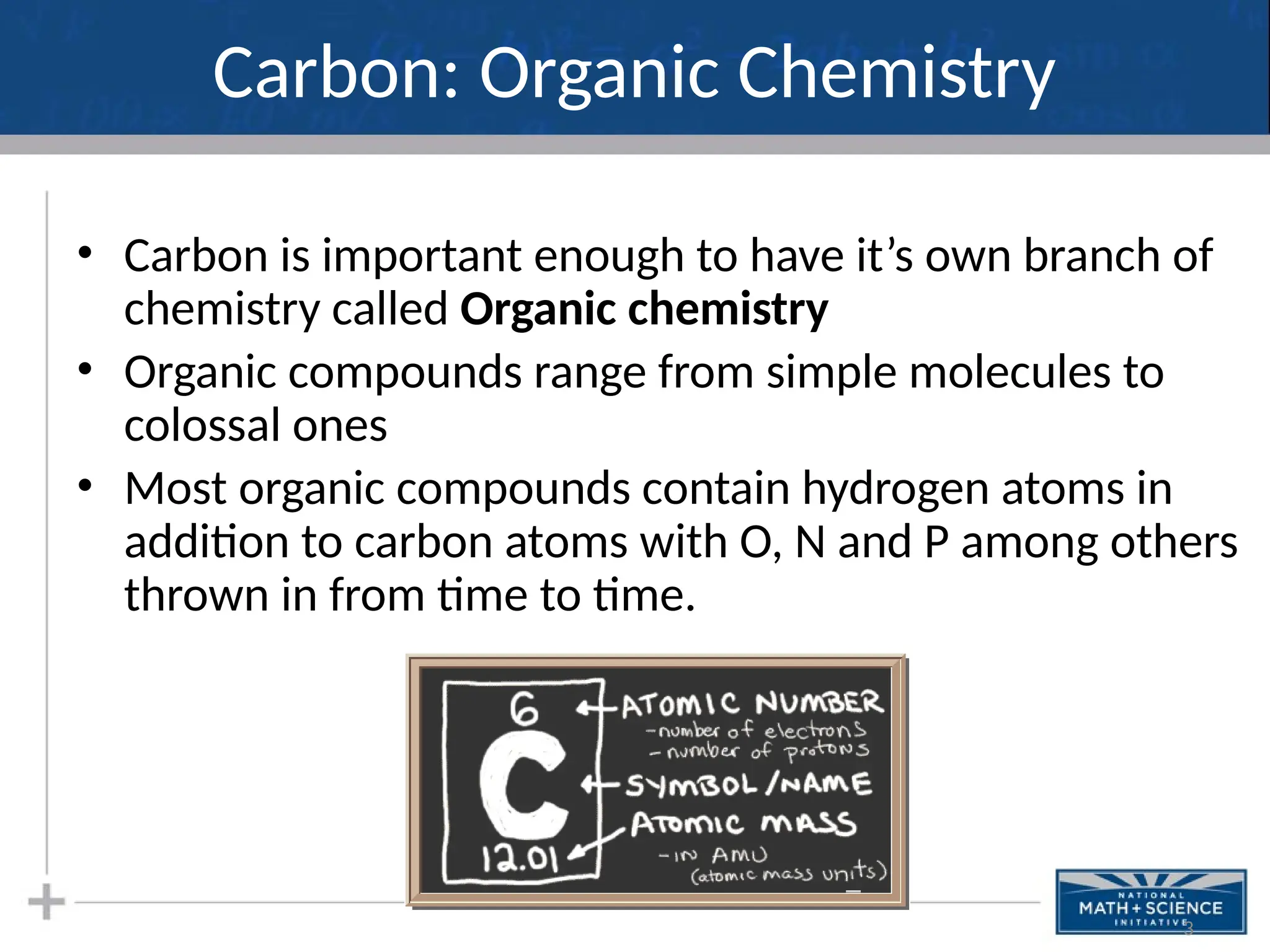
• Carbon is important enough to have it’s own branch of
chemistry called Organic chemistry
• Organic compounds range from simple molecules to
colossal ones
• Most organic compounds contain hydrogen atoms in
addition to carbon atoms with O, N and P among others
thrown in from time to time.
3
Experimental Design:
The origin of life on this planet
• The Miller-Urey experiment
demonstrated the abiotic
synthesis of organic compounds.
• Water (H2O), methane (CH4),
ammonia (NH3), and hydrogen
(H2) were all sealed inside a
sterile array of glass tubes and
flasks connected in a loop, with
one flask half-full of liquid water
and another flask containing a
pair of electrodes.
4
Experimental Design:
The origin of life on this planet
• The liquid water was heated
to induce evaporation, sparks
were fired between the
electrodes to
simulate lightning through
the atmosphere and water
vapor, and then the
atmosphere was cooled again
so that the water could
condense and trickle back into
the first flask in a continuous
cycle.
5
Experimental Design:
The origin of life on this planet
• Within a day, the mixture
had turned pink in
color, and at the end of
two weeks of continuous
operation, Miller and Urey
observed that as much as
10–15% of
the carbon within the
system was now in the
form of organic
compounds.
6
Experimental Design:
The origin of life on this planet
• Two percent of the carbon
had formed amino acids that
are used to make proteins in
living cells, with glycine as the
most abundant. Nucleic acids
were not formed within the
reaction. But the common 20
amino acids were formed, in
various concentrations.
7
Carbon has 4 valence electrons,
thus makes 4 bonds
• With four valence electrons, carbon
can form four covalent bonds with a
variety of atoms
• This ability makes large, complex
molecules possible
• In molecules with multiple carbons,
each carbon bonded to four other
atoms has a tetrahedral shape
8
“CNOPS” can combine together to make
double and triple covalent bonds
• However, when two carbon atoms are joined by a
double bond, the atoms joined to the carbons are in
the same plane as the carbons
• Why is this important? Because the shape of a
molecule dictates its reactivity, thus its function!
9
No need to memorize these!
10
Carbon Skeletons Vary
• Carbon chains form the skeletons of most organic molecules
• Carbon chains vary in length and shape
Hydrocarbons
• Hydrocarbons are organic molecules consisting of
only carbon and hydrogen
• Many organic molecules, such as fats, have
hydrocarbon components
• Hydrocarbons can undergo reactions that release a
large amount of energy
12
Nucleus
Fat droplets
(b) A fat molecule
(a) Part of a human adipose cell
10 m
Fats
Isomers
• Isomers are compounds with the same
molecular formula but different structures,
thus different properties.
– Structural isomers have different covalent
arrangements of their atoms
– Cis-trans isomers have the same covalent bonds
but differ in spatial arrangements
– Enantiomers are isomers that are mirror images
of each other & rotate light differently
14
More detail than you need,
but cool none the less!
15
More detail than you need,
but cool none the less!
16
More detail than you need,
but cool none the less!
17
More detail than you need,
but cool none the less!
• Enantiomers are important in the pharmaceutical
industry
• Two enantiomers of a drug may have different
effects
• Usually only one isomer is biologically active
• Differing effects of enantiomers demonstrate that
organisms are sensitive to even subtle variations
in molecules
18
Drug
Ibuprofen
Albuterol
Condition
Effective
Enantiomer
Ineffective
Enantiomer
Pain;
inflammation
Asthma
S-Ibuprofen R-Ibuprofen
R-Albuterol S-Albuterol
Note the mirror imaging
Functional Groups
A few chemical groups are key to the functioning of
molecules
• Distinctive properties of organic molecules depend on
the carbon skeleton and on the molecular
components attached to it
• A number of characteristic groups can replace the
hydrogens attached to skeletons of organic molecules
20
• Functional groups are
the components of
organic molecules that
are most commonly
involved in chemical
reactions
• The number and
arrangement of
functional groups give
each molecule its
unique properties
21
Functional Groups
STRUCTURE
EXAMPLE
Alcohols
(Their specific
names usually
end in -ol.)
NAME OF
COMPOUND
FUNCTIONAL
PROPERTIES
(may be written
HO—)
Ethanol
• Is polar as a result
of the electrons
spending more
time near the
electronegative
oxygen atom.
• Can form hydrogen
bonds with water
molecules, helping
dissolve organic
compounds such
as sugars.
Hydroxyl
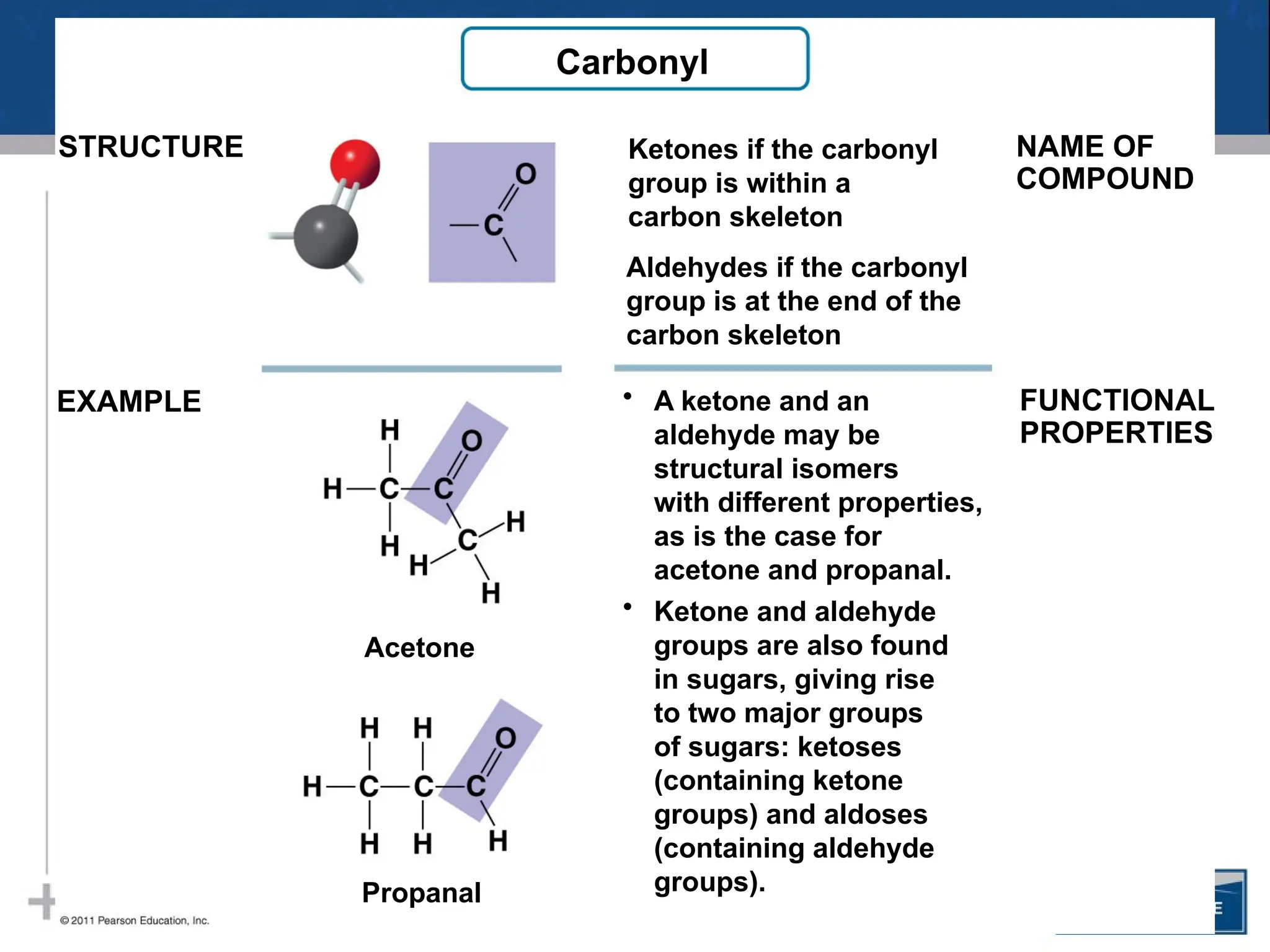
Carbonyl
STRUCTURE
EXAMPLE
Ketones if the carbonyl
group is within a
carbon skeleton
NAME OF
COMPOUND
FUNCTIONAL
PROPERTIES
Aldehydes if the carbonyl
group is at the end of the
carbon skeleton
• A ketone and an
aldehyde may be
structural isomers
with different properties,
as is the case for
acetone and propanal.
Acetone
Propanal
• Ketone and aldehyde
groups are also found
in sugars, giving rise
to two major groups
of sugars: ketoses
(containing ketone
groups) and aldoses
(containing aldehyde
groups).
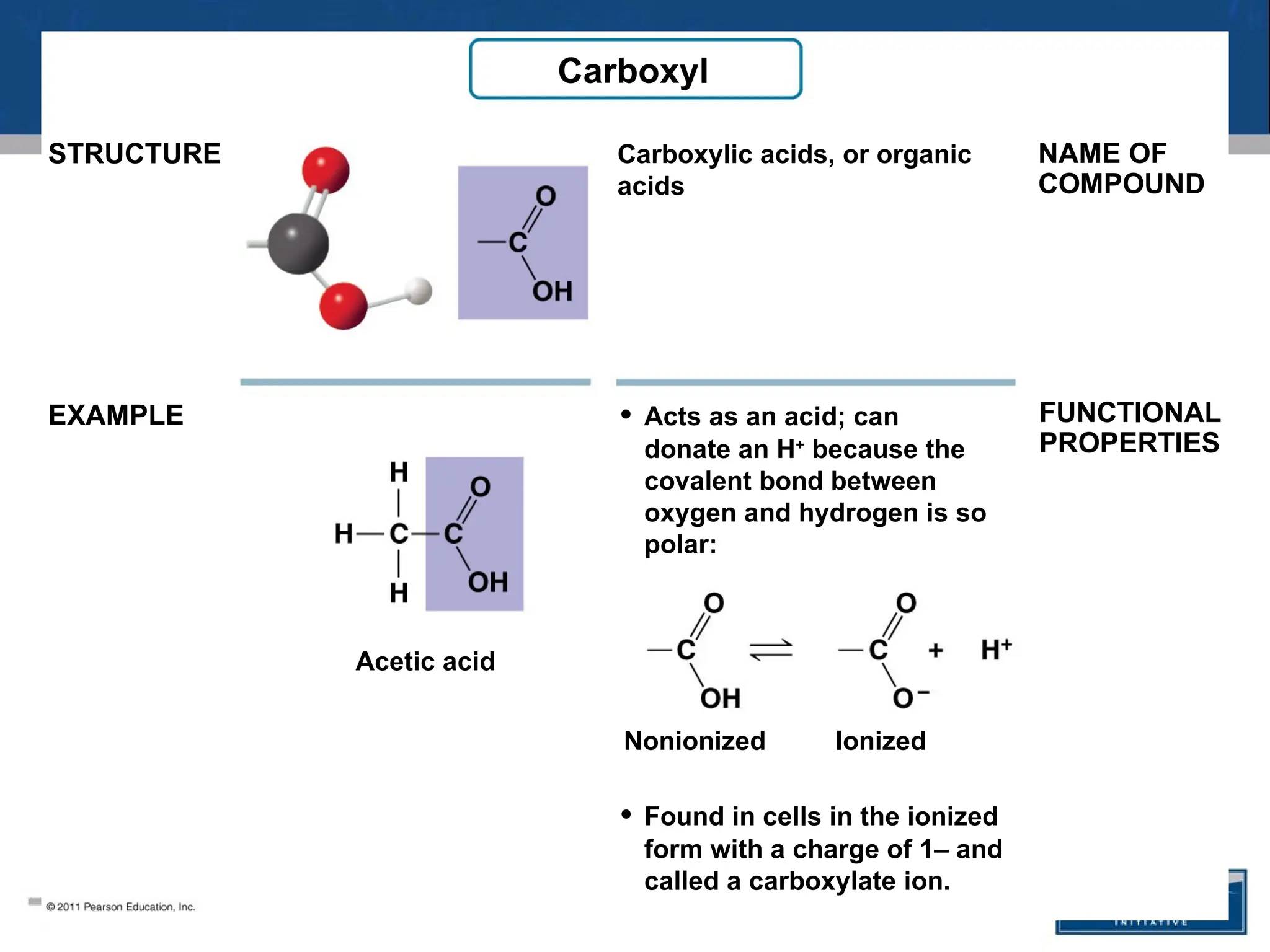
Carboxyl
STRUCTURE
EXAMPLE
Carboxylic acids, or organic
acids
NAME OF
COMPOUND
FUNCTIONAL
PROPERTIES
Acetic acid
• Acts as an acid; can
donate an H+
because the
covalent bond between
oxygen and hydrogen is so
polar:
• Found in cells in the ionized
form with a charge of 1– and
called a carboxylate ion.
Nonionized Ionized
Amino
Amines
Glycine
STRUCTURE
EXAMPLE • Acts as a base; can
pick up an H+
from the
surrounding solution
(water, in living
organisms):
NAME OF
COMPOUND
FUNCTIONAL
PROPERTIES
• Found in cells in the
ionized form with a
charge of 1.
Nonionized Ionized
Sulfhydryl
Thiols
(may be
written HS—)
STRUCTURE
EXAMPLE • Two sulfhydryl groups can
react, forming a covalent
bond. This “cross-linking”
helps stabilize protein
structure.
NAME OF
COMPOUND
FUNCTIONAL
PROPERTIES
• Cross-linking of cysteines
in hair proteins maintains
the curliness or straightness
of hair. Straight hair can be
“permanently” curled by
shaping it around curlers
and then breaking and
re-forming the cross-linking
bonds.
Cysteine
Phosphate
STRUCTURE
EXAMPLE
NAME OF
COMPOUND
FUNCTIONAL
PROPERTIES
Organic phosphates
Glycerol phosphate
• Contributes negative
charge to the molecule
of which it is a part
(2– when at the end of
a molecule, as at left;
1– when located
internally in a chain of
phosphates).
• Molecules containing
phosphate groups have
the potential to react
with water, releasing
energy.
Methyl
STRUCTURE
EXAMPLE
NAME OF
COMPOUND
FUNCTIONAL
PROPERTIES
Methylated compounds
5-Methyl cytidine
• Addition of a methyl group
to DNA, or to molecules
bound to DNA, affects the
expression of genes.
• Arrangement of methyl
groups in male and female
sex hormones affects their
shape and function.
• One phosphate molecule, adenosine triphosphate
(ATP), is the primary energy-transferring molecule in
the cell
• ATP consists of an organic molecule called adenosine
attached to a string of three phosphate groups
29
ATP: An Important Source of Energy for
Cellular Processes
• The versatility of carbon makes possible the great
diversity of organic molecules
• Variation at the molecular level lies at the foundation
of all biological diversity
30
Final Thoughts
Created by:
René McCormick
National Math and Science
Dallas, TX

03 AP Bio Carbon and the Molecular Diversity of Life (1).pptx

  • 1.
    Carbon & TheMolecular Diversity of Life
  • 2.
    Carbon: The Backboneof Life • Living organisms consist mostly of carbon-based compounds • Carbon is unparalleled in its ability to form large, complex, and diverse molecules • Proteins, DNA, carbohydrates, and other molecules that distinguish living matter are all composed of carbon compounds 2
  • 3.
    Carbon: Organic Chemistry •Carbon is important enough to have it’s own branch of chemistry called Organic chemistry • Organic compounds range from simple molecules to colossal ones • Most organic compounds contain hydrogen atoms in addition to carbon atoms with O, N and P among others thrown in from time to time. 3
  • 4.
    Experimental Design: The originof life on this planet • The Miller-Urey experiment demonstrated the abiotic synthesis of organic compounds. • Water (H2O), methane (CH4), ammonia (NH3), and hydrogen (H2) were all sealed inside a sterile array of glass tubes and flasks connected in a loop, with one flask half-full of liquid water and another flask containing a pair of electrodes. 4
  • 5.
    Experimental Design: The originof life on this planet • The liquid water was heated to induce evaporation, sparks were fired between the electrodes to simulate lightning through the atmosphere and water vapor, and then the atmosphere was cooled again so that the water could condense and trickle back into the first flask in a continuous cycle. 5
  • 6.
    Experimental Design: The originof life on this planet • Within a day, the mixture had turned pink in color, and at the end of two weeks of continuous operation, Miller and Urey observed that as much as 10–15% of the carbon within the system was now in the form of organic compounds. 6
  • 7.
    Experimental Design: The originof life on this planet • Two percent of the carbon had formed amino acids that are used to make proteins in living cells, with glycine as the most abundant. Nucleic acids were not formed within the reaction. But the common 20 amino acids were formed, in various concentrations. 7
  • 8.
    Carbon has 4valence electrons, thus makes 4 bonds • With four valence electrons, carbon can form four covalent bonds with a variety of atoms • This ability makes large, complex molecules possible • In molecules with multiple carbons, each carbon bonded to four other atoms has a tetrahedral shape 8
  • 9.
    “CNOPS” can combinetogether to make double and triple covalent bonds • However, when two carbon atoms are joined by a double bond, the atoms joined to the carbons are in the same plane as the carbons • Why is this important? Because the shape of a molecule dictates its reactivity, thus its function! 9
  • 10.
    No need tomemorize these! 10
  • 11.
    Carbon Skeletons Vary •Carbon chains form the skeletons of most organic molecules • Carbon chains vary in length and shape
  • 12.
    Hydrocarbons • Hydrocarbons areorganic molecules consisting of only carbon and hydrogen • Many organic molecules, such as fats, have hydrocarbon components • Hydrocarbons can undergo reactions that release a large amount of energy 12
  • 13.
    Nucleus Fat droplets (b) Afat molecule (a) Part of a human adipose cell 10 m Fats
  • 14.
    Isomers • Isomers arecompounds with the same molecular formula but different structures, thus different properties. – Structural isomers have different covalent arrangements of their atoms – Cis-trans isomers have the same covalent bonds but differ in spatial arrangements – Enantiomers are isomers that are mirror images of each other & rotate light differently 14
  • 15.
    More detail thanyou need, but cool none the less! 15
  • 16.
    More detail thanyou need, but cool none the less! 16
  • 17.
    More detail thanyou need, but cool none the less! 17
  • 18.
    More detail thanyou need, but cool none the less! • Enantiomers are important in the pharmaceutical industry • Two enantiomers of a drug may have different effects • Usually only one isomer is biologically active • Differing effects of enantiomers demonstrate that organisms are sensitive to even subtle variations in molecules 18
  • 19.
  • 20.
    Functional Groups A fewchemical groups are key to the functioning of molecules • Distinctive properties of organic molecules depend on the carbon skeleton and on the molecular components attached to it • A number of characteristic groups can replace the hydrogens attached to skeletons of organic molecules 20
  • 21.
    • Functional groupsare the components of organic molecules that are most commonly involved in chemical reactions • The number and arrangement of functional groups give each molecule its unique properties 21 Functional Groups
  • 22.
    STRUCTURE EXAMPLE Alcohols (Their specific names usually endin -ol.) NAME OF COMPOUND FUNCTIONAL PROPERTIES (may be written HO—) Ethanol • Is polar as a result of the electrons spending more time near the electronegative oxygen atom. • Can form hydrogen bonds with water molecules, helping dissolve organic compounds such as sugars. Hydroxyl
  • 23.
    Carbonyl STRUCTURE EXAMPLE Ketones if thecarbonyl group is within a carbon skeleton NAME OF COMPOUND FUNCTIONAL PROPERTIES Aldehydes if the carbonyl group is at the end of the carbon skeleton • A ketone and an aldehyde may be structural isomers with different properties, as is the case for acetone and propanal. Acetone Propanal • Ketone and aldehyde groups are also found in sugars, giving rise to two major groups of sugars: ketoses (containing ketone groups) and aldoses (containing aldehyde groups).
  • 24.
    Carboxyl STRUCTURE EXAMPLE Carboxylic acids, ororganic acids NAME OF COMPOUND FUNCTIONAL PROPERTIES Acetic acid • Acts as an acid; can donate an H+ because the covalent bond between oxygen and hydrogen is so polar: • Found in cells in the ionized form with a charge of 1– and called a carboxylate ion. Nonionized Ionized
  • 25.
    Amino Amines Glycine STRUCTURE EXAMPLE • Actsas a base; can pick up an H+ from the surrounding solution (water, in living organisms): NAME OF COMPOUND FUNCTIONAL PROPERTIES • Found in cells in the ionized form with a charge of 1. Nonionized Ionized
  • 26.
    Sulfhydryl Thiols (may be written HS—) STRUCTURE EXAMPLE• Two sulfhydryl groups can react, forming a covalent bond. This “cross-linking” helps stabilize protein structure. NAME OF COMPOUND FUNCTIONAL PROPERTIES • Cross-linking of cysteines in hair proteins maintains the curliness or straightness of hair. Straight hair can be “permanently” curled by shaping it around curlers and then breaking and re-forming the cross-linking bonds. Cysteine
  • 27.
    Phosphate STRUCTURE EXAMPLE NAME OF COMPOUND FUNCTIONAL PROPERTIES Organic phosphates Glycerolphosphate • Contributes negative charge to the molecule of which it is a part (2– when at the end of a molecule, as at left; 1– when located internally in a chain of phosphates). • Molecules containing phosphate groups have the potential to react with water, releasing energy.
  • 28.
    Methyl STRUCTURE EXAMPLE NAME OF COMPOUND FUNCTIONAL PROPERTIES Methylated compounds 5-Methylcytidine • Addition of a methyl group to DNA, or to molecules bound to DNA, affects the expression of genes. • Arrangement of methyl groups in male and female sex hormones affects their shape and function.
  • 29.
    • One phosphatemolecule, adenosine triphosphate (ATP), is the primary energy-transferring molecule in the cell • ATP consists of an organic molecule called adenosine attached to a string of three phosphate groups 29 ATP: An Important Source of Energy for Cellular Processes
  • 30.
    • The versatilityof carbon makes possible the great diversity of organic molecules • Variation at the molecular level lies at the foundation of all biological diversity 30 Final Thoughts
  • 31.
    Created by: René McCormick NationalMath and Science Dallas, TX

Editor's Notes

  • #1 Note this is the third portion of the Biochemistry Unit. It is quite possible that your students know a bit of this, so use it as you see fit. It would be very appropriate to have them view the companion screencast prior to and outside of class and spend time simply answering questions. A good deal of this information will be “prior knowledge” for the AP Biology exam. BUT, be sure to emphasize the points that are unique to AP Biology as pointed out throughout these speaker notes.
  • #2 Note this is the third portion of the Biochemistry Unit. It is quite possible that your students know a bit of this, so use it as you see fit. It would be very appropriate to have them view the companion screencast prior to and outside of class and spend time simply answering questions. A good deal of this information will be “prior knowledge” for the AP Biology exam. BUT, be sure to emphasize the points that are unique to AP Biology as pointed out throughout these speaker notes.
  • #3 Remind students that while carbon has six total electrons, two of them are in the 1st Energy level, leaving the other 4 electrons in the 2nd Energy level which is the valence level, thus only these 4 valence electrons are capable of forming bonds. Also remind them that carbon forms covalent bonds.
  • #4 Historical note: Originally, Miller reported that 11 amino acids were formed. After his death in 2007, the Professor Jeffrey Bada, himself Miller's student, inherited the original equipment from the experiment when Miller died in 2007. Based on sealed vials from the original experiment, scientists have been able to show that although successful, Miller was never able to find out, with the equipment available to him, the full extent of the experiment's success.
  • #7 23 amino acids exist, but only 20 are commonly found in living systems.
  • #8 Most likely prior knowledge if your students have had a Chemistry I course.
  • #9 Shape (or the “Big People” word conformation) matters! Use a puzzle piece, or lock and key analogy with students to explain why the shape of a molecule is tied so closely to its function.
  • #10 No need to memorize, simply an illustration of how the shape of the molecule changes as additional –CH2 subunits are added vs. losing a pair of H’s each time an additional C-C bond is added to form a double or triple bonds.
  • #11 Again, no need to memorize! Just know that carbon can make ringed compounds as well as linear chains.
  • #12 ATP is in their near future. Again, probably prior learning.
  • #13 A three carbon backbone (glycerol) has long chains of hydrocarbons to form a triglyceride…more about that in the next portion of this unit. No need to go into too much detail at this time.
  • #14 The dreaded and ever so confusing “I” words: ion, isotope and isomer. Make sure that students can articulate the differences! Ions can be monatomic or polyatomic, but either way they have gained (negative ion, anion) or lost an electron (positive ion, cation). Isotopes have a different number of neutrons, but the same number of protons and electrons—carbon-12, carbon-13 and carbon-14 are excellent examples. Isomers have the same chemical formula (#’s of C’s and H’s and O’s, etc.) but a different arrangement of said parts, thus function differently.
  • #15 Linear vs. branched arrangements of the carbon skeleton. Different shapes result in different functions or physical properties!
  • #16 No need to memorize, just interesting! A nice opportunity to reinforce that the prefix trans- means “across” as in “transmembrane proteins” . In this case, across (opposite sides of) the double bond. These two molecules will exhibit different properties.
  • #17 My personal favorite! Enantiomer literally means “opposite form”. Some curious student is bound to ask, “What’s the deal with the L-isomer vs. the D-isomer. Well, this is more than you probably want to know, but…An aqueous solution of one form of an optical isomer rotates the plane of polarization of a beam of polarized light in a counterclockwise direction (levorotatory), vice-versa for the (+) (dextrorotatory) optical isomer.  
  • #18 Glucose, for example has 32 isomers, 16 L and 16 D. Not all are sweet!
  • #19 The pharmacological importance of enantiomers. Not all enantiomers are created equal. Now, that same student asks “Why are these R & S as opposed to D & L?” This is also more than you ever wanted to know, but…The symbol R comes from the Latin rectus for right, and S from the Latin sinister for left. D & L works well for carbohydrates and amino acids, but the naming system didn’t translate well to more complex molecules. So, a new system was developed. The resulting nomenclature system is sometimes called the CIP system or the R-S system.
  • #20 While a student shouldn’t memorize these functional groups, it is helpful if they recognize them.
  • #21 This is just an introduction. Emphasize that structure relates to function and with each subtle molecular change, the IMFs are affected, thus molecular function is affected.
  • #22 Students may be confused. OH- is known as “the hydroxide ion” in inorganic chemistry and signifies a base, which is all they know at this point. They may or may not know that the OH group attached to a carbon skeleton forms an alcohol. Emphasize the polarity of an alcohol which is exactly why alcohols are water soluble.
  • #23 Don’t stress over the names “aldehyde or ketone”, but rather emphasize that “moving” the -C=O group, alters the properties and reactivity of the molecules.
  • #24 Ah, this has many, many names thanks to inorganic and organic chemists that can’t get along! The carboxyl group terminology is in most biology books, as in “carboxylic acids” which we’ll see again as we build amino acids. The “acetyl” group as it is often known in inorganic chemistry.
  • #25 Students should already know that “ammonia”, the NH3 molecule is a weak inorganic base. Emphasize that this is the “amine” portion of amino acid fame.
  • #26 Not one of the more popular throughout the course, but handy to know once we get to protein structure as it relates to the formation of disulfide bridges.
  • #27 Here’s a biggie! Students should know the phosphate ion from Chemistry I. Furthermore they should already know it has a -3 charge. In ATP we have three of those -3 ions stacked next to each other which is a great deal of negative ion-negative ion repulsion!
  • #28 An easy one! They should know methane from Chemistry I, so simply remove an H atom to make the methyl functional group. Don’t skip past the DNA + gene expression comment on this slide. It’s important later in the course!
  • #29 They most likely know this molecule’s general structure from their Biology I course. Emphasize yet again that breaking a bond requires energy (as in removing one of those phosphates) while bond formation releases energy.
  • #30 It’s all about carbon!