Mendel & Heredity
Chapter 6
The Origins of Genetics
 Genetics – the study of biological
  inheritance patterns and variation in
  organisms
 Traits – distinguishing characteristics that
  are inherited
 Heredity – the passing of characters (traits)
  from parents to offspring
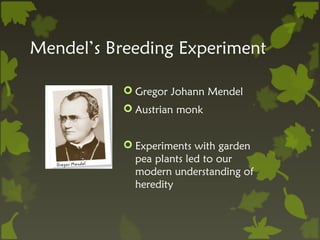
Mendel’s Breeding Experiment

            Gregor Johann Mendel
            Austrian monk


            Experiments with garden
             pea plants led to our
             modern understanding of
             heredity
Why are Pea Plants Good Subjects?
 Several characters (traits) of the plant exist in two
  clearly different forms
    Flower color
    Seed color
    Seed shape
    Pod color
    Pod shape
    Flower position
    Plant height
 Easy to grow
 Short life cycle
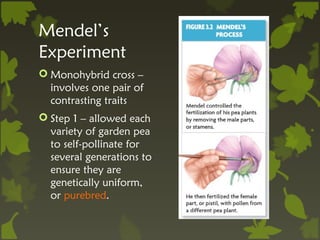
Mendel’s
Experiment
 Monohybrid cross –
  involves one pair of
  contrasting traits
 Step 1 – allowed each
  variety of garden pea
  to self-pollinate for
  several generations to
  ensure they are
  genetically uniform,
  or purebred.
Mendel’s Experiment

 Step 2 – cross-pollinated first two parent plants
  (P generation) that had contrasting traits
 The offspring of these plants were called the first
  filial generation (F1 generation)
 He examined each F1 plant and recorded the
  number of plants expressing each trait
Mendel’s Experiment


 Step 3 – allowed the F1 generation to self-
  pollinate
 The offspring are called the F2 generation
 Each F2 plant was examined and the traits
  recorded
Mendel’s Results
Mendel’s Results


 In F1 generation, all plants were purple
 In F2 generation, the ratio of purple to white
  plants was 3 to 1


 Ratio: 3:1 or 3 to 1 or 3/1
Mendel’s Hypotheses

1. There are alternative versions of genes
    Example: the gene for flower color in peas
     can exist in a “purple” version or a “white”
     version


Today the different versions of a gene are called its
   alleles.
Mendel’s Hypotheses

2. When two different alleles occur together, one
   of them may be completely expressed, while
   the other may have no observable effect on the
   organism’s appearance.


Expressed form of the character – dominant
Trait that is not expressed - recessive
Mendel’s First Law or
Law of Segregation

 Organisms carry two copies of each gene, one
  from each parent
 When gametes are formed, the alleles for each
  gene in an individual separate. Thus, gametes
  carry only one allele for each inherited character.
The same gene can have many
versions


 Gene – a piece of DNA that holds the instructions
  to make a certain protein
 Allele – any of the alternative forms of a gene
  that are at a certain locus on a chromosome
Homozygous vs. Heterozygous
 If two alleles of a particular
  gene present in an individual
  are the same, the individual is
  said to be homozygous for
  that trait.

 If the alleles of a particular
  gene present in an individual
  are different, the individual is
  said to be heterozygous for
  that trait.
Genotype vs. Phenotype

 Genome – all of an organism’s genetic material
 Genotype – the set of alleles that an individual has
 Phenotype – the physical appearance of a character

                  Genotype            Phenotype
                  PP                  Purple flower
                  Pp                  Purple flower
                  pp                  White flower
Punnett Squares

 A diagram that
  predicts the outcome
  of a genetic cross by
  considering all
  possible combinations
  of gametes in the
  cross.
Outcomes of Crosses


 Probability – the likelihood that a specific event
  will occur


Probability =    # of 1 kind of outcome
                total # possible outcomes

Mendel & Heredity

  • 1.
  • 2.
    The Origins ofGenetics  Genetics – the study of biological inheritance patterns and variation in organisms  Traits – distinguishing characteristics that are inherited  Heredity – the passing of characters (traits) from parents to offspring
  • 3.
    Mendel’s Breeding Experiment  Gregor Johann Mendel  Austrian monk  Experiments with garden pea plants led to our modern understanding of heredity
  • 4.
    Why are PeaPlants Good Subjects?  Several characters (traits) of the plant exist in two clearly different forms  Flower color  Seed color  Seed shape  Pod color  Pod shape  Flower position  Plant height  Easy to grow  Short life cycle
  • 5.
    Mendel’s Experiment  Monohybrid cross– involves one pair of contrasting traits  Step 1 – allowed each variety of garden pea to self-pollinate for several generations to ensure they are genetically uniform, or purebred.
  • 6.
    Mendel’s Experiment  Step2 – cross-pollinated first two parent plants (P generation) that had contrasting traits  The offspring of these plants were called the first filial generation (F1 generation)  He examined each F1 plant and recorded the number of plants expressing each trait
  • 7.
    Mendel’s Experiment  Step3 – allowed the F1 generation to self- pollinate  The offspring are called the F2 generation  Each F2 plant was examined and the traits recorded
  • 8.
  • 9.
    Mendel’s Results  InF1 generation, all plants were purple  In F2 generation, the ratio of purple to white plants was 3 to 1  Ratio: 3:1 or 3 to 1 or 3/1
  • 10.
    Mendel’s Hypotheses 1. Thereare alternative versions of genes  Example: the gene for flower color in peas can exist in a “purple” version or a “white” version Today the different versions of a gene are called its alleles.
  • 11.
    Mendel’s Hypotheses 2. Whentwo different alleles occur together, one of them may be completely expressed, while the other may have no observable effect on the organism’s appearance. Expressed form of the character – dominant Trait that is not expressed - recessive
  • 12.
    Mendel’s First Lawor Law of Segregation  Organisms carry two copies of each gene, one from each parent  When gametes are formed, the alleles for each gene in an individual separate. Thus, gametes carry only one allele for each inherited character.
  • 13.
    The same genecan have many versions  Gene – a piece of DNA that holds the instructions to make a certain protein  Allele – any of the alternative forms of a gene that are at a certain locus on a chromosome
  • 14.
    Homozygous vs. Heterozygous If two alleles of a particular gene present in an individual are the same, the individual is said to be homozygous for that trait.  If the alleles of a particular gene present in an individual are different, the individual is said to be heterozygous for that trait.
  • 15.
    Genotype vs. Phenotype Genome – all of an organism’s genetic material  Genotype – the set of alleles that an individual has  Phenotype – the physical appearance of a character Genotype Phenotype PP Purple flower Pp Purple flower pp White flower
  • 16.
    Punnett Squares  Adiagram that predicts the outcome of a genetic cross by considering all possible combinations of gametes in the cross.
  • 18.
    Outcomes of Crosses Probability – the likelihood that a specific event will occur Probability = # of 1 kind of outcome total # possible outcomes