Chapter 6

Pathways of Photosynthesis
Photosynthesis produces food and
        released oxygen
Photosynthesizers are autotrophs that produce
  their own food
• Photosynthesis
   – Converts solar energy to chemical energy (glucose)
• Autotrophs
   – Produce their own food
• Heterotrophs
   – Consumers
• Nearly all food chains start with plants or algae
In eukaryotes, chloroplasts carry
         out photosynthesis
• Materials for photosynthesis
  – CO2
     • Comes through stomata
     • Comes from organisms breathing out
  – H2O
     • Comes in through roots
• The materials diffuse into chloroplasts, where
  photosynthesis occurs
• Thylakoids are within chloroplasts and
  chlorophyll is found inside of them
• Chlorophyll is within thylakoids and absorbs
  solar energy
Photosynthesis involves two sets of
reactions: the light reactions and the Calvin
              cycle reactions
• Oxidation
   – Loss of hydrogen atoms
   – Loses electrons
• Reduction
   – Gain of hydrogen atoms
   – Gains electrons
• This type of reactions is called a redox reaction
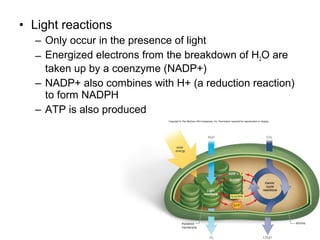
• Light reactions
  – Only occur in the presence of light
  – Energized electrons from the breakdown of H2O are
    taken up by a coenzyme (NADP+)
  – NADP+ also combines with H+ (a reduction reaction)
    to form NADPH
  – ATP is also produced
• Calvin Cycle
  – Light independent (can occur with or without light)
  – CO2 reduces to CH2O, which can be used to form
    glucose
  – H+ comes from NADPH
  – Energy comes from ATP
The light reactions capture solar
                energy
Solar energy is absorbed by
  pigments
• Solar energy
   – Radiant energy from the sun
• Visible light
   – Type of radiation used for
     photosynthesis and vision
   – Shorter wavelength means more
     energy
       • Violet-shortest wavelength, most
         energy
       • Red-longest wavelength, least
         energy
• Chlorophyll a, chlorophyll b, and carotenoids are
  found in photosynthesizing cells and are capable
  of absorbing various portions of visible light
• Green is reflected instead of absorbed, this is
  why plants appear green
During fall, enzymes that rebuild chorophyll work
 at a slower speed due to lower temperatures.
 Chlorophyll eventually disintegrates, leaving only
 carotenoids to absorb light. Carotenoids reflect
 yellow, orange, and red, which is why leaves
 appear to change colors.
Solar energy boosts electrons to a
       higher energy level
Antenna molecule
  – Takes in light energy
  – Pass energy to the
    reaction center
Electrons release their energy as
             ATP forms
• Chloroplasts use
  electrons energized by
  solar energy to generate
  ATP by way of electron
  transport chain
   – High energy electrons
     enter
   – Low energy electrons leave
   – Energy is released each
     time the electron is
     transferred
   – Energy is ultimately used to
     make ATP
The Calvin cycle reactions
       synthesize carbohydrates
ATP and NADPH from the light dependent reactions are
  needed to produce a carbohydrate
• CO2 comes in from the atmosphere and combines with
  RuBP (an enzyme that speeds the Calvin cycle)
• CO2 is reduced to form CH2O
   – ATP and NADPH are needed for this to occur
   – ATP breaks down to ADP + P
   – NADPH breaks down to NADP+
• G3P (glyceraldehyde-3-phosphate) (CH2O)is then
  produced, which is the building block for many
  carbohydrates (glucose, starch, and cellulose) and RuBP
• The ADP + P and NADP+ can go back to the light
  reactions to form ATP and NADPH again
http://media.pearsoncmg.com/bc/bc_0media_bio/bioflix/bioflix.htm?cc5photosynthesis
Tropical rain forests and global
            climates change
• Rain forest vegetation absorbs large amounts of
  CO2
• CO2 traps radiant heat from the sun and warms
  the world, similar to a greenhouse, which is why
  it is called a greenhouse gas
• Without greenhouse gasses, Earth would be
  about 33˚C cooler
• With excess greenhouse gasses, climate
  patterns will be disrupted (more heatwaves,
  droughts, and storms) and more hurricanes and
  tornadoes will occur
• Burning fossil fuels releases CO2, clearing
  rainforests usually involves burning them (slash
  and burn), releasing the trapped CO2, and
  reducing the amount of vegetation that can
  absorb CO2
• At warmer temperatures, photosynthesis rates
  have been seen to decrease
• Cut down forests => more CO2 in the air =>
  warmer temperatures => lower photosynthesis
  rates => less CO2 is absorbed
• Protecting remaining forests and reestablishing
  deforested areas may help to slow climate
  change

Bio 100 Chapter 6

  • 1.
    Chapter 6 Pathways ofPhotosynthesis
  • 2.
    Photosynthesis produces foodand released oxygen Photosynthesizers are autotrophs that produce their own food • Photosynthesis – Converts solar energy to chemical energy (glucose) • Autotrophs – Produce their own food • Heterotrophs – Consumers • Nearly all food chains start with plants or algae
  • 3.
    In eukaryotes, chloroplastscarry out photosynthesis • Materials for photosynthesis – CO2 • Comes through stomata • Comes from organisms breathing out – H2O • Comes in through roots • The materials diffuse into chloroplasts, where photosynthesis occurs • Thylakoids are within chloroplasts and chlorophyll is found inside of them • Chlorophyll is within thylakoids and absorbs solar energy
  • 4.
    Photosynthesis involves twosets of reactions: the light reactions and the Calvin cycle reactions • Oxidation – Loss of hydrogen atoms – Loses electrons • Reduction – Gain of hydrogen atoms – Gains electrons • This type of reactions is called a redox reaction
  • 5.
    • Light reactions – Only occur in the presence of light – Energized electrons from the breakdown of H2O are taken up by a coenzyme (NADP+) – NADP+ also combines with H+ (a reduction reaction) to form NADPH – ATP is also produced
  • 6.
    • Calvin Cycle – Light independent (can occur with or without light) – CO2 reduces to CH2O, which can be used to form glucose – H+ comes from NADPH – Energy comes from ATP
  • 7.
    The light reactionscapture solar energy Solar energy is absorbed by pigments • Solar energy – Radiant energy from the sun • Visible light – Type of radiation used for photosynthesis and vision – Shorter wavelength means more energy • Violet-shortest wavelength, most energy • Red-longest wavelength, least energy
  • 8.
    • Chlorophyll a,chlorophyll b, and carotenoids are found in photosynthesizing cells and are capable of absorbing various portions of visible light • Green is reflected instead of absorbed, this is why plants appear green
  • 9.
    During fall, enzymesthat rebuild chorophyll work at a slower speed due to lower temperatures. Chlorophyll eventually disintegrates, leaving only carotenoids to absorb light. Carotenoids reflect yellow, orange, and red, which is why leaves appear to change colors.
  • 10.
    Solar energy boostselectrons to a higher energy level Antenna molecule – Takes in light energy – Pass energy to the reaction center
  • 11.
    Electrons release theirenergy as ATP forms • Chloroplasts use electrons energized by solar energy to generate ATP by way of electron transport chain – High energy electrons enter – Low energy electrons leave – Energy is released each time the electron is transferred – Energy is ultimately used to make ATP
  • 12.
    The Calvin cyclereactions synthesize carbohydrates ATP and NADPH from the light dependent reactions are needed to produce a carbohydrate • CO2 comes in from the atmosphere and combines with RuBP (an enzyme that speeds the Calvin cycle) • CO2 is reduced to form CH2O – ATP and NADPH are needed for this to occur – ATP breaks down to ADP + P – NADPH breaks down to NADP+ • G3P (glyceraldehyde-3-phosphate) (CH2O)is then produced, which is the building block for many carbohydrates (glucose, starch, and cellulose) and RuBP • The ADP + P and NADP+ can go back to the light reactions to form ATP and NADPH again
  • 13.
  • 14.
    Tropical rain forestsand global climates change • Rain forest vegetation absorbs large amounts of CO2 • CO2 traps radiant heat from the sun and warms the world, similar to a greenhouse, which is why it is called a greenhouse gas • Without greenhouse gasses, Earth would be about 33˚C cooler • With excess greenhouse gasses, climate patterns will be disrupted (more heatwaves, droughts, and storms) and more hurricanes and tornadoes will occur
  • 15.
    • Burning fossilfuels releases CO2, clearing rainforests usually involves burning them (slash and burn), releasing the trapped CO2, and reducing the amount of vegetation that can absorb CO2 • At warmer temperatures, photosynthesis rates have been seen to decrease • Cut down forests => more CO2 in the air => warmer temperatures => lower photosynthesis rates => less CO2 is absorbed • Protecting remaining forests and reestablishing deforested areas may help to slow climate change