Richa Sharma
M.Sc. 1st yr.
Dr. BR Ambedkar center for
Biomedical Research (ACBR)
University of Delhi
 Life on earth ultimately depends on energy derived
from the sun.
 Photosynthesis is the only process of biological
importance that can harvest sunlight.
 Light energy derives the synthesis of carbohydrates
and generation of oxygen from CO₂ and H₂O.
6CO₂ + 12H₂O → C₆H₁₂O₆ + 6O₂
 Energy stored in these molecules can be used later to
power cellular processes in the plant and can serve as
the energy source for all forms of life.
 Light has both wave and particle nature.
 Light is described best in terms of energy packets
called photons.
 Energy received from the sun comprises of a broad
range of such photons, distinguishable due to the
characteristic energies, they possess.
 Energy content of light is not continuous but rather is
delivered in these discrete packets,the quanta.
 Energy of a photon can be characterized in terms of
two variables called frequency (ν) and wavelength (λ) .
 • Only 1% of the total solar energy reaching on the
earth is used in the process of photosynthesis.
 • Green wavelength of spectrum is reflected by leaves
and therefore not used in photosynthesis.
 • The bacteriochlorophyll have the ability to absorb
infra-red radiations.
CO₂ + H₂O → (CH₂O) + O₂
 Eqᵐ constant calculated from tabulated free energies of
formation for each of the compounds involved is about
10⁻⁵⁰⁰
 This no. is so close to 0 that means no glucose has
spontaneously formed from H₂O and CO₂ without external
energy being provided.
 Energy needed to derive the photosynthetic reaction comes
from light.
 The efficiency of conversion of light energy into chemical
energy is about 27% which is remarkably high for an energy
conversion system.
 The energy is trapped due to photosynthetic pigments, namely
chlorophyll and other accessory pigments.
 All pigments active in photosynthesis are found in the chloroplast.
 Chlorophyll and bacteriochlorophyll are the typical pigments of
photosynthetic organisms.
 They absorb the red and blue wavelengths of the visible light spectrum
and reflect green light.
 Accessory pigments include the carotenoids and phycobilins which
absorb light and transfer it to chlorophyll.
 Carotenoids form an intergral part of the thylakoid membrane and
protect the photosynthetic apparatus from photooxidative damage.
 An absorption spectrum provides info about the amount of light energy
taken up or absorbed by a pigment as a function of the wavelength of
light.
 Action spectra is the graphical representation of rate of photosynthesis
ocurring at different wavelengths of light.
 Interaction of photons with matter may have many outcomes however
the most common of them is the absorption of the photon by the
molecules.
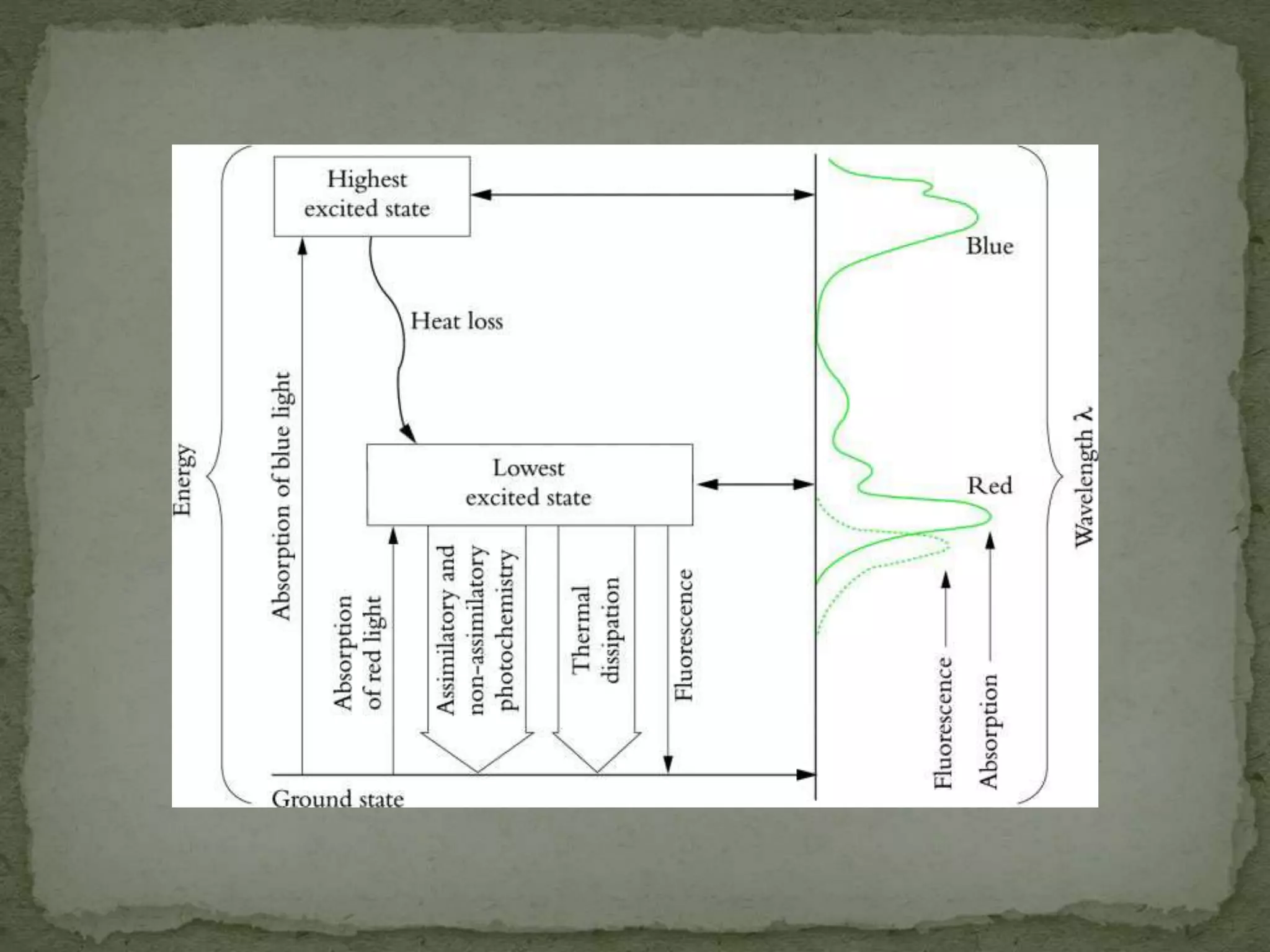
 Chlorophyll on absorbing light makes a transition from its lower energy
or ground state to high energy or excited state.
Chl + hν → Chl*
 Absorption of blue light excites the chl to a higher energy state than
absorption of red light because energy of photons is higher when their
wavelength is shorter.
 In excited state chl is extremely unstable, very rapidly gives up some of
its energy to surroundings as heat and enters the lowest excited state.
 The excess energy can be relieved in a variety of mutually
competing processes:
1. flouroscence : excited electron can re emit a photon and
thereby return to its ground state.
2. As heat
3. Energy transfer
4. Photochemistry
 The photochemical reactions of photosynthesis are among
the fastest known chemical reactions.
 During the process of photosynthesis a no. of
chlorophyll molecules cooperate in the conversion of
solar energy into chemical energy and release a
molecule of oxygen.
 The majority of pigments serve as an antenna complex,
collecting light and transferring the energy to the
reaction center complex,where the chemical oxidation
and reduction reactions leading to long term energy
storage.
 Size of antenna system varies considerably in different organisms,ranging from a low of
20-30 bacteriochlorophyll per reaction center in some photosynthetic bacteria,to
generally 200-300 chl per reaction center in higher plants to a few 1000 pigments per
reaction center in some types of algae and bacteria.
 Physical mechanism by which excitation energy is conveyed from the chl that absorbs the
light to the reaction center is thought to be FRET.
 By this mechanism the excitation energy is transferred from one molecule to another by a
non radiative process.
 A useful analogy for resonance transfer is the transfer of energy between 2 tuning forks.
 If one tuning fork is struck and properly placed near another, the second tuning fork
receives some energy from first and begins to vibrate.
 Approx 95 % to 99% of photons absorbed by the antenna pigments have their energy
transferred to reaction center where it can be used for photochemistry.
 In 1932 Robert Emerson and William Arnold 1st evidence for the cooperation of
many chl molecules in energy conversion during photosynthesis.
 Chlorella pyrenoidosa was exposed to brief flashes of light for short duration (10μ
sec).
 As they increased the intensity of light, an increase in the evolution of oxygen was
expected.
 However they noted, that even after increasing the intensity of light, saturation was
achieved by 2500 molecules of chlorophyll realising a molecule of oxygen.
 This led to the conclusion that light was not absorbed individually, by chlorophyll
molecules but as a cluster of chlorophyll and accessory molecules, now known as
photosynthetic unit (quantasomes).
 Since 10 flashes of light were required to yield one O2 molecule, one photosynthetic
unit will contain 250 chlorophyll molecules
 Later studies have revealed that 8 photons and 250-300 chl molecules are required
to produce a molecule of oxygen
 About 300 pigment molecules are grouped together as light harvesting complex
called photosynthetic unit, where only 1 member chl a acts as reaction
center,transferring electrons to an electron acceptor,while the others act as antenna
complex.
 Emerson measured the quantum yield of photosynthesis as a
function of wavelength and revealed the effect known as red
drop.
 They measured quantum yield, number of oxygen molecules
released per quantum of light, at different wavelength of light.
Quantum yield = no. of O₂ molecules produced/
no. of quanta
 The quantum yield remained constant in the visible region upto
680 nm, beyond which there was sudden drop in rate of
photosynthesis, known as red drop.
 In another experiment, Emerson noticed that the photosynthetic
efficiency could be dramatically increased when two set of
beams,one of red region (wavelengths less than 680nm) and another
in the far red region (wavelength greater than 680nm) were given
simultaneously.
 The rate of photosynthesis enhanced twice or thrice folds, as
compared to rates obtained while giving the beam separately.
Light reaction in photosynthesis

Light reaction in photosynthesis

  • 1.
    Richa Sharma M.Sc. 1styr. Dr. BR Ambedkar center for Biomedical Research (ACBR) University of Delhi
  • 2.
     Life onearth ultimately depends on energy derived from the sun.  Photosynthesis is the only process of biological importance that can harvest sunlight.  Light energy derives the synthesis of carbohydrates and generation of oxygen from CO₂ and H₂O. 6CO₂ + 12H₂O → C₆H₁₂O₆ + 6O₂  Energy stored in these molecules can be used later to power cellular processes in the plant and can serve as the energy source for all forms of life.
  • 3.
     Light hasboth wave and particle nature.  Light is described best in terms of energy packets called photons.  Energy received from the sun comprises of a broad range of such photons, distinguishable due to the characteristic energies, they possess.  Energy content of light is not continuous but rather is delivered in these discrete packets,the quanta.  Energy of a photon can be characterized in terms of two variables called frequency (ν) and wavelength (λ) .
  • 5.
     • Only1% of the total solar energy reaching on the earth is used in the process of photosynthesis.  • Green wavelength of spectrum is reflected by leaves and therefore not used in photosynthesis.  • The bacteriochlorophyll have the ability to absorb infra-red radiations.
  • 6.
    CO₂ + H₂O→ (CH₂O) + O₂  Eqᵐ constant calculated from tabulated free energies of formation for each of the compounds involved is about 10⁻⁵⁰⁰  This no. is so close to 0 that means no glucose has spontaneously formed from H₂O and CO₂ without external energy being provided.  Energy needed to derive the photosynthetic reaction comes from light.  The efficiency of conversion of light energy into chemical energy is about 27% which is remarkably high for an energy conversion system.
  • 7.
     The energyis trapped due to photosynthetic pigments, namely chlorophyll and other accessory pigments.  All pigments active in photosynthesis are found in the chloroplast.  Chlorophyll and bacteriochlorophyll are the typical pigments of photosynthetic organisms.  They absorb the red and blue wavelengths of the visible light spectrum and reflect green light.  Accessory pigments include the carotenoids and phycobilins which absorb light and transfer it to chlorophyll.  Carotenoids form an intergral part of the thylakoid membrane and protect the photosynthetic apparatus from photooxidative damage.  An absorption spectrum provides info about the amount of light energy taken up or absorbed by a pigment as a function of the wavelength of light.  Action spectra is the graphical representation of rate of photosynthesis ocurring at different wavelengths of light.
  • 8.
     Interaction ofphotons with matter may have many outcomes however the most common of them is the absorption of the photon by the molecules.  Chlorophyll on absorbing light makes a transition from its lower energy or ground state to high energy or excited state. Chl + hν → Chl*  Absorption of blue light excites the chl to a higher energy state than absorption of red light because energy of photons is higher when their wavelength is shorter.  In excited state chl is extremely unstable, very rapidly gives up some of its energy to surroundings as heat and enters the lowest excited state.
  • 9.
     The excessenergy can be relieved in a variety of mutually competing processes: 1. flouroscence : excited electron can re emit a photon and thereby return to its ground state. 2. As heat 3. Energy transfer 4. Photochemistry  The photochemical reactions of photosynthesis are among the fastest known chemical reactions.
  • 11.
     During theprocess of photosynthesis a no. of chlorophyll molecules cooperate in the conversion of solar energy into chemical energy and release a molecule of oxygen.  The majority of pigments serve as an antenna complex, collecting light and transferring the energy to the reaction center complex,where the chemical oxidation and reduction reactions leading to long term energy storage.
  • 12.
     Size ofantenna system varies considerably in different organisms,ranging from a low of 20-30 bacteriochlorophyll per reaction center in some photosynthetic bacteria,to generally 200-300 chl per reaction center in higher plants to a few 1000 pigments per reaction center in some types of algae and bacteria.  Physical mechanism by which excitation energy is conveyed from the chl that absorbs the light to the reaction center is thought to be FRET.  By this mechanism the excitation energy is transferred from one molecule to another by a non radiative process.  A useful analogy for resonance transfer is the transfer of energy between 2 tuning forks.  If one tuning fork is struck and properly placed near another, the second tuning fork receives some energy from first and begins to vibrate.  Approx 95 % to 99% of photons absorbed by the antenna pigments have their energy transferred to reaction center where it can be used for photochemistry.
  • 14.
     In 1932Robert Emerson and William Arnold 1st evidence for the cooperation of many chl molecules in energy conversion during photosynthesis.  Chlorella pyrenoidosa was exposed to brief flashes of light for short duration (10μ sec).  As they increased the intensity of light, an increase in the evolution of oxygen was expected.  However they noted, that even after increasing the intensity of light, saturation was achieved by 2500 molecules of chlorophyll realising a molecule of oxygen.  This led to the conclusion that light was not absorbed individually, by chlorophyll molecules but as a cluster of chlorophyll and accessory molecules, now known as photosynthetic unit (quantasomes).  Since 10 flashes of light were required to yield one O2 molecule, one photosynthetic unit will contain 250 chlorophyll molecules  Later studies have revealed that 8 photons and 250-300 chl molecules are required to produce a molecule of oxygen  About 300 pigment molecules are grouped together as light harvesting complex called photosynthetic unit, where only 1 member chl a acts as reaction center,transferring electrons to an electron acceptor,while the others act as antenna complex.
  • 16.
     Emerson measuredthe quantum yield of photosynthesis as a function of wavelength and revealed the effect known as red drop.  They measured quantum yield, number of oxygen molecules released per quantum of light, at different wavelength of light. Quantum yield = no. of O₂ molecules produced/ no. of quanta  The quantum yield remained constant in the visible region upto 680 nm, beyond which there was sudden drop in rate of photosynthesis, known as red drop.
  • 18.
     In anotherexperiment, Emerson noticed that the photosynthetic efficiency could be dramatically increased when two set of beams,one of red region (wavelengths less than 680nm) and another in the far red region (wavelength greater than 680nm) were given simultaneously.  The rate of photosynthesis enhanced twice or thrice folds, as compared to rates obtained while giving the beam separately.