Interstellar Exploration 
Through Repeated External 
Acceleration 
Andrew Bingham 
NIAC Student Fellows Prize 
Department of Mechanical and Aeronautical Engineering, Clarkson University 
NIAC Fellows Meeting, March 7thNIAC 7th--8th, 20068th, 2006
Agenda 
„„ Introduction/Background 
„„ Repeated External Acceleration Concept 
„„ Current Study 
„„ Future Work 
„„ Acknowledgements/References
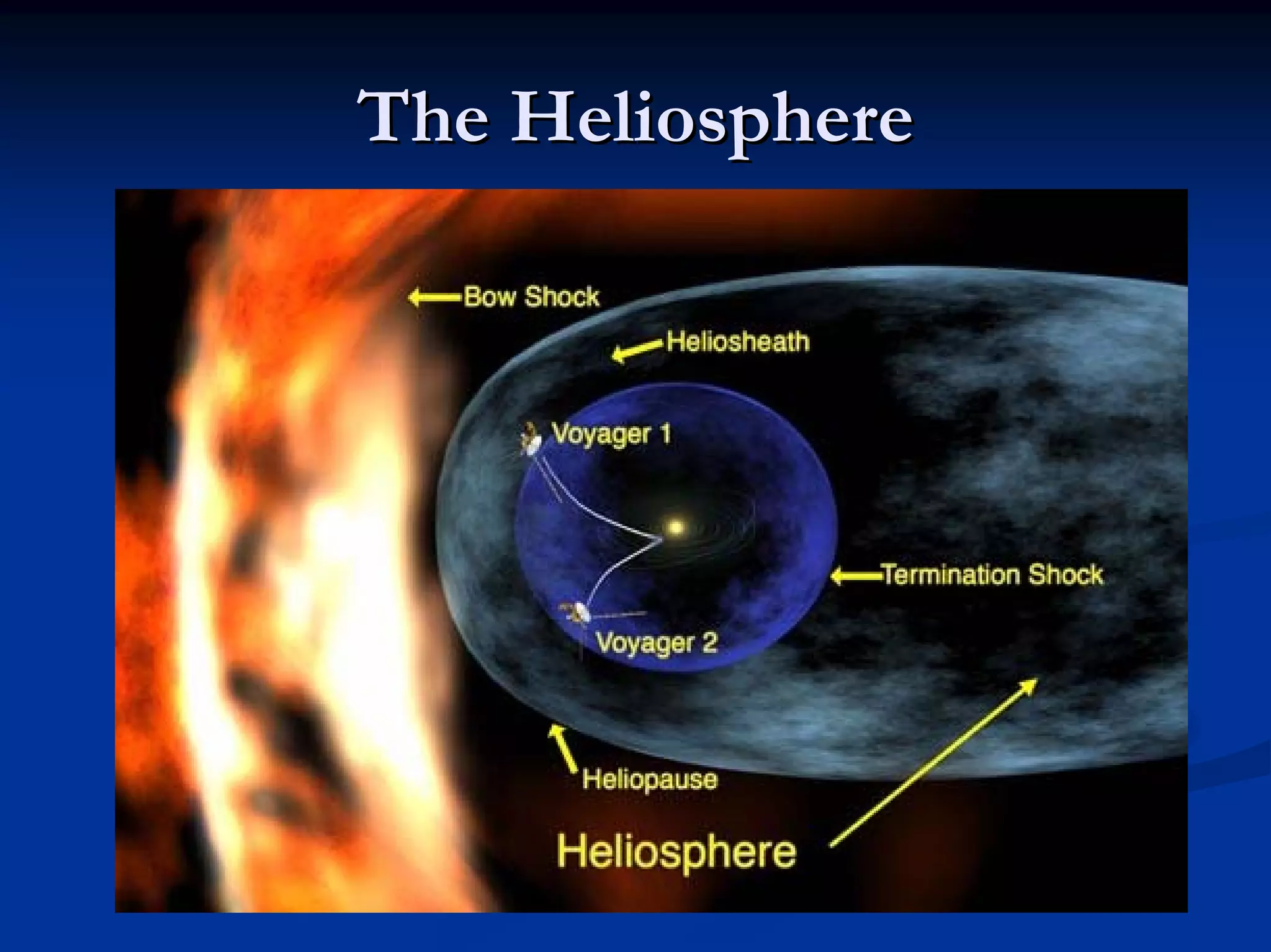
The Heliosphere
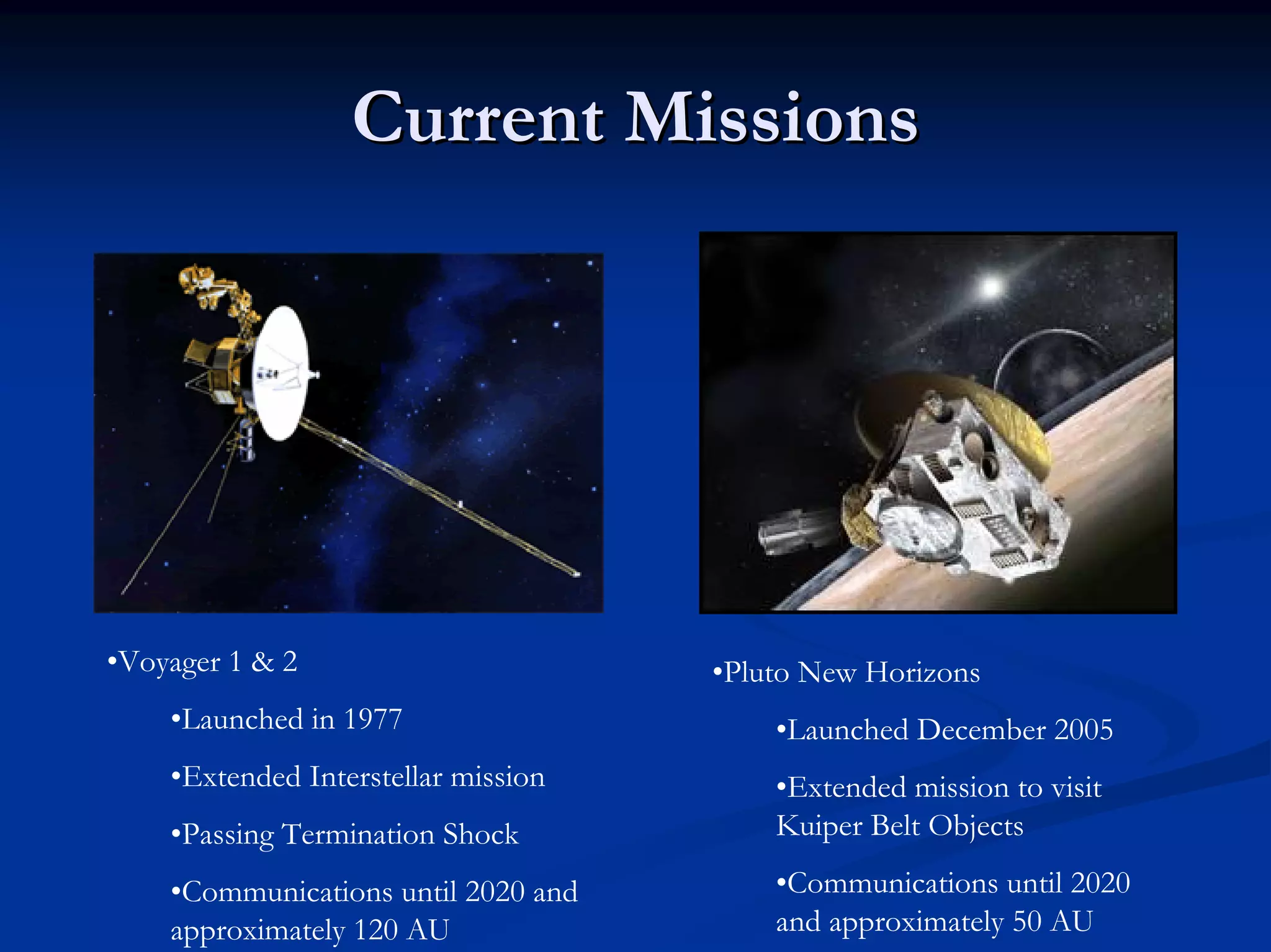
Current Missions 
•Voyager 1 & 2 
•Launched in 1977 
•Extended Interstellar mission 
•Passing Termination Shock 
•Communications until 2020 and approximately 120 AU 
•Pluto New Horizons 
•Launched December 2005 
•Extended mission to visit KuiperBelt Objects 
•Communications until 2020 and approximately 50 AU
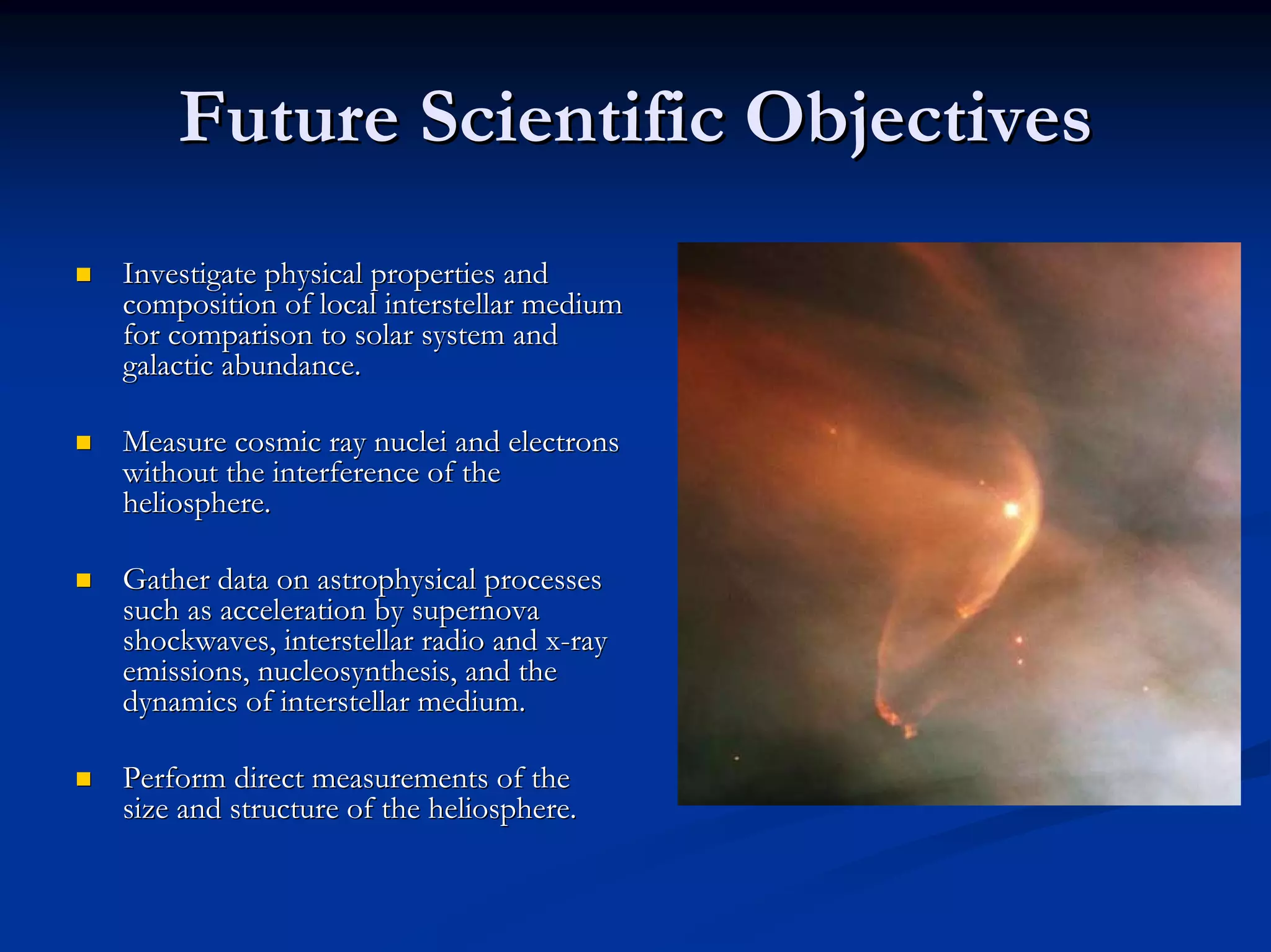
Future Scientific Objectives 
„„ Investigate physical properties and 
composition of local interstellar medium 
for comparison to solar system and 
galactic abundance. 
„„ Measure cosmic ray nuclei and electrons 
without the interference of the 
heliosphere. 
„„ Gather data on astrophysical processes 
such as acceleration by supernova 
shockwaves, interstellar radio and x x-ray 
emissions, nucleosynthesis nucleosynthesis, and the 
, dynamics of interstellar medium. 
„„ Perform direct measurements of the 
size and structure of the heliosphere.
Agenda 
„„ Introduction/Background 
„„ Repeated External Acceleration Concept 
„„ Current Study 
„„ Future Work 
„„ Acknowledgements/References
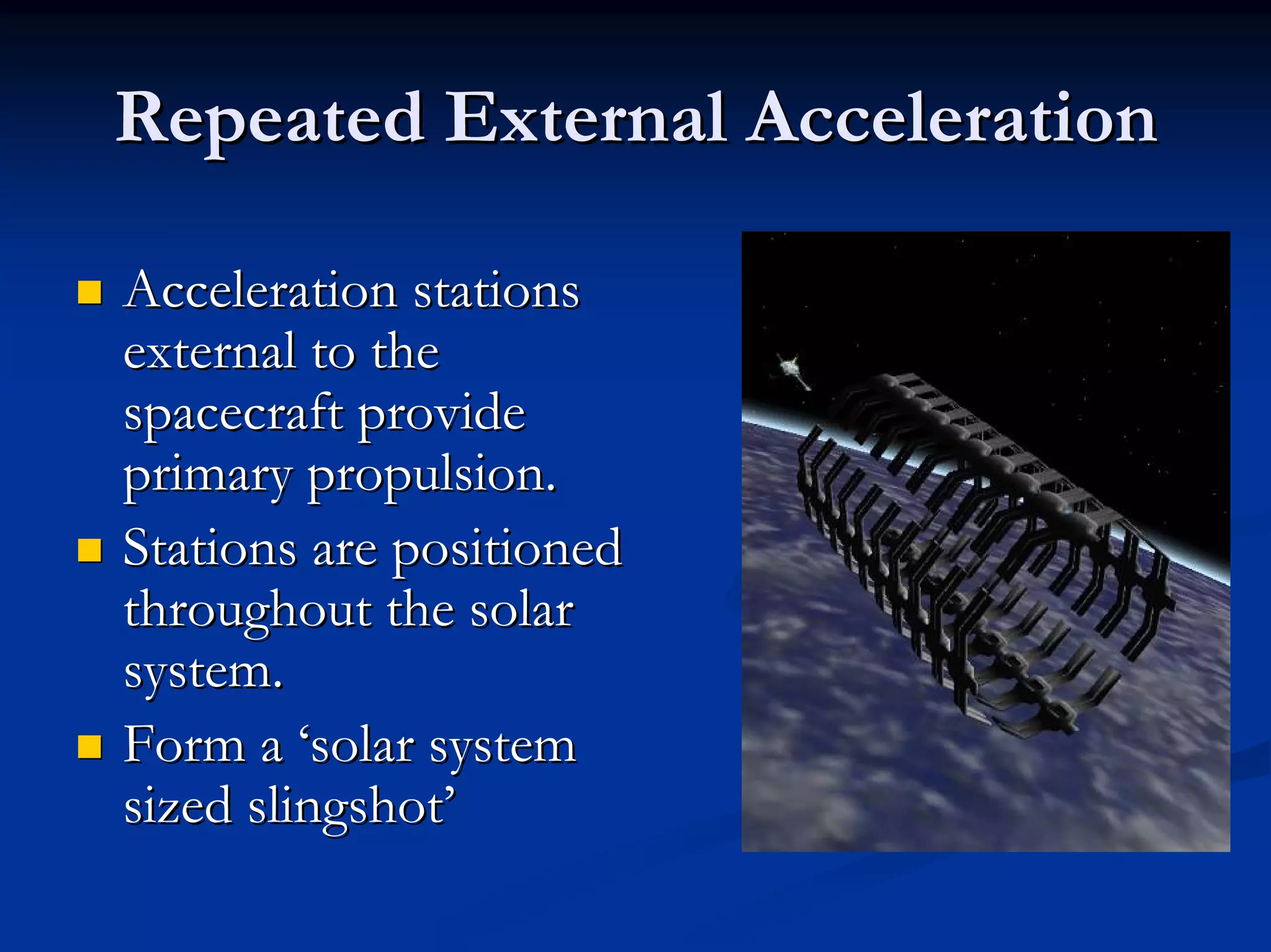
Repeated External Acceleration 
„„ Acceleration stations 
external to the 
spacecraft provide 
primary propulsion. 
„„ Stations are positioned 
throughout the solar 
system. 
„„ Form a ‘solar system 
sized slingshot’
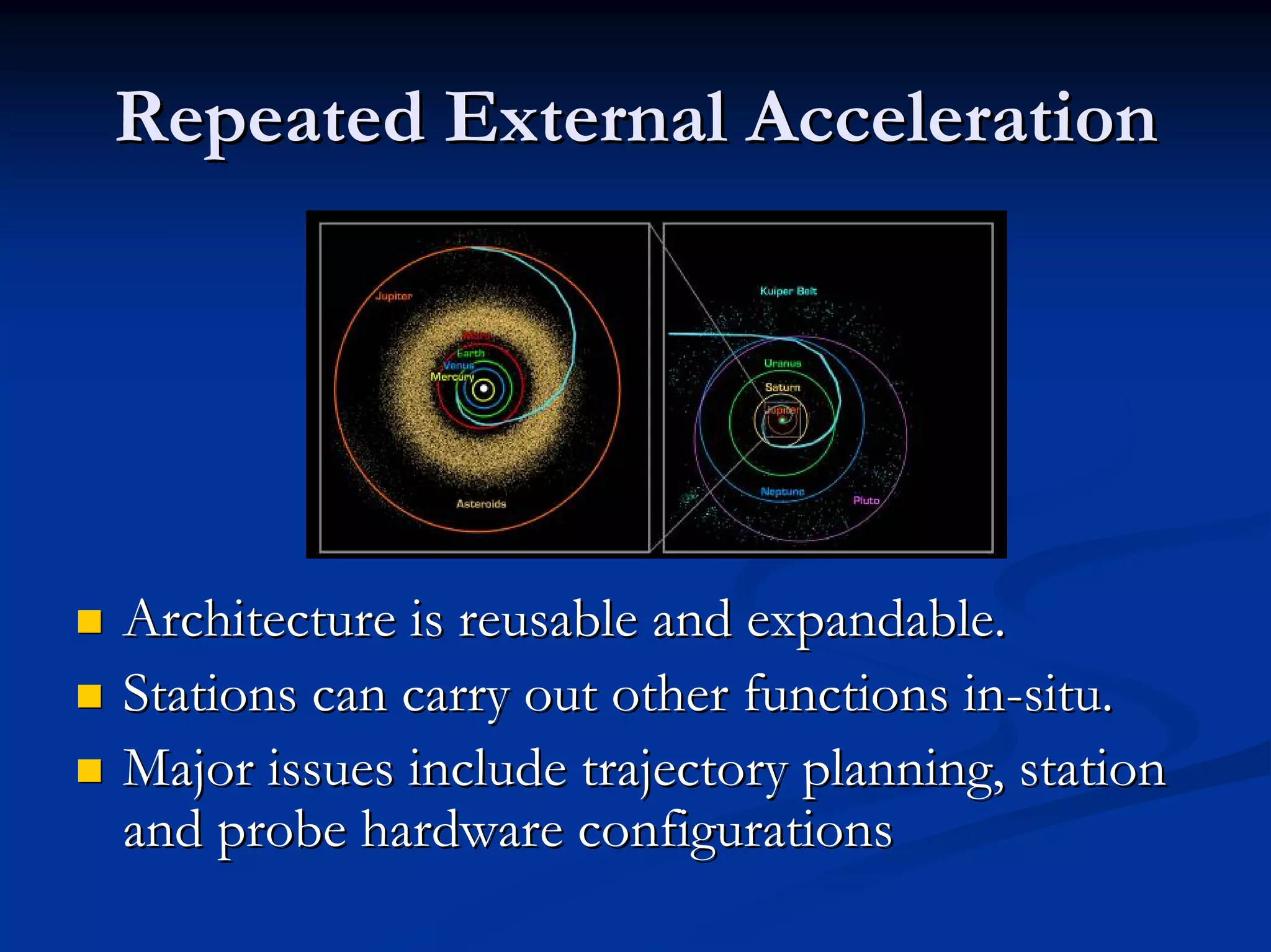
Repeated External Acceleration 
„„ Architecture is reusable and expandable. 
„„ Stations can carry out other functions in in-situ. 
„„ Major issues include trajectory planning, station 
and probe hardware configurations
Agenda 
„„ Introduction/Background 
„„ Repeated External Acceleration Concept 
„„ Current Study 
„„ Trajectory Analysis 
„„ Station Configuration 
„„ Probe Configuration 
„„ Future Work 
„„ Acknowledgements/References
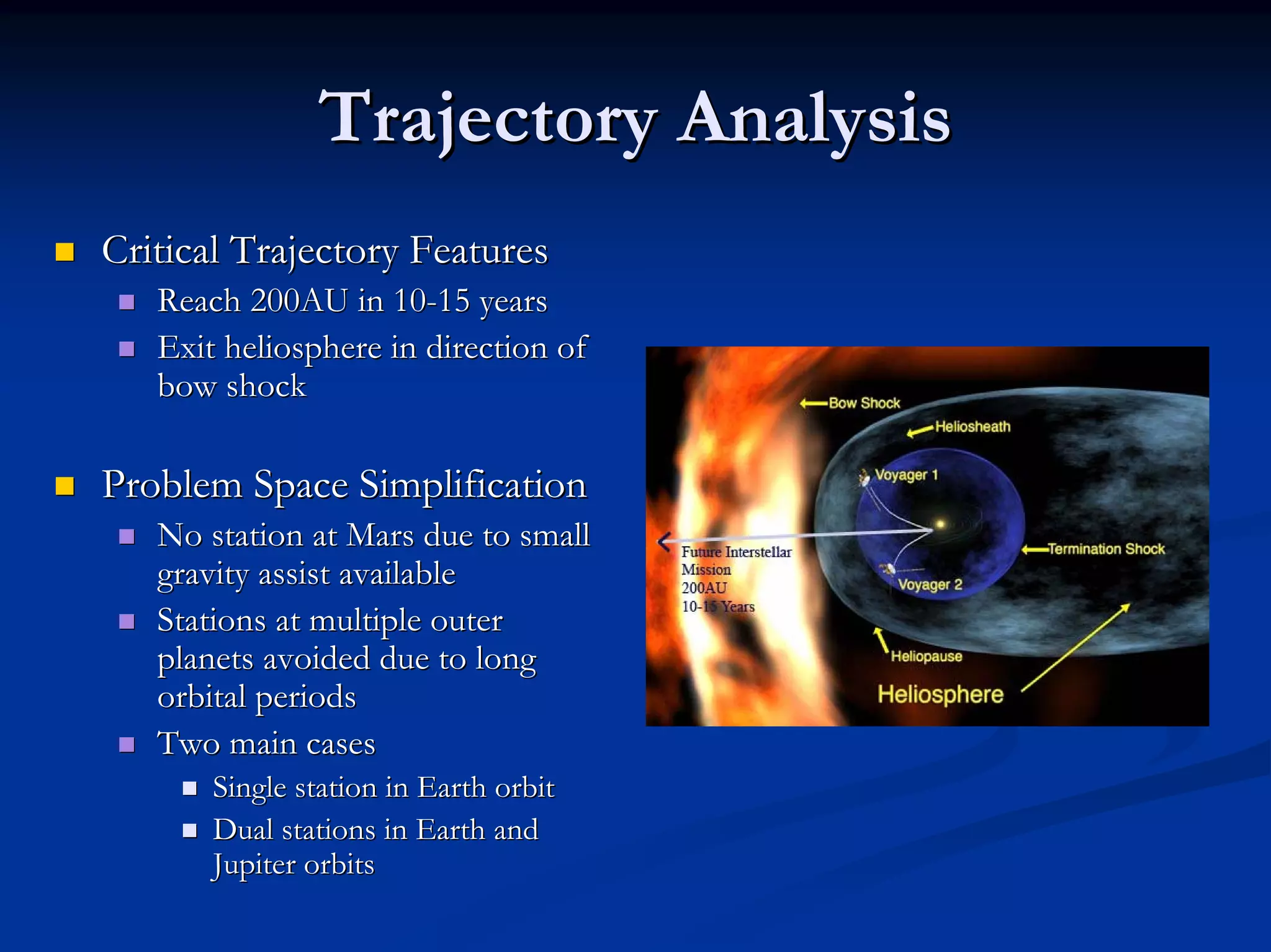
Trajectory Analysis 
„„ Critical Trajectory Features 
„„ Reach 200AU in 10 10-15 years 
„„ Exit heliosphere in direction of 
bow shock 
„„ Problem Space Simplification 
„„ No station at Mars due to small 
gravity assist available 
„„ Stations at multiple outer 
planets avoided due to long 
orbital periods 
„„ Two main cases 
„„ Single station in Earth orbit 
„„ Dual stations in Earth and 
Jupiter orbits
Basic Calculations 
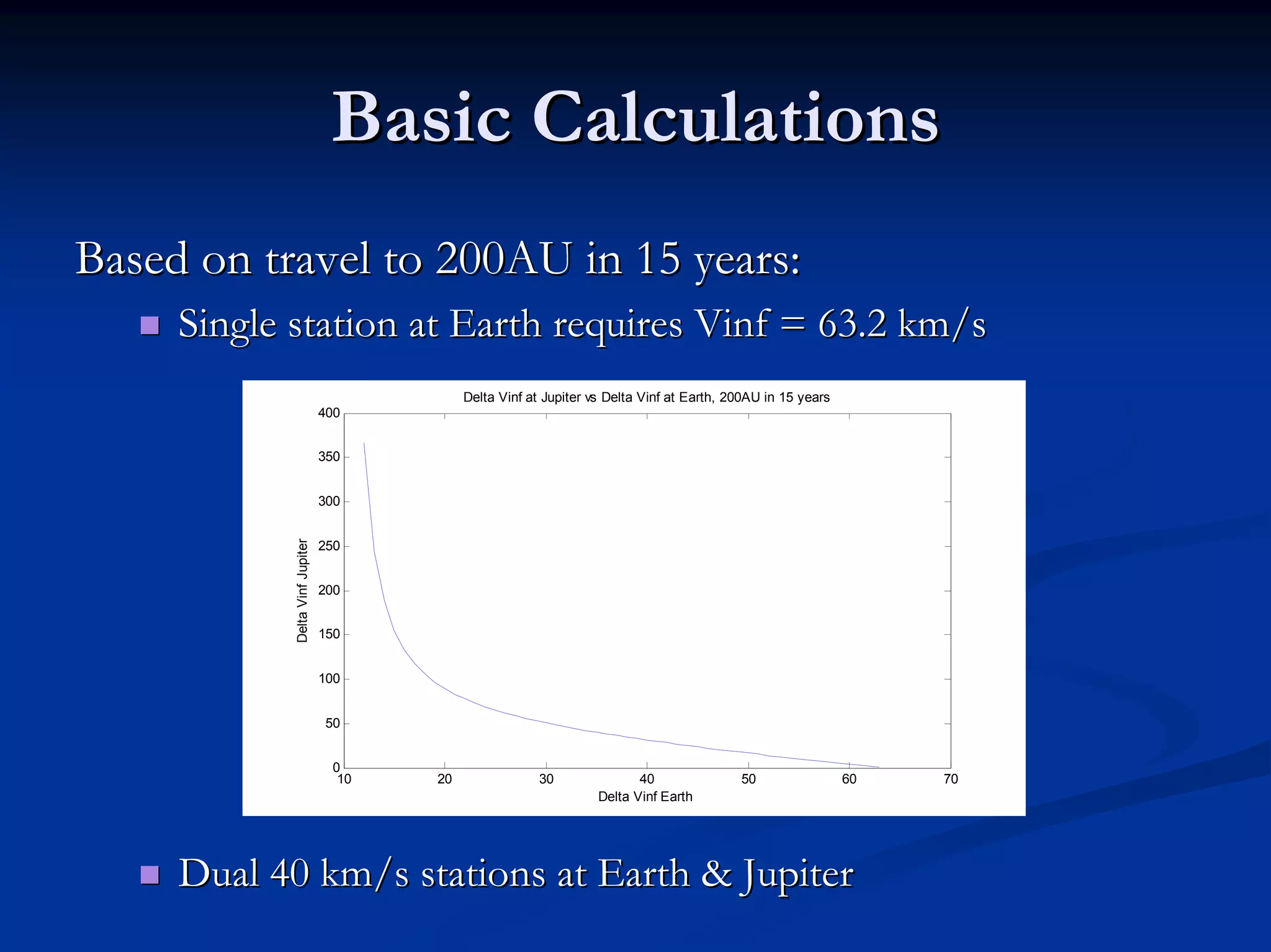
Based on travel to 200AU in 15 years: 
„„ Single station at Earth requires Vinf = 63.2 km/s 
„„ Dual 40 km/s stations at Earth & Jupiter10203040506070050100150200250300350400Delta Vinf Earth Delta Vinf Jupiter Delta Vinf at Jupiter vs Delta Vinf at Earth, 200AU in 15 years 
Jupiter
Requested Software 
„„ SNAP –– NASA Glenn 
„„ Spacecraft N N-Body Analysis Program 
„„ Propagates using 8 8th th order Runge Runge-Kutta Fehlberg routine 
„„ MIDAS –– Jet Propulsion Laboratory 
„„ Patched conic trajectory optimization program 
„„ Capable of automatically varying, adding, deleting mission 
phases 
„„ Satellite Toolkit 
„„ Industry standard trajectory planning tool
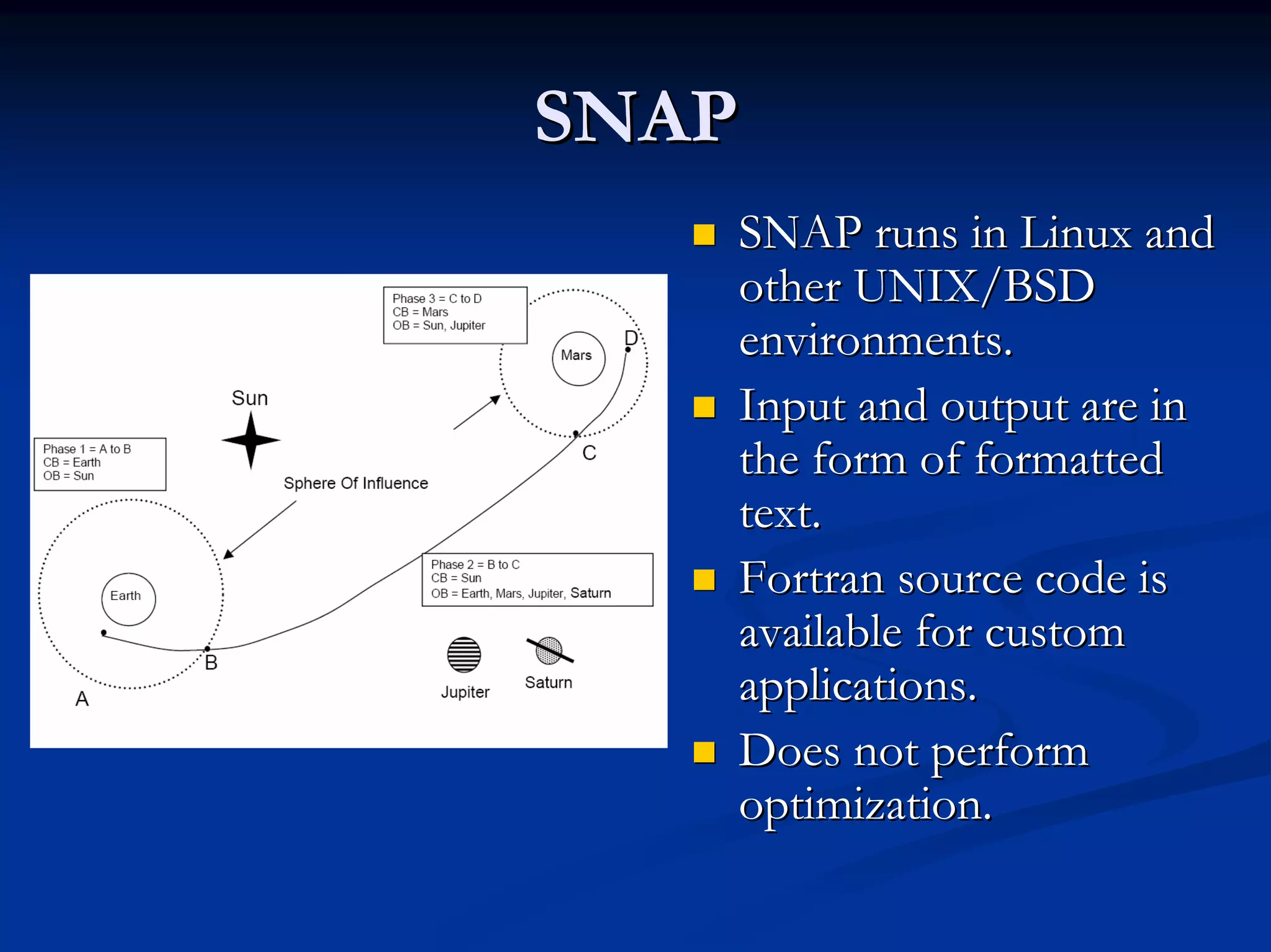
SNAP 
„„SNAP runs in Linux and other UNIX/BSD environments.„„Input and output are in the form of formatted text.„„Fortran source code is available for custom applications.„„Does not perform optimization.
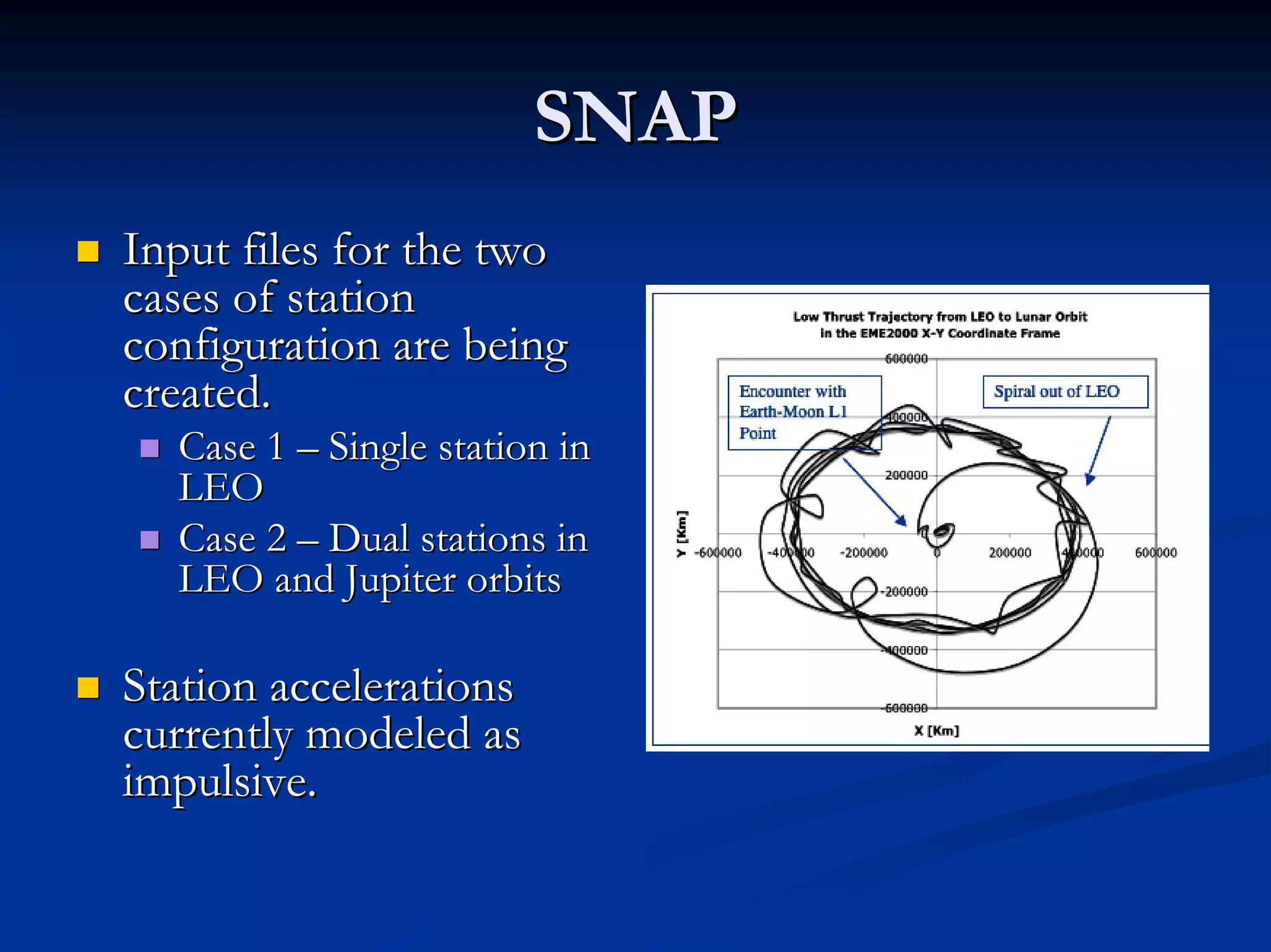
SNAP 
„„ Input files for the two 
cases of station 
configuration are being 
created. 
„„ Case 1 –– Single station in 
LEO 
„„ Case 2 –– Dual stations in 
LEO and Jupiter orbits 
„„ Station accelerations 
currently modeled as 
impulsive.
Further Optimization 
„„ By wrapping an optimization code around 
SNAP, more efficient trajectories can be found. 
„„ Currently, a simple optimizer is being written 
using GNU/Octave. 
„„ Capable of varying parameters within the 
representative input files and comparing resulting 
output for mission success based on critical 
trajectory limitations.
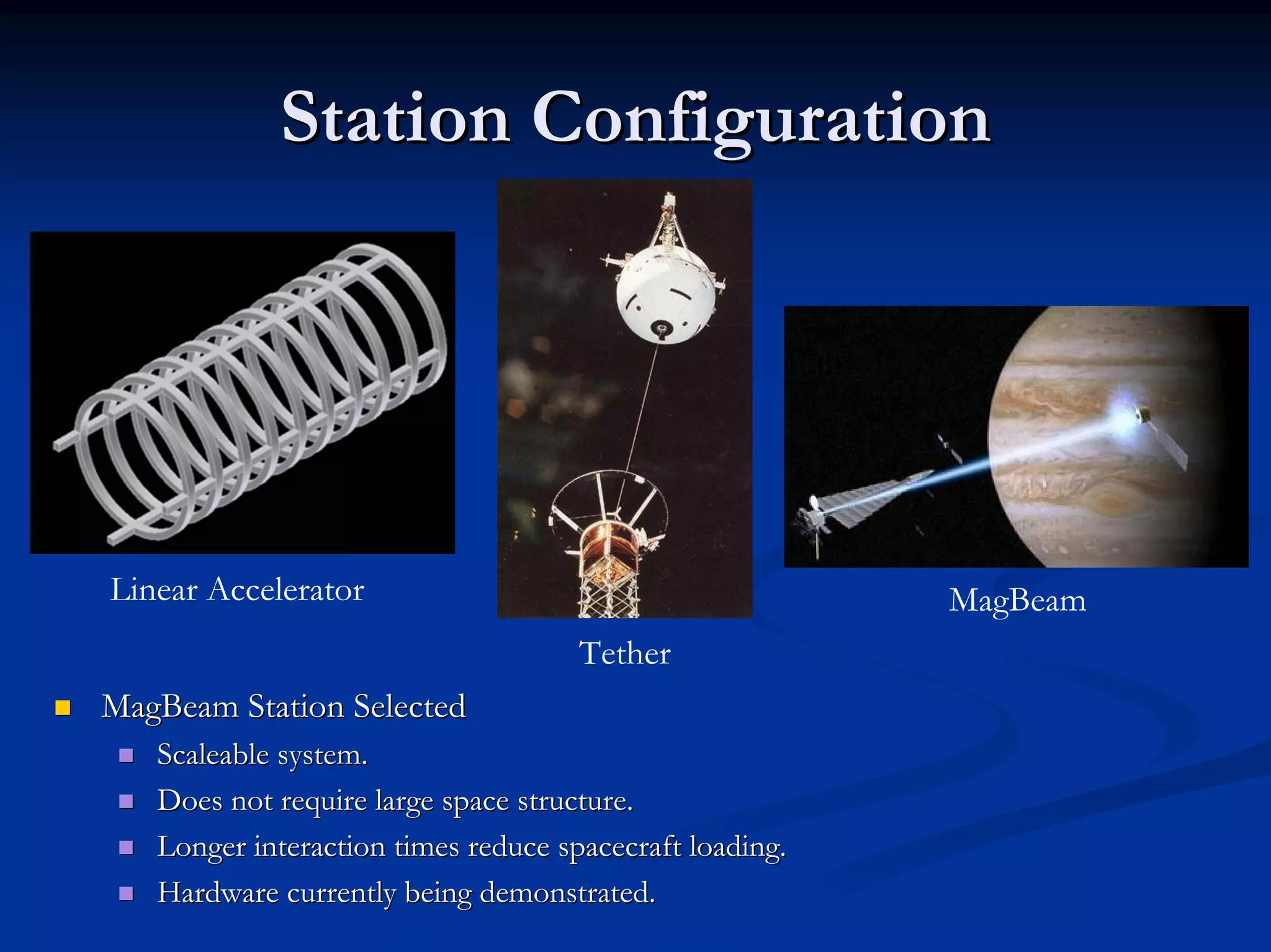
Station Configuration 
Linear AcceleratorTetherMagBeam „„MagBeamMagBeamStation SelectedStation Selected „„Scaleable system.„„Does not require large space structure.„„Longer interaction times reduce spacecraft loading.„„Hardware currently being demonstrated.
Probe Configuration 
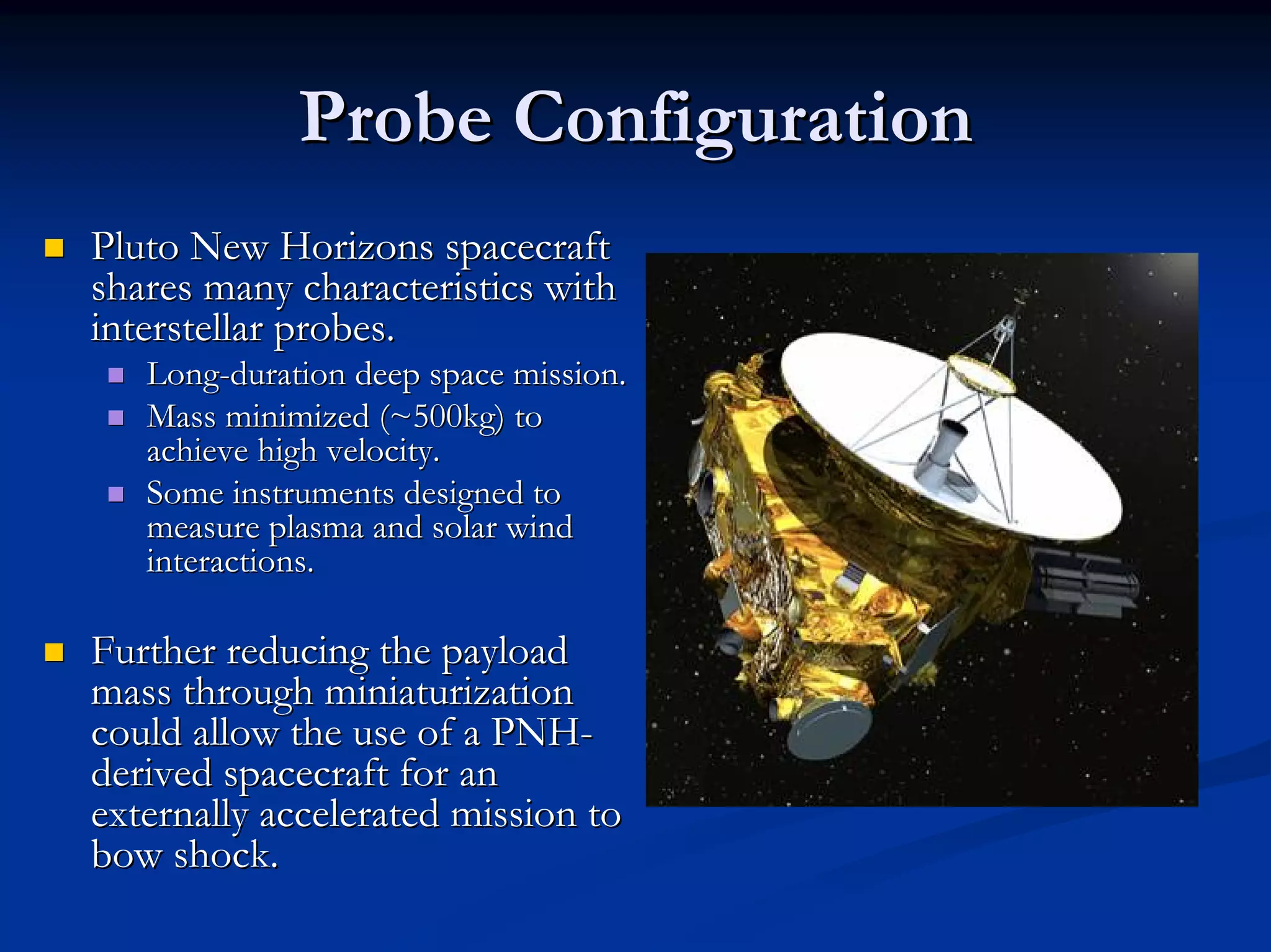
„„ Pluto New Horizons spacecraft 
shares many characteristics with 
interstellar probes. 
„„ Long Long-duration deep space mission. 
„„ Mass minimized (~500kg) to 
achieve high velocity. 
„„ Some instruments designed to 
measure plasma and solar wind 
interactions. 
„„ Further reducing the payload 
mass through miniaturization 
could allow the use of a PNH PNH- 
derived spacecraft for an 
externally accelerated mission to 
bow shock.
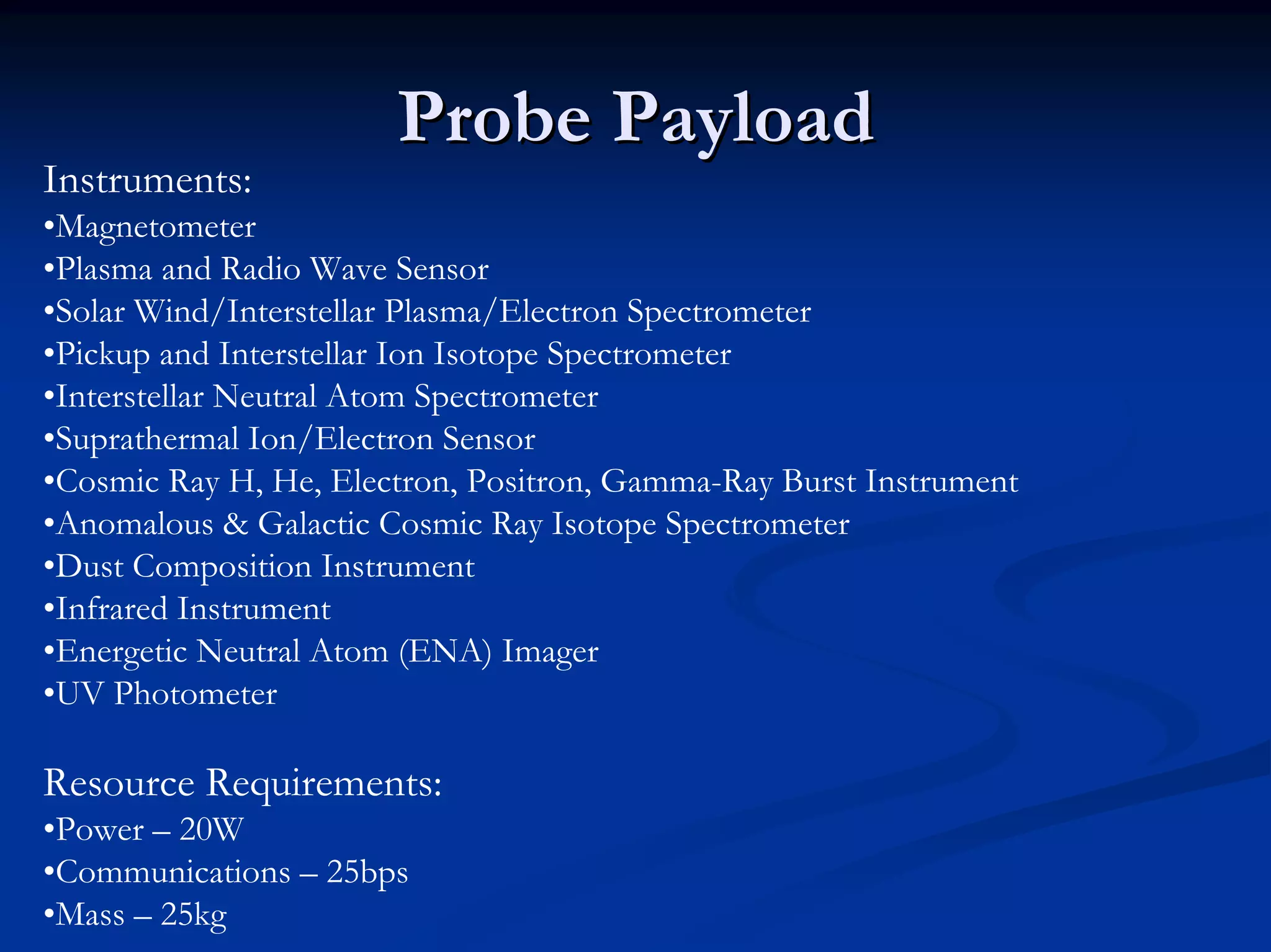
Probe PayloadProbe PayloadInstruments: •Magnetometer•Plasma and Radio Wave Sensor•Solar Wind/Interstellar Plasma/Electron Spectrometer•Pickup and Interstellar Ion Isotope Spectrometer•Interstellar Neutral Atom Spectrometer•SuprathermalIon/Electron Sensor•Cosmic Ray H, He, Electron, Positron, Gamma-Ray Burst Instrument•Anomalous & Galactic Cosmic Ray Isotope Spectrometer•Dust Composition Instrument•Infrared Instrument•Energetic Neutral Atom (ENA) Imager•UV Photometer Resource Requirements: •Power –20W•Communications –25bps•Mass –25kg
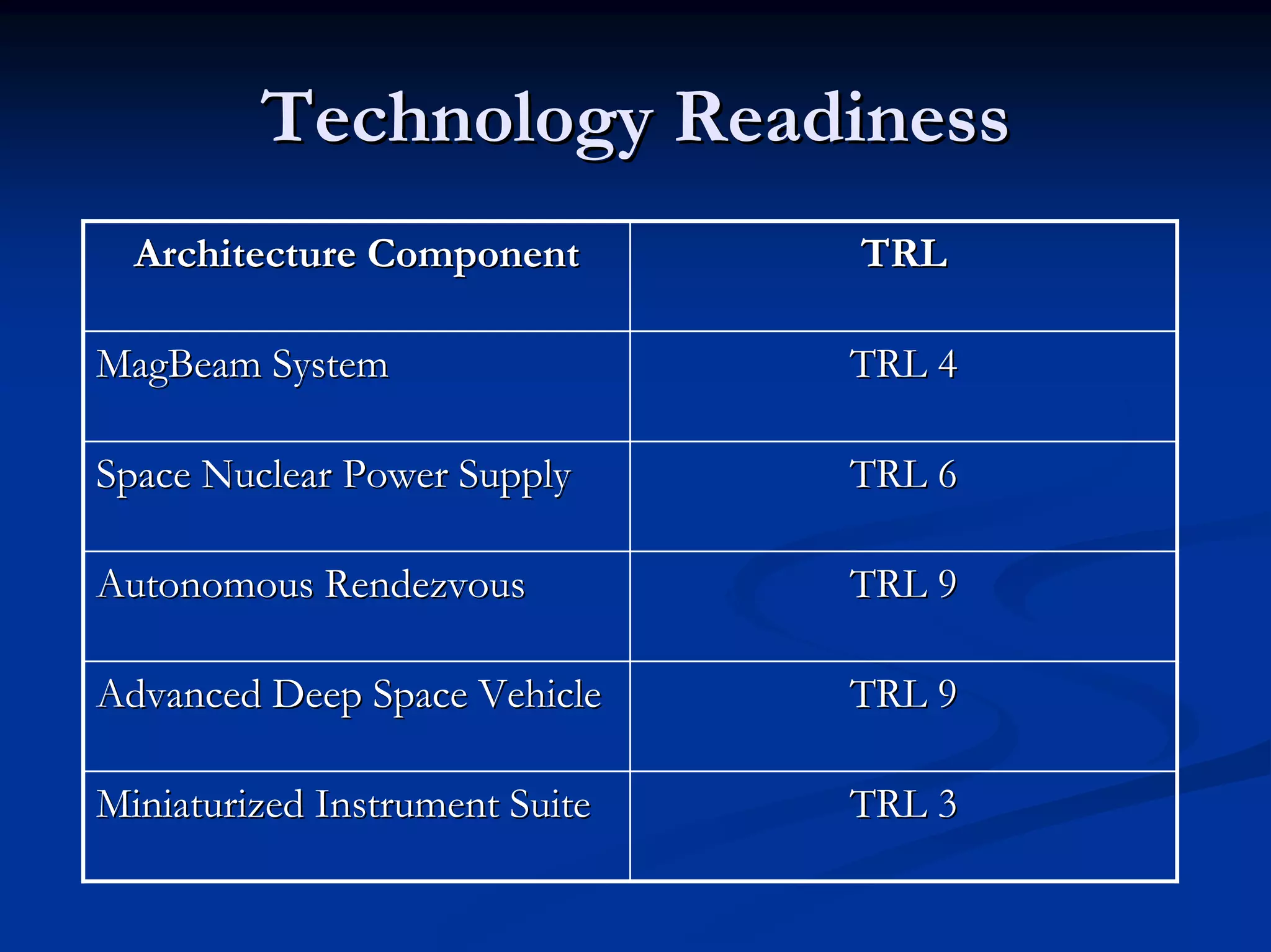
Technology Readiness 
Architecture Component 
TRL 
Space Nuclear Power Supply 
TRL 6 
Autonomous Rendezvous 
TRL 9 
Advanced Deep Space Vehicle 
TRL 9 
MagBeam System 
TRL 4 
Miniaturized Instrument Suite 
TRL 3
Agenda 
„„ Introduction/Background 
„„ Repeated External Acceleration Concept 
„„ Current Study 
„„ Future Work/Outreach 
„„ Acknowledgements/References
Continuing Work & Outreach 
„„ Complete trajectory analysis 
„„ Potential Case 3 –– LEO + Mars Stations 
„„ Publish Web Site 
„„ Present at AIAA Region I I-NE Student 
Conference, March 30 30th th-April 1 1st st 
„„ Present at Clarkson University Symposium for 
Undergraduate Research, April 7 7th th 
„„ Final Report
Agenda 
„„ Introduction/Background 
„„ Repeated External Acceleration Concept 
„„ Current Study 
„„ Future Work/Outreach 
„„ Acknowledgements/References
Acknowledgements 
„„ NIAC, for providing the resources to continue 
working on this project. 
„„ Dr. Kenneth Visser Visser, for advising me throughout 
, the process. 
„„ NASA Glenn for providing SNAP. 
„„ AGI for providing STK. 
„„ Family, friends, and everyone else who 
supported me throughout the last year.
References 
Analytical Graphics, Inc, Satellite Toolkit, v.6.2. 
Hoyt, et. al, A Modular Momentum-Exchange/Electrodynamic-ReboostTether System Architecture, AIAA-2003-2514. 
Interstellar Boundary Explorer Science Strategy. http://www.ibex.swri.edu/mission/strategy.shtml 
Martini, Michael. Spacecraft N-Body Analysis Program 2.3 Users Guide. AnalexCorperation, NASA Glenn Research Center, 2005. 
Mewaldt, R. A., and Liewar, P. C., An Interstellar Probe Mission to the Boundaries of the Heliosphere and Nearby Interstellar Space, NASA Jet Propulsion Laboratory, 1999. 
Pluto New Horizons Science Payload, http://pluto.jhuapl.edu/spacecraft/sciencePay.html 
Riehl, Phil.Tools Used By Analysis & Integration Group –MIDAS. http://trajectory.grc.nasa.gov/tools/midas.shtml 
Vallado, David A, Fundamentals of Astrodynamicsand Applications, Microcosm, 2001. 
Winglee, et. al, Magnetized Beam Propulsion, NIAC Fellows Meeting 2005.
Questions?

Bingham andrew[1]

  • 1.
    Interstellar Exploration ThroughRepeated External Acceleration Andrew Bingham NIAC Student Fellows Prize Department of Mechanical and Aeronautical Engineering, Clarkson University NIAC Fellows Meeting, March 7thNIAC 7th--8th, 20068th, 2006
  • 2.
    Agenda „„ Introduction/Background „„ Repeated External Acceleration Concept „„ Current Study „„ Future Work „„ Acknowledgements/References
  • 3.
  • 4.
    Current Missions •Voyager1 & 2 •Launched in 1977 •Extended Interstellar mission •Passing Termination Shock •Communications until 2020 and approximately 120 AU •Pluto New Horizons •Launched December 2005 •Extended mission to visit KuiperBelt Objects •Communications until 2020 and approximately 50 AU
  • 5.
    Future Scientific Objectives „„ Investigate physical properties and composition of local interstellar medium for comparison to solar system and galactic abundance. „„ Measure cosmic ray nuclei and electrons without the interference of the heliosphere. „„ Gather data on astrophysical processes such as acceleration by supernova shockwaves, interstellar radio and x x-ray emissions, nucleosynthesis nucleosynthesis, and the , dynamics of interstellar medium. „„ Perform direct measurements of the size and structure of the heliosphere.
  • 6.
    Agenda „„ Introduction/Background „„ Repeated External Acceleration Concept „„ Current Study „„ Future Work „„ Acknowledgements/References
  • 7.
    Repeated External Acceleration „„ Acceleration stations external to the spacecraft provide primary propulsion. „„ Stations are positioned throughout the solar system. „„ Form a ‘solar system sized slingshot’
  • 8.
    Repeated External Acceleration „„ Architecture is reusable and expandable. „„ Stations can carry out other functions in in-situ. „„ Major issues include trajectory planning, station and probe hardware configurations
  • 9.
    Agenda „„ Introduction/Background „„ Repeated External Acceleration Concept „„ Current Study „„ Trajectory Analysis „„ Station Configuration „„ Probe Configuration „„ Future Work „„ Acknowledgements/References
  • 10.
    Trajectory Analysis „„Critical Trajectory Features „„ Reach 200AU in 10 10-15 years „„ Exit heliosphere in direction of bow shock „„ Problem Space Simplification „„ No station at Mars due to small gravity assist available „„ Stations at multiple outer planets avoided due to long orbital periods „„ Two main cases „„ Single station in Earth orbit „„ Dual stations in Earth and Jupiter orbits
  • 11.
    Basic Calculations Basedon travel to 200AU in 15 years: „„ Single station at Earth requires Vinf = 63.2 km/s „„ Dual 40 km/s stations at Earth & Jupiter10203040506070050100150200250300350400Delta Vinf Earth Delta Vinf Jupiter Delta Vinf at Jupiter vs Delta Vinf at Earth, 200AU in 15 years Jupiter
  • 12.
    Requested Software „„SNAP –– NASA Glenn „„ Spacecraft N N-Body Analysis Program „„ Propagates using 8 8th th order Runge Runge-Kutta Fehlberg routine „„ MIDAS –– Jet Propulsion Laboratory „„ Patched conic trajectory optimization program „„ Capable of automatically varying, adding, deleting mission phases „„ Satellite Toolkit „„ Industry standard trajectory planning tool
  • 13.
    SNAP „„SNAP runsin Linux and other UNIX/BSD environments.„„Input and output are in the form of formatted text.„„Fortran source code is available for custom applications.„„Does not perform optimization.
  • 14.
    SNAP „„ Inputfiles for the two cases of station configuration are being created. „„ Case 1 –– Single station in LEO „„ Case 2 –– Dual stations in LEO and Jupiter orbits „„ Station accelerations currently modeled as impulsive.
  • 15.
    Further Optimization „„By wrapping an optimization code around SNAP, more efficient trajectories can be found. „„ Currently, a simple optimizer is being written using GNU/Octave. „„ Capable of varying parameters within the representative input files and comparing resulting output for mission success based on critical trajectory limitations.
  • 16.
    Station Configuration LinearAcceleratorTetherMagBeam „„MagBeamMagBeamStation SelectedStation Selected „„Scaleable system.„„Does not require large space structure.„„Longer interaction times reduce spacecraft loading.„„Hardware currently being demonstrated.
  • 17.
    Probe Configuration „„Pluto New Horizons spacecraft shares many characteristics with interstellar probes. „„ Long Long-duration deep space mission. „„ Mass minimized (~500kg) to achieve high velocity. „„ Some instruments designed to measure plasma and solar wind interactions. „„ Further reducing the payload mass through miniaturization could allow the use of a PNH PNH- derived spacecraft for an externally accelerated mission to bow shock.
  • 18.
    Probe PayloadProbe PayloadInstruments:•Magnetometer•Plasma and Radio Wave Sensor•Solar Wind/Interstellar Plasma/Electron Spectrometer•Pickup and Interstellar Ion Isotope Spectrometer•Interstellar Neutral Atom Spectrometer•SuprathermalIon/Electron Sensor•Cosmic Ray H, He, Electron, Positron, Gamma-Ray Burst Instrument•Anomalous & Galactic Cosmic Ray Isotope Spectrometer•Dust Composition Instrument•Infrared Instrument•Energetic Neutral Atom (ENA) Imager•UV Photometer Resource Requirements: •Power –20W•Communications –25bps•Mass –25kg
  • 19.
    Technology Readiness ArchitectureComponent TRL Space Nuclear Power Supply TRL 6 Autonomous Rendezvous TRL 9 Advanced Deep Space Vehicle TRL 9 MagBeam System TRL 4 Miniaturized Instrument Suite TRL 3
  • 20.
    Agenda „„ Introduction/Background „„ Repeated External Acceleration Concept „„ Current Study „„ Future Work/Outreach „„ Acknowledgements/References
  • 21.
    Continuing Work &Outreach „„ Complete trajectory analysis „„ Potential Case 3 –– LEO + Mars Stations „„ Publish Web Site „„ Present at AIAA Region I I-NE Student Conference, March 30 30th th-April 1 1st st „„ Present at Clarkson University Symposium for Undergraduate Research, April 7 7th th „„ Final Report
  • 22.
    Agenda „„ Introduction/Background „„ Repeated External Acceleration Concept „„ Current Study „„ Future Work/Outreach „„ Acknowledgements/References
  • 23.
    Acknowledgements „„ NIAC,for providing the resources to continue working on this project. „„ Dr. Kenneth Visser Visser, for advising me throughout , the process. „„ NASA Glenn for providing SNAP. „„ AGI for providing STK. „„ Family, friends, and everyone else who supported me throughout the last year.
  • 24.
    References Analytical Graphics,Inc, Satellite Toolkit, v.6.2. Hoyt, et. al, A Modular Momentum-Exchange/Electrodynamic-ReboostTether System Architecture, AIAA-2003-2514. Interstellar Boundary Explorer Science Strategy. http://www.ibex.swri.edu/mission/strategy.shtml Martini, Michael. Spacecraft N-Body Analysis Program 2.3 Users Guide. AnalexCorperation, NASA Glenn Research Center, 2005. Mewaldt, R. A., and Liewar, P. C., An Interstellar Probe Mission to the Boundaries of the Heliosphere and Nearby Interstellar Space, NASA Jet Propulsion Laboratory, 1999. Pluto New Horizons Science Payload, http://pluto.jhuapl.edu/spacecraft/sciencePay.html Riehl, Phil.Tools Used By Analysis & Integration Group –MIDAS. http://trajectory.grc.nasa.gov/tools/midas.shtml Vallado, David A, Fundamentals of Astrodynamicsand Applications, Microcosm, 2001. Winglee, et. al, Magnetized Beam Propulsion, NIAC Fellows Meeting 2005.
  • 25.