INTRODUCTION MOTIVATION METHODS DATA AND ANALYSIS RESULTS DISCUSSION CONCLUSION REFERENCES
An Earth-sized planet with an Earth-like density
Akinsanmi A. Babatunde
Department of Astronomy
University of Porto
Paper by Pepe et al (2014)
AST 4007, November 2015
INTRODUCTION MOTIVATION METHODS DATA AND ANALYSIS RESULTS DISCUSSION CONCLUSION REFERENCES
Outline
1 INTRODUCTION
2 MOTIVATION
3 METHODS
4 DATA AND ANALYSIS
5 RESULTS
6 DISCUSSION
7 CONCLUSION
8 REFERENCES
INTRODUCTION MOTIVATION METHODS DATA AND ANALYSIS RESULTS DISCUSSION CONCLUSION REFERENCES
Introduction
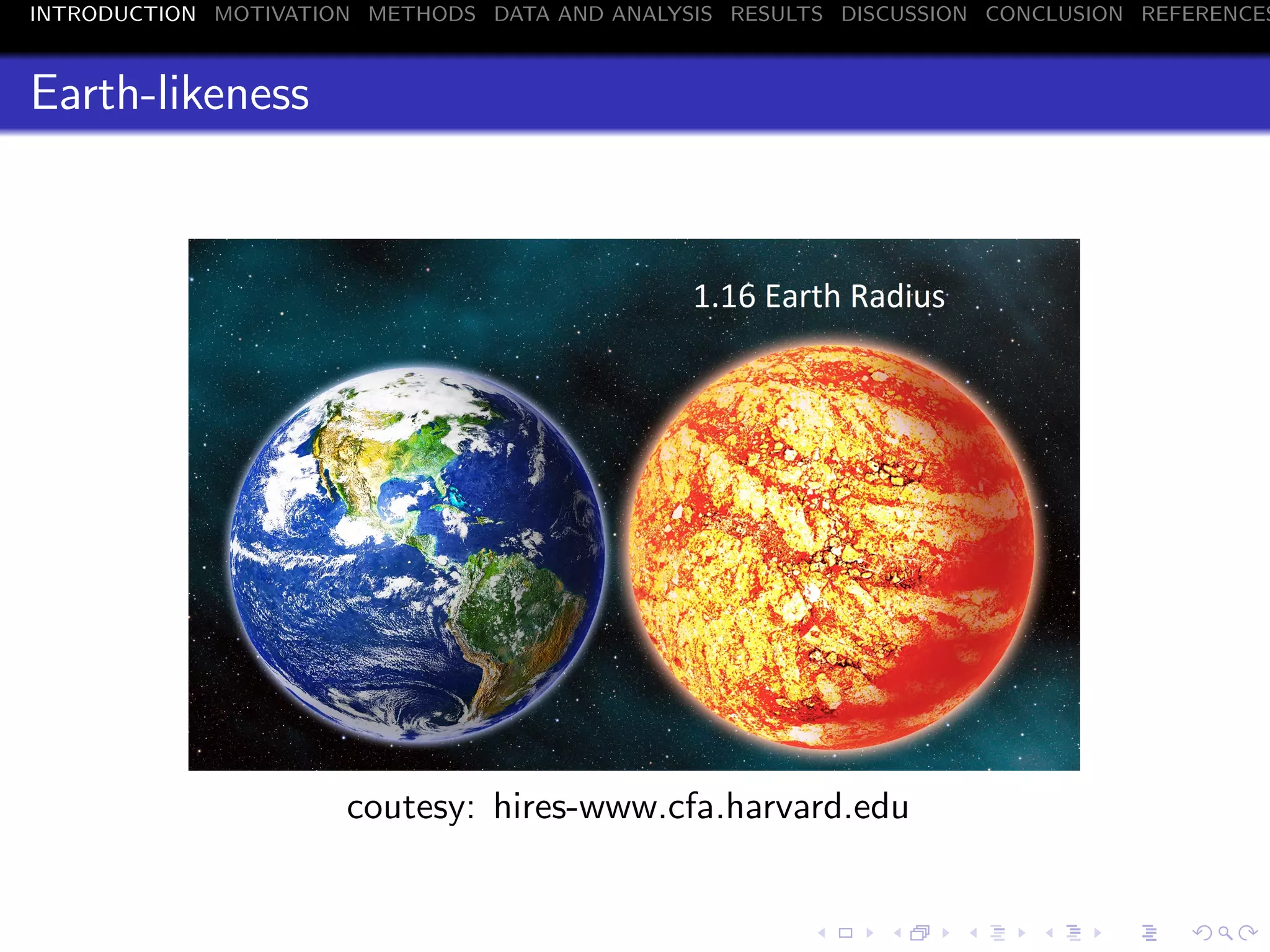
The Star Kepler-78 was identified in 2013 to be harbouring a
transiting planet of 1.16 times the size of the Earth with an
orbital period of only 8.5 hours.
While the exquisite Kepler photometry was able to determine
its radius and period, the mass of the planet (and thus its
mean density) remained unknown in the absence of precise
radial-velocity measurements
Here we present an accurate mass measurement of Kepler-78b
using the HARPS-N spectrograph, installed on the Telescopio
Nazionale Galileo (INAF) at the Roque de los Muchachos
Observatory, La Palma, Spain
INTRODUCTION MOTIVATION METHODS DATA AND ANALYSIS RESULTS DISCUSSION CONCLUSION REFERENCES
Earth-likeness
coutesy: hires-www.cfa.harvard.edu
INTRODUCTION MOTIVATION METHODS DATA AND ANALYSIS RESULTS DISCUSSION CONCLUSION REFERENCES
Motivation
A direct measurement of the mass of Kepler-78b would permit
an evaluation of its mean density and, by inference, its
composition.
Are Earth-sized planets indeed similar to the Earth in bulk
composition?
INTRODUCTION MOTIVATION METHODS DATA AND ANALYSIS RESULTS DISCUSSION CONCLUSION REFERENCES
Methods
Kepler Spacecraft, determines the size or radius of a planet by
the amount of starlight blocked when it passes (transits) in
front of its host star
To determine the planet’s mass, we employ the radial velocity
method to measure how much the gravitational tug of an
orbiting planet causes its star to wobble.
INTRODUCTION MOTIVATION METHODS DATA AND ANALYSIS RESULTS DISCUSSION CONCLUSION REFERENCES
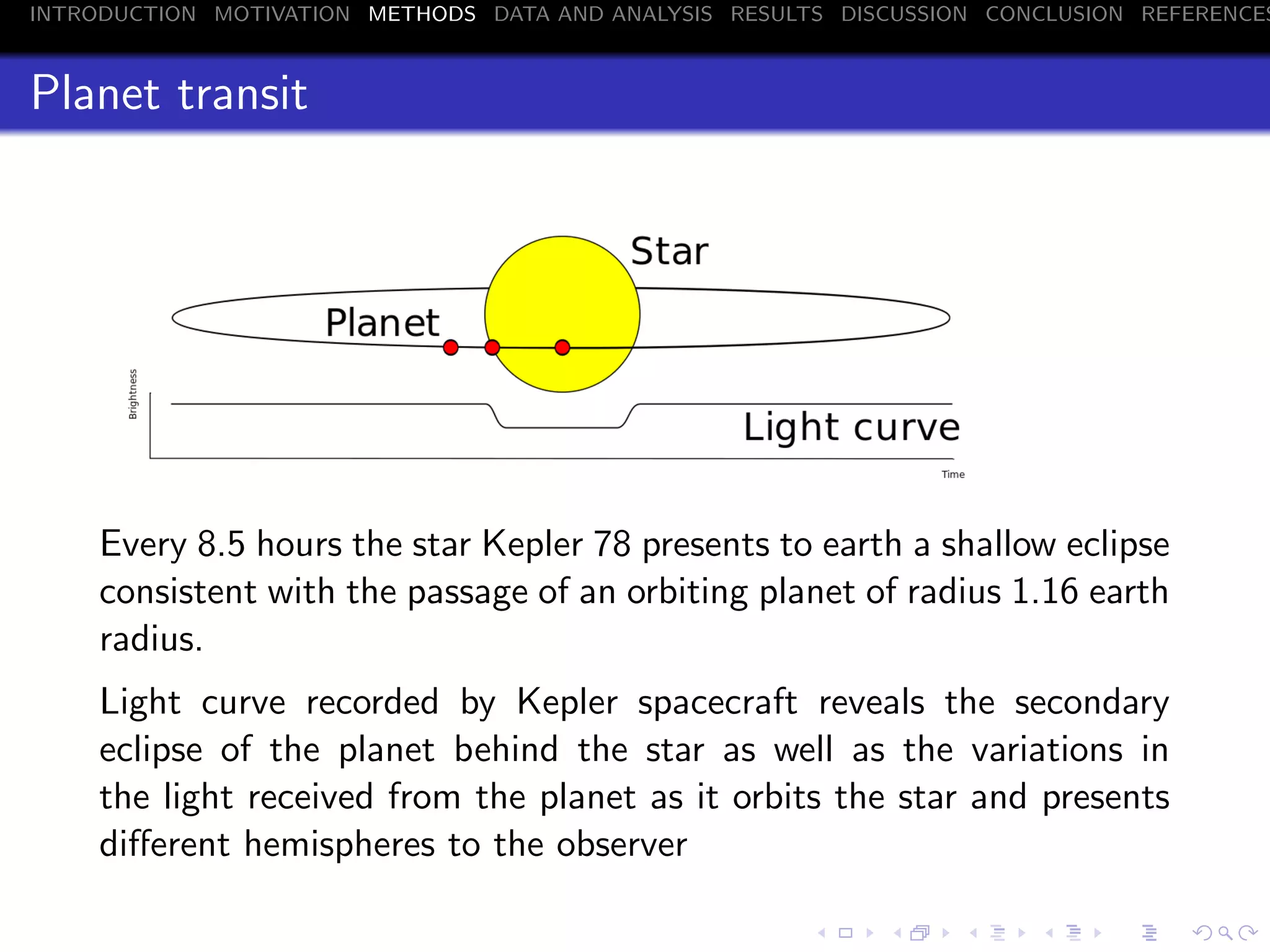
Planet transit
Every 8.5 hours the star Kepler 78 presents to earth a shallow eclipse
consistent with the passage of an orbiting planet of radius 1.16 earth
radius.
Light curve recorded by Kepler spacecraft reveals the secondary
eclipse of the planet behind the star as well as the variations in
the light received from the planet as it orbits the star and presents
different hemispheres to the observer
INTRODUCTION MOTIVATION METHODS DATA AND ANALYSIS RESULTS DISCUSSION CONCLUSION REFERENCES
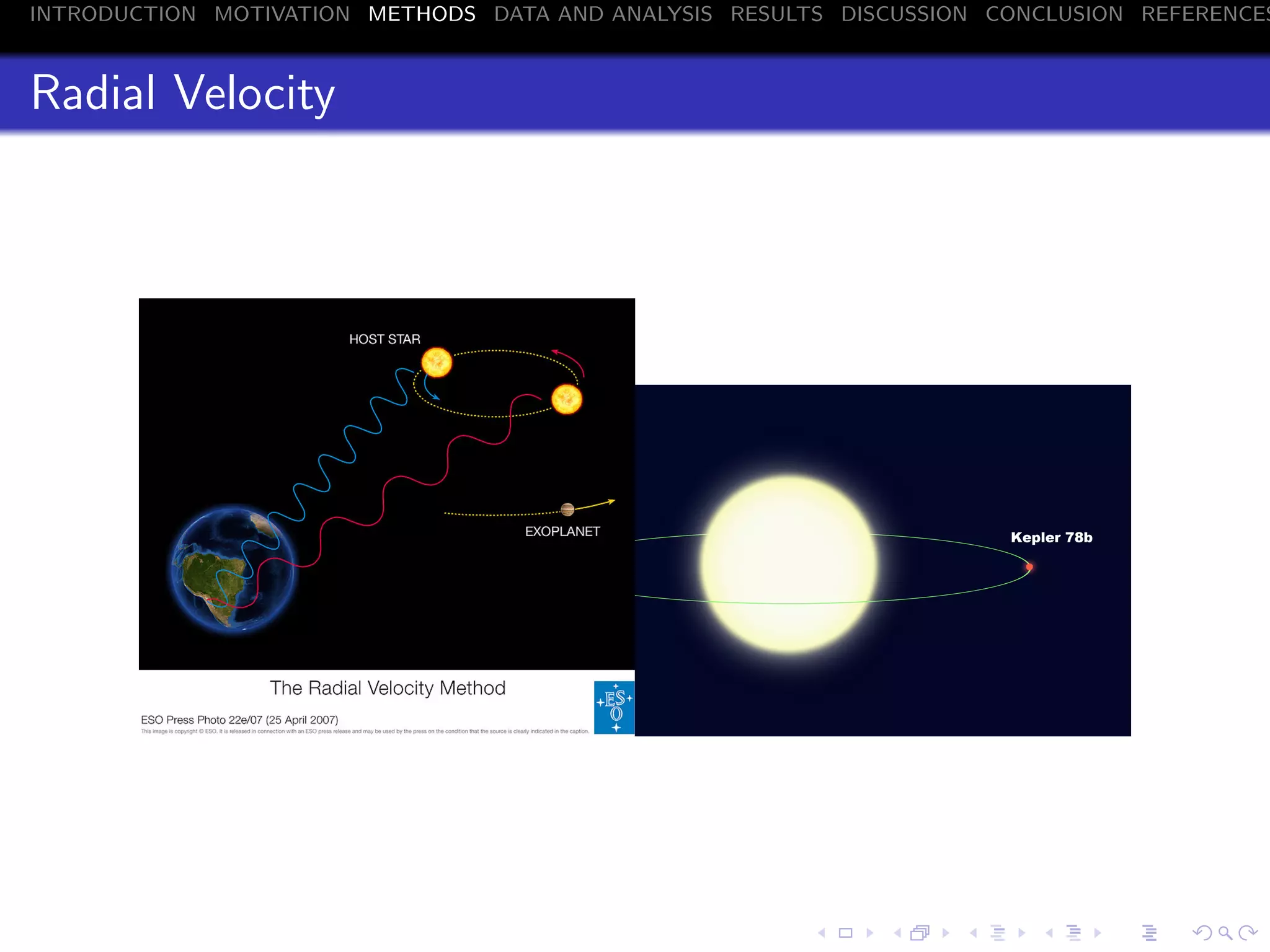
Radial Velocity
INTRODUCTION MOTIVATION METHODS DATA AND ANALYSIS RESULTS DISCUSSION CONCLUSION REFERENCES
Radial Velocity
As the planet orbits, its gravitational pull causes the parent
star to move back and forth. This tiny radial motion shifts the
observed spectrum of the star by a correspondingly small
amount because of the Doppler shift.
The shifts can be measured and used to infer details of a
planets mass and orbit
HARP-N instrument was used for this measurement
INTRODUCTION MOTIVATION METHODS DATA AND ANALYSIS RESULTS DISCUSSION CONCLUSION REFERENCES
Media
courtesy ESO/L. Calada
INTRODUCTION MOTIVATION METHODS DATA AND ANALYSIS RESULTS DISCUSSION CONCLUSION REFERENCES
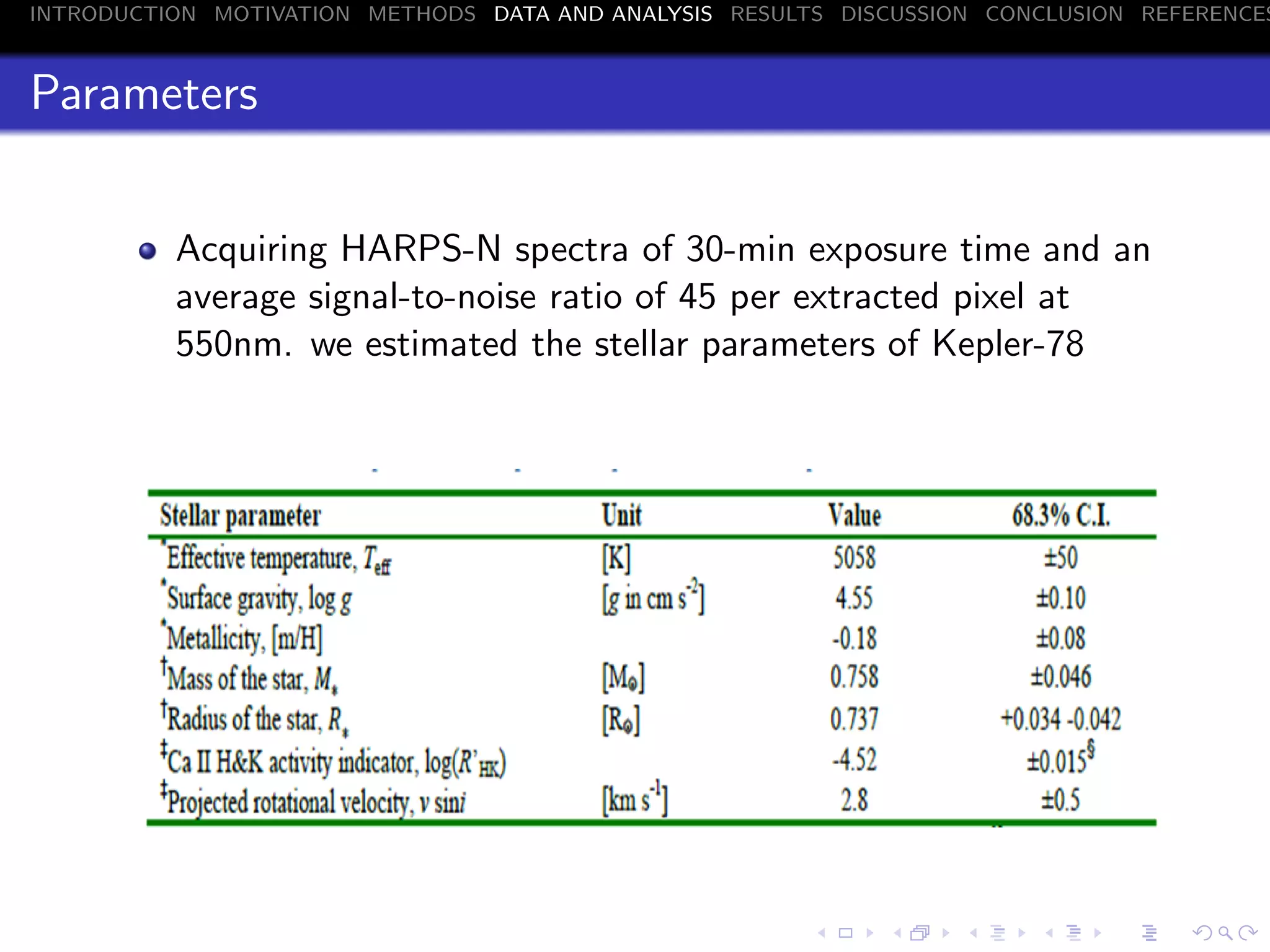
Parameters
Acquiring HARPS-N spectra of 30-min exposure time and an
average signal-to-noise ratio of 45 per extracted pixel at
550nm. we estimated the stellar parameters of Kepler-78
INTRODUCTION MOTIVATION METHODS DATA AND ANALYSIS RESULTS DISCUSSION CONCLUSION REFERENCES
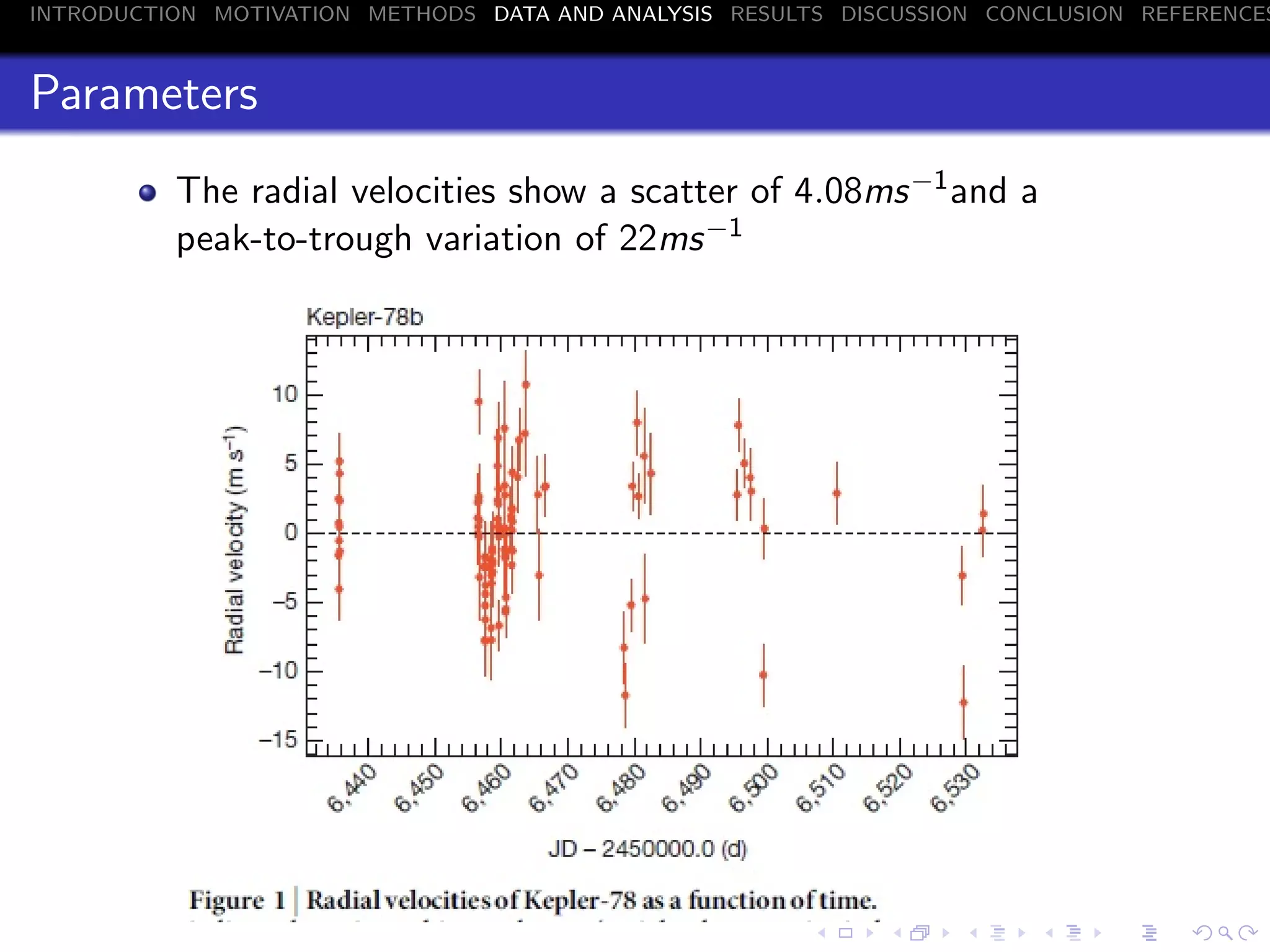
Parameters
The radial velocities show a scatter of 4.08ms−1and a
peak-to-trough variation of 22ms−1
INTRODUCTION MOTIVATION METHODS DATA AND ANALYSIS RESULTS DISCUSSION CONCLUSION REFERENCES
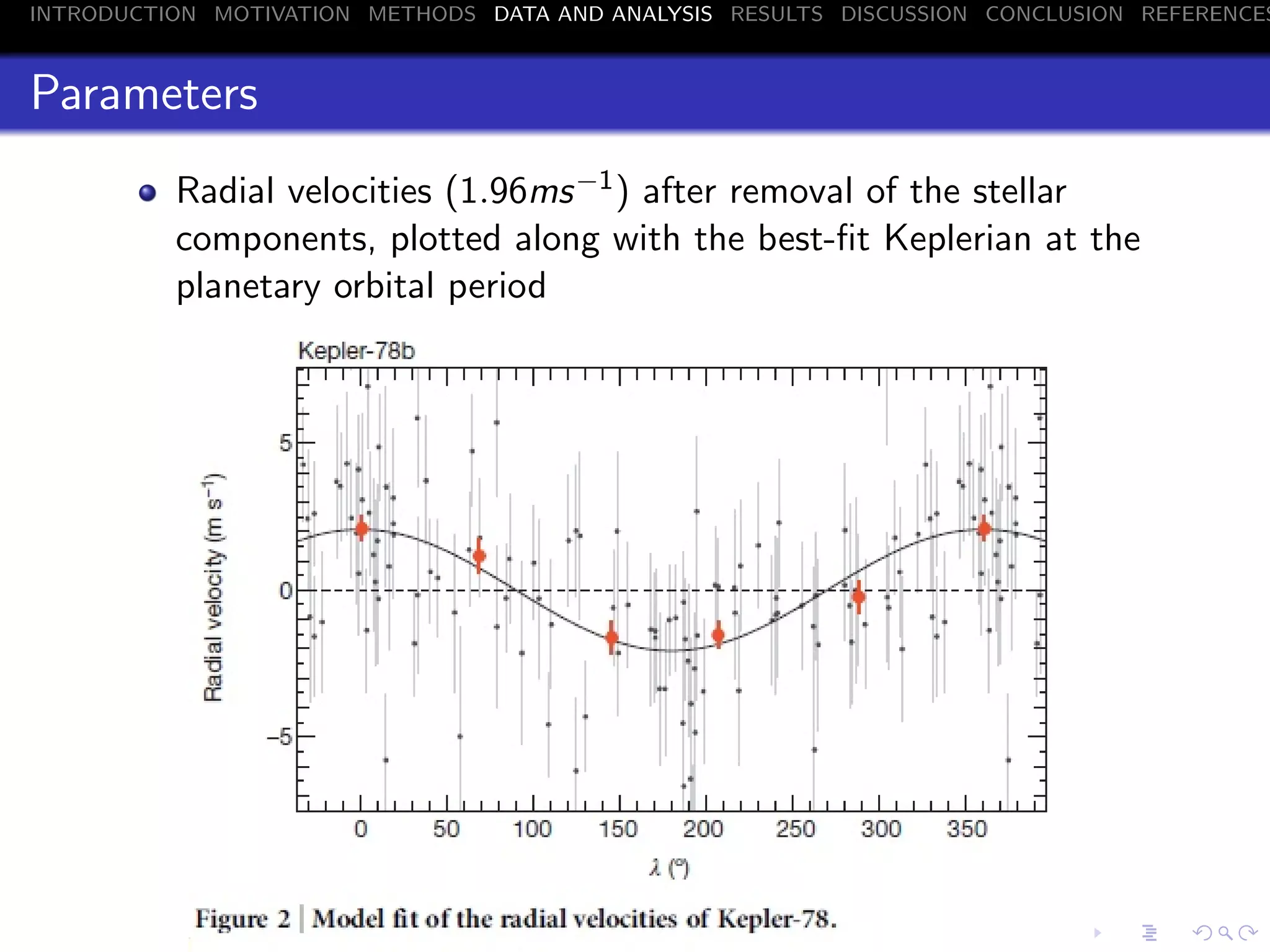
Parameters
Radial velocities (1.96ms−1) after removal of the stellar
components, plotted along with the best-fit Keplerian at the
planetary orbital period
INTRODUCTION MOTIVATION METHODS DATA AND ANALYSIS RESULTS DISCUSSION CONCLUSION REFERENCES
Signal
To separate this signal from that caused by the planet, we
proceeded to estimate the rotation period of the star from the
de-trended light curve from Kepler (Fig 3a). We obtain period
of 12.6 days.
The power spectral density (fig 3b) of the de-trended light
curve also shows strong harmonics at respective periods of 6.3
and 4.2 d.
We note that these timescales are much longer than the
orbital period of the planet.
INTRODUCTION MOTIVATION METHODS DATA AND ANALYSIS RESULTS DISCUSSION CONCLUSION REFERENCES
Light Curve
INTRODUCTION MOTIVATION METHODS DATA AND ANALYSIS RESULTS DISCUSSION CONCLUSION REFERENCES
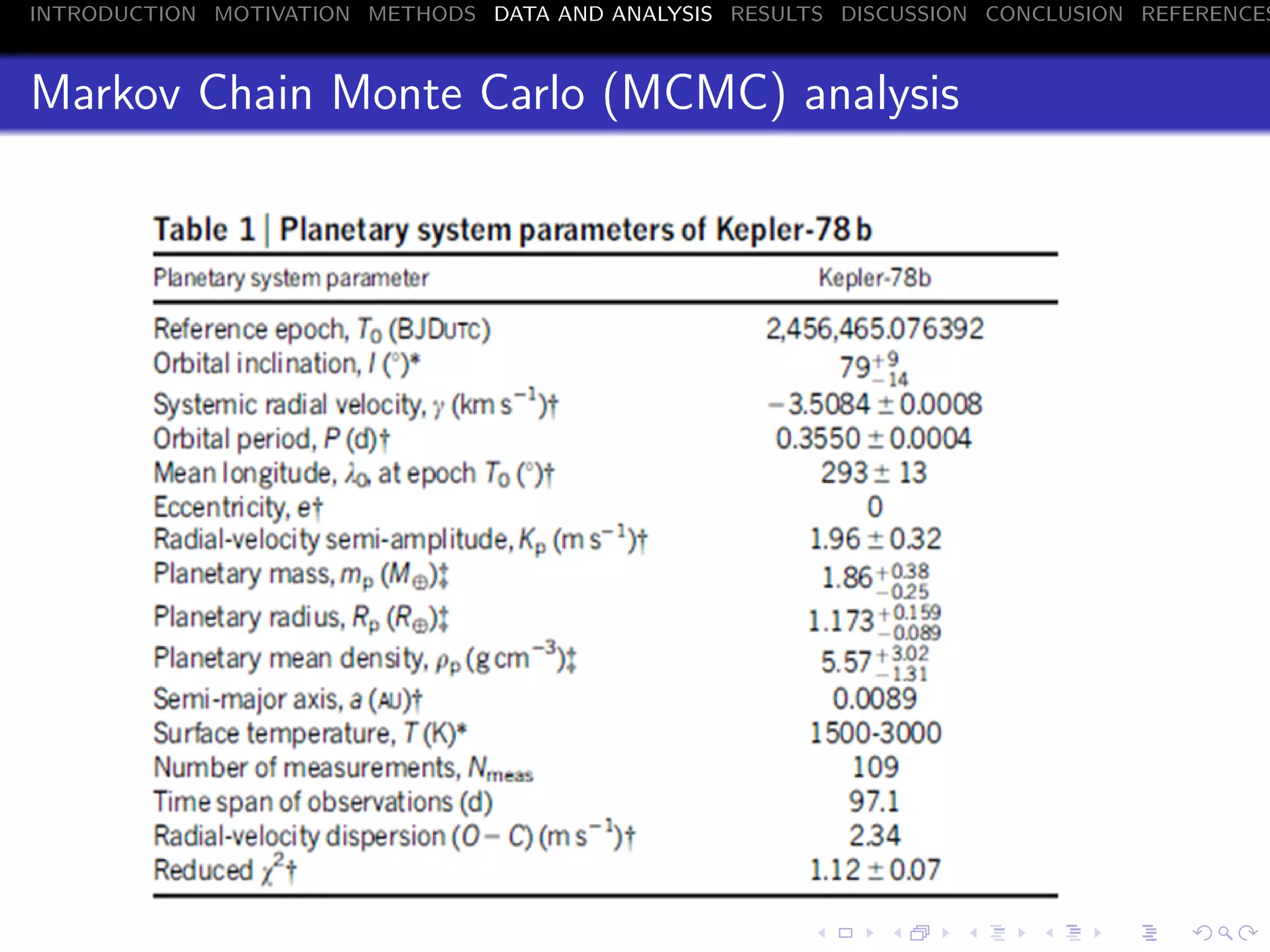
Markov Chain Monte Carlo (MCMC) analysis
INTRODUCTION MOTIVATION METHODS DATA AND ANALYSIS RESULTS DISCUSSION CONCLUSION REFERENCES
Results
These new data yield a mass of 1.86 Earth masses. The
resulting mean density of the planet is 5.57 grams per cubic
centimetre, which is similar to that of the Earth and implies a
composition of iron and rock.
Kepler-78b, orbits a Sun-like star called Kepler 78 located in
the Cygnus constellation at a distance of about 400 light years
from us, is now the smallest exoplanet for which both the
mass and radius are known accurately.
INTRODUCTION MOTIVATION METHODS DATA AND ANALYSIS RESULTS DISCUSSION CONCLUSION REFERENCES
Results
In terms of mass, radius and mean density, Kepler-78b is the
most similar to the Earth among the exoplanets for which
these quantities have been determined. We plot the
mass-radius diagram
INTRODUCTION MOTIVATION METHODS DATA AND ANALYSIS RESULTS DISCUSSION CONCLUSION REFERENCES
Discussion
With a semi-major axis of 0.0089AU, how did this planet
come to be and what is its fate?
INTRODUCTION MOTIVATION METHODS DATA AND ANALYSIS RESULTS DISCUSSION CONCLUSION REFERENCES
conclusion
The observations of Kepler-78 have shown the potential of the
much anticipated HARPS-N spectrograph. It will have a
crucial role in the characterization of the many Kepler planet
candidates with radii similar to that of the Earth
By acquiring and analysing a large number of precise
radial-velocity measurements, we can learn whether
Earth-sized planets (typically) have Earth-like densities (and,
by inference, Earthlike compositions), or whether even small
planets have a wide range of compositions
INTRODUCTION MOTIVATION METHODS DATA AND ANALYSIS RESULTS DISCUSSION CONCLUSION REFERENCES
Reference
Sanchis-Ojeda, R. et al. Transits and occultations of an
Earth-sized planet in an 8.5-hour orbit. Astrophys. J. 774,
5462 (2013).
Zeng, L.Sasselov, D.A detailedmodel grid for solid planets
from0.1 through 100 Earth masses. Publ. Astron. Soc. Pacif.
125, 227239 (2013).
Lissauer, J. J. et al. All six planets known to orbit Kepler-11
have low densities. Astrophys. J. 770, 131145 (2013).
INTRODUCTION MOTIVATION METHODS DATA AND ANALYSIS RESULTS DISCUSSION CONCLUSION REFERENCES
...............................THANK YOU..................................

earth_like_planet_presentation

  • 1.
    INTRODUCTION MOTIVATION METHODSDATA AND ANALYSIS RESULTS DISCUSSION CONCLUSION REFERENCES An Earth-sized planet with an Earth-like density Akinsanmi A. Babatunde Department of Astronomy University of Porto Paper by Pepe et al (2014) AST 4007, November 2015
  • 2.
    INTRODUCTION MOTIVATION METHODSDATA AND ANALYSIS RESULTS DISCUSSION CONCLUSION REFERENCES Outline 1 INTRODUCTION 2 MOTIVATION 3 METHODS 4 DATA AND ANALYSIS 5 RESULTS 6 DISCUSSION 7 CONCLUSION 8 REFERENCES
  • 3.
    INTRODUCTION MOTIVATION METHODSDATA AND ANALYSIS RESULTS DISCUSSION CONCLUSION REFERENCES Introduction The Star Kepler-78 was identified in 2013 to be harbouring a transiting planet of 1.16 times the size of the Earth with an orbital period of only 8.5 hours. While the exquisite Kepler photometry was able to determine its radius and period, the mass of the planet (and thus its mean density) remained unknown in the absence of precise radial-velocity measurements Here we present an accurate mass measurement of Kepler-78b using the HARPS-N spectrograph, installed on the Telescopio Nazionale Galileo (INAF) at the Roque de los Muchachos Observatory, La Palma, Spain
  • 4.
    INTRODUCTION MOTIVATION METHODSDATA AND ANALYSIS RESULTS DISCUSSION CONCLUSION REFERENCES Earth-likeness coutesy: hires-www.cfa.harvard.edu
  • 5.
    INTRODUCTION MOTIVATION METHODSDATA AND ANALYSIS RESULTS DISCUSSION CONCLUSION REFERENCES Motivation A direct measurement of the mass of Kepler-78b would permit an evaluation of its mean density and, by inference, its composition. Are Earth-sized planets indeed similar to the Earth in bulk composition?
  • 6.
    INTRODUCTION MOTIVATION METHODSDATA AND ANALYSIS RESULTS DISCUSSION CONCLUSION REFERENCES Methods Kepler Spacecraft, determines the size or radius of a planet by the amount of starlight blocked when it passes (transits) in front of its host star To determine the planet’s mass, we employ the radial velocity method to measure how much the gravitational tug of an orbiting planet causes its star to wobble.
  • 7.
    INTRODUCTION MOTIVATION METHODSDATA AND ANALYSIS RESULTS DISCUSSION CONCLUSION REFERENCES Planet transit Every 8.5 hours the star Kepler 78 presents to earth a shallow eclipse consistent with the passage of an orbiting planet of radius 1.16 earth radius. Light curve recorded by Kepler spacecraft reveals the secondary eclipse of the planet behind the star as well as the variations in the light received from the planet as it orbits the star and presents different hemispheres to the observer
  • 8.
    INTRODUCTION MOTIVATION METHODSDATA AND ANALYSIS RESULTS DISCUSSION CONCLUSION REFERENCES Radial Velocity
  • 9.
    INTRODUCTION MOTIVATION METHODSDATA AND ANALYSIS RESULTS DISCUSSION CONCLUSION REFERENCES Radial Velocity As the planet orbits, its gravitational pull causes the parent star to move back and forth. This tiny radial motion shifts the observed spectrum of the star by a correspondingly small amount because of the Doppler shift. The shifts can be measured and used to infer details of a planets mass and orbit HARP-N instrument was used for this measurement
  • 10.
    INTRODUCTION MOTIVATION METHODSDATA AND ANALYSIS RESULTS DISCUSSION CONCLUSION REFERENCES Media courtesy ESO/L. Calada
  • 11.
    INTRODUCTION MOTIVATION METHODSDATA AND ANALYSIS RESULTS DISCUSSION CONCLUSION REFERENCES Parameters Acquiring HARPS-N spectra of 30-min exposure time and an average signal-to-noise ratio of 45 per extracted pixel at 550nm. we estimated the stellar parameters of Kepler-78
  • 12.
    INTRODUCTION MOTIVATION METHODSDATA AND ANALYSIS RESULTS DISCUSSION CONCLUSION REFERENCES Parameters The radial velocities show a scatter of 4.08ms−1and a peak-to-trough variation of 22ms−1
  • 13.
    INTRODUCTION MOTIVATION METHODSDATA AND ANALYSIS RESULTS DISCUSSION CONCLUSION REFERENCES Parameters Radial velocities (1.96ms−1) after removal of the stellar components, plotted along with the best-fit Keplerian at the planetary orbital period
  • 14.
    INTRODUCTION MOTIVATION METHODSDATA AND ANALYSIS RESULTS DISCUSSION CONCLUSION REFERENCES Signal To separate this signal from that caused by the planet, we proceeded to estimate the rotation period of the star from the de-trended light curve from Kepler (Fig 3a). We obtain period of 12.6 days. The power spectral density (fig 3b) of the de-trended light curve also shows strong harmonics at respective periods of 6.3 and 4.2 d. We note that these timescales are much longer than the orbital period of the planet.
  • 15.
    INTRODUCTION MOTIVATION METHODSDATA AND ANALYSIS RESULTS DISCUSSION CONCLUSION REFERENCES Light Curve
  • 16.
    INTRODUCTION MOTIVATION METHODSDATA AND ANALYSIS RESULTS DISCUSSION CONCLUSION REFERENCES Markov Chain Monte Carlo (MCMC) analysis
  • 17.
    INTRODUCTION MOTIVATION METHODSDATA AND ANALYSIS RESULTS DISCUSSION CONCLUSION REFERENCES Results These new data yield a mass of 1.86 Earth masses. The resulting mean density of the planet is 5.57 grams per cubic centimetre, which is similar to that of the Earth and implies a composition of iron and rock. Kepler-78b, orbits a Sun-like star called Kepler 78 located in the Cygnus constellation at a distance of about 400 light years from us, is now the smallest exoplanet for which both the mass and radius are known accurately.
  • 18.
    INTRODUCTION MOTIVATION METHODSDATA AND ANALYSIS RESULTS DISCUSSION CONCLUSION REFERENCES Results In terms of mass, radius and mean density, Kepler-78b is the most similar to the Earth among the exoplanets for which these quantities have been determined. We plot the mass-radius diagram
  • 19.
    INTRODUCTION MOTIVATION METHODSDATA AND ANALYSIS RESULTS DISCUSSION CONCLUSION REFERENCES Discussion With a semi-major axis of 0.0089AU, how did this planet come to be and what is its fate?
  • 20.
    INTRODUCTION MOTIVATION METHODSDATA AND ANALYSIS RESULTS DISCUSSION CONCLUSION REFERENCES
  • 21.
    INTRODUCTION MOTIVATION METHODSDATA AND ANALYSIS RESULTS DISCUSSION CONCLUSION REFERENCES conclusion The observations of Kepler-78 have shown the potential of the much anticipated HARPS-N spectrograph. It will have a crucial role in the characterization of the many Kepler planet candidates with radii similar to that of the Earth By acquiring and analysing a large number of precise radial-velocity measurements, we can learn whether Earth-sized planets (typically) have Earth-like densities (and, by inference, Earthlike compositions), or whether even small planets have a wide range of compositions
  • 22.
    INTRODUCTION MOTIVATION METHODSDATA AND ANALYSIS RESULTS DISCUSSION CONCLUSION REFERENCES Reference Sanchis-Ojeda, R. et al. Transits and occultations of an Earth-sized planet in an 8.5-hour orbit. Astrophys. J. 774, 5462 (2013). Zeng, L.Sasselov, D.A detailedmodel grid for solid planets from0.1 through 100 Earth masses. Publ. Astron. Soc. Pacif. 125, 227239 (2013). Lissauer, J. J. et al. All six planets known to orbit Kepler-11 have low densities. Astrophys. J. 770, 131145 (2013).
  • 23.
    INTRODUCTION MOTIVATION METHODSDATA AND ANALYSIS RESULTS DISCUSSION CONCLUSION REFERENCES ...............................THANK YOU..................................