
Space Launch System (SLS)Marshall Space Flight CenterTodd MaySLS Program Office March 30, 2011
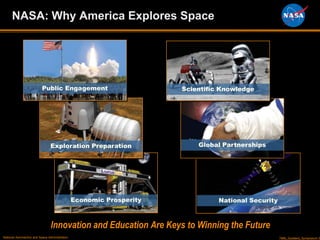
NASA: Why America Explores SpaceInnovation and Education Are Keys to Winning the FuturePublic EngagementScientific KnowledgeGlobal PartnershipsExploration PreparationEconomic ProsperityNational SecurityNational Aeronautics and Space Administration7980_Goddard_Symposium.2
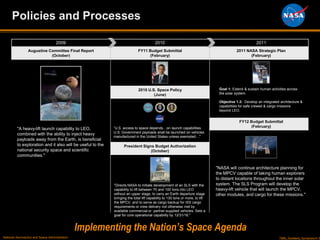
Policies and Processes200920102011Augustine Committee Final Report(October)FY11 Budget Submittal(February)2011 NASA Strategic Plan(February)Goal 1: Extend & sustain human activities across the solar system. Objective 1.3:  Develop an integrated architecture & capabilities for safe crewed & cargo missions beyond LEO.2010 U.S. Space Policy(June)FY12 Budget Submittal(February)"A heavy-lift launch capability to LEO, combined with the ability to inject heavy payloads away from the Earth, is beneficial to exploration and it also will be useful to the national security space and scientific communities."”U.S. access to space depends…on launch capabilities. U.S. Government payloads shall be launched on vehicles manufactured in the United States unless exempted…"President Signs Budget Authorization(October)"NASA will continue architecture planning for the MPCV capable of taking human explorers to distant locations throughout the inner solar system. The SLS Program will develop the heavy-lift vehicle that will launch the MPCV, other modules, and cargo for these missions.""Directs NASA to initiate development of an SLS with the capability to lift between 70 and 100 tons into LEO without an upper stage, to carry an Earth departure stage bringing the total lift capability to 130 tons or more, to lift the MPCV, and to serve as cargo backup for ISS cargo requirements or crew delivery not otherwise met by available commercial or  partner-supplied vehicles. Sets a goal for core operational capability by 12/31/16."Implementing the Nation’s Space AgendaNational Aeronautics and Space Administration7980_Goddard_Symposium.3
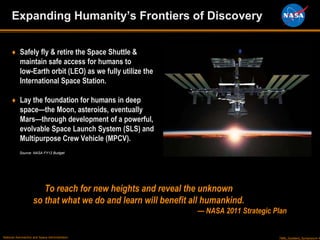
Expanding Humanity’s Frontiers of DiscoverySafely fly & retire the Space Shuttle & maintain safe access for humans to low-Earth orbit (LEO) as we fully utilize the International Space Station.Lay the foundation for humans in deep space—the Moon, asteroids, eventually Mars—through development of a powerful, evolvable Space Launch System (SLS) and Multipurpose Crew Vehicle (MPCV).Source: NASA FY12 BudgetTo reach for new heights and reveal the unknown so that what we do and learn will benefit all humankind. — NASA 2011 Strategic PlanNational Aeronautics and Space Administration7980_Goddard_Symposium.4
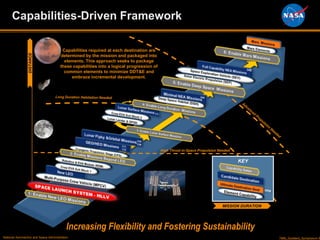
Capabilities-Driven FrameworkMars  MissionsCapabilities required at each destination are determined by the mission and packaged into elements. This approach seeks to package these capabilities into a logical progression of common elements to minimize DDT&E and embrace incremental development. 35A35BMars Elements6: Enable Mars MissionsDISTANCEFull Capability NEA Missions34BSpace Exploration Vehicle (SEV)Solar Electric Propulsion (SEP)5: Enable Deep Space  MissionsMinimal NEA MissionsLong Duration Habitation Needed34ADeep Space Habitat (DSH)4: Enable Long Duration  MissionsLunar Surface MissionsCrew EVA Suit Block 233CLunar Lander & GPODAdvanced Propulsion Needed3: Enable Lunar Surface MissionsLunar Flyby &Orbital Missions33A33BGEO/HEO Missions32A32BHigh Thrust in-Space Propulsion NeededCryogenic Propulsion Stage (CPS)2: Enable Missions Beyond LEOKEYRobotics & EVA Module (REM)Crew EVA Suit Block 1Capability GatesNew LEO  Missions31ACandidate DestinationMulti-Purpose Crew Vehicle (MPCV)DRMUltimate Destination GoalSPACE LAUNCH SYSTEM - HLLVDRMElement Capability1: Enable New LEO MissionsMISSION DURATIONIncreasing Flexibility and Fostering SustainabilityNational Aeronautics and Space Administration7980_Goddard_Symposium.5
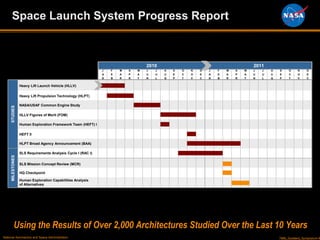
Space Launch System Progress ReportUsing the Results of Over 2,000 Architectures Studied Over the Last 10 Years20102011JANFEBMARAPRMAYJUNJULAUGSEPOCTNOVDECJANFEBMARAPRMAYJUNJULAUGSEPOCTNOVDECHeavy Lift Launch Vehicle (HLLV)Heavy Lift Propulsion Technology (HLPT)NASA/USAF Common Engine StudySTUDIESHLLV Figures of Merit (FOM)Human Exploration Framework Team (HEFT) IHEFT IIHLPT Broad Agency Announcement (BAA)SLS Requirements Analysis Cycle I (RAC I)SLS Mission Concept Review (MCR)MILESTONESHQ CheckpointHuman Exploration Capabilities Analysis of AlternativesNational Aeronautics and Space Administration7980_Goddard_Symposium.6
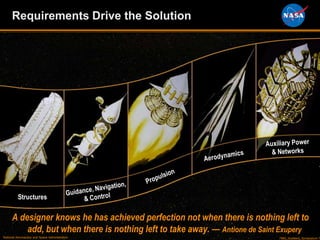
Requirements Drive the SolutionAuxiliary Power & NetworksAerodynamicsPropulsionGuidance, Navigation, & ControlStructuresA designer knows he has achieved perfection not when there is nothing left to add, but when there is nothing left to take away. — Antione de Saint ExuperyNational Aeronautics and Space Administration7980_Goddard_Symposium.7
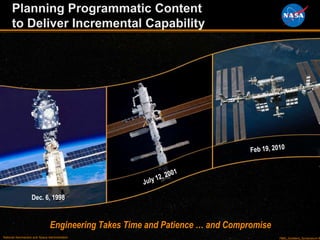
Feb 19, 2010July 12, 2001Dec. 6, 1998Planning Programmatic Content to Deliver Incremental CapabilityEngineering Takes Time and Patience … and CompromiseNational Aeronautics and Space Administration7980_Goddard_Symposium.8
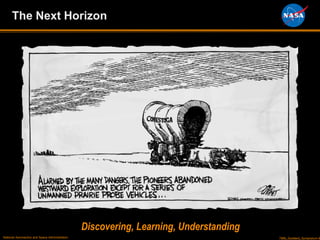
The Next HorizonDiscovering, Learning, UnderstandingNational Aeronautics and Space Administration7980_Goddard_Symposium.9
For More Informationwww.nasa.gov

Space Launch System (SLS)

  • 1.
    Space Launch System(SLS)Marshall Space Flight CenterTodd MaySLS Program Office March 30, 2011
  • 2.
    NASA: Why AmericaExplores SpaceInnovation and Education Are Keys to Winning the FuturePublic EngagementScientific KnowledgeGlobal PartnershipsExploration PreparationEconomic ProsperityNational SecurityNational Aeronautics and Space Administration7980_Goddard_Symposium.2
  • 3.
    Policies and Processes200920102011AugustineCommittee Final Report(October)FY11 Budget Submittal(February)2011 NASA Strategic Plan(February)Goal 1: Extend & sustain human activities across the solar system. Objective 1.3: Develop an integrated architecture & capabilities for safe crewed & cargo missions beyond LEO.2010 U.S. Space Policy(June)FY12 Budget Submittal(February)"A heavy-lift launch capability to LEO, combined with the ability to inject heavy payloads away from the Earth, is beneficial to exploration and it also will be useful to the national security space and scientific communities."”U.S. access to space depends…on launch capabilities. U.S. Government payloads shall be launched on vehicles manufactured in the United States unless exempted…"President Signs Budget Authorization(October)"NASA will continue architecture planning for the MPCV capable of taking human explorers to distant locations throughout the inner solar system. The SLS Program will develop the heavy-lift vehicle that will launch the MPCV, other modules, and cargo for these missions.""Directs NASA to initiate development of an SLS with the capability to lift between 70 and 100 tons into LEO without an upper stage, to carry an Earth departure stage bringing the total lift capability to 130 tons or more, to lift the MPCV, and to serve as cargo backup for ISS cargo requirements or crew delivery not otherwise met by available commercial or partner-supplied vehicles. Sets a goal for core operational capability by 12/31/16."Implementing the Nation’s Space AgendaNational Aeronautics and Space Administration7980_Goddard_Symposium.3
  • 4.
    Expanding Humanity’s Frontiersof DiscoverySafely fly & retire the Space Shuttle & maintain safe access for humans to low-Earth orbit (LEO) as we fully utilize the International Space Station.Lay the foundation for humans in deep space—the Moon, asteroids, eventually Mars—through development of a powerful, evolvable Space Launch System (SLS) and Multipurpose Crew Vehicle (MPCV).Source: NASA FY12 BudgetTo reach for new heights and reveal the unknown so that what we do and learn will benefit all humankind. — NASA 2011 Strategic PlanNational Aeronautics and Space Administration7980_Goddard_Symposium.4
  • 5.
    Capabilities-Driven FrameworkMars MissionsCapabilities required at each destination are determined by the mission and packaged into elements. This approach seeks to package these capabilities into a logical progression of common elements to minimize DDT&E and embrace incremental development. 35A35BMars Elements6: Enable Mars MissionsDISTANCEFull Capability NEA Missions34BSpace Exploration Vehicle (SEV)Solar Electric Propulsion (SEP)5: Enable Deep Space MissionsMinimal NEA MissionsLong Duration Habitation Needed34ADeep Space Habitat (DSH)4: Enable Long Duration MissionsLunar Surface MissionsCrew EVA Suit Block 233CLunar Lander & GPODAdvanced Propulsion Needed3: Enable Lunar Surface MissionsLunar Flyby &Orbital Missions33A33BGEO/HEO Missions32A32BHigh Thrust in-Space Propulsion NeededCryogenic Propulsion Stage (CPS)2: Enable Missions Beyond LEOKEYRobotics & EVA Module (REM)Crew EVA Suit Block 1Capability GatesNew LEO Missions31ACandidate DestinationMulti-Purpose Crew Vehicle (MPCV)DRMUltimate Destination GoalSPACE LAUNCH SYSTEM - HLLVDRMElement Capability1: Enable New LEO MissionsMISSION DURATIONIncreasing Flexibility and Fostering SustainabilityNational Aeronautics and Space Administration7980_Goddard_Symposium.5
  • 6.
    Space Launch SystemProgress ReportUsing the Results of Over 2,000 Architectures Studied Over the Last 10 Years20102011JANFEBMARAPRMAYJUNJULAUGSEPOCTNOVDECJANFEBMARAPRMAYJUNJULAUGSEPOCTNOVDECHeavy Lift Launch Vehicle (HLLV)Heavy Lift Propulsion Technology (HLPT)NASA/USAF Common Engine StudySTUDIESHLLV Figures of Merit (FOM)Human Exploration Framework Team (HEFT) IHEFT IIHLPT Broad Agency Announcement (BAA)SLS Requirements Analysis Cycle I (RAC I)SLS Mission Concept Review (MCR)MILESTONESHQ CheckpointHuman Exploration Capabilities Analysis of AlternativesNational Aeronautics and Space Administration7980_Goddard_Symposium.6
  • 7.
    Requirements Drive theSolutionAuxiliary Power & NetworksAerodynamicsPropulsionGuidance, Navigation, & ControlStructuresA designer knows he has achieved perfection not when there is nothing left to add, but when there is nothing left to take away. — Antione de Saint ExuperyNational Aeronautics and Space Administration7980_Goddard_Symposium.7
  • 8.
    Feb 19, 2010July12, 2001Dec. 6, 1998Planning Programmatic Content to Deliver Incremental CapabilityEngineering Takes Time and Patience … and CompromiseNational Aeronautics and Space Administration7980_Goddard_Symposium.8
  • 9.
    The Next HorizonDiscovering,Learning, UnderstandingNational Aeronautics and Space Administration7980_Goddard_Symposium.9
  • 10.