HYPERBOLIC FLYBY
ANOMALY RESEARCH
ENDEAVOR (FLARE)
BRIEFING: SCOPE AND CONCEPT OF OPERATIONS
SCOPE
NEED: To evaluate whether apparent hyperbolic flyby anomalies are representative of real phenomena, or
are otherwise unaccounted for data artifacts.
STAKEHOLDERS: NASA/JPL Mission Designers, Trajectory Software Engineers, Physics Community
GOAL: Collect a greater quantity of data points during hyperbolic flybys and extremely elliptical orbits.
OBJECTIVE: Track a high quantity of small satellites through elliptical and hyperbolic flybys to obtain
position, velocity, and acceleration data comparable or superior to NEAR’s flyby data.
MISSION: Two phases will gather data on extremely elliptical orbits and hyperbolic flybys of Earth, due
to the planet’s well determined gravity field, rapid rotation, and measurement capability.
REQUIREMENTS
• Timeline Requirements
• Mission shall provide tracking data for at least 12 flyby or similar events within 5 years of initial launch.
• Coverage Requirements
• Position, and thus velocity data, shall be obtained for at least a period of 184 hours centered at time of perigee
for each orbit.
• Data sampling frequency shall be no less than 10 Hz.
• Flyby position and velocity data shall be collected at a range of orbital declinations, orbital angular
momentums, and perigee altitudes TBD.
REQUIREMENTS
• Data Requirements
• Velocity data noise level shall be no more than 0.1 mm/s.
• Position data shall be collected at cm precision order of magnitude.
• Sufficient spacecraft state data shall be collected to account for spacecraft velocity perturbations of order of
magnitude of at least 0.1 mm/s.
• Data loss shall be less than 5%, with no data gaps greater than 10 minutes duration.
CONCEPT OF OPERATIONS
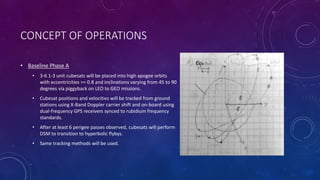
• Baseline Phase A
• 3-6 1-3 unit cubesats will be placed into high apogee orbits
with eccentricities >= 0.8 and inclinations varying from 45 to 90
degrees via piggyback on LEO to GEO missions.
• Cubesat positions and velocities will be tracked from ground
stations using X-Band Doppler carrier shift and on-board using
dual-frequency GPS receivers synced to rubidium frequency
standards.
• After at least 6 perigee passes observed, cubesats will perform
DSM to transition to hyperbolic flybys.
• Same tracking methods will be used.
CONCEPT OF OPERATIONS
• Baseline Phase B
• A ‘mothership’ satellite will be launched into Venus
transfer orbit, utilizing hyperbolic flyby at Venus to
return to Earth upon a hyperbolic flyby trajectory.
• During Earth approach, mothership will deploy at least 6
cubesats (identical to Phase A sats) into constellation
with mothership across varying declinations, altitudes,
and orbital angular velocities.
• All satellites will be tracked through hyperbolic flyby in
same manner as Phase A. Many flybys will be observed
nearly simultaneously, allowing direct comparison
across several variables.
ADDITIONAL SCOPE INFORMATION
• Constraints
• Initial budgetary considerations (Phase A uses cubesats only).
• Launch availability for cubesat piggyback.
• Phase B relies on synodic periods of Venus and Earth for launch opportunities.
• Assumptions
• Only high TRL methods will be used (cubesats, cold gas, GPS, X-Band, etc.)
• Authority
• Preliminary systems engineering, design, scope, ConOps, and trades will be performed by UT Spacecraft/Mission
Design students.
• Further development & design, manufacturing, integration, testing, flight, and operation will be conducted by NASA
JPL.
• Mission Benefits
• May lead to more advantageous trajectory modelling for hyperbolic flyby use.
• May provide evidence for new physics, which in turn provide technological and economic growth.
REFERENCES
• Anderson, J. D., Campbell, J. K., Ekelund, J. E., Ellis, J., and Jordan, J. F., “Anomalous Orbital-Energy
Changes Observed during Spacecraft Flybys of Earth,” Physical Review Letters, Vol. 100, No. 091102,
2008.
• Páramos, J., and Hechenblaikner, G., “Probing the Flyby Anomaly with the future STE-QUEST mission,”
Planetary and Space Science, Vol. 79-80, 2013, pp. 76-81.
• Young, S., “Flyby Anomaly Experiment,” University of Texas at Austin, Semester Project for ASE 374K
Systems Engineering.

FLARE_Brief

  • 1.
    HYPERBOLIC FLYBY ANOMALY RESEARCH ENDEAVOR(FLARE) BRIEFING: SCOPE AND CONCEPT OF OPERATIONS
  • 2.
    SCOPE NEED: To evaluatewhether apparent hyperbolic flyby anomalies are representative of real phenomena, or are otherwise unaccounted for data artifacts. STAKEHOLDERS: NASA/JPL Mission Designers, Trajectory Software Engineers, Physics Community GOAL: Collect a greater quantity of data points during hyperbolic flybys and extremely elliptical orbits. OBJECTIVE: Track a high quantity of small satellites through elliptical and hyperbolic flybys to obtain position, velocity, and acceleration data comparable or superior to NEAR’s flyby data. MISSION: Two phases will gather data on extremely elliptical orbits and hyperbolic flybys of Earth, due to the planet’s well determined gravity field, rapid rotation, and measurement capability.
  • 3.
    REQUIREMENTS • Timeline Requirements •Mission shall provide tracking data for at least 12 flyby or similar events within 5 years of initial launch. • Coverage Requirements • Position, and thus velocity data, shall be obtained for at least a period of 184 hours centered at time of perigee for each orbit. • Data sampling frequency shall be no less than 10 Hz. • Flyby position and velocity data shall be collected at a range of orbital declinations, orbital angular momentums, and perigee altitudes TBD.
  • 4.
    REQUIREMENTS • Data Requirements •Velocity data noise level shall be no more than 0.1 mm/s. • Position data shall be collected at cm precision order of magnitude. • Sufficient spacecraft state data shall be collected to account for spacecraft velocity perturbations of order of magnitude of at least 0.1 mm/s. • Data loss shall be less than 5%, with no data gaps greater than 10 minutes duration.
  • 5.
    CONCEPT OF OPERATIONS •Baseline Phase A • 3-6 1-3 unit cubesats will be placed into high apogee orbits with eccentricities >= 0.8 and inclinations varying from 45 to 90 degrees via piggyback on LEO to GEO missions. • Cubesat positions and velocities will be tracked from ground stations using X-Band Doppler carrier shift and on-board using dual-frequency GPS receivers synced to rubidium frequency standards. • After at least 6 perigee passes observed, cubesats will perform DSM to transition to hyperbolic flybys. • Same tracking methods will be used.
  • 6.
    CONCEPT OF OPERATIONS •Baseline Phase B • A ‘mothership’ satellite will be launched into Venus transfer orbit, utilizing hyperbolic flyby at Venus to return to Earth upon a hyperbolic flyby trajectory. • During Earth approach, mothership will deploy at least 6 cubesats (identical to Phase A sats) into constellation with mothership across varying declinations, altitudes, and orbital angular velocities. • All satellites will be tracked through hyperbolic flyby in same manner as Phase A. Many flybys will be observed nearly simultaneously, allowing direct comparison across several variables.
  • 7.
    ADDITIONAL SCOPE INFORMATION •Constraints • Initial budgetary considerations (Phase A uses cubesats only). • Launch availability for cubesat piggyback. • Phase B relies on synodic periods of Venus and Earth for launch opportunities. • Assumptions • Only high TRL methods will be used (cubesats, cold gas, GPS, X-Band, etc.) • Authority • Preliminary systems engineering, design, scope, ConOps, and trades will be performed by UT Spacecraft/Mission Design students. • Further development & design, manufacturing, integration, testing, flight, and operation will be conducted by NASA JPL. • Mission Benefits • May lead to more advantageous trajectory modelling for hyperbolic flyby use. • May provide evidence for new physics, which in turn provide technological and economic growth.
  • 8.
    REFERENCES • Anderson, J.D., Campbell, J. K., Ekelund, J. E., Ellis, J., and Jordan, J. F., “Anomalous Orbital-Energy Changes Observed during Spacecraft Flybys of Earth,” Physical Review Letters, Vol. 100, No. 091102, 2008. • Páramos, J., and Hechenblaikner, G., “Probing the Flyby Anomaly with the future STE-QUEST mission,” Planetary and Space Science, Vol. 79-80, 2013, pp. 76-81. • Young, S., “Flyby Anomaly Experiment,” University of Texas at Austin, Semester Project for ASE 374K Systems Engineering.