Week 6
Binary Trees
CC 104 – Data Structures & Algorithms
RIANNEL B. TECSON, MIS
Instructor
Flow of the Learning Session
 Short Review of the Previous Lesson
 Basic Concepts on Tree Data Structure
 Lesson Proper & Discussion
 Binary Search Tree Traversal
 Pre-order, In-order, Post-order
 Evaluation
 Guided Practice
 Binary Search Tree Visualization & Animation
 Independent Practice
 Assessment
 Online Quiz
2
Recall:
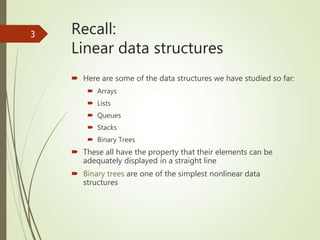
Linear data structures
 Here are some of the data structures we have studied so far:
 Arrays
 Lists
 Queues
 Stacks
 Binary Trees
 These all have the property that their elements can be
adequately displayed in a straight line
 Binary trees are one of the simplest nonlinear data
structures
3
Objectives
At the end of the lesson, students should be able to:
 Construct a Binary Search Tree (BST);
 Traverse a BST using Pre-order, In-order, and Post-
order modes
 Use Online Visualization applications to create a
Binary Search Tree and perform Tree Traversals
4
Parts of a binary tree
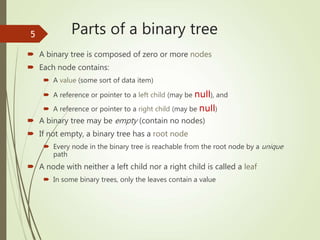
 A binary tree is composed of zero or more nodes
 Each node contains:
 A value (some sort of data item)
 A reference or pointer to a left child (may be null), and
 A reference or pointer to a right child (may be null)
 A binary tree may be empty (contain no nodes)
 If not empty, a binary tree has a root node
 Every node in the binary tree is reachable from the root node by a unique
path
 A node with neither a left child nor a right child is called a leaf
 In some binary trees, only the leaves contain a value
5
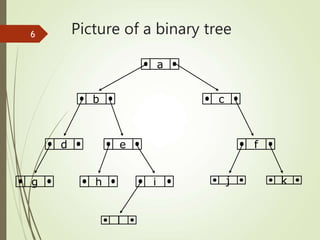
Picture of a binary tree
6
a
b c
d e
g h i
l
f
j k
Size and depth
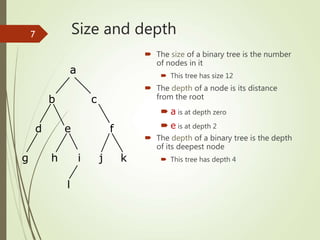
 The size of a binary tree is the number
of nodes in it
 This tree has size 12
 The depth of a node is its distance
from the root
 a is at depth zero
 e is at depth 2
 The depth of a binary tree is the depth
of its deepest node
 This tree has depth 4
7
a
b c
d e f
g h i j k
l
Balance
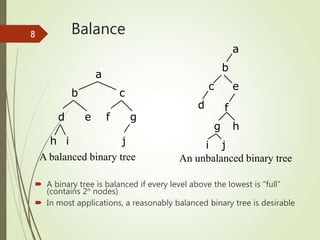
 A binary tree is balanced if every level above the lowest is “full”
(contains 2n nodes)
 In most applications, a reasonably balanced binary tree is desirable
8
a
b c
d e f g
h i j
A balanced binary tree
a
b
c
d
e
f
g h
i j
An unbalanced binary tree
Binary search in an array
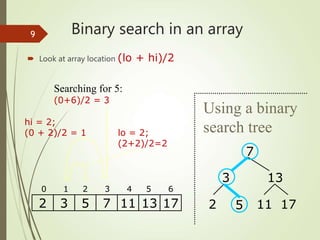
 Look at array location (lo + hi)/2
9
2 3 5 7 11 13 17
0 1 2 3 4 5 6
Searching for 5:
(0+6)/2 = 3
hi = 2;
(0 + 2)/2 = 1 lo = 2;
(2+2)/2=2
7
3 13
2 5 11 17
Using a binary
search tree
Tree traversals
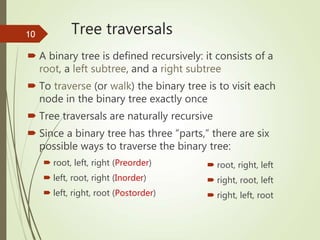
 A binary tree is defined recursively: it consists of a
root, a left subtree, and a right subtree
 To traverse (or walk) the binary tree is to visit each
node in the binary tree exactly once
 Tree traversals are naturally recursive
 Since a binary tree has three “parts,” there are six
possible ways to traverse the binary tree:
 root, left, right (Preorder)
 left, root, right (Inorder)
 left, right, root (Postorder)
 root, right, left
 right, root, left
 right, left, root
10
Tree traversals using “flags”
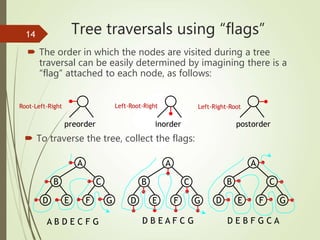
 The order in which the nodes are visited during a tree
traversal can be easily determined by imagining there is a
“flag” attached to each node, as follows:
 To traverse the tree, collect the flags:
14
preorder inorder postorder
A
B C
D E F G
A
B C
D E F G
A
B C
D E F G
A B D E C F G D B E A F C G D E B F G C A
Root-Left-Right Left-Root-Right Left-Right-Root
Practice:
Binary Search Tree Traversal
 https://algorithm-visualizer.org/brute-
force/binary-tree-traversal
 https://yongdanielliang.github.io/animation/web/B
ST.html
15
Binary Search Tree Traversals Applications:
Questions?
 Clarifications?
16
Assessment:
Binary Search Tree Traversal
 https://docs.google.com/forms/d/e/1FAIpQLSf8RT
BMIkGGapJ4jGxg7z2P-
pE3QaROdxiRHSsrRxm6gcxU2g/viewform?authuse
r=1
17
Answer the problems in Google Form below:
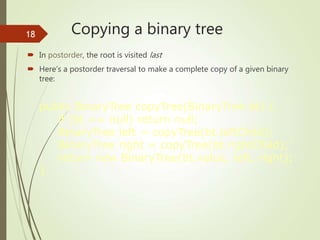
Copying a binary tree
 In postorder, the root is visited last
 Here’s a postorder traversal to make a complete copy of a given binary
tree:
public BinaryTree copyTree(BinaryTree bt) {
if (bt == null) return null;
BinaryTree left = copyTree(bt.leftChild);
BinaryTree right = copyTree(bt.rightChild);
return new BinaryTree(bt.value, left, right);
}
18
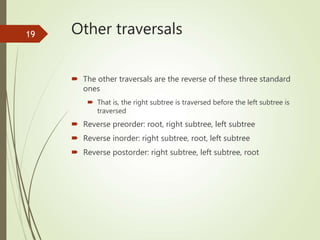
Other traversals
 The other traversals are the reverse of these three standard
ones
 That is, the right subtree is traversed before the left subtree is
traversed
 Reverse preorder: root, right subtree, left subtree
 Reverse inorder: right subtree, root, left subtree
 Reverse postorder: right subtree, left subtree, root
19
The End
20

Binary Trees.ppt

  • 1.
    Week 6 Binary Trees CC104 – Data Structures & Algorithms RIANNEL B. TECSON, MIS Instructor
  • 2.
    Flow of theLearning Session  Short Review of the Previous Lesson  Basic Concepts on Tree Data Structure  Lesson Proper & Discussion  Binary Search Tree Traversal  Pre-order, In-order, Post-order  Evaluation  Guided Practice  Binary Search Tree Visualization & Animation  Independent Practice  Assessment  Online Quiz 2
  • 3.
    Recall: Linear data structures Here are some of the data structures we have studied so far:  Arrays  Lists  Queues  Stacks  Binary Trees  These all have the property that their elements can be adequately displayed in a straight line  Binary trees are one of the simplest nonlinear data structures 3
  • 4.
    Objectives At the endof the lesson, students should be able to:  Construct a Binary Search Tree (BST);  Traverse a BST using Pre-order, In-order, and Post- order modes  Use Online Visualization applications to create a Binary Search Tree and perform Tree Traversals 4
  • 5.
    Parts of abinary tree  A binary tree is composed of zero or more nodes  Each node contains:  A value (some sort of data item)  A reference or pointer to a left child (may be null), and  A reference or pointer to a right child (may be null)  A binary tree may be empty (contain no nodes)  If not empty, a binary tree has a root node  Every node in the binary tree is reachable from the root node by a unique path  A node with neither a left child nor a right child is called a leaf  In some binary trees, only the leaves contain a value 5
  • 6.
    Picture of abinary tree 6 a b c d e g h i l f j k
  • 7.
    Size and depth The size of a binary tree is the number of nodes in it  This tree has size 12  The depth of a node is its distance from the root  a is at depth zero  e is at depth 2  The depth of a binary tree is the depth of its deepest node  This tree has depth 4 7 a b c d e f g h i j k l
  • 8.
    Balance  A binarytree is balanced if every level above the lowest is “full” (contains 2n nodes)  In most applications, a reasonably balanced binary tree is desirable 8 a b c d e f g h i j A balanced binary tree a b c d e f g h i j An unbalanced binary tree
  • 9.
    Binary search inan array  Look at array location (lo + hi)/2 9 2 3 5 7 11 13 17 0 1 2 3 4 5 6 Searching for 5: (0+6)/2 = 3 hi = 2; (0 + 2)/2 = 1 lo = 2; (2+2)/2=2 7 3 13 2 5 11 17 Using a binary search tree
  • 10.
    Tree traversals  Abinary tree is defined recursively: it consists of a root, a left subtree, and a right subtree  To traverse (or walk) the binary tree is to visit each node in the binary tree exactly once  Tree traversals are naturally recursive  Since a binary tree has three “parts,” there are six possible ways to traverse the binary tree:  root, left, right (Preorder)  left, root, right (Inorder)  left, right, root (Postorder)  root, right, left  right, root, left  right, left, root 10
  • 11.
    Tree traversals using“flags”  The order in which the nodes are visited during a tree traversal can be easily determined by imagining there is a “flag” attached to each node, as follows:  To traverse the tree, collect the flags: 14 preorder inorder postorder A B C D E F G A B C D E F G A B C D E F G A B D E C F G D B E A F C G D E B F G C A Root-Left-Right Left-Root-Right Left-Right-Root
  • 12.
    Practice: Binary Search TreeTraversal  https://algorithm-visualizer.org/brute- force/binary-tree-traversal  https://yongdanielliang.github.io/animation/web/B ST.html 15 Binary Search Tree Traversals Applications:
  • 13.
  • 14.
    Assessment: Binary Search TreeTraversal  https://docs.google.com/forms/d/e/1FAIpQLSf8RT BMIkGGapJ4jGxg7z2P- pE3QaROdxiRHSsrRxm6gcxU2g/viewform?authuse r=1 17 Answer the problems in Google Form below:
  • 15.
    Copying a binarytree  In postorder, the root is visited last  Here’s a postorder traversal to make a complete copy of a given binary tree: public BinaryTree copyTree(BinaryTree bt) { if (bt == null) return null; BinaryTree left = copyTree(bt.leftChild); BinaryTree right = copyTree(bt.rightChild); return new BinaryTree(bt.value, left, right); } 18
  • 16.
    Other traversals  Theother traversals are the reverse of these three standard ones  That is, the right subtree is traversed before the left subtree is traversed  Reverse preorder: root, right subtree, left subtree  Reverse inorder: right subtree, root, left subtree  Reverse postorder: right subtree, left subtree, root 19
  • 17.