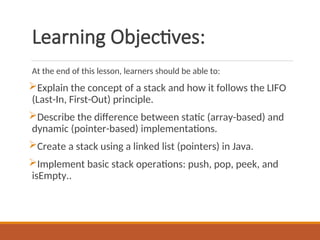
Learning Objectives:
At theend of this lesson, learners should be able to:
Explain the concept of a stack and how it follows the LIFO
(Last-In, First-Out) principle.
Describe the difference between static (array-based) and
dynamic (pointer-based) implementations.
Create a stack using a linked list (pointers) in Java.
Implement basic stack operations: push, pop, peek, and
isEmpty..
3.
Review
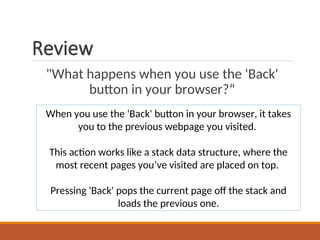
"What happens whenyou use the 'Back'
button in your browser?“
When you use the 'Back' button in your browser, it takes
you to the previous webpage you visited.
This action works like a stack data structure, where the
most recent pages you’ve visited are placed on top.
Pressing 'Back' pops the current page off the stack and
loads the previous one.
4.
Review
"Have you everstacked plates or boxes? What
happens when you remove the top item?"
When you remove the top item, you take the most
recently placed one.
The other items below stay in the same order.
This is similar to how a stack works in programming —
you can only access or remove the item at the top,
following the Last-In, First-Out (LIFO) principle.
5.
Brief Recap
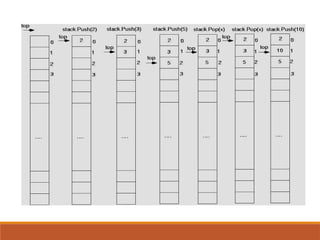
Astack is a linear data structure that allows
adding (push) and removing (pop) elements
only at the top of the stack.
2 Implementations:
1. Static implementation uses arrays;
2. Dynamic implementation uses pointers or
linked lists which allow flexibility in size.
6.
What is aPointer in Java?
In traditional languages like C or C++, a pointer is
a variable that stores the memory address of
another variable.
However, Java does not have explicit pointers like
those languages.
Instead, Java uses references, which behave
similarly to pointers but with important
differences:
7.
What is aPointer in Java?
🔍 Key Points:
In Java, objects are accessed through references.
A reference in Java is like a pointer — it points to
the location in memory where the object is stored.
Unlike C/C++, Java does not allow direct memory
access, making it safer and easier to manage.
8.
Example:
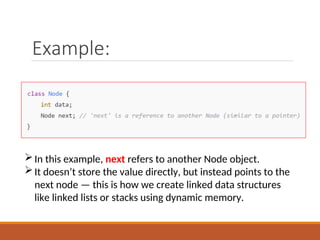
In this example,next refers to another Node object.
It doesn’t store the value directly, but instead points to the
next node — this is how we create linked data structures
like linked lists or stacks using dynamic memory.
9.
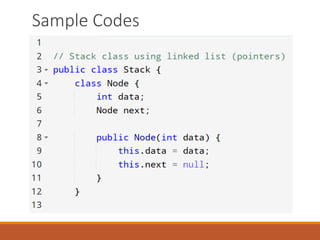
Stack Using LinkedList
(Dynamic Implementation)
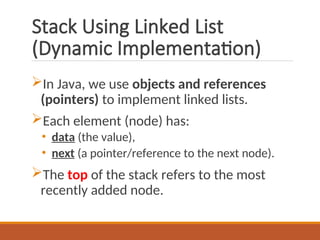
In Java, we use objects and references
(pointers) to implement linked lists.
Each element (node) has:
• data (the value),
• next (a pointer/reference to the next node).
The top of the stack refers to the most
recently added node.
10.
What is aNode?
In data structures like linked lists or
stack implementations (using
pointers/references), a Node is a basic
building block that stores data and a
reference to the next node.
11.
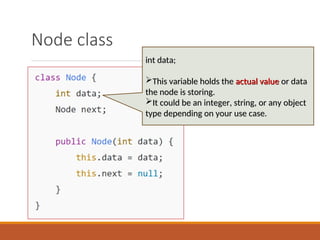
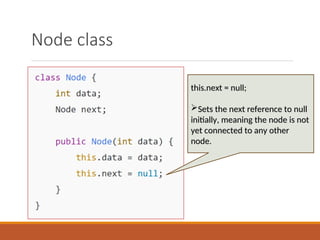
Node class ClassNode {
Class Node {
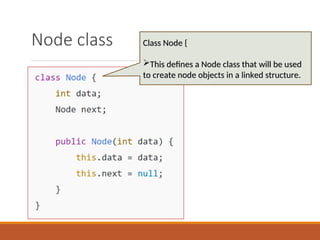
This defines a Node class that will be used
This defines a Node class that will be used
to create node objects in a linked structure.
to create node objects in a linked structure.
12.
Node class
int data;
intdata;
This variable holds the
This variable holds the actual value
actual value or data
or data
the node is storing.
the node is storing.
It could be an integer, string, or any object
It could be an integer, string, or any object
type depending on your use case.
type depending on your use case.
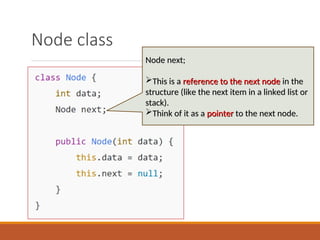
13.
Node class
Node next;
Nodenext;
This is a
This is a reference to the next node
reference to the next node in the
in the
structure (like the next item in a linked list or
structure (like the next item in a linked list or
stack).
stack).
Think of it as a
Think of it as a pointer
pointer to the next node.
to the next node.
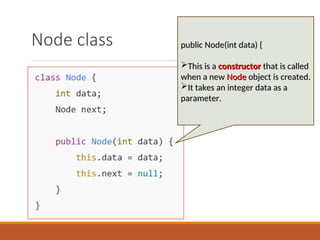
14.
Node class publicNode(int data) {
public Node(int data) {
This is a
This is a constructor
constructor that is called
that is called
when a new
when a new Node
Node object is created.
object is created.
It takes an integer data as a
It takes an integer data as a
parameter.
parameter.
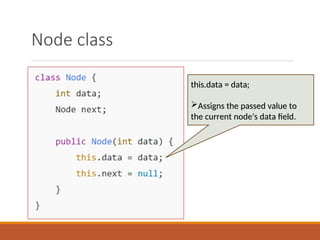
15.
Node class
this.data =data;
this.data = data;
Assigns the passed value to
Assigns the passed value to
the current node's data field.
the current node's data field.
16.
Node class
this.next =null;
this.next = null;
Sets the next reference to null
Sets the next reference to null
initially, meaning the node is not
initially, meaning the node is not
yet connected to any other
yet connected to any other
node.
node.
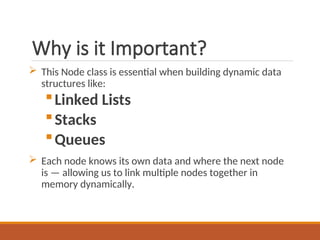
17.
Why is itImportant?
This Node class is essential when building dynamic data
structures like:
Linked Lists
Stacks
Queues
Each node knows its own data and where the next node
is — allowing us to link multiple nodes together in
memory dynamically.
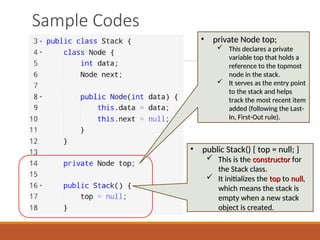
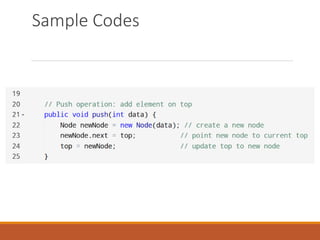
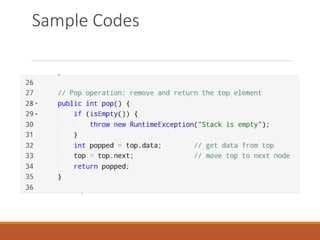
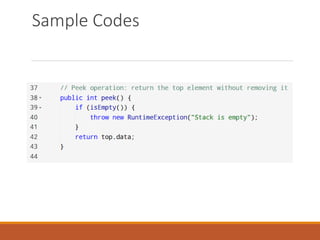
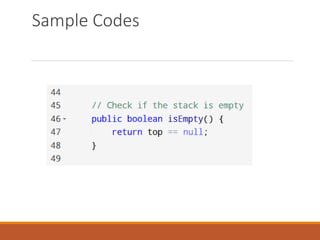
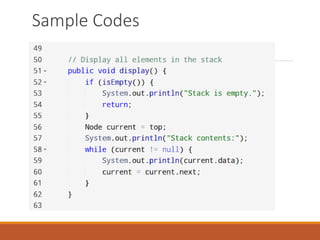
Sample Codes
• privateNode top;
private Node top;
This declares a private
This declares a private
variable top that holds a
variable top that holds a
reference to the topmost
reference to the topmost
node in the stack.
node in the stack.
It serves as the entry point
It serves as the entry point
to the stack and helps
to the stack and helps
track the most recent item
track the most recent item
added (following the Last-
added (following the Last-
In, First-Out rule).
In, First-Out rule).
• public Stack() { top = null; }
public Stack() { top = null; }
This is the
This is the constructor
constructor for
for
the Stack class.
the Stack class.
It initializes the
It initializes the top
top to
to null
null,
,
which means the stack is
which means the stack is
empty when a new stack
empty when a new stack
object is created.
object is created.
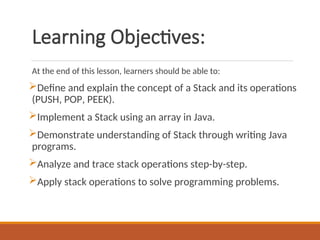
Learning Objectives:
At theend of this lesson, learners should be able to:
Define and explain the concept of a Stack and its operations
(PUSH, POP, PEEK).
Implement a Stack using an array in Java.
Demonstrate understanding of Stack through writing Java
programs.
Analyze and trace stack operations step-by-step.
Apply stack operations to solve programming problems.
29.
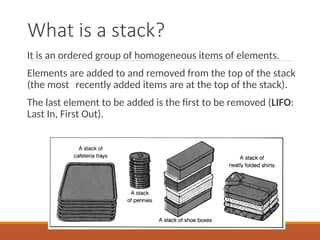
What is astack?
It is an ordered group of homogeneous items of elements.
Elements are added to and removed from the top of the stack
(the most recently added items are at the top of the stack).
The last element to be added is the first to be removed (LIFO:
Last In, First Out).
30.
What is aStack?
• A Stack is a linear data structure which follows
the LIFO principle (Last In, First Out).
• The most recently added element is the first to be
removed.
• Common operations:
•PUSH: Add an element to the top.
•POP: Remove the top element.
•PEEK: View the top element without removing it.
•isEmpty(): Check if the stack is empty.
•isFull(): Check if the stack is full (for array
implementation).
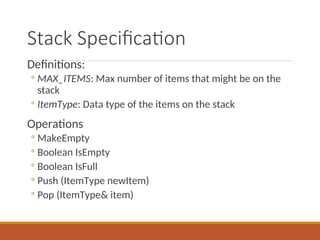
31.
Stack Specification
Definitions:
◦ MAX_ITEMS:Max number of items that might be on the
stack
◦ ItemType: Data type of the items on the stack
Operations
◦ MakeEmpty
◦ Boolean IsEmpty
◦ Boolean IsFull
◦ Push (ItemType newItem)
◦ Pop (ItemType& item)
32.
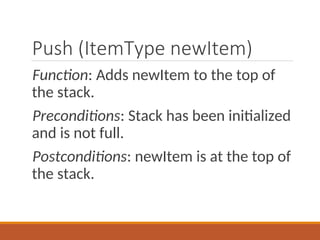
Push (ItemType newItem)
Function:Adds newItem to the top of
the stack.
Preconditions: Stack has been initialized
and is not full.
Postconditions: newItem is at the top of
the stack.
33.
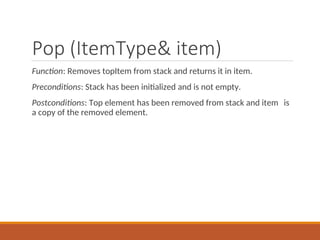
Pop (ItemType& item)
Function:Removes topItem from stack and returns it in item.
Preconditions: Stack has been initialized and is not empty.
Postconditions: Top element has been removed from stack and item is
a copy of the removed element.
35.
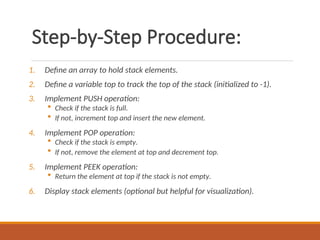
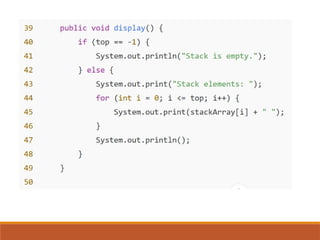
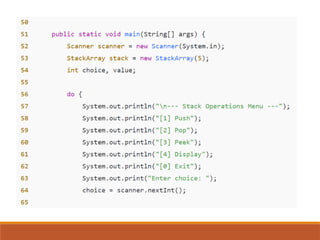
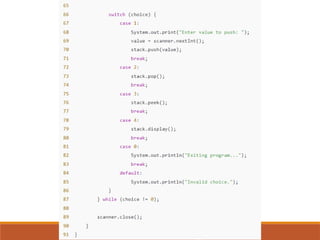
Step-by-Step Procedure:
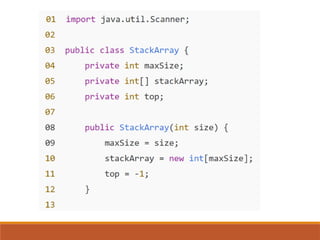
1. Definean array to hold stack elements.
2. Define a variable top to track the top of the stack (initialized to -1).
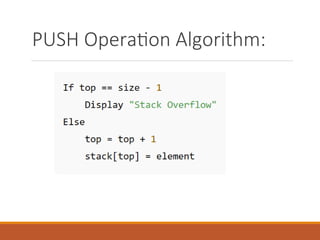
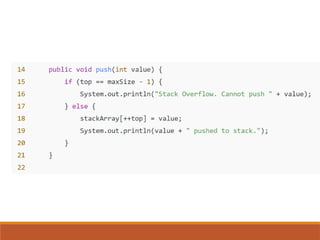
3. Implement PUSH operation:
Check if the stack is full.
If not, increment top and insert the new element.
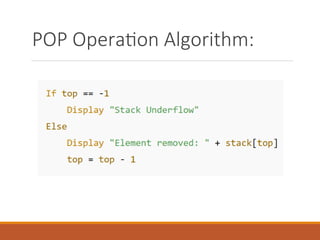
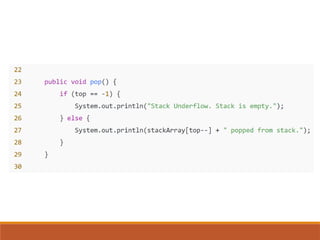
4. Implement POP operation:
Check if the stack is empty.
If not, remove the element at top and decrement top.
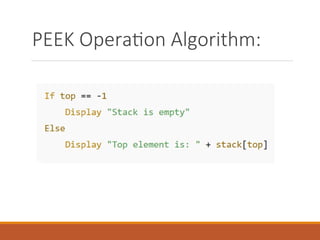
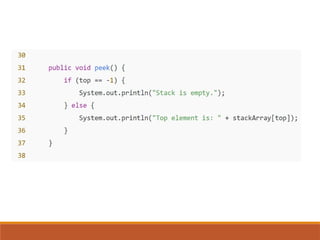
5. Implement PEEK operation:
Return the element at top if the stack is not empty.
6. Display stack elements (optional but helpful for visualization).
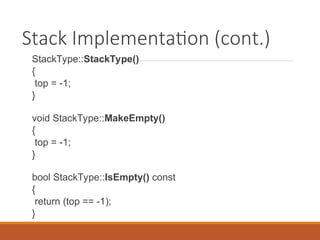
Stack Implementation
#include "ItemType.h"
//Must be provided by the user of the class
// Contains definitions for MAX_ITEMS and ItemType
class StackType {
public:
StackType();
void MakeEmpty();
bool IsEmpty() const;
bool IsFull() const;
void Push(ItemType);
void Pop(ItemType&);
private:
int top;
ItemType items[MAX_ITEMS];
};
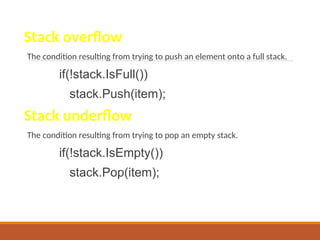
Stack overflow
The conditionresulting from trying to push an element onto a full stack.
if(!stack.IsFull())
stack.Push(item);
Stack underflow
The condition resulting from trying to pop an empty stack.
if(!stack.IsEmpty())
stack.Pop(item);
51.
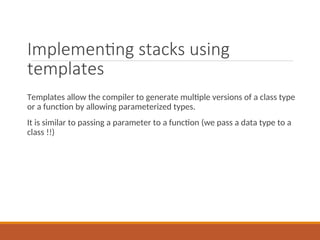
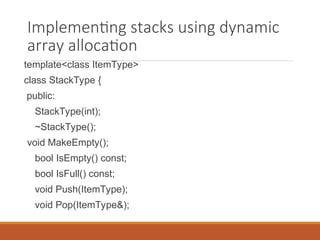
Implementing stacks using
templates
Templatesallow the compiler to generate multiple versions of a class type
or a function by allowing parameterized types.
It is similar to passing a parameter to a function (we pass a data type to a
class !!)
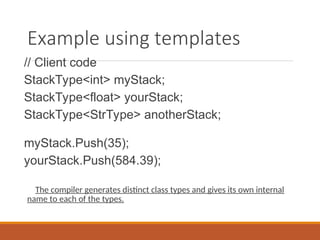
Example using templates
//Client code
StackType<int> myStack;
StackType<float> yourStack;
StackType<StrType> anotherStack;
myStack.Push(35);
yourStack.Push(584.39);
The compiler generates distinct class types and gives its own internal
name to each of the types.
54.
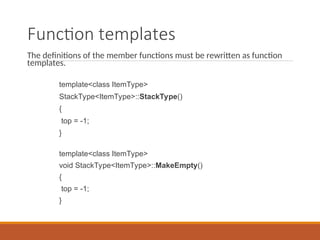
Function templates
The definitionsof the member functions must be rewritten as function
templates.
template<class ItemType>
StackType<ItemType>::StackType()
{
top = -1;
}
template<class ItemType>
void StackType<ItemType>::MakeEmpty()
{
top = -1;
}
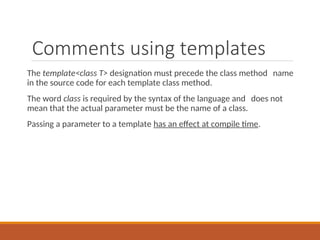
Comments using templates
Thetemplate<class T> designation must precede the class method name
in the source code for each template class method.
The word class is required by the syntax of the language and does not
mean that the actual parameter must be the name of a class.
Passing a parameter to a template has an effect at compile time.
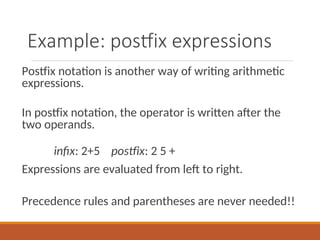
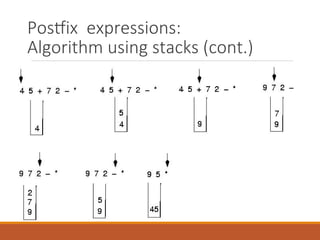
Example: postfix expressions
Postfixnotation is another way of writing arithmetic
expressions.
In postfix notation, the operator is written after the
two operands.
infix: 2+5 postfix: 2 5 +
Expressions are evaluated from left to right.
Precedence rules and parentheses are never needed!!
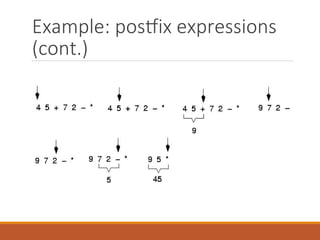
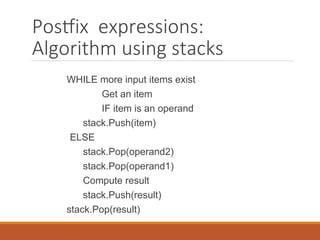
Postfix expressions:
Algorithm usingstacks
WHILE more input items exist
Get an item
IF item is an operand
stack.Push(item)
ELSE
stack.Pop(operand2)
stack.Pop(operand1)
Compute result
stack.Push(result)
stack.Pop(result)
64.
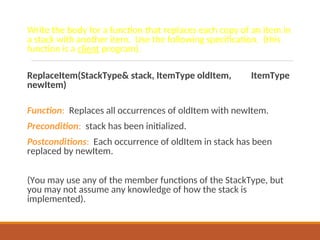
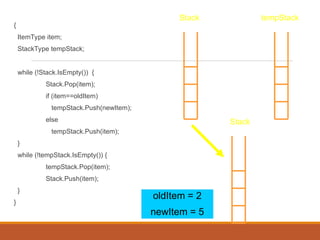
Write the bodyfor a function that replaces each copy of an item in
a stack with another item. Use the following specification. (this
function is a client program).
ReplaceItem(StackType& stack, ItemType oldItem, ItemType
newItem)
Function: Replaces all occurrences of oldItem with newItem.
Precondition: stack has been initialized.
Postconditions: Each occurrence of oldItem in stack has been
replaced by newItem.
(You may use any of the member functions of the StackType, but
you may not assume any knowledge of how the stack is
implemented).
![Stack Implementation
#include "ItemType.h"
// Must be provided by the user of the class
// Contains definitions for MAX_ITEMS and ItemType
class StackType {
public:
StackType();
void MakeEmpty();
bool IsEmpty() const;
bool IsFull() const;
void Push(ItemType);
void Pop(ItemType&);
private:
int top;
ItemType items[MAX_ITEMS];
};](https://image.slidesharecdn.com/stackdatastructureimplementation-250819061123-4f65980a/85/Stack-Data-Structure-Implementations-ppt-47-320.jpg)
![Stack Implementation (cont.)
bool StackType::IsFull() const
{
return (top == MAX_ITEMS-1);
}
void StackType::Push(ItemType newItem)
{
top++;
items[top] = newItem;
}
void StackType::Pop(ItemType& item)
{
item = items[top];
top--;
}](https://image.slidesharecdn.com/stackdatastructureimplementation-250819061123-4f65980a/85/Stack-Data-Structure-Implementations-ppt-49-320.jpg)
![Implementing stacks using templates
template<class ItemType>
class StackType {
public:
StackType();
void MakeEmpty();
bool IsEmpty() const;
bool IsFull() const;
void Push(ItemType);
void Pop(ItemType&);
private:
int top;
ItemType items[MAX_ITEMS];
};
(cont.)](https://image.slidesharecdn.com/stackdatastructureimplementation-250819061123-4f65980a/85/Stack-Data-Structure-Implementations-ppt-52-320.jpg)
![Function templates (cont.)
template<class ItemType>
bool StackType<ItemType>::IsEmpty() const
{
return (top == -1);
}
template<class ItemType>
bool StackType<ItemType>::IsFull() const
{
return (top == MAX_ITEMS-1);
}
template<class ItemType>
void StackType<ItemType>::Push(ItemType newItem)
{
top++;
items[top] = newItem;
}](https://image.slidesharecdn.com/stackdatastructureimplementation-250819061123-4f65980a/85/Stack-Data-Structure-Implementations-ppt-55-320.jpg)
![Function templates (cont.)
template<class ItemType>
void StackType<ItemType>::Pop(ItemType& item)
{
item = items[top];
top--;
}](https://image.slidesharecdn.com/stackdatastructureimplementation-250819061123-4f65980a/85/Stack-Data-Structure-Implementations-ppt-56-320.jpg)
![Implementing stacks using
dynamic array allocation (cont.)
template<class ItemType>
StackType<ItemType>::StackType(int max)
{
maxStack = max;
top = -1;
items = new ItemType[max];
}
template<class ItemType>
StackType<ItemType>::~StackType()
{
delete [ ] items;
}](https://image.slidesharecdn.com/stackdatastructureimplementation-250819061123-4f65980a/85/Stack-Data-Structure-Implementations-ppt-59-320.jpg)


![stack_presentaton_HUSNAIN[2].pojklklklptx](https://cdn.slidesharecdn.com/ss_thumbnails/stackpresentatonhusnain2-240417175650-c212f10f-thumbnail.jpg?width=640&height=640&fit=bounds)


