Binary search tree
Sana Yameen
Presented By:
Definition
• A binary search tree is a rooted binary tree, whose internal nodes
each store a key (and optionally, an associated value) and each
have two distinguished sub-trees, commonly denoted left and
right.
• The left sub-tree of a node has a key less than or equal to its
parent node's key.
• The right sub-tree of a node has a key greater than to its parent
node's key.
Representation
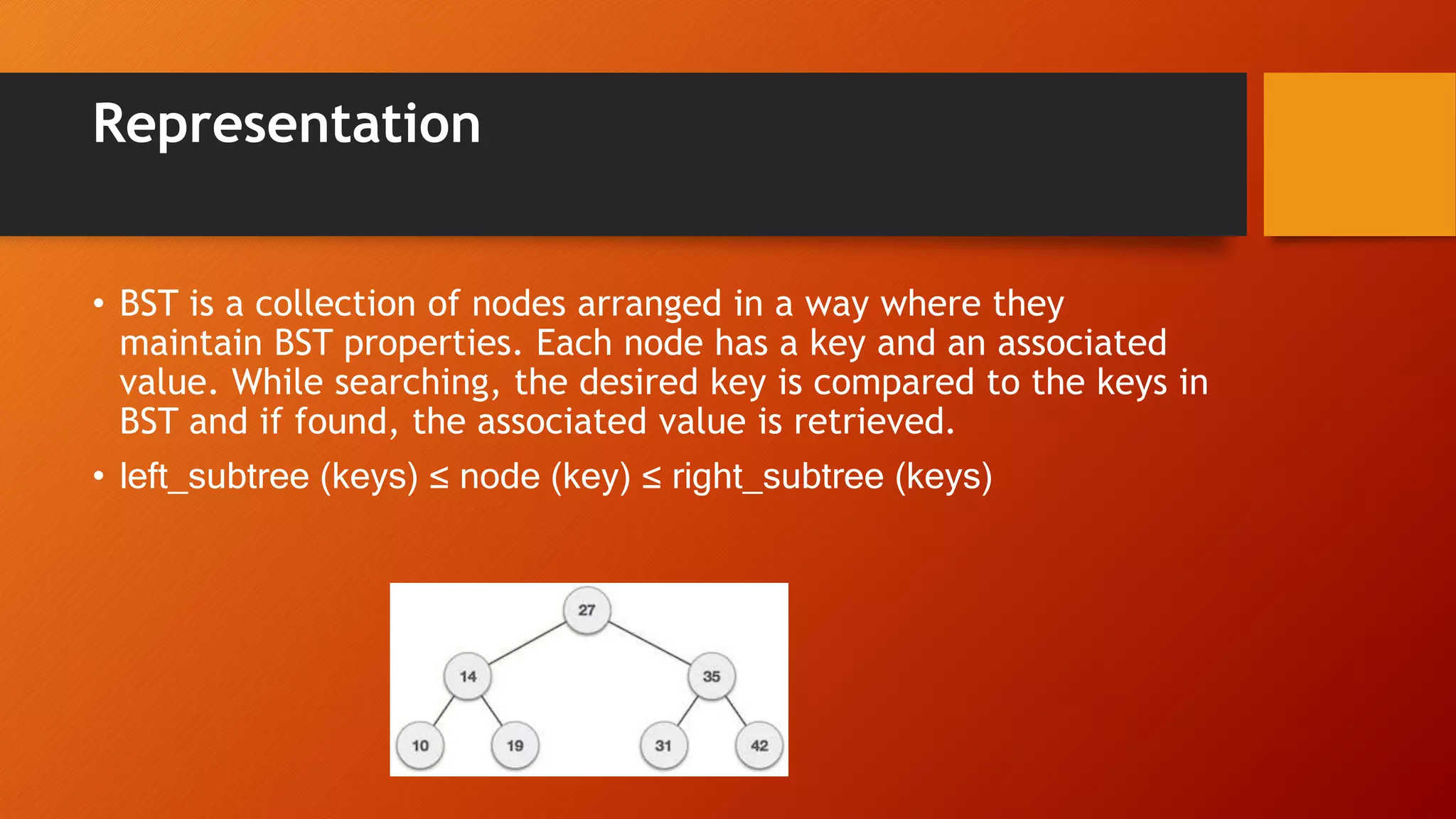
• BST is a collection of nodes arranged in a way where they
maintain BST properties. Each node has a key and an associated
value. While searching, the desired key is compared to the keys in
BST and if found, the associated value is retrieved.
• left_subtree (keys) ≤ node (key) ≤ right_subtree (keys)
Some BST terminologies
• The root node is the top node of tree.
• A child node has exactly one parent node and a parent node has at
most two child nodes, sibling nodes shares the same parent node.
• A leaf node has no child nodes, an interior node has at least one
child node.
• Every node in BST is a sub tree of the BST rooted at the node.
Basic Operations
• Search
• Inserting
• Deleting
• Traversing
Searching in BST
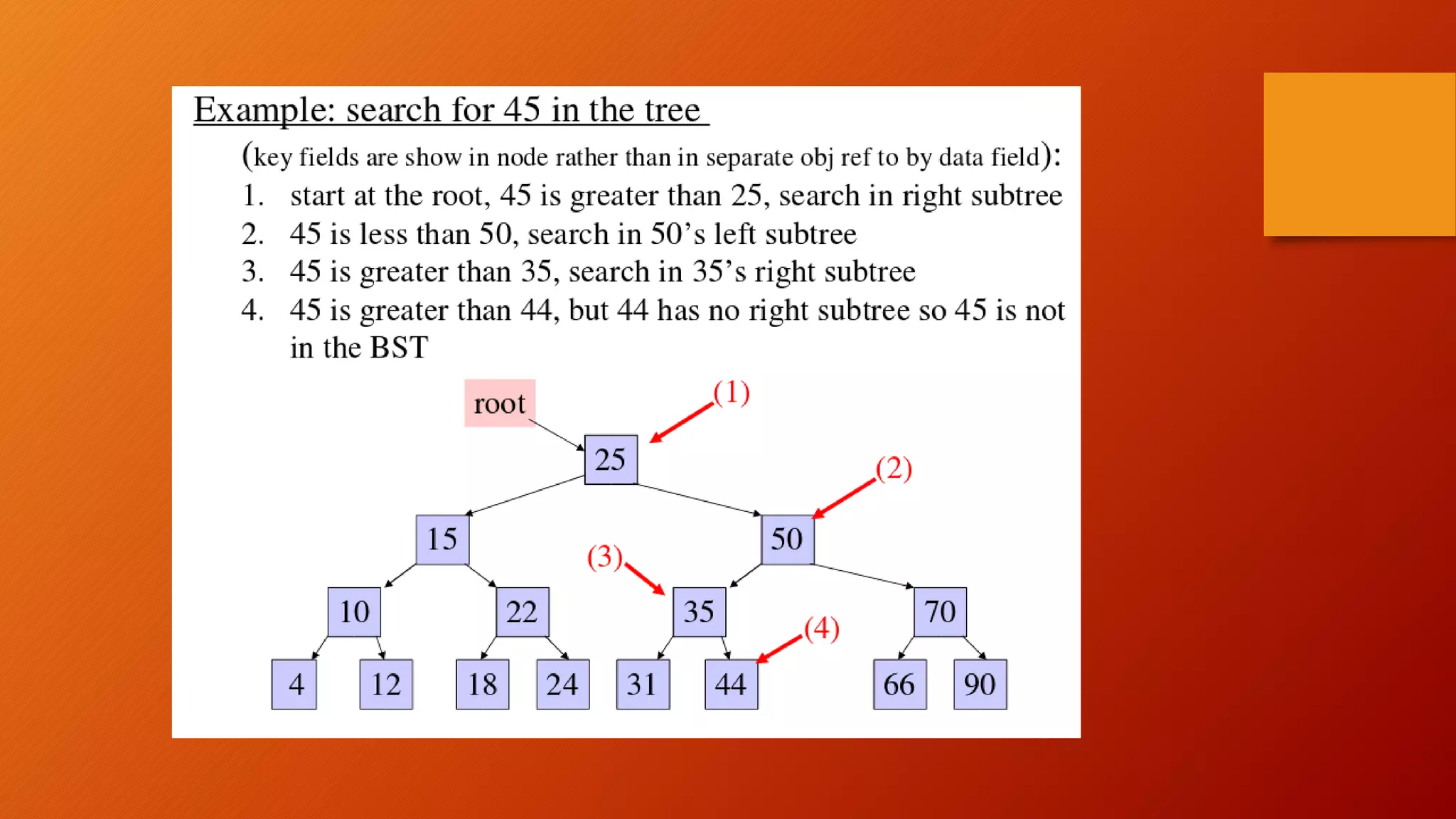
• Searching a binary search tree for a specific key can be
programmed recursively or iteratively.
• To search a given key in Binary Search Tree, we first compare it
with root, if the key is present at root, we return root. If key is
greater than root’s key, we recur for right sub tree of root node.
Otherwise we recur for left sub tree.
Algorithm of searching
If root==search-data
Return root
Else
While data not found
If search-data>node-data
Go to right sub tree
Else
Go to left sub tree
If data found
Return node
End while
Return data not found
End if
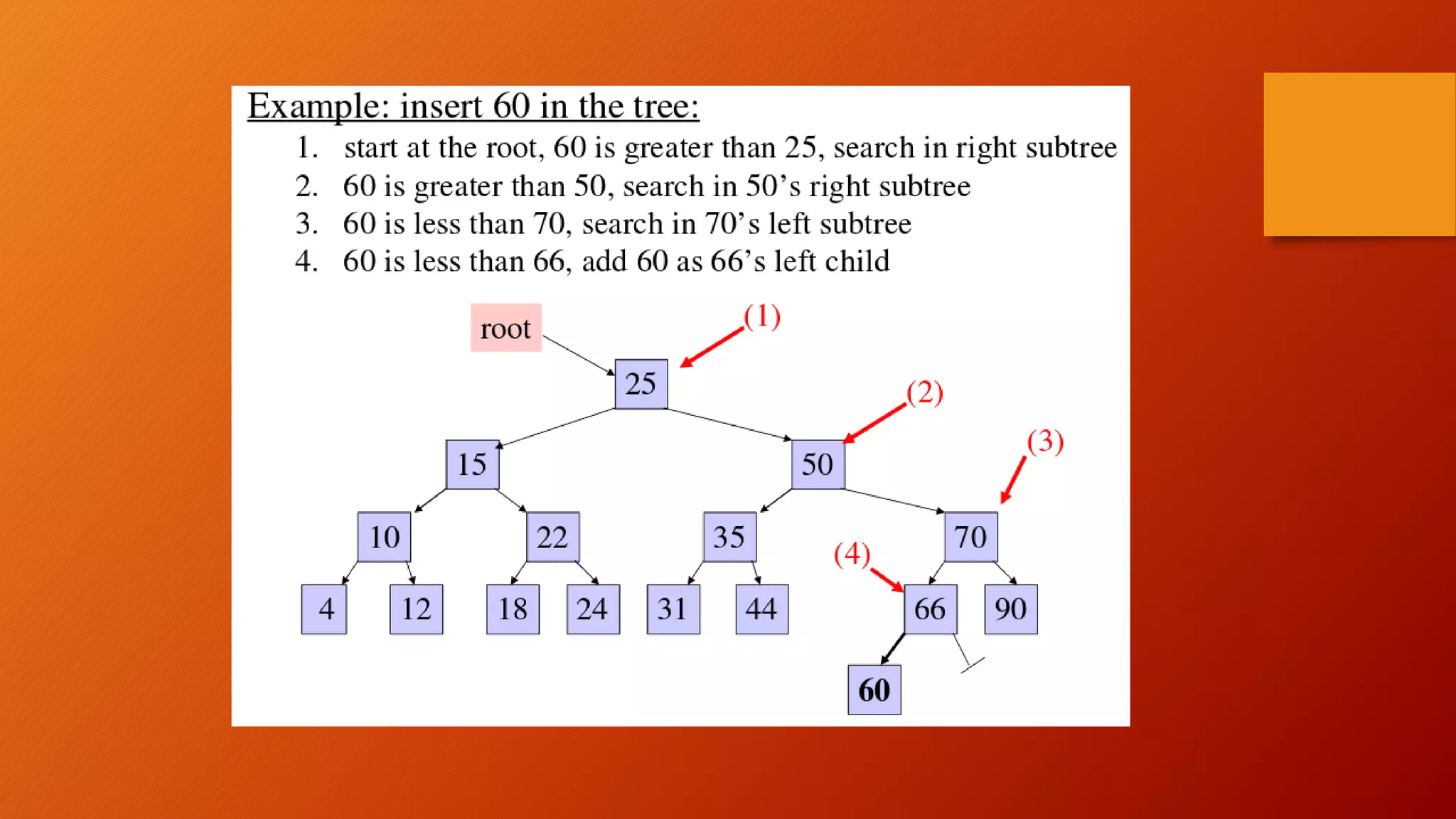
Inserting
Whenever an element is to be inserted, first locate its
proper location. Start searching from the root node, then
if the data is less than the key value, search for the empty
location in the left subtree and insert the data.
Otherwise, search for the empty location in the right sub
tree and insert the data.
Binary search tree. Adding a value
Adding a value to BST can be divided into two stages:
• Search for a place to put a new element
• Insert the new element to this place.
• A new key is always inserted at leaf. We start searching a key from
root till we hit a leaf node. Once a leaf node is found, the new
node is added as a child of the leaf node.
Algorithm of inserting
If root==null
Create root node
Return
If root exist then
If data> node
Go to right sub tree
Else
Go to left sub tree
End if
Insert data
End if
Deleting
There are three possible cases to consider:
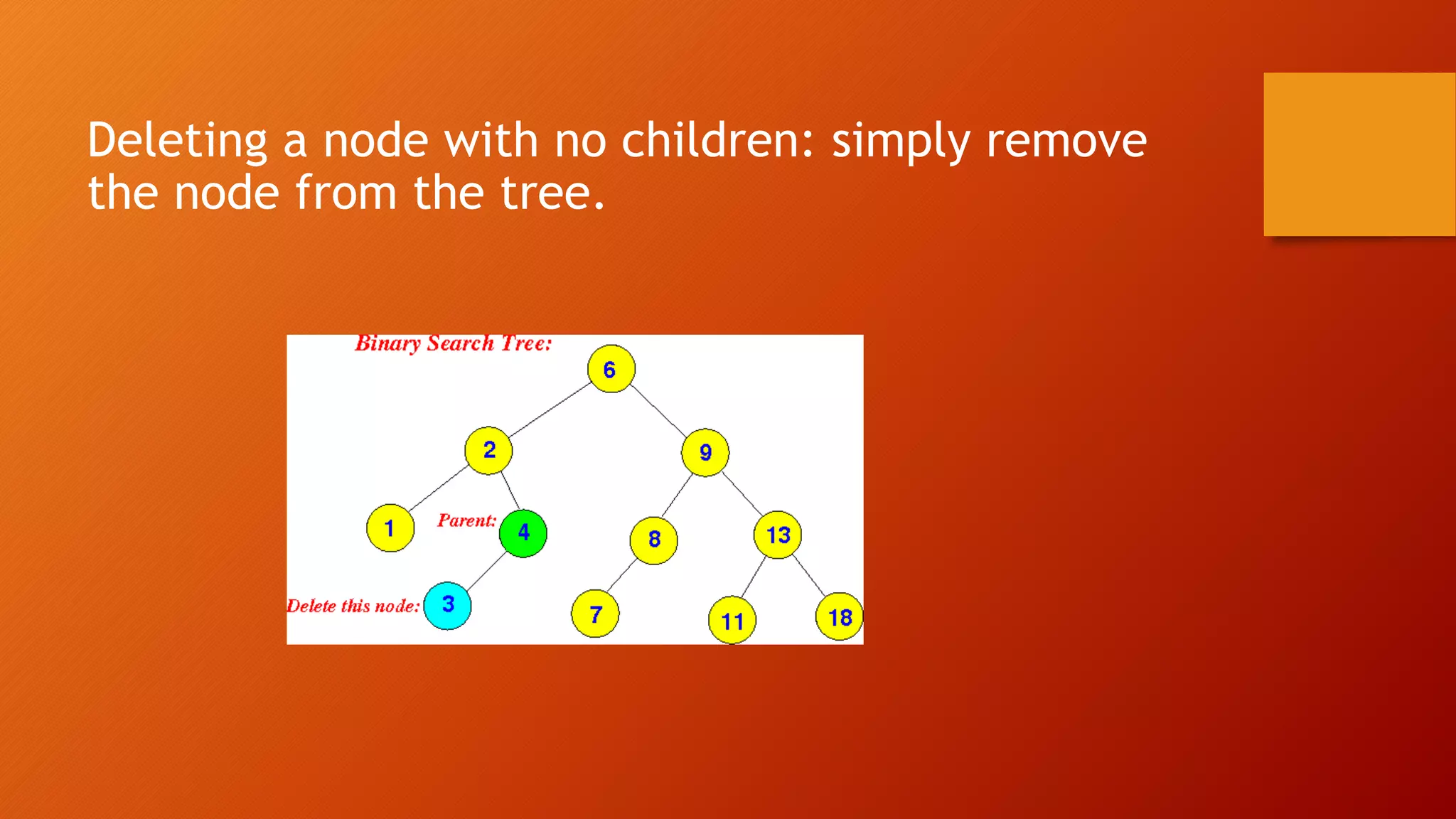
• Deleting a node with no children: simply remove the node from
the tree.
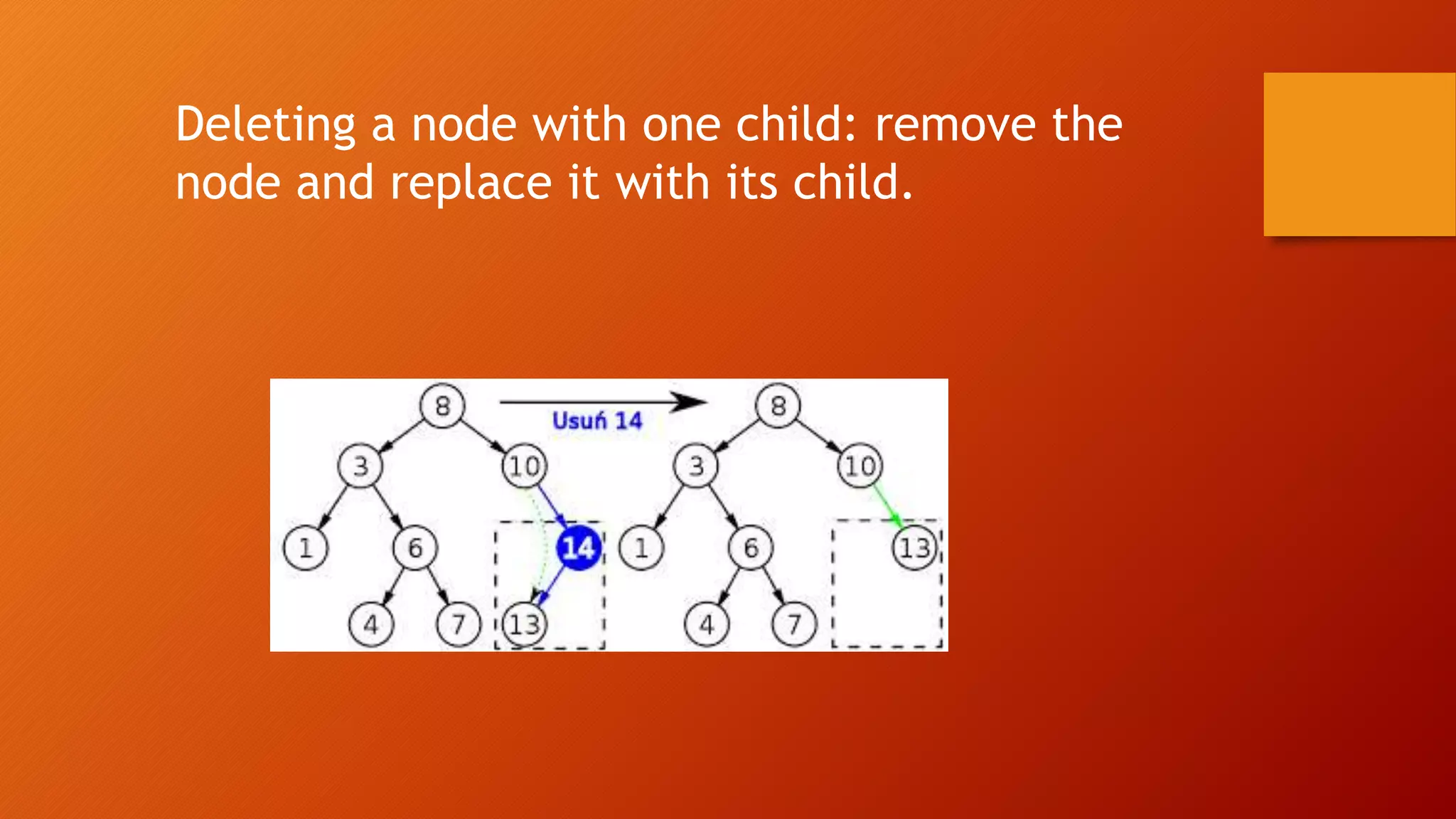
• Deleting a node with one child: remove the node and replace it
with its child.
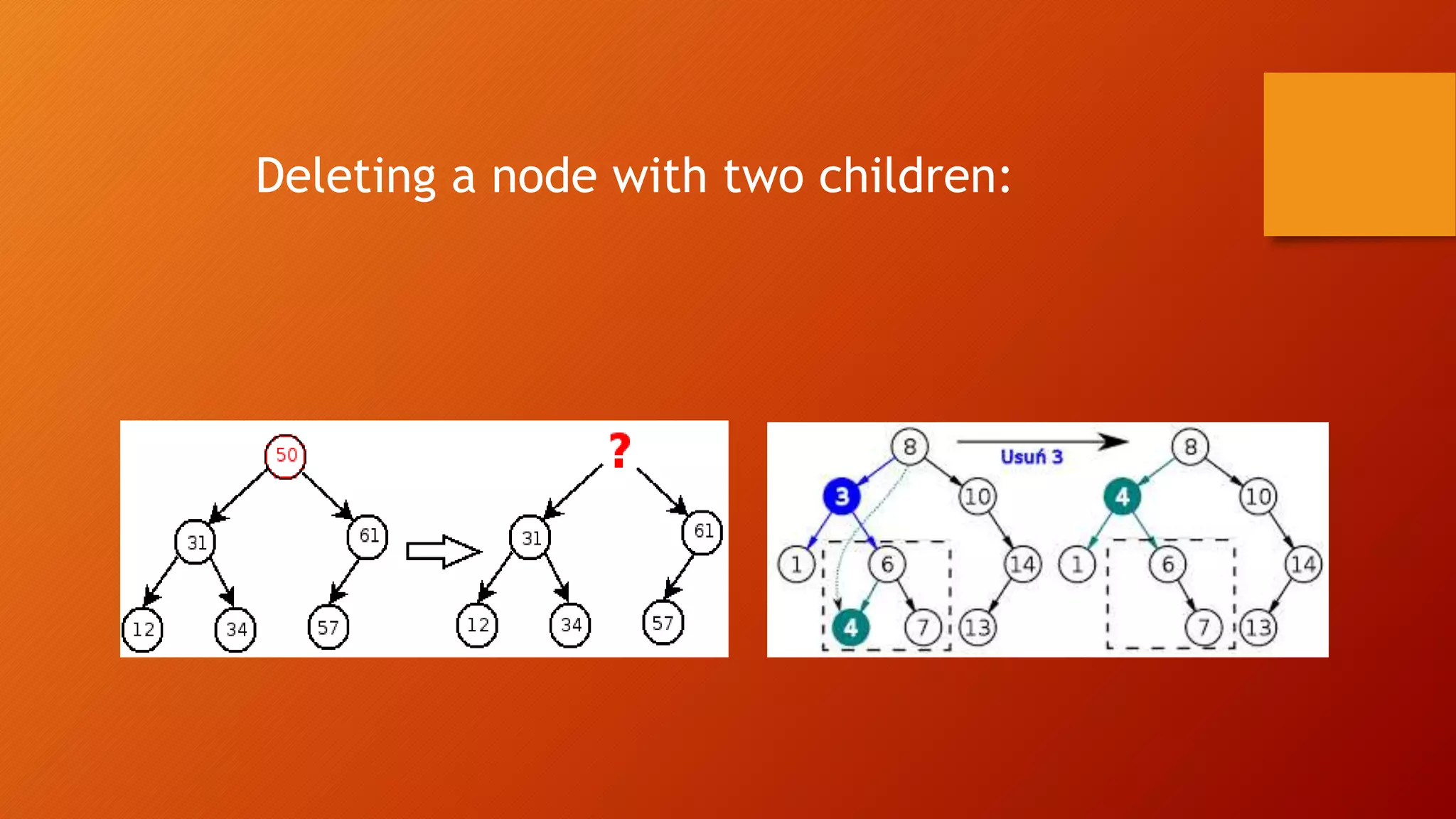
• Deleting a node with two children: call the node to be deleted N.
Do not delete N. Instead, choose either its in-order successor node
or its in-order predecessor node, R. Copy the value of R to N, then
recursively call delete on the original R until reaching one of the
first two cases.
Deleting a node with no children: simply remove
the node from the tree.
Deleting a node with one child: remove the
node and replace it with its child.
Deleting a node with two children:
Traversing
Traversal of a binary tree is to access every node of binary tree at
most.
Such traversals are classified by the order in which the nodes are
visited.
There are three ways of traversing:
Pre order (Root, Left, Right)
In order (Left, Root, Right)
Post order (Left, Right, Root)
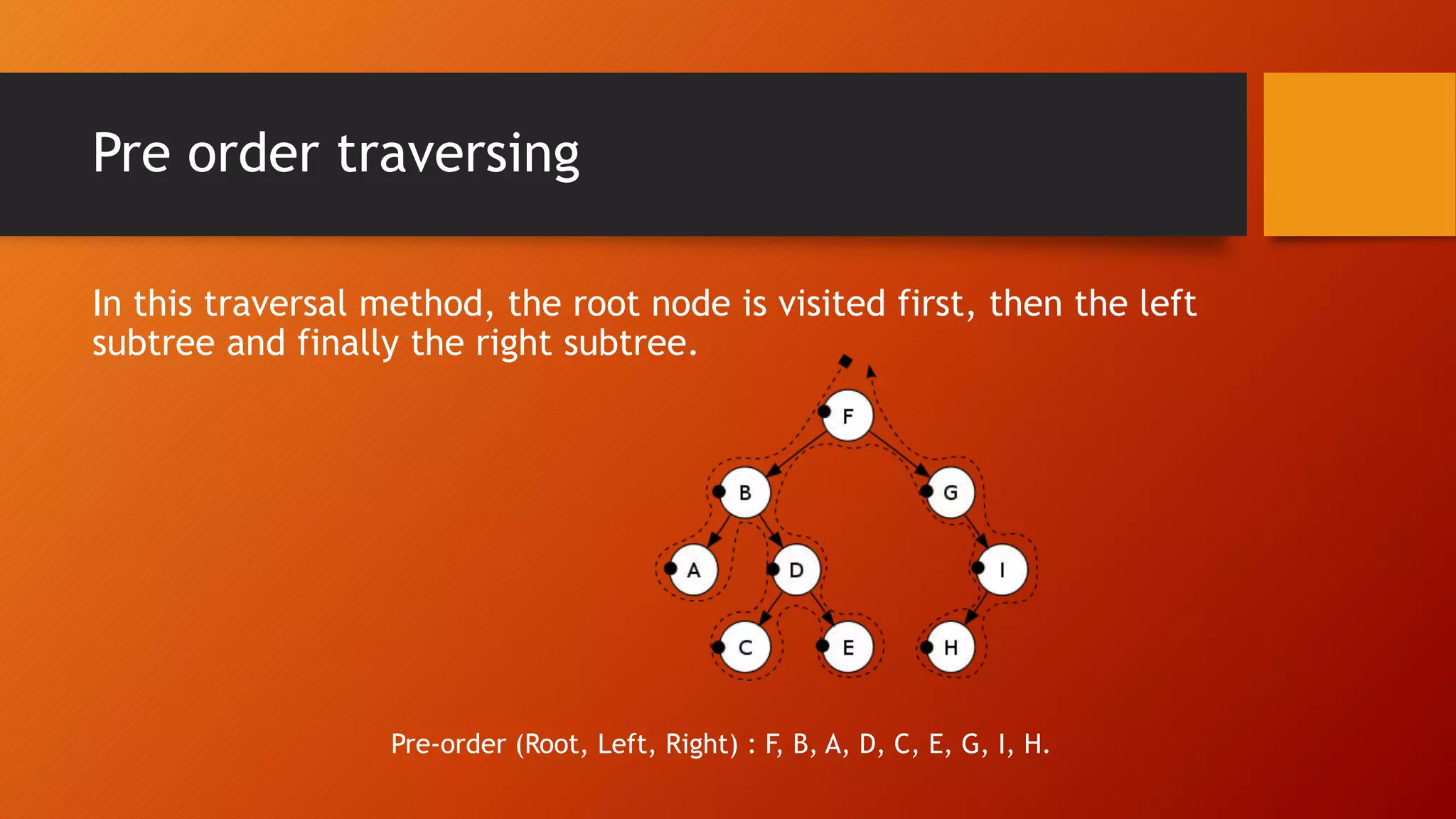
Pre order traversing
In this traversal method, the root node is visited first, then the left
subtree and finally the right subtree.
Pre-order (Root, Left, Right) : F, B, A, D, C, E, G, I, H.
Algorithm of pre order
Until all nodes are traversed −
Step 1 − Visit root node.
Step 2 − Recursively traverse left subtree.
Step 3 − Recursively traverse right subtree.
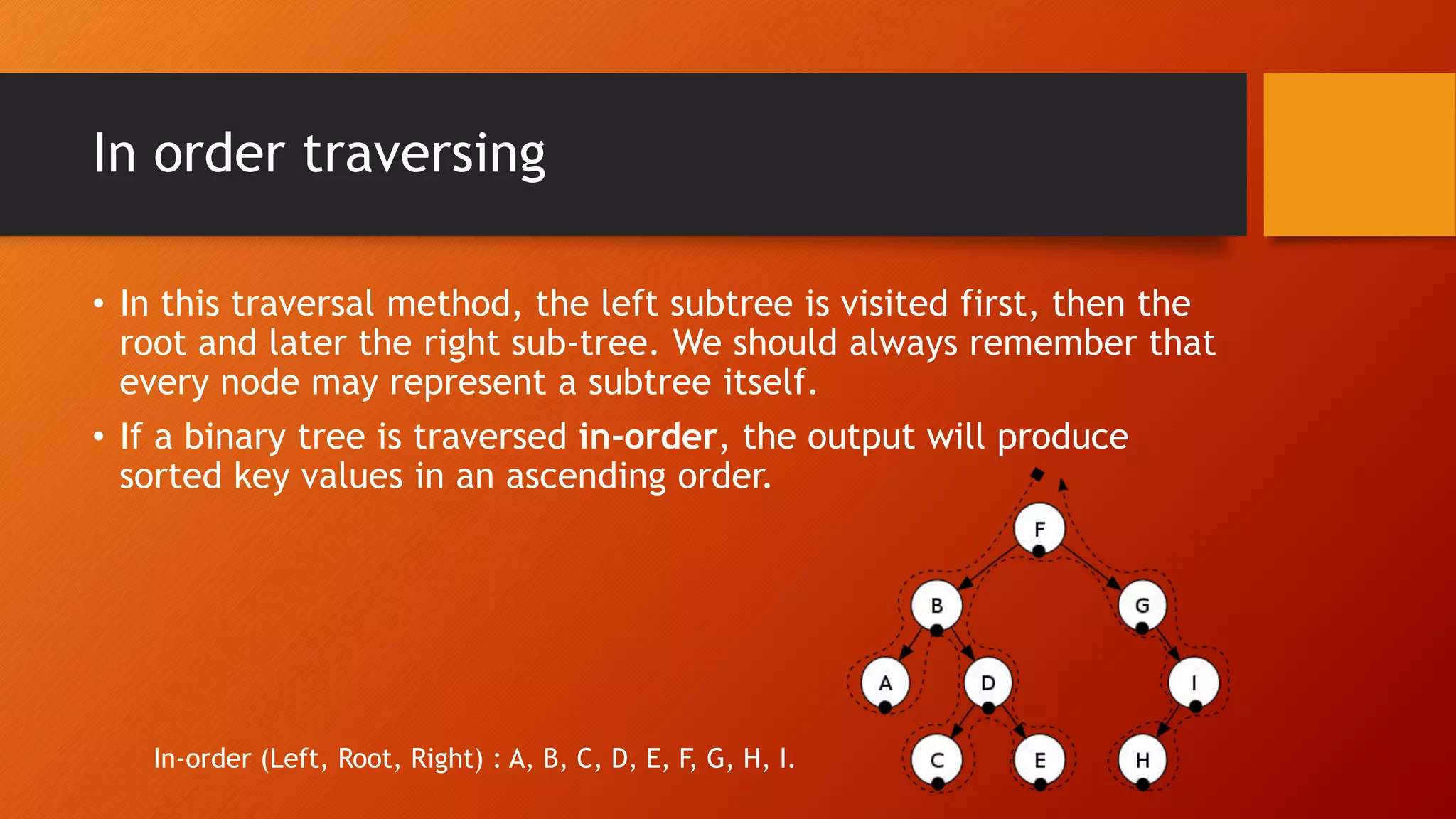
In order traversing
• In this traversal method, the left subtree is visited first, then the
root and later the right sub-tree. We should always remember that
every node may represent a subtree itself.
• If a binary tree is traversed in-order, the output will produce
sorted key values in an ascending order.
In-order (Left, Root, Right) : A, B, C, D, E, F, G, H, I.
Algorithm of in order
• Until all nodes are traversed −
• Step 1 − Recursively traverse left subtree.
• Step 2 − Visit root node.
• Step 3 − Recursively traverse right subtree.
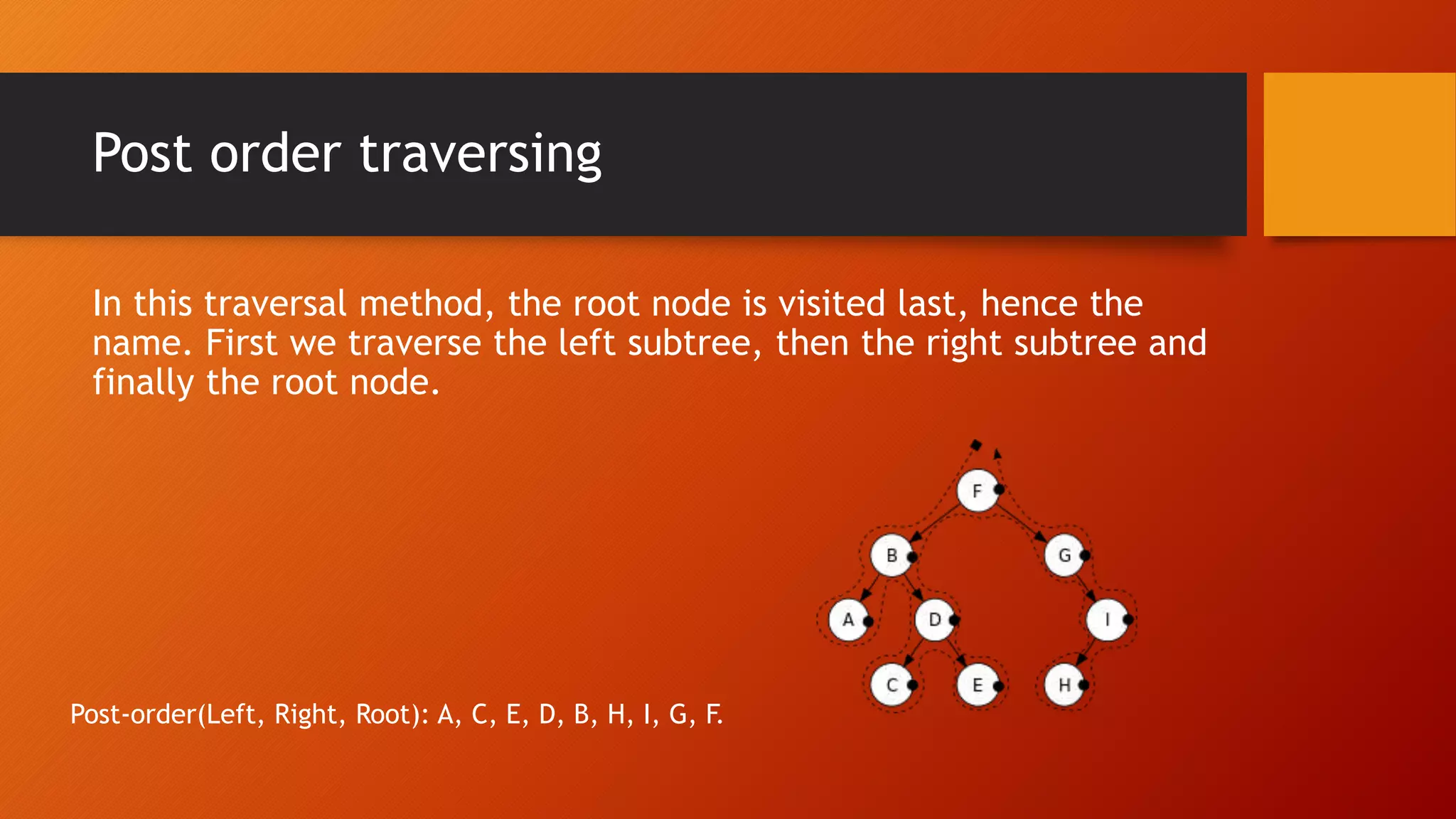
Post order traversing
In this traversal method, the root node is visited last, hence the
name. First we traverse the left subtree, then the right subtree and
finally the root node.
Post-order(Left, Right, Root): A, C, E, D, B, H, I, G, F.
Algorithm of post order traversing
• Until all nodes are traversed −
• Step 1 − Recursively traverse left subtree.
• Step 2 − Recursively traverse right subtree.
• Step 3 − Visit root node.
Any Question
Binary search tree

Binary search tree

  • 2.
    Binary search tree SanaYameen Presented By:
  • 3.
    Definition • A binarysearch tree is a rooted binary tree, whose internal nodes each store a key (and optionally, an associated value) and each have two distinguished sub-trees, commonly denoted left and right. • The left sub-tree of a node has a key less than or equal to its parent node's key. • The right sub-tree of a node has a key greater than to its parent node's key.
  • 4.
    Representation • BST isa collection of nodes arranged in a way where they maintain BST properties. Each node has a key and an associated value. While searching, the desired key is compared to the keys in BST and if found, the associated value is retrieved. • left_subtree (keys) ≤ node (key) ≤ right_subtree (keys)
  • 5.
    Some BST terminologies •The root node is the top node of tree. • A child node has exactly one parent node and a parent node has at most two child nodes, sibling nodes shares the same parent node. • A leaf node has no child nodes, an interior node has at least one child node. • Every node in BST is a sub tree of the BST rooted at the node.
  • 6.
    Basic Operations • Search •Inserting • Deleting • Traversing
  • 7.
    Searching in BST •Searching a binary search tree for a specific key can be programmed recursively or iteratively. • To search a given key in Binary Search Tree, we first compare it with root, if the key is present at root, we return root. If key is greater than root’s key, we recur for right sub tree of root node. Otherwise we recur for left sub tree.
  • 8.
    Algorithm of searching Ifroot==search-data Return root Else While data not found If search-data>node-data Go to right sub tree Else Go to left sub tree If data found Return node End while Return data not found End if
  • 10.
    Inserting Whenever an elementis to be inserted, first locate its proper location. Start searching from the root node, then if the data is less than the key value, search for the empty location in the left subtree and insert the data. Otherwise, search for the empty location in the right sub tree and insert the data.
  • 11.
    Binary search tree.Adding a value Adding a value to BST can be divided into two stages: • Search for a place to put a new element • Insert the new element to this place. • A new key is always inserted at leaf. We start searching a key from root till we hit a leaf node. Once a leaf node is found, the new node is added as a child of the leaf node.
  • 12.
    Algorithm of inserting Ifroot==null Create root node Return If root exist then If data> node Go to right sub tree Else Go to left sub tree End if Insert data End if
  • 14.
    Deleting There are threepossible cases to consider: • Deleting a node with no children: simply remove the node from the tree. • Deleting a node with one child: remove the node and replace it with its child. • Deleting a node with two children: call the node to be deleted N. Do not delete N. Instead, choose either its in-order successor node or its in-order predecessor node, R. Copy the value of R to N, then recursively call delete on the original R until reaching one of the first two cases.
  • 15.
    Deleting a nodewith no children: simply remove the node from the tree.
  • 16.
    Deleting a nodewith one child: remove the node and replace it with its child.
  • 17.
    Deleting a nodewith two children:
  • 18.
    Traversing Traversal of abinary tree is to access every node of binary tree at most. Such traversals are classified by the order in which the nodes are visited. There are three ways of traversing: Pre order (Root, Left, Right) In order (Left, Root, Right) Post order (Left, Right, Root)
  • 19.
    Pre order traversing Inthis traversal method, the root node is visited first, then the left subtree and finally the right subtree. Pre-order (Root, Left, Right) : F, B, A, D, C, E, G, I, H.
  • 20.
    Algorithm of preorder Until all nodes are traversed − Step 1 − Visit root node. Step 2 − Recursively traverse left subtree. Step 3 − Recursively traverse right subtree.
  • 21.
    In order traversing •In this traversal method, the left subtree is visited first, then the root and later the right sub-tree. We should always remember that every node may represent a subtree itself. • If a binary tree is traversed in-order, the output will produce sorted key values in an ascending order. In-order (Left, Root, Right) : A, B, C, D, E, F, G, H, I.
  • 22.
    Algorithm of inorder • Until all nodes are traversed − • Step 1 − Recursively traverse left subtree. • Step 2 − Visit root node. • Step 3 − Recursively traverse right subtree.
  • 23.
    Post order traversing Inthis traversal method, the root node is visited last, hence the name. First we traverse the left subtree, then the right subtree and finally the root node. Post-order(Left, Right, Root): A, C, E, D, B, H, I, G, F.
  • 24.
    Algorithm of postorder traversing • Until all nodes are traversed − • Step 1 − Recursively traverse left subtree. • Step 2 − Recursively traverse right subtree. • Step 3 − Visit root node.
  • 25.