PRESENTED BY:
HAFSA SARA ZUBAIR
BDS
OBJECTIVES:
• OCCLUSION
• CLASS I OCCLUSION
• CLASS I MALOCCLUSION
• LINE OF OCCLUSION
• CAUSES OF CLASS I MALOCCLUSION
• BIMAXILLARY PROTRUSION
• FEATURES OF BIMAXILLARY
PROTRUSION
• FEATURES OF CLASS I MALOCCLUSION
• DIAGNOSIS
• MANAGEMENT OF CLASS I
WHAT IS OCCLUSION ?
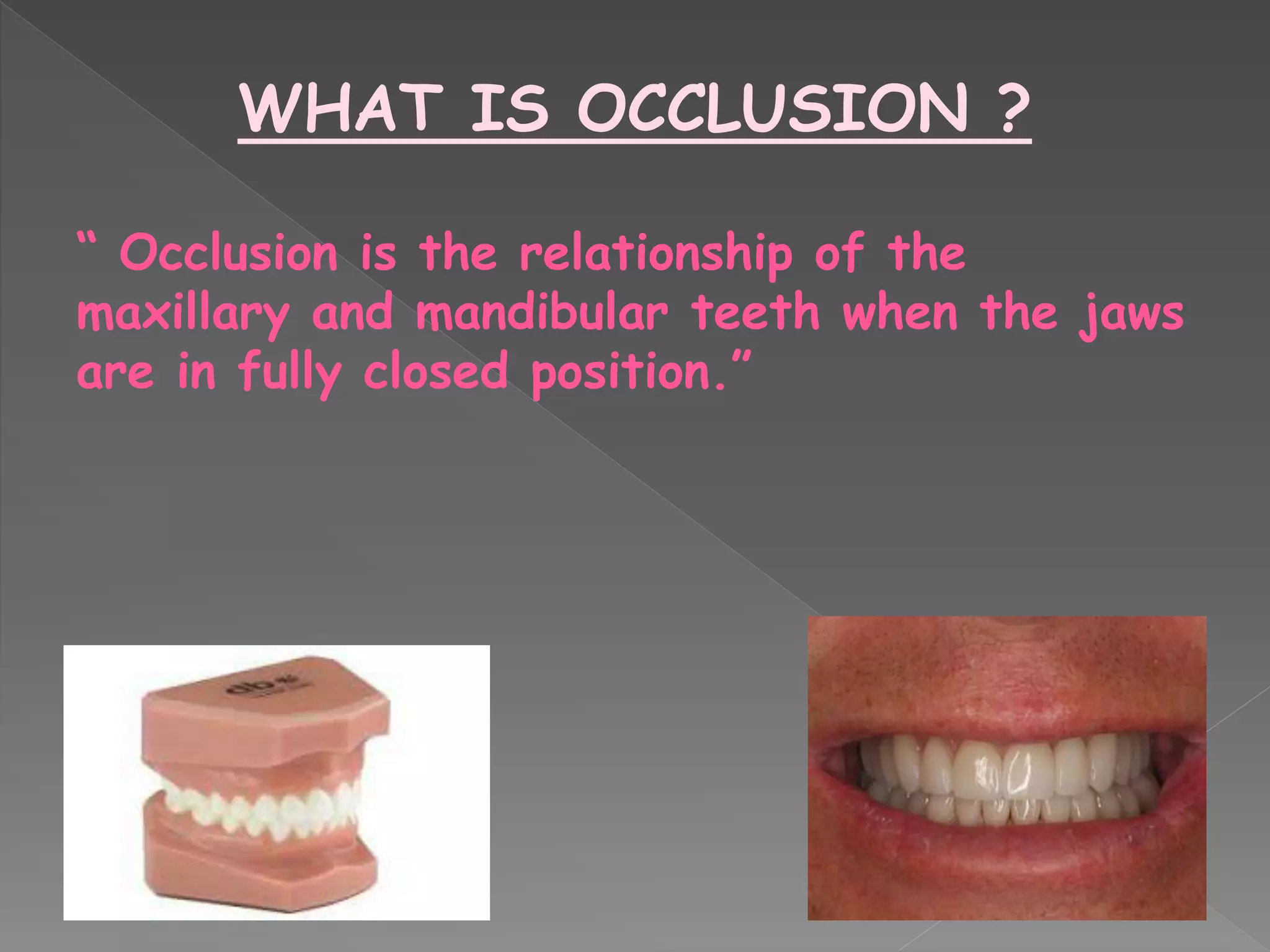
“ Occlusion is the relationship of the
maxillary and mandibular teeth when the jaws
are in fully closed position.”
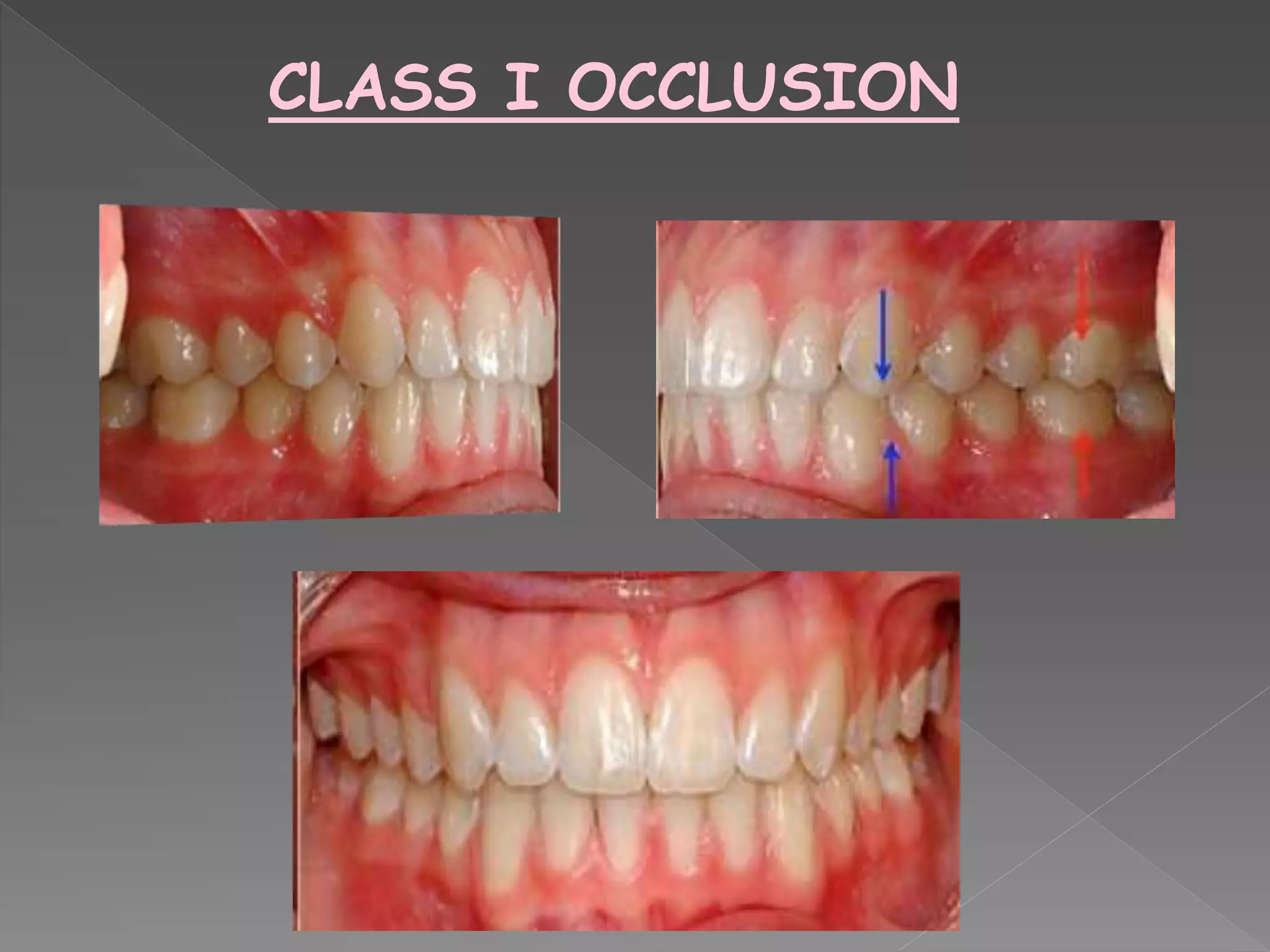
CLASS I OCCLUSION
CLASS I MALOCCLUSION
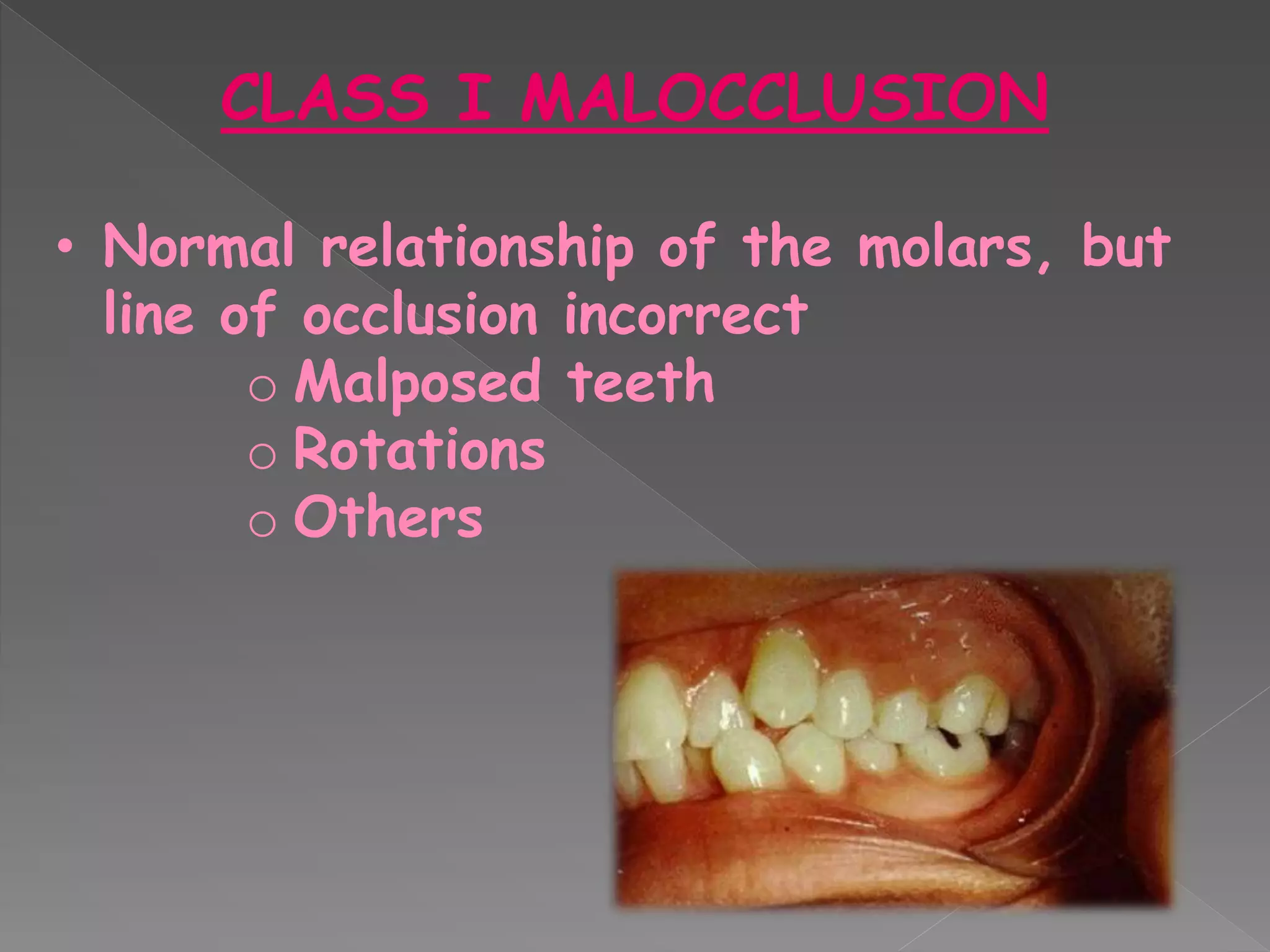
• Normal relationship of the molars, but
line of occlusion incorrect
o Malposed teeth
o Rotations
o Others
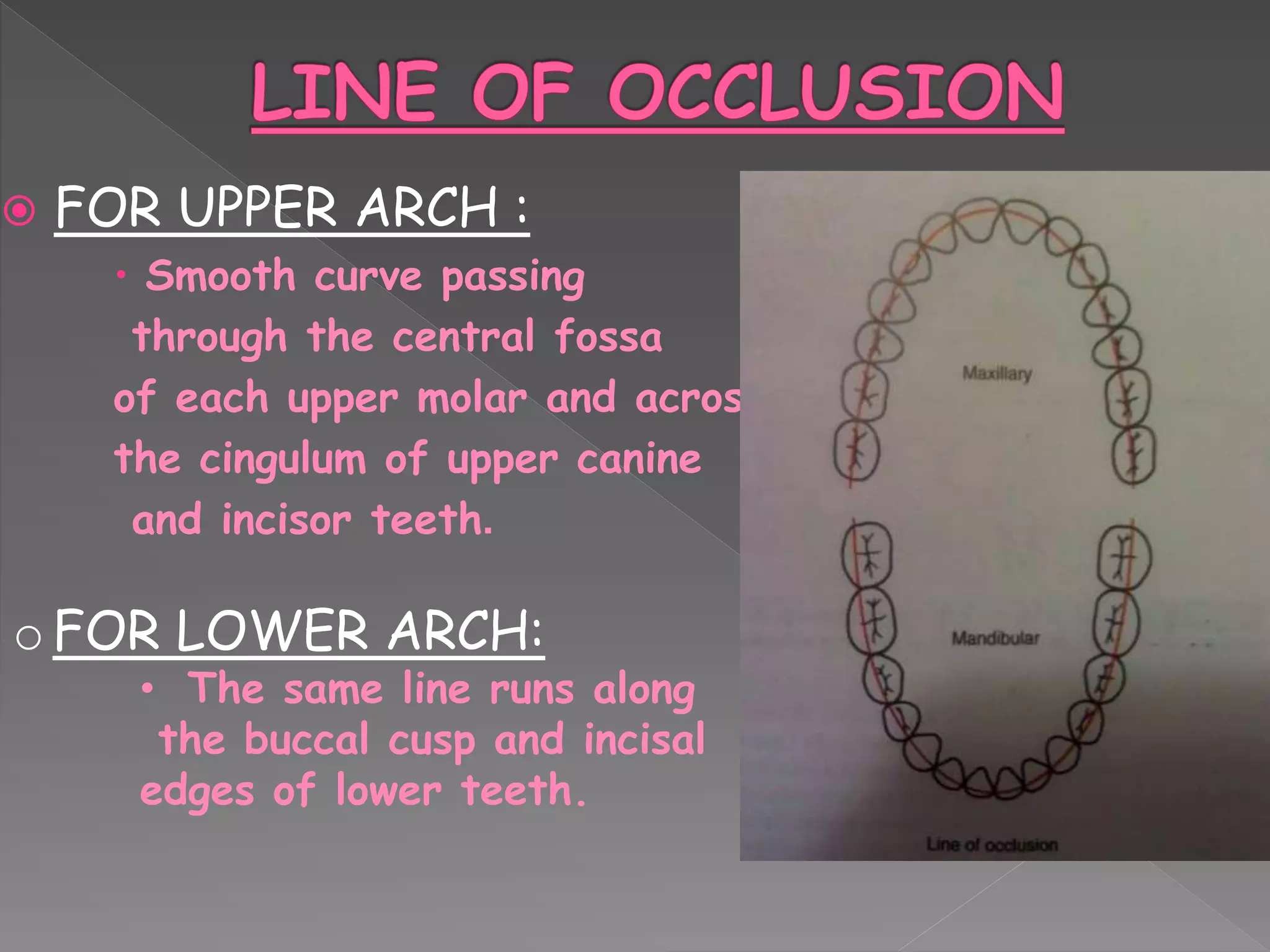
 FOR UPPER ARCH :
 Smooth curve passing
through the central fossa
of each upper molar and across
the cingulum of upper canine
and incisor teeth.
o FOR LOWER ARCH:
• The same line runs along
the buccal cusp and incisal
edges of lower teeth.
CAUSES OF CLASS I
MALOCCLUSION
DEVELOPMENTAL GENETIC ENVIRONMENTAL
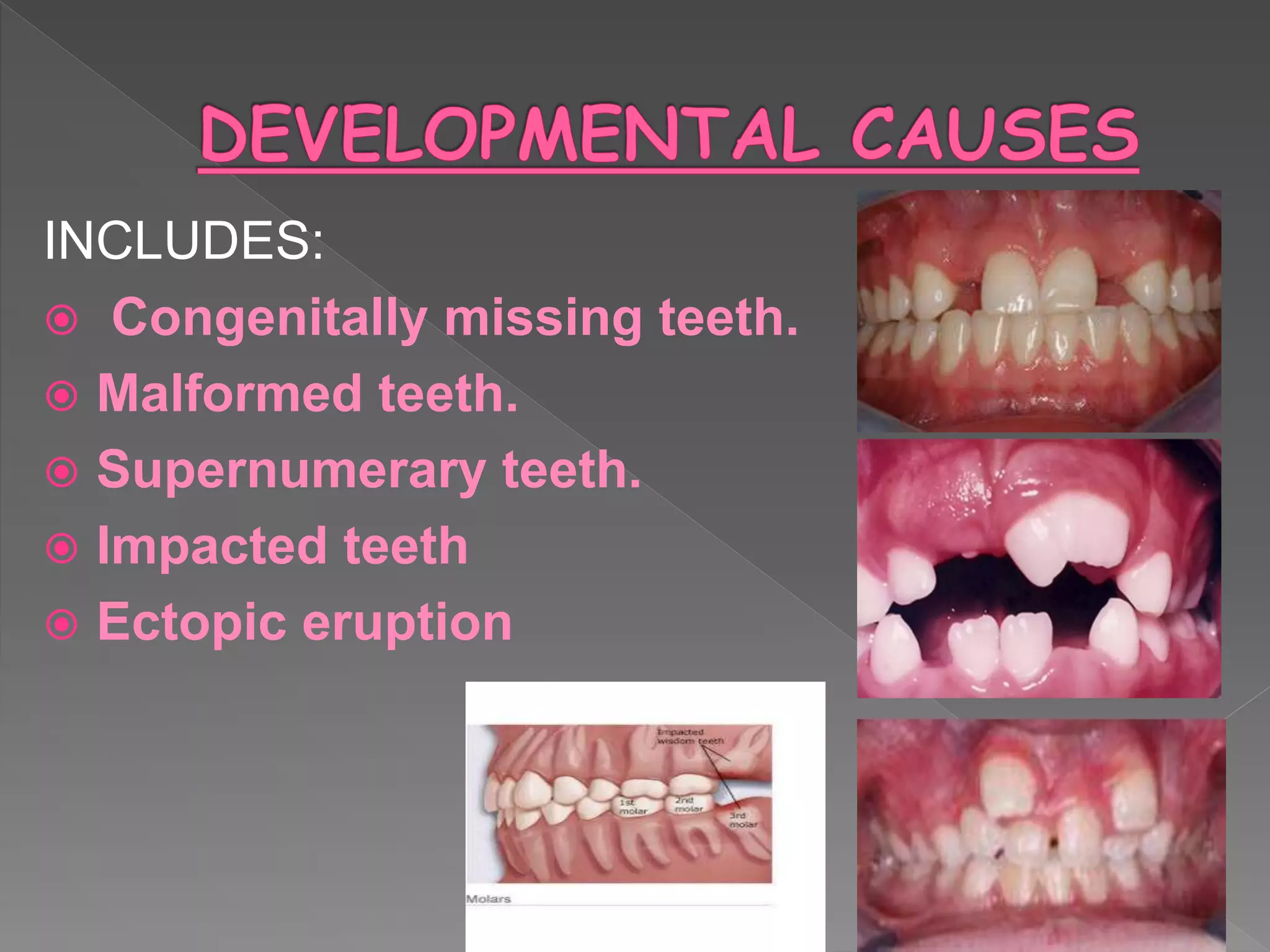
INCLUDES:
 Congenitally missing teeth.
 Malformed teeth.
 Supernumerary teeth.
 Impacted teeth
 Ectopic eruption
 Plays major role for malocclusion where
there is discrepancy between the size
of jaws and size of teeth.
CAUSED BY:
Injuries which has two types:
 BIRTH INJURIES:
› Fetal moulding
› Trauma during birth from usage of forceps.
 INJURIES THROUGHOUT LIFE:
Trauma to teeth can lead to:
 Damage to permanent tooth bud.
 Premature loss of primary teeth leads
to permanent tooth movement.
 Direct injury to permanent teeth.
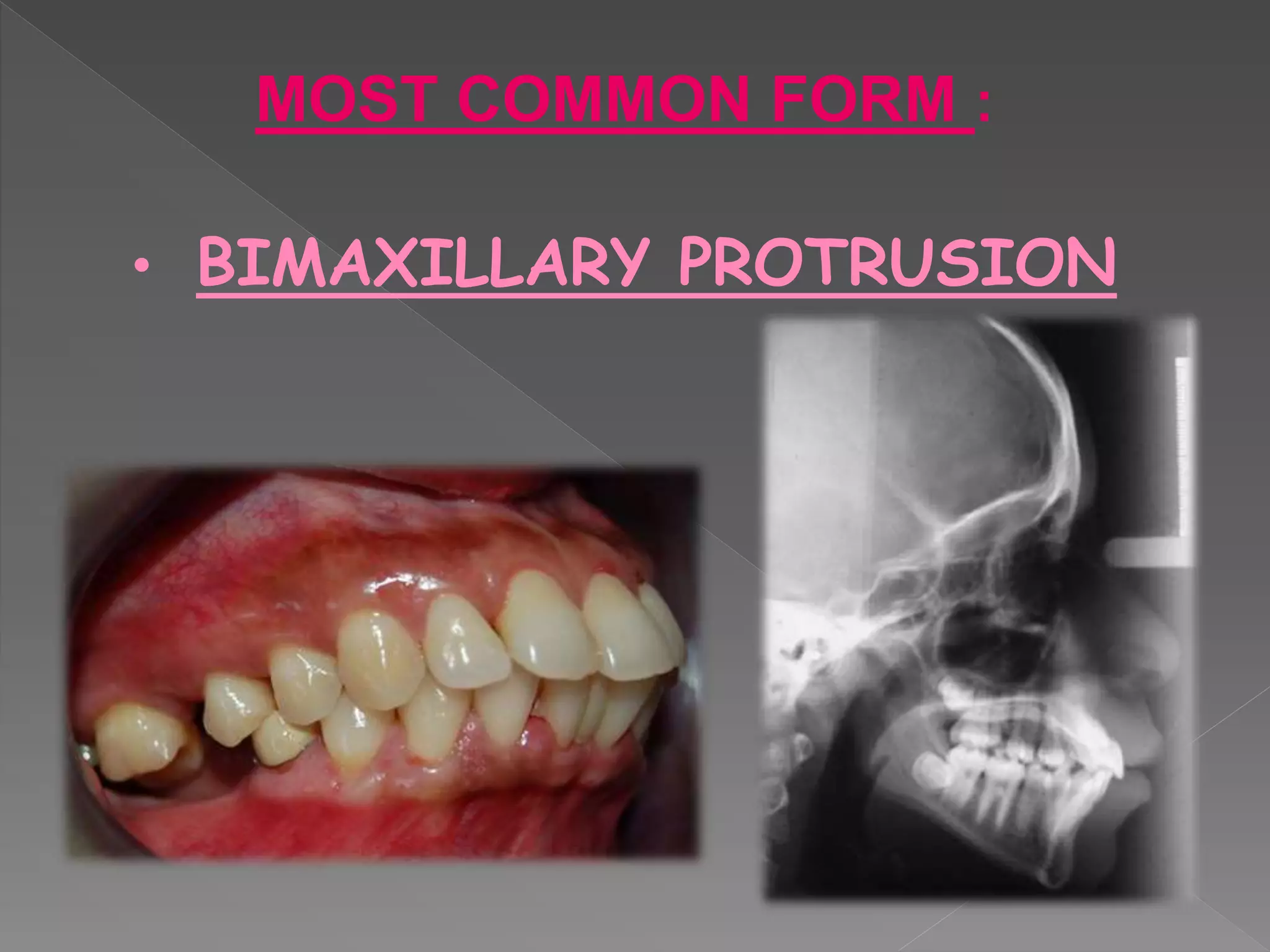
MOST COMMON FORM :
• BIMAXILLARY PROTRUSION
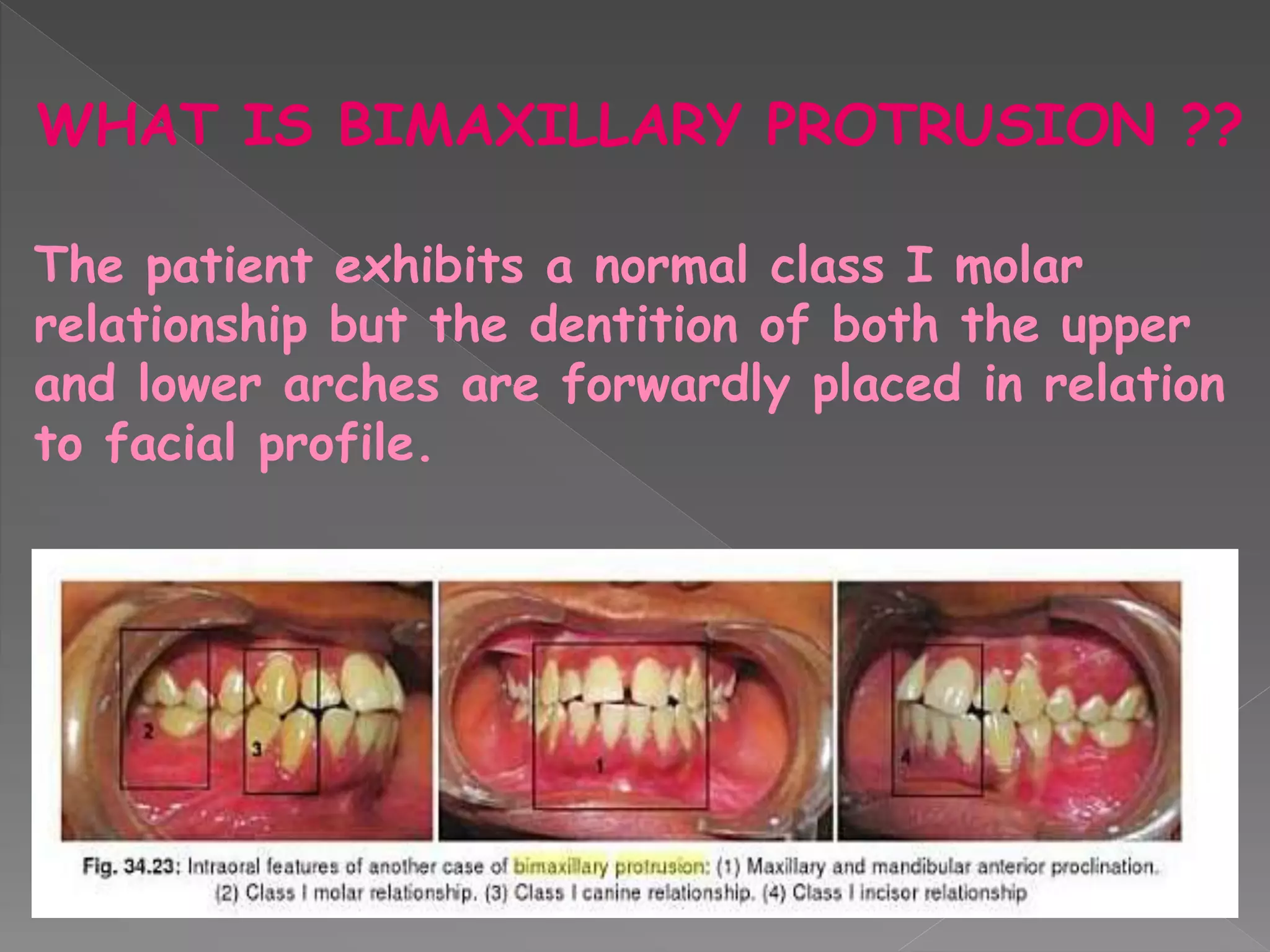
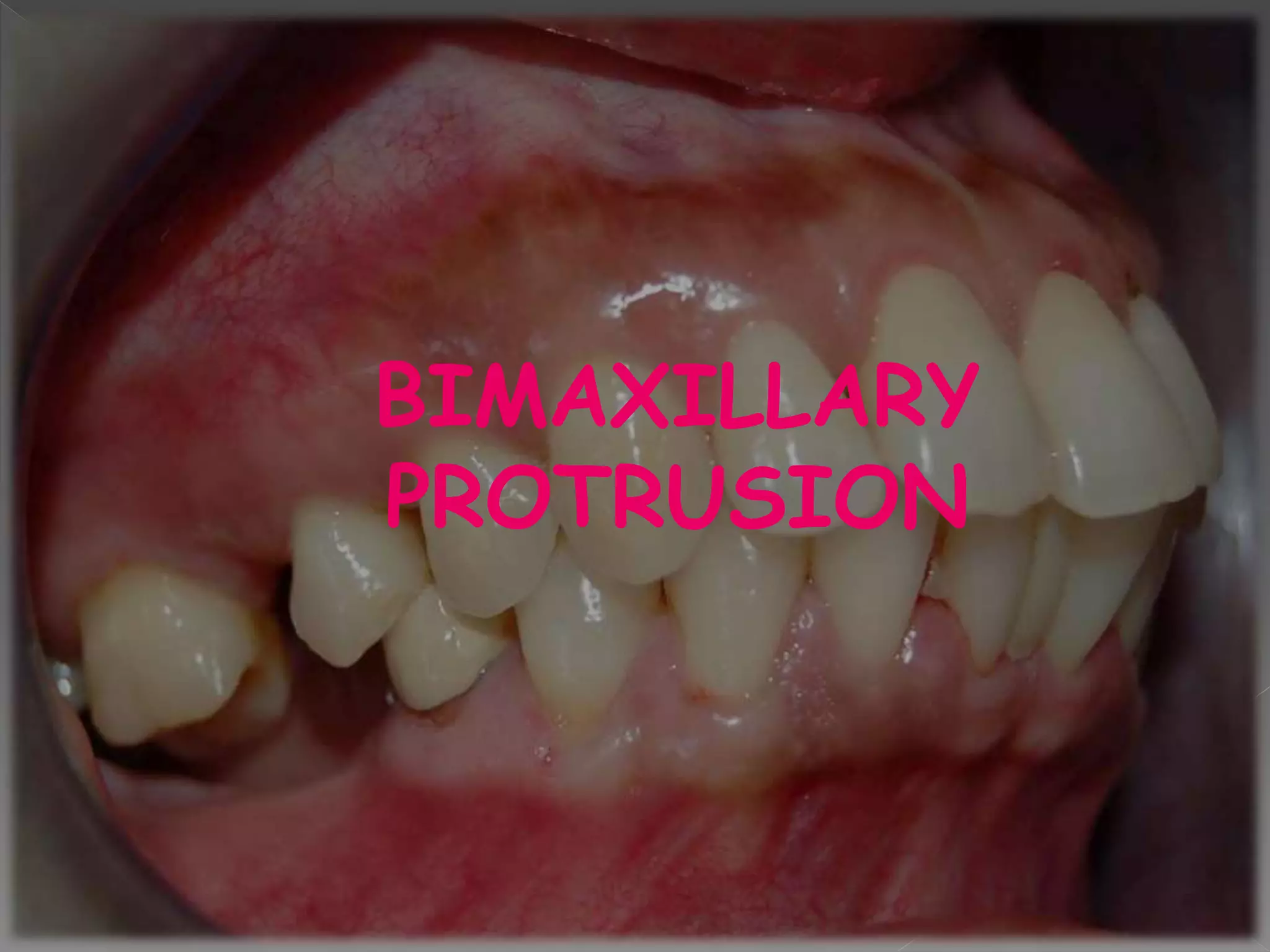
WHAT IS BIMAXILLARY PROTRUSION ??
The patient exhibits a normal class I molar
relationship but the dentition of both the upper
and lower arches are forwardly placed in relation
to facial profile.
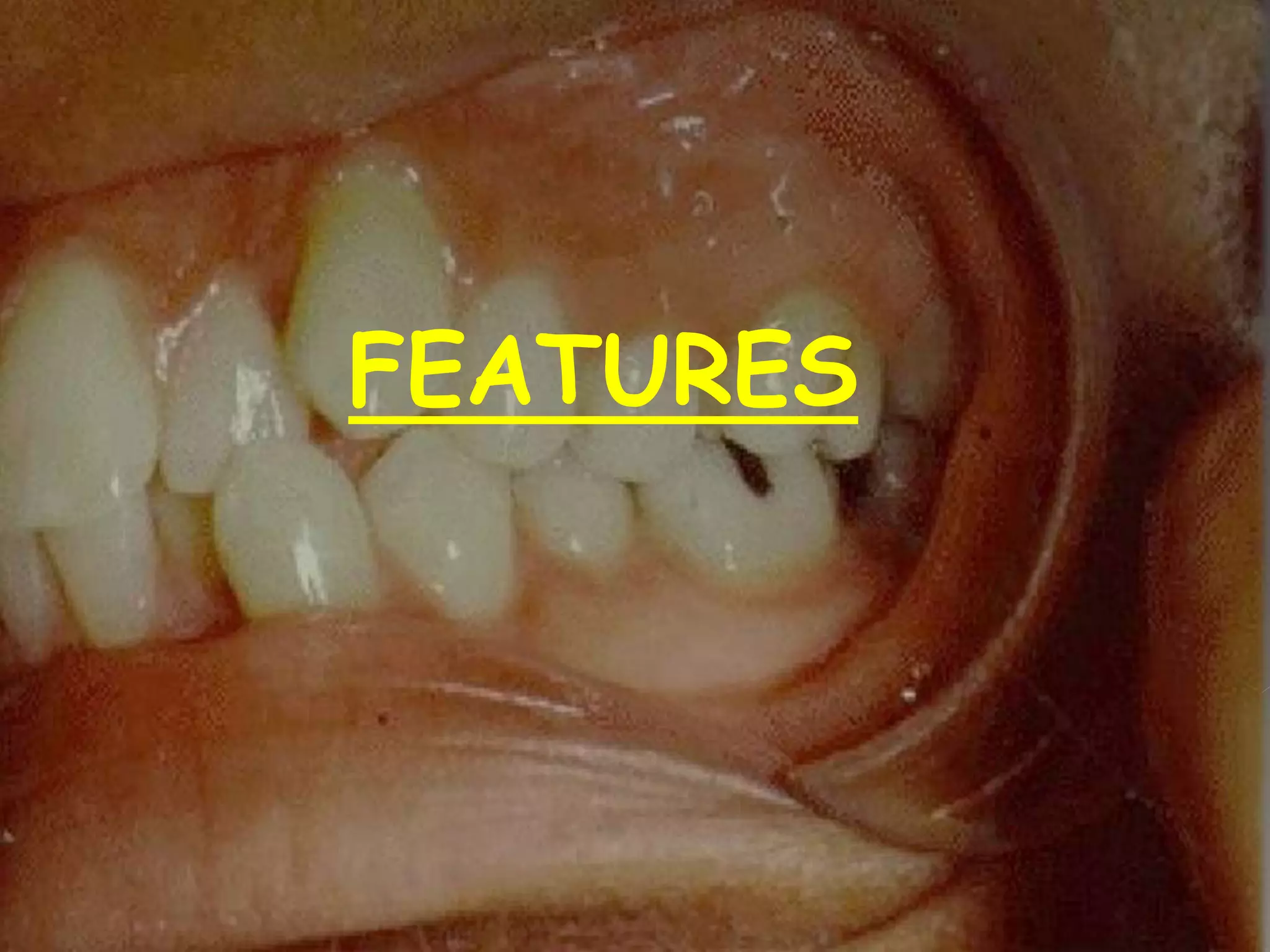
FEATURES
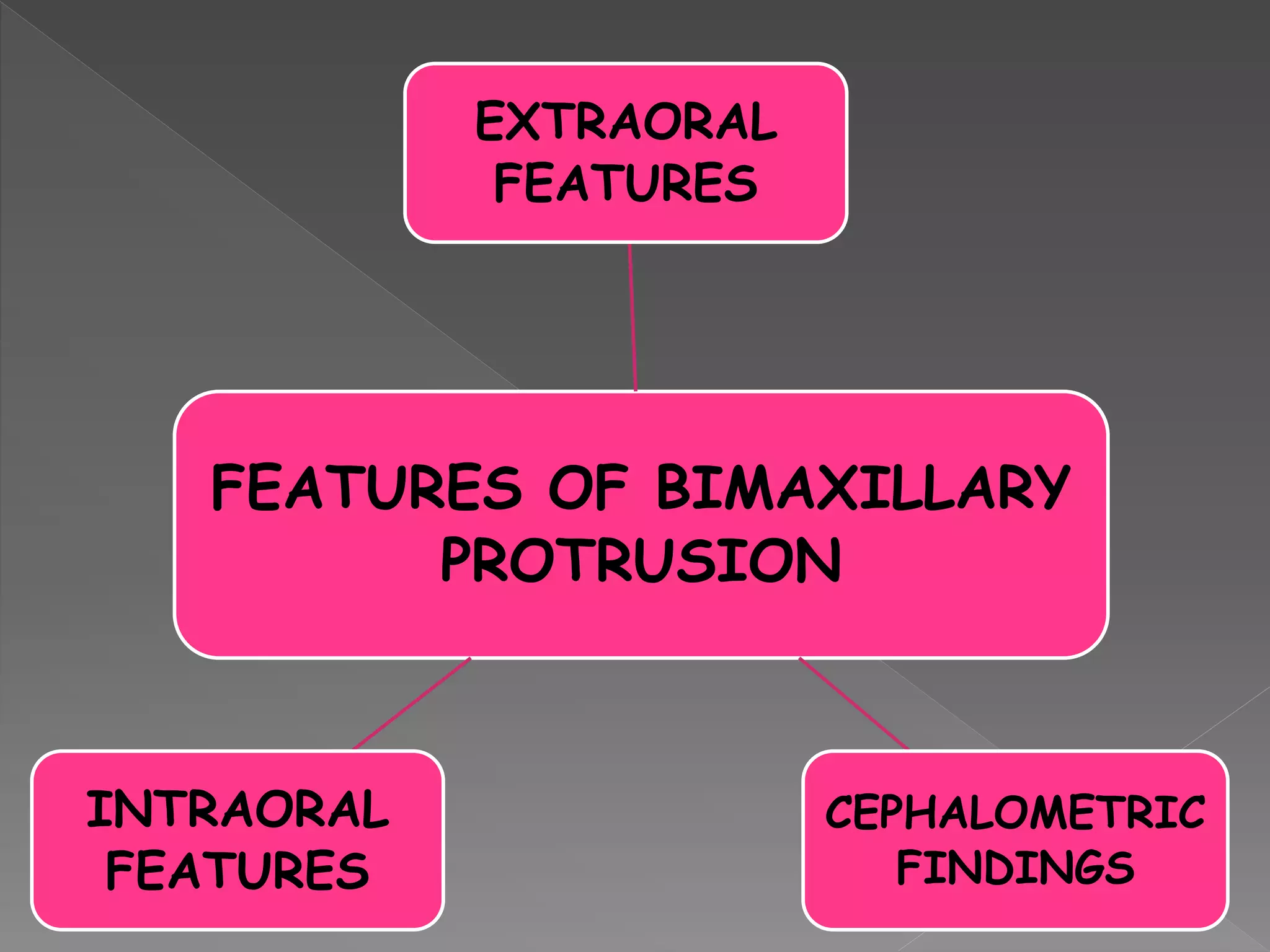
FEATURES OF BIMAXILLARY
PROTRUSION
EXTRAORAL
FEATURES
CEPHALOMETRIC
FINDINGS
INTRAORAL
FEATURES
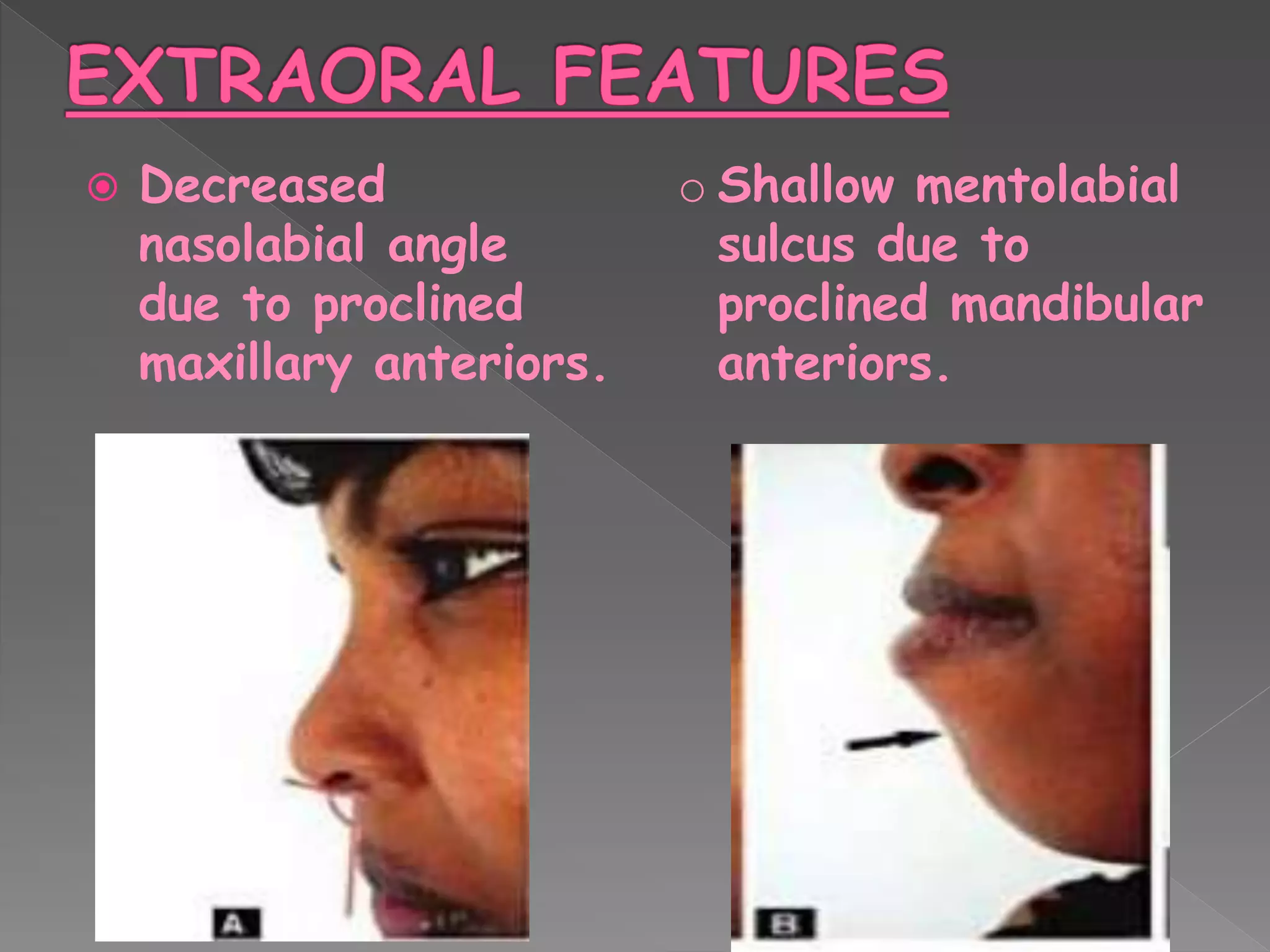
 Decreased
nasolabial angle
due to proclined
maxillary anteriors.
o Shallow mentolabial
sulcus due to
proclined mandibular
anteriors.
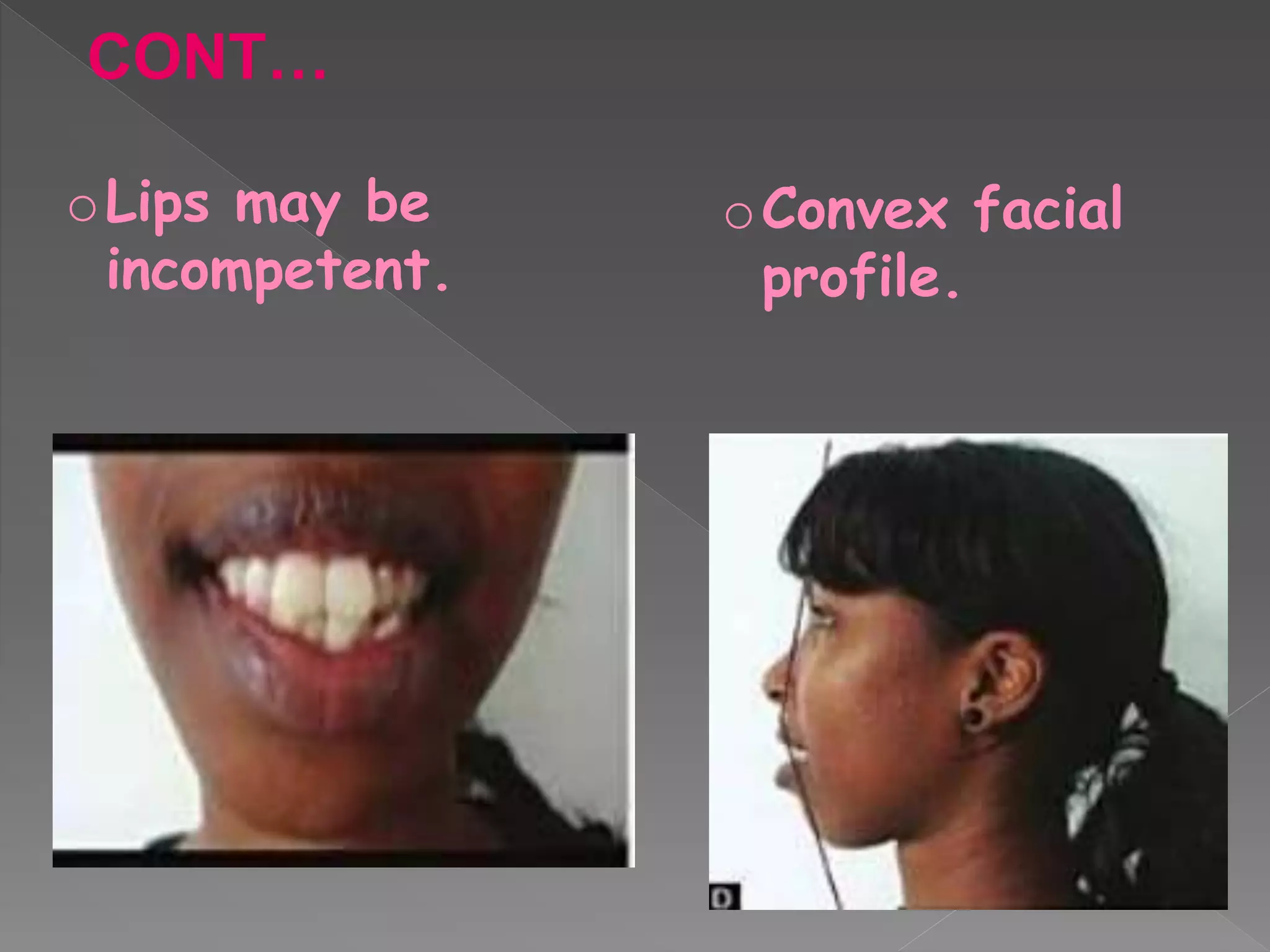
oLips may be
incompetent.
oConvex facial
profile.
CONT…
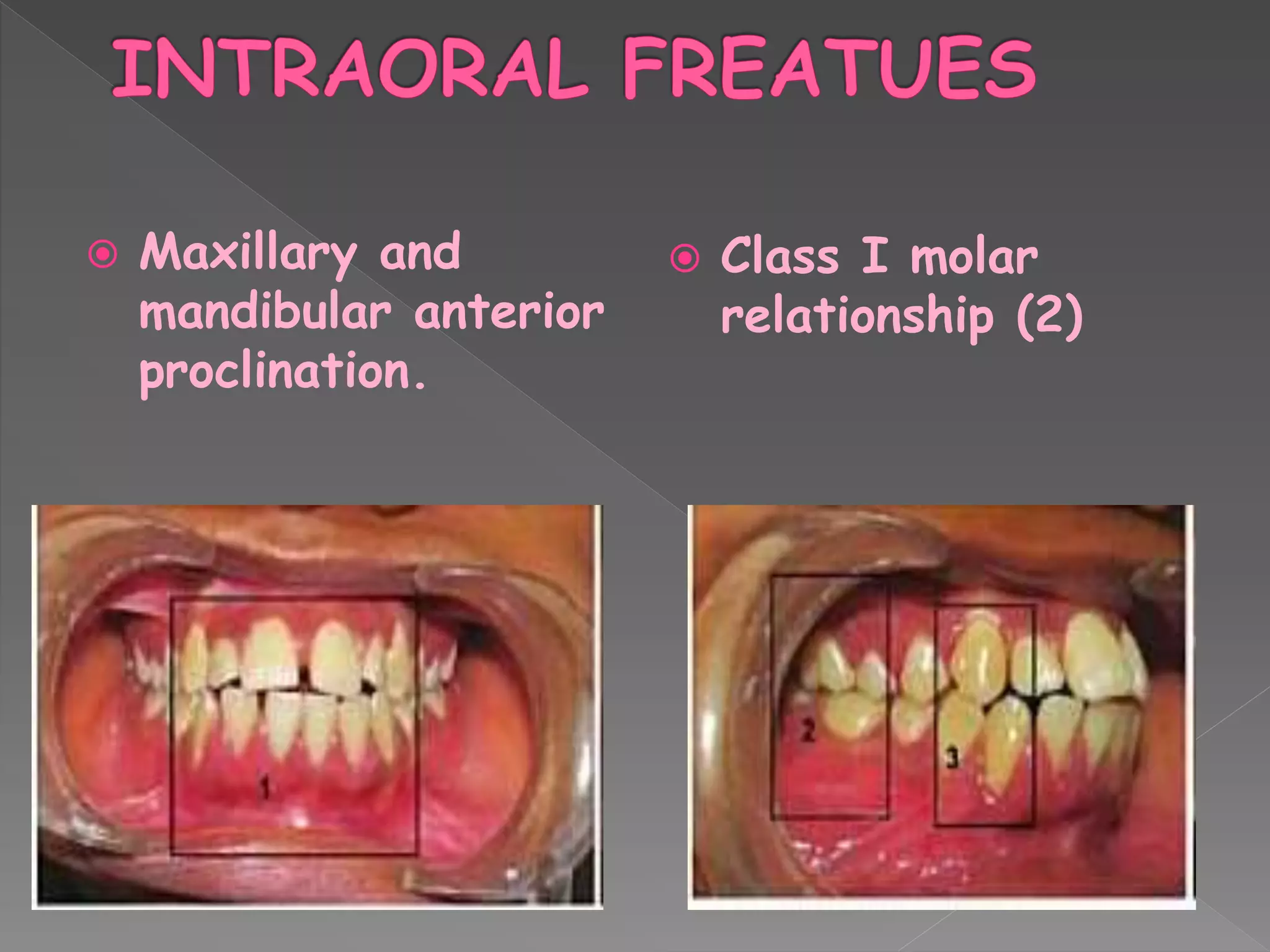
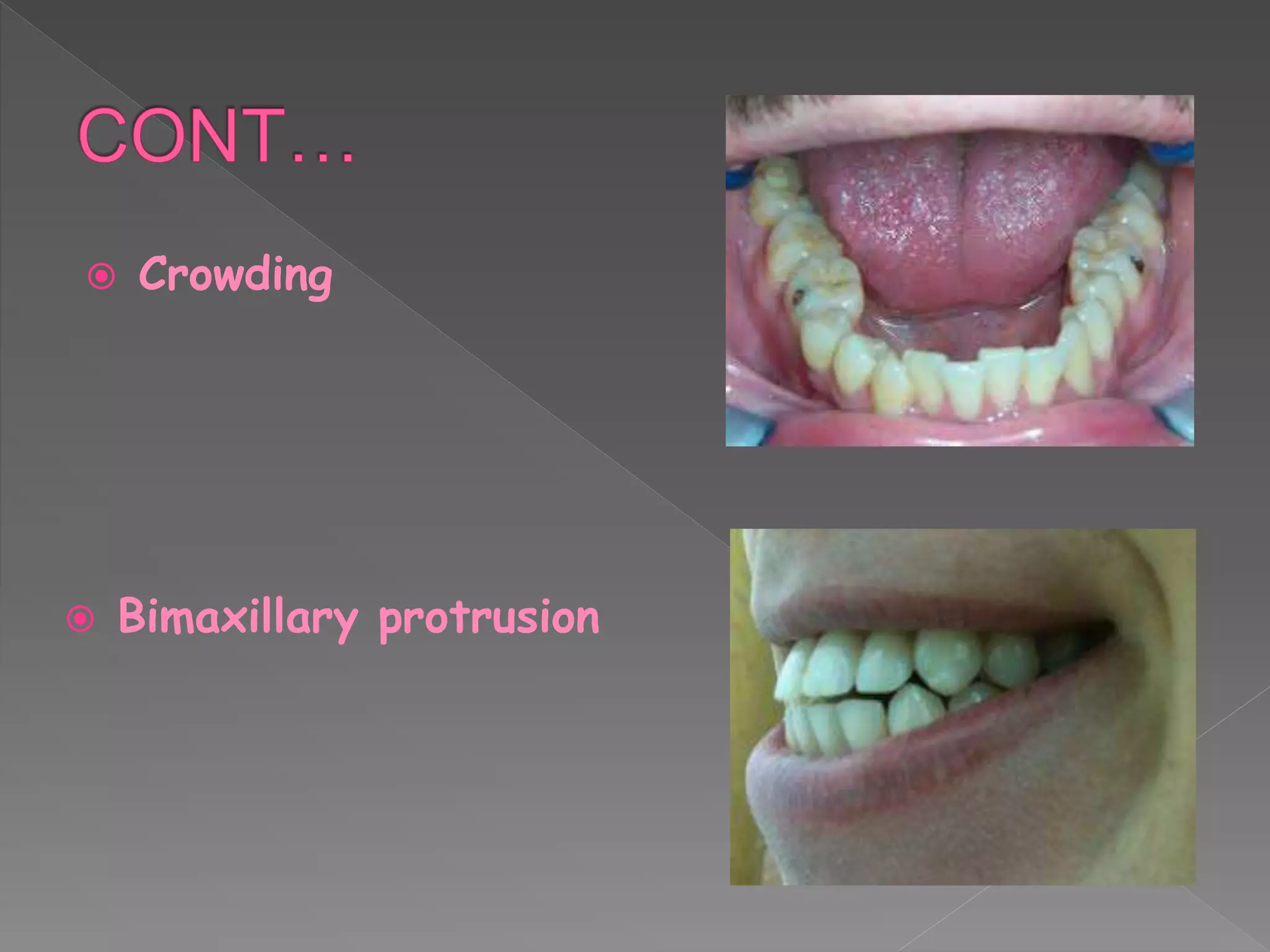
 Maxillary and
mandibular anterior
proclination.
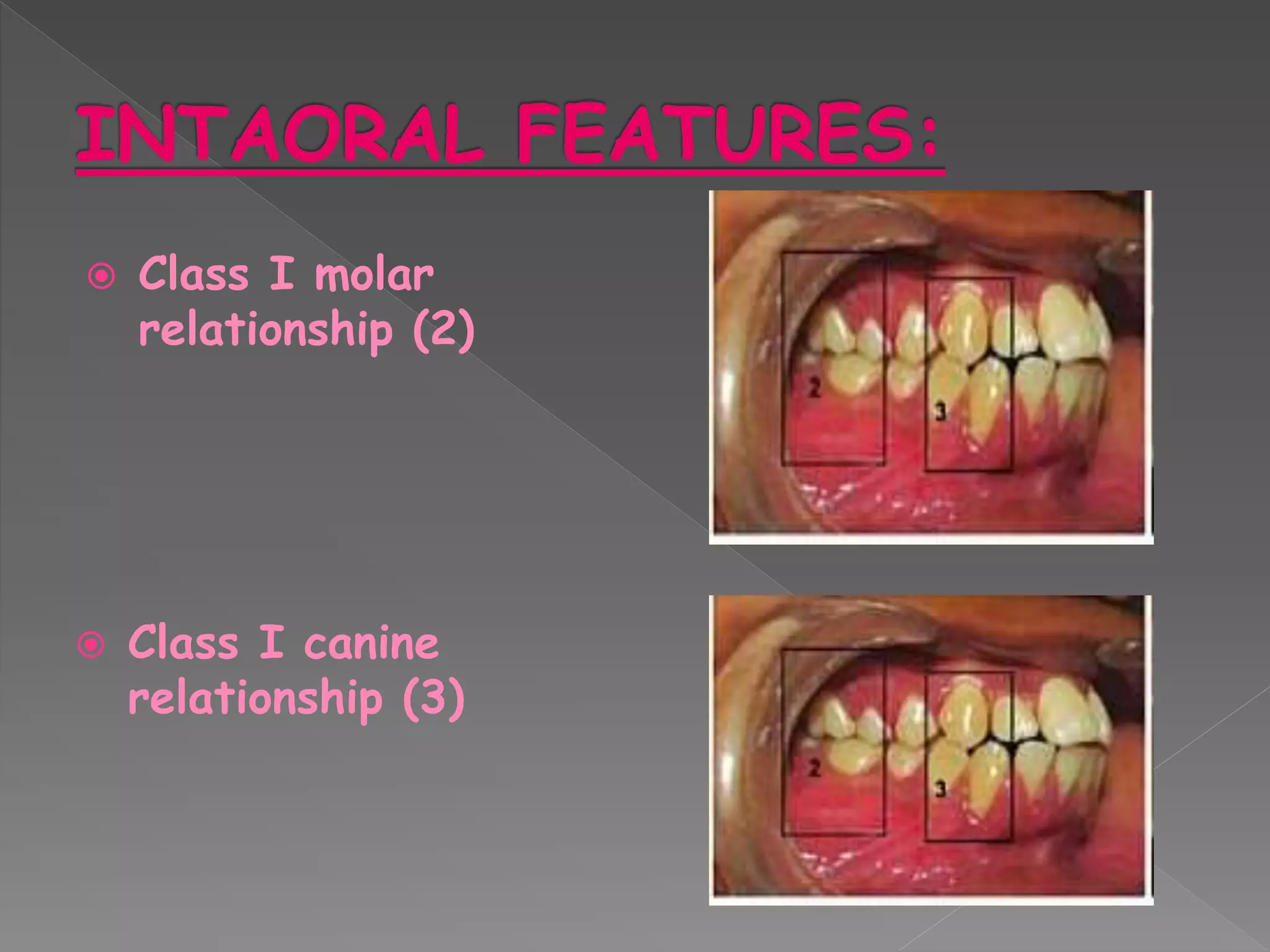
 Class I molar
relationship (2)
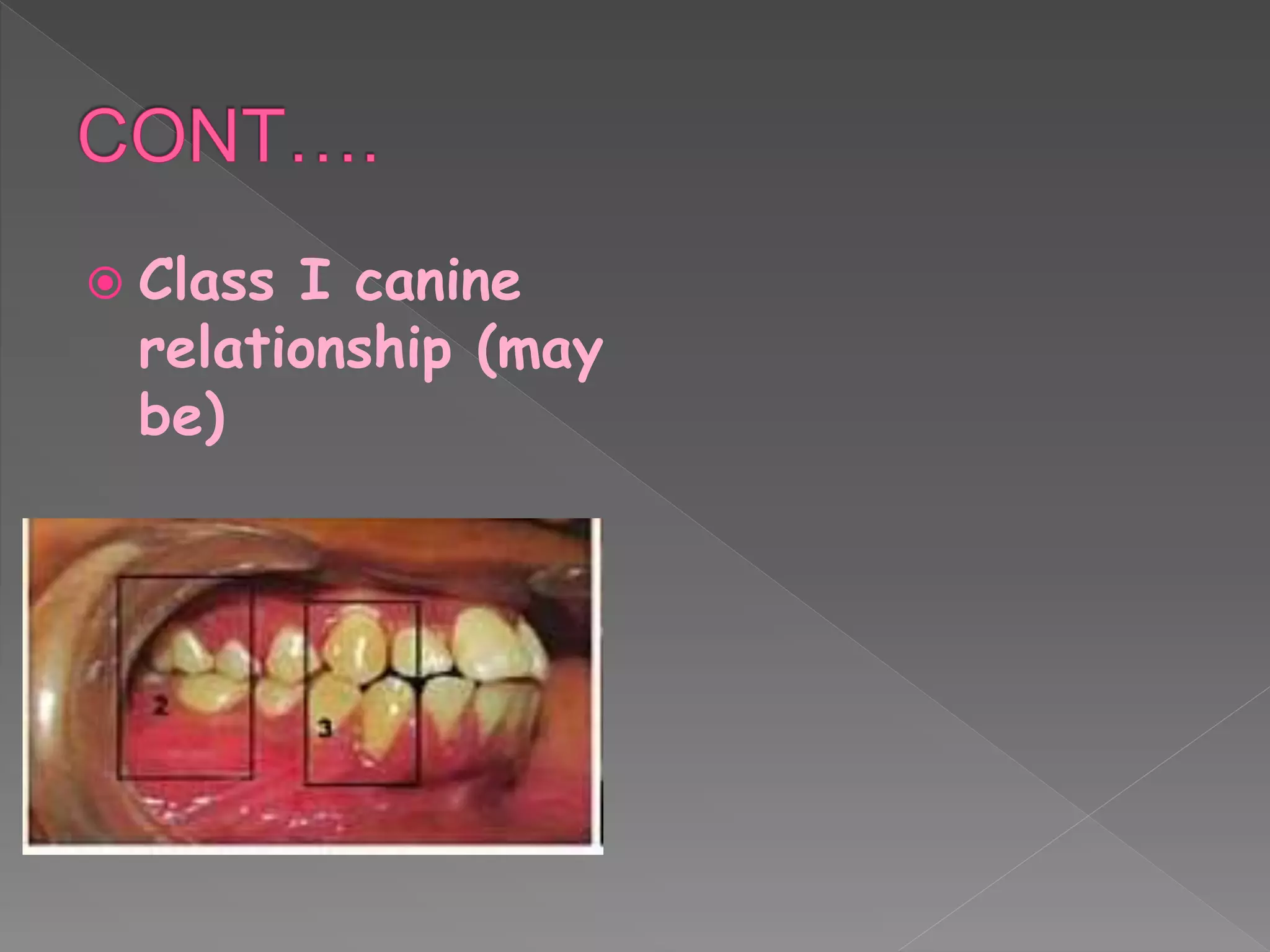
 Class I canine
relationship (may
be)
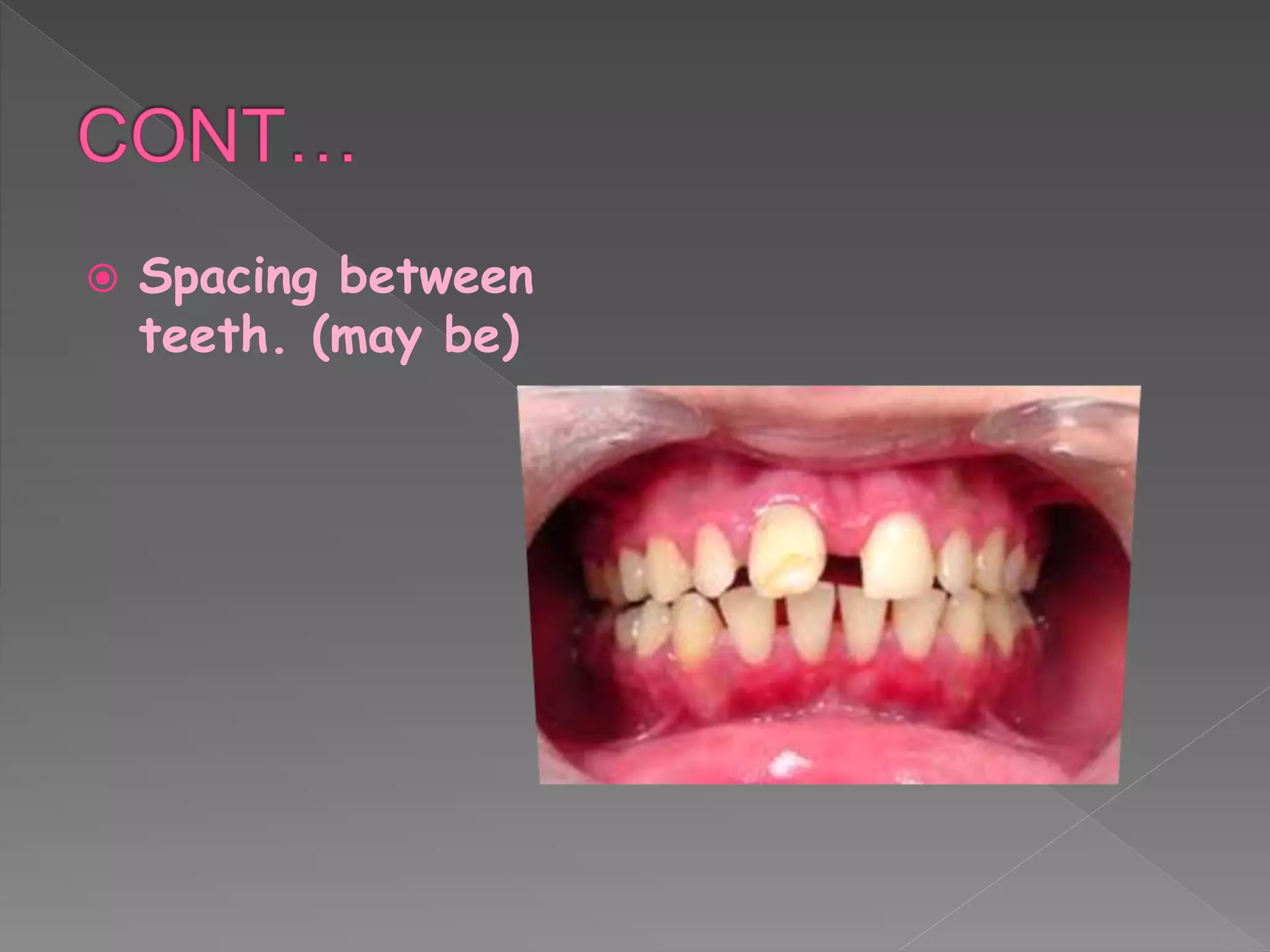
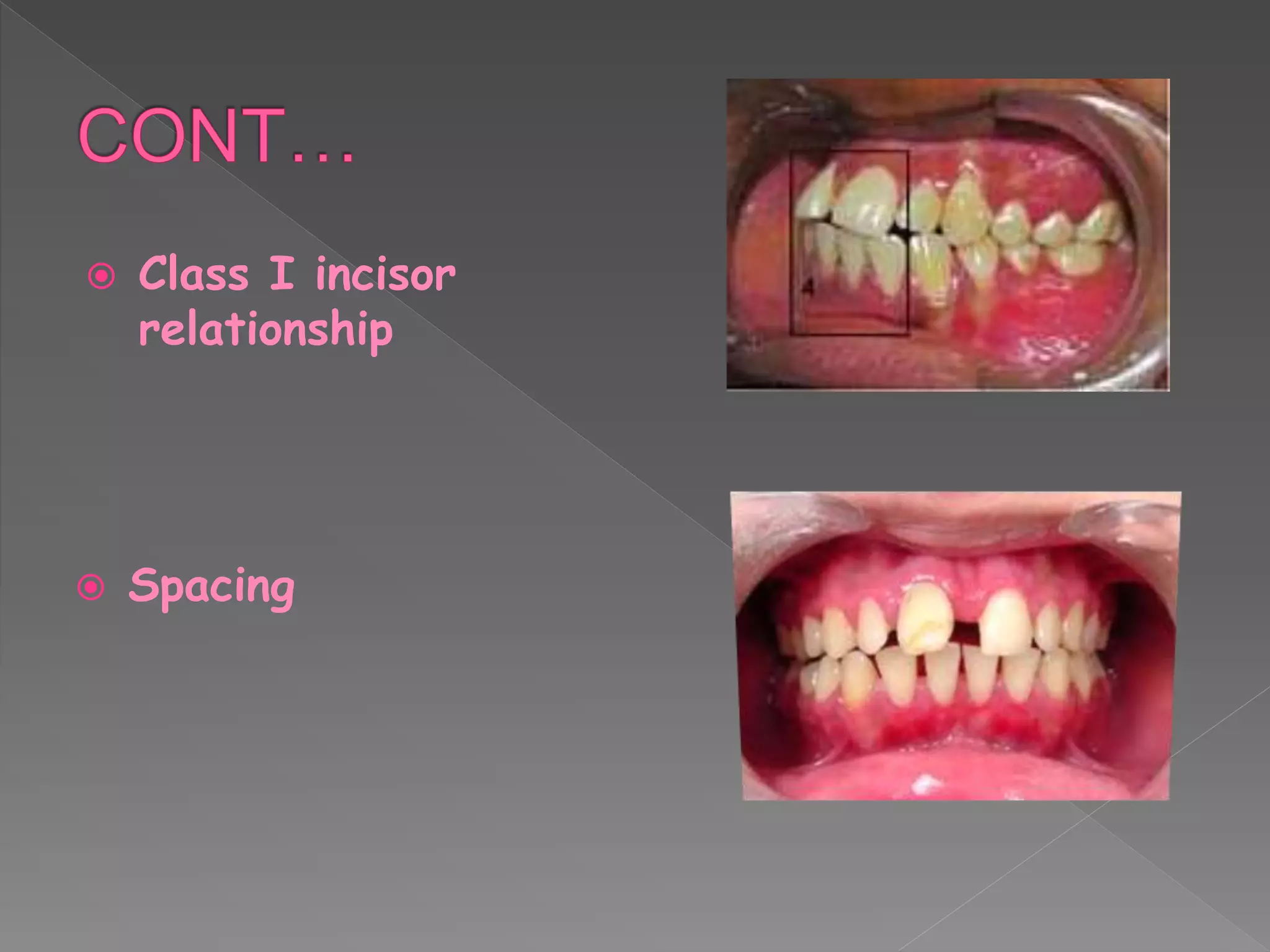
 Spacing between
teeth. (may be)
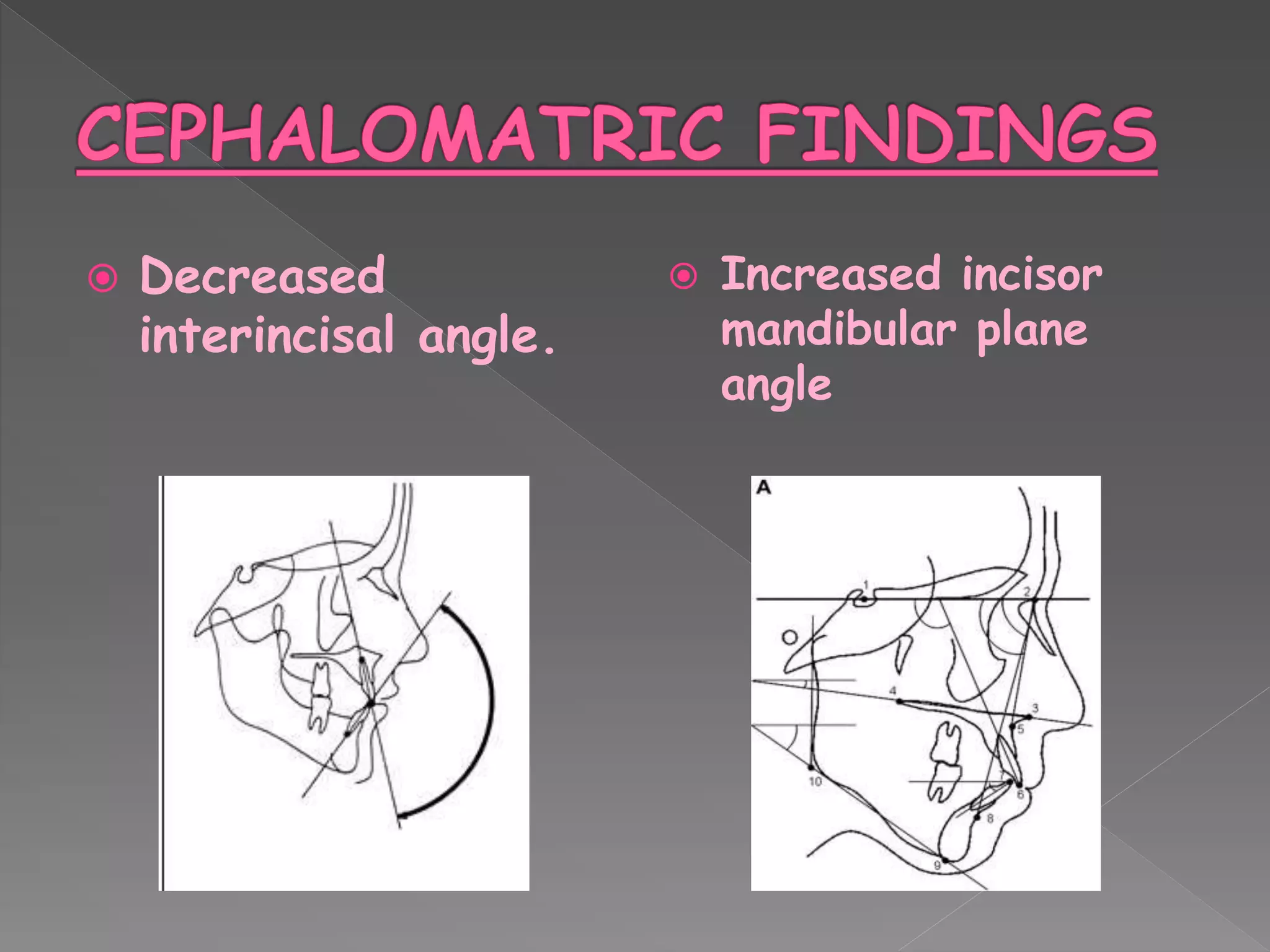
 Decreased
interincisal angle.
 Increased incisor
mandibular plane
angle
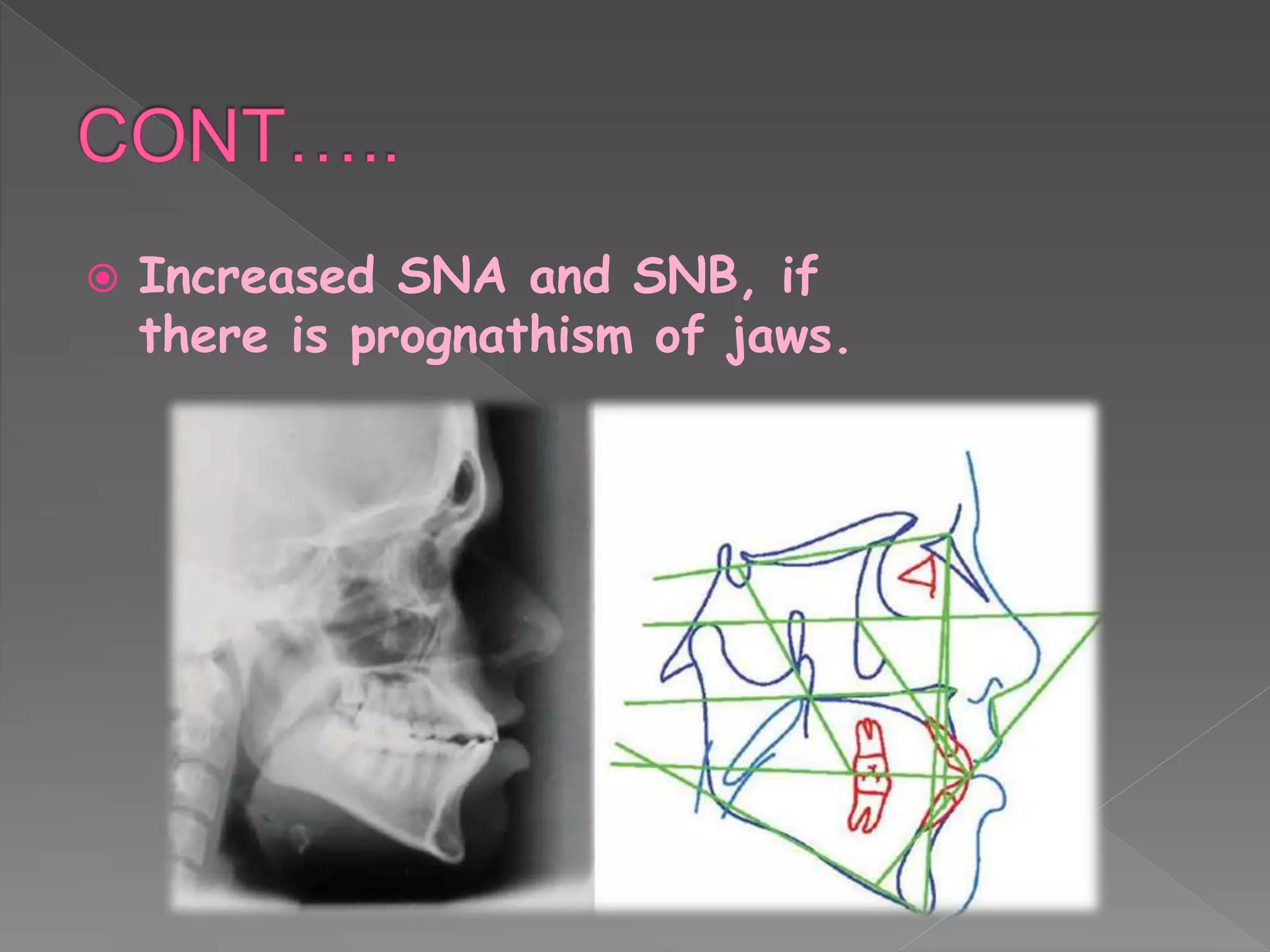
 Increased SNA and SNB, if
there is prognathism of jaws.
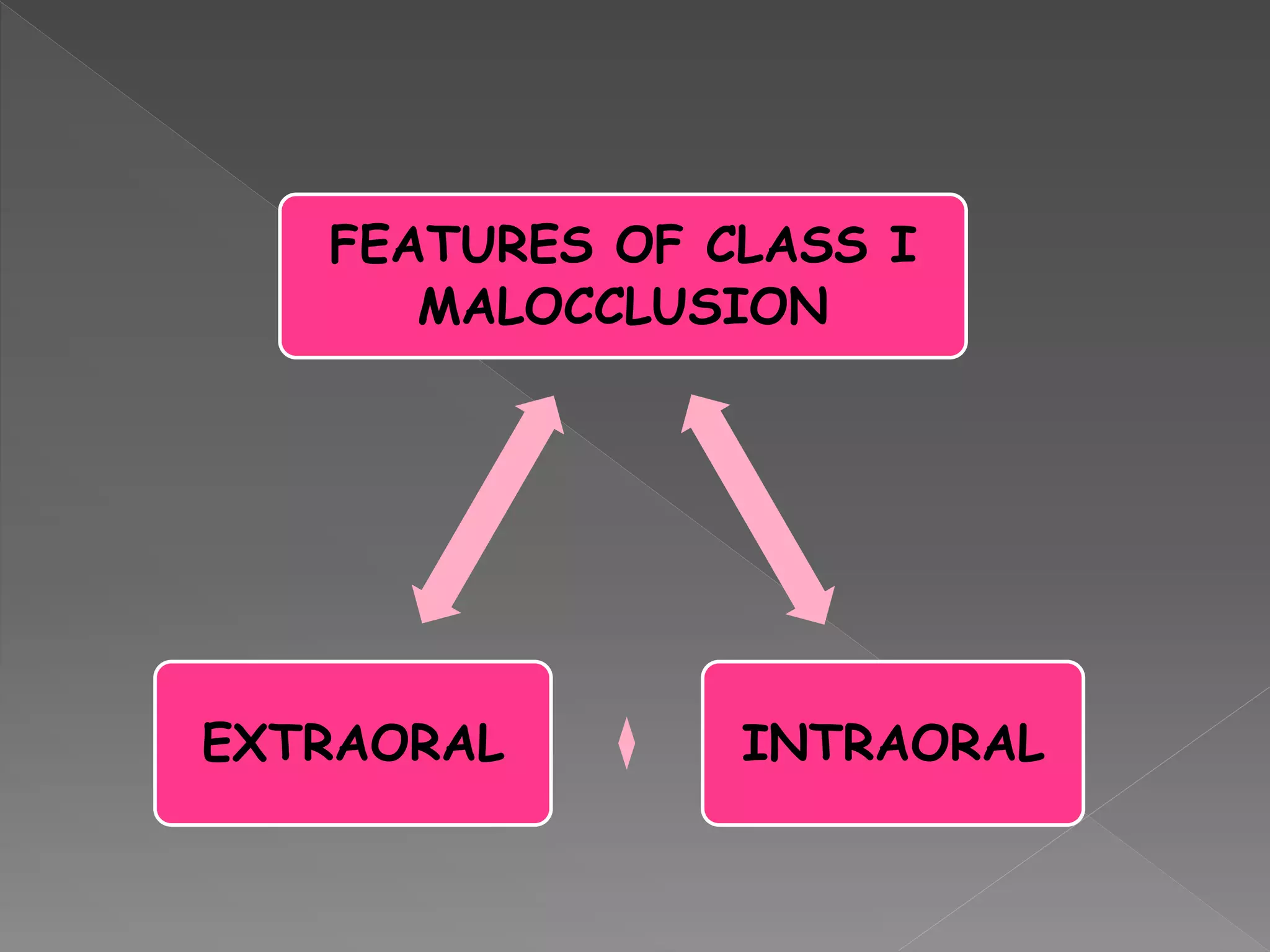
FEATURES OF CLASS I
MALOCCLUSION
INTRAORALEXTRAORAL
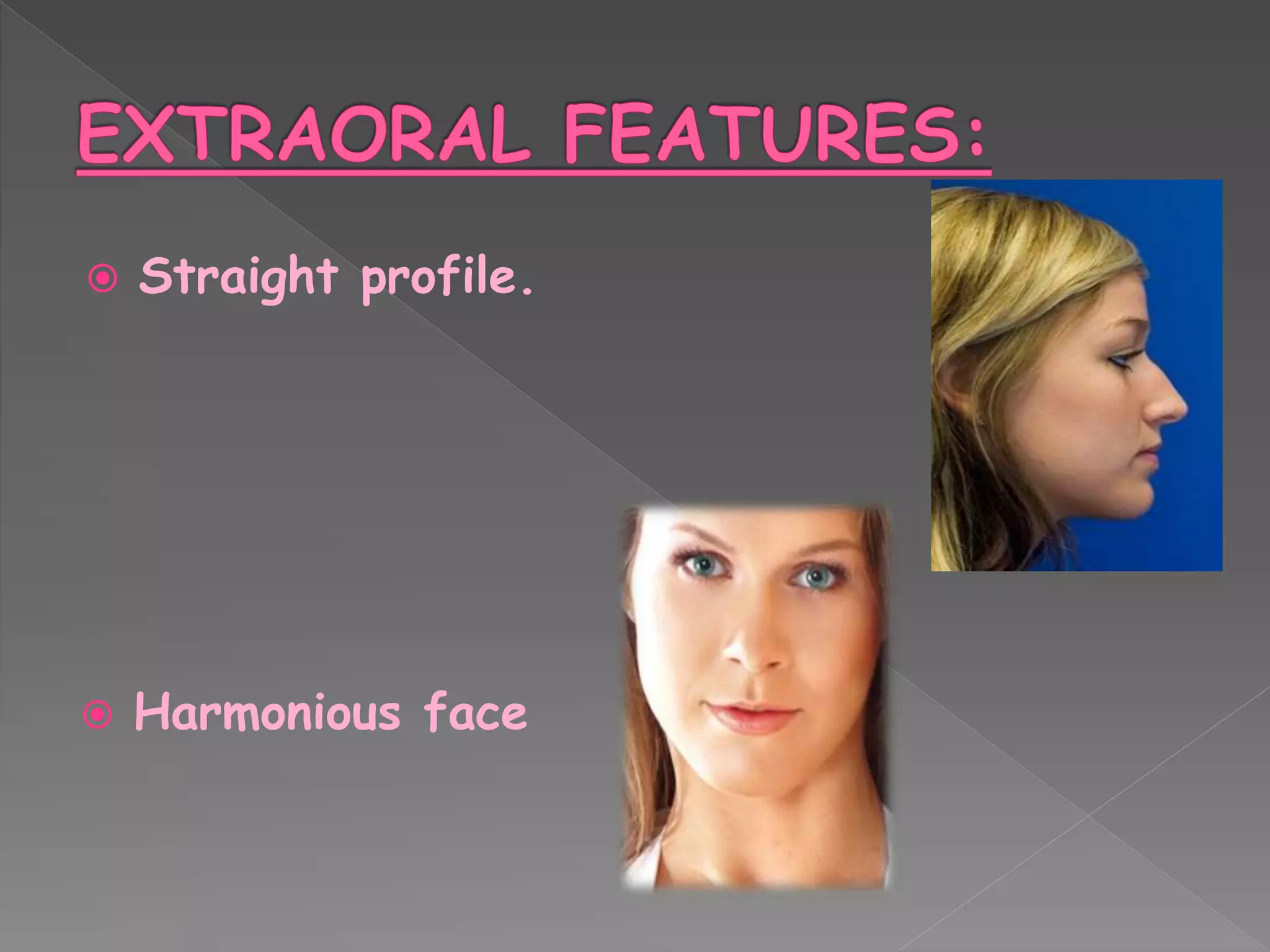
 Straight profile.
 Harmonious face
 Class I molar
relationship (2)
 Class I canine
relationship (3)
 Class I incisor
relationship
 Spacing
 Crowding
 Bimaxillary protrusion
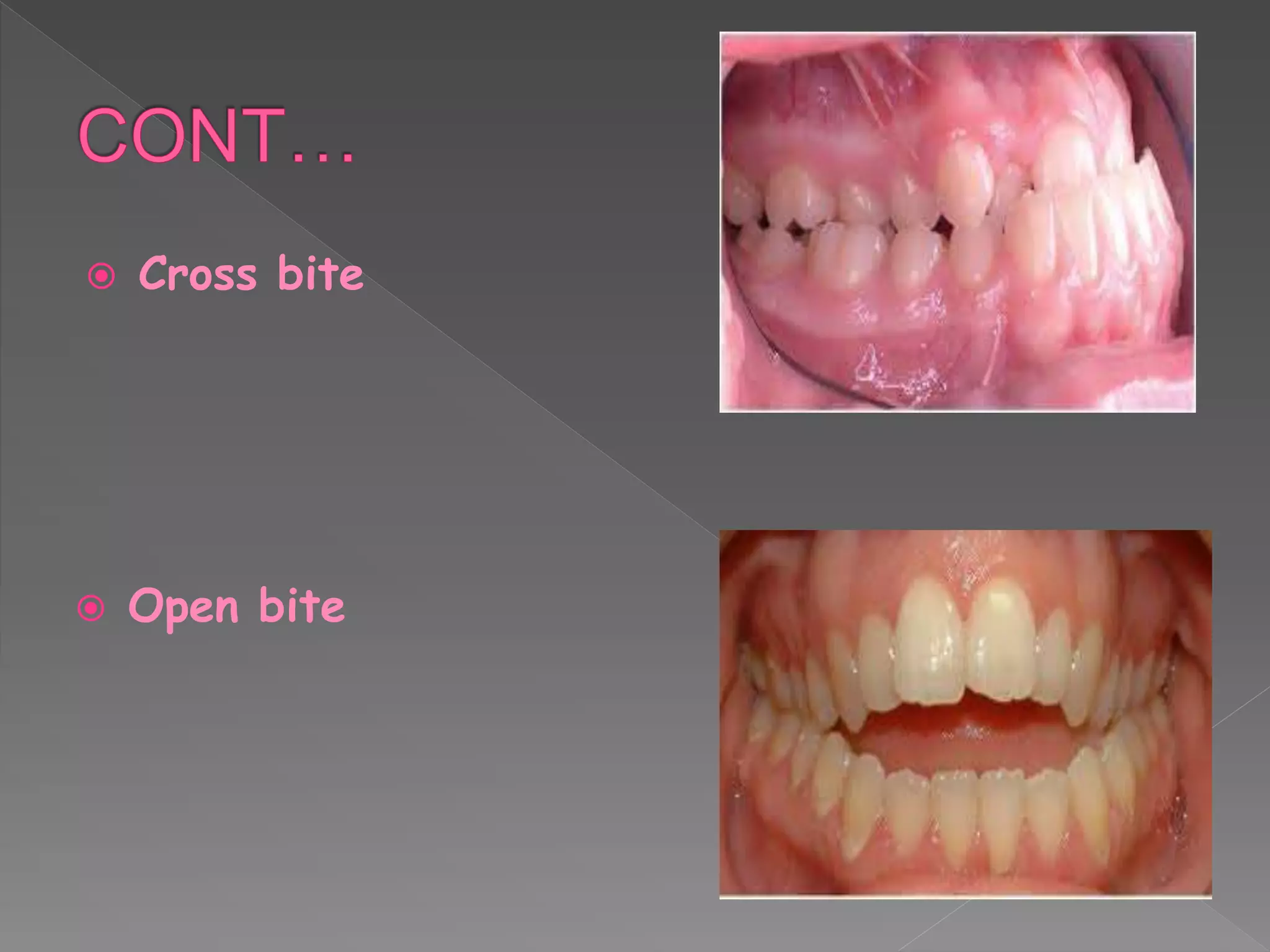
 Cross bite
 Open bite
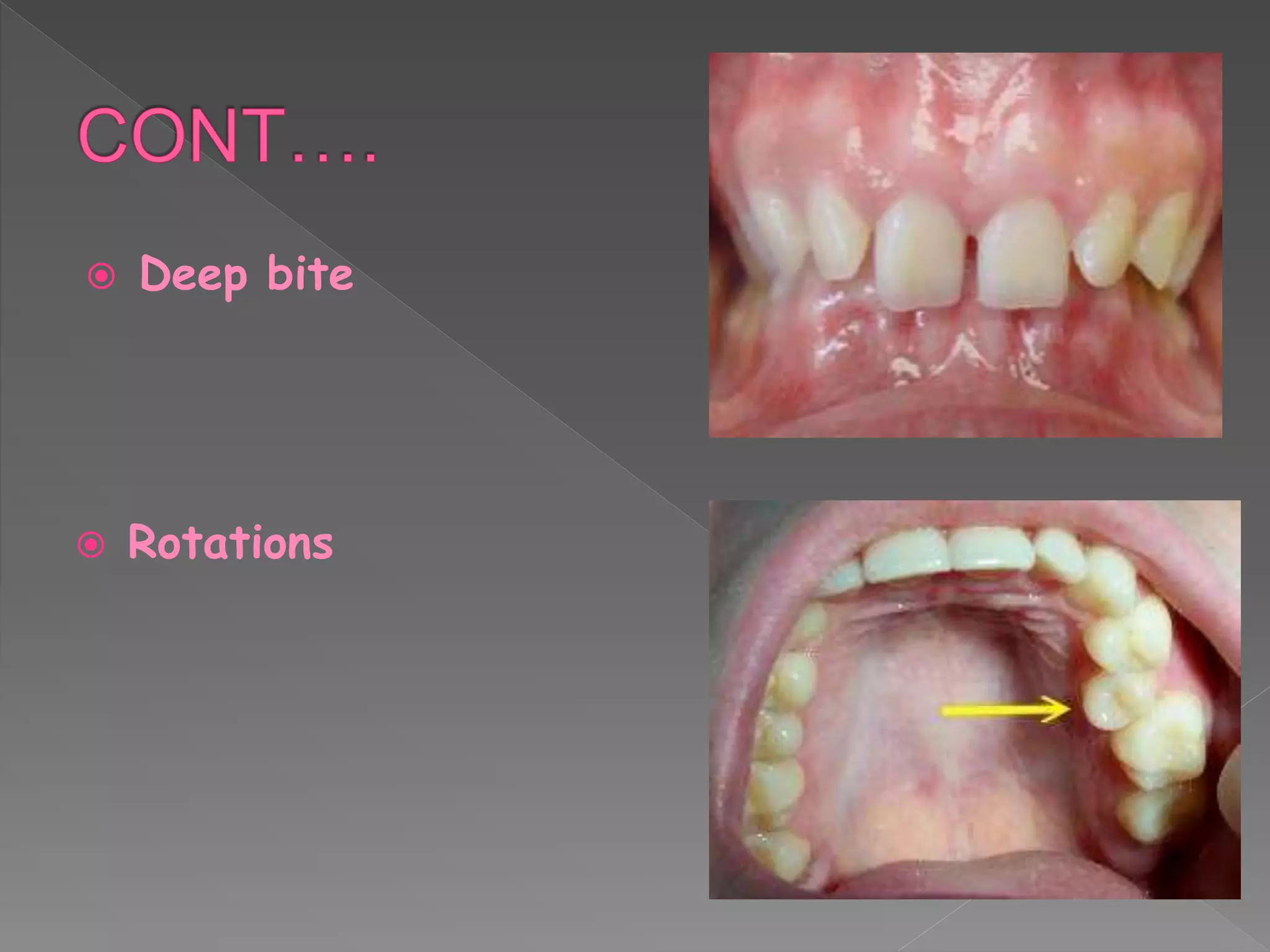
 Deep bite
 Rotations
• HISTORY
• CLINICAL EXAMINATION
• STUDY MODELS
RADIOGRAPHS:
• OPG
• LATERAL CEPHALOGRAM
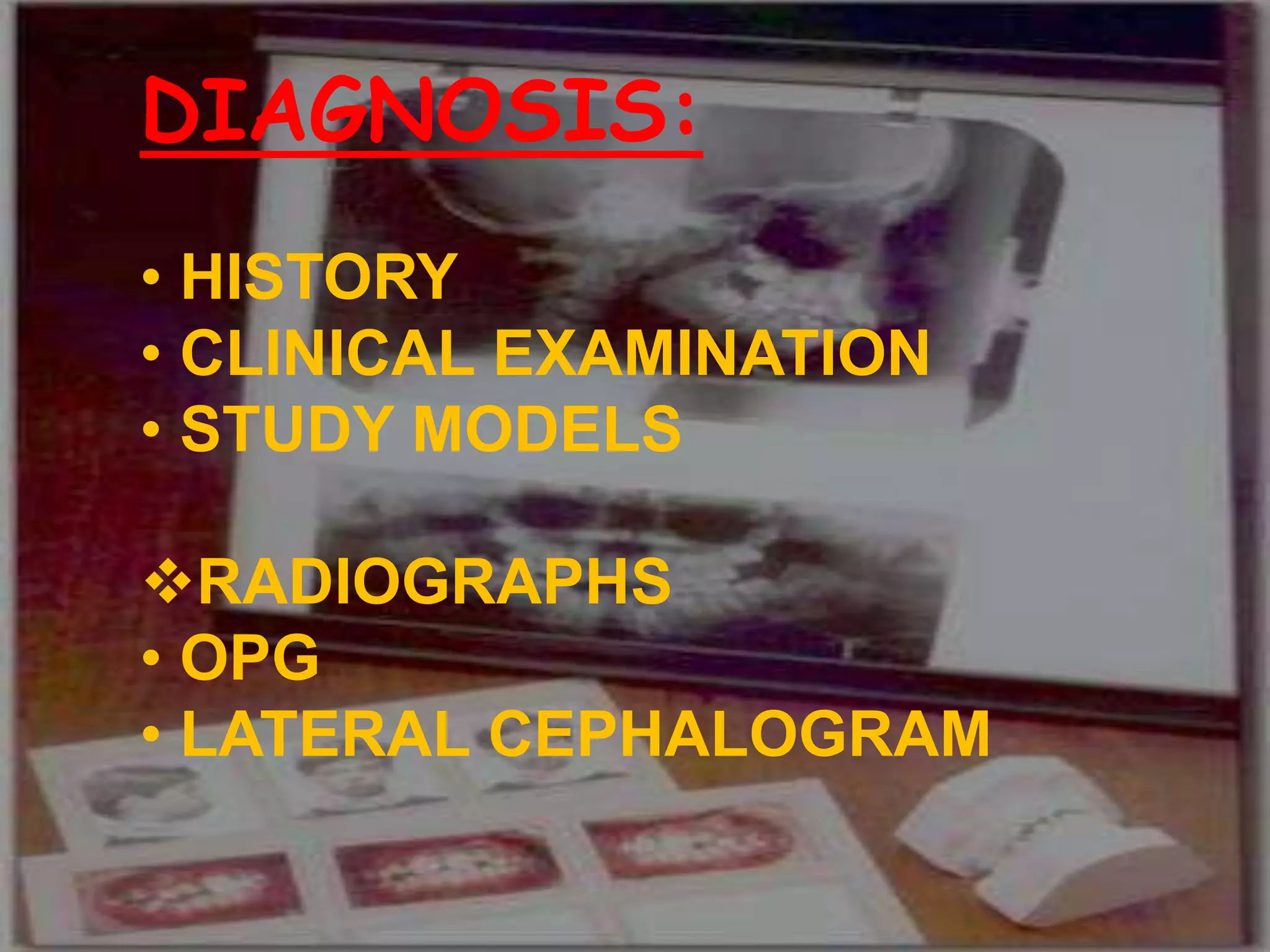
DIAGNOSIS:
• HISTORY
• CLINICAL EXAMINATION
• STUDY MODELS
RADIOGRAPHS
• OPG
• LATERAL CEPHALOGRAM
MANAGEMENT OF CLASS I
MALOCCLUSION
MANAGEMENT :
AIMED AT CORRECTION OF
DISTURBANCE IN LINE OF OCCLUSION
LEADING TO
• CROWDING
• SPACING
• OPEN BITE
• CROSS BITE
• DEEP BITE
• ROTATIONS
• BIMAXILLARY PROCLINATION
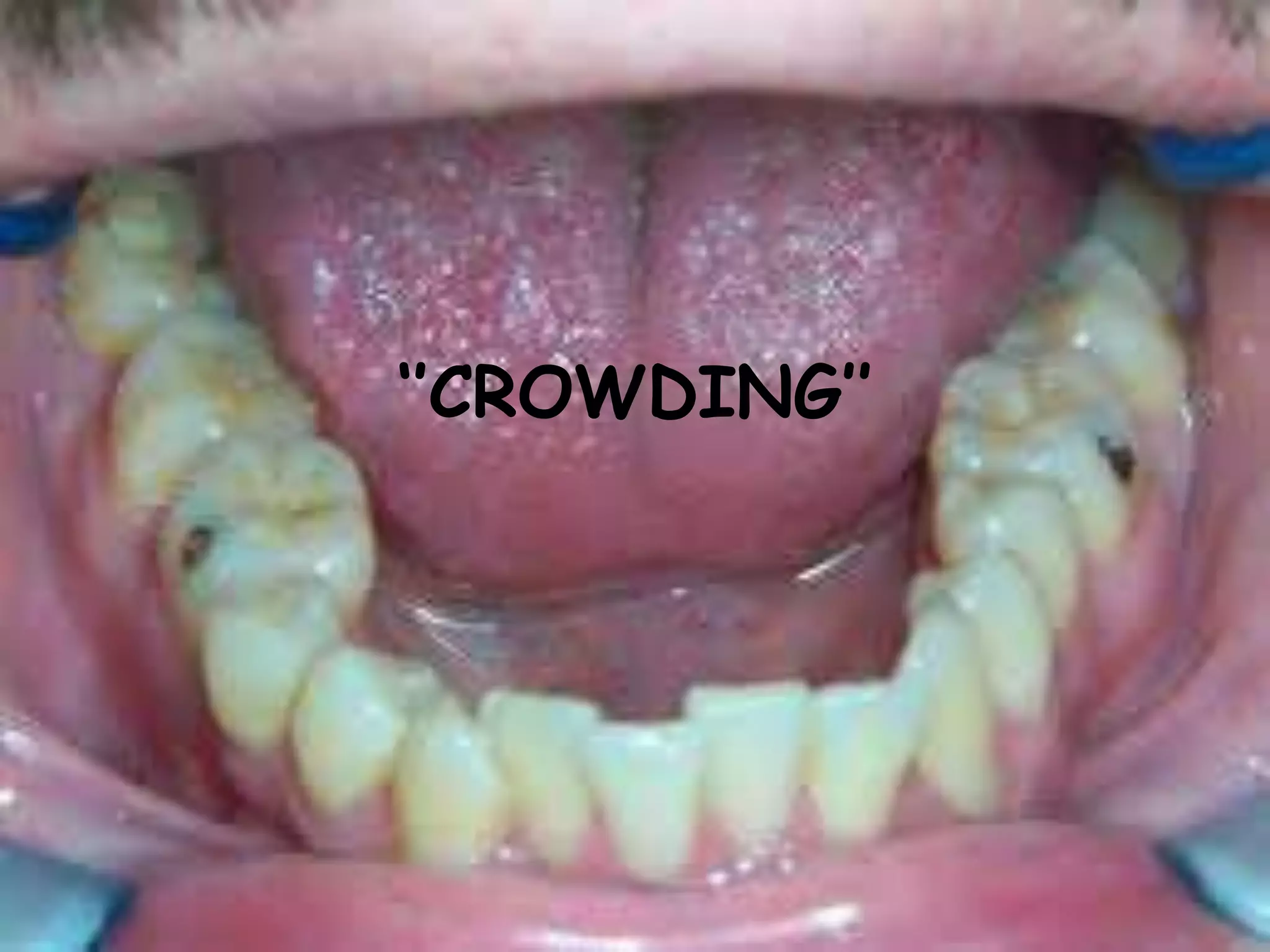
‘’CROWDING’’
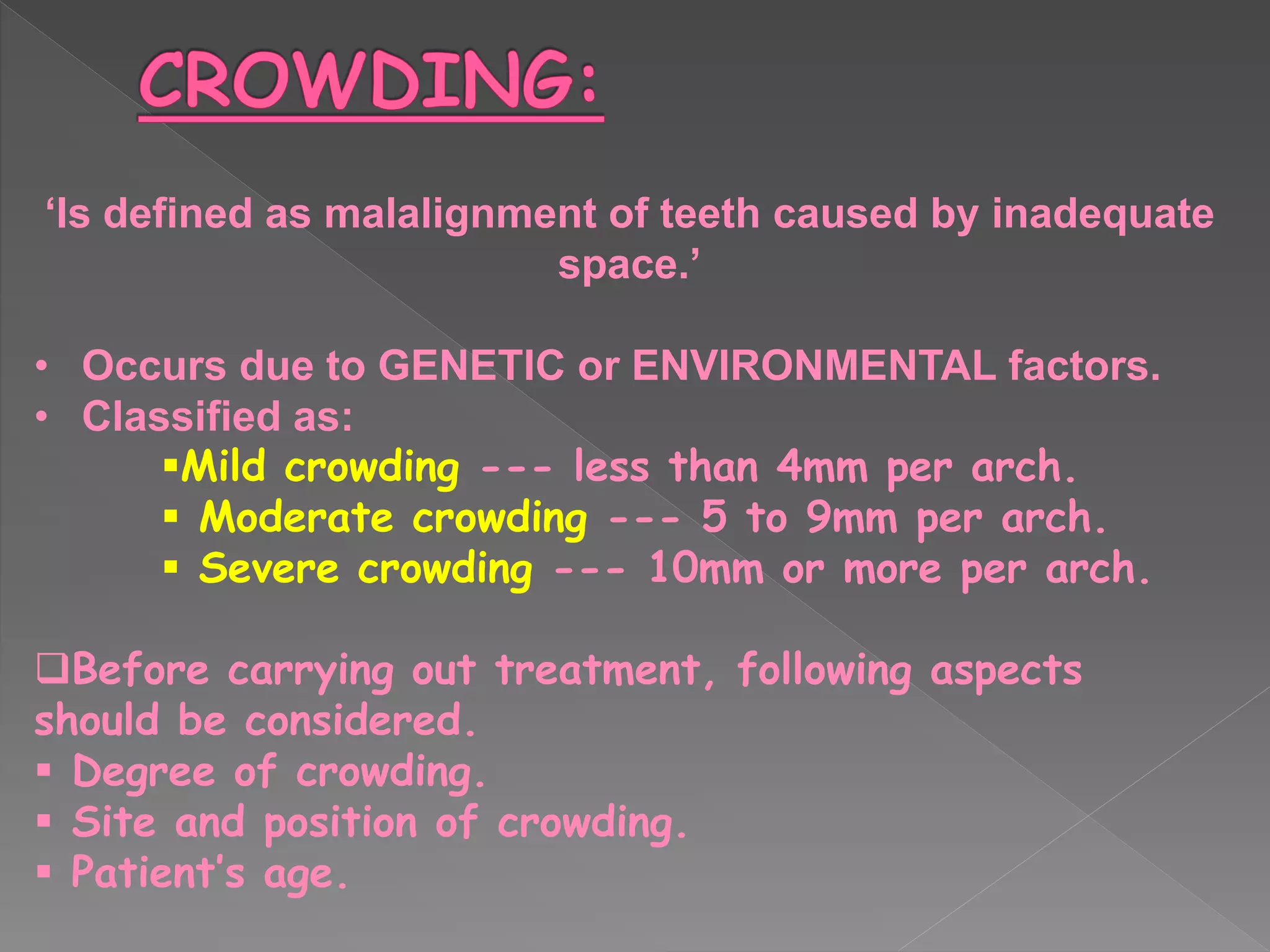
‘Is defined as malalignment of teeth caused by inadequate
space.’
• Occurs due to GENETIC or ENVIRONMENTAL factors.
• Classified as:
Mild crowding --- less than 4mm per arch.
 Moderate crowding --- 5 to 9mm per arch.
 Severe crowding --- 10mm or more per arch.
Before carrying out treatment, following aspects
should be considered.
 Degree of crowding.
 Site and position of crowding.
 Patient’s age.
• MILD CROWDING
• Resolves without extraction.
• Proximal stripping
• Alignment of teeth by labial bow or z-
spring.
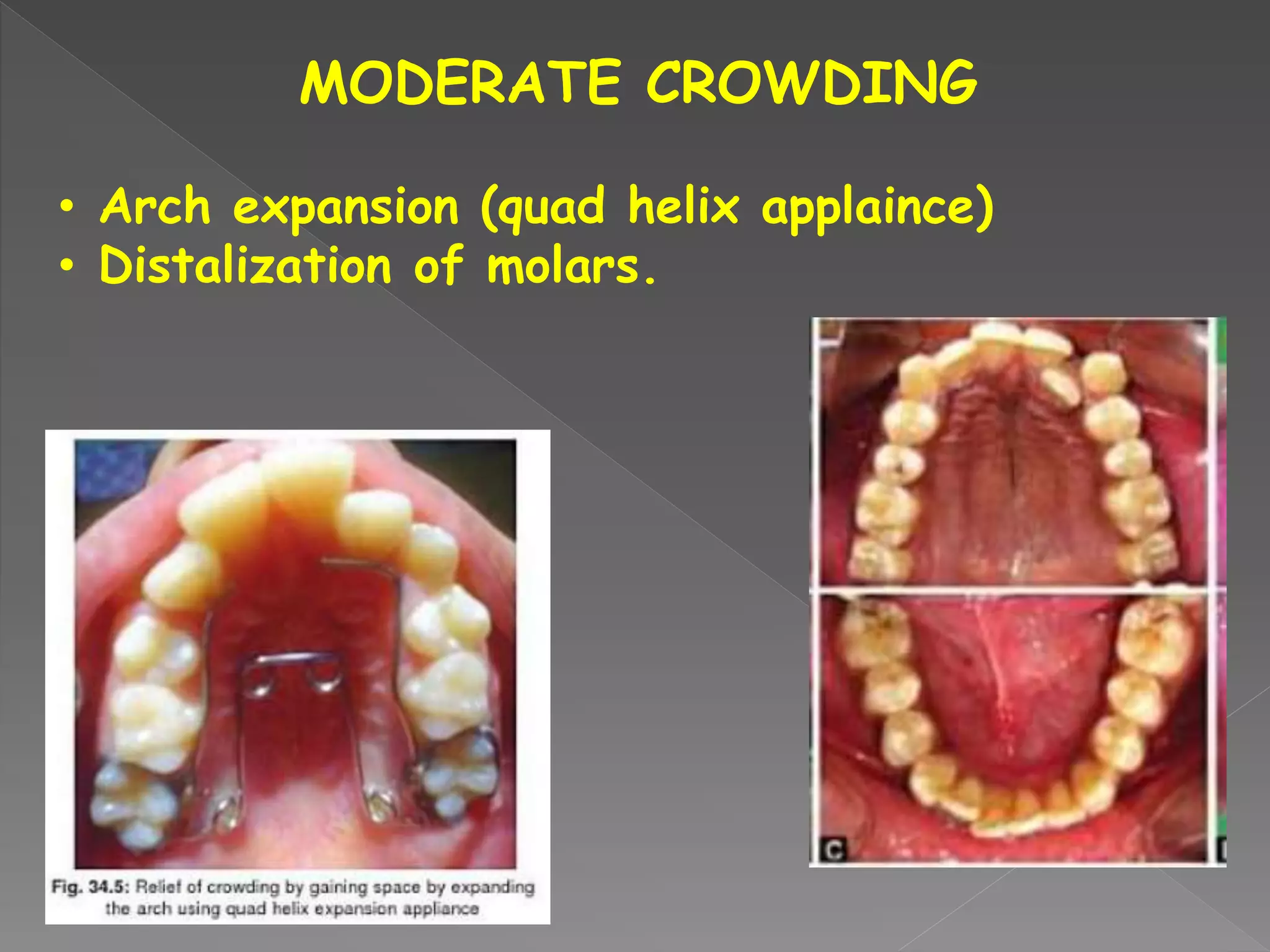
MODERATE CROWDING
• Arch expansion (quad helix applaince)
• Distalization of molars.
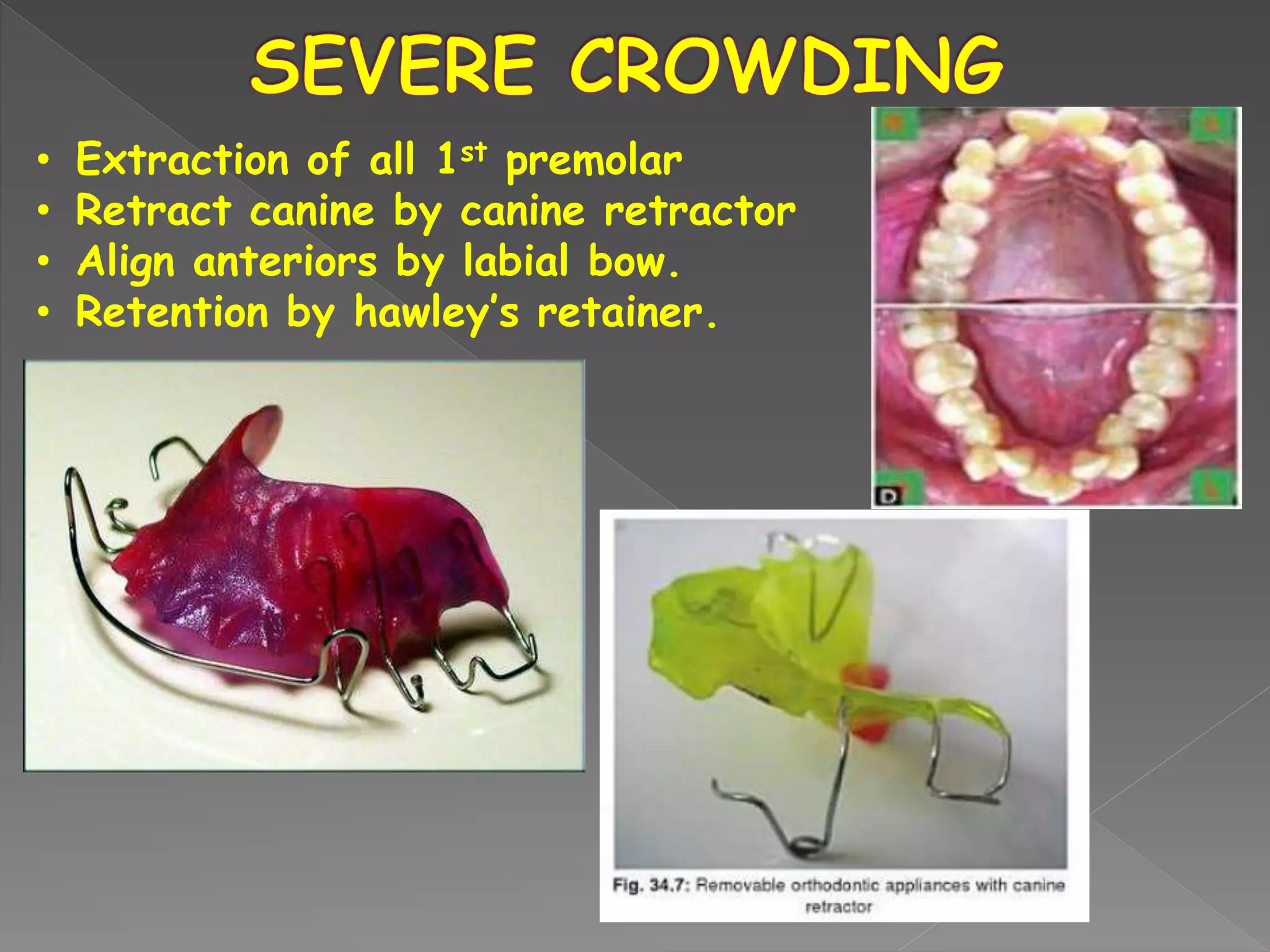
• Extraction of all 1st premolar
• Retract canine by canine retractor
• Align anteriors by labial bow.
• Retention by hawley’s retainer.
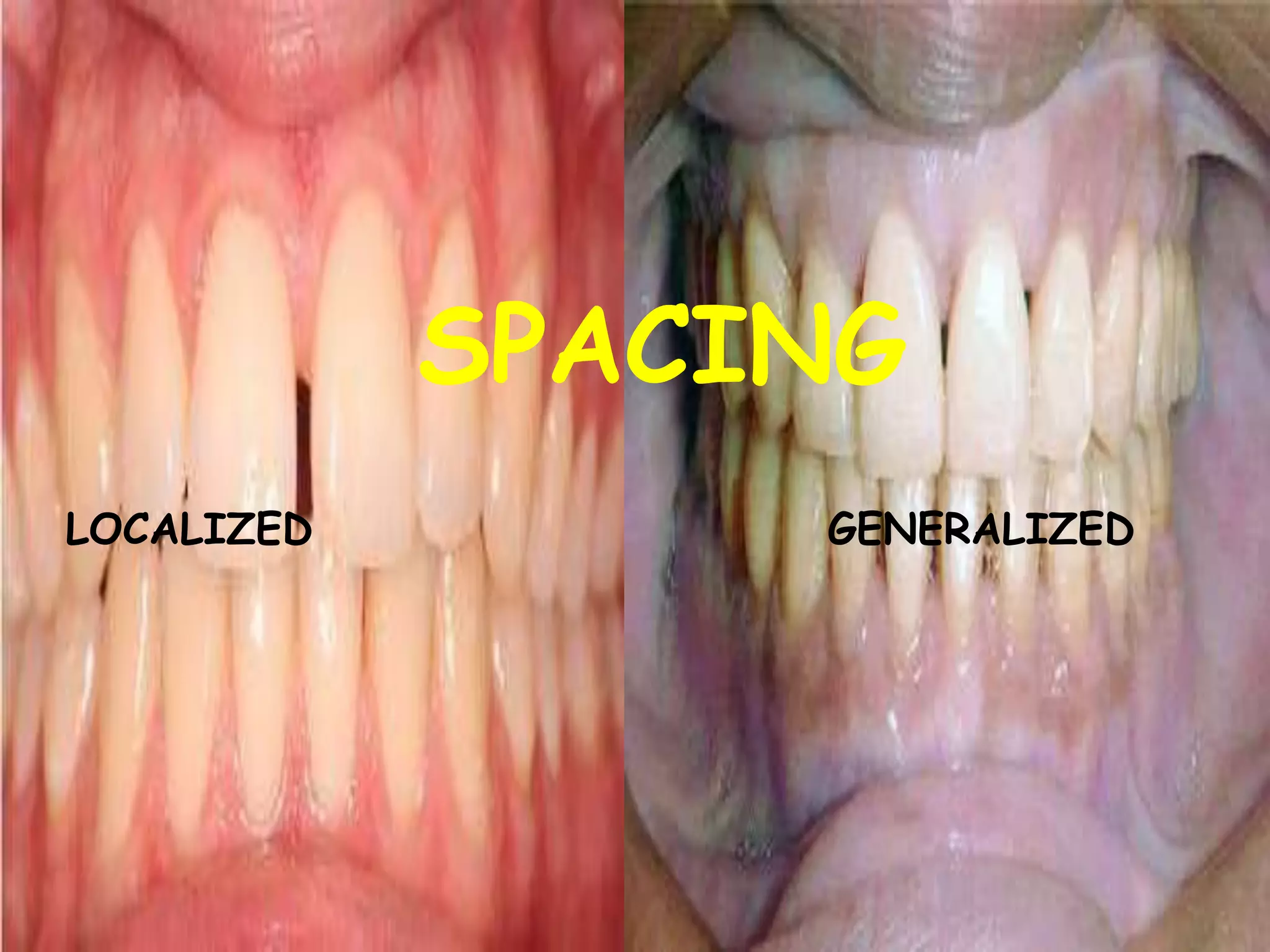
SPACING
LOCALIZED GENERALIZED
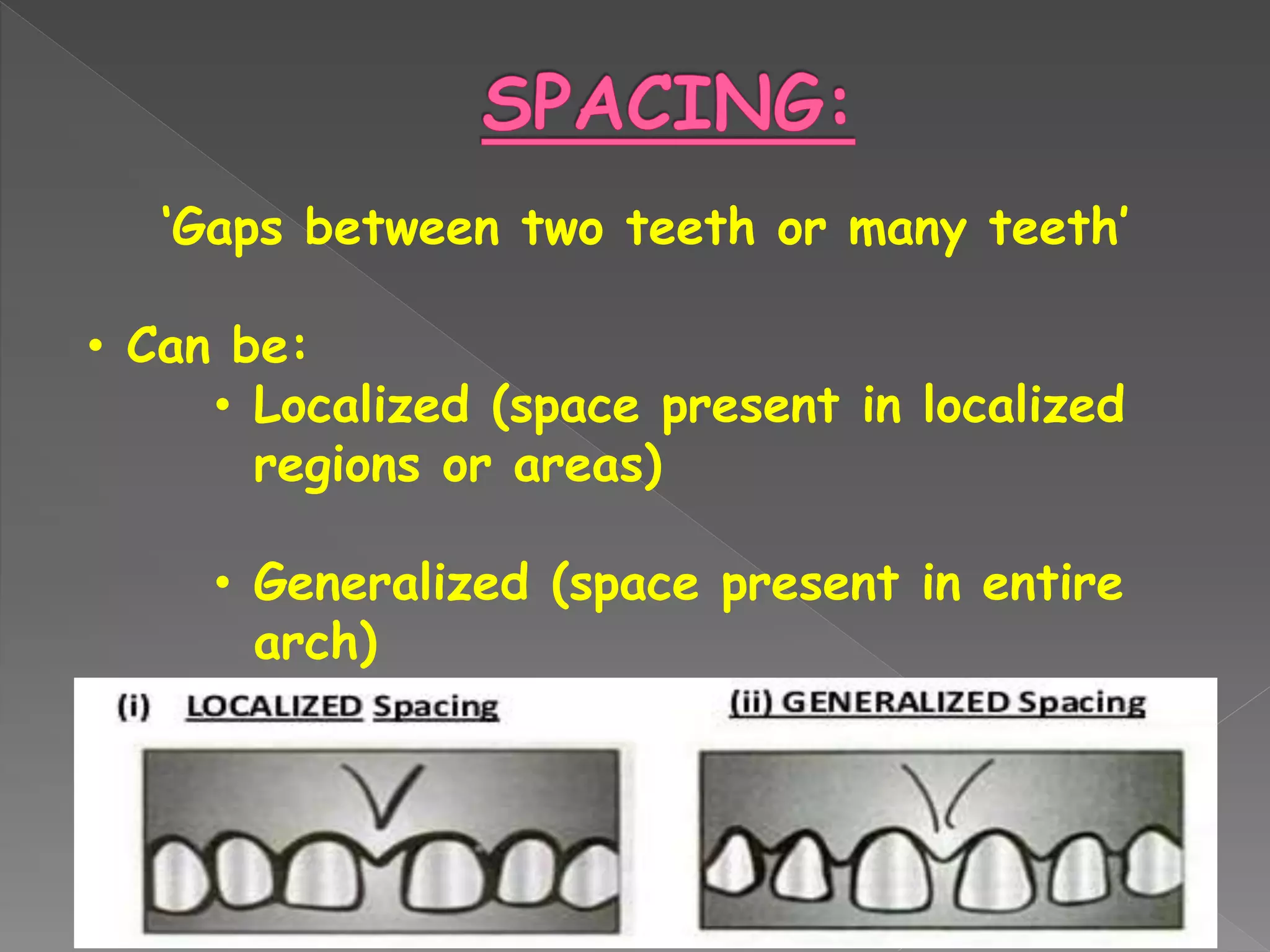
‘Gaps between two teeth or many teeth’
• Can be:
• Localized (space present in localized
regions or areas)
• Generalized (space present in entire
arch)
• Results from hypodontia along with small teeth
(microdontia) in well developed arches.
• IN CASE OF MICRODONTIA:
• Eliminate spaces between anteriors, leaving a
space between canine and 1st premolar.
• Give prosthesis or implant.
• It results from loss of tooth due to trauma, or
hypodontia or due to presence of midline diastema.
 Intervention is required in cases with:
Diastema greater than 3mm, no space for perm. lateral
incisors to erupt.
 Permanent canines have erupted, diastema still
present.
 Labial frenum has not migrated to labial attached
mucosa.
 Congenitally missing incisors.
 Presence of supernumerary teeth.
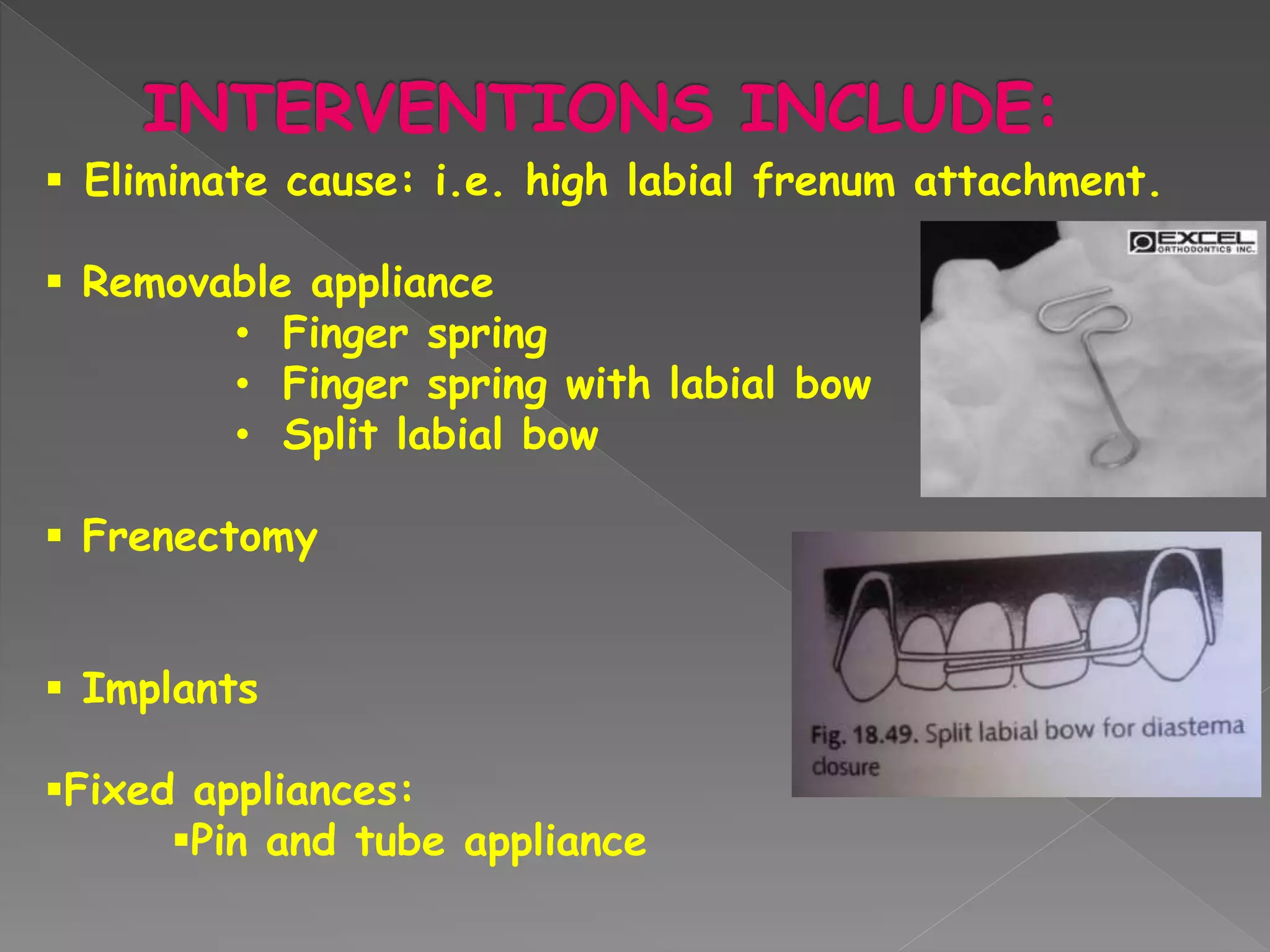
 Eliminate cause: i.e. high labial frenum attachment.
 Removable appliance
• Finger spring
• Finger spring with labial bow
• Split labial bow
 Frenectomy
 Implants
Fixed appliances:
Pin and tube appliance
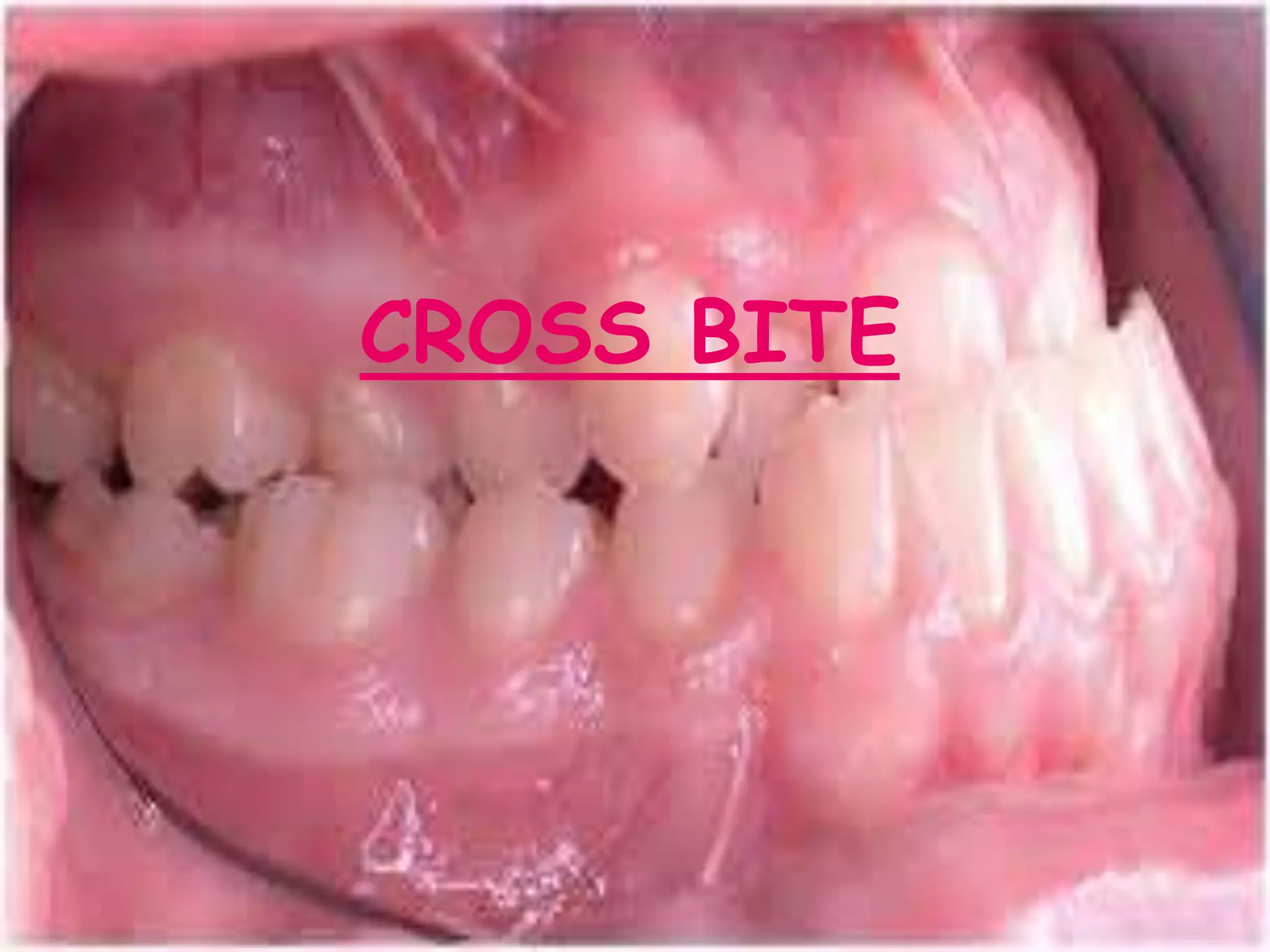
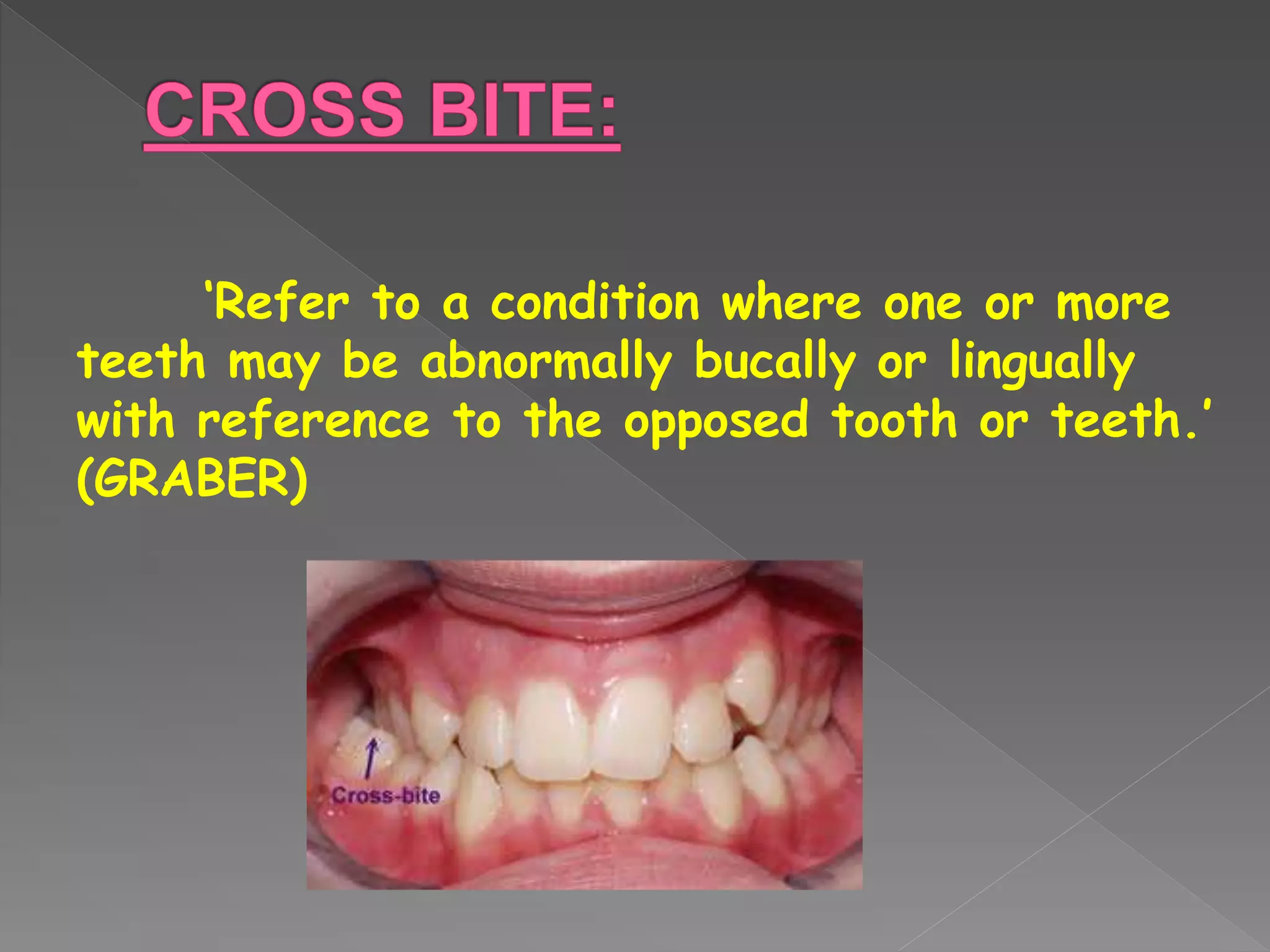
CROSS BITE
‘Refer to a condition where one or more
teeth may be abnormally bucally or lingually
with reference to the opposed tooth or teeth.’
(GRABER)
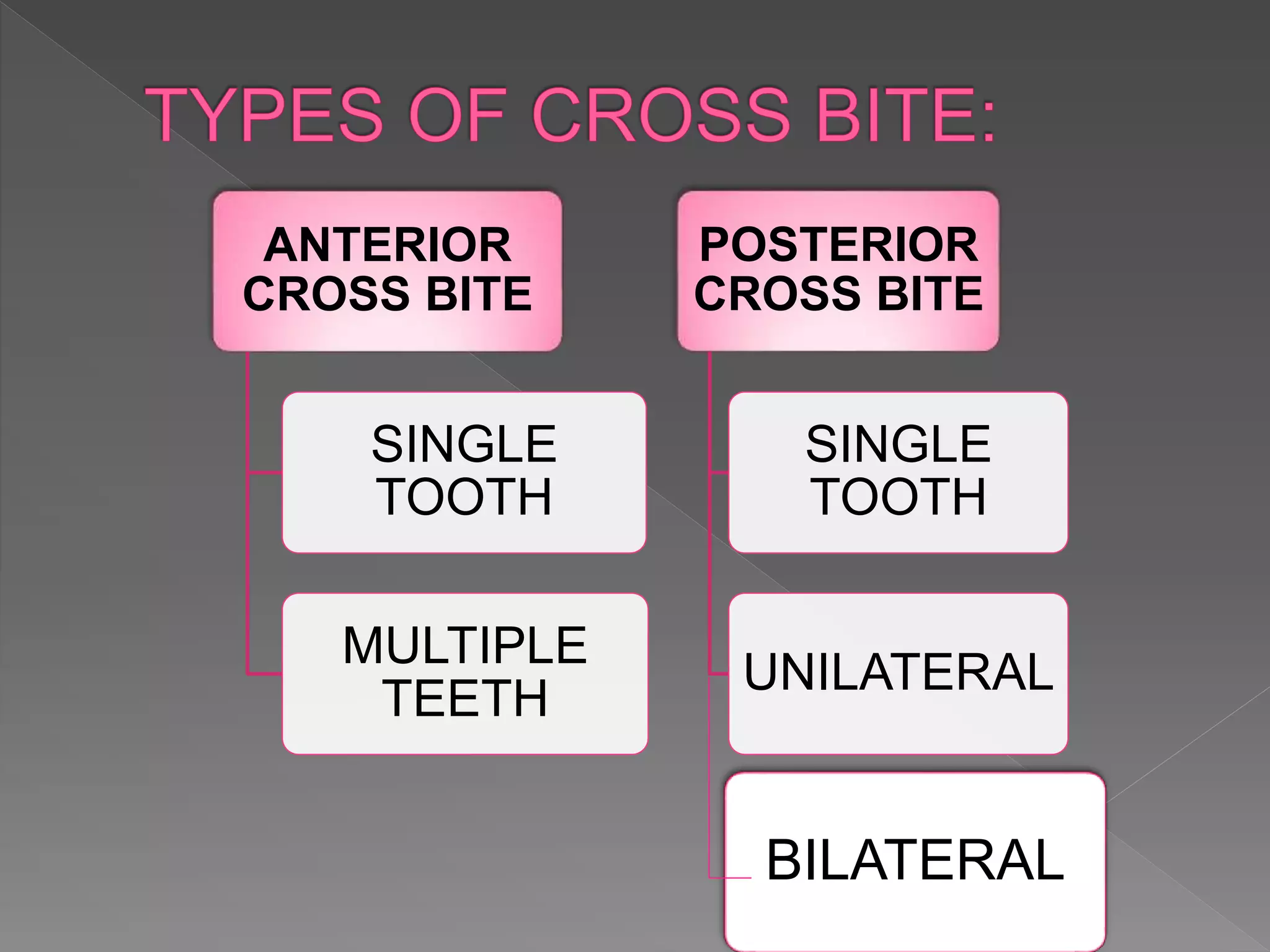
ANTERIOR
CROSS BITE
SINGLE
TOOTH
MULTIPLE
TEETH
POSTERIOR
CROSS BITE
SINGLE
TOOTH
UNILATERAL
BILATERAL
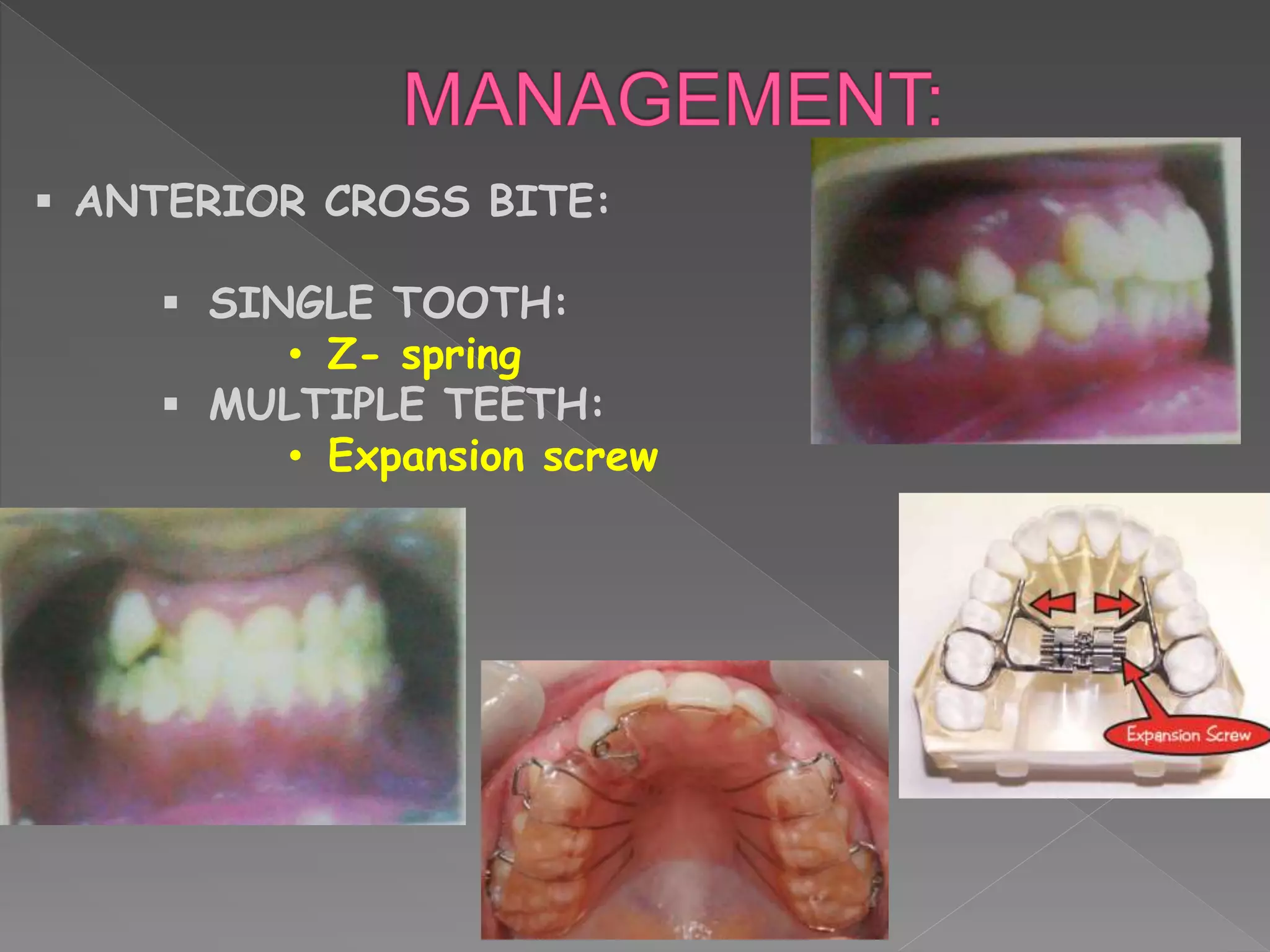
 ANTERIOR CROSS BITE:
 SINGLE TOOTH:
• Z- spring
 MULTIPLE TEETH:
• Expansion screw
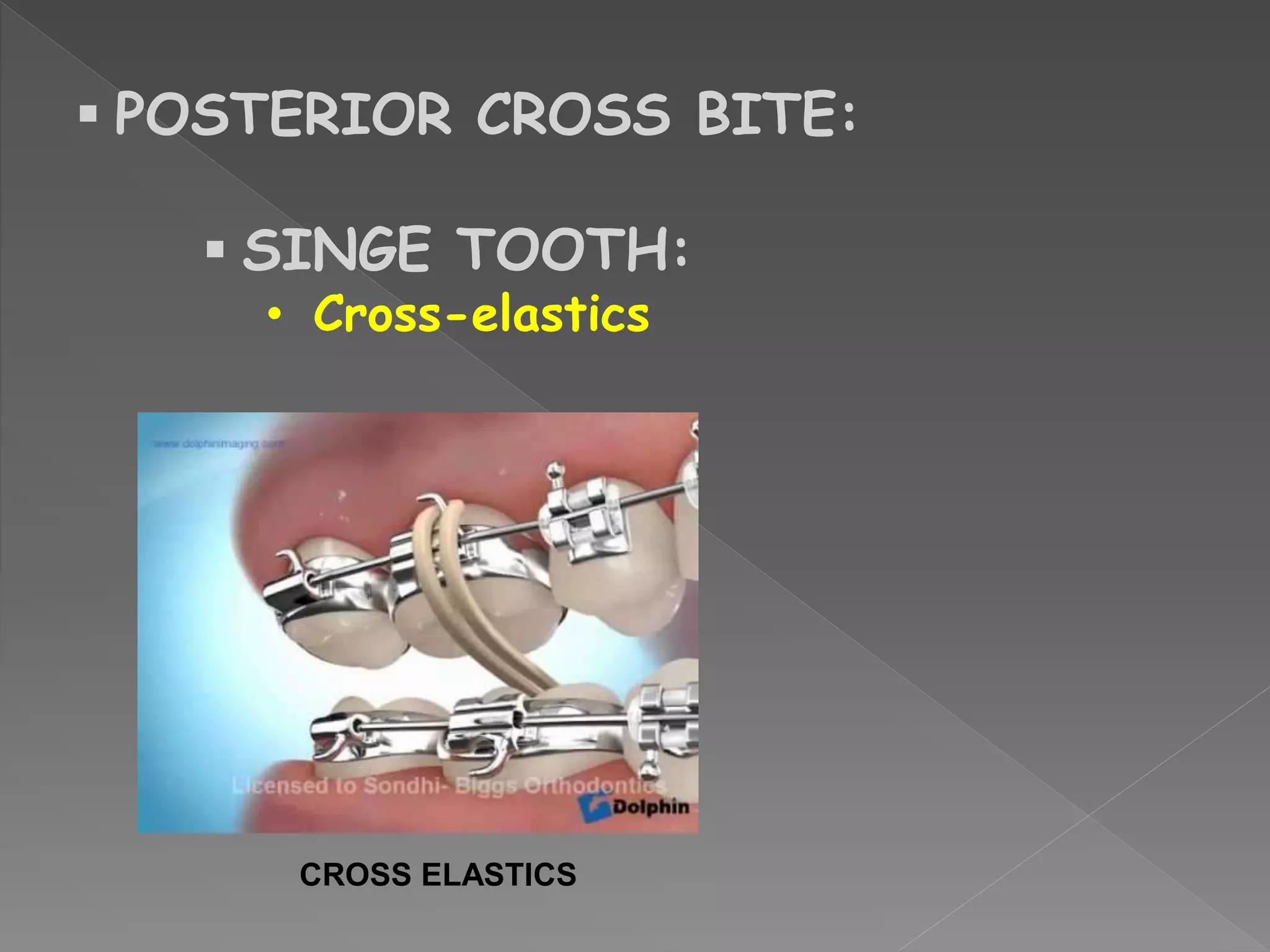
 POSTERIOR CROSS BITE:
 SINGE TOOTH:
• Cross-elastics
CROSS ELASTICS
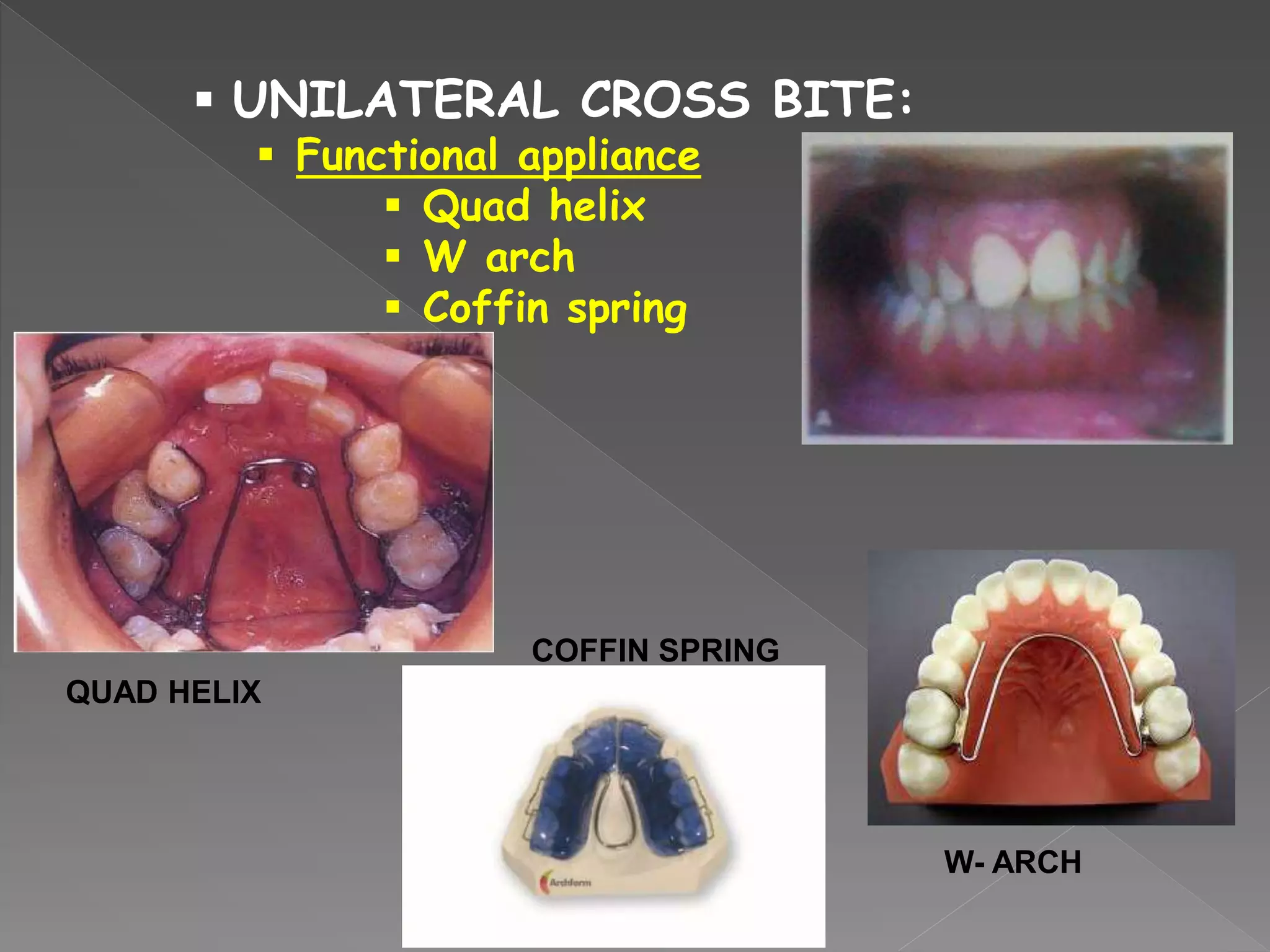
 UNILATERAL CROSS BITE:
 Functional appliance
 Quad helix
 W arch
 Coffin spring
QUAD HELIX
W- ARCH
COFFIN SPRING
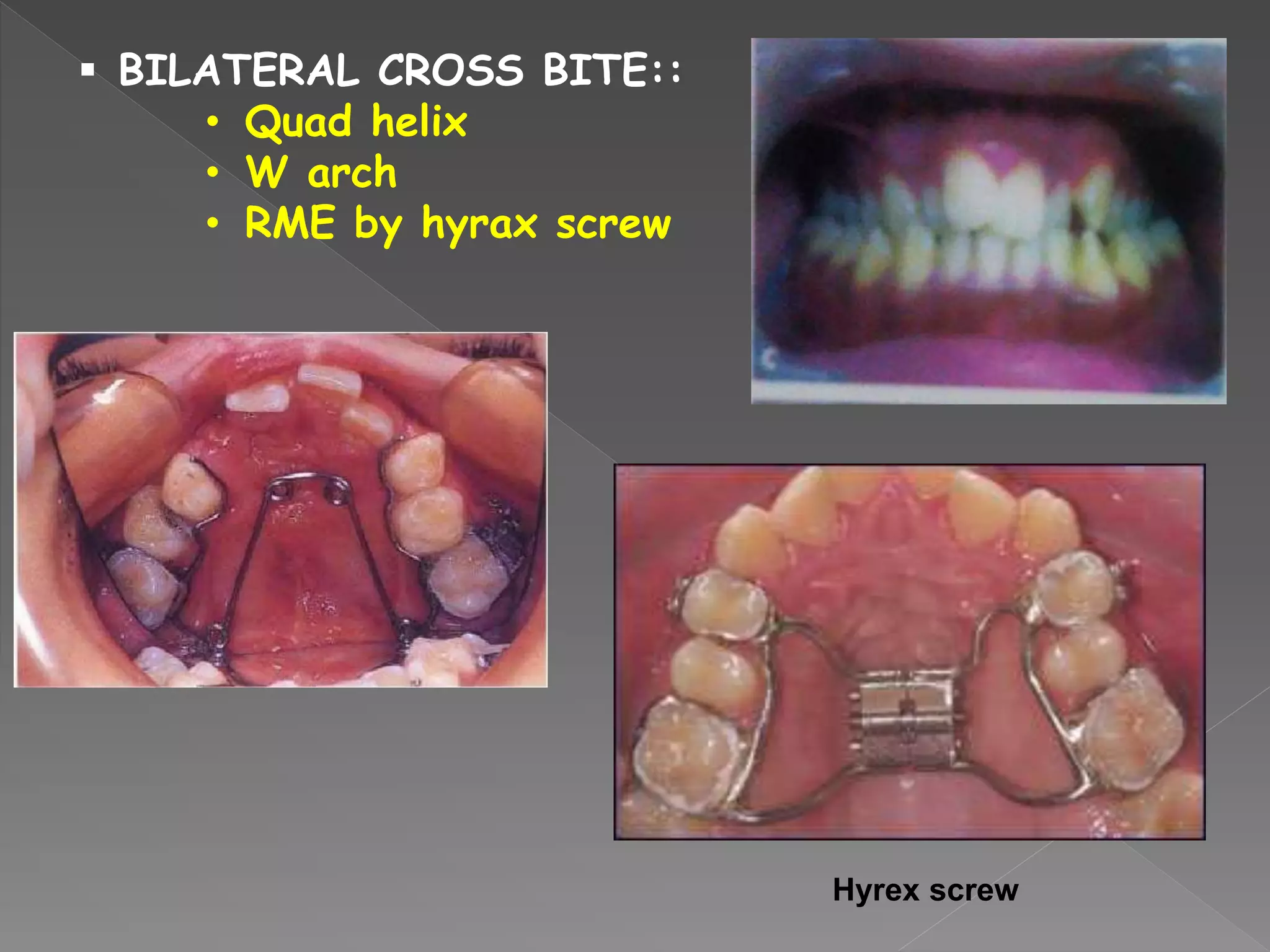
 BILATERAL CROSS BITE::
• Quad helix
• W arch
• RME by hyrax screw
Hyrex screw
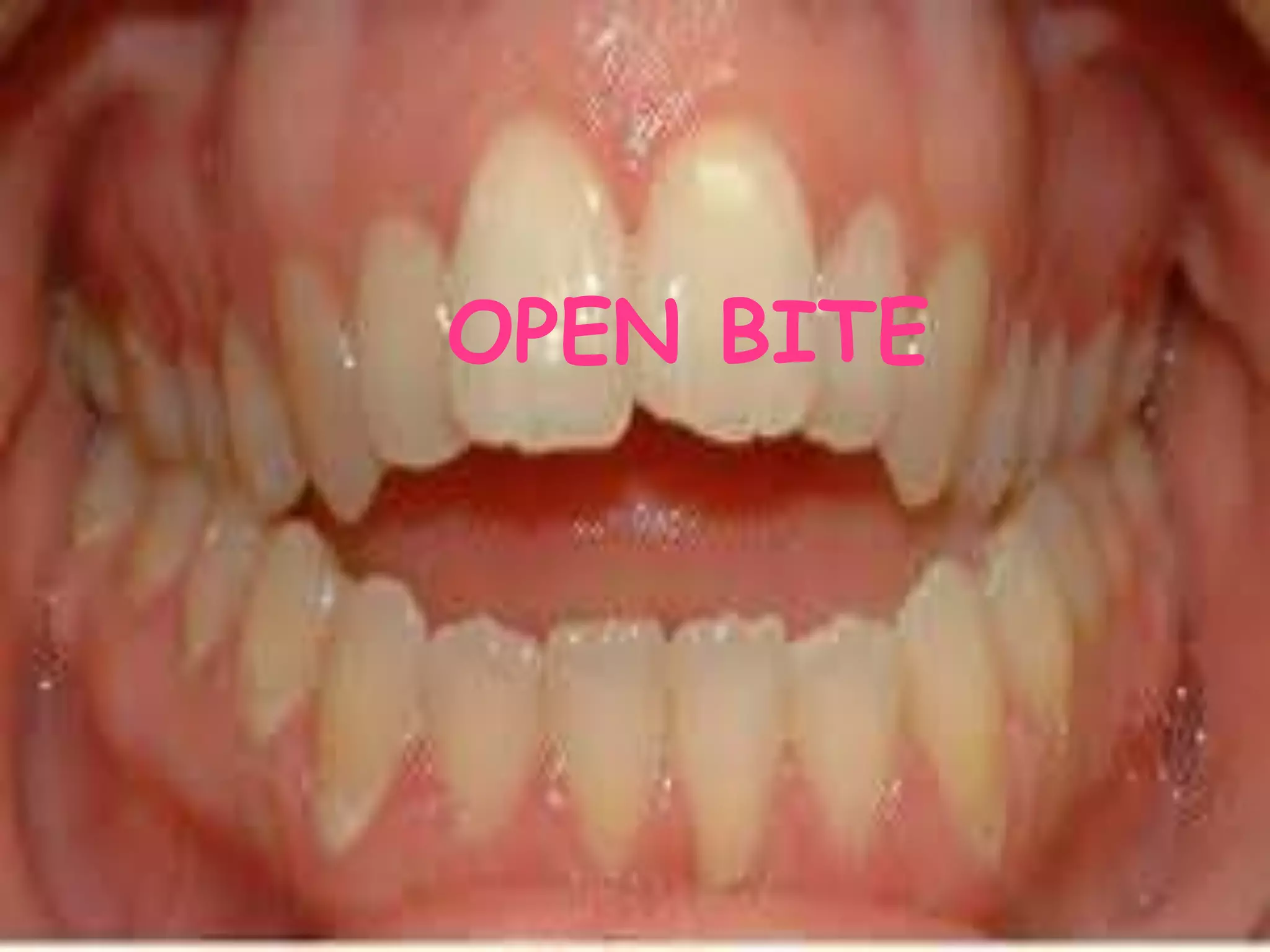
OPEN BITE
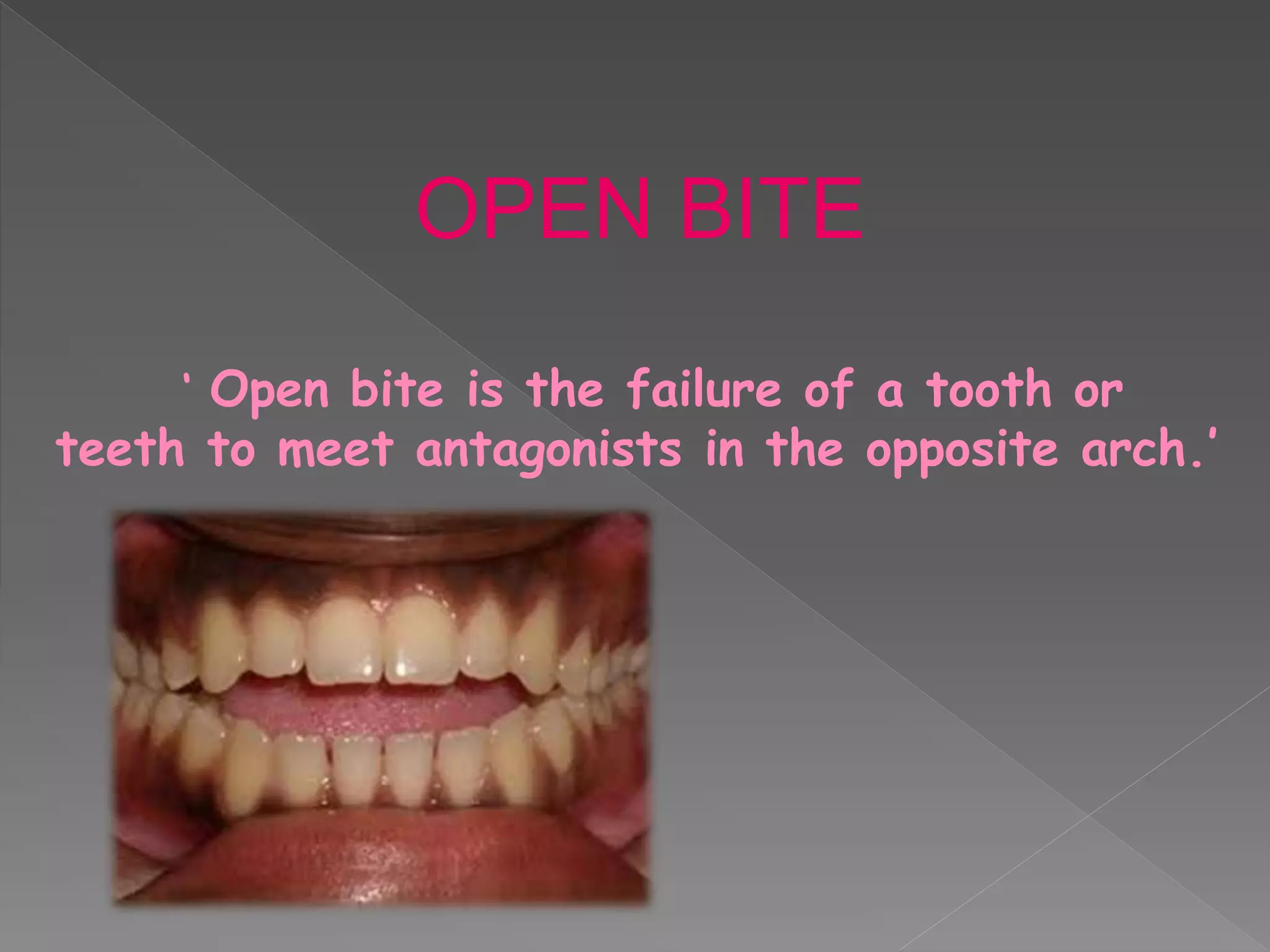
OPEN BITE
‘ Open bite is the failure of a tooth or
teeth to meet antagonists in the opposite arch.’
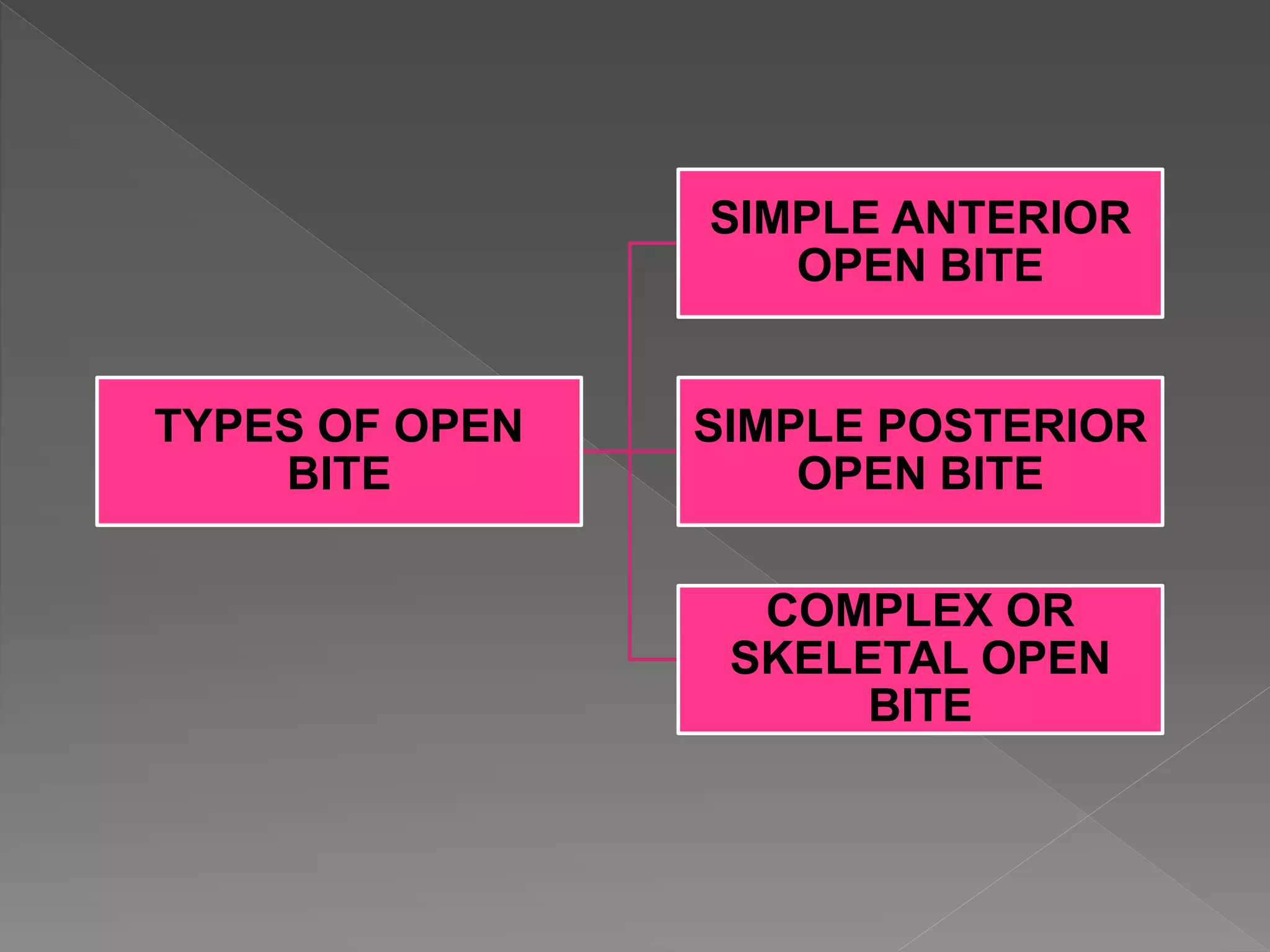
TYPES OF OPEN
BITE
SIMPLE ANTERIOR
OPEN BITE
SIMPLE POSTERIOR
OPEN BITE
COMPLEX OR
SKELETAL OPEN
BITE
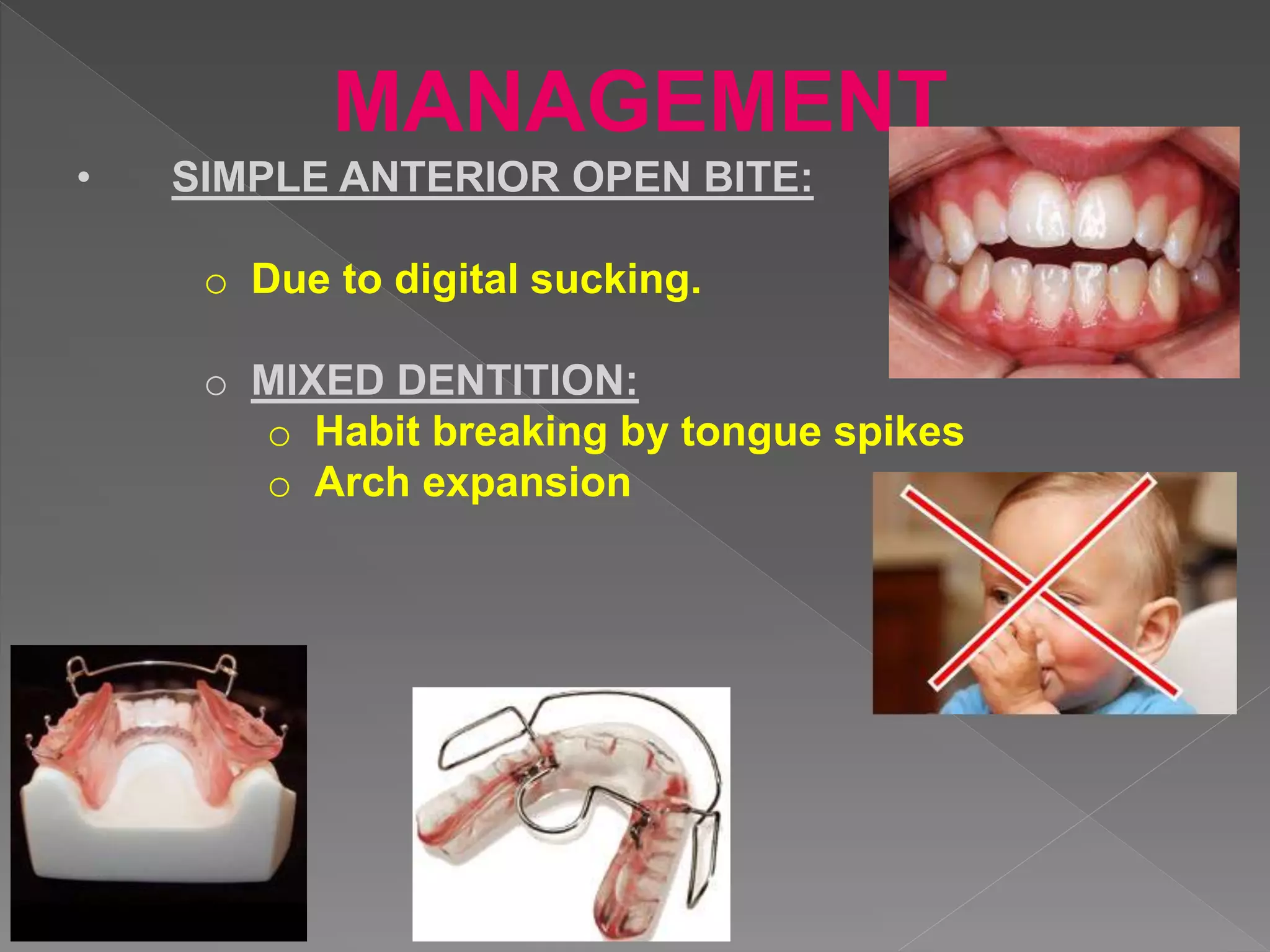
MANAGEMENT
• SIMPLE ANTERIOR OPEN BITE:
o Due to digital sucking.
o MIXED DENTITION:
o Habit breaking by tongue spikes
o Arch expansion
o LATE MIXED DETITION AND EARLY
PERMENANT DENTITION:
oHabit breaking.
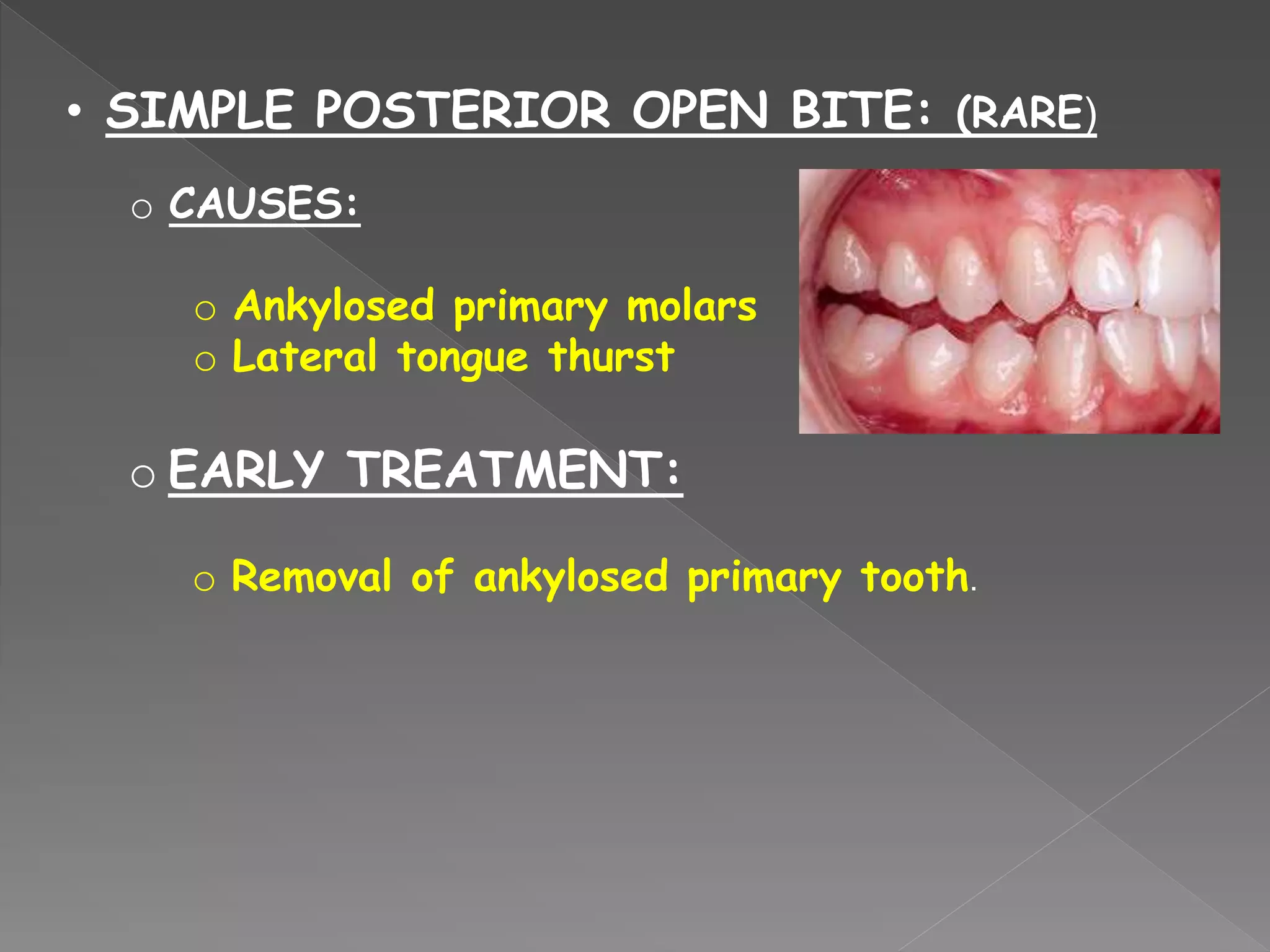
• SIMPLE POSTERIOR OPEN BITE: (RARE)
o CAUSES:
o Ankylosed primary molars
o Lateral tongue thurst
o EARLY TREATMENT:
o Removal of ankylosed primary tooth.
• COMPLEX OR SKELETAL OPEN BITE:
o EARLY MANAGEMENT:
o Bionator
o Frankel appliance
o ADULT SKELETAL OPEN BITE:
o Orthognathic surgery
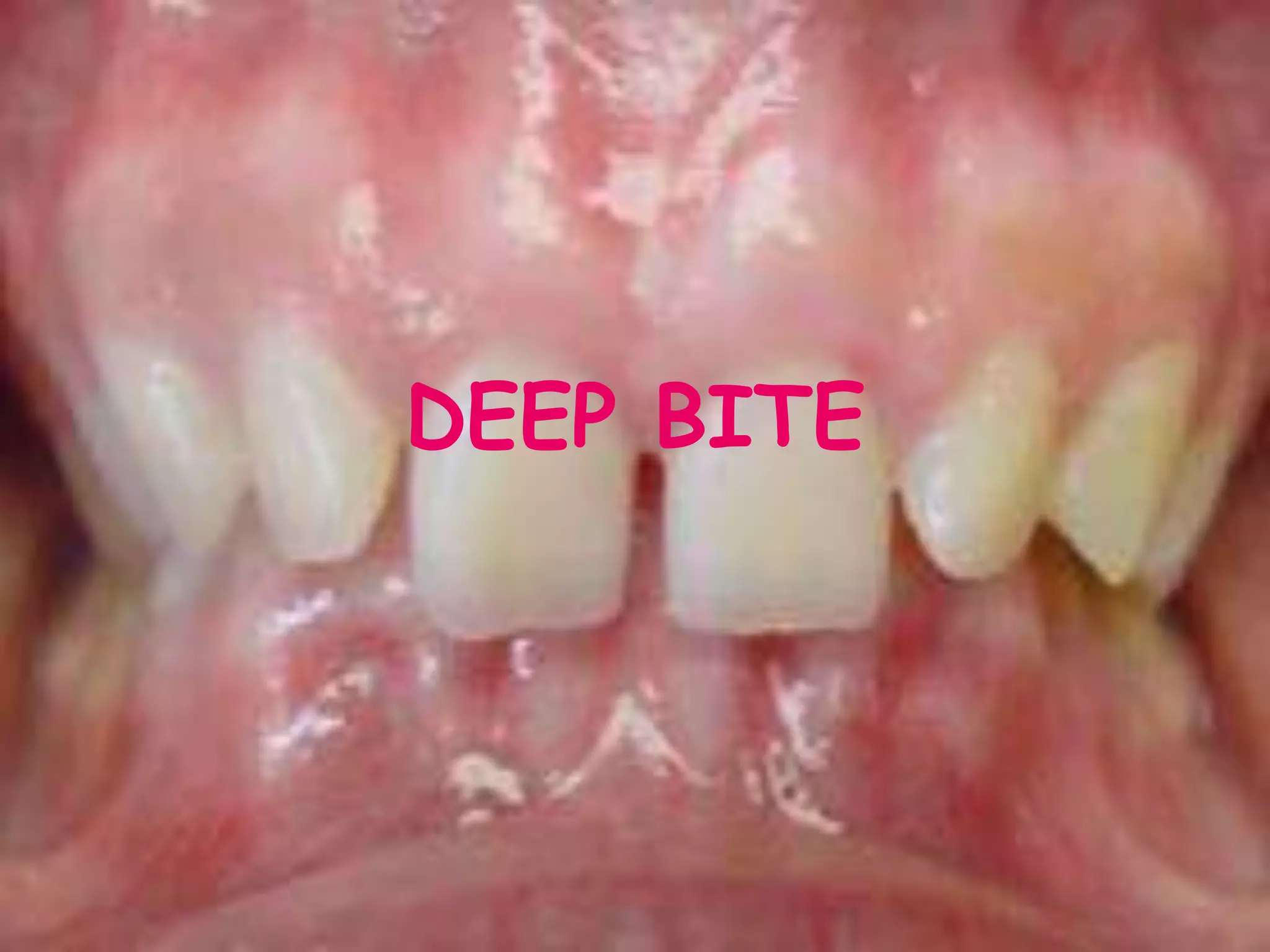
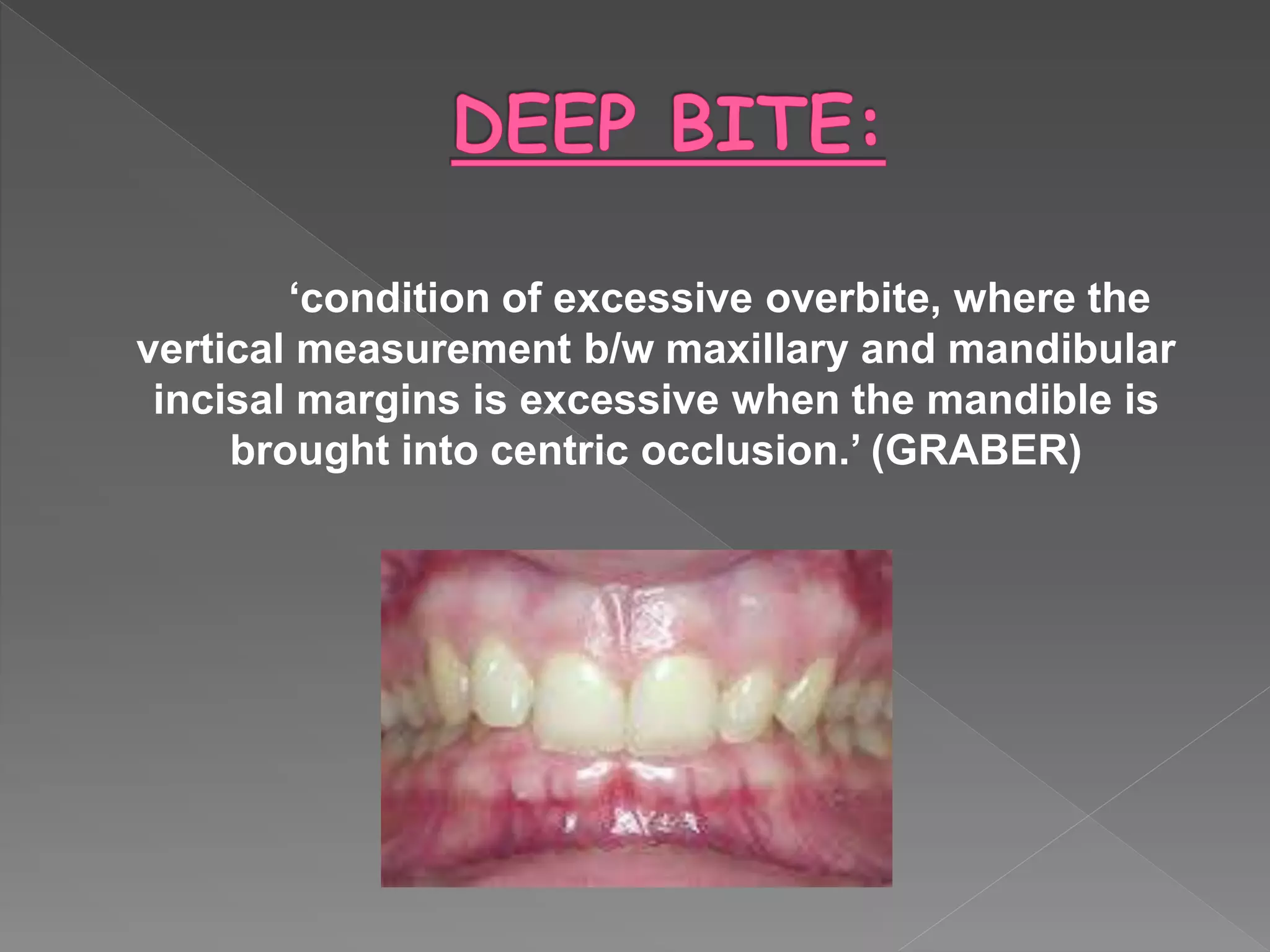
DEEP BITE
‘condition of excessive overbite, where the
vertical measurement b/w maxillary and mandibular
incisal margins is excessive when the mandible is
brought into centric occlusion.’ (GRABER)
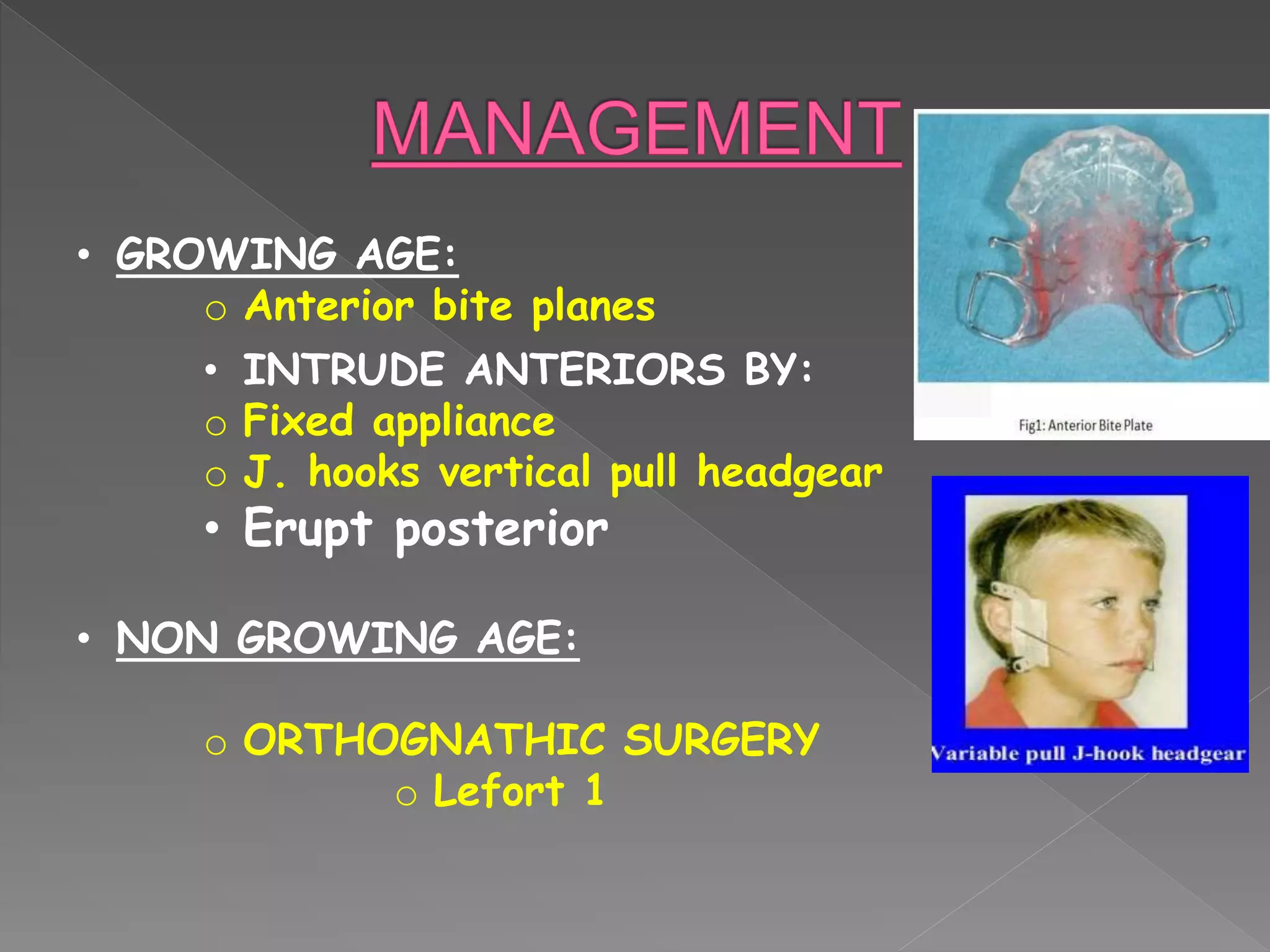
• GROWING AGE:
o Anterior bite planes
• INTRUDE ANTERIORS BY:
o Fixed appliance
o J. hooks vertical pull headgear
• Erupt posterior
• NON GROWING AGE:
o ORTHOGNATHIC SURGERY
o Lefort 1
BIMAXILLARY
PROTRUSION
MANAGEMENT
• Extract all 1st premolars.
• TREATMENT DEPENDS UPON ANGULATION OF
CANINE:
o DISTALLY INCLINED CANINE:
o Retract canine and align incisors using
retainer.
o MESIALLY INCLINED CANINE:
o Fixed appliance
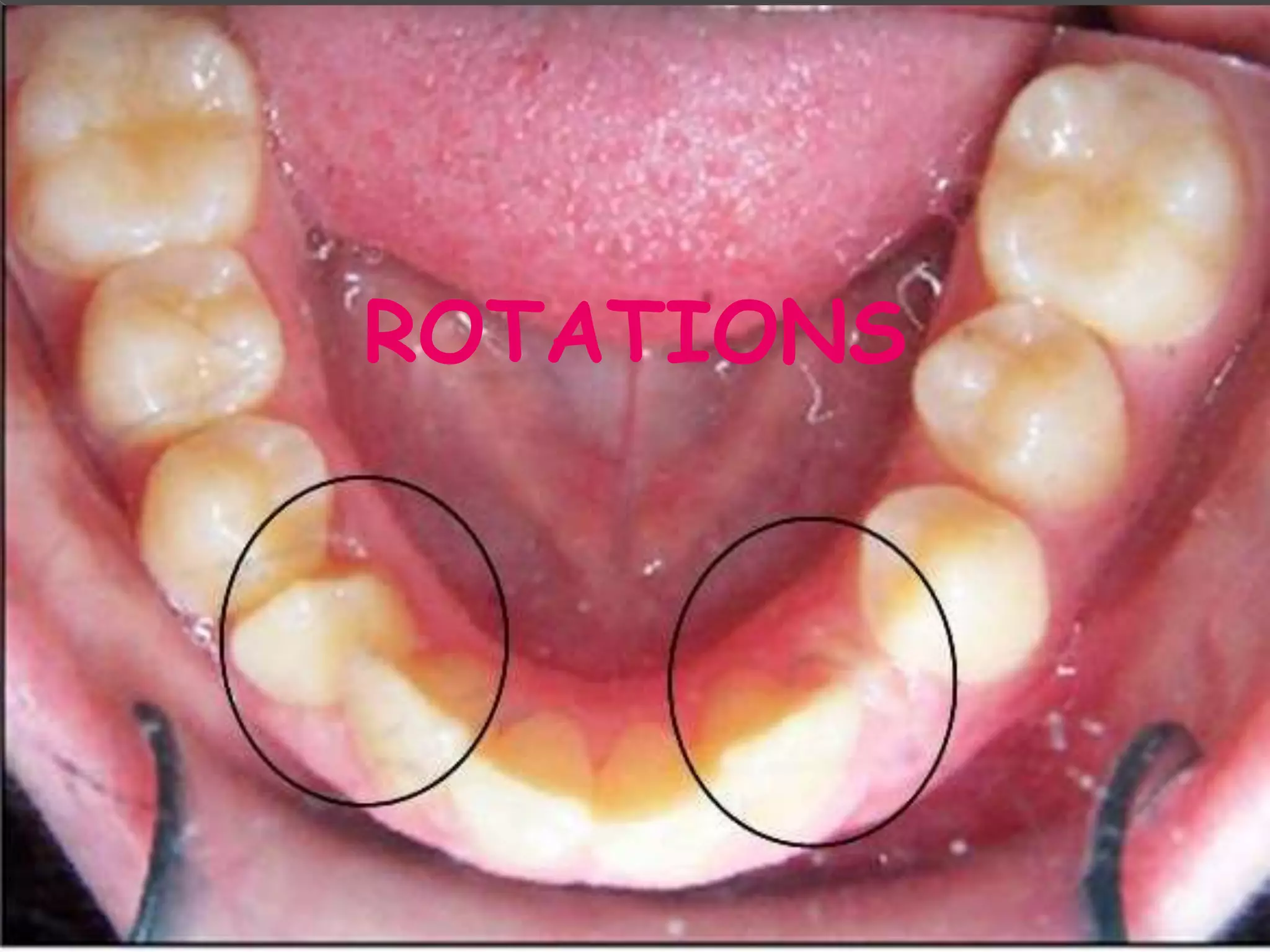
ROTATIONS
• SINGLE TOOTH:
• REMOVABLE APPLIANCES:
• Double cantilever spring
• Labial bow
• MULTIPLE ROTATIONS:
• FIXED APPLIANCE
• SEMI- FIXED APPLIANCE:
• High labial bow with t- spring
Double cantilever
spring
High labial bow
T spring
• CONTEMPORARY ORTHODONTICS BY
WILLIAM R. PROFFIT
• HANDBOOK OF ORTHODONTICS BY
ROBERT E. MOYERS
• ORTHODONTICS PRINCIPLE AND
PRACTICE BY BASAVARAJ PHULARI
• GOOGLE
Management of class i malocclusion

Management of class i malocclusion

  • 1.
  • 2.
    OBJECTIVES: • OCCLUSION • CLASSI OCCLUSION • CLASS I MALOCCLUSION • LINE OF OCCLUSION • CAUSES OF CLASS I MALOCCLUSION • BIMAXILLARY PROTRUSION • FEATURES OF BIMAXILLARY PROTRUSION • FEATURES OF CLASS I MALOCCLUSION • DIAGNOSIS • MANAGEMENT OF CLASS I
  • 3.
    WHAT IS OCCLUSION? “ Occlusion is the relationship of the maxillary and mandibular teeth when the jaws are in fully closed position.”
  • 4.
  • 5.
    CLASS I MALOCCLUSION •Normal relationship of the molars, but line of occlusion incorrect o Malposed teeth o Rotations o Others
  • 6.
     FOR UPPERARCH :  Smooth curve passing through the central fossa of each upper molar and across the cingulum of upper canine and incisor teeth. o FOR LOWER ARCH: • The same line runs along the buccal cusp and incisal edges of lower teeth.
  • 7.
    CAUSES OF CLASSI MALOCCLUSION DEVELOPMENTAL GENETIC ENVIRONMENTAL
  • 8.
    INCLUDES:  Congenitally missingteeth.  Malformed teeth.  Supernumerary teeth.  Impacted teeth  Ectopic eruption
  • 9.
     Plays majorrole for malocclusion where there is discrepancy between the size of jaws and size of teeth.
  • 10.
    CAUSED BY: Injuries whichhas two types:  BIRTH INJURIES: › Fetal moulding › Trauma during birth from usage of forceps.
  • 11.
     INJURIES THROUGHOUTLIFE: Trauma to teeth can lead to:  Damage to permanent tooth bud.  Premature loss of primary teeth leads to permanent tooth movement.  Direct injury to permanent teeth.
  • 12.
    MOST COMMON FORM: • BIMAXILLARY PROTRUSION
  • 13.
    WHAT IS BIMAXILLARYPROTRUSION ?? The patient exhibits a normal class I molar relationship but the dentition of both the upper and lower arches are forwardly placed in relation to facial profile.
  • 14.
  • 15.
  • 16.
     Decreased nasolabial angle dueto proclined maxillary anteriors. o Shallow mentolabial sulcus due to proclined mandibular anteriors.
  • 17.
    oLips may be incompetent. oConvexfacial profile. CONT…
  • 18.
     Maxillary and mandibularanterior proclination.  Class I molar relationship (2)
  • 19.
     Class Icanine relationship (may be)
  • 20.
  • 21.
     Decreased interincisal angle. Increased incisor mandibular plane angle
  • 22.
     Increased SNAand SNB, if there is prognathism of jaws.
  • 23.
    FEATURES OF CLASSI MALOCCLUSION INTRAORALEXTRAORAL
  • 24.
  • 25.
     Class Imolar relationship (2)  Class I canine relationship (3)
  • 26.
     Class Iincisor relationship  Spacing
  • 27.
  • 28.
  • 29.
  • 30.
    • HISTORY • CLINICALEXAMINATION • STUDY MODELS RADIOGRAPHS: • OPG • LATERAL CEPHALOGRAM DIAGNOSIS: • HISTORY • CLINICAL EXAMINATION • STUDY MODELS RADIOGRAPHS • OPG • LATERAL CEPHALOGRAM
  • 31.
    MANAGEMENT OF CLASSI MALOCCLUSION
  • 32.
    MANAGEMENT : AIMED ATCORRECTION OF DISTURBANCE IN LINE OF OCCLUSION LEADING TO • CROWDING • SPACING • OPEN BITE • CROSS BITE • DEEP BITE • ROTATIONS • BIMAXILLARY PROCLINATION
  • 33.
  • 34.
    ‘Is defined asmalalignment of teeth caused by inadequate space.’ • Occurs due to GENETIC or ENVIRONMENTAL factors. • Classified as: Mild crowding --- less than 4mm per arch.  Moderate crowding --- 5 to 9mm per arch.  Severe crowding --- 10mm or more per arch. Before carrying out treatment, following aspects should be considered.  Degree of crowding.  Site and position of crowding.  Patient’s age.
  • 35.
    • MILD CROWDING •Resolves without extraction. • Proximal stripping • Alignment of teeth by labial bow or z- spring.
  • 36.
    MODERATE CROWDING • Archexpansion (quad helix applaince) • Distalization of molars.
  • 37.
    • Extraction ofall 1st premolar • Retract canine by canine retractor • Align anteriors by labial bow. • Retention by hawley’s retainer.
  • 38.
  • 39.
    ‘Gaps between twoteeth or many teeth’ • Can be: • Localized (space present in localized regions or areas) • Generalized (space present in entire arch)
  • 40.
    • Results fromhypodontia along with small teeth (microdontia) in well developed arches. • IN CASE OF MICRODONTIA: • Eliminate spaces between anteriors, leaving a space between canine and 1st premolar. • Give prosthesis or implant.
  • 41.
    • It resultsfrom loss of tooth due to trauma, or hypodontia or due to presence of midline diastema.  Intervention is required in cases with: Diastema greater than 3mm, no space for perm. lateral incisors to erupt.  Permanent canines have erupted, diastema still present.  Labial frenum has not migrated to labial attached mucosa.  Congenitally missing incisors.  Presence of supernumerary teeth.
  • 42.
     Eliminate cause:i.e. high labial frenum attachment.  Removable appliance • Finger spring • Finger spring with labial bow • Split labial bow  Frenectomy  Implants Fixed appliances: Pin and tube appliance
  • 43.
  • 44.
    ‘Refer to acondition where one or more teeth may be abnormally bucally or lingually with reference to the opposed tooth or teeth.’ (GRABER)
  • 45.
  • 46.
     ANTERIOR CROSSBITE:  SINGLE TOOTH: • Z- spring  MULTIPLE TEETH: • Expansion screw
  • 47.
     POSTERIOR CROSSBITE:  SINGE TOOTH: • Cross-elastics CROSS ELASTICS
  • 48.
     UNILATERAL CROSSBITE:  Functional appliance  Quad helix  W arch  Coffin spring QUAD HELIX W- ARCH COFFIN SPRING
  • 49.
     BILATERAL CROSSBITE:: • Quad helix • W arch • RME by hyrax screw Hyrex screw
  • 50.
  • 51.
    OPEN BITE ‘ Openbite is the failure of a tooth or teeth to meet antagonists in the opposite arch.’
  • 52.
    TYPES OF OPEN BITE SIMPLEANTERIOR OPEN BITE SIMPLE POSTERIOR OPEN BITE COMPLEX OR SKELETAL OPEN BITE
  • 53.
    MANAGEMENT • SIMPLE ANTERIOROPEN BITE: o Due to digital sucking. o MIXED DENTITION: o Habit breaking by tongue spikes o Arch expansion
  • 54.
    o LATE MIXEDDETITION AND EARLY PERMENANT DENTITION: oHabit breaking.
  • 55.
    • SIMPLE POSTERIOROPEN BITE: (RARE) o CAUSES: o Ankylosed primary molars o Lateral tongue thurst o EARLY TREATMENT: o Removal of ankylosed primary tooth.
  • 56.
    • COMPLEX ORSKELETAL OPEN BITE: o EARLY MANAGEMENT: o Bionator o Frankel appliance o ADULT SKELETAL OPEN BITE: o Orthognathic surgery
  • 57.
  • 58.
    ‘condition of excessiveoverbite, where the vertical measurement b/w maxillary and mandibular incisal margins is excessive when the mandible is brought into centric occlusion.’ (GRABER)
  • 59.
    • GROWING AGE: oAnterior bite planes • INTRUDE ANTERIORS BY: o Fixed appliance o J. hooks vertical pull headgear • Erupt posterior • NON GROWING AGE: o ORTHOGNATHIC SURGERY o Lefort 1
  • 60.
  • 61.
    MANAGEMENT • Extract all1st premolars. • TREATMENT DEPENDS UPON ANGULATION OF CANINE: o DISTALLY INCLINED CANINE: o Retract canine and align incisors using retainer. o MESIALLY INCLINED CANINE: o Fixed appliance
  • 62.
  • 63.
    • SINGLE TOOTH: •REMOVABLE APPLIANCES: • Double cantilever spring • Labial bow • MULTIPLE ROTATIONS: • FIXED APPLIANCE • SEMI- FIXED APPLIANCE: • High labial bow with t- spring Double cantilever spring High labial bow T spring
  • 64.
    • CONTEMPORARY ORTHODONTICSBY WILLIAM R. PROFFIT • HANDBOOK OF ORTHODONTICS BY ROBERT E. MOYERS • ORTHODONTICS PRINCIPLE AND PRACTICE BY BASAVARAJ PHULARI • GOOGLE