Google Bigtable
         Fay Chang, Jeffrey Dean, Sanjay Ghemawat,
          Wilson C. Hsieh, Deborah A. Wallach, Mike
           Burrows, Tushar Chandra, Andrew Fikes,
                      Robert E. Gruber
                         Google, Inc.

                  UWCS OS Seminar Discussion
                        Erik Paulson
                       2 October 2006


See also the (other)UW presentation by Jeff Dean in September of 2005
 (See the link on the seminar page, or just google for “google bigtable”)
Before we begin…
• Intersection of databases and distributed
  systems
• Will try to explain (or at least warn) when
  we hit a patch of database
• Remember this is a discussion!


                                   2 of 19
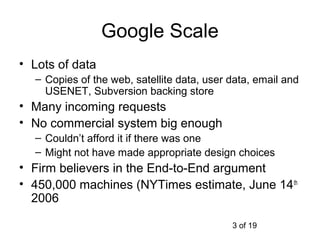
Google Scale
• Lots of data
  – Copies of the web, satellite data, user data, email and
    USENET, Subversion backing store
• Many incoming requests
• No commercial system big enough
  – Couldn’t afford it if there was one
  – Might not have made appropriate design choices
• Firm believers in the End-to-End argument
• 450,000 machines (NYTimes estimate, June 14 th
  2006

                                            3 of 19
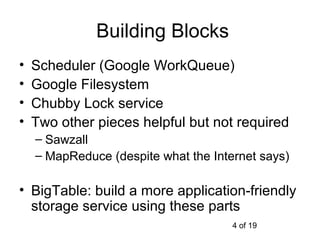
Building Blocks
•   Scheduler (Google WorkQueue)
•   Google Filesystem
•   Chubby Lock service
•   Two other pieces helpful but not required
    – Sawzall
    – MapReduce (despite what the Internet says)

• BigTable: build a more application-friendly
  storage service using these parts
                                      4 of 19
Google File System
• Large-scale distributed “filesystem”
• Master: responsible for metadata
• Chunk servers: responsible for reading
  and writing large chunks of data
• Chunks replicated on 3 machines, master
  responsible for ensuring replicas exist
• OSDI ’04 Paper

                               5 of 19
Chubby
• {lock/file/name} service
• Coarse-grained locks, can store small
  amount of data in a lock
• 5 replicas, need a majority vote to be
  active
• Also an OSDI ’06 Paper


                                  6 of 19
Data model: a big map
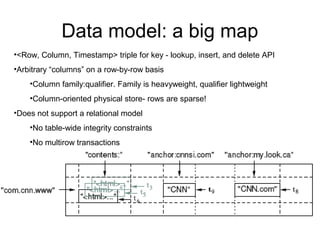
•<Row, Column, Timestamp> triple for key - lookup, insert, and delete API
•Arbitrary “columns” on a row-by-row basis
    •Column family:qualifier. Family is heavyweight, qualifier lightweight
    •Column-oriented physical store- rows are sparse!
•Does not support a relational model
    •No table-wide integrity constraints
    •No multirow transactions


                                                               7 of 19
SSTable
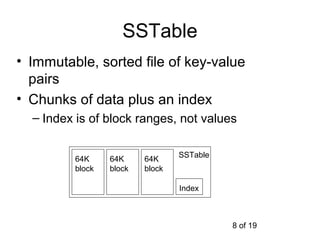
• Immutable, sorted file of key-value
  pairs
• Chunks of data plus an index
  – Index is of block ranges, not values

                                 SSTable
         64K     64K     64K
         block   block   block

                                 Index


                                           8 of 19
Tablet
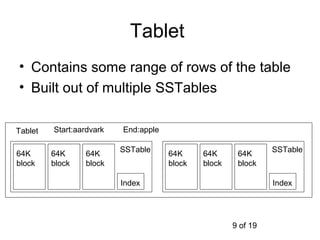
• Contains some range of rows of the table
• Built out of multiple SSTables

Tablet   Start:aardvark   End:apple

                          SSTable                               SSTable
64K      64K     64K                  64K     64K      64K
block    block   block                block   block    block

                          Index                                 Index


                                                      9 of 19
Table
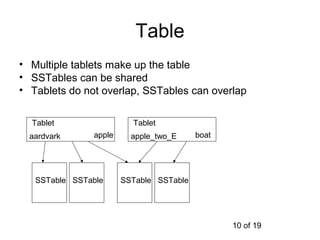
• Multiple tablets make up the table
• SSTables can be shared
• Tablets do not overlap, SSTables can overlap

  Tablet                 Tablet
  aardvark     apple     apple_two_E     boat


   SSTable SSTable     SSTable SSTable


                                                10 of 19
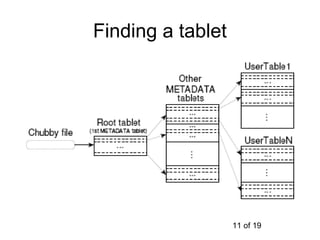
Finding a tablet


                   11 of 19
Servers
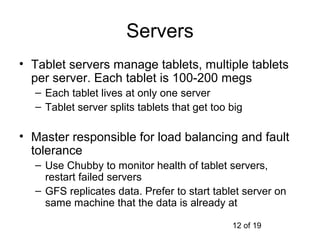
• Tablet servers manage tablets, multiple tablets
  per server. Each tablet is 100-200 megs
  – Each tablet lives at only one server
  – Tablet server splits tablets that get too big

• Master responsible for load balancing and fault
  tolerance
  – Use Chubby to monitor health of tablet servers,
    restart failed servers
  – GFS replicates data. Prefer to start tablet server on
    same machine that the data is already at

                                              12 of 19
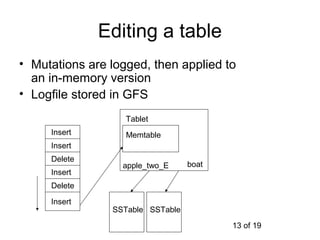
Editing a table
• Mutations are logged, then applied to
  an in-memory version
• Logfile stored in GFS
                   Tablet
     Insert        Memtable
     Insert
     Delete
                  apple_two_E     boat
     Insert
     Delete

     Insert
                SSTable SSTable
                                         13 of 19
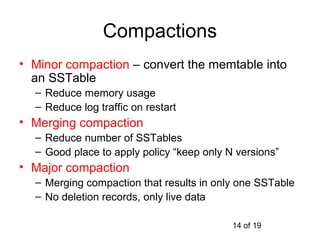
Compactions
• Minor compaction – convert the memtable into
  an SSTable
  – Reduce memory usage
  – Reduce log traffic on restart
• Merging compaction
  – Reduce number of SSTables
  – Good place to apply policy “keep only N versions”
• Major compaction
  – Merging compaction that results in only one SSTable
  – No deletion records, only live data

                                           14 of 19
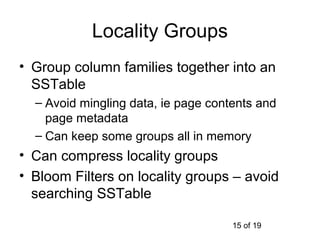
Locality Groups
• Group column families together into an
  SSTable
  – Avoid mingling data, ie page contents and
    page metadata
  – Can keep some groups all in memory
• Can compress locality groups
• Bloom Filters on locality groups – avoid
  searching SSTable

                                     15 of 19
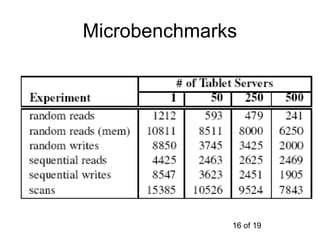
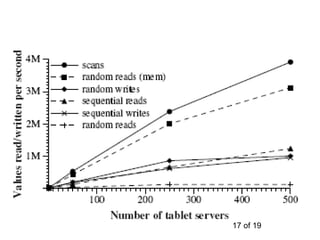
Microbenchmarks


              16 of 19
17 of 19
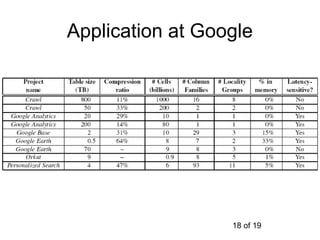
Application at Google


                  18 of 19
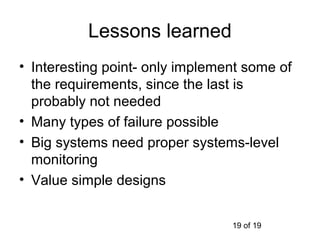
Lessons learned
• Interesting point- only implement some of
  the requirements, since the last is
  probably not needed
• Many types of failure possible
• Big systems need proper systems-level
  monitoring
• Value simple designs


                                 19 of 19

Bigtable

  • 1.
    Google Bigtable Fay Chang, Jeffrey Dean, Sanjay Ghemawat, Wilson C. Hsieh, Deborah A. Wallach, Mike Burrows, Tushar Chandra, Andrew Fikes, Robert E. Gruber Google, Inc. UWCS OS Seminar Discussion Erik Paulson 2 October 2006 See also the (other)UW presentation by Jeff Dean in September of 2005 (See the link on the seminar page, or just google for “google bigtable”)
  • 2.
    Before we begin… •Intersection of databases and distributed systems • Will try to explain (or at least warn) when we hit a patch of database • Remember this is a discussion! 2 of 19
  • 3.
    Google Scale • Lotsof data – Copies of the web, satellite data, user data, email and USENET, Subversion backing store • Many incoming requests • No commercial system big enough – Couldn’t afford it if there was one – Might not have made appropriate design choices • Firm believers in the End-to-End argument • 450,000 machines (NYTimes estimate, June 14 th 2006 3 of 19
  • 4.
    Building Blocks • Scheduler (Google WorkQueue) • Google Filesystem • Chubby Lock service • Two other pieces helpful but not required – Sawzall – MapReduce (despite what the Internet says) • BigTable: build a more application-friendly storage service using these parts 4 of 19
  • 5.
    Google File System •Large-scale distributed “filesystem” • Master: responsible for metadata • Chunk servers: responsible for reading and writing large chunks of data • Chunks replicated on 3 machines, master responsible for ensuring replicas exist • OSDI ’04 Paper 5 of 19
  • 6.
    Chubby • {lock/file/name} service •Coarse-grained locks, can store small amount of data in a lock • 5 replicas, need a majority vote to be active • Also an OSDI ’06 Paper 6 of 19
  • 7.
    Data model: abig map •<Row, Column, Timestamp> triple for key - lookup, insert, and delete API •Arbitrary “columns” on a row-by-row basis •Column family:qualifier. Family is heavyweight, qualifier lightweight •Column-oriented physical store- rows are sparse! •Does not support a relational model •No table-wide integrity constraints •No multirow transactions 7 of 19
  • 8.
    SSTable • Immutable, sortedfile of key-value pairs • Chunks of data plus an index – Index is of block ranges, not values SSTable 64K 64K 64K block block block Index 8 of 19
  • 9.
    Tablet • Contains somerange of rows of the table • Built out of multiple SSTables Tablet Start:aardvark End:apple SSTable SSTable 64K 64K 64K 64K 64K 64K block block block block block block Index Index 9 of 19
  • 10.
    Table • Multiple tabletsmake up the table • SSTables can be shared • Tablets do not overlap, SSTables can overlap Tablet Tablet aardvark apple apple_two_E boat SSTable SSTable SSTable SSTable 10 of 19
  • 11.
  • 12.
    Servers • Tablet serversmanage tablets, multiple tablets per server. Each tablet is 100-200 megs – Each tablet lives at only one server – Tablet server splits tablets that get too big • Master responsible for load balancing and fault tolerance – Use Chubby to monitor health of tablet servers, restart failed servers – GFS replicates data. Prefer to start tablet server on same machine that the data is already at 12 of 19
  • 13.
    Editing a table •Mutations are logged, then applied to an in-memory version • Logfile stored in GFS Tablet Insert Memtable Insert Delete apple_two_E boat Insert Delete Insert SSTable SSTable 13 of 19
  • 14.
    Compactions • Minor compaction– convert the memtable into an SSTable – Reduce memory usage – Reduce log traffic on restart • Merging compaction – Reduce number of SSTables – Good place to apply policy “keep only N versions” • Major compaction – Merging compaction that results in only one SSTable – No deletion records, only live data 14 of 19
  • 15.
    Locality Groups • Groupcolumn families together into an SSTable – Avoid mingling data, ie page contents and page metadata – Can keep some groups all in memory • Can compress locality groups • Bloom Filters on locality groups – avoid searching SSTable 15 of 19
  • 16.
  • 17.
  • 18.
  • 19.
    Lessons learned • Interestingpoint- only implement some of the requirements, since the last is probably not needed • Many types of failure possible • Big systems need proper systems-level monitoring • Value simple designs 19 of 19