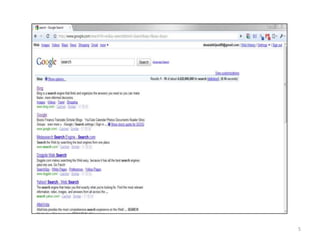
Cluster ArchitectureWeb Search for a Planet and much more….Abhijeet Desaidesaiabhijeet89@gmail.com1
2
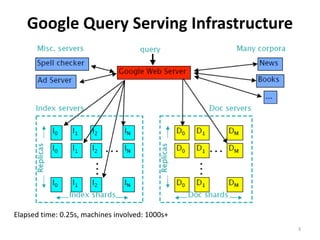
Google Query Serving InfrastructureElapsed time: 0.25s, machines involved: 1000s+3
PageRankPageRankTM is the core technology to measure the importance of a pageGoogle's theory	– If page A links to page B		# Page B is important		# The link text is irrelevant	– If many important links point to page A		# Links from page A are also important4
5
Key Design PrinciplesSoftware reliabilityUse replication for better request throughput and availability Price/performance beats peak performanceUsing commodity PCs reduces the cost of computation 6
The Power ProblemHigh density of machines (racks)	– High power consumption 400-700 W/ft2		# Typical data center provides 70-150 W/ft2		# Energy costs	– Heating		# Cooling system costsReducing power	– Reduce performance (c/p may not reduce!)	– Faster hardware depreciation (cost up!)7
ParallelismLookup of matching docs in a large index	--> many lookups in a set of smaller indexes followed by a merge stepA query stream	--> multiple streams		(each handled by a cluster)Adding machines to a pool increases serving capacity8
Hardware Level Consideration Instruction level parallelism does not helpMultiple simple, in-order, short-pipeline coreThread level parallelismMemory system with moderate sized L2 cache is enoughLarge shared-memory machines are not required to boost the performance9
GFS (Google File System) Design Master manages metadata
 Data transfers happen directly between clients/chunk servers
 Files broken into chunks (typically 64 MB)10
GFS Usage @ Google• 200+ clusters• Many clusters of 1000s of machines• Pools of 1000s of clients• 4+ PB Filesystems• 40 GB/s read/write load	– (in the presence of frequent HW failures)11
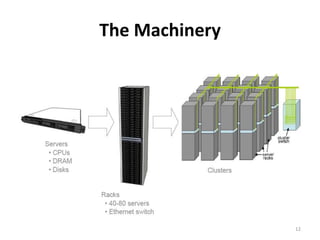
The Machinery12
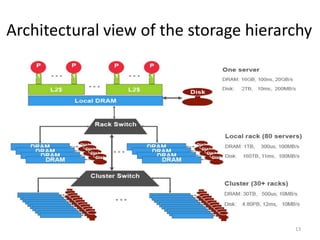
Architectural view of the storage hierarchy13
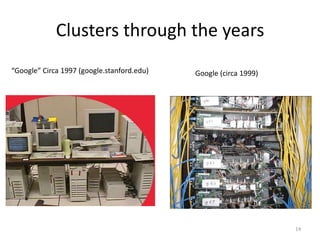
Clusters through the years“Google” Circa 1997 (google.stanford.edu)Google (circa 1999)14
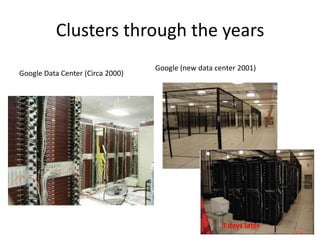
Clusters through the yearsGoogle (new data center 2001)Google Data Center (Circa 2000)3 days later15
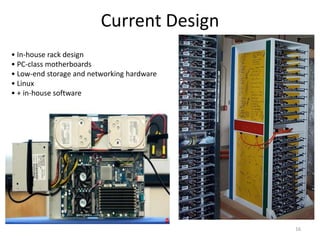
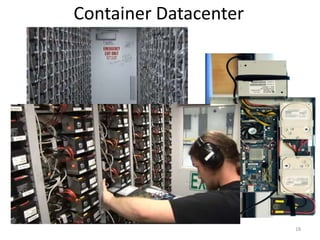
Current Design• In-house rack design• PC-class motherboards• Low-end storage and networking hardware• Linux• + in-house software16
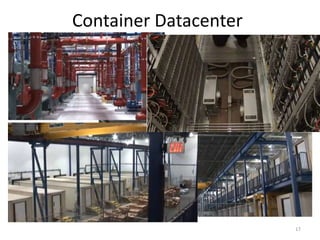
Container Datacenter 17
Container Datacenter 18
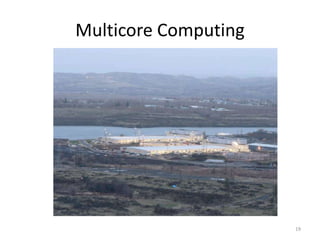
Multicore Computing19
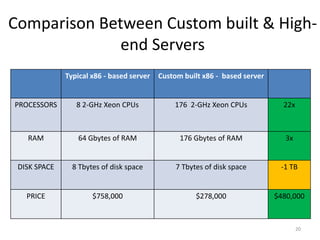
Comparison Between Custom built & High-end Servers 20
Implications of the Computing EnvironmentStuff Breaks• If you have one server, it may stay up three years (1,000 days)• If you have 10,000 servers, expect to lose ten a day• “Ultra-reliable” hardware doesn’t really help• At large scale, super-fancy reliable hardware still fails, albeit less often	– software still needs to be fault-tolerant	– commodity machines without fancy hardware give better performance/$• Reliability has to come from the software• Making it easier to write distributed programs21
Infrastructure for Search SystemsSeveral key pieces of infrastructure:	– GFS	– MapReduce	– BigTable22
MapReduce• A simple programming model that applies to many large-scale computing problems• Hide messy details in MapReduce runtime library:	– automatic parallelization	– load balancing	– network and disk transfer             optimizations	– handling of machine failures	– robustness	– improvements to core library benefit all users of library!23
Typical problem solved by MapReduce• Read a lot of data• Map: extract something you care about from each record• Shuffle and Sort• Reduce: aggregate, summarize, filter, or transform• Write the results• Outline stays the same, map and reduce change to fit the problem24

Google cluster architecture

  • 1.
    Cluster ArchitectureWebSearch for a Planet and much more….Abhijeet Desaidesaiabhijeet89@gmail.com1
  • 2.
  • 3.
    Google Query ServingInfrastructureElapsed time: 0.25s, machines involved: 1000s+3
  • 4.
    PageRankPageRankTM is thecore technology to measure the importance of a pageGoogle's theory – If page A links to page B # Page B is important # The link text is irrelevant – If many important links point to page A # Links from page A are also important4
  • 5.
  • 6.
    Key Design PrinciplesSoftwarereliabilityUse replication for better request throughput and availability Price/performance beats peak performanceUsing commodity PCs reduces the cost of computation 6
  • 7.
    The Power ProblemHighdensity of machines (racks) – High power consumption 400-700 W/ft2 # Typical data center provides 70-150 W/ft2 # Energy costs – Heating # Cooling system costsReducing power – Reduce performance (c/p may not reduce!) – Faster hardware depreciation (cost up!)7
  • 8.
    ParallelismLookup of matchingdocs in a large index --> many lookups in a set of smaller indexes followed by a merge stepA query stream --> multiple streams (each handled by a cluster)Adding machines to a pool increases serving capacity8
  • 9.
    Hardware Level ConsiderationInstruction level parallelism does not helpMultiple simple, in-order, short-pipeline coreThread level parallelismMemory system with moderate sized L2 cache is enoughLarge shared-memory machines are not required to boost the performance9
  • 10.
    GFS (Google FileSystem) Design Master manages metadata
  • 11.
    Data transfershappen directly between clients/chunk servers
  • 12.
    Files brokeninto chunks (typically 64 MB)10
  • 13.
    GFS Usage @Google• 200+ clusters• Many clusters of 1000s of machines• Pools of 1000s of clients• 4+ PB Filesystems• 40 GB/s read/write load – (in the presence of frequent HW failures)11
  • 14.
  • 15.
    Architectural view ofthe storage hierarchy13
  • 16.
    Clusters through theyears“Google” Circa 1997 (google.stanford.edu)Google (circa 1999)14
  • 17.
    Clusters through theyearsGoogle (new data center 2001)Google Data Center (Circa 2000)3 days later15
  • 18.
    Current Design• In-houserack design• PC-class motherboards• Low-end storage and networking hardware• Linux• + in-house software16
  • 19.
  • 20.
  • 21.
  • 22.
    Comparison Between Custombuilt & High-end Servers 20
  • 23.
    Implications of theComputing EnvironmentStuff Breaks• If you have one server, it may stay up three years (1,000 days)• If you have 10,000 servers, expect to lose ten a day• “Ultra-reliable” hardware doesn’t really help• At large scale, super-fancy reliable hardware still fails, albeit less often – software still needs to be fault-tolerant – commodity machines without fancy hardware give better performance/$• Reliability has to come from the software• Making it easier to write distributed programs21
  • 24.
    Infrastructure for SearchSystemsSeveral key pieces of infrastructure: – GFS – MapReduce – BigTable22
  • 25.
    MapReduce• A simpleprogramming model that applies to many large-scale computing problems• Hide messy details in MapReduce runtime library: – automatic parallelization – load balancing – network and disk transfer optimizations – handling of machine failures – robustness – improvements to core library benefit all users of library!23
  • 26.
    Typical problem solvedby MapReduce• Read a lot of data• Map: extract something you care about from each record• Shuffle and Sort• Reduce: aggregate, summarize, filter, or transform• Write the results• Outline stays the same, map and reduce change to fit the problem24