









Big Data on Azure
@davidgiard
David Giard
Microsoft Technical Evangelist
dgiard@Microsoft.com
Davidgiard.com
@davidgiard
@davidgiard
Cloud Computing
Host some or all of your data or application
on a third-party server
in a highly-scalable, highly-reliable way
@davidgiard
Advantages of Cloud Computing
• Lower capital costs
• Flexible operating cost (Rent vs Buy)
• Platform as a Service
• Freedom from infrastructure / hardware
• Redundancy
• Automatic monitoring and failover
@davidgiard
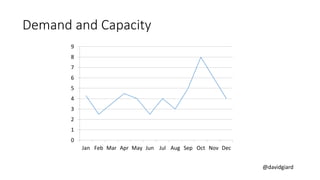
0
1
2
3
4
5
6
7
8
9
Jan Feb Mar Apr May Jun Jul Aug Sep Oct Nov Dec
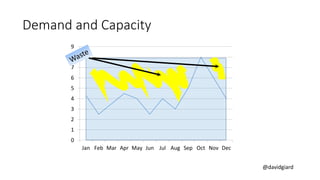
Demand and Capacity
@davidgiard
0
1
2
3
4
5
6
7
8
9
Jan Feb Mar Apr May Jun Jul Aug Sep Oct Nov Dec
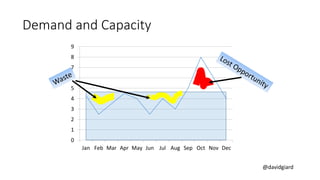
Demand and Capacity
@davidgiard
0
1
2
3
4
5
6
7
8
9
Jan Feb Mar Apr May Jun Jul Aug Sep Oct Nov Dec
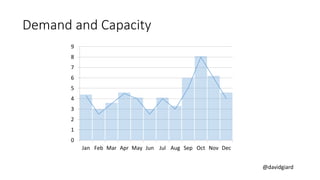
Demand and Capacity
@davidgiard
0
1
2
3
4
5
6
7
8
9
Jan Feb Mar Apr May Jun Jul Aug Sep Oct Nov Dec
Demand and Capacity
@davidgiard
0
1
2
3
4
5
6
7
8
9
Mon Tue Wed Thu Fri Sat Sun Mon Tue Wed Thu Fri
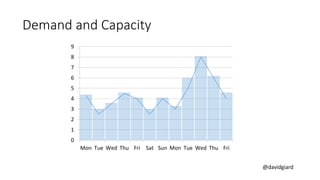
Demand and Capacity
@davidgiard
0
1
2
3
4
5
6
7
8
9
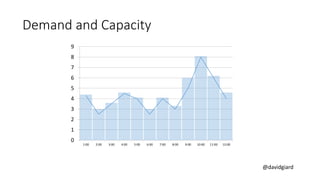
1:00 2:00 3:00 4:00 5:00 6:00 7:00 8:00 9:00 10:00 11:00 12:00
Demand and Capacity
@davidgiard
0
1
2
3
4
5
6
7
8
9
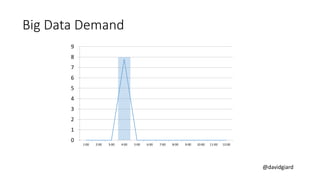
1:00 2:00 3:00 4:00 5:00 6:00 7:00 8:00 9:00 10:00 11:00 12:00
Big Data Demand
@davidgiard
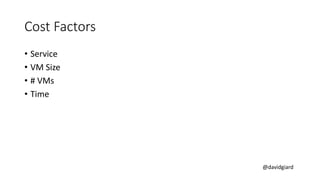
Cost Factors
• Service
• VM Size
• # VMs
• Time
@davidgiard
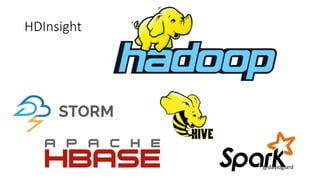
HDInsight
@davidgiard
Azure HDInsight
• Microsoft Azure’s big-data solution using Hadoop
• Open-source framework for storing and analyzing massive amounts of data
on clusters built from commodity hardware
• Uses Hadoop Distributed File System (HDFS) for storage
• Employs the open-source Hortonworks Data Platform implementation
of Hadoop
• Includes HBase, Hive, Pig, Storm, Spark, and more
• Integrates with popular BI tools
• Includes Power BI, Excel, SSAS, SSRS, Tableau
@davidgiard
Apache Hadoop on Azure
• Automatic cluster provisioning and configuration
• Bypass an otherwise manual-intensive process
• Cluster scaling
• Change number of nodes without deleting/re-creating the cluster
• High availability/reliability
• Managed solution - 99.9% SLA
• HDInsight includes a secondary head node
• Reliable and economical storage
• HDFS mapped over Azure Blob Storage
• Accessed through “wasb://” protocol prefix
@davidgiard
Lambda Architecture
• Batch Layer
• Speed Layer
• Serving Layer
@davidgiard
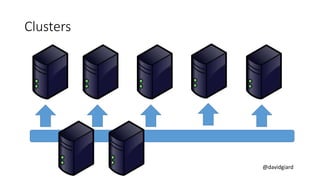
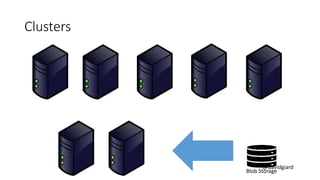
Clusters
@davidgiard
Clusters
Blob Storage
@davidgiard
HDInsight Cluster Types
• Hadoop: Query workloads
• Reliable data storage, simple MapReduce
• HBase: NoSQL workloads
• Distributed database offering random access to large amounts of
data
• Apache Storm: Stream workloads
• Real-time analysis of moving data streams
• Apache Spark: High-performance workloads
• In-memory parallel processing
@davidgiard
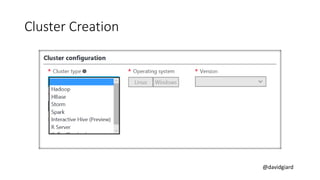
Cluster Creation
@davidgiard
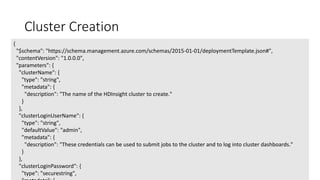
Cluster Creation
{
"$schema": "https://schema.management.azure.com/schemas/2015-01-01/deploymentTemplate.json#",
"contentVersion": "1.0.0.0",
"parameters": {
"clusterName": {
"type": "string",
"metadata": {
"description": "The name of the HDInsight cluster to create."
}
},
"clusterLoginUserName": {
"type": "string",
"defaultValue": "admin",
"metadata": {
"description": "These credentials can be used to submit jobs to the cluster and to log into cluster dashboards."
}
},
"clusterLoginPassword": {
"type": "securestring",
@davidgiard
Demo
@davidgiard
@davidgiard
Storm
• Apache Storm is a distributed, fault-tolerant, open-source computation
system that allows you to process data in real-time with Hadoop.
• Apache Storm on HDInsight allows you to create distributed, real-time
analytics solutions in the Azure environment by using Apache Hadoop.
• Storm solutions can also provide guaranteed processing of data, with the
ability to replay data that was not successfully processed the first time.
• Ability to write Storm components in C#, JAVA and Python.
• Azure Scale up or Scale down without an impact for running Storm
topologies.
• Ease of provision and use in Azure portal.
• Visual Studio project templates for Storm apps
@davidgiard
Storm
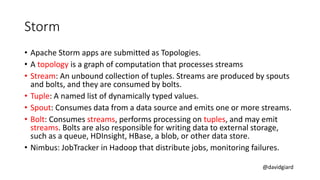
• Apache Storm apps are submitted as Topologies.
• A topology is a graph of computation that processes streams
• Stream: An unbound collection of tuples. Streams are produced by spouts
and bolts, and they are consumed by bolts.
• Tuple: A named list of dynamically typed values.
• Spout: Consumes data from a data source and emits one or more streams.
• Bolt: Consumes streams, performs processing on tuples, and may emit
streams. Bolts are also responsible for writing data to external storage,
such as a queue, HDInsight, HBase, a blob, or other data store.
• Nimbus: JobTracker in Hadoop that distribute jobs, monitoring failures.
@davidgiard
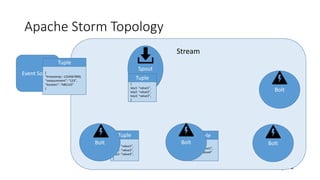
Stream
Apache Storm Topology
Event Source
Tuple
(
“timestamp:: 1234567890,
“measurement”: “123”,
“location”: “ABC123”
)
Tuple
{
key1: “value1”,
key2: “value2”,
key3: “value3”,
}
{
key1: “value1”,
key2: “value2”,
key3: “value3”,
}
Tuple Tuple
{
key1: “value1”,
key4: “value4”
}
Bolt
Spout
Bolt Bolt
Bolt
Tuple
{
key1: “value1”,
key2: “value2”,
key3: “value3”,
}
@davidgiard
Demo
@DavidGiard
@davidgiard
HBase
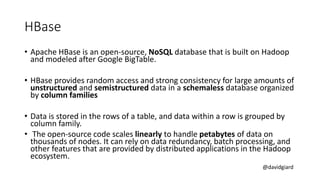
• Apache HBase is an open-source, NoSQL database that is built on Hadoop
and modeled after Google BigTable.
• HBase provides random access and strong consistency for large amounts of
unstructured and semistructured data in a schemaless database organized
by column families
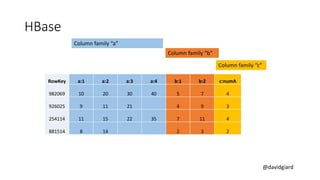
• Data is stored in the rows of a table, and data within a row is grouped by
column family.
• The open-source code scales linearly to handle petabytes of data on
thousands of nodes. It can rely on data redundancy, batch processing, and
other features that are provided by distributed applications in the Hadoop
ecosystem.
@davidgiard
HBase
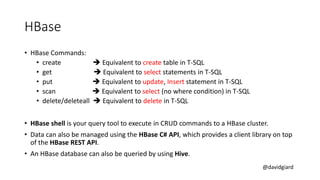
• HBase Commands:
• create  Equivalent to create table in T-SQL
• get  Equivalent to select statements in T-SQL
• put  Equivalent to update, Insert statement in T-SQL
• scan  Equivalent to select (no where condition) in T-SQL
• delete/deleteall  Equivalent to delete in T-SQL
• HBase shell is your query tool to execute in CRUD commands to a HBase cluster.
• Data can also be managed using the HBase C# API, which provides a client library on top
of the HBase REST API.
• An HBase database can also be queried by using Hive.
@davidgiard
HBase
RowKey a:1 a:2 a:3 a:4 b:1 b:2 c:numA
982069 10 20 30 40 5 7 4
926025 9 11 21 4 9 3
254114 11 15 22 35 7 11 4
881514 8 14 2 3 2
Column family “a”
Column family “b”
Column family “c”
@DavidGiard
@davidgiard
Hive
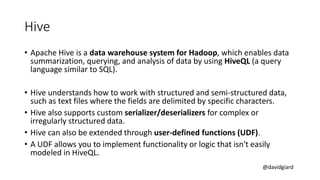
• Apache Hive is a data warehouse system for Hadoop, which enables data
summarization, querying, and analysis of data by using HiveQL (a query
language similar to SQL).
• Hive understands how to work with structured and semi-structured data,
such as text files where the fields are delimited by specific characters.
• Hive also supports custom serializer/deserializers for complex or
irregularly structured data.
• Hive can also be extended through user-defined functions (UDF).
• A UDF allows you to implement functionality or logic that isn't easily
modeled in HiveQL.
@davidgiard
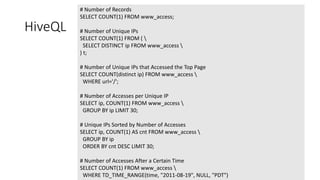
HiveQL
# Number of Records
SELECT COUNT(1) FROM www_access;
# Number of Unique IPs
SELECT COUNT(1) FROM ( 
SELECT DISTINCT ip FROM www_access 
) t;
# Number of Unique IPs that Accessed the Top Page
SELECT COUNT(distinct ip) FROM www_access 
WHERE url='/';
# Number of Accesses per Unique IP
SELECT ip, COUNT(1) FROM www_access 
GROUP BY ip LIMIT 30;
# Unique IPs Sorted by Number of Accesses
SELECT ip, COUNT(1) AS cnt FROM www_access 
GROUP BY ip
ORDER BY cnt DESC LIMIT 30;
# Number of Accesses After a Certain Time
SELECT COUNT(1) FROM www_access 
WHERE TD_TIME_RANGE(time, "2011-08-19", NULL, "PDT")
@DavidGiard
@davidgiard
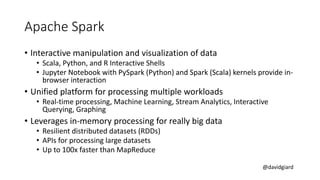
Apache Spark
• Interactive manipulation and visualization of data
• Scala, Python, and R Interactive Shells
• Jupyter Notebook with PySpark (Python) and Spark (Scala) kernels provide in-
browser interaction
• Unified platform for processing multiple workloads
• Real-time processing, Machine Learning, Stream Analytics, Interactive
Querying, Graphing
• Leverages in-memory processing for really big data
• Resilient distributed datasets (RDDs)
• APIs for processing large datasets
• Up to 100x faster than MapReduce
@davidgiard
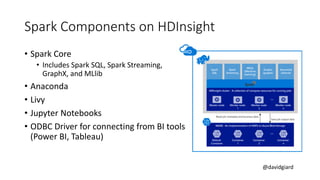
Spark Components on HDInsight
• Spark Core
• Includes Spark SQL, Spark Streaming,
GraphX, and MLlib
• Anaconda
• Livy
• Jupyter Notebooks
• ODBC Driver for connecting from BI tools
(Power BI, Tableau)
@davidgiard
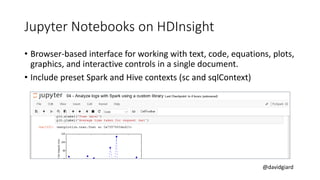
Jupyter Notebooks on HDInsight
• Browser-based interface for working with text, code, equations, plots,
graphics, and interactive controls in a single document.
• Include preset Spark and Hive contexts (sc and sqlContext)
@davidgiard
Demo
@davidgiard
Items of Note About HDInsight
• There is no “suspend” on HDInsight clusters
• Provision the cluster, do work, then delete the cluster to avoid unnecessary
charges
• Storage can be decoupled from the cluster and reused across deployments
• Can deploy from the portal, but often scripted in practice
• Easier/repeatable creation and deletion
@davidgiard
Get Started
azure.com
@DavidGiard
Thank you!
@DavidGiard
Links
www.slideshare.net/dgiard/big-data-on-azure-70554456
github.com/MSFTImagine/computerscience/tree/master/Workshop/7.%20HDInsight

Big Data on azure

  • 1.
  • 2.
    @davidgiard David Giard Microsoft TechnicalEvangelist dgiard@Microsoft.com Davidgiard.com @davidgiard
  • 3.
    @davidgiard Cloud Computing Host someor all of your data or application on a third-party server in a highly-scalable, highly-reliable way
  • 4.
    @davidgiard Advantages of CloudComputing • Lower capital costs • Flexible operating cost (Rent vs Buy) • Platform as a Service • Freedom from infrastructure / hardware • Redundancy • Automatic monitoring and failover
  • 5.
    @davidgiard 0 1 2 3 4 5 6 7 8 9 Jan Feb MarApr May Jun Jul Aug Sep Oct Nov Dec Demand and Capacity
  • 6.
    @davidgiard 0 1 2 3 4 5 6 7 8 9 Jan Feb MarApr May Jun Jul Aug Sep Oct Nov Dec Demand and Capacity
  • 7.
    @davidgiard 0 1 2 3 4 5 6 7 8 9 Jan Feb MarApr May Jun Jul Aug Sep Oct Nov Dec Demand and Capacity
  • 8.
    @davidgiard 0 1 2 3 4 5 6 7 8 9 Jan Feb MarApr May Jun Jul Aug Sep Oct Nov Dec Demand and Capacity
  • 9.
    @davidgiard 0 1 2 3 4 5 6 7 8 9 Mon Tue WedThu Fri Sat Sun Mon Tue Wed Thu Fri Demand and Capacity
  • 10.
    @davidgiard 0 1 2 3 4 5 6 7 8 9 1:00 2:00 3:004:00 5:00 6:00 7:00 8:00 9:00 10:00 11:00 12:00 Demand and Capacity
  • 11.
    @davidgiard 0 1 2 3 4 5 6 7 8 9 1:00 2:00 3:004:00 5:00 6:00 7:00 8:00 9:00 10:00 11:00 12:00 Big Data Demand
  • 12.
    @davidgiard Cost Factors • Service •VM Size • # VMs • Time
  • 13.
  • 14.
    @davidgiard Azure HDInsight • MicrosoftAzure’s big-data solution using Hadoop • Open-source framework for storing and analyzing massive amounts of data on clusters built from commodity hardware • Uses Hadoop Distributed File System (HDFS) for storage • Employs the open-source Hortonworks Data Platform implementation of Hadoop • Includes HBase, Hive, Pig, Storm, Spark, and more • Integrates with popular BI tools • Includes Power BI, Excel, SSAS, SSRS, Tableau
  • 15.
    @davidgiard Apache Hadoop onAzure • Automatic cluster provisioning and configuration • Bypass an otherwise manual-intensive process • Cluster scaling • Change number of nodes without deleting/re-creating the cluster • High availability/reliability • Managed solution - 99.9% SLA • HDInsight includes a secondary head node • Reliable and economical storage • HDFS mapped over Azure Blob Storage • Accessed through “wasb://” protocol prefix
  • 16.
    @davidgiard Lambda Architecture • BatchLayer • Speed Layer • Serving Layer
  • 17.
  • 18.
  • 19.
    @davidgiard HDInsight Cluster Types •Hadoop: Query workloads • Reliable data storage, simple MapReduce • HBase: NoSQL workloads • Distributed database offering random access to large amounts of data • Apache Storm: Stream workloads • Real-time analysis of moving data streams • Apache Spark: High-performance workloads • In-memory parallel processing
  • 20.
  • 21.
    @davidgiard Cluster Creation { "$schema": "https://schema.management.azure.com/schemas/2015-01-01/deploymentTemplate.json#", "contentVersion":"1.0.0.0", "parameters": { "clusterName": { "type": "string", "metadata": { "description": "The name of the HDInsight cluster to create." } }, "clusterLoginUserName": { "type": "string", "defaultValue": "admin", "metadata": { "description": "These credentials can be used to submit jobs to the cluster and to log into cluster dashboards." } }, "clusterLoginPassword": { "type": "securestring",
  • 22.
  • 23.
  • 24.
    @davidgiard Storm • Apache Stormis a distributed, fault-tolerant, open-source computation system that allows you to process data in real-time with Hadoop. • Apache Storm on HDInsight allows you to create distributed, real-time analytics solutions in the Azure environment by using Apache Hadoop. • Storm solutions can also provide guaranteed processing of data, with the ability to replay data that was not successfully processed the first time. • Ability to write Storm components in C#, JAVA and Python. • Azure Scale up or Scale down without an impact for running Storm topologies. • Ease of provision and use in Azure portal. • Visual Studio project templates for Storm apps
  • 25.
    @davidgiard Storm • Apache Stormapps are submitted as Topologies. • A topology is a graph of computation that processes streams • Stream: An unbound collection of tuples. Streams are produced by spouts and bolts, and they are consumed by bolts. • Tuple: A named list of dynamically typed values. • Spout: Consumes data from a data source and emits one or more streams. • Bolt: Consumes streams, performs processing on tuples, and may emit streams. Bolts are also responsible for writing data to external storage, such as a queue, HDInsight, HBase, a blob, or other data store. • Nimbus: JobTracker in Hadoop that distribute jobs, monitoring failures.
  • 26.
    @davidgiard Stream Apache Storm Topology EventSource Tuple ( “timestamp:: 1234567890, “measurement”: “123”, “location”: “ABC123” ) Tuple { key1: “value1”, key2: “value2”, key3: “value3”, } { key1: “value1”, key2: “value2”, key3: “value3”, } Tuple Tuple { key1: “value1”, key4: “value4” } Bolt Spout Bolt Bolt Bolt Tuple { key1: “value1”, key2: “value2”, key3: “value3”, }
  • 27.
  • 28.
  • 29.
    @davidgiard HBase • Apache HBaseis an open-source, NoSQL database that is built on Hadoop and modeled after Google BigTable. • HBase provides random access and strong consistency for large amounts of unstructured and semistructured data in a schemaless database organized by column families • Data is stored in the rows of a table, and data within a row is grouped by column family. • The open-source code scales linearly to handle petabytes of data on thousands of nodes. It can rely on data redundancy, batch processing, and other features that are provided by distributed applications in the Hadoop ecosystem.
  • 30.
    @davidgiard HBase • HBase Commands: •create  Equivalent to create table in T-SQL • get  Equivalent to select statements in T-SQL • put  Equivalent to update, Insert statement in T-SQL • scan  Equivalent to select (no where condition) in T-SQL • delete/deleteall  Equivalent to delete in T-SQL • HBase shell is your query tool to execute in CRUD commands to a HBase cluster. • Data can also be managed using the HBase C# API, which provides a client library on top of the HBase REST API. • An HBase database can also be queried by using Hive.
  • 31.
    @davidgiard HBase RowKey a:1 a:2a:3 a:4 b:1 b:2 c:numA 982069 10 20 30 40 5 7 4 926025 9 11 21 4 9 3 254114 11 15 22 35 7 11 4 881514 8 14 2 3 2 Column family “a” Column family “b” Column family “c”
  • 32.
  • 33.
    @davidgiard Hive • Apache Hiveis a data warehouse system for Hadoop, which enables data summarization, querying, and analysis of data by using HiveQL (a query language similar to SQL). • Hive understands how to work with structured and semi-structured data, such as text files where the fields are delimited by specific characters. • Hive also supports custom serializer/deserializers for complex or irregularly structured data. • Hive can also be extended through user-defined functions (UDF). • A UDF allows you to implement functionality or logic that isn't easily modeled in HiveQL.
  • 34.
    @davidgiard HiveQL # Number ofRecords SELECT COUNT(1) FROM www_access; # Number of Unique IPs SELECT COUNT(1) FROM ( SELECT DISTINCT ip FROM www_access ) t; # Number of Unique IPs that Accessed the Top Page SELECT COUNT(distinct ip) FROM www_access WHERE url='/'; # Number of Accesses per Unique IP SELECT ip, COUNT(1) FROM www_access GROUP BY ip LIMIT 30; # Unique IPs Sorted by Number of Accesses SELECT ip, COUNT(1) AS cnt FROM www_access GROUP BY ip ORDER BY cnt DESC LIMIT 30; # Number of Accesses After a Certain Time SELECT COUNT(1) FROM www_access WHERE TD_TIME_RANGE(time, "2011-08-19", NULL, "PDT")
  • 35.
  • 36.
    @davidgiard Apache Spark • Interactivemanipulation and visualization of data • Scala, Python, and R Interactive Shells • Jupyter Notebook with PySpark (Python) and Spark (Scala) kernels provide in- browser interaction • Unified platform for processing multiple workloads • Real-time processing, Machine Learning, Stream Analytics, Interactive Querying, Graphing • Leverages in-memory processing for really big data • Resilient distributed datasets (RDDs) • APIs for processing large datasets • Up to 100x faster than MapReduce
  • 37.
    @davidgiard Spark Components onHDInsight • Spark Core • Includes Spark SQL, Spark Streaming, GraphX, and MLlib • Anaconda • Livy • Jupyter Notebooks • ODBC Driver for connecting from BI tools (Power BI, Tableau)
  • 38.
    @davidgiard Jupyter Notebooks onHDInsight • Browser-based interface for working with text, code, equations, plots, graphics, and interactive controls in a single document. • Include preset Spark and Hive contexts (sc and sqlContext)
  • 39.
  • 40.
    @davidgiard Items of NoteAbout HDInsight • There is no “suspend” on HDInsight clusters • Provision the cluster, do work, then delete the cluster to avoid unnecessary charges • Storage can be decoupled from the cluster and reused across deployments • Can deploy from the portal, but often scripted in practice • Easier/repeatable creation and deletion
  • 41.
  • 42.
  • 43.

Editor's Notes

  • #17 Batch Layer Pre-computes results Some latency Speed Layer Real-time view of most recent data e.g. Apache Storm Serving Layer Ad-hoc queries Pre-computed views e.g, Apache HBase
  • #20 https://en.wikipedia.org/wiki/Lambda_architecture
  • #33 No schema No referential intergrity Forward-only, read-only database Perfect for timed data Very fast Highly scalable Often look only at latest entry in each family
  • #41 https://github.com/MSFTImagine/computerscience/tree/master/Workshop/7.%20HDInsight