The Elements of Music Melody Rhythm Harmony Texture Form Tempo and Dynamics
Melody: Musical Line The Nature of Melody Melody  is a succession of single tones perceived by the mind as a unity melody is the element with the widest and most appeal
Characteristics of Melody Range distance between highest and lowest notes classified as wide, medium or narrow Shape determined by upward or downward direction of melody graphed as ascending/descending line, arch or wave
Characteristics of Melody Type of Movement determined by whether melody moves by step or leap conjunct  - melody moves by step disjunct  - melody moves by leap
Structure of Melody Melodic structure is analyzed much like a sentence phrase  - unit of meaning within a larger structure cadence  - end or resting place; may be inconclusive or final; like a comma or period
Structure of Melody Combination of phrases with several inconclusive and one final cadence make up most music; like sentences in a paragraph
Rhythm: Musical Time The Nature of Rhythm  Rhythm  refers to the controlled movement of music in time is the quality which causes people to move in response automatically imposes a pattern to a series of noises, which are arranged as strong and weak beats
Meter Meter  is the fixed time patterns within which musical events take place Rhythm is the overall movement of music in time while meter involves the actual measurement of time.
Meter Characteristics of meter: Beat  - the basic unit of length; some beats are strong (accented) and some are weak (unaccented) Measure  - groups containing fixed beats with the first beat being the strongest
Metrical Patterns Simple Meter  - beat is subdivided into two beats Duple  - two beats per measure; strong-weak; traditionally associated with marches Triple  - three beats per measure; strong-weak-weak; associated with waltz (dance) form
Metrical Patterns Simple Meter  - beat is subdivided into two beats Quadruple  - four beats per measure; primary accent on one and secondary accent on three; has broader feel than duple; also called  Common Time
Metrical Patterns Compound Meter  - beat is subdivided into three beats Sextuple  - Two beats per measure (six when subdivided); gentle and flowing when slow; rollicking feel when fast Syncopation  - deliberate upsetting of rhythm by temporary shifting of accent to weak beat or subdivided beat
Harmony: Musical Space Harmony  is the movement and relationship of intervals and chords, and implies movement and progression in music Harmony gives perspective to music melody is horizontal aspect and harmony is vertical aspect
Components of Harmony Interval  - distance and relationship between two tones Scale  - series of tones arranged in ascending or descending consecutive order Octave  - distance from highest to lowest tones in scale
Components of Harmony Chord  - combination of two or more tones that constitute a single block of harmony Triad  - combination of three tones utilizing every other tone of a scale; this is the basic formation of harmony
Function of Harmony Harmony implies movement and progression in music progression achieved by movement from one chord to another
Function of Harmony Melody and Harmony are interdependent melody implies the harmony to accompany each constantly influences the other
Tonality Harmony requires a system of procedures for organizing tones into intelligible  relationships Tonality  - the principle of organization around a central tone, called tonic tonic -  first note of a scale which serves as base around which other tones revolve and to which they ultimately gravitate
Components of Tonality The particular scale chosen as the basis of a piece of music determines the tonic and tonality of the music
Components of Tonality Two types of scales are found in Western music between 1650 and 1900, and each is characterized in intervals on which they are based Major  - has brighter sound; used for triumphal marches and grand finales, etc. Minor  - has darker sound; used for dirges, laments, etc.
Components of Tonality Diatonic vs. Chromatic Diatonic  - music based on one of the 12 major or minor scales Chromatic  - not based on a scale, but using all notes of the octave freely
Consonance and Dissonance Consonance   a concordant or agreeable combination of tones that provides a sense of fulfillment in music consonance is the resolution of dissonance
Consonance and Dissonance Dissonance a combination of tones that sounds discordant, unstable and in need of resolution introduces a necessary tension in music In general, music has grown more dissonant through the ages
Musical Texture Types of Texture Monophonic  - single-voice texture; is a melody without accompaniment in the form of harmony Polyphonic  - combination of two or more melodic lines Counterpoint  - basis of polyphonic music; the technique of writing polyphony
Musical Texture Types of Texture Homophony  - single melody with chordal accompaniment; sound is based on harmony Heterophony  - combination of two melodic lines based on improvisation; each line is the same melody, but at least one is improvised
Contrapunctal Devices Imitation  - subject or motive is presented in one voice and restated in another Canon  - imitation lasting for an entire work Round  - simplest form of canon; each voice enters in succession with the same melody
Contrapunctal Devices Inversion  - melody turned upside down; same intervals in opposite direction Retrograde  - restatement of melody backward; start at end and proceed to beginning Retrograde Inversion  - combination of techniques resulting in upside down and backward at the same time
Contrapunctal Devices Augmentation  - melody is presented in longer time values than original Diminution  - melody is presented in shorter time values than original
Musical Form What is  Form ? That quality in a work which presents to the mind of the listener an impression of conscious choice and arrangement relationship of the parts to the whole
Structure and Design in Music Repetition  - fixes material in the mind; familiarity Contrast  - sustains interest by introducing change Interaction of repetition and contrast is basic element of form
Structure and Design in Music Variation  - falls between repetition and contrast where aspects are altered but recognizable Alterations generally focus on one element at a time
Types of Form Binary Form  - two part or A-B form; based on statement and departure without return to opening section Ternary Form  - three part or A-B-A form; based on statement, departure, and restatement of material Both binary and ternary forms are common in short pieces such as songs and dances
Building Blocks of Form Theme  - most basic element of form which provides unity and from which the idea develops
Building Blocks of Form Thematic Development  - techniques for developing a theme sequence  - restatement of theme at new pitch level repetition  - exact of varied restatement of melody
Building Blocks of Form Thematic Development  - techniques for developing a theme motive  - smallest fragment of melody that forms rhythmic/melodic unit movement  - several separate pieces within a large scale work
Tempo and Dynamics Tempo  - speed at which beats occur within meter; close connection between tempo and mood Dynamics  - degree of loudness or softness at which music is played
Tempo and Dynamics Markings for tempo and dynamics contribute to the expressive content of music Early music had few markings, and usage has steadily increased throughout time
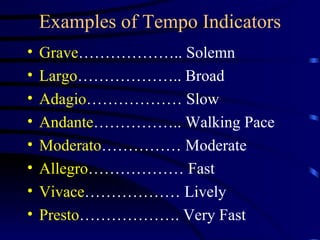
Examples of Tempo Indicators Grave ……………….. Solemn Largo ……………….. Broad Adagio ……………… Slow Andante …………….. Walking Pace Moderato …………… Moderate Allegro ……………… Fast Vivace ……………… Lively Presto ………………. Very Fast
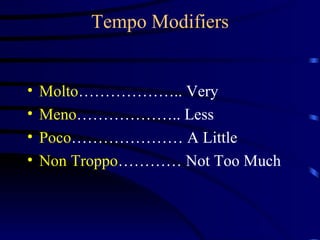
Tempo Modifiers Molto ……………….. Very Meno ……………….. Less Poco ………………… A Little Non Troppo ………… Not Too Much
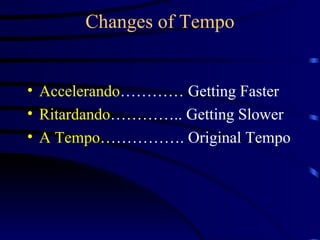
Changes of Tempo Accelerando ………… Getting Faster Ritardando ………….. Getting Slower A Tempo ……………. Original Tempo
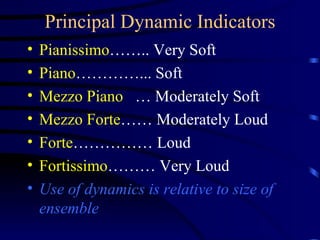
Principal Dynamic Indicators Pianissimo …….. Very Soft Piano …………... Soft Mezzo Piano   … Moderately Soft Mezzo Forte …… Moderately Loud Forte …………… Loud Fortissimo ……… Very Loud Use of dynamics is relative to size of ensemble
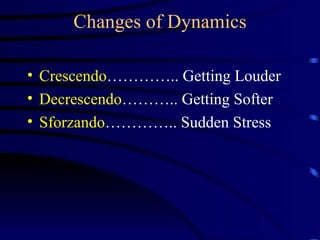
Changes of Dynamics Crescendo ………….. Getting Louder Decrescendo ……….. Getting Softer Sforzando ………….. Sudden Stress

Big basics

  • 1.
    The Elements ofMusic Melody Rhythm Harmony Texture Form Tempo and Dynamics
  • 2.
    Melody: Musical LineThe Nature of Melody Melody is a succession of single tones perceived by the mind as a unity melody is the element with the widest and most appeal
  • 3.
    Characteristics of MelodyRange distance between highest and lowest notes classified as wide, medium or narrow Shape determined by upward or downward direction of melody graphed as ascending/descending line, arch or wave
  • 4.
    Characteristics of MelodyType of Movement determined by whether melody moves by step or leap conjunct - melody moves by step disjunct - melody moves by leap
  • 5.
    Structure of MelodyMelodic structure is analyzed much like a sentence phrase - unit of meaning within a larger structure cadence - end or resting place; may be inconclusive or final; like a comma or period
  • 6.
    Structure of MelodyCombination of phrases with several inconclusive and one final cadence make up most music; like sentences in a paragraph
  • 7.
    Rhythm: Musical TimeThe Nature of Rhythm Rhythm refers to the controlled movement of music in time is the quality which causes people to move in response automatically imposes a pattern to a series of noises, which are arranged as strong and weak beats
  • 8.
    Meter Meter is the fixed time patterns within which musical events take place Rhythm is the overall movement of music in time while meter involves the actual measurement of time.
  • 9.
    Meter Characteristics ofmeter: Beat - the basic unit of length; some beats are strong (accented) and some are weak (unaccented) Measure - groups containing fixed beats with the first beat being the strongest
  • 10.
    Metrical Patterns SimpleMeter - beat is subdivided into two beats Duple - two beats per measure; strong-weak; traditionally associated with marches Triple - three beats per measure; strong-weak-weak; associated with waltz (dance) form
  • 11.
    Metrical Patterns SimpleMeter - beat is subdivided into two beats Quadruple - four beats per measure; primary accent on one and secondary accent on three; has broader feel than duple; also called Common Time
  • 12.
    Metrical Patterns CompoundMeter - beat is subdivided into three beats Sextuple - Two beats per measure (six when subdivided); gentle and flowing when slow; rollicking feel when fast Syncopation - deliberate upsetting of rhythm by temporary shifting of accent to weak beat or subdivided beat
  • 13.
    Harmony: Musical SpaceHarmony is the movement and relationship of intervals and chords, and implies movement and progression in music Harmony gives perspective to music melody is horizontal aspect and harmony is vertical aspect
  • 14.
    Components of HarmonyInterval - distance and relationship between two tones Scale - series of tones arranged in ascending or descending consecutive order Octave - distance from highest to lowest tones in scale
  • 15.
    Components of HarmonyChord - combination of two or more tones that constitute a single block of harmony Triad - combination of three tones utilizing every other tone of a scale; this is the basic formation of harmony
  • 16.
    Function of HarmonyHarmony implies movement and progression in music progression achieved by movement from one chord to another
  • 17.
    Function of HarmonyMelody and Harmony are interdependent melody implies the harmony to accompany each constantly influences the other
  • 18.
    Tonality Harmony requiresa system of procedures for organizing tones into intelligible relationships Tonality - the principle of organization around a central tone, called tonic tonic - first note of a scale which serves as base around which other tones revolve and to which they ultimately gravitate
  • 19.
    Components of TonalityThe particular scale chosen as the basis of a piece of music determines the tonic and tonality of the music
  • 20.
    Components of TonalityTwo types of scales are found in Western music between 1650 and 1900, and each is characterized in intervals on which they are based Major - has brighter sound; used for triumphal marches and grand finales, etc. Minor - has darker sound; used for dirges, laments, etc.
  • 21.
    Components of TonalityDiatonic vs. Chromatic Diatonic - music based on one of the 12 major or minor scales Chromatic - not based on a scale, but using all notes of the octave freely
  • 22.
    Consonance and DissonanceConsonance a concordant or agreeable combination of tones that provides a sense of fulfillment in music consonance is the resolution of dissonance
  • 23.
    Consonance and DissonanceDissonance a combination of tones that sounds discordant, unstable and in need of resolution introduces a necessary tension in music In general, music has grown more dissonant through the ages
  • 24.
    Musical Texture Typesof Texture Monophonic - single-voice texture; is a melody without accompaniment in the form of harmony Polyphonic - combination of two or more melodic lines Counterpoint - basis of polyphonic music; the technique of writing polyphony
  • 25.
    Musical Texture Typesof Texture Homophony - single melody with chordal accompaniment; sound is based on harmony Heterophony - combination of two melodic lines based on improvisation; each line is the same melody, but at least one is improvised
  • 26.
    Contrapunctal Devices Imitation - subject or motive is presented in one voice and restated in another Canon - imitation lasting for an entire work Round - simplest form of canon; each voice enters in succession with the same melody
  • 27.
    Contrapunctal Devices Inversion - melody turned upside down; same intervals in opposite direction Retrograde - restatement of melody backward; start at end and proceed to beginning Retrograde Inversion - combination of techniques resulting in upside down and backward at the same time
  • 28.
    Contrapunctal Devices Augmentation - melody is presented in longer time values than original Diminution - melody is presented in shorter time values than original
  • 29.
    Musical Form Whatis Form ? That quality in a work which presents to the mind of the listener an impression of conscious choice and arrangement relationship of the parts to the whole
  • 30.
    Structure and Designin Music Repetition - fixes material in the mind; familiarity Contrast - sustains interest by introducing change Interaction of repetition and contrast is basic element of form
  • 31.
    Structure and Designin Music Variation - falls between repetition and contrast where aspects are altered but recognizable Alterations generally focus on one element at a time
  • 32.
    Types of FormBinary Form - two part or A-B form; based on statement and departure without return to opening section Ternary Form - three part or A-B-A form; based on statement, departure, and restatement of material Both binary and ternary forms are common in short pieces such as songs and dances
  • 33.
    Building Blocks ofForm Theme - most basic element of form which provides unity and from which the idea develops
  • 34.
    Building Blocks ofForm Thematic Development - techniques for developing a theme sequence - restatement of theme at new pitch level repetition - exact of varied restatement of melody
  • 35.
    Building Blocks ofForm Thematic Development - techniques for developing a theme motive - smallest fragment of melody that forms rhythmic/melodic unit movement - several separate pieces within a large scale work
  • 36.
    Tempo and DynamicsTempo - speed at which beats occur within meter; close connection between tempo and mood Dynamics - degree of loudness or softness at which music is played
  • 37.
    Tempo and DynamicsMarkings for tempo and dynamics contribute to the expressive content of music Early music had few markings, and usage has steadily increased throughout time
  • 38.
    Examples of TempoIndicators Grave ……………….. Solemn Largo ……………….. Broad Adagio ……………… Slow Andante …………….. Walking Pace Moderato …………… Moderate Allegro ……………… Fast Vivace ……………… Lively Presto ………………. Very Fast
  • 39.
    Tempo Modifiers Molto……………….. Very Meno ……………….. Less Poco ………………… A Little Non Troppo ………… Not Too Much
  • 40.
    Changes of TempoAccelerando ………… Getting Faster Ritardando ………….. Getting Slower A Tempo ……………. Original Tempo
  • 41.
    Principal Dynamic IndicatorsPianissimo …….. Very Soft Piano …………... Soft Mezzo Piano … Moderately Soft Mezzo Forte …… Moderately Loud Forte …………… Loud Fortissimo ……… Very Loud Use of dynamics is relative to size of ensemble
  • 42.
    Changes of DynamicsCrescendo ………….. Getting Louder Decrescendo ……….. Getting Softer Sforzando ………….. Sudden Stress